Services Trade and Policy
by
Joseph FRANCOIS
*)Bernard HOEKMAN
Working Paper No. 0903
March 2009
D
D
E
E
P
P
A
A
R
R
T
T
M
M
E
E
N
N
T
T
O
O
F
F
E
E
C
C
O
O
N
N
O
O
M
M
I
I
C
C
S
S
J
J
OOHHAANNNNEESSK
K
EEPPLLEERRU
U
NNIIVVEERRSSIITTYYOOFFL
L
IINNZZJohannes Kepler University of Linz Department of Economics
Altenberger Strasse 69 A-4040 Linz - Auhof, Austria
www.econ.jku.at *)
Services Trade and Policy
Joseph FrancoisUniversity of Linz and CEPR Bernard Hoekman World Bank and CEPR
December 2009
Abstract: Since the mid-1980s a substantial body of research has taken shape on trade in services. Much of this is inspired by the WTO and regional trade agreements. However, an increasing number of papers focus on the impacts of unilateral services sector liberalization. The literature touches on important linkages between trade and FDI in services and the general pattern of productivity growth and economic development. This paper surveys the literature on services trade, focusing on contributions that investigate the determinants of international trade and investment in services, the potential gains from greater trade, and efforts to cooperate to achieve such liberalization through trade agreements. There is increasing evidence that services liberalization is a major potential source of gains in economic performance, including productivity in manufacturing and the coordination of activities both between and within firms. The performance of service sectors, and thus services policies, may also be an important determinant of trade volumes, the distributional effects of trade, and overall patterns of economic growth and development. At the same time, services trade is also a source of increasing political unease about the impacts of globalization on labor markets, linked to worries about offshoring and the potential pressure this places on wages in high income countries.
JEL codes: F1, F2, F5, L80
Keywords: trade in services,outsourcing, modes of supply, trade and FDI, foreign affiliate trade, WTO, GATS, trade agreements, economic development
Note: final version will be forthcoming,Journal of Economic Literature.
Acknowledgements: The authors thank the editor, Roger Gordon, and three referees for extensive comments and suggestions. We are also grateful to Patrick Messerlin and the Groupe d’Economie Mondiale, Sciences Po, for providing a supportive environment in which to work on the first draft of this paper, to Carsten Fink for detailed comments and to Rolf Adlung, Kym Anderson, Philippa Dee, Rolf Langhammer, Keith Maskus and Aaditya Mattoo for helpful feedback and discussions. We also thank Batashur Gootiiz and Aaditya Mattoo for sharing data and Mary-Lynne Francois for valuable editorial assistance. The views expressed are personal and should not be attributed to the World Bank.
1. Introduction
The importance of services as a share of overall production and employment increases with growth and development. This expansion in the services-intensity of economies is driven by a number of forces, including final demand factors and basic structural changes in production linked to development. Accelerating this process, recent advances in information and communication technologies are increasingly permitting cross-border, “disembodied” trade in services. The competitiveness of manufacturing firms in open economies is determined in part by access to low-cost and high-quality producer services – telecommunications, transport and distribution services, financial intermediation, etc. In particular, the feasibility of processes linked to outsourcing (also called fragmentation, production sharing and off-shoring) depends on access to and the cost of such services. Additionally, international exchange is increasingly taking the form of trade in tasks as opposed to trade in products, as the production process is sliced into different parts that are performed in different locations (Grossman and Rossi-Hansberg, 2008).
According to the WTO, the global value of cross-border services exports in 2007 was $3.3 trillion, or some 20 percent of world trade in goods and services. However, the share of services rises to almost 50 percent if transactions are measured in terms of direct and indirect value added content – that is, if trade is measured in terms of the value that is added by processing of imported components into final products for export as opposed to measuring trade flows on the basis of the gross value of goods crossing the border (Escaith, 2008). If we add in the sales of services by foreign affiliates of multinational firms, then the value of trade in services rises further. Data for 15 OECD countries puts the value of such sales at some $1.5 trillion in 2007 (WTO, 2008).
While the expanding economic importance of services has not gone unnoticed, services have not figured prominently in the economic growth and development literature, and have only recently been highlighted in the trade literature. Traditional international economics textbooks tend to assume (assert)
that services are largely non-tradable.1 This started to change with the emergence of services on the
international policy agenda in the 1980s, in part as a consequence of U.S. proposals to negotiate multilateral rules on policies affecting trade and investment in services. The initial response of most countries to the U.S. initiative, put forward formally at the 1982 GATT Ministerial meeting, was to call for further study. One result was to mobilize the first analytical contributions to the trade literature. The initial research effort suggested that many countries had a potential interest in liberalizing trade in services, reflected, for example, in many of the poorest developing countries having a “revealed
1 Initially limited to a few path-breaking studies such as those by Baumol (1967), Fuchs (1968), and Hill (1977), starting in the 1980s more attention began to be devoted to services. Griffiths (1975) is an early study documenting barriers to trade in services.
comparative advantage” in services when measured on a balance-of-payments basis.2 This realization
helped overcome some of the early resistance by developing countries to launching negotiations on trade in services in the Uruguay Round and the creation of the WTO General Agreement on Trade in Services
(GATS) in 1994.3 Building on the early literature in this area, there is now a substantial body of research
on the topic, as well as a long list of research issues yet to tackle.4
In this paper we survey the literature and discuss the research agenda relating to the joint phenomena of service sector growth and increased internationalization of services. Section 2 briefly discusses the increasing importance of services in the economic landscape. Evidence from the literature on both OECD and developing countries strongly suggests that producer services, in particular, play a critical role in productivity growth in general, including manufacturing competitiveness. The contribution of services in this regard is closely related to patterns of market segmentation, openness, and trade. In Section 3 we focus on the theoretical literature on services trade. This includes issues of complementarity between cross-border services trade and FDI, the role of market structure, and the organization of international service firms. Section 4 provides an overview of the empirical literature, a research area with great potential to directly impact policy formation. In some areas, there is complementarity between the issues highlighted in the theoretical literature, and those that emerge from careful study of the data. However, there is still great deal of room for research that better arbitrages between the issues highlighted in the theoretical and empirical literatures. Section 5 is devoted to the recent literature on the political economy of trade and policy in services, including efforts to quantify negotiated commitments in trade agreements. Section 6 concludes with suggestions for further research.
2. The Role of Services
Modern economies are increasingly dominated by services. Over the last three decades, services have grown from roughly 58 percent of GDP to almost 75 percent across the OECD (Table 2.1). The sector is also important by other measures, including employment shares, cost shares for industry, and sector share
2 Sapir and Lutz (1980, 1981), Bhagwati (1987), Hindley (1988), Stern and Hoekman (1987) and Francois (1987). The revealed comparative advantage index is the ratio of a country's exports of specific products to its total exports relative to the world average. If the ratio is greater than one a country is said to have a revealed comparative advantage in the product.
3 See Feketekuty (1988) for an influential and comprehensive discussion of why and how services were put on the agenda of the GATT as well as a contemporary survey of the issues involved.
4 Much of this either focuses on the Uruguay Round and Doha Round talks and/or the GATS or is inspired by it. Books that have been published on the economics of services, services trade and economic development in the last 25 years include Inman (1985), Riddle (1986), Giarini (1987), Giersch (1988), Messerlin and Sauvant (1990), Harker (1996), UNCTAD and World Bank (1994), Stibora and de Vaal (1995), Sauvé and Stern (2000), Stern (2000) and Findlay and Warren (2000). Sapir and Winter (1994) survey the service trade literature as of the early 1990s. Recent compilations of analyses of services trade include a special issue of the Journal of Industry, Competition and Trade
(Lejour and Smith 2008), Stern, Mattoo and Zannini (2008), Marchetti and Roy (2008) and Reinsdorf and Slaughter (2009).
of overall FDI.5 In the case of the industrialized countries, this is a trend that actually began much earlier,
linked to fundamental changes in the structure of the economy that were already underway in the late 19th
and early 20th century (Francois 1990a; Broadberry and Ghosal 2005). It is also a trend reflected in
changes across the global economy. From Table 2.1, services have grown from 55 percent of global GDP to roughly 70 percent between 1977 and 2007. This reflects not only changes in the OECD. In Latin America, for example, services accounted for 66 percent of value added in 2007, up from 49 percent in 1977. Similar trends can be seen in other regions. Even in sub-Saharan Africa, where per-capita income growth has lagged behind other developing regions, there has been a marked shift in value added toward the service sectors.
Though the general rise in the importance of services in modern economies is driven by both final and intermediate demand factors, changes in the trade and production patterns of producer services are
particularly striking.6 Services are very heterogeneous, and span a wide range of economic activities.
Conceptually, this diversity masks a fundamental function that many services perform in relation to overall economic growth and economic development: they are inputs into production. One dimension of this ‘input function’ is that services facilitate transactions through space (transport, telecommunications) or time (financial services) (Melvin, 1989). Another dimension is that services are frequently direct inputs into economic activities, and thus determinants of the productivity of the ‘fundamental’ factors of production – labor and capital – that generate knowledge, goods and other services. Education, R&D and health services are examples of inputs into the production of human capital. With growth in national and international outsourcing by firms – especially manufacturing firms – the demand for services as
5 For a discussion of ‘stylized facts’ regarding the changing role and structure of services as countries become richer, see Inman (1985), Stern and Hoekman (1988), Francois and Reinert (1997), Schettkat and Yocarini (2006), and Francois and Woerz (2008). Francois and Reinert note that: (i) the share of value added originating in services is positively linked to the level of per capita income; (ii) income levels are positively associated with employment shares for intermediate services and with the share of services activities within total manufacturing employment; (iii) income levels are strongly linked to demand by firms for intermediate or producer services, particularly in manufacturing; and (iv) changes in the allocation of service activities between manufacturing and service firms (outsourcing) explains only a small share of service sector growth – fundamental changes in the structure/organization of production dominate.
6 Both final and intermediate demand factors are important in explaining the growing share of services in the economy. Early explanations for the rise of services initially focused on final demand factors (Clark 1940, Baumol 1967). Demand-side explanations relate the pattern of rising final or consumer service prices and expenditure shares to relative productivity differentials. The result is a prediction of stagnating overall productivity growth – the ‘Baumol disease’ – and the related theoretical literature explaining the Balassa-Samuelson effect. This includes Bhagwati (1984b), Hunter and Markusen (1988) and Panagariya (1988). Also see Kravis, Heston and Summers (1983), Inman (1985), Park and Chan (1989) and Uno (1989). Production-side explanations are more recent, and stress analytical and empirical linkages between intermediate or producer services and the manufacturing sector, assigning both a direct and indirect role for services in the economy and making contrary predictions to those linked to the Baumol disease. For example, Hoekman and Mattoo (2008) stress the conjecture by Francois (1987, 1990a) that rising demand for producer services as inputs into manufacturing implies overall productivity growth commensurate with a rising overall services share in employment and value added. This is linked to what Katouzian (1970) called increased roundaboutness of production in general and in manufacturing in particular, i.e., greater specialization and division of labor. See footnote 7 for further discussion.
intermediate inputs in production has grown commensurately. Parallel with a growing importance of intermediate services and outsourcing, on the international side the combination of disintegration of production processes into tradable tasks – also called ‘splintering’ of production by Bhagwati (1984a) – and technological progress in information and communication technologies has allowed a rising share of intermediate services in total trade. This dominance is clear from recent shares in total services trade (Figure 2.1).
While there are serious measurement challenges that afflict productivity measurement for many service industries (because it is often difficult to define the real output of a service sector), empirical analyses have documented significant productivity growth in a number of service sectors. For example, Triplett and Bosworth (2004) have calculated both labor and multifactor productivity for a range of service industries, concluding that productivity growth in distribution and financial services fueled much of the post-1995 overall expansion in U.S. productivity. Information technology and managerial innovations – such as outsourcing and specialization – and new concepts of retailing such as the “big
box” store format helped to transform and accelerate productivity in these sectors.7
Moving past U.S.-based evidence, productivity performance of service industries differs significantly across OECD countries. For a sample of seven OECD countries, Inklaar, Timmer and van Ark (2007, 2008) show that differences in aggregate productivity levels and growth rates are largely attributable to service sectors. That is, productivity levels/growth rates in manufacturing are relatively similar across countries compared to intermediate services. Higher services productivity growth in the post-1995 period for countries such as the U.S., Canada and the U.K. is only partially explained by information and communications technology investment/use. More important is total factor productivity (TFP) growth. This TFP growth is not observed for the Euro-land countries in their sample. Decomposition by industry suggests that much of the differential is due to variation in business services
7 An obvious but relatively unexplored avenue for research is joint analysis of competing final and intermediate demand mechanisms (Baumol 1967 and Francois 1990a) – stagnation linked to consumer services, and productivity growth linked to producer services – in a unified framework. Systematic variation across countries ranked by incomes in cross-section macro data, from consumer to producer services, supports such an approach. Once it is recognized that services are often inputs, an expansion of the service sector can increase growth. Oulton (2001) has shown that an expansion in stagnant services inputs may increase overall growth, because greater outsourcing of services by (productive) firms in non-stagnant sectors entails a reallocation of factors that increase overall output and aggregate productivity. In a related analysis, Fixler and Siegel (1999) argue that outsourcing of services by manufacturing firms may show up in short term divergences in measured productivity growth of services vs. manufacturing sectors. Kox (2004) provides some empirical support for Oulton’s argument, showing that business services in the Netherlands both expanded rapidly in the 1990s and displayed stagnating productivity growth. However, from an economy-wide perspective, the business services sector is a mechanism for the transmission of knowledge spillovers, with the expansion in the supply of such services being associated with a change in the production process of client firms, as opposed to simple labor substitution. That said, in the long run, if the growth rate of productivity is lower in final demand services than in manufacturing, the Baumol result still holds. See Sasaki (2007) for an analysis of the question using a model of aggregate productivity growth that considers the role of services both as intermediate inputs and as final consumer products. Most of this literature does not consider the role of services in the “production function” for R&D and human capital formation. Pugno (2006) is an exception.
performance across countries. An obvious question raised by this finding is what explains the divergence in performance (i.e., what determines services productivity), and to what extent policy variables such as regulation, limits on entry into or scaling up of business services, investment restrictions, etc. affect services performance. More specifically, a question Inklaar, Timmer and van Ark do not focus on is how trade and thus trade policy affects services performance. For example, insofar as all of the OECD countries in their sample are similar in regard to openness to foreign competition, domestic regulatory policies that segment markets may be the major determinant of diverging productivity performance (Nicoletti 2001; Nicoletti and Scarpetta 2003). But if there are sectors where there is very little international competition, trade policy may also play a significant role. Reinforcing this result, Francois and Woerz (2008) find that increased import penetration by producer services has a positive effect on the skill and technology mix of exports in a panel of OECD countries, with greater openness in producer service sectors implying better export performance by skill and technology intensive industries. They also observe a negative impact of more producer service imports on value added and exports in labor intensive manufacturing industries. Recent evidence at the firm level reinforces the basic message of linkages between services offshoring, firm productivity, and the skill intensity of production. This includes Arnold, Mattoo and Narciso (2008) who examine African firms, and Jensen (2008) who examines U.S. firms. The question of linkages between intermediate services, regulation, and general patterns of productivity is a
promising line of future research as more data become available.8
3. Trade in Services: Theory
What is different about trade in services compared with trade in goods? There are many points that could be emphasized. In this section, we provide a broad overview of the theory on the mechanics of international services trade and some of the implications this carries for public policy and the gains from trade. The emphasis on alternative modes through which international exchange may occur, market structure, and regulation also guides much of the empirical and political economy literature reviewed in the sections that follow.
3.1 The proximity burden
Because, by definition, services are a flow and so are not storable, their exchange frequently requires the proximity of supplier and consumer. Providers must move to the location of the buyer/consumer of a service, or vice versa (Hill 1977). Given the need for proximity in exchange, factors like distance place a
8 The OECD is actively producing survey-based measures of regulatory regimes, and the World Bank is supplementing these with surveys of the investment climate and services trade policies in developing countries. At the same time, we have expanding access to relatively comparable datasets mapping intermediate linkages and input-output structures across countries, like the EU-KLEMS dataset funded by the European Commission, and the GTAP database funded by a consortium of international and national organizations.
cost burden on certain forms of services delivery. This is the proximity burden (Christen and Francois 2009). Beginning in the early 1980s, technological change has progressively weakened the proximity burden. In an early paper on this phenomenon, Bhagwati (1984a) explored its implications, emphasizing mechanisms through which services are “disembodied” or “splintered” from goods or people as “carriers.” He argued that trade in services may expand as a result of the incentive to “splinter” the production chain geographically, not just in terms of tangible inputs but also services. The more recent literature calls this process fragmentation. Fragmentation in turn may lead to basic changes in the structure and pattern of trade, as low-wage activities can be sliced away and outsourced. Of course, the fragmentation of production is not an issue unique to services trade (Francois 1990c, Jones and Kierzkowski 1990, Baldwin and Robert-Nicoud 2007). However, the significance of underlying proximity constraints for service transactions to be feasible means that “trade” may require a heavier dose of local presence of suppliers in the mix of cross-border and locally-supplied services than is the case with goods. Indeed, while the standard definition of outsourcing is broad – including all inputs acquired from unaffiliated companies (Helpman 2006) – the recent outsourcing literature focuses more narrowly on arms-length intermediate service transactions with foreign firms (Amiti and Wei, 2005; Bhagwati, Panagariya, and Srinivasan 2004).
In general, services provision will often have an element of “jointness in production” in the sense that complementary inputs – including other services – are needed to allow effective exchange (trade) of a service to occur. This is recognized in the policy community, where the cross-border and local presence (or commercial establishment) components of international service transactions are referred to as modes of supply. Indeed, an important paper by Sampson and Snape (1985) developed the typology for modes that was largely incorporated in the design of the GATS. The first of these modes, what has come to be
called mode 1 in GATS-speak, is cross-border supply. It applies when service suppliers resident in one
country provide services in another country, without either supplier or buyer/consumer moving to the physical location of the other. Mode 2, consumption abroad, refers to a consumer resident in one country
moving to the location of the supplier(s) to consume a service. Mode 3, commercial presence, refers to
legal persons (firms) moving to the location of consumers to sell services locally through the establishment of a foreign affiliate or branch. The fourth mode of supply, mode 4 or movement of natural persons, refers to a process through which individuals (temporarily) move to the country of the consumer to provide the service. In reality, there are services where the proximity burden remains so strong that delivery must be local, so that foreign ownership (establishment) is required (mode 3). We summarize the four modes in the Table 3.1.
Jointness in production has a number of implications for the normative and positive aspects of trade and foreign investment in services. For example, jointness means there may be basic inconsistencies between potential trade flow rankings in services and relative domestic price rankings, complicating the
analysis of potential trade volumes, as well as the estimation of trade barriers based on price comparisons, i.e., apparently higher priced markets may actually have comparative export advantage. In addition, asymmetric information and the resulting need for regulation also implies that regulatory regimes affecting the (temporary) movement of people and the longer-term establishment of service suppliers (e.g., visa restrictions and economic needs tests; FDI policies) are important determinants of the feasibility of trade in services. Finally, proximity requirements also lead to potential complementarity in modes of protection on trade and FDI. Cross-border trade restrictions may limit FDI incentives, while restrictions on the operations of foreign firms may limit cross-border trade in goods. We focus on this issue in the following sub-section on modes of supply and the theory of the firm. It should be borne in mind that in many cases the proximity burden is complete, in that sales can only be accomplished locally, with little or no scope for cross-border trade – movement of suppliers or consumers is required.
3.2 Modes of supply and the firm
The international mechanisms (the GATS and regional integration agreements) that discipline government policies affecting the foreign activities of service firms emphasize alternative channels for market access, and negotiations are structured around improved conditions for access through these channels. An important question therefore relates to how the combination of cross-border trade and establishment trade is realized. Does it take place within firms (a mix of intra-firm and establishment trade) or occur through arms-length (unaffiliated) trade? Understanding this involves internalization incentives, the benefits of licensing service technologies, and the decision (and feasibility) of service firms to sell cross-border, invest locally, or engage in a mix of the two.
In a sense, the questions outlined in the paragraph above are very similar to those addressed in the literature on horizontal vs. vertical FDI for goods-producing firms. In particular, the integrating approach called the “knowledge-capital model” of FDI, and recent theoretical work on the boundary of the firm and firm efficiency (Antràs 2003, Blonigen, Davies and Head 2003; Ethier and Markusen 1996; Markusen and Maskus 2003; Markusen 2002; Helpman, Melitz and Yeaple 2004; and Helpman 2006) focus on similar questions. There are, however, potentially important differences (Markusen and Strand 2009). The literature on foreign production by multinational enterprises (MNEs) in goods emphasizes trade-offs between coordination costs and trade costs (both physical transport costs and policy-driven costs) on the one hand, and potentially higher costs of foreign production linked to management of multi-plant operations. For services, we do not have physical transport costs that hinge on distance, while conceptually FDI may involve local establishments that do not serve primarily as production nodes or plants, but rather as transit points for sale of home production to foreign markets. Furthermore, distance costs may be linked to problems of coordination when dealing with customers, rather than with problems linked to physical loading and shipping of goods. Indeed, recent evidence suggests that, at the aggregate
level of industries and total flows, the collective response of individual service firms to distance leads to a striking difference in the impact of distance on the mix of establishment based sales and direct export sales when we compare goods and services. (Christen and Francois 2009, Lennon 2008).
Another pattern in the data to be explained theoretically is variation in the mix between unaffiliated (external) trade in services, affiliated (internal) trade, and delivery through foreign establishments. While there is an exploratory literature on the empirical aspects of this relationship, the theoretical foundations remain weak. In our view, the new theory on firm selection and efficiency provides some insight here, and promises a useful framework for analysis of firm-level choice of modes
in the service sector.9 Behrens and Ottaviano (2009) provide a useful synthesis for our purposes, working
with a stylized representation of recent firm models to explore a range of issues affecting goods-producing firms. Given a mix of trade and coordination costs, there is a natural sorting into local, exporting, and MNEs driven by variations in firm productivity. Turning to the decision to internalize transactions, they examine good-producing firms that face the same physical trade costs for exports, while shipments outside the firm face an additional cost relative to internal shipments. At the same time, they assume internal shipments save on contract costs but impose additional firm governance or management costs. In such a setup, when combined with heterogeneity in overall cost structures, the relationship between productivity and the decision to trade internally or at arms length depends on the trade-off between these various costs. With an appropriate range of parameters, firms with low overall productivity serve only the local market, firms with more intermediate costs serve foreign markets through arm’s-length or unaffiliated trade, while the most efficient firms serve distant markets through intra-firm exports.
While the recent body of theory on firms and trade focuses on goods producing firms, the same basic theoretical framework also promises valuable insights for service firms, once we reinterpret physical transport costs as distance costs following from the proximity burden. The first insight relates to “natural” elements of firm costs (those outside policy). Where the most efficient firms engage in internal trade and FDI, since in heterogeneous firm models market share primarily goes to the more efficient firms, we should see most cross-border services trade taking place within MNEs rather than through unaffiliated sales. Going further, establishment sales should be more important than unaffiliated sales for the same reasons. Another insight relates to the impact of policy. In the theoretical literature, internalization hinges on a mix of costs affecting internal and arms-length delivery, as well as multi-plant versus single plant costs and distance costs. If we map these to the different modes of supply, concessions made in trade agreements or unilateral changes in national policies that affect these different costs should affect the choice of modes, the importance of establishment sales, and the importance of arms-length versus internal
cross-border sales, in predictable ways. This suggests potentially fruitful application of the recent theory on goods-producing MNEs and internalization of transactions to formulate questions that map nicely to patterns in the services trade and policy data.
3.3 Market structure, tasks, and fragmentation
Scale economies, imperfect competition, and product differentiation all carry implications for growth and the gains from trade. Markusen (1989, 1990) has emphasized the role of increased specialization in producer services as a source of gains from trade in services. This implies gains from increased varieties of services and expanded markets. It has been an important mechanism for estimated gains from trade in the empirical literature reviewed in the next section. Even lacking externalities in the service sector, trade may still support productivity growth in manufacturing. For example, Oulton (2001) has shown that this may increase overall growth, because greater outsourcing of services by (productive) firms in non-stagnant sectors entails a reallocation of factors that increase overall output and aggregate productivity. Along similar lines, Fixler and Siegel (1999) argue that outsourcing of services by manufacturing firms may show up in short terms divergences in measured productivity growth of services vs. manufacturing sectors.
The literature also highlights productivity linkages between the organization of production (tasks) within firms and the role of services in making possible the process of offshoring (Debaere, Görg, and Raff 2009). Francois (1987, 1990a) offers a formal model of nested tasks based on the Edwards and Star (1987) characterization of division of labor in production. Services serve a coordination role, and make possible a further subdivision of tasks and wholesale reorganization of production, leading to economies of scale. Jones and Kierzkowski (1990) offer a less formal analysis of the same issue. Given the emphasis of this literature on the role of producer services in the organization of production, the support of division of labor in manufacturing provides an additional vector for growth effects. Other papers along these lines include Guerrieri et al. (2005) with a theoretical analysis that includes the role of greater competition in producer services as a driver of economic growth, and Burgess and Venables (2004) who identify the importance of a variety of services “inputs” that support specialization, creation and diffusion of knowledge, and exchange.
Historically, service industries have also been characterized by a mix of network externalities (telecommunications, finance, transportation), heavy regulation (communications, insurance, professional services), and both natural and policy barriers to entry. This is also true, of course, in many goods sectors. However, in the case of services, the sectors involved are often “margin sectors,” meaning they facilitate transactions between agents though transport, communications, trade, and intermediation activities (Deardorff, 2001). This implies potential market power both downstream through oligopoly or monopoly pricing, and upstream through oligopsony or monopsony pricing. Market power then drives a pricing
wedge between goods producing firms and their customers, between savers and investors, and between economic agents relying on communications and transport linkages. For these reasons, the theoretical literature on trade and FDI in services has also emphasized the importance of regulation and competition. One theme highlighted in contributions to this literature is market power in trade and distribution sectors. This is closely related to the recent macroeconomic literature on price pass-through, which also highlights the structure of retail sectors in determining transmission of border prices to consumers and downstream industry. Raff and Schmidt (2009) examine the potential for trade liberalization in goods to lead to increased concentration in the retail sectors, while Francois and Wooton (2009) focus on the impact of combined oligopsony/oligopoly pricing in retail and wholesale trade on the gains from trade liberalization. Francois and Wooton (2001b) focus on a related issue, developing a theoretical structure where trade requires transport costs supplied by a shipping sector operating as an oligopoly. In general, the message from this literature is that with intermediate service firms exercising market power on two margins (including retail, wholesale, and transport/logistic firms), the gains from trade in goods hinges on the degree of competition in service sectors, and trade and FDI policy in services may therefore impact directly and substantively on trade in goods.
In addition to cross-sector adjustment issues, the theoretical literature also demonstrates that sequencing of policy reforms may be important because of interactions between market structure and alternative modes of supply within sectors. Francois and Wooton (2001a) introduce this point, examining the interaction between different modes of market access liberalization in services. Their results illustrate one of the ways in which there are interdependencies across modes of supply and the policies affecting the feasibility (cost) of using alternative modes. As the cost of disembodied cross-border trade (mode 1) falls (from negotiated concessions, for example), the incentive for domestic oligopolistic sectors to accommodate foreign competitors through welfare-reducing establishment (mode 3) rises. A policy implication is that active domestic competition law enforcement may be beneficial in such instances.
3.4 Regulation
Regulation in services is pervasive and is driven by both efficiency and equity concerns. The characteristics of many services give rise to market failures. For example, the existence of natural monopoly or oligopoly is a feature of “infrastructure services” that require specialized distribution networks: roads and railways, airports, or cables and satellites for telecommunications. Entry into such activities will often be restricted because of geography and policy. Regulation of the owners/operators of the networks can then enhance efficiency by seeking to preclude prohibitive charges for access or interconnection to their established networks. Problems of imperfect and asymmetric information are frequent in the services context. Buyers (consumers) confront serious hurdles in assessing the quality of service providers – e.g., the competence of professionals such as doctors and lawyers, the safety of
transport services, or the soundness of banks and insurance companies. When such information is costly to obtain and disseminate and consumers have similar preferences about the relevant attributes of the service supplier, the regulation of entry and operations in a sector can increase welfare. In addition to efficiency justifications for regulation, governments may regulate to achieve equity objectives – e.g., ensuring access to services for disadvantaged regions, communities or households. Instruments to pursue equity objectives may rely on command and control – e.g., requiring a minimum number of poor households to be served, establishment of certain number of facilities in specific locations – or on the price mechanism. Examples of the latter are universal access funds that are competitively allocated to
providers and used to cover the additional costs of service delivery.10
The design of efficient regulation is not something on which trade economists have much to say. However, the existence of regulation, and the fact that regulation of the same service differs across countries, can have important implications for the feasibility of trade, the welfare impacts of trade liberalization, and empirical assessments of the size of such impacts.
4. Empirics
Quantifying the effects of policies geared toward foreign services transactions is subject to a three-dimensioned measurement problem. As discussed above, international services transactions are more complex to analyze because of the need to consider different modes of supply (i.e., different “carriers” that transport services), their availability (costs), and the relationship between different modes (complements or substitutes). The prominent role of such complexity in services means that governments have a great many degrees of freedom in restricting foreign transactions, and the nature of these restrictions often may imply even less transparency than is the case for nontariff barriers affecting goods. Limited transparency leads to the first facet of the measurement problem – the availability of information
on policies that restrict international trade in services is limited and inherently imprecise. The second
aspect of the problem is related to the first – there are conceptual problems haunting even the basic definitions on which such measures are based. Adding to the measurement problems of observation and definition are problems linked to the tracking of actual foreign transactions across modes. This leads to the third facet – we have poor information on foreign transactions in services. Detailed data on goods trade flows exist because these flows are taxed. The data are an ancillary product of the application of tariffs on imports imposed at the border. Because services are not directly observed crossing borders, at best factors of production (labor, suppliers) may be observed. In the case of services, governments do
10 Kenny and Keremane (2007) discuss the example of telecommunications, where countries such as Chile, Peru and Uganda have put in place systems in which private providers compete (bid) for performance-based subsidies that are conditional on providing services to targeted households/regions. This ensures that they reap some of the benefits of competition, while minimizing outlays for the government – the “reverse auction” process allows it to discover the true cost of service provision.
technically need to track flows for maintenance of basic balance of payment statistics. However, it has been only recently that these data have shifted from residual flows to more serious efforts to explicitly
track foreign commercial transactions.11
Sector studies reveal that it makes little sense to speak collectively of “the service sector.” Different services play different roles in the economy, have very different market structures, and rely on (require) different modes of supply in contesting foreign markets. From a trade perspective it is necessary to better understand the interactions between various modes of supply for specific services (mode 3 and mode 4 in accounting; modes 1 and 3 for off-shoring of back office services; all four modes for health services, etc.), as this will determine in practice which policies are a binding barrier to trade and which are redundant. More generally, such knowledge is needed to identify the appropriate sequencing and design of policy reform and trade agreements, as discussed in the next section. Therefore, while we place emphasis in this section on policy broadly affecting different modes of supply, like the literature itself we will also concentrate on sector-specific issues where we deem it particularly relevant or informative.
Keeping the many necessary caveats in mind about measurement, we focus on three broad questions in this section. The first is the evidence on modes of supply. This lends insight into the range of policy tools used to regulate international service transactions. The second is the quantification of the nature and magnitude of current barriers to cross border and establishment-based services trade. The third is the impact of service sector liberalization on key indicators of broader economic performance.
4.1. The evidence on modes of supply and firm behavior
One implication of much of the early theoretical contributions on services trade was that negotiating attention should center on FDI and the (temporary) movement of service suppliers, that is, international factor movement. Over time, however, it became increasingly apparent that the disembodied cross-border trade in services that was the focus of Bhagwati’s (1984a) analysis was not a theoretical curiosity but was rapidly growing as technological advances permitted services to be digitized and transported internationally through satellite and telecom networks. As patterns of technology underpinning services trade evolve, explicit consideration of the existence of alternative modes of supply and their relationships is needed not just for better understanding of the determinants and pattern of trade, but also the effects of policies. Whether different modes of supply are complements or substitutes will have important implications for the effects of specific policies. Thus, if modes are substitutes, a particular policy restriction may be redundant or less restrictive than it would appear to be when considered in isolation.
Given likely linkages across modes and the potentially critical role for foreign establishment (FDI) in overall services trade, a key issue is the need to complement existing measurement of
international transactions on the basis of geographic location (the residency criterion) with measures that center on the ownership of firms (Baldwin and Kimura 1998). To address this, the concept of Foreign Affiliates Trade in Services (FATS) was created by statisticians in the late 1990s in a new Manual on Statistics of International Trade in Services. The aim of the Manual is to lay out agreed methodologies for defining and collecting data on transactions in services, while ensuring consistency with existing international statistical standards (Karsenty 2000). Sales of services by affiliates of foreign-owned firms are not regarded as trade in the national accounts or balance of payments, giving rise to the need to collect such data separately. Progress on collecting such statistics has been made but the extent of available data remains frustratingly limited. The best FATS data are collected by the U.S. They suggest that mode 3 is the most important channel for U.S. firms to sell services to foreigners. In 2005, sales of services by U.S. foreign affiliates ($530 billion) were some 50 percent higher than total cross border services exports as registered in the balance of payments ($360 billion). The global stock of FDI stood at some $15 trillion in 2007, of which about 60 percent was in services. The total value of FATS for 15 OECD countries in 2007 has been estimated at some $3 trillion (Hoekman and Kostecki 2009).
The more rapid rise in FATS than cross border trade in services since the mid-1990s may be driven by changes in policy towards FDI and large scale privatization of service sector firms in many
countries during the late 1980s and the 1990s.12 Increased use of services outsourcing may result in
cross-border trade in services coming to dominate FATS at some point in the future, but this is far from being
the case today.13 A noteworthy stylized fact of the 2008 collapse of world trade was that cross-border
trade in services proved to be more robust than trade in goods (Borchert and Mattoo, 2009). In 2008 global trade in commercial services increased 12 percent, to some $3.7 trillion (WTO, 2009).
Given the limited availability of data, the empirical literature on relationships between modes of supply is also relatively limited. Langhammer (2004) calculates revealed comparative advantage (RCA)
12 This is another open question in the literature. In addition to the growth in the value of FATS, there has also been a marked shift in the composition of global FDI flows (Hoekman and Kostecki 2009). In 1970 finance and trade (distribution) accounted for 65% of the total stock; this dropped to 45% in 2003. Conversely, during the same period the share of telecoms, energy, and business services rose from 17% to 44%. There are also significant differences in FDI inflows into developed and developing countries. Thus, business services accounted for 40% of the total inward FDI stock in developing countries in 2003, compared to only 20% in the OECD. Non-equity FDI is not captured in the forgoing statistics, e.g., franchising, management contracts, or leasing.
13 The relative magnitude of FATS and cross border trade is determined in part by accounting conventions. For example, licensing and franchising are common methods for exploiting firm-specific assets in services industries such as hotels and transportation. Franchising essentially involves a payment flow for an intangible asset (knowledge, reputation, etc.). In principle such payments are captured in the balance of payments under royalties and license fees and/or leasing, so that there is double counting if FATS data for such activities are also included. Similar issues arise more generally with respect to the trade in “headquarter” or “management” services associated with coordination and running of a multinational firm, which is now a basic feature of international trade theory that allows for the existence of FDI (e.g., Helpman and Krugman 1985; Rivera-Batiz and Rivera-Batiz 1992; Markusen and Venables 1998, 2000; Helpman 2006). How to measure and value the associated intra-firm services transactions/flows is a major challenge for statisticians – see e.g., the contributions in Reinsdorf and Slaughter (2009).
indices for modes 1 and 3 trade for the EU, Japan and the U.S. The former can be expected to reflect relative resource endowments, while the latter will be determined by services characteristics (need for producer-consumer proximity) and domestic regulations and other variables that determine the attractiveness of the country for FDI. He shows that RCAs for U.S. trade in services are similar in some service sectors for the two modes, but not in all. Thus, for communication services the US has a positive RCA when measured on the basis of FATS (mode 3) but a negative one if measured on the basis of mode
1 transactions.14 Lennon (2007) uses aggregate U.S. FATS data to examine mode interactions, while Fillat
et al. (2008) work with a panel of IMF and OECD balance of payments and FDI data for several countries for both aggregate services and a number of sub-sectors. Both Lennon and Fillat et al. find evidence of complementarities between border and establishment modes. (The econometric results on cross-mode effects of trade restrictions in Section 4.2 are also consistent with complementarity.)
Related to the literature on interaction across modes is a literature on specific modes. Rugman (1987) and Boddewyn, Halbrich and Perry (1986) are early examples focusing on establishment-based trade. The latter analyze whether the ownership, location and internalization (OLI) paradigm carries over to service multinationals. They argue that it does, but also note that certain features of services are likely to have implications for the form that FDI takes. For example, franchising and leasing type arrangements are likely to be more prevalent, as for some services equity control of affiliates is not needed by the multinational. Empirical research on the determinants of services FDI has concluded that services FDI tends to be market seeking and is positively correlated with prior FDI in the manufacturing and industry sectors. Both explanatory variables are intuitive in that they reflect the characteristics of services (non-storability in particular). Raff and Ruhr (2007) develop a theoretical model of FDI in business services that predicts that U.S. FDI in business services should be affected by informational barriers to entry that are easier to overcome in markets in which there is already a significant U.S. business presence. The implication is that the host market should have a larger effect on services FDI the larger the ratio of U.S. FDI to local market size. They test the predictions of their model using panel data on U.S. FDI in 23 host
countries from 1976 to 1995 and find that its predictions cannot be rejected.15
Cross-border trade has become more controversial in policy terms as the absolute value of such trade has grown. To date the number of jobs affected by cross-border trade in services has been small, in part because the share of total services transactions that involve international flows are just a small part of the total market for services that can be provided at arms-length (in ‘disembodied’ form). Bhagwati et al. (2004) note that much of observed cross-border trade is intra-firm, i.e., flows between a parent and
14 This may reflect the idiosyncrasies of the international pricing regime for telecom services that lead the U.S. to have the largest outward settlement payments for call termination charges.
15 Other empirical papers in this vein include Buch and Lipponer (2007), and Kolstad and Villanger (2008). UNCTAD (2005) is a recent survey of services FDI. Sauvant and Zimny (1987) is an early paper stressing the importance of FDI as a mode of supplying services in a foreign market. Also see Norbäck and Persson (2008).
affiliate firms, and that what matters is the net effect. In the data, we see that two-way trade in mode 1 services is important, i.e., there is both “in-sourcing” as well as outsourcing. Francois (1993) provides early evidence from U.S. data that the intensity of two-way cross-border trade in services is closely related to the income level of trading partners, as is the case with goods. Moreover, as the literature on mode interaction highlights, cross-border imports are often associated with establishment sales or ‘exports,’ so that cross-border imports are complemented by an income flow from outward FDI in services that supports the cross-border imports.
The most recent strand of this literature uses new firm level datasets to examine modes and related import and export patterns. Firm-level data offer the potential to examine linkages between modes of supply and firm efficiency in services, as well as the linkages between outsourcing at firm level, fragmentation of tasks, and the mechanics of services trade. Because datasets in this area are relatively new, much of the literature exists as working papers. It includes research on the performance of German service exporters (Vogel and Wagner 2009), Irish offshoring (Debaere, Görg and Raff, 2009), German and Austrian outsourcing patterns (Marin 2007), patterns of outsourcing by African firms (Arnold, Mattoo and Narciso 2008), the behavior of British service trading firms (Breinlichy and Criscuolo 2009), and services outsourcing by U.S. firms (Liu and Trefler 2008). The results are so far mixed. Breinlichy and Criscuolo report that service exporters are bigger and more productive. They are also more likely to either be part of a multinational enterprise, or else to be foreign owned. In addition, productivity differences relative to strictly domestic firms are smaller than in the case of manufacturing. Vogel and Wagner report that, in the case of German firms, there is no discernable productivity difference linked to exporting. Indeed, exporters may be less efficient. Debaere, Görg and Raff find that more productive firms tend to source more intermediates from abroad, and that the thickness of local services markets is correlated with greater foreign sourcing.
Industry-level and micro data have also been used to assess impact of services offshoring on employment and, to a lesser extent, wages. Amiti and Wei (2005, 2007) estimate industry-level labor demand for the UK and the US, respectively, using offshoring of services as a regressor. They find that service offshoring has a significant positive effect on productivity. They also find a negligible negative effect on employment at the finest level of disaggregation possible, an effect that disappears if a more aggregate classification is used. Using similar techniques but more disaggregated data on employment dynamics for UK firms, Hijzen et al (2007) also concludes there is little evidence for a negative effect of offshoring of services. Indeed, they observe that firms that engage in offshoring have more rapid employment growth than other firms. A similar result is obtained for the US by Jensen (2008), who finds that tradable service activities employ more educated workers and pay higher wages, that services exporters are more prevalent in “high-tech” industries, and that service exporters tend to be larger, more
productive, and pay higher wages.16 Jensen notes that as the US has a comparative advantage in high tech
industries it is less likely to be vulnerable to offshoring of services. This conclusion is supported by employment growth trends: growth in tradable services activities has been similar to growth in nontradable service industries. Geishecker and Görg (2008) is one of the few papers to analyze the effect of services offshoring on wages using firm-level data. Controlling for technological change, sourcing of intermediate components, and individual and industry heterogeneity, they conclude that in the case of the
UK, offshoring has contributed to a widening of the wage gap between skilled and unskilled workers.17
The offshoring of services that is analyzed in these papers mostly concerns so-called business process outsourcing that occurs via mode 1, for which there often may be little in the way of policy restrictions. This is not the case for some of the other major modes of supply, especially modes 3 and 4. A significant effort has been made in recent years to characterize prevailing policies and their effects, to which we turn next.
4.2. Measuring openness in services
Two different approaches have been taken in the recent literature to assess the magnitude and impact of policy barriers to trade in services. The first involves collection of information on applied policies, converting these into coverage/frequency indicators and using the resulting indices as regressors to
explain observed measures of prices or costs (often the price-cost margin is the focus of estimation).18 The
second approach is to rely on indirect methods, such as calculation of price-cost margins by sector across countries or gravity regressions to estimate what trade flows “should be” and back out an estimate of the tariff equivalent of policies from the difference between estimated and observed flows. A well-known problem with indirect approaches is that it is not possible to attribute price-cost margins or differences in trade volumes to specific policies. Other factors such as the business cycle and natural barriers to trade/contestability will also play a role. Most of the literature has therefore pursued the first approach, although more is being made of gravity regressions as more comprehensive data on bilateral trade in services have become available.
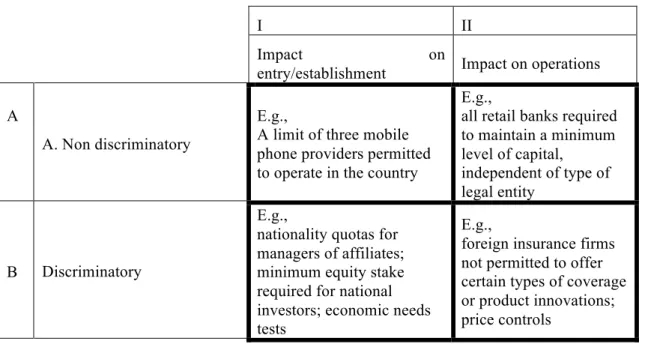
As measurement efforts have progressed, it has become clear that there are policies that impact on mercantile aspects of market potential, while not necessarily being discriminatory. Related to this, policies can also impact market potential by serving as barriers to entry, or by raising costs once a market is entered. This point is summarized in Table 4.1. Discriminatory barriers to entry, for example, include
16 See also Crino (2007).
17 Blinder (2009) estimates that somewhere between 22 and 29 percent of all U.S. jobs are potentially offshorable. He argues that there is little or no correlation between the offshorability of an occupation and its skill level, but that controlling for education, the most highly offshorable occupations were paying significantly lower wages in 2004. Liu and Trefler (2008) argue that in the case of the US, inshoring largely offsets offshoring effects.
18 Price comparisons of services across countries are generally inappropriate given the characteristics of services – the use of local inputs, extensive product differentiation and heterogeneity, etc.
limits on foreign equity ownership shares or direct prohibition of entry by MNEs. Non-discriminatory barriers to entry include a limit on the number of firms or providers in a market regardless of nationality. Regulations that impact on cost and are discriminatory could include additional capital requirements for foreign insurance firms, or pricing regulations specifically targeting foreign insurance providers. The same rules could also be applied on a non-discriminatory basis, so that they raise costs for both foreign and domestic firms. The negotiation of market access in services hinges in part on removing discrimination (applying the national treatment principle) and on the willingness of governments to make
concessions linked to (changes in) non-discriminatory regulatory regimes.19 In federal systems and
customs unions where subsidiarity (a vertical delineation of legal competence between central and local or sub-state authority) between central and regional authorities applies to service sectors, the scope for negotiating even on discriminatory regulations can be problematic.
Given the typology in Table 4.1, we use the term liberalization to mean deliberate actions that reduce discrimination. However, reducing discrimination may not result in a greater volume of international transactions. For example if government policies support a monopoly, nondiscrimination will have no effect, as entry is barred to all potential sources, whether foreign or domestic. More generally, even if entry is feasible, technically non-discriminatory policy may affect the operating costs of a foreign entrant differentially from domestic firms (de facto discrimination). As a result of these considerations, the literature on services trade policies argues that a distinction needs to be made between policies that discriminate on the basis of nationality of ownership of factors of production, and whether
policies affect entry into a market – through whatever mode of supply – and/or the operation of firms
(e.g., see Warren and Findley 2000; Deardorff and Stern 2008). This can alternatively be thought about in terms of whether policies affect fixed or variable costs.
4.2.1. Openness indexes and trade cost rankings
Information on policy can, in principle, be collected on a sector-by-sector basis, but is not available in the form of databases of the kinds that researchers can use when analyzing merchandise trade flows. Although there is much to complain about in regard to the latter databases, (e.g., see Anderson and van Wincoop 2004) the situation is incomparably worse for services. What would appear to be the most obvious source of information on services policies – trade agreements – is at best incomplete and at worst
19 Under the GATT, governments may not differentiate between domestic and foreign like products on the basis of how they are produced, though they are free to regulate product safety (consumer protection). For services, the mixture of local and foreign production and delivery modes, and the clouding of how firms organize production and what constitutes consumer safety, makes such clear distinctions problematic. Hence, while non-discrimination (rows A.II & B.II in Table 4.1) offers a clear parallel to the GATT treatment of goods, we do not have the same parallel for regulations that impact on a non-discriminatory basis and hence impose limits on the production methods of foreign providers (rows A.I and B.I). In such cases either regulatory change is required to reduce market segmentation (e.g., harmonization) or countries need to accept that their regimes are equivalent (e.g., through a mutual recognition agreement).
misleading given the limited coverage of country commitments.20 Efforts to directly measure the extent of
policy barriers on a sector and cross-country basis generally employ a policy index of some kind that is used to estimate the price, cost or quantity effects of policies. The policy indices are constructed by identifying existing policies towards entry/establishment and seeking to determine if policies differentiate between domestic and foreign firms. Once indices of policy have been constructed, the approach taken in much of the literature is to use this information by estimating their price and/or cost effects, controlling for standard determinants of performance for the sector concerned. A problem in doing this is to distinguish the effects of nondiscriminatory regulation from discriminatory policies. Regulations generally will increase fixed and/or variable costs of production for firms, and may result in a de facto or de jure exclusion of new entry, thereby increasing prices. Insofar as regulation is motivated by market failures created by the characteristics of specific service industries, e.g., network externalities and asymmetric information, such price impacts may be social welfare enhancing. As mentioned, another approach involves inferring trade costs from predicted vs. actual trade flows using gravity models. A logical but relatively unexplored avenue is the integration of openness indexes with gravity-based estimation at the sector level.
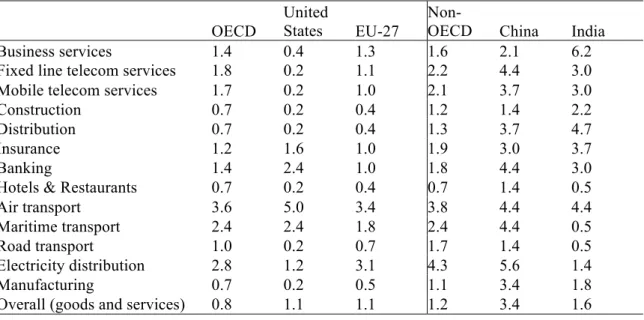
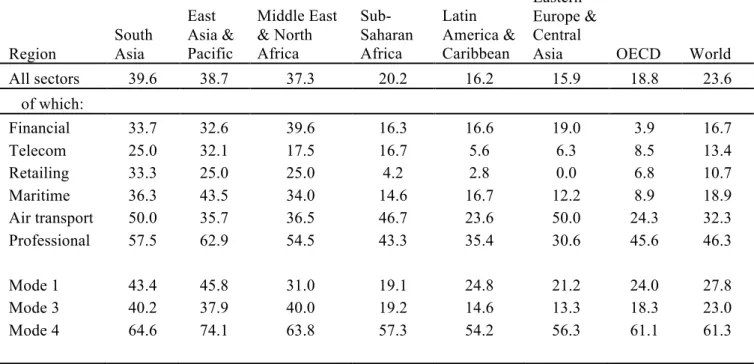
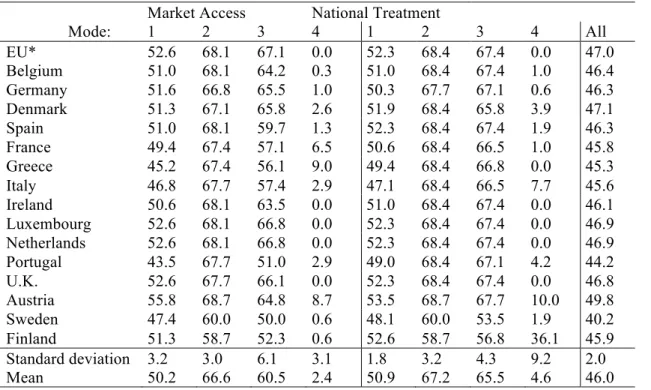
Available policy indexes affecting services trade are primarily a result of research supported by the Australian Productivity Commission, and ongoing work at the OECD and World Bank. A number of the price and costs estimates as summarized by Deardorff and Stern (2008) and Dee (2005) are reported in Table 4.2. OECD indexes are summarized in Table 4.3. World Bank estimates are summarized in Figure 4.1 and Table 4.4. The work of the Productivity Commission suggests that barriers to services trade appear to be substantial, especially for modes 3 and 4, in the sense that there is significant discrimination against foreign providers of services (Findlay and Warren 2000). The estimates summarized in Table 4.2 do not focus specifically on discriminatory policies, but instead on the impact of regulation more generally. The various restrictiveness indices that have been constructed suggest there is significant variation in the estimated extent of discrimination against foreign providers. Given that such discrimination tends to be higher in the developing countries that are in the samples, estimated price and/or cost effects tend to be higher in those countries, and in most instances are significantly greater than the level of trade barriers observed for merchandise trade.
The OECD rankings on policy related to the operation of service sector MNEs include a mixture of restrictions, such as cross-border movement of personnel, ownership limits, and barriers to the establishment and operation of foreign firms. Like the estimates summarized in Table 4.2, the indexes in Table 4.3 also point to generally higher restrictions in developing countries than in the OECD. At the
20 See Section 5 for more on this. As is often remarked in the literature, a major problem with the WTO (GATS) is that a positive list approach to scheduling commitments was used, which does not generate comprehensive and economically meaningful data on the measures that are imposed by countries.