Learning to Rank Using Privileged Information
Viktoriia Sharmanska
IST Austria
Klosterneuburg, Austria
[email protected]Novi Quadrianto
University of Cambridge
Cambridge, UK
[email protected]Christoph H. Lampert
IST Austria
Klosterneuburg, Austria
[email protected]Abstract
Many computer vision problems have an asymmetric dis-tribution of information between training and test time. In this work, we study the case where we are given additional information about the training data, which however will not be available at test time. This situation is called learn-ing uslearn-ing privileged information (LUPI). We introduce two maximum-margin techniques that are able to make use of this additional source of information, and we show that the framework is applicable to several scenarios that have been studied in computer vision before. Experiments with at-tributes,bounding boxes,image tagsandrationalesas ad-ditional information in object classification show promising results.
1. Introduction
In this work we study the problem oflearning using priv-ileged information (LUPI), as it was formally introduced by Vapnik in [25]. To learn with privileged information means that for a learning task, e.g. object categorization, one has access not only to input/output training pairs of the task we want to learn, but also to additional information about the training examples. Typically this additional data is more in-formative about the task at hand than the training data alone, so one would like to use it for better prediction. However, it is not clear how to do so, since at test time there will be no such data source. A possible analogy is human learning with a teacher: when a student learn a concept in school, for example algebra, the teacher can provide additional ex-planations at any time. Hopefully this will make the student learn faster than if the teacher would only pose questions and give their answers. However, when later in life the stu-dent faces an algebra problem, he or she will not be able to rely on the teacher’s expertise anymore.
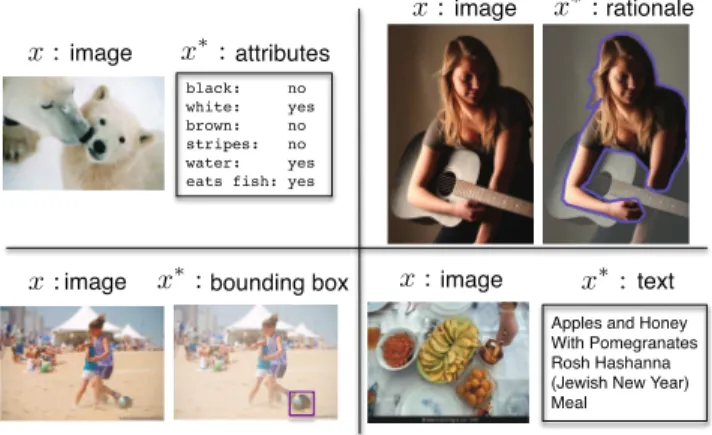
In this work we demonstrate the relevancy of this ob-servation in a variety of computer vision scenarios: we ex-plore four different types of privileged information in the context of object classification: attributesthat describe
se-image x: attributes x∗: black: no white: yes brown: no stripes: no water: yes eats fish: yes
bounding box
x∗:
x∗:rationale
Apples and Honey With Pomegranates Rosh Hashanna (Jewish New Year) Meal image x: x∗:text image x: image x:
Figure 1:Four different forms ofprivilegedinformation that can help learning better object recognition systems: attributes, anno-tator rationales,object bounding boxes, andtextual descriptions.
mantic properties of an object instead of just visual ones, bounding boxesthat specify the exact localization of the tar-get object in an image,image tagsthat describe the context of an image in textual form, andannotator rationalesthat provide additional informationwhya training example was annotated the way it was.
Figure 1 illustrates these four modalities. All of them have been studied previously in the computer vision litera-ture, see our discussion in Section 2. However, in each case a separate method was designed to handle the specific ad-ditional source of information. One of our contributions in this work is to show that it is possible to handle all these situations in a unified framework: LUPI.
Approach and contribution. At first sight, it is not clear
how a data modality that is not available at test time would be useful for classification at all: for example, training a classifier on the privileged data is useless, since there is no way to evaluate the resulting classifier on the test data. LUPI therefore requires an additional step of information transferfrom the privileged to the original data modality.
2013 IEEE International Conference on Computer Vision
1550-5499/13 $31.00 © 2013 IEEE 825
2013 IEEE International Conference on Computer Vision
At the core of our work in this paper lies the insight thatprivileged information allows us to distinguish between easyandhardexamples in the training set1.Assuming that the privileged data is similarly informative about the prob-lem at hand as the original data, one can presume that exam-ples that are easy or hard with respect to the privileged infor-mation will also be easy or hard with respect to the original data. Thereby we have gained additional knowledge about the learning problem, and this can guide the training of an image-based predictor to a better solution.
We formalize the above observation in Section 3, where we also introduce two maximum-margin learning tech-niques for LUPI. The first, SVM+, works in a classification setting and was originally described by Vapnik [25]. The second,Rank Transfer, is a new contribution, which targets a ranking setup. In Section 4, we report on experiments in the four privileged information scenarios introduced earlier, and we end with conclusions in Section 5.
2. Related work
In computer vision problems it is common to have ac-cess to multiple sources of information. Sometimes all of them are visual, such as when images are represented by color features as well as by texture features. Sometimes, the modalities are mixed, such as for images with text cap-tions. If all modalities are present both at training and at test time, it is rather straight-forward to combine them for better prediction performance. This is studied, e.g., in the fields ofmulti-modalormulti-viewlearning. Methods suggested here range fromstacking, where one simply concatenates the feature vectors of all data modalities, to complex adap-tive methods for early or late data fusions [23], including multiple kernel learning[26] andLP-β[10].
Situations with an asymmetric distribution of informa-tion have also been explored. Inweakly supervised learn-ing, the annotation available at training time is less detailed than the output one wants to predict. This situation occurs, e.g., when trying to learn animage segmentationsystem us-ing only per-image or boundus-ing box annotation [13]. In multiple instancelearning, training labels are given not for individual examples, but collectively for groups of exam-ples [16]. The inverse situation also occurs: for example in the PASCAL object recognition challenge, it has become a standard technique to incorporate strong annotation in the form of bounding boxes or per-pixel segmentations, even when the goal is just per-image object categorization [8].
The situation we are interested in occurs when at training time we have an additional data representation compared to test time. Different settings of this kind have appeared in the computer vision literature, but each was studied in a separate way. For clustering with multiple image
modal-1One might also call themtypicalandatypical, orinliersandoutliers.
ities, it has been proposed to use CCA to learn a shared representation that can be computed from either of repre-sentations [3]. Similarly the shared representation is also used for cross-modal retrieval [20]. Alternatively, one can use the training data to learn a mapping from the image to the privileged modality and use this predictor to fill in the values missing at test time [5]. Feature vectors made out of semantic attributes have been used to improve ob-ject categorization when very few or no training examples are available [14, 27]. Recentlyannotator rationales[28] have been introduced to the computer vision community. In [7] it was shown that these can act as additional sources of information during training, as long as the rationales can be expressed in the same data representation as the original data (e.g. characteristic regions within the training images). Our work follows a different route than the above proaches. We are not looking for task-specific solutions ap-plicable to a specific form of privileged information. In-stead, we aim for a generic method that is applicable to any form of privilege information that is given as additional rep-resentations of the training data. We show in the following sections that such frameworks do indeed exist, and in Sec-tion 4 we illustrate that the individual situaSec-tions described above can naturally be expressed in these frameworks.
3. Learning using Privileged Information
We assume a situation of supervised binary classifica-tion: given a set ofN training examples, represented by feature vectorsX = {x1, . . . , xN} ⊂ X ⊂ Rd, and their label annotation,Y ={y1, . . . , yN} ∈Y={+1,−1}, the task is to learn a prediction functionf : X → R from a spaceFof possible functions, e.g. all linear classifiers. In the following, we will think of the examples as images and of their representation as computed from the image content, for examplebag-of-visual-wordshistograms [6].
Adopting the LUPI setting, we are given additional infor-mation about the training set, which we assume also to be in the form of feature vectors,X∗ = {x∗1, . . . , x∗N} ⊂ X∗ ⊂
Rd∗, where any x∗
i encodes the additional information we have aboutxi. Note that we do not make further assump-tion about thisprivilegeddata. In particular,x∗i might not be computable from the original image, but rather reflect a very different kind of information, such as explanation provided by a human teacher. Also, in generalX∗ will be different fromX, so is it not possible, e.g., to apply functions defined onXtoX∗or vice versa.
The goal of LUPI is to use the privileged data,X∗, to learn a better classifier than one would learn without it. However, it is clear thatf :X→Ritself cannot rely on the
X∗ domain, since this is not available at test time. There-fore, it has to be ourchoiceoff ∈ Fthat is influenced by the privileged data.
priv-ileged data helps us to distinguish betweeneasyandhard examples in the training set. This knowledge allows us to identify the relevant aspects of the training data and con-centrate the learning step towards these, thereby finding a function of higher prediction quality.
In the following, we explain two maximum-margin methods for learning with privileged information that fit to this interpretation. For simplicity of notation we write all problems in their primal form. Kernelizing and dualizing them is possible using standard techniques [21].
3.1. SVM+
A first model for learning with privileged information, SVM+, was proposed by Vapniket al. [17, 25]. It is based on the insight that training a support vector machine (SVM) would be easier if one had access to aslack oracle. Ordi-nary SVM training is based on the following constrained objective function: 1 2w2+C N i=1 ξi (1)
subject to, for alli= 1, . . . , N,
yi[w, xi+b]≥1−ξi and ξi≥0. (2) By minimizing over the classifier parametersw, band the slack variables ξ1, . . . , ξN, we obtain the SVM solution. When the number of training examples increases, this is known to converge with a rate of √1
N to the optimal clas-sifier [24]. However, if we knew the optimal slack values ξiin advance, for example from anoracle, and perform the optimization with respect towandb, then the convergence rate improves toN1 [25]. Consequently, such anOracleSVM would require fewer training examples to reach a certain prediction accuracy than an ordinary SVM.
An intuitive interpretation of this is that the slack vari-ables tell us which training examples areeasyand which arehard. In the OracleSVM, the training process does not have to infer this from the data and can use all statistical information contained in the training examples to find the actual object of interest: the classifying hyperplane.
The idea of the SVM+ classifier is to use the privileged information as a proxy to the oracle. For this we parameter-izeξi=w∗, x∗i+b∗with unknownw∗andb∗, obtaining the SVM+ training problem:
min w∈Rd,b∈R w∗∈Rd∗,b∗∈R 1 2 w2+γw∗2+CN i=1 w∗, x∗ i+b∗ (3) subject to, for alli= 1, . . . , N,
yi[w, xi+b]≥1−[w∗, x∗i+b∗] (4)
and w∗, x∗i+b∗≥0. (5)
Numerical optimization. The SVM+ optimization prob-lem (3)/(4) is convex, but it cannot be solved by off-the-shelf SVM packages, because of the way the weight vectors interact. In [18], suitable sequential minimal optimization (SMO) algorithms were derived, one of which we use for our experiments (Section 4). As it is the case for the origi-nal SMO algorithm for SVM training [11], the numeric op-timization works with the dual representation and is only applicable to problems with a small to medium size.
3.2. Rank Transfer
To overcome the limitations of the SVM+ setup we intro-duce a second method for making use of privileged informa-tion in this work. Again, the underlying idea is to identify easy and hard cases. However, instead of using the privi-leged data to identify easy-to-classify and hard-to-classify examples, we adopt a ranking setup and identify easy-to-separate and hard-to-easy-to-separate example pairs.
Our formulation is based on the learning to rank frame-work [12], which requires solving the following optimiza-tion problem min w∈Rd, ξij∈R 1 2w2+C N i,j=1 ξij (6)
subject to, for alli, j= 1, . . . , N, withyi > yj,
w, xij ≥1−ξij and ξij ≥0, (7) wherexij =xi−xj. From the solution vectorwwe obtain ranking scoresf(x) =w, xfor new examplesx.
The above formulation enforces a difference of at least
1in ranking score between any pair of examples of differ-ent class label. However, it is intuitively clear that some example pairs will be easier to separate than others. Some example pairs might even be impossible to rank correctly in the given data representation. Following the same intu-ition as above, we hypothesize that knowinga prioriwhich example pairs are easy and which are hard to separate and taking this into account during learning should improve the prediction performance.
This consideration leads us to theRank Transfermethod, summarized in Algorithm 1. We first train an ordinary rank-ing SVM onX∗. The resulting ranking functionf∗we use to compute the margins achieved between any two train-ing images2,ρ
ij :=f∗(x∗i)−f∗(x∗j). Example pairs with a large values of ρij can be considered easy to separate, whereas small or even negative values ofρij indicate hard or even impossible to separate pairs. We then train a rank-ing SVM on X, aiming for a data-dependent margin ρij
2Note that we deliberately evaluate the ranking function on the same
data it was trained on. The reason is that the quantity we are interested in is how easy it is to separate two examples during training, not by how much one could expect two samples would be separated at test time.
Algorithm 1Rank Transfer fromX∗toX
Inputoriginal dataX, privileged dataX∗, labelsY f∗←ranking SVM (6)/(7) trained on(X∗, Y) ρij =f∗(x∗i)−f∗(x∗j) (between-sample margins) f ←ranking SVM (8)/(9) trained on(X, Y)usingρij Returnf :X→R
between any two examplesxiandxjrather than enforcing a constant margin of1between all pairs. The corresponding optimization problem is min w∈Rd, ξ ij∈R 1 2w2+C N i,j=1 ξij (8)
subject to, for alli, j= 1, . . . , N, withyi≥yjandρij>0,
w, xij ≥ρij−ξij and ξij≥0. (9) One can see that example pairs with small values ofρijhave more limited influence onw than in the ordinary ranking SVM. Incorrectly ranked pairs are even completely ignored. Our interpretation is that if it was not possible to correctly rank a pair in the privileged space, it will also be not pos-sible to do so in the, presumably weaker, original space. Forcing the optimization to solve a hopeless tasks would only lead to overfitting and reduced ranking accuracy. Numeric Optimization. Both learning steps in theRank Transfermethod, ranking onX∗and onX, are convex opti-mization problems. Furthermore, in contrast to SVM+, we can use standard SVM packages to solve them, including efficient methods working in primal representation [4], and solvers based on stochastic gradient descent [22].
For the ranking SVM onX∗this is clear, since the opti-mization problem (6)/(7) is identical to a binary SVM with-out bias term, trained on training examplesxij that all have positive labels. For the ranking with data-dependent mar-gin, we achieve the same by a reparameterization: we di-vide each constraint (9) by the correspondingρij, which is possible since only pairs withρij > 0 occur. Changing variables fromxij toˆxij = xij
ρij and fromξij toξˆij =
ξij
ρij
we obtain the equivalent optimization problem
min w∈Rd,ξˆ ij∈R 1 2w2+C N i,j=1 ρijξˆij (10) subject to, for alli, j= 1, . . . , Nwithyi≥yjandρij>0,
w,xˆij ≥1−ξˆij and ξˆij≥0. (11) This corresponds to an ordinary SVM optimization with training examplesxˆij = xiρ−ijxj, where each slack variable
has an individual weightCρijin the objective. Many exist-ing SVM packages support such per-sample weights, in our experiments we useLIBLINEAR[9]. Furthermore, in prac-tice we only include example pairs withρij >0.1, thereby preventing numeric instabilities and increasing computa-tional efficiency.
4. Experiments
In our experimental setting we study four different types of privileged information, showing that all of these can be handled in a unified framework, where previously hand crafted methods were used. We consider attribute annota-tion, bounding box annotaannota-tion, textual description and ra-tionales as sources of privileged information if these are present at training time but not at test time. As we will see, some modalities are more suitable for transferring the rank than others. We will discuss this in the following subsec-tions. Note that we also include results where the privileged information does not help. Besides scientific honesty, the reason for this is to show thatno negative transferoccurs.
Methods. We analyze two methods of learning using privileged information: our proposed Rank Transfer method for transferring the rank, and the SVM+ method [18] kindly provided by the authors. We compare the results with rank-ing SVM and ordinary SVM when learnrank-ing on the original spaceXdirectly (SVM rank and SVM baselines). We also provide as a reference the performance of SVM rank in the privileged spaceX∗, as if we had the access to the privileged information during testing.
Evaluation metric. To evaluate the performance of the methods we use average precision (AP), which corresponds to the area under the precision-recall curve. In fact, we re-port percentage accuracy of AP score (0%to100%).
Model selection. For the LUPI methods, we perform a joint cross validation model selection approach for choosing the regularization parameters in the original and privileged spaces. In the SVM+ method these areC andγ (3), and in the Rank Transfer these areC’s in the two-stage proce-dure (6), (8). For the methods that do not use privileged information there is only a regularization parameter C to be cross validated. In the privileged space we select over7 parameters{10−3, . . . ,103}. We use the same range in the original space if the data isL2 normalized, and the range {100, . . . ,105}forL
1 normalized data. In all our experi-ments we use 5 fold cross-validation scheme, the best pa-rameter (or pair of papa-rameters) found is used to retrain the complete training set.
4.1. Attributes as privileged information
Attribute annotation incorporates high-level description of the semantic properties of different objects like shape, color, habitation forms etc. We use the Animals with At-tributes (AwA)dataset [14]. We focus on the default10test
Figure 2:AwA dataset (attributes as privileged information). Pairwise comparison of the methods that utilize privileged information and their baseline counterparts is shown via difference of the AP performance (Rank Transfer versus SVM rank, SVM+ versus SVM). The length of the45bars corresponds to relative improvement of the average precision over45cases.
SVM rank Rank Transfer SVM SVM+ Reference image image+attributes image image+attributes (SVM rank attributes) 1 Chimpanzee versus Giant panda 91.76±0.35 91.83±0.37 91.53±0.36 92.12±0.40 93.34±0.34 2 Chimpanzee versus Leopard 94.33±0.35 94.80±0.29 94.16±0.35 94.23±0.39 98.58±0.07 3 Chimpanzee versus Persian cat 91.39±0.43 91.86±0.38 91.09±0.44 91.73±0.38 96.94±0.24 4 Chimpanzee versus Pig 87.75±0.36 88.59±0.25 87.45±0.33 88.06±0.43 94.02±0.20 5 Chimpanzee versus Hippopotamus 87.49±0.37 87.57±0.42 87.58±0.36 87.53±0.36 95.67±0.17 6 Chimpanzee versus Humpback whale 98.52±0.18 98.52±0.15 98.12±0.18 98.57±0.16 99.94±0.00 7 Chimpanzee versus Raccoon 89.41±0.35 89.54±0.29 89.00±0.38 89.67±0.35 94.11±0.24 8 Chimpanzee versus Rat 87.31±0.51 88.47±0.45 86.84±0.62 87.96±0.53 96.54±0.23 9 Chimpanzee versus Seal 92.68±0.34 92.58±0.36 92.53±0.38 92.59±0.35 97.04±0.16 10 Giant panda versus Leopard 95.26±0.24 95.11±0.21 95.13±0.24 94.95±0.27 98.35±0.08 11 Giant panda versus Persian cat 94.66±0.28 94.38±0.23 94.66±0.28 94.68±0.26 95.55±0.21 12 Giant panda versus Pig 88.82±0.40 88.69±0.45 88.67±0.46 88.95±0.42 92.78±0.23 13 Giant panda versus Hippopotamus 92.62±0.44 92.78±0.43 92.35±0.43 92.85±0.42 96.98±0.16 14 Giant panda versus Humpback whale 98.83±0.18 98.88±0.14 98.77±0.20 98.76±0.22 99.84±0.02 15 Giant panda versus Raccoon 91.52±0.35 91.33±0.37 91.76±0.34 91.90±0.40 93.18±0.15 16 Giant panda versus Rat 91.13±0.36 90.33±0.41 90.50±0.42 90.61±0.47 95.26±0.20 17 Giant panda versus Seal 93.63±0.31 93.58±0.26 93.33±0.29 93.40±0.24 96.34±0.21 18 Leopard versus Persian cat 95.72±0.21 95.92±0.18 95.50±0.25 95.65±0.26 98.65±0.09 19 Leopard versus Pig 90.65±0.20 90.88±0.25 90.40±0.20 90.40±0.18 97.82±0.10 20 Leopard versus Hippopotamus 93.78±0.27 93.81±0.28 93.60±0.28 93.83±0.27 97.68±0.12 21 Leopard versus Humpback whale 99.08±0.08 99.17±0.08 99.06±0.09 99.20±0.07 99.95±0.00 22 Leopard versus Raccoon 83.66±0.57 83.15±0.57 83.23±0.60 83.18±0.64 91.50±0.19 23 Leopard versus Rat 90.43±0.19 90.98±0.26 90.28±0.24 90.65±0.26 97.19±0.12 24 Leopard versus Seal 95.10±0.22 95.49±0.19 94.98±0.23 95.14±0.22 98.31±0.09 25 Persian cat versus Pig 83.71±0.49 83.39±0.58 83.23±0.44 83.38±0.51 84.19±0.46 26 Persian cat versus Hippopotamus 93.11±0.39 93.41±0.34 92.66±0.38 93.14±0.35 97.50±0.13 27 Persian cat versus Humpback whale 96.94±0.33 97.26±0.29 96.19±0.39 96.69±0.39 99.82±0.02 28 Persian cat versus Raccoon 90.79±0.41 91.20±0.35 90.46±0.45 90.94±0.47 93.50±0.21 29 Persian cat versus Rat 69.94±0.52 70.40±0.48 69.38±0.46 69.43±0.43 73.13±0.67 30 Persian cat versus Seal 86.75±0.64 86.91±0.58 86.06±0.66 86.97±0.71 94.56±0.22 31 Pig versus Hippopotamus 77.21±0.58 79.02±0.63 76.45±0.53 77.42±0.54 88.03±0.45 32 Pig versus Humpback whale 97.02±0.22 97.32±0.18 96.78±0.31 97.04±0.19 99.63±0.03 33 Pig versus Raccoon 80.60±0.56 81.79±0.57 80.08±0.53 81.50±0.53 91.55±0.27 34 Pig versus Rat 72.98±0.60 73.68±0.53 72.25±0.58 72.63±0.50 84.16±0.35 35 Pig versus Seal 80.67±0.72 81.76±0.65 79.76±0.74 80.33±0.68 88.91±0.46 36 Hippopotamus versus Humpback whale 93.86±0.33 93.75±0.33 93.83±0.28 93.63±0.30 98.88±0.12 37 Hippopotamus versus Raccoon 86.77±0.64 87.37±0.61 86.49±0.57 86.83±0.68 94.59±0.21 38 Hippopotamus versus Rat 85.68±0.44 87.37±0.38 85.12±0.44 85.99±0.39 94.82±0.27 39 Hippopotamus versus Seal 73.78±0.67 75.85±0.67 72.82±0.69 73.41±0.60 80.90±0.55 40 Humpback whale versus Raccoon 97.01±0.24 97.15±0.22 96.92±0.25 97.11±0.22 99.76±0.03 41 Humpback whale versus Rat 95.43±0.21 95.53±0.18 95.21±0.21 95.45±0.21 99.66±0.02 42 Humpback whale versus Seal 86.28±0.56 86.93±0.47 86.44±0.52 86.89±0.52 96.69±0.14 43 Raccoon versus Rat 79.97±0.46 80.31±0.56 79.59±0.47 79.67±0.44 86.76±0.30 44 Raccoon versus Seal 92.52±0.28 92.80±0.24 92.22±0.28 92.55±0.23 94.26±0.21 45 Rat versus Seal 81.11±0.62 82.34±0.62 80.44±0.64 80.68±0.73 92.46±0.35
Table 1:AwA dataset (attributes as privileged information). The numbers are mean and standard error of the AP performance over20runs. The best result is highlighted inboldface, which in total is7forSVM rank,27forRank Transfer,1forSVM, and10forSVM+. Highlighted blue indicates significant improvement of the methods that utilize privileged information (Rank Transfer and/or SVM+) over the methods that do not (SVM rank and SVM). We used a paired Wilcoxon test with95%confidence level as a reference. Additionally, we also provide the SVM rank performance onX∗(last column).
classes, for which the attribute annotation is provided to-gether with the dataset. The10classes arechimpanzee, gi-ant panda, leopard, persian cat, pig, hippopotamus, hump-back whale, raccoon, rat, seal, and contain6180images in total. The attributes capture85 properties of the animals, color, texture, shape, body parts, behavior among others.
We use L1 normalized 2000 dimensional SURF descrip-tors [1] as original features, and85dimensional predicted attributes as the privileged information. The values of the predicted attributes are obtained from DAP model [14] and correspond to probability estimates of the binary attributes in the images. We train45binary classifiers for each pair
of the10classes with varying size of training data:50,100 images per class. We use200samples per class for testing. To get better statistics of the performance we repeat the pro-cedure of train/test split20times. Due to space constraints, we only include the results withN = 100training samples per class here. Please, refer to the supplementary material for the caseN = 50.
Results. As we can see from the Figure 2, utilizing at-tributes as privileged information for object classification task is useful. Rank Transfer outperforms SVM rank in34 out of45cases, and SVM+ outperforms SVM in39out of
45cases. Noticeably, the Rank Transfer model is able to utilize privileged information better than the SVM+. We observe partial overlap of cases where Rank Transfer and SVM+ are not able to utilize privileged information (loca-tion of the red bars). Full comparison of the AP perfor-mance of all methods is shown in the Table 1. In general, we observe that ranking-based models are superior to the non-ranking ones, and in particular, we can see clear advan-tage of the Rank Transfer model over all other baselines. We also notice, that the gain of the Rank Transfer method is higher in the regime when the problem is hard, i.e. when AP performance is below90%. We obtain very similar re-sults withN = 50training samples per class. As a fur-ther analysis, we also check the hypothetical performance of SVM rank in the privileged spaceX∗. The privileged information has consistently higher AP performance than SVM rank inX. In most cases, higher AP performance in the privileged space than in the original translates to posi-tive effect in rank transfer. We also analyze the data ranking in the original space, privileged space, and in the original space with transferred rank. Typically the data ranking in the privileged space of attributes is well spread out compar-ing to the original space. In this case the distinction between easy-to-separate and hard-to-separate pairs is feasible in the privileged space and we can potentially benefit from it by transferring the rank.
4.2. Bounding box as privileged information
Bounding box annotation is designed to capture the exact location of an object in the image. When performing image-level object recognition, knowing the exact location of the object in the training data is privileged information. We use a subset of the categories from the ImageNet 2012 challenge (ILSVRC2012) for which bounding box annotation is avail-able3. We define two groups of interest: group with variety of snakes, and group with balls in different sport activities. The group of snakes has17classes: thunder snake, ring-neck snake, hognose snake, green snake, king snake, garter snake, water snake, vine snake, night snake, boa constrictor, rock python, indian cobra, green mamba, sea snake, horned viper, diamondback, sidewinder, and has8254images in
to-3http://www.image-net.org/challenges/LSVRC/2012/index
tal, on average500samples per class. We ignore few images with too small bounding box region, and use8227images for further analysis. The group balls has6classes: soccer ball, croquet ball, golf ball, ping-pong ball, rugby ball, ten-nis ball, and has3259images in total, on average500 sam-ples per class. Here, we also ignore images with uninforma-tive bounding box annotation and use3165images instead. We consider one-versus-rest scenario for each group sepa-rately. We useL2normalized4096-dimensional Fisher vec-tors [19] extracted from the whole images as well as from only the bounding box regions, and we use the former as the original data representation and the latter as privileged information. We train one binary classifier for each class,
17in the first group and6in the second group. For training we use100images from the desired class and100samples randomly drawn from the remaining classes. For testing we use the rest of the images in the desired class and the same amount from the other categories. To get better statistics of the performance we repeat the train/test split10times. Due to space constraints, we only include the results with the group of snakes here. Please, refer to the supplementary material for the group of balls.
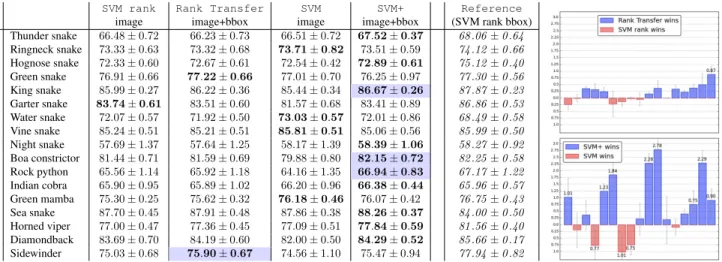
Results.As we can see from Table 2, utilizing bounding box annotation as privileged information for fine-grained classification is useful. We show the pairwise difference in performance of the methods that utilize privileged infor-mation and that do not in the bar plot on the right of Ta-ble 2. Rank Transfer clearly outperforms SVM rank (im-age) in10cases, and SVM+ outperforms SVM in12cases out of 17. In this experiment, the SVM+ method is able to exploit the privileged information better than the Rank Transfer method (in 13out of 17cases). And overall we observe that non-ranking models are superior to the ranking ones. In the group of balls, both LUPI methods outperform non-LUPI baselines in 4out of 6cases (refer to the sup-plementary). Noticeably, SVM rank performs worse than all other methods, where as standard SVM is a competitive baseline. Interestingly, the performance in the privileged space is not superior to the original data space, sometimes it is even worse, especially in the group of balls. However the LUPI methods are able to exploit easy and hard sam-ples in both spaces. We credit this to the fact that in this experiment, both spaces are of the same modality, i.e. the privileged information is obtained from a subset of the same image features that are used for the original data represen-tation. Thus, our underlying assumption that the same ex-amples are easy and hard in both modalities is fulfilled.
4.3. Textual description as privileged information
A textual description provides complementary view to a visual representation of an object. This can be used as privileged information in object classification task. We use IsraelImagesdataset introduced in [2]. The dataset has11
SVM rank Rank Transfer SVM SVM+ Reference image image+bbox image image+bbox (SVM rank bbox) Thunder snake 66.48±0.72 66.23±0.73 66.51±0.72 67.52±0.37 68.06±0.64 Ringneck snake 73.33±0.63 73.32±0.68 73.71±0.82 73.51±0.59 74.12±0.66 Hognose snake 72.33±0.60 72.67±0.61 72.54±0.42 72.89±0.61 75.12±0.40 Green snake 76.91±0.66 77.22±0.66 77.01±0.70 76.25±0.97 77.30±0.56 King snake 85.99±0.27 86.22±0.36 85.44±0.34 86.67±0.26 87.87±0.23 Garter snake 83.74±0.61 83.51±0.60 81.57±0.68 83.41±0.89 86.86±0.53 Water snake 72.07±0.57 71.92±0.50 73.03±0.57 72.01±0.86 68.49±0.58 Vine snake 85.24±0.51 85.21±0.51 85.81±0.51 85.06±0.56 85.99±0.50 Night snake 57.69±1.37 57.64±1.25 58.17±1.39 58.39±1.06 58.27±0.92 Boa constrictor 81.44±0.71 81.59±0.69 79.88±0.80 82.15±0.72 82.25±0.58 Rock python 65.56±1.14 65.92±1.18 64.16±1.35 66.94±0.83 67.17±1.22 Indian cobra 65.90±0.95 65.89±1.02 66.20±0.96 66.38±0.44 65.96±0.57 Green mamba 75.30±0.25 75.62±0.32 76.18±0.46 76.07±0.42 76.75±0.43 Sea snake 87.70±0.45 87.91±0.48 87.86±0.38 88.26±0.37 84.00±0.50 Horned viper 77.00±0.47 77.36±0.45 77.09±0.51 77.84±0.59 81.56±0.40 Diamondback 83.69±0.70 84.19±0.60 82.00±0.50 84.29±0.52 85.66±0.17 Sidewinder 75.03±0.68 75.90±0.67 74.56±1.10 75.47±0.94 77.94±0.82
Table 2: ImageNet dataset, group of snakes (bounding box annotation as privileged information). The numbers are mean and standard error of the AP performance over10runs. The best result is highlighted inboldface. Highlighted blue indicates significant improvement of the methods that utilize privileged information (Rank Transfer and/or SVM+) over the methods that do not (SVM rank and SVM). We used a paired Wilcoxon test with95%confidence level as a reference. Additionally, we also provide the SVM rank performance onX∗ (last column). The bar plots on the right show advantage of the LUPI methods over non-LUPI (Rank Transfer versus SVM rank, SVM+ versus SVM). The length of the17bars corresponds to relative improvement of the average precision over17snake classes.
classes,1823images in total, with a textual description (up to18words) attached to each of the image. The number of samples per class is relatively small, around150samples, and varies from96to191samples. We merge the classes into three groups: nature (birds, trees, flowers, desert), religion (christianity, islam, judaism, symbols) and urban (food, housing, personalities), and perform binary classifi-cation on the pairs of groups. We useL2normalized4096 -dimensional Fisher vectors [19] extracted from the images as the original data representation and bag-of-words repre-sentation of the text data as privileged information. We use
100images per group for training and all the rest for testing. We repeat the train/test split20times.
Results. As we can see from Table 3, utilizing tex-tual privileged information as provided in theIsraelImages dataset does not help. All four methods have near equal performance, and there is no signal of privileged informa-tion being utilized in both LUPI methods. This might seem contradictory to the high performance of the reference base-line in the text domain,X∗. However high accuracy in the privileged space does not necessarily mean that the privi-leged information is helpful. For example, assume we used the labels themselves as privileged modality: classification would be trivial, but it would provide no additional infor-mation to transfer. In theIsraelImages, the textual descrip-tions of the images are sparse and contain duplicates. For samples with identical scores there is no information in their relative ranking. Therefore, ranking the samples in the priv-ileged space does not capture the relation between objects and mainly preserves the class separation only. The perfor-mance does not degrade nevertheless.
4.4. Rationales as privileged information
Rationale annotation was introduced in [7] as a way to capture additional informationwhyan annotator makes the decision about the given image. This information is pro-vided in the form of the most informative hand-annotated region in the image, and is privileged in the LUPI frame-work. We use theHot or Notdataset4, which is designed for binary classification, whether male and female people in the images arehot. Following the setting of [7], we use
108and 104images for female and male classes accord-ingly with+1(hot) and−1(not) label. The original data and the privileged data are represented withL1normalized500 dimensional densely sampled SIFT features, extracted from the whole image and from the rationales accordingly. We train two binary classifiers for females and males separately with varying size of training data50and100samples. We use the remaining data for testing. We repeat the train/test split100times.
Results. First we would like to mention that theHot or Notdataset is very challenging: the AP performance is rela-tively low for all four methods and the standard deviation is high. In case ofN = 50, the data contains too little signal for any method to work with, thus it is hard to draw a con-clusion. In case ofN = 100(see Table 4), we can not make statistical summary of the result due to small test sample size (8and4samples accordingly). Nevertheless we per-form this experiment to position our result with respect to the original work [7]. Formaleclass the authors report clas-sification accuracy 60.01%, and 57.07%forfemale class.
SVM rank Rank Transfer SVM SVM+ Reference image image+text image image+text (SVM rank text) Nature vs Religion 89.06±0.34 89.28±0.24 89.51±0.27 89.41±0.26 96.94±0.12 Religion vs Urban 71.82±0.66 71.71±0.59 72.04±0.56 72.11±0.40 96.20±0.11
Nature vs Urban 88.56±0.23 88.94±0.22 88.85±0.24 88.92±0.23 94.41±0.17
Table 3:Israeli dataset (textual description as privileged information). The numbers are mean and standard error of the AP performance over20runs. As reference we also provide the SVM rank performance on theX∗(last column).
SVM rank Rank Transfer SVM SVM+ Reference
image image+rationale image image+rationale (SVM rank rationale) Female N=100 58.06±1.40 56.58±1.34 57.58±1.39 57.06±1.49 75.65±1.52 Male N=100 72.33±1.82 75.50±1.97 72.25±1.75 73.58±1.81 79.91±1.94
Table 4: HotOrNot dataset (rationale as privileged information). The numbers are mean and standard error of the AP performance over 100runs. As reference we also provide the SVM rank performance onX∗(last column).
Because of the different performance measures (AP versus accuracy) we can not directly compare our results, but the numbers are ‘in the same ballpark’.
5. Conclusion
We have studied the setting of learning using privileged information (LUPI) in visual object classification tasks. We showed how it can be applied to several situations that pre-viously were handled by hand-crafted separate methods. Our experiments show that prediction performance often improves when utilizing the privileged information. When it does not, at least no negative transfer occurs. We have studied two approaches for solving the LUPI task: SVM+ and the proposed Rank Transfer method. Rank Transfer shows comparable performance to the SVM+ algorithm and can easily be applied using standard SVM solvers.
In future work, we plan to further analyze the poten-tial of both approaches, also in light of recent results that SVM+ classifiers can be reformulated as a special forms of example-weighted binary SVMs [15].
Acknowledgments. This work was in parts funded by the European Research Council under the Euro-pean Union’s Seventh Framework Programme (FP7/2007-2013)/ERC grant agreement no 308036. NQ is supported by the Newton International Fellowship. We thank Dmitry Pechyony for SVM+ code.
References
[1] H. Bay, A. Ess, T. Tuytelaars, and L. Van Gool. Speeded-up robust features (SURF).CVIU, 2008.
[2] R. Bekkerman and J. Jeon. Multi-modal clustering for multimedia collections. InCVPR, 2007.
[3] M. B. Blaschko and C. H. Lampert. Correlational spectral clustering. InCVPR, 2008.
[4] O. Chapelle. Training a support vector machine in the primal.Neural Computation, pages 1155–1178, 2007.
[5] C. M. Christoudias, R. Urtasun, and T. Darrell. Multi-view learning in the presence of view disagreement. InUAI, 2008.
[6] C. Dance, J. Willamowski, L. Fan, C. Bray, and G. Csurka. Visual categorization with bags of keypoints. InECCV, 2004.
[7] J. Donahue and K. Grauman. Annotator rationales for visual recog-nition. InICCV, 2011.
[8] M. Everingham, L. J. V. Gool, C. K. I. Williams, J. M. Winn, and A. Zisserman. The Pascal VOC challenge.IJCV, 2010.
[9] R.-E. Fan, K.-W. Chang, C.-J. Hsieh, X.-R. Wang, and C.-J. Lin. LIBLINEAR: A library for large linear classification.JMLR, 2008. [10] P. Gehler and S. Nowozin. On feature combination for multiclass
object classification. InICCV, 2009.
[11] T. Joachims. Making large-scale SVM learning practical. In Ad-vances in kernel methods, pages 169–184, 1999.
[12] T. Joachims. Optimizing search engines using clickthrough data. In
KDD, 2002.
[13] D. Kuettel, M. Guillaumin, and V. Ferrari. Segmentation propagation in ImageNet. InECCV, 2012.
[14] C. H. Lampert, H. Nickisch, and S. Harmeling. Attribute-based clas-sification for zero-shot visual object categorization.PAMI, 2013. [15] M. Lapin, M. Hein, and B. Schiele. Learning using privileged
information: SVM+ and weighted SVM, 2013. arXiv:1306.3161 [stat.ML].
[16] O. Maron and A. L. Ratan. Multiple-instance learning for natural scene classification. InICML, 1998.
[17] D. Pechyony and V. Vapnik. On the theory of learning with privileged information. InNIPS, 2010.
[18] D. Pechyony and V. Vapnik. Fast optimization algorithms for solving SVM+. InStat. Learning and Data Science, 2011.
[19] F. Perronnin, J. S´anchez, and T. Mensink. Improving fisher kernel for large-scale image classification. InECCV, 2010.
[20] N. Quadrianto and C. H. Lampert. Learning multi-view neighbor-hood preserving projections. InICML, 2011.
[21] B. Sch¨olkopf and A. Smola. Learning with Kernels. MIT Press, 2002.
[22] S. Shalev-Shwartz, Y. Singer, and N. Srebro. Pegasos: Primal esti-mated sub-gradient solver for SVM. InICML, 2007.
[23] C. G. Snoek, M. Worring, and A. W. Smeulders. Early versus late fusion in semantic video analysis. InACM MM, 2005.
[24] V. Vapnik.The nature of statistical learning theory. Springer, 1999. [25] V. Vapnik and A. Vashist. A new learning paradigm: Learning using
privileged information.Neural Networks, 2009.
[26] A. Vedaldi, V. Gulshan, M. Varma, and A. Zisserman. Multiple ker-nels for object detection. InICCV, 2009.
[27] Y. Wang and G. Mori. A discriminative latent model of object classes and attributes. InECCV, 2010.
[28] O. F. Zaidan and J. Eisner. Modeling annotators: A generative ap-proach to learning from annotator rationales. InConference on Em-pirical Methods in Natural Language Processing, 2008.