Board of Directors’ Effectiveness and Firm Performa
nce:
Evidence from Jordan
Mohammed Hassan Makhlouf* Nur Hidayah Laili Mohamad Yazis Ali Basah Nur Ainna Ramli Faculty of Economics and Muamalat, Universiti Sains Islam Malaysia (USIM), Bandar Baru Nilai, 71800 Nilai,
Negeri Sembilan, Malaysia Abstract
This paper aims to examine the relationship between the board of director’s effectiveness and firm performance in Jordanian listed firms. The study used panel data approach over a period of five years from 2009 to 2013, with a sample of 120 non-financial firms listed on Amman Stock Exchange, these firms represents around 56% of Jordanian listed firms. In terms of the effect of board of directors on firm performance, five characteristics of the board of directors are identified: board of directors’ independence, board size, board meetings, leadership structure and board of directors' ownership. The firm performance was assessed by (ROA) as an accounting-based performance measure and Tobin’s Q (TQ) as a market-based indicator. The findings indicate that the independence of board of directors and board of directors' ownership have a positive impact on firm performance. The results also find that the smaller board size enhances the firm performance. Further analysis shows that the findings fail to reveal any significant impact for the frequency of board meetings and leadership structure on firm performance. The study contributes to the literature on board of directors’ effectiveness and firm performance in developing countries especially in Jordan. This study provides useful information that is of great value to policy makers, academics and other stakeholders.
Keywords: Corporate governance, board of directors’ effectiveness, firm performance, Jordan. 1. Introduction
Corporate governance has become one of the most important issues discussed in the world economies and represents an important factor that enhances the success of economic and organizational reforms (Akbar, 2015; Emile, Ragab, & Kyaw, 2014; JCGC, 2008). The role of good corporate governance provides useful information for the managers, shareholders and other beneficiary parties in order to enhance the firm performance (Duztas, 2008). Black, Jang, and Kim (2006) argued that the firms with good corporate governance have better performance than the firms with poor corporate governance.
The board of directors is considered one of the most important mechanisms of corporate governance and a governance structure safeguard between the firm and the shareholders (Arora, 2015; H. Liu & Fong, 2010). The Cadbury Report (1992) describes the board of directors as the centre stage of the governance structure and states that it plays a pivotal role in the progress and success of a firm. Therefore, corporate governance is more interested in the functioning of the board of directors and its composition, tasks, activities, process, and relationships (Arora, 2015).
The existence of an effective board of directors is important for the proper functioning of listed firms and for enhancing firm performance. Accordingly, from the agency theory perspective, the board of directors is responsible for performing different of monitoring tasks including, for instance, supervising management behaviours to dilute agency conflicts and align the interests of shareholders and management, monitoring the chief executive officer (CEO), appointing and firing management staff and protecting shareholders’ interests (A. Amran, Ishak, Zulkafli, & Nejati, 2010; Fama & Jensen, 1983b; La Porta, Lopez-de-Silanes, Shleifer, & Vishny, 1997; McIntyre, Murphy, & Mitchell, 2007). Moreover, resource dependence theory asserts that the board of directors represents a strategic and creative resource for the firm (Miller & Triana, 2009) by for instance, bolstering the public image of the firm, providing expertise, building external relationships, advising and counselling managers and so on (Bathula, 2008). Through these tasks, effective boards are able to perform a significant economic role in improving firm performance and play a crucial role in a company’s strategic decision-making (Fama & Jensen, 1983a).
Many previous studies have addressed the influence of the board of directors on firm performance, but the majority of these studies were implemented in developed economies such as the United States of America (USA) and the United Kingdom (UK) (Anderson & Reeb, 2004; Bhagat & Bolton, 2008, 2013; El-Faitouri, 2014; Guest, 2009; Horvath & Spirollari, 2012; Mura, 2006; e.g., Weir, Laing, & McKnight, 2002). Some studies have been conducted on this issue in developing countries, such as Malaysia (N. Amran & Ayouib, 2011; Fooladi & Shukor, 2012; Shukeri, Shin, & Shaari, 2012), China (Hu, Tam, & Tan, 2010; Y. Liu, Miletkov, Wei, & Yang, 2015), Romania (Achim, Borlea, & Mare, 2016), India (Arora & Sharma, 2016), and Egypt (Desoky & Mousa, 2012; Emile et al., 2014; Wahba & Zaima, 2015).
In Middle East countries, the occurrence of revolutions in some Arab countries and financial crises (e.g., the global crisis of 2008, Dubai crisis of 2009) contributed to a renewal of interest in gaining an understanding of the
role of the board of directors in improving firm performance. In particular, there is a renewed interest in examining this relationship in the context of Jordan for the following reasons: Firstly, the Jordanian economy has been influenced by the ‘Arab Spring’ (i.e., revolutions in Egypt, Syria, Yemen, and Libya); as a result of these revolutions, most investors moved their funds from Jordan to other countries, which in turn, affected firm performance (Almasarwah, 2015). Secondly, a scandal involving the Jordan Phosphate Mines Company (JPMC) in 2012, which arose as a result of abuse of office by the board chairman and the ignoring of some of the aspects of board governance such as board independence and the separation of the roles of board chairman and CEO (Khorma, 2014). Thirdly, previous studies that addressed this relationship in Jordan, such as Alwshah (2009); Jaafar and El Shawa (2009); Zedan and Abu Nassar (2014) and Marashdeh (2014) were based on data before the implementation of the Jordanian Corporate Governance Code (JCGC) in 2009.
Moreover, Jordan as a small developing country located in the heart of middle east is different from other countries especially in terms of economy, legal framework, and ownership structures where major owners prefer to manage their own firms in which they own a large stock (Warrad, Almahamid, Slihat, & Alnimer, 2013). In addition, Jordan has limited sources, high budget deficit and it’s suffered of collapses and scandals and it's surrounded by countries which are suffering from wars, collapses and unstable political climate.
Despite all economic conflicts and political conditions which surrounded the Middle East and specifically Jordan, tangible progress has been observed in the Jordanian economy, significant increases in the number of listed firms in Amman Stock Exchange, growing in trading volumes in recent years. Meaningful efforts have been made by the Jordanian government to attract the foreign investors and help the economy of the country integrate with the global economy; for instance, the capital markets were liberalised, the regulations of improving transparency, accountability and disclosure are introduced and structures of corporate governance were reformed (Idris, 2012; Marashdeh, 2014).
On the other hand, the board represents a strategic resource for the firm, since the board is responsible for improving and choosing creative decisions in the advancement of the firm, for example, bolstering the public image of the firm, providing expertise, building external relations, administering advice and counsel and etc. (Bathula, 2008). This view is in line with the resource dependence theory which assumed that the primary function of the board of directors is to provide different resources to the firm.
In the context of Jordan, Alwshah (2009) argues that boards of directors in Jordan are characterized as corporate devices that have a weak disciplinary function, mainly because of a lack of understanding of the mechanisms that govern the composition of the board of directors, lack of awareness of the concept of truly independent directors, and the ineffectiveness of the guiding principles governing the balance of power between executive and non-executive directors. In addition, there is a lack of awareness in Jordanian firms about some aspects of board governance, such as CEO duality, the forming of committees and appointment of independent directors (Al-Kassar & Al-Nidawiy, 2014; Al Ramahi, Alaboud, Owais, AlRefae, & Shahwan, 2014). Matar and Nauimat (2014) state that the implementation of board governance mechanisms is still weak in Jordan, and that this weakness leads to a weakening of the board’s monitoring ability. This affects strategic decision-making, and thus negatively affects firm performance (Arora & Sharma, 2016; Bathula, 2008).
Based on the above discussion about the importance of the board of directors, there are several factors that have contributed to the renewal of interest in examining the effect of the board of directors on firm performance in Jordan. Firstly, there is dissatisfaction among some shareholders regarding the weak performance of firms and the falling value of firms, which has raised questions about the effectiveness of the board of directors in enhancing firm performance (Matar & Nauimat, 2014; Zureigat, Fadzil, & Ismail, 2014). Secondly, there is an increasing realization among some shareholders that an effective board is a source of strength in terms of attracting investment capital, providing greater shareholder returns and improving firm performance (Marashdeh, 2014). Therefore, the aim of this research is to examine the influence of the board of directors’ characteristics (namely, board independence, board size, board meetings, leadership structure, and board of directors’ ownership) on firm performance in Jordanian listed firms.
The paper is organized as follows: Section 2 discusses the literature review, which explores the relationship between board of director’s characteristics and firm performance and the development of hypotheses; Section 3 describes the data and the empirical method of the study; Section 4 presents a discussion of the empirical results; Section 5 provides the conclusion of the study including avenues for further research.
2. Theoretical Background and Hypotheses Development
Board of directors is the top executive unit of a firm and it is responsible for supervising the company’s management, and is legally and ethically responsible for the shareholders. The main task of board of directors is supervising the management on behalf of the shareholders. Numerous prior studies addressed the relationship between the board of directors’ characteristics and firm performance as will be show in this part. The following mechanisms will be discussed: board of directors’ independence, board size, board of directors’ meetings, leadership structure and board of directors’ ownership.
2.1 Board of Directors’ Independence
Board independence is related to the availability of outside directors in the board of directors (Silva & Leal, 2005). Board independence is at the essence of many corporate governance reforms, in both developed and emerging markets, and is more professional in listed firms and can more easily achieve the supervising task, lessen the possibility of the complicity of top executives, and prevent misuse of company resources, and thus improving performance (Black et al., 2006; Chiang, 2005).
According to the agency theory, the existence of independent directors enhances and improves firm's performance by offering the monitoring services without bias, and guiding their expertise to the firm's and shareholder's interest (Fama & Jensen, 1983b). The boards with independent directors are able to find the best resolutions to the agency problems between managers and owners and are able to monitor the executive decisions (Lutfi, Iramani, & MellyzaSilvy, 2014). In contrast, the stewardship theory reported that the high firm performance is associated with insider directors because the inside directors understand the business activity they govern better than outside directors and introduce superior decisions (Aduda, Chogii, & Magutu, 2013; Albrecht, Albrecht, & Albrecht, 2004). Meanwhile, the resource dependence theory has another look to the board of directors' independence, it's the extent of usefulness of the board members that is based on the quality of the advice and counsel given to management and the quantity of resources made available to the firm and the CEO via the board members (Aduda et al., 2013).
The relation between the proportion of outside directors (board independence), and firm performance is mixed and the results are still inconclusive (Brown & Caylor, 2009). There are studies such as, those conducted by (Coles, Danielb, & Naveen, 2012; Duchin, Matsusaka, & Ozbas, 2010; S, Olusola, & Abiodun, 2013) found positive relationship between independence of board of directors and firms performance. They gave the reasons that, independent directors being financially independent of management, free of bias, they can protect the rights of shareholders, mitigation of agency problems and provide the monitoring in the best form to manage the firm resources. Also, Daily, Dalton, and Cannella (2003) concludes that the presence of many independent directors
may protect the firms from bankruptcy. Wu, Lin, Lin, and Lai (2009) found that the firm’s performance has a
positive and significant relationship with board independence. They suggest that the presence of independent directors leads to better firm performance. Therefore, this study expects that:
H1: There is a positive relationship between independence of board of directors and firm performance. 2.2 Board size
The optimal size of board of directors is difficult to determine. From the agency theory’s perspective, large boards can make coordination and decision making more complex and difficult and reduce the efficiency and performance, because there is an increased difficulty in obtaining agreement regarding decisions. So, the small boards are better (Chiang, 2005; Fama & Jensen, 1983b). In contrast, the resource dependence theory supports that the large boards lead to enhancing the firm’s performance, because the larger boards bring more professional members with different backgrounds (Dhamadasa, Gamage, & Herath, 2014; Guest, 2009).
The findings of previous studies are mixed. Yermark (1996) found higher firm's value for small board sizes because the large boards can't monitor or control the agency problem as well as smaller boards (Lasfer, 2006). S et al. (2013) found that board size has a negative significant relationship with firm's performance, so the small size is better because the large boards size needs high cost of coordination and expense such as rewards and incentives. Cheng (2008) argues that smaller boards are more efficient and faster in decision-making because it is more difficult for the firm to arrange board meetings and for the board to reach a consensus. He argues that when board size is bigger it will be easier for the CEO to be dominant on the board and increase the CEO power in decision-making.
Sanda, Garba, and Mikailu (2011) found that firm performance is positively correlated with small boards as opposed to large boards. Shorter communication distance between members helps to increase the efficiency of the board's decision making, and so, small boards have positive relationship with firm performance (Guest, 2009). So, the study hypothesizes that:
H2: There is a negative relationship between board of directors' size and firm performance. 2.3 Board of Directors Meetings
Considering the agency theory as a technique for monitoring (Fama & Jensen, 1983b), it would be a hint to increase the frequency of board meetings to attain better governance and to improve firm performance (Bathula, 2008; Vafeas, 1999). In contrary, the stewardship theory suggested that the board of directors’ meetings are irrelevant to the implementation of a board’s governance obligations because monitoring is an entirely endogenous process (Hahn & Lasfer, 2007). So, the relationship between firm performance and board meeting may be negative.
The goal of these meetings is to discuss the firm situations, any matter that arises, or any new suggestions. Previous studies examined the frequency of board meetings and their effect on firm performance. Board
meetings frequency is positively related to firm performance, especially, with lack of experiences in management and supervising (Brick & Chidambaran, 2007; Tong, Junarsin, & Davidson, 2013). Ntim and Osei (2011) found a positive relationship with firm's performance, because meetings frequency is a monitoring means and leads to increased firm value. Therefore, the study expects that:
H3: There is a positive relationship between frequency of board meetings and firm performance. 2.4 Leadership Structure (CEO duality)
The agency theory argued that CEO duality provides the opportunities for CEOs to dominate decision-making processes. In addition, it is difficult to prove whether a CEO Chairman will perform his functions independently from his own interests (Boonyawat, 2013). So, CEO duality reduces the efficient monitoring role of the board and allows the board to be dominated by the CEO (M. Jensen, 1993). The stewardship theory argued that the CEO duality provides a faster and more efficient decision-making process that responds to a firm’s changing environment (Boyd, 1995).
Previous studies search to find a relation between CEO duality and firm performance. Omran, Bolbolc, and Fatheldin (2008) show that firm performance is not affected by a separation between CEO and chairman. Studies conducted by Desoky and Mousa (2012); Haniffa and Hudaib (2006); Kajola (2008); Weir et al. (2002) found a negative relation between firm performance and CEO duality; they explained that with separate boards the performance will be very well. They argued that the reason for the duality is a weakness in legal system in the internal control unit of firms. So, the study hypothesizes that:
H4: There is a positive relationship between CEOs dual and firm performance. 2.5 Board of Directors’ Ownership
M. C. Jensen and Meckling (1976) suggest that board's ownership is a mean to reduction agency problems by encouraging manager and owners to consider the entrepreneurial gain, which gives them incentive to increase firm value.
Previous studies investigated the relationship between ownership of board of directors and their relatives and firm performance. Horner (2010) argues that the increase of directors' ownership leads to support on the managerial entrenchment to arrive at the best performance. Liang (2009) found a strong positive impact of board of directors' ownership on firm performance at medium and low level, due to the effectiveness of monitoring. However, with high level of ownership (above 25%) a negative relationship was found. So, the study hypothesizes that:
H5: there is a positive relationship between board of director's ownership and firm performance. 3. Methodology
3.1 Sample of Study
Amman stock exchange consists of 240 listed companies in 31/12/2013, distributed for three sectors (Financial, Industry and Services). The study excluded the financial sector, because of the nature of financial firms, the corporate governance mechanisms have to be applied differently in financial sectors (Dalwai, Basiruddin, Abdul Rasid, Kakabadse, & Fleur, 2015) Also, the firms in this sector are governed by a different set of rules and regulations and thus make them incomparable to firms in other sectors (Abed, Al-Attar, & Suwaidan, 2012; Marashdeh, 2014). Al-Matari, Al-Swidi, and Fadzil (2014) argues that the financial and non-financial firms use different methods and have different structures.
The study covers two sectors of Amman Stock Exchange; Industry and services sectors that represent around 56 % (134 companies) of the listed companies. Industry sector includes 72 firms represent 30 % of Amman stock exchange firms, services sectors represent 26 % of Amman stock exchange firms. Afterwards, 14 firms are excluded from the sample (5 of industrial firms and 9 of services firms) due to missing data, invalid data or incomplete online annual reports. Thus, the final sample is 120 firms. The study period extends from 2009 to 2013. The study period begins of 2009 because the Jordanian corporate governance code issued in 2008 and came into effect of January 1st.2009. The year 2013 was selected because it's the latest financial year for which all companies' published annual reports were available at the time when the data collection started. 3.2 Variables Measurement
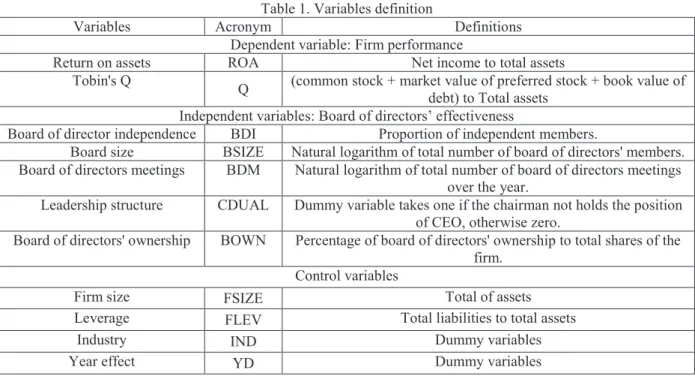
In this study, the firm performance represents the dependent variable, Accounting based measurement such as return on assets (ROA) and market based measurement such as Tobin’s Q (TQ) are used. In terms of independent variables, the study adopts five of the board of directors’ characteristics’ variables characteristics (namely board of director's independence, board size, board meetings, leadership structure and board of director’s ownership), in addition to the firm size, leverage, industry and year effect as control variables. Table 1 presents the operational definitions adopted in the study.
Table 1. Variables definition
Variables Acronym Definitions
Dependent variable: Firm performance
Return on assets ROA Net income to total assets
Tobin's Q Q (common stock + market value of preferred stock + book value of
debt) to Total assets Independent variables: Board of directors’ effectiveness
Board of director independence BDI Proportion of independent members.
Board size BSIZE Natural logarithm of total number of board of directors' members.
Board of directors meetings BDM Natural logarithm of total number of board of directors meetings
over the year.
Leadership structure CDUAL Dummy variable takes one if the chairman not holds the position
of CEO, otherwise zero.
Board of directors' ownership BOWN Percentage of board of directors' ownership to total shares of the
firm. Control variables
Firm size FSIZE Total of assets
Leverage FLEV Total liabilities to total assets
Industry IND Dummy variables
Year effect YD Dummy variables
3.3 Research Model
The study uses the panel data approach as it eliminates unobservable heterogeneity that different firms in the sample data could present, has less collinearity among the variables and a better measurement than pure cross section or pure time series data (Gujarati, 2009). The model used is as follows:
(1)
Where: FP refers to the firm performance which represents the dependent variable, and measured by ROA and Tobin's Q. The board of directors’ characteristics includes the following variables: Directors independence (BDI), Board size (BSIZE), Board meetings (BDM), leadership structure (CDUAL) and Board of director’s ownership (BOWN). Control variables are represented by firm size (FSIZE), leverage (FLEV), Industry (IND) and year effect (YD).
4. Results
4.1 Descriptive Analysis
In this study, the ROA and Tobin’s Q were used as measures for firm performance. The descriptive analysis on firm performance measures of the sample firms are depicted in Table 2 below. The maximum value of ROA is close to (84%) whereas the lowest value is close to (-44) with mean of (1.75%) for the overall sample. With regard to Tobin’s Q, the maximum value of Tobin’s Q is close to (4.67) whereas the lowest value is close to (0.11). The mean of (1.21) and this means that the firms’ performance is good. Regarding board of directors’ variables; the average board independence value is (0.53) which is compiled to JCGC recommendations that at least one third of the board members are independent members. This finding is higher than the result of Marashdeh (2014) which used the data from 2002-2010. Therefore, it seems that Jordanian firms became more committed to corporate governance rules after the issuance of corporate governance code in 2009. The average board size is (8,06) members approximately with a minimum of three and a maximum of thirteen for the whole sample, and this finding supports previous work done in Jordan (Alwshah, 2009; Idris, 2012; Zedan & Abu Nassar, 2014).
According to JCGC, the board of directors shall have meeting at least six times in a year. With a minimum of three and a maximum of thirteen for the whole sample, the study found that the average board meetings is (7.40) per year and this result is comparable with the JCGC recommendations which state that the board of directors should meet at least six times per year. Regarding the leadership structure, the mean is (0.63) which means that (63%) of the sample firms do separate the positions of CEO and chairman of the board of directors. This finding is higher and better than that of Marashdeh (2014) and Al Daoud, Ismail, and Lode (2015). In terms of board of director's ownership, (46 %) of firms’ equity is on the board of directors’ members' hands.
Jordanian firms’ size ranges from a minimum of (469848) million to the maximum of (1765784380) million with an average of (71462430) million Jordanian Dinar. Also, the average firms’ leverage (FLEV) is around (0.35%).
Table 2. Descriptive analysis
Variables Mean Maximum Minimum Std. D Skewness Kurtosis
ROA 1.75 84 -44 10.14 -0.35 2.44 TQ 1.21 5 0.11 0.67 1.42 2.05 BDI 0.37 1 0 0.17 0.83 0.18 BSIZE 8.06 13 3 2.22 0.30 -0.47 BDM 7.40 23 5 1.84 0.97 0.39 CDUAL 0.63 1 0 0.48 -0.53 -1.73 BOWN 0.46 42 0 0.28 0.10 -1.02 FSIZE 71462430 1765784380 469848 185668841.97 5.17 30.82 FLEV 0.35 2 0 0.25 0.88 0.33 4.2 Diagnostic Tests
Since multivariate regression is used to test the hypotheses, assumptions of normality, multicollinearity, homoscedasticity and autocorrelation are also tested.
Regarding normality, the study adopted the Skewness and Kurtosis tests. Data is considered to be normal if the standard skewness is within ±1.96 and standard kurtosis is ± 3 (Haniffa & Hudaib, 2006). As shown in Table 2, the skewness results in the acceptable range of (± 1.96) except for the firm size (5.17) which exceeds the range of (± 1.96). This result is confirmed by the standard kurtosis statistics, where the results in the range of ±3 except for the firm size (30.82) which exceeds the range of (±3). When the firm size violates the normality assumption, data transformations steps are undertaken.
The multicollinearity is existing if the correlation between two independent variables is more than 0.90 (Hair, Black, Babin, & Anderson, 2009). In this study, in addition to correlation matrix, the variance inflation factor (VIF) is used to detect the multicollinearity. Generally, if the VIF > 10 this indicates that there is high level of multicollinearity (Gujarati, 2009). As shown in Table 3, there is no multicollinearity problem.
Table 3. correlation matrix and VIF results
ROA TQ BDI BSIZE BDM CDUAL BOWN FSIZE FLEV VIF
ROA 1 TQ .177** 1 BDI -.087* -.015 1 1.17 BSIZE .115** .035 .235** 1 1.31 BDM -.057 -.010 .061 .039 1 1.03 CDUAL -.106** -.072 .159** -.024 -.045 1 1.04 BOWN .162** .080 -.180** .038 -.004 -.042 1 1.07 FSIZE .345** -.014 -.047 .388** .080* -.009 -.017 1 1.32 FLEV -.240** -.032 .001 -.001 .138** .086* -.151** .261** 1 1.14
**. Correlation is significant at the 0.01 level. *. Correlation is significant at the 0.05 level.
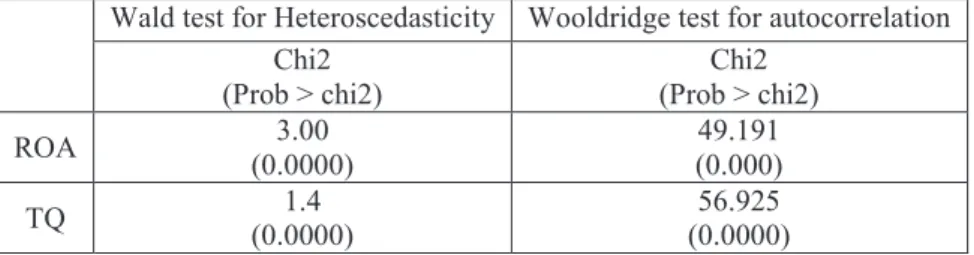
To check the Heteroscedasticity the Modified Wald test was used. The results of the Modified Wald test indicated that there is a problem of Heteroscedasticity. Meanwhile, the Wooldridge test was conducted to check whether there is an autocorrelation issue in the data. The finding indicated that the model suffers from autocorrelation issue. Therefore, the remedy for heteroscedasticity and autocorrelation is to use the cluster robust standard errors as suggested by Wooldridge (2012) and Hoechle (2007).
Table 4. check Heteroscedasticity and Autocorrelation
Wald test for Heteroscedasticity Wooldridge test for autocorrelation Chi2 (Prob > chi2) Chi2 (Prob > chi2) ROA (0.0000) 3.00 (0.000) 49.191 TQ (0.0000) 1.4 (0.0000) 56.925
4.3 Choosing the Appropriate Regression Model for Panel Data
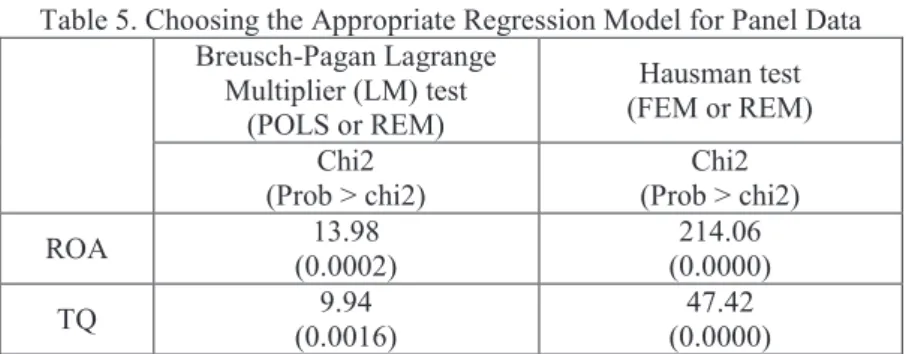
The Breusch-Pagan Lagrange Multiplier (LM) test has been used to choose between the REM and POLS. If the p-value is less than 0.05, the REM is more appropriate than the POLS.
Table 5. Choosing the Appropriate Regression Model for Panel Data Breusch-Pagan Lagrange Multiplier (LM) test (POLS or REM) Hausman test (FEM or REM) Chi2 (Prob > chi2) Chi2 (Prob > chi2) ROA (0.0002) 13.98 (0.0000) 214.06 TQ (0.0016) 9.94 (0.0000) 47.42
It’s clear from Table 5 that the (P-value < 0.05). Thus, the null hypothesis is rejected, and the REM is more appropriate than POLS regression. In this case, the study should have another test such as (Hausman test) to choose between the REM and FEM models. According to Hausman test, if the null hypothesis is rejected the FEM model is more appropriate than REM model. As shown in Table 5, the result of Hausman test indicates that the P-value is significant (P-value < 0.05). Thus, the null hypothesis is rejected, and the fixed effect model is more appropriate for this study.
5. Regression Results
Fixed-effects regression model is employed in this study as recommended by Hausman test's result. The F-statistic of the regression model, measuring the explanatory power of the study model and its F-statistical significance in testing, is statistically significant at p < 0.01, which indicates goodness of fit in the regression for ROA, and Tobin’s Q.
Table 6 shows that the board of directors’ independence has a strongly positive relationship with the ROA at level of 1%. The positive relationship means that the directors with greater independence enhance firm performance. Board size has a negative significant relationship at level of 5%, which means that the increase in board size causes the decrease of firm performance. The finding supports the previous studies (Akpan, 2015; Britton & Waterston, 2006; Darko, Aribi, Uzonwanne, Eweje, & Eweje, 2016; Guo & Kga, 2012; Haniffa & Hudaib, 2006; S et al., 2013; Switzer & Tang, 2009; Yermark, 1996) which indicate that the larger boards are not effective as they tend to be symbolic instead of being a part of the actual management process.
Table 6. The effect of board of directors’ characteristics on ROA
Variables Coefficients P-value
Constant 6.200 0.0017*** BDI 0.733 0.0000*** BSIZE -0.285 0.0284** BDM -0.188 0.1492 CDUAL -0.651 0.4008 BOWN 1.265 0.3342 FSIZE 1.788 0.0000*** FLEV -5.825 0.0000*** Adjusted R2 0.468226 F-statistic 39.341***
However, the findings do not reveal a significant link between the board of directors meeting (BDM), leadership structure (CDUAL) and firm performance as measured by ROA. The coefficient signs of these variables are inconsistent with expectations. Finally, the relationship between board of directors’ ownership and ROA is positive but insignificant.
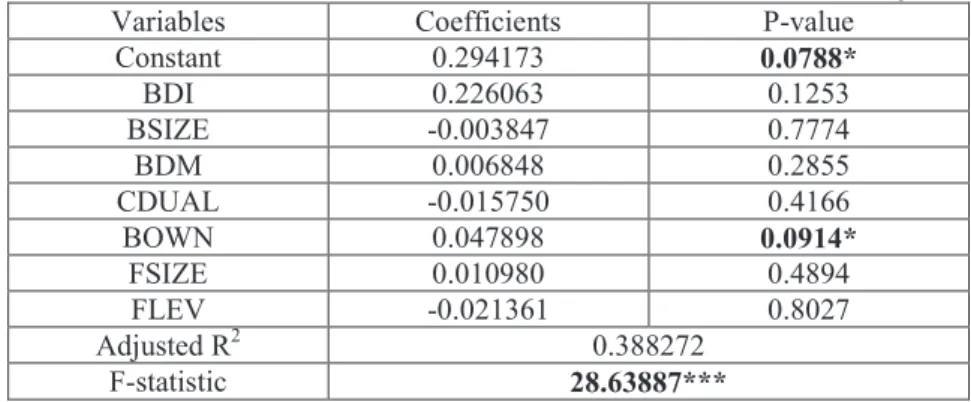
Table 7 presents the regression model with Tobin’s Q as the dependent variable. With Tobin’s q, Board independence has the same direction sign as the previous model (ROA) but insignificant. Board size is shown to have a negative and insignificant effect on Tobin’s Q. In terms of board meetings, Table 5 shows a direction opposite to accounting performance measure (ROA), the finding indicates a positive relationship between board meetings and Tobin's Q but also is not significant (P-value= (02855). The positive result is confirmed by the previous studies’ findings (Brick & Chidambaran, 2007; Ntim & Osei, 2011; Tong et al., 2013) which found that the frequency of board meetings as a monitoring means is positively associated with performance especially in the case of lack of experiences in management and supervising.
Leadership structure has the same results, where the relationship with Tobin’s Q is insignificant and negative. In terms of board of directors' ownership the proportion of outstanding shares held by the directors has a positive and a significant influence on Tobin’s Q at the level of 10%. The positive results mean that the increase in directors' ownership enhances the performance in Jordanian listed firms. The result is consistent with the previous studies (Bhagat & Bolton, 2009; Kapopoulos & Lazaretou, 2007; Liang, 2009; Marashdeh, 2014)
which found a positive relationship between the directors ownership and firm performance. Table 7. The effect of board of directors’ characteristics on Tobin's Q
Variables Coefficients P-value
Constant 0.294173 0.0788* BDI 0.226063 0.1253 BSIZE -0.003847 0.7774 BDM 0.006848 0.2855 CDUAL -0.015750 0.4166 BOWN 0.047898 0.0914* FSIZE 0.010980 0.4894 FLEV -0.021361 0.8027 Adjusted R2 0.388272 F-statistic 28.63887***
The findings of this study with respect to the relationship between the control variables and firm performance differ according to the performance measures (ROA and TQ) used. In this research, total assets were used as a proxy to measure firm size. It was found that ROA and TQ have a positive direction with a high level of significance with ROA. The positive sign indicates that firms with big total assets have better performance. The finding is consistent with (Marashdeh, 2014), who argued that larger firms undertake broader activities, creation new sources and improve the performance in Jordanian firms.
Leverage was used as a control variable in this research and was calculated as the total liabilities divided by the total assets. The findings show a negative and statistically significant effect on ROA and a negative insignificant effect with TQ. This indicates that a higher level of debt leads to a decrease in firm performance. Lastly, time dummies and industry dummies were also used as control variables. Therefore, where the fixed effect model was used, the industry variable was omitted because it is a time-invariant variable (Park, 2009; Ren, 2014); however, its effect was controlled.
5.1 Results Discussion
The first hypothesis (H1) proposed the prediction of positive relationship between the directors’ independence and firm performance. The coefficients sign is consistent with the expectations. The findings revealed that there is a positive significant influence on ROA, but insignificant with TQ. The positive results are in the line with the agency theory’s perspective, which holds that the presence of a larger proportion of independent directors in the board adds value to the firm by providing the firm with independent decisions and judgments. In addition, the finding is consistent with the resource dependence theory, where the existence of outsiders on the board leads to the entering of new information, skills, and suppliers and enhances the gaining to vital sources (Hillman & Dalziel, 2003). This finding is consistent with the previous studies (Coles et al., 2012; Duchin et al., 2010; S et al., 2013) which found that the independent directors have a positive effect on firm performance.
The second hypothesis suggested that there is a negative relationship between board size and performance. The findings show that there is a significant negative relationship between board size and ROA, while it's insignificant with TQ. The coefficient’s sign is consistent with the expectations. The result of this study is in the line with the agency theory’s perspective, where smaller boards are more likely to reach consensus and allow members to engage in genuine debate and interaction but the large boards can make coordination and decision making more complex and harder and reduce the efficiency and performance (Chiang, 2005; Fama & Jensen, 1983b). In the small boards the shorter communication distance between members will help increase the efficiency of the board's decision making (Guest, 2009). The negative finding supports the results of (Akpan, 2015; Britton & Waterston, 2006; Darko et al., 2016; Guo & Kga, 2012; Haniffa & Hudaib, 2006; S et al., 2013; Switzer & Tang, 2009; Yermark, 1996) who indicate that the larger boards are not effective as they tend to be symbolic instead of being a part of the actual management process.
The board of directors’ meetings represents the third hypothesis; H3 suggested that the frequency of board of directors’ meetings has a positive impact on performance. The finding shows that there is a positive insignificant relationship with ROA but it’s negative with TQ. The positive finding is in the line with the agency theory’s perspective, whereas the major role of board of directors is management monitoring to dilute agency problems, while the characteristics of board of directors could appear when board meets regularly which leads to the improvement of the board's performance. The positive result is confirmed by the previous studies’ findings (Brick & Chidambaran, 2007; Ntim & Osei, 2011; Tong et al., 2013) which found that the frequency of board meetings as a monitoring means is positively associated with performance especially in the case of lack of experiences in management and supervising. The interpretation for the negative impact is that frequent meetings need more expenses such as the costs related to board meetings, including managerial time, travel expenses, hotel accommodation, and directors' meeting fees.
The fourth hypothesis suggests a positive relationship between the practice of separating leadership role and firm performance. However, the findings of this study reveal that there is no statistical significant relationship between the leadership structure and firm performance. The findings imply that there is no notable difference in the performance between firms that follow duality and those that separate the role of the CEO and the chairman. Therefore, the finding of this study supports previous work done by other researchers such as (Mustapa, 2013) who found that there is no relationship between the leadership structure and firm’s performance.
The last hypothesis examined the effect of the directors’ ownership on firm performance and suggests a positive relationship; the finding indicated that there is an insignificant positive relationship with (ROA), while the relationship is significant at level of 10% with (TQ). The positive results mean that the increase in directors' ownership enhances the performance in Jordanian listed firms. Some previous studies also found a positive relationship between board of directors' ownership and firm performance (Bhagat & Bolton, 2009; Kapopoulos & Lazaretou, 2007; Liang, 2009; Marashdeh, 2014) the studies found that a positive relationship between the directors ownership and firm performance indicates that owning shares aligns the interests of managers and external (non-executive) shareholders, resulting in a positive effect in performance.
6. Conclusion
This paper examined the relationship between board of directors' characteristics variables (namely board of directors’ independence, board size, board meetings, leadership structure and board of director’s ownership) and two corporate performance measures, namely, market (Tobin’s Q) and accounting (ROA) returns. The study is motivated by the gap in the existing literature and the limited evidence concerning the developing countries, specifically in Jordan. We demonstrated a mixed result in terms of the impact of board of directors' characteristics on firm performance. In general, the results are in the line with the agency theory’s perspective especially in terms of board independence, board size and board of directors’ ownership. Also, the results are consistent with the previous studies.
Finally, the findings of this study indicate that the effectiveness of board of directors of Jordanian listed firms on firm performance is sensitive to the measures of performance. So, the results are different according to firm performance measure. Future studies may consider other mechanisms of corporate governance, such as ownership structure and disclosure and transparency. Additionally, the moderating variables such as directors' demographic characteristics and family control should be considered.
References
Abed, S., Al-Attar, A., & Suwaidan, M. (2012). Corporate Governance And Earnings Management: Jordanian Evidence. International Business Research, 5(1), 216.
Achim, M.-V., Borlea, S.-N., & Mare, C. (2016). Corporate Governance And Business Performance: Evidence For The Romanian Economy. Journal of Business Economics and Management, 17(3), 458-474.
Aduda, J., Chogii, R., & Magutu, P. O. (2013). An Empirical Test Of Competing Corporate Governance Theories On The Performance Of Firms Listed At The Nairobi Securities Exchange. European Scientific Journal, 9(13), 107-137.
Akbar, A. (2015). The Role Of Corporate Governance Mechanism In Optimizing Firm Performance: A Conceptual Model For Corporate Sector Of Pakistan. Journal of Asian Business Strategy, 5(6), 109-115. Akpan, E. O. (2015). Corporate Board Meetings And Company Performance: Empirical Evidence From
Nigerian Quoted Companies. Global Journal of Commerce & Management Perspective, 4(1), 75-82. Al-Kassar, T. A., & Al-Nidawiy, M. A. (2014). The Role Of Corporate Governance And Its Impact On The
Share Price Of Industrial Corporations Listed On The Amman Stock Exchange. European Journal of Accounting Auditing and Finance Research, 2(6), 106-123.
Al-Matari, E. M., Al-Swidi, A. K., & Fadzil, F. H. B. (2014). The Effect of Board of Directors Characteristics, Audit Committee Characteristics and Executive Committee Characteristics on Firm Performance in Oman: An Empirical Study. Asian Social Science, 10(11), 149.
Al Daoud, K. A., Ismail, K. N. I. K., & Lode, N. A. (2015). The Impact of Internal Corporate Governance on the Timeliness of Financial Reports of Jordanian Firms: Evidence using Audit and Management Report Lags. Mediterranean Journal of Social Sciences, 6(1), 430.
Al Ramahi, N., Alaboud, E., Owais, W., AlRefae, K., & Shahwan, Y. (2014). The Results of Applying the Principles of Corporate Governance in Corporations Listed on the First Market in the Amman Stock Exchange. Research Journal of Finance and Accounting, 5(14), 41-53.
Albrecht, W. S., Albrecht, C. C., & Albrecht, C. O. (2004). Fraud and Corporate Executives: Agency, Stewardship and Broken Trust. Journal of Forensic Accounting, V, 109-130.
Almasarwah, A. K. (2015). Earnings Management And Its Relationship With Corporate Governance Mechanisms In Jordanian Industrial Firms. (PhD Thesis), Loughborough University.
And Financial Decisions Of Firms: Evidence From Jordan. (PhD thesis), University of Hull.
Amran, A., Ishak, M. S., Zulkafli, A. H., & Nejati, M. (2010). Board structure and extent of corporate governance statement. International Journal of Managerial and Financial Accounting, 2(4), 383-400. Amran, N., & Ayouib, A. (2011). Board Mechanisms and Malaysian Family Companies' Performance. Asian
Journal of Accounting and Governance, 2, 15–26.
Anderson, R., & Reeb, D. (2004). Board Composition: Balancing Family Influence in S&P 500 Firms. Administrative Science, 49(2), 209-237.
Arora, A. (2015). Literature Review Assessing the Relationship between Corporate Governance and Firm Performance. Paper presented at the Compendium of Research Papers of National Conference on Managing tomorrow: Issues and Challenges by DY Patil Institute of Management Studies, Pune.
Arora, A., & Sharma, C. (2016). Corporate Governance And Firm Performance In Developing Countries: Evidence From India. Corporate Governance, 16(2), 420-436.
Bathula, H. (2008). Board Characteristics And Firm Performance: Evidence From New Zealand. (PhD thesis), Auckland University of Technology.
Bhagat, S., & Bolton, B. (2008). Corporate governance and firm performance. Journal of Corporate Finance, 14, 253-273.
Bhagat, S., & Bolton, B. (2009). Corporate Governance and Firm Performance: Recent Evidence.
Bhagat, S., & Bolton, B. (2013). Director Ownership, Governance, And Performance. Journal of Financial and Quantitative Analysis, 48(01), 105-135.
Black, B. S., Jang, H., & Kim, W. (2006). Does Corporate Governance Predict Firms' Market Values? Evidence from Korea. Journal of Law, Economics, and Organization, 22(2), 366-416.
Boonyawat, K. (2013). The Impact of Ownership Structure and Other Corporate Governance Mechanisms on Firm Performance, Accounting Discretions and Investor Perceptions: Evidence from Thailand before and after the Corporate Governance Reforms. (PhD thesis), Durham University.
Boyd, B. K. (1995). Ceo Duality And Firm Performance: A Contingency Model. Strategic Management Journal, 16(4), 301-312.
Brick, I. E., & Chidambaran, N. K. (2007). Board Meetings, Committee Structure, and Firm Performance. Britton, A., & Waterston, C. (2006). Financial Accounting (4th ed.): Prentice Hall, Harlow
Brown, L. D., & Caylor, M. L. (2009). Corporate Governance and Firm Operating Performance. Review of Quantitative Finance and Accounting, 32(2), 129-144.
. The Cadbury Report (1992) Report of the Committee on the Financial Aspects of Corporate Governance. Cheng, S. (2008). Board size and the variability of corporate performance. Journal of Financial Economics 87
(1), 157-176.
Chiang, H. (2005). An Empirical Study of Corporate Governance and Corporate Performance. Journal of American academy of business, 31(1), 122-140.
Coles, J. L., Danielb, N. D., & Naveen, L. (2012). Boards: Does one size fit all? Journal of Financial Economics, 87(2), 329-356.
Daily, C. M., Dalton, D. R., & Cannella, A. A. (2003). Corporate Governance: Decades of Dialogue and Data.
Academy of Management Review. Vol. 28 P. 371–382., P. 371–382.
Dalwai, T. A. R., Basiruddin, R., Abdul Rasid, S. Z., Kakabadse, N., & Fleur, M. (2015). A Critical Review Of Relationship Between Corporate Governance And Firm Performance: GCC Banking Sector Perspective. Corporate Governance: The international journal of business in society, 15(1), 18-30.
Darko, J., Aribi, Z. A., Uzonwanne, G. C., Eweje, G., & Eweje, G. (2016). Corporate Governance: The Impact Of Director And Board Structure, Ownership Structure And Corporate Control On The Performance Of Listed Companies On The Ghana Stock Exchange. Corporate Governance: The international journal of business in society, 16(2).
Desoky, A. M., & Mousa, G. A. (2012). Do Board Ownership and Characteristics Affect on Firm Performance? Evidence from Egypt. Global Advanced Research Journal of Economics, Accounting and Finance, 1(2), 15-32.
Dhamadasa, P., Gamage, P., & Herath, S. K. (2014). Corporate Governance, Board Characteristics and Firm Performance: Evidence from Sri Lanka. South Asian Journal of Management, 21(1), 7-31.
Duchin, R., Matsusaka, J. G., & Ozbas, O. (2010). When are outside directors effective? Journal of Financial Economics, 96(2), 195-214.
Duztas, S. (2008). Corporate Governance: The Effects Of Board Characteristics, Information Technology Maturity And Transparency On Company Performance. (Ph.D Thesis), Yeditepe University.
El-Faitouri, R. (2014). Board of Directors and Tobin’s Q: Evidence from UK Firms. Journal of Finance and Accounting, 2(4), 82-99.
Emile, R., Ragab, A., & Kyaw, S. (2014). The Effect of Corporate Governance on Firm Performance, Evidence from Egypt. Asian Economic and Financial Review, 4(12), 1865-1877.
Fama, E. F., & Jensen, M. C. (1983a). Agency problems and residual claims. Journal of law and Economics, 26(2), 327-349.
Fama, E. F., & Jensen, M. C. (1983b). Separation of ownership and control. Journal of law and Economics, 26(2), 301-325.
Fooladi, M., & Shukor, Z. A. (2012). Board of Directors, Audit Quality and firm performance: Evidence from Malaysia. Paper presented at the National Research & Innovation Conference for Graduate Students in Social Sciences (GS-NRIC 2012), Melaka http://ssrn.com/abstract=2259523
Guest, P. (2009). The Impact of Board Size on Firm Value: Evidence from the UK. The European Journal of Finance, 15(4), 385-404.
Gujarati, D. N. (2009). Basic Econometrics (5th ed.). New York: McGraw-Hill.
Guo, Z., & Kga, U. K. (2012). Corporate Governance And Firm Performance Of Listed Firms In Sri Lanka. Procedia-Social and Behavioral Sciences, 40, 664-667.
Hahn, P. D., & Lasfer, M. (2007). Vanishing Board Meetings: Has Governance Doomed The Board Meeting. London: Cass Business School Research Paper.
Hair, J. F., Black, W. C., Babin, B. J., & Anderson, R. E. (2009). Multivariate Data Analysis (7th ed.). New Jersey: Person Prentic Hall.
Haniffa, R., & Hudaib, M. (2006). Corporate Governance Structure and Performance of Malaysian Listed Companies. Journal of Business Finance & Accounting, 33(7-8), 1034-1062.
Hillman, A. J., & Dalziel, T. (2003). Boards Of Directors And Firm Performance: Integrating Agency And Resource Dependence Perspectives. Academy of Management Review, 28(3), 383-396.
Horner, S. V. (2010). Board Power, CEO Appointments And CEO Duality Academy of Strategic Management Journa, 9(2), 43-58.
Horvath, R., & Spirollari, P. (2012). Do the Board of Directors' Characteristics Influence Firm's Performance? The U.S. Evidence. Prague Economic Papers, 470-486.
Hu, H. W., Tam, O. K., & Tan, M. G.-S. (2010). Internal Governance Mechanisms and Firm Performance in China. Asia Pacific Journal of Management, 27(4), 727-749.
Idris, M. I. I. (2012). The Impact Of Ownership Structure And External Audit On Accruals And Real Activities Earnings Management In Jordan. (PhD ), University of Gloucestershire.
Jaafar, A., & El Shawa, M. (2009). Ownership Concentration, Board Characteristics And Performance: Evidence From Jordan. in Mathew Tsamenyi, Shahzad Uddin (ed.) Accounting in Emerging Economies (Research in Accounting in Emerging Economies) Emerald Group Publishing Limited, 9, 73-95.
JCGC. (2008). Jordanian Corporate Governance Code. Jordan security commission Retrieved 3 February 2015, from http://jsc.gov.jo/library/634365426651890968.pdf
Jensen, M. (1993). The Modern Industrial Revolution, Exit, And The Failure Of Internal Control Systems. The Journal of Finance, 48(3), 831-880.
Jensen, M. C., & Meckling, W. H. (1976). Theory of the firm: managerial behavior, agency costs and ownership structure. Journal of Financial Economics, 3(4), 305-360.
Kajola. (2008). Corporate Governance and Firm Performance: The Case of Nigerian Listed Firms European Journal of Economics, Finance and Administrative Sciences(14), 16-28.
Kapopoulos, P., & Lazaretou, S. (2007). Corporate Ownership Structure And Firm Performance: Evidence From Greek Firms. Corporate Governance: An International Review, 15(2), 144-158.
Khorma, T. (2014). The Myth of the Jordanian Monarchy's Resilience to the Arab Spring: Lack of Genuine Political Reform Undermines Social Base of Monarchy. Retrieved 16 Dec 2016, from https://www.swp-berlin.org/fileadmin/contents/products/comments/2014C33_kor.pdf
La Porta, R., Lopez-de-Silanes, F., Shleifer, A., & Vishny, R. W. (1997). Legal determinants of external finance. The Journal of Finance, 52(3), 1131-1150.
Lasfer, M. (2006). The Interrelationship Between Managerial Ownership and Board Structure. Journal of Business Finance & Accounting, Vol. 33(7-8), pp. 1006-1033.
Liang, F.-M. (2009). Ownership Structure and Firm Performance in an Emerging Market: the Moderating Role of Social Networks. Contemporary Management Research, 5(2), 201-212.
Liu, H., & Fong, M. W. (2010). Board Characteristics Of Medium And Large Chinese Companies. Corporate Governance: The international journal of business in society, 10(2), 163-175.
Liu, Y., Miletkov, M. K., Wei, Z., & Yang, T. (2015). Board Independence And Firm Performance In China. Journal of Corporate Finance, 30, 223-244.
Lutfi, Iramani, R., & MellyzaSilvy. (2014). The role of board of commissioners and transparency in improving bank operational effeciency and profitability. Paper presented at the The 3rd International Conference on Business and Banking Pattaya, Thailand.
Marashdeh, Z. M. S. (2014). The Effect of Corporate Governance on Firm Performance in Jordan. (Ph.D thesis), University of Central Lancashire.
Matar, M., & Nauimat, Z. (2014). The Response of The Boards of Directors In the Distressed Jordanian Public Shareholding Companies to The Risk And Repercussions of The Global Financial Crisis. Jordan Journal of Business Administration, 10(1).
McIntyre, M. L., Murphy, S. A., & Mitchell, P. (2007). The Top Team: Examining Board Composition And Firm Performance. Corporate Governance: The international journal of business in society, 7(5), 547-561. Miller, T., & Triana, M. d. C. (2009). Demographic Diversity In The Boardroom: Mediators Of The Board
Diversity–Firm Performance Relationship. Journal of Management Studies, 46(5), 755-786.
Mura, R. (2006). Firm Performance: Do Non-Executive Directors Have a Mind of Their Own? Evidence from Uk Panel Data. Financial Management, 36(3), 81-112.
Mustapa, I. R. (2013). The Moderating Influence of Organizational Culture and Organizational Capacity on the Association between Corporate Governance and Performance of Malaysian Listed Companies. (PhD Thesis), International Islamic University Malaysia.
Ntim, C. G., & Osei, K. A. (2011). The Impact of Corporate Board Meetings on Corporate Performance in South Africa. African Review of Economics and Finance, 2(2), 83-103.
Omran, M. M., Bolbolc, A., & Fatheldin, A. (2008). Corporate Governance and Firm Performance in Arab Equity Markets: Does Ownership Concentration Matter? International Review of Law and Economics, 28(1), 32-45.
Park, H. M. (2009). Linear Regression Models For Panel Data Using Sas, Stata, Limdep, And Spss. Indiana University.
Ren, Y. (2014). Corporate Governance, Conservatism And Firm Performance: Evidence From China. (PhD thesis), Edith Cowan University.
S, A. O., Olusola, A. G., & Abiodun, O. F. (2013). Relationship Between Corporate Governance And Organizational Performance: Nigerian Listed Organizations Experience. International Journal of Business and Management Invention, 2(9), 1-6.
Sanda, A. U., Garba, T., & Mikailu, A. S. (2011). Board Independence and Firm Financial Performance: Evidence from Nigeria. African Economic Research Consortium.
Shukeri, S. N., Shin, O. W., & Shaari, M. S. (2012). Does Board of Director’s Characteristics Affect Firm Performance? Evidence from Malaysian Public Listed Companies. International Business Research, 5(9), 120-127.
Silva, A. L. C. d., & Leal, R. P. C. (2005). Corporate Governance Index, Firm Valuation and Performance in Brazil. Revista Brasileira de Financ, 3(1), 1–18.
Switzer, L. N., & Tang, M. (2009). The Impact Of Corporate Governance On The Performance Of Us Small-Cap Firms. International Journal of Business, 14(4), 341.
Tong, S., Junarsin, E., & Davidson, W. N. (2013). A Comparison of Chinese State-Owned Enterprise Firm’s Boards and Private Firm’s Boards. Paper presented at the 23rd International Business Research Conference, Melbourne, Australia.
Vafeas, N. (1999). Board meeting frequency and firms performance Journal of Financial Economics, 113-142. Wahba, H., & Zaima, J. (2015). The Joint Effect Of Board Characteristics On Financial Performance: Empirical
Evidence From Egypt. Review of Accounting and Finance, 14(1), 20-40.
Warrad, L., Almahamid, S. M., Slihat, N., & Alnimer, M. (2013). The relationship between ownership concentration and company performance,a case of Jordanian non-financial listed companies. Institute of Interdisciplinary Business Research.
Weir, C., Laing, D., & McKnight, P. J. (2002). Internal And External Governance Mechanisms: Their Impact On The Performance Of Large Uk Public Companies. Journal of Business Finance & Accounting, 29, 579–611. Wu, M.-C., Lin, H.-C., Lin, I.-C., & Lai, C.-F. (2009). The Effects of Corporate Governance on Firm
Performance. working paper.
Yermark, D. (1996). Higher market valuation of companies with a small board of directors. Journal of Financial Economics, 40, 185-221.
Zedan, H. I., & Abu Nassar, M. H. (2014). The Effect of Corporate Governance on Operating Performance of Jordanian Manufacturing Companies: Evidence from Amman Stock Exchange. Dirasat: Administrative Sciences, 41(2), 465-481.
Zureigat, B. N., Fadzil, F. H., & Ismail, S. S. S. (2014). The Relationship between Corporate Governance Mechanisms and Going Concern Evaluation: Evidence from Firms Listed on Amman Stock Exchange. Journal of Public Administration and Governance, 4(4), 100-110.