Submission to the Senate Select Committee Inquiry into the
Future of Work and Workers
Jon Altman a b and Francis Markham b aDeakin University
b The Australian National University
We are pleased to provide some input to the deliberations of the Senate Select Committee on the Future of Work and Workers that is examining the impact of technological and other change on the future of work and workers in Australia. We do so coming from academic backgrounds in economic anthropology and economic geography, respectively; we have both lived and worked in remote Australia, mainly with Indigenous people; and we were and are strong advocates for the now defunct Community Development Employment Projects (CDEP) scheme and for the urgent need to consider Basic Income (BI) options in situations where there is no or very limited mainstream labour market opportunities.
We are not experts in labour force planning or in predicting the impact of artificial intelligence and robotics on future employment prospects. But we are aware that some reputable think tanks, as well as economists from the Department of Industry, Innovation and Science (Edmonds & Bradley, 2015), have made predictions about the decline in paid jobs in a wide range of professions, summarised in books like Tim Dunlop’s recent Why the Future is Workless (2016). We believe there is a risk that mainstream employment will decline as automatable jobs are lost. Even in the best-case scenario in which new jobs replace
automated jobs, there is a risk that the skills and experience that new jobs require will not match those of the unemployed, meaning that a large proportion of the population will be unemployed and unable to be employed in new jobs.
Indeed, this process is already underway. Edmonds & Bradley (2015) suggest that a
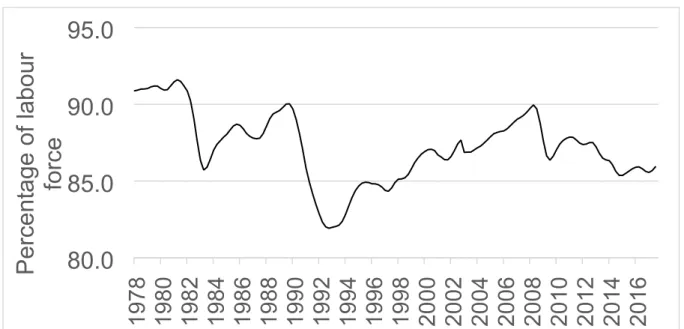
significant number of jobs were automated away over the decade to 2014. Examples abound, for instance the decline in mining jobs due to the automation of mining vehicles in remote Australia. Nationally, official data from the Australian Bureau of Statistics (ABS) suggest that a structural transformation in mainstream labour markets may have occurred. As labour utilisation estimates from the Labour Force Survey show (Figure 1), only 85 per cent of people who want paid employment can get as many hours of work as they would like. This level of labour force utilisation has typically only been associated with recessions and their aftermath. And there is little indication in these data to suggest that the utilisation rate will return to its 2008 peak before the Global Financial Crisis (GFC), let alone the levels seen in the 1970s. Despite the return to normal GDP growth after the GFC, more and more paid employment is part-time, casualised or precarious, with little evidence of labour market tightening (hence wage stagnation). In other words, the post-GFC economic revival has been a ‘workless’ recovery in the sense that labour force utilisation rates have not returned to pre-GFC levels. Put simply, there is reason to believe we are already witnessing a qualitative change in the relationship between economic growth and labour markets, in which economic production and employment are less tightly coupled.
1978
1980
1982
1984
1986
1988
1990
1992
1994
1996
1998
2000
2002
2004
2006
2008
2010
2012
2014
2016
80.0
85.0
90.0
95.0
Percentage
of
labour
force
Figure 1: Labour force utilisation in Australia (total labour force, less the unemployed and underemployed), 1978 – 2017. Source: Labour Force Survey, September 2017.
We set out to briefly address each of the terms of reference for this Inquiry, but from a very particular perspective. We seek to highlight the situation for one section of Australian society, Indigenous peoples, already in deep ‘employment’ difficulty. The causes of Indigenous people’s labour force position are complex, and include historical colonial
processes of exclusion, racism, cultural difference and geographic location – especially when people reside on their legally-recognised ancestral lands in remote Australia. These reasons are predominantly structural and are clearly evident in the remote situations that we focus on, where employment opportunities are few, and so there are insufficient jobs for all adults of working age. In these circumstances, the current policy focus on behavioural modification and work preparation will have limited impact, as it does little to conjure up jobs in remote towns where commercial opportunity can be very limited.
Terms of reference
a. The future earnings, job security, employment status and working patterns of
Australians
If we accept the dire predictions of what some might label ‘automation pessimists’ about the future weakness of Australian labour markets, the future of work has already arrived in remote Indigenous Australia. For this reason, remote Australia might prove an important harbinger of what might occur in non-remote, predominantly non-Indigenous Australia. To that end, we describe the labour market conditions of remote Indigenous Australia.
We have examined 2016 Census data from remote Australia where the dominant institution for providing income support and connecting people with training and employment is the Community Development Programme (CDP), introduced from 1 July 2015. Across 60 administrative regions, the Indigenous employment-to-working-age-population ratio averaged less than 30 per cent. In other words, less than 3 in 10 Indigenous people of working age are in paid employment across the 75 per cent of the continent covered by the CDP scheme. In many CDP regions, the employment-to-working-age-population ratio is
much lower, for example around 13 per cent in CDP Region 23 ‘Alice Springs District NT’. Even these alarmingly low employment rates are likely to be overstated. More than 10 per cent of the persons that the ABS believe are living in CDP regions did not complete either the Indigenous status nor the labour force status question on the census, mostly because they lived in a household that did not return a census form (Markham & Biddle, 2017). This ‘missing population’ – who are not included in our employment-to-population calculation – are likely to be even less attached to labour markets than those who were enumerated by the census.
The abolition of a locally-directed, state-subsidised employment scheme, the Community Development Employment Projects (CDEP), and its replacement with the confusingly named work-for-the-dole unemployment program (CDP), has resulted in the unprecedented
destruction of jobs in remote Australia. At a time when much future focus in discussions about the employment prospects of Indigenous people is framed within the over-arching policy framework of Closing the Gap, in remote Australia the employment gap has widened extraordinarily (see Figure 2). Thousands of CDEP jobs have been replaced with mutual obligations within the welfare system, with its attendant monitoring of activity requirements and penalties for non-compliance. Separate pieces of research by both authors show that this trend in Indigenous labour underutilisation, coupled with inadequate social security
payments, has resulted in escalating poverty rates in remote Australia (Altman, 2017a; Markham & Biddle, 2018).
2006
2011
2016
0%
10%
20%
30%
40%
50%
60%
70%
80%
90%
Indigenous Remote Non-Indigenous Remote Indigenous Non-Remote Non-Indigenous Non-Remote
Employment-to-population
ratio
, 15-64
year
olds
Figure 2: Indigenous and non-Indigenous employment-to-working-age-population ratios in remote and non-remote Australia. Source: 2016 Census of Population and Housing.
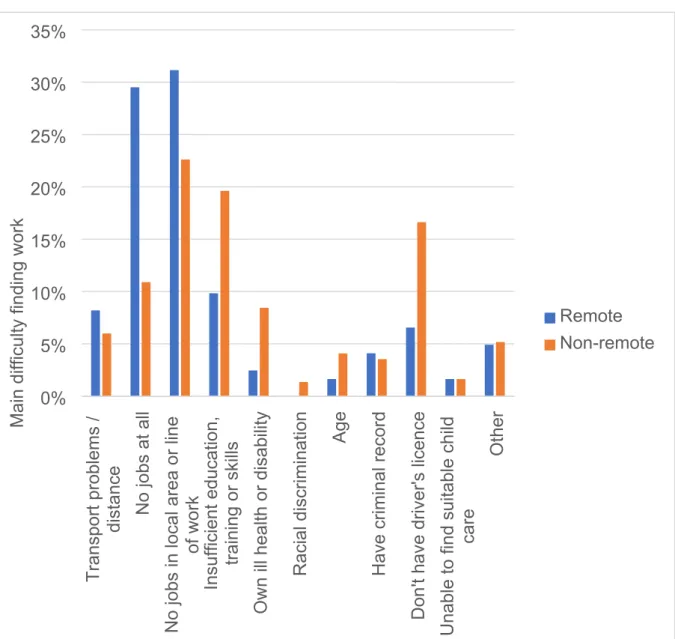
In remote areas, Indigenous underemployment is largely a result of weak local labour markets. As Figure 3 shows, 69 per cent of Indigenous jobseekers in remote Australia stated that their main difficulty finding work is that there are ‘no jobs in local area or line of work’ (31%), that there are just ‘no jobs at all’ (30%), or that they have problems getting transport to jobs (8%). Less than 10 per cent of remote Indigenous job-seekers felt that a lack of training or skills was stopping them from finding employment, throwing doubt on the
conventional and decades-long employment policy focuses on building human capital. Remote Indigenous labour markets are a harbinger of the kind of conditions that we may expect to see nationally if predictions of automation come to pass.
Transport problems / distance No jobs at all No jobs in local area or line of work Insufficient education, training or skills Own ill health or disability Racial discrimination Age Have criminal record Don't have driver's licence Unable to find suitable child care Other 0% 5% 10% 15% 20% 25% 30% 35% Remote Non-remote Main difficulty finding work
Figure 3: Main difficulty finding work for Aboriginal and Torres Strait Islander people, by remoteness. Source: NATSISS 2014-15.
Put simply, employment conditions for remote Indigenous people are dire. In remote Australia, only 30 per cent of the working age Indigenous population is in paid work, and a lack of local jobs is the most important barrier preventing the unemployed from finding paid work. Experimentation with employment programs like CDP is premised on possibility of formal employment for all, and therefore enforces punitive incentives to enter a labour market that is either non-existent or insufficiently developed to accommodate a significant number of the unemployed. If this is the future of work in Australia, it is a bleak future indeed.
b. The different impact of that change on Australians, particularly on regional Australians, depending on their demographic and geographic characteristics
While Aboriginal and Torres Strait Islander people living in remote areas are already in an extremely disadvantaged labour force situation, they are also more likely to be adversely affected by future changes to the workforce. According to figures from the 2014–15 National Aboriginal and Torres Strait Islander Social Survey (NATSISS) and the 2014 General Social Survey (GSS), more than one-in-three Indigenous employees are casually employed,
compared to one-in-four non-Indigenous Australians (Figure 4). While casual employment may be considered better than unemployment, casual work is precarious. Because casual employees do not have the right to notice of termination, protection from unfair dismal, nor guaranteed hours of work, they are vulnerable to be the first to have their employment terminated or their working hours reduced in times of industrial restructuring.
Non-remote Indigenous Remote Indigenous Non-remote Non-Indigenous Remote Non-Indigenous 0% 5% 10% 15% 20% 25% 30% 35% 40% Casual employment among those employed
Figure 4: Casual employment rates among Indigenous and non-Indigenous employed persons. Sources: NATSISS 2014-15, GSS 2014 (non-Indigenous sample).
Furthermore, Indigenous workers are more likely than non-Indigenous workers to work in occupations that are vulnerable to automation. We have applied estimates of the probability that any job will be automated to 2016 census data. These estimates are calculated using Frey and Osborne’s (2013) measure of the automation susceptibility of occupations in the United States, as translated to the Australian and New Zealand Standard Classification of
Occupations (ANZSCO) by Edmonds & Bradley (2015) for the Department of Industry, Innovation and Science. These estimates should not necessarily be interpreted in terms of the disappearance and non-replacement of jobs, but rather the likelihood that occupations will become redundant, meaning that workers will at the very least need to find work in other occupations where they may lack experience, expertise or credentials.
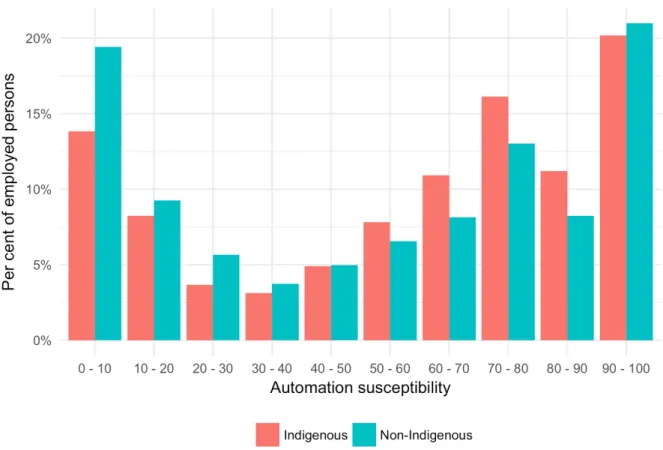
Applying Edmonds & Bradley (2015) susceptibility scores to the 2016 census data, we find that Indigenous workers are more likely to be working in occupations with a high automation susceptibility than non-Indigenous workers (Figure 5). While non-Indigenous workers are slightly more likely to be employed in occupations with an extremely high automation susceptibility, Indigenous workers are overly represented in occupations with an automation susceptibility of 50 per cent or more. Indigenous workers are particularly underrepresented in
the least automatable occupations, those with an automation susceptibility of less than 10 per cent.
Figure 5: Estimated automation susceptibility of employed persons by Indigenous status. Source: Estimates from Edmonds & Bradley (2015) applied to the 2016 Census of Population and Housing.
When further disaggregated by sex and remoteness, we find that Indigenous men are particularly exposed to automation-related unemployment. Following Frey and Osborne (2013), we define jobs with an automation susceptibility of 70 or more as being at high-risk of automation. Figure 6 shows that in urban and regional areas, more than 50 per cent of jobs held by Indigenous men are at high risk of automation. Automation risk for Indigenous women is much lower, slightly higher than but still comparable to that facing non-Indigenous workers. While Indigenous men face greater automation risk than Indigenous women, for non-Indigenous people women are at greater risk than men. For both populations, automation risks are greater in regional areas and smaller in remote and very remote areas.
Figure 6: Estimated automation susceptibility of employed persons by Indigenous status, sex and remoteness. Source: Estimates from Edmonds & Bradley (2015) applied to the 2016 Census of Population and Housing using the 2011 ABS remoteness geography.
In summary, Aboriginal and Torres Strait Islander people are likely to be disproportionately affected by automation-related impacts on employment. This is both because they are more likely to be
employed precariously under casual contracts, and because they are more likely to work in jobs with a high automation susceptibility. Automation susceptibility is particularly acute for Indigenous men in urban and regional areas.
c. The wider effects of that change on inequality, the economy, government and society
The analyses above suggest that automation-led unemployment is likely to widen existing inequalities in Australian society. While we have illustrated this with respect to the
Indigenous population – an already economically disadvantaged group who are likely to be disproportionality effected by changes to the nature of work – we expect that automation will increase inequalities between other social classes. Increased inequality is, by definition, socially divisive. Widening inequality will weaken social cohesion and lead to reduced socioeconomic outcomes, as has been amply demonstrated in a growing body of research (e.g. Dabla-Norris et al. 2015; Pickett & Wilkinson 2015; Wilkinson & Pickett 2009). If widespread political discontent is to be avoided, punitive approaches to social security for the unemployed must be minimised. We urgently call for a return to social security policy which treats income support as a citizenship entitlement for those unable to find suitable work in a local labour market, rather than as a tool of behavioural management and punishment.
d. The adequacy of Australia’s laws, including industrial relations laws and regulations, policies and institutions to prepare Australians for that change;
We have been truly surprised that Australia’s regulatory laws have allowed the forced labour of jobless people for 25 hours a week, spread over five days a week at below minimum award rates under the Community Development Programme. This has occurred at a time when Australia has been at the forefront of nations campaigning globally with Andrew Forrest’s Walk Free Foundation against modern slavery globally. It exposes the jobless to a double jeopardy as not only are they required to work for the dole every day of the working week for NewStart Allowance equivalents (about $260 a week), but they are also diverted from
undertaking more productive work e.g. in self-provisioning during this period of enforced work (Altman 2017b). And any failure to turn up for make-work is penalised which explains in part the deepening poverty in CDP regions (Altman, 2017). This damaging approach should cease immediately and negative lessons from policy experimentation on vulnerable populations learnt. We can only hope that this punitive and unproductive approach will not be countenanced for jobless people if unemployment escalates in the future; and fear what the impact of such a punitive approach might be on the social fabric of the nation if, as predicted by some, formal unemployment nationally reaches the levels being experienced in remote Indigenous Australia today. The disappearance of abundant secure and well-paying jobs requires a rethinking of social security policy goals. The state may be required to intervene very differently than at present if extreme populism or even civil unrest are to be avoided. In this context, the removal of welfare conditionality, and the trialling of new approaches like a universal basic income and paid job guarantees may be required.
e. International efforts to address that change
Experiments with moving away from welfare conditionality are taking place globally. There are Basic Income pilots and experiments being undertaken in many countries, the most recent of which is Scotland. We are regularly updated about these initiatives and their evaluations via the Basic Income Earth Network (BIEN) see http://basicincome.org/. As with many areas requiring innovative policy development, Australia is not moving fast enough. At once BIEN reports that Australia is one of the few countries globally that categorically refuses to either engage in policy debate about UBI or else actively opposes the idea possibly owing to union capture. We believe that it important that some form of Basic Income controlled experiments are established in Australia as soon as possible. We highlight the special need of remote Australia, where jobs are fewest and where historically the CDEP scheme operated as a form of Basic Income in the most remote and difficult circumstances with no mainstream
employment prospects at all. With hindsight, the work creation and income supplementation achievements of the CDEP scheme are outcomes that not only far surpass those from any program instituted since its abolition but that also might prove worthy goals for the future.
f. Any related matters.
Alternative approaches are needed to ameliorate the impact of employment losses on workers and communities. In remote Australia, that alternative might see people productively
engaging in a suite of activities that will include full- or part-time seasonal employment, but might also include non-market activities, cottage industries, art and cultural production, and
the utilisation of surplus labour for urgent national projects like carbon farming and the delivery of other environmental services. We have referred to such engagement as ‘the hybrid economy’, a form of plurality that creatively combines market, state and customary sectors to enhance wellbeing and access to cash and non-cash (imputed) income. Such possibilities are especially pertinent for remote Australia where most land is owned by Indigenous Australians under land rights or native title laws. Just as the future of work is not going to replicate the past, future development in remote Australia is unlikely to replicate what has happened historically in temperate, densely-populated parts of Australia. If collapsing labour markets rapidly reduce livelihood options in non-remote Australia and for all Australians, then the suite of possibilities enabled by adequate unconditional income support and supplemented by a diversity of productive activities might prove vitally important for economic survival. We want to end by commending the language of this Inquiry, in that is looking at the future of work in broad terms, rather than just the future of paid employment. We suspect that during the Inquiry there will be conflation between these two concepts. The bottom line is that there is a quantified risk that paid employment will decline in future. As a risk
management strategy, it is imperative that Australia explores ways to ensure that people can access meaningful activity, support livelihoods, prevent inequality from increasing
dramatically and thereby ensure that there is sufficient cohesion to safeguard societal viability.
References
Altman, J. 2017a. ‘Deepening Indigenous poverty in the Northern Territory’. Land Right
News - Northern Edition, October, 18–19.
Altman, J. 2017b. ‘Modern slavery in remote Australia?’. Arena Magazine, No. 150, 12–15. Dabla-Norris E, Kochhar K, Suphaphiphat N, Ricka F, & Tsounta E. 2015. Causes and
consequences of income inequality: a global perspective, International Monetary Fund,
Washington, DC.
http://www.imf.org/en/Publications/Staff-Discussion- Notes/Issues/2016/12/31/Causes-and-Consequences-of-Income-Inequality-A-Global-Perspective-42986
Dunlop, T. 2016. Why the Future is Workless, New South Books, Sydney.
Edmonds, D. & Bradley, T. 2015. ‘Mechanical boon: will automation advance Australia?’ Research Paper 7/2015, Department of Industry, Innovation and Science Office of the Chief Economist, Canberra. http://industry.gov.au/Office-of-the-Chief-Economist/Research-Papers/Documents/Research-Paper-7-Mechanical-boon.pdf
Frey C. & Osborne, M. 2013. ‘The future of employment: how susceptible are jobs to computerisation’, Oxford Martin School, Oxford.
http://www.oxfordmartin.ox.ac.uk/downloads/academic/ The_Future_of_Employment.pdf
Markham, F. & Biddle, N. 2017. ‘Indigenous Population change in the 2016 Census’. 2016 Census Paper No. 1, Centre for Aboriginal Economic Policy Research, The Australian National University, Canberra. http://caepr.cass.anu.edu.au/research/publications/2016-census-papers
Markham, F. & Biddle, N. 2018. ‘Income, Poverty and Inequality’. 2016 Census Paper No. 2, Centre for Aboriginal Economic Policy Research, The Australian National University,
Canberra. http://caepr.cass.anu.edu.au/research/publications/2016-census-papers
Pickett, K. & Wilkinson, R. 2015. Income inequality and health: a causal review. Social
Science & Medicine 128 (Supplement C): 316–326.
Wilkinson R. & Pickett K. 2009. The spirit level: Why greater equality makes societies stronger, Bloomsbury Press, New York.