This chapter outlines the theoretical assumptions underlying the notion of Theme in the present study. Halliday (1994) hypothesises that the basic organising principle of language is ‘functional’, and he proposes three ‘metafunctions’ to account for its organisation: an ideational, a textual and an interpersonal metafunction. Halliday further contends that looking at actual texts as the instantiation of language through the prism of the meta-functions will help us understand the way in which meaning is made through language. The focus of this study is the textual metafunction, and the way in which certain interpersonal meanings, i.e. meanings that belong to the interpersonal metafunction, are embedded within the choice of Theme in a clause complex (the ‘sentence’ of traditional grammar). The study aims to discover whether selected Themes in memos, letters and reports reveal both textual and interpersonal features which writers select to convey the intended meaning of a text.
In particular the study is concerned with the following questions relating to the definition, identification, constituent features and multiple functions performed by Theme. The general question is:
1) What function does Theme perform in written workplace texts?
Before attempting to answer this general question, it is clear that more specific questions need to be addressed, including:
2) Where should the boundary between Theme and Rheme be drawn? 3) What, if any, are the major issues related to establishing this boundary? 4) How can different Theme choices be labelled?
5) What are the constituent elements of Theme and what function does each perform? As the chapter develops it becomes clear that even more specific questions require answers such as:
6) How does extended Theme function in the texts?
7) What evidence is there that the choice of Theme is genre-related?
8) What linguistic resources are used to realise and construe interpersonal realisations through choice of Theme?
Research by Davies (1988, 1994, 1997), Martin (1992b), Berry (1995, 1996), Thompson (1994, 1996), Fries (1995a) and others are cited to support the view that the choice of Theme in English workplace texts influences not only the structure of a text, but also meanings of an interpersonal nature.
In Section 3.1, the theoretical framework is established by an exposition of the way in which Theme is understood in this study. The concept of metafunction is outlined and the major features of textual metafunction are introduced. The function of Theme in text, especially its role as a device for structuring text, is then discussed. The various ways in which scholars have defined and identified Theme is considered in Section 3.2. In this section the position adopted in the present study, especially in relation to the decision to consider everything up to and including the Subject of an independent clause as Theme, is outlined. A description of the unit of analysis applied to the data in the present study is provided in Section 3.3. The way in which the different elements constituting Theme are treated, with special reference to the choice of textual, interpersonal and topical Theme, are discussed in Section 3.4. In addition, factors related to the Subject, an obligatory part of Theme, are reviewed. The arguments for including marked Theme as part of extended Theme, and for believing that extended Theme occurs at important stages in the text, are presented in Section 3.5. Finally, a brief summary of the key arguments and concerns related to the definition and identification of Theme is provided in Section 3.6.
3.1 Overview of Theme 3.1.1 Three metafunctions
SFL views language “not as a set of structures but as a network of SYSTEMS, or inter-related sets of options for making meaning” (Halliday, 1994:15, upper case in original). In order to account for this meaning-making potential of language, as introduced in Section 2.7.2, Halliday (1994) proposes three metafunctions at a lexico-grammatical level:
ideational – “construing a model of experience” interpersonal – “enacting social relationships” textual – “creating relevance to context”
(Halliday, 1994:36) These three metafunctions are drawn on simultaneously whenever language is realised. The speaker/writer can be seen to have made lexico-grammatical choices to represent the world,
both imaginary and real, abstract and concrete (ideational metafunction), to convey their relationship to the listener/reader (interpersonal metafunction), and to organise the presentation of their message (textual metafunction). These metafunctions, although fundamental organising principles of language, may also be thought of as ‘tools’ which enable the linguist to analyse, understand and talk about the linguistic choices made in a given text. The analyst may employ them as tools to ‘deconstruct’ any message encoded within text in relation to the linguistic realisations in each metafunction.
The present research focuses on the textual metafunction. Within the textual meta-function, however, the choices are inextricably related to simultaneous choices in both the ideational and interpersonal metafunctions. As a consequence, the other metafunctions cannot be completely ignored. As Matthiessen (1995) points out, the textual metafunction allows the ideational and interpersonal features of a text to be understood by the speaker and listener: “it [the textual metafunction] has a distinctive part to play in the overall creation of meaning – one that is oriented specifically towards the creation of meaning in the realm of semiosis” (Matthiessen, 1995:20).
3.1.2 Textual metafunction: Theme and Rheme
Within the textual metafunction the two choices Theme and Rheme form the major system. Theme, for Halliday, is the “point of departure; it is that with which the clause is concerned” (Halliday, 1994:37). Theme is seen as a universal element; in every language there is a means for identifying what the clause is about. Halliday defines Theme as a function where a “special status [is] assigned to one part of it [the clause]” (Halliday, 1994:37). In English, Theme is realised by what is placed in initial position within the clause and this initial position gives the Theme a ‘special status’ within the clause. For example, the writer has chosen to give special status to the problem in Letter 12, clause 14 (wherever possible, examples have been taken from the present study’s corpus; in such instances, the text and the clause/clause complex from which the example is drawn is presented):
Example 3.1
The problem requires continued vigilance.
Theme Rheme
The writer could have chosen a different starting point, but consciously or unconsciously chooses to thematise the problem. The special status given to the initial position in English is not a universal trait. Other languages have different ways of marking the Theme of a clause. The Theme of a clause in Japanese, for example, is followed by the particle wa or
ga (Halliday, 1994:37), and in Tagalog the particle ang is used to identify the Theme of the message (Martin, 1983).
In English the Theme, the ‘point of departure’ for the clause, is also one of the means by which the clause is organised as a message. Theme is the ‘glue’ that structures and binds the ideational and interpersonal meanings. In studies of Theme in children’s writing and in writing in the workplace, the choice and representation of Theme is seen as a crucial element related to the success of a text (Martin, 1985/89, 1992b, 1993b; Martin and Rothery, 1993; Berry, 1995, 1996; Stainton, 1996, amongst others). The belief that an understanding of the way in which Theme works can be usefully incorporated into pedagogy is the motivation behind this and many other studies of Theme.
Theme, then, is seen to play a crucial role in focussing and organising the message and to contribute to the coherence and success of the message. Martin (1992b) argues that the choice of what comes first is “a textual resource systematically exploited” to effect different patterns (Martin, 1992b:12). Martin adds that the different patterns and meanings made by the choice of Theme can be manipulated and exploited, consciously or un-consciously, by the writer in order to convey their ‘angle’ or viewpoint. In more recent work, Martin (2000b) and Martin and Rose (forthcoming) suggest that Theme and many other features in a text function to construe the writer’s viewpoint. In Example 3.1, the writer has chosen the problem as the Theme of the clause in order to emphasise its importance. In contrast the writer could have chosen a number of different options as the starting point of the message. For example, the writer could have chosen:
Example 3.2
You are required to be vigilant with this problem.
Theme Rheme
Each choice of Theme represents a different starting point for the message conveyed in the clause. In Example 3.2, the agent you has thematic status within the organisation of the clause, and as the Theme of the clause it carries ‘a special status’.
Rheme is everything that is not Theme: it is the part of the clause where the Theme is developed (Halliday, 1994:37). A message structure in English is comprised of a Theme plus a Rheme. There is an order to the structure: Theme comes first, followed by Rheme, and whatever is placed in initial position is Theme (Halliday, 1994:37). In many instances Rheme is related to New Information, while Theme is related to Given Information. Given refers to what is already known or predictable, while New refers to what is unknown or un-predictable. Halliday elaborates the distinction between Given and New as “information that is presented by the speaker as recoverable (Given) or not recoverable (New) to the listener” (Halliday, 1994:298). Martin (1992a) also points out that Theme is equated with “what the speaker is on about” while New is the structure which is “listener-oriented” (Martin, 1992a:448). Halliday adds that although the two pairs of clause functions, i.e. Theme/Given and Rheme/New, are similar, they are not the same thing. Theme realises the ‘angle’ of the story and the New elaborates the field, developing it in experiential terms (Martin, 1992a:452). Martin (1992a) also adds that Theme is generally restricted to grounding the genre of the text, while the New is not restricted in this way and is far more flexible. As interesting as the interaction between these two pairs of concepts is, an investigation into Given and New is beyond the scope of the present study.
3.1.3 Function of Theme
Although there are some disagreements between scholars regarding the boundary between the functional constituents Theme and Rheme, there is general agreement regarding both the function of Theme and its importance. As noted above, Theme gives a special status to a chosen part of the clause – it helps organise the message and plays a crucial role in the success of a text from a reader’s perspective. It also helps construe the intended inter-pretation of the clause and the text as a whole. In addition, it is commonly understood that Theme is important since it extends the analysis of a text beyond the grammatical structure of individual clauses or sentences to the unit of text. Theme incorporates, at a higher level, the author’s aims in participating in discourse. Davies (1988) points out that Theme
may be seen at a level between the grammatical constraints on allowable sentence patterns, and the high level, goal oriented discourse constraints.
(Davies, 1988:179) This highlights not only the choices with which a writer or speaker is faced, but also the constraints that they must observe. The grammatical constraints in question are those
which structure both written and spoken English in different genres. The discourse constraints are more abstract than the grammatical constraints, and are related to the idea of the social context in which the discourse is produced. Plum (1988), Martin (1992a:453) and Fries (1995a) agree with this notion and believe that the thematic choices to some extent are influenced by a genre. Plum (1988) and Fries (1995a) both point out that Theme choices are not only influenced by the genre, but that particular stages within a genre influence the choice of Theme. Thematic choice must take generic conventions into consideration. For example, in the context of an English business letter written to an influential client in a very formal organisation within the UK, USA or Australia, it would appear very strange if the writer used Themes such as: as my friend said, yeah it would be true to say, so sorry that I, etc. According to McCarthy (1998), such Themes are found within the context of spoken informal English. They are not commonly expected Themes in formal written workplace texts. As Davies (1988) and Fries (1995a) comment, the writer must take into consideration the ‘real world’ situation in which the reader may receive the information. Concerns related to the genre and the intended audience will influence the choice of Theme.
Martin (1992b) notes that the choice of Theme “constructs a particular angle of inter-pretation on the topic of each text which resonates with other aspects of discourse organisation” (Martin, 1992b:12). Therefore, in the examples above, putting either the problem or you in initial position, and thus making either an abstract nominal group or a personal pronoun – both realising the Subject in their respective clauses – the starting point of the message helps construct, in combination with other features in the text, the ‘angle’ with which the message will be interpreted by the intended reader. Depending on the context, either of the Examples 3.1 or 3.2 may have more or less influence on the intended reader’s decision whether to be vigilant or not.
There are many resources which help construct the angle of the intended meaning. The choice of the Subject of the main clause, which in this study is analysed as part of Theme, is one resource for organising the message. Who or what holds modal responsibility in the main clause is made clear within the clause and plays a crucial role in the construction of the meaning of the clause (Iedema, 1995, 1999, 2000). The notion of modal responsibility is discussed further in Section 3.4.3. Textual and interpersonal Themes, discussed in detail in Sections 3.4.1 to 3.4.3, also influence the reader’s interpretation of the text. A Theme
can either be a simple Theme where only the Subject realises the Theme, or what Halliday (1994:52-54) terms a ‘multiple Theme’, where a textual and/or interpersonal Theme is placed before the topical Theme.
Another feature which affects the way in which the Theme is interpreted is ‘markedness’, e.g. by choosing to place a(nother) Theme before the Subject of the main clause, this Theme becomes a ‘marked’ Theme (since the clause Subject is always considered the unmarked Theme; see Section 3.5 for examples). These marked Themes may be realised by a variety of grammatical elements, namely Circumstantial Adjunct, hypotactic enhancing clause, projecting clause and Complement. The Complement is a nominal group that is not functioning as Subject, but could be the Subject if the order were changed (Halliday, 1994:44). Theme, then, is seen to contribute to the construal of a text’s meanings, to the organisation of the ideas in a text, and to a reader’s interpretation of the message.
Theme enhances the understanding of language at various levels:
clause – Theme helps in understanding the starting point of the message.
text – Theme helps us understand the way in which the message is organised, and it is a major device that helps us understand a text as coherent.
genre – Theme helps us understand some of the generic conventions which exist in a given genre. For example, Coffin (1997:218-9) cites hyper-Theme choices such as “One major effect of World War II”, “Another effect of the war”, “A third consequence of the war” as hyper-Themes of a history text.
Theme is valuable both as an analytical tool and a pedagogic resource. As Matthiessen points out, Theme is “a resource enabling the ideational construction of ‘knowledge’ organized into instantial ideational systems” (Matthiessen, 1995:20). At the same time, the textual metafunction acts as an ‘enabling’ resource so that it is possible for each clause to be interpreted (Matthiessen, 1995:20). The analysis of the choice of Theme and, by default, the choice of Rheme, allows the analyst to discuss linguistic choices which are crucial to the organisation, interpretation and construal of meaning.
While Theme has been investigated in a range of genres, only limited research has been carried out at a lexico-grammatical level into authentic workplace texts, the examples being Davies (1994, 1997), Berry (1995, 1996), Iedema (1995, 1997) and Stainton (1996).
Workplace texts, as pointed out in Chapter Two, play a central role in the language taught at primary, secondary and tertiary levels. Training in workplace English, and the production of texts of workplace English, is also an expanding market. In applied linguistics, discussions of the language, communication patterns and discourse of work-place occupy a prominent work-place. However, not much is known about the lexico-grammar of workplace texts.
3.2 Theme and Rheme
3.2.1 Halliday’s definition of Theme
The most common approach to identifying Theme in a clause is based on Halliday (1994), who states that “Theme extends from the beginning of the clause and up to (and including) the first element that has a function in transitivity” (Halliday, 1994:53). Thus, according to Halliday (1994), the Theme of a clause “ends with the first constituent that is either participant, circumstance, or process” (Halliday, 1994:52) and Rheme is “the remainder of the message” (Halliday, 1994:67), i.e. everything which is not Theme. Examples 3.3 and 3.4 illustrate the way in which Halliday identifies Theme and (by implication) Rheme in the clause:
Example 3.3 Unmarked Theme
China started its massive programme of tax reform as part of an overall economic restructuring in January 1994.
Theme Rheme
Example 3.4 Marked Theme
In January 1994, China started its massive programme of tax reform as part of an overall economic restructuring.
Theme Rheme
Report 6, Clause 4
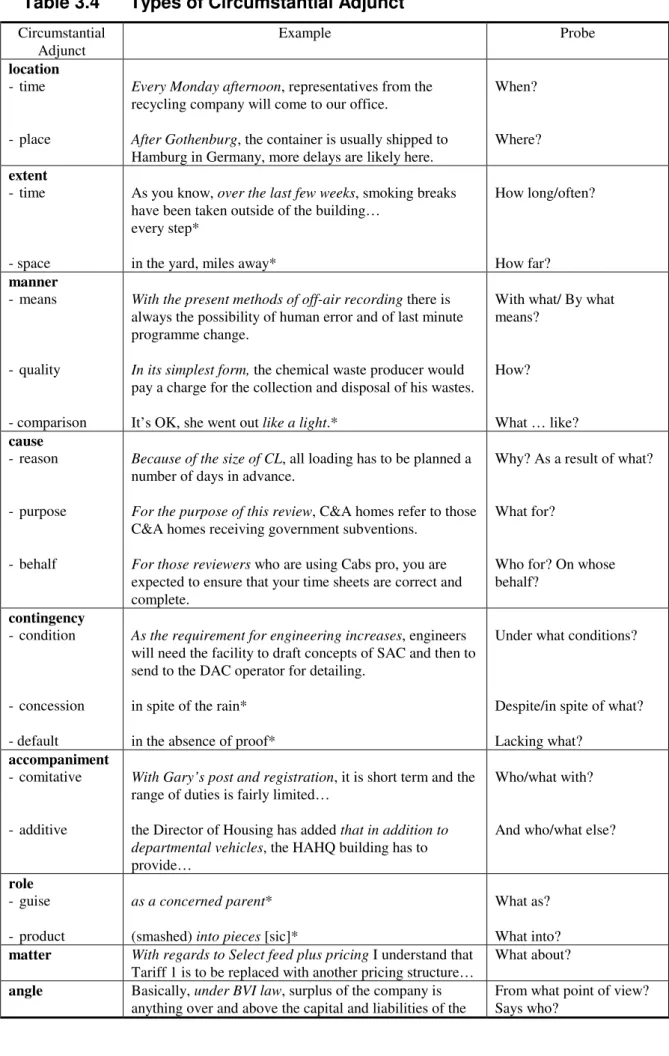
We may interpret Example 3.4, following Halliday, as the writer having made the date the Theme of the clause – perhaps to remind the reader of action which occurred previously. In Example 3.4, the first element with a ‘function in transitivity’ is not the Subject, but a Circumstantial Adjunct of location: time, in January 1994, and because it has ideational force, Halliday identifies this element as Theme. (A discussion of Circumstantial Adjuncts occurs in Section 3.5.2.) Furthermore, since Halliday considers any clause element coming before the Subject in the clause a ‘marked’ Theme, the Circumstantial Adjunct in January
1994 is a marked Theme in this clause. In this example, it follows that the Subject in this clause, China, is part of Rheme (rather than part of Theme) since the function of Theme is not merely realised by the Circumstantial Adjunct but ‘exhausted’ by it. On the other hand, in Example 3.3, the Subject of the clause, China, is the first element with a ‘function in transitivity’ in the clause, and thus it is not only Theme but also considered the ‘unmarked’ Theme. The present study diverges from Halliday in the identification of Theme and the reasons for this are given below. In the corpus texts marked Theme features quite prominently and a more detailed discussion of marked Theme is presented in Section 3.4. Findings related to marked Theme in the present data are presented in Chapters Five and Six.
3.2.2 Alternative definitions of Theme
Although most scholars follow Halliday (1994) in their analysis of Theme, alternatives do exist and these are discussed below.
Building on Halliday’s work on Theme, Berry (1995, 1996) argues that Theme need not necessarily be only the first ideational element in a clause. If only the first ideational element is analysed as Theme, Berry (1996) suggests, then some co-referential elements will not be captured by an analysis of Theme in a text. She claims that “the priority concerns, discoursal or causal, of a speaker or writer need not be ideational” (Berry, 1996:19), and that the writer may choose to select a feature as Theme because it relates to the surrounding text, or the concerns of the immediate clause, or something more closely related to the reader’s concerns. Berry states that when conducting an analysis of the thematic choices in a text, she is more interested in its interpersonal and textual features and that extending the boundary of Theme aids her understanding of such features. In some cases, she argues that the Theme can be seen to act as an interpersonal Theme at a discourse level, and that such interpersonal Themes will influence the meaning of a number of clauses or a paragraph. Therefore Berry, along with Davies (1988, 1994, 1997), Stainton (1993), Ravelli (1995) and others, argues that the boundary of Theme needs to be extended to include some elements relegated to Rheme in Halliday’s style of analysis.
Stainton (1993) argues not only for the Subject to be included in Theme but also the auxiliary verb. Berry’s position (1996) takes her further still, proposing that the lexical verb may be included as part of Theme as well. She argues that by including the lexical verb
within the Theme, the Theme will then include prioritised interpersonal meaning. Berry adds that by including the lexical verb, the Theme is seen to represent “the part of the clause associated with the speaker’s/writer’s main communicative concerns” (Berry, 1996:46). However, to date little support has been given to the proposal that the boundary of Theme should be extended to include the auxiliary and/or lexical verb. The case for the inclusion of the auxiliary verb is stronger than that for the lexical verb, because as argued by Halliday (1994), in an interrogative clause the auxiliary verb is included as part of Theme. Berry took a different position on this issue in an earlier paper (Berry, 1995), where she argued that Theme should be extended up to and including the Subject. However, most SFL scholars have been content to advance arguments as to whether or not the boundary between Theme and Rheme should be moved to include the Subject or not, with Davies (1988, 1994, 1997), Matthiessen (1992), Berry (1995), Ravelli (1995), Martin and Rose (forthcoming) all suggesting that Theme should include the Subject.
3.2.3 Subject as an obligatory element in Theme
The main argument in favour of analysing the Subject as part of Theme is that the thematic development of a text may be more easily understood (Davies, 1988, 1997; Matthiessen, 1992; Berry, 1995, 1996; and Ravelli, 1995). Berry (1995) argues that it is only when one starts to analyse everything before (but not including) the main verb as Theme that one can clearly show how a text fits together. The writer may wish to include more than one element as the start of the message. Matthiessen (1992) agrees with Berry that “… experiential Adjuncts may pile up at the beginning of the clause and the effect is clearly one of successive Thematic contextualisation” (1992:50). By including the Subject as part of the Theme, Berry and Davies argue that this ‘piling up’ of ideational meaning in the initial part of the clause should be investigated further.
The views put forward by Berry, Matthiessen and Stainton are supported by Thompson (1996), and Martin and Rose (forthcoming), in addition to Davies, who argues that non-Subject Themes are ‘framing elements’ (Davies, 1994:172; 1997:55). Martin (1992a), Davies (1994) and Thompson (1996) among others believe that these elements are used as a signal for showing a step or a stage in the progression of the text, or as a change in focus, whereas Subjects are seen as ‘recurrent elements’. Thompson (1996:122) states that an Adjunct in thematic position tends “to serve a particular function in signalling textual
marked Theme choices occur at important stages in the text. The recurrent (Subject) elements continue the lexical chains and cohesion throughout the text and marked Themes, called ‘framing elements’ by Davies (1988, 1994, 1997), generally show a change in topic or progression.
These ‘framing elements’, which Davies calls ‘Contextual Frames’, help establish the context of the clause. Davies (1988) points out that non-Subject thematic elements
…are seen to serve the distinct function of providing different frameworks or contexts for the development of the topic as the discourse proceeds.
(Davies, 1988:177, bold in orig.) Davies argues that while the Subject of the clause is an obligatory element of Theme, a contextual frame is “optional and is seen to serve the function of signalling changes in the real-world, fictional, or discourse circumstances” (Davies, 1997:55). Davies adds that by considering the Subject as part of the Theme, we can show that Theme has the two potential functions of the “identification of Topic, realised by Subject, and provision of
Contextual Frame, realised by elements preceding the Subject, i.e. Circumstantial Adjunct and/or modal or conjunctive adjuncts and conjunctions.” (Davies 1997:55; italics in orig.).
In arguing for a dynamic view of Theme, Ravelli (1995) also argues that what is identified as the Theme of a clause should always include the Subject of the clause. She believes that the Subject is an important element in understanding thematic development and is a necessary part of Theme. In her work on modelling the textual system, Ravelli presents a view of Theme which makes thematic choices clearer. She recommends that “Synoptic and dynamic perspectives need to be interwoven, and both should be applied simultaneously to data to achieve full understanding of text”, and that such a model would be of benefit to SFL theory (Ravelli, 1995:191). She views the linguistic choices in a text as being dynamic where whatever is chosen as the Theme, and consequently the Rheme, of a text will affect the way in which the text unfolds. She argues by looking at the decisions that lead to, or follow, the specific point at which the choice of Theme is made, i.e. the
path leading to the Theme, that the choice of Theme can be understood. Moreover, factors which occurred before or after the decision are seen to affect the decision made at the point of making the choice of Theme. The choices of Theme at particular places in the text can be understood by establishing the factors influencing the decision-making point. Certain paths may lead to a marked Theme being chosen above an unmarked Theme, and
understanding the successive choices, and the local contexts for each choice, would be extremely informative. In part, this is what happens when conducting an analysis of thematic development. Ravelli is calling for a more in-depth analysis related to successive choices; such an investigation would reveal interesting findings, but would be impractical if analysing large corpora.
An analysis of a text which allows the Subject to be considered part of Theme, whether it is preceded by a marked Theme or not, makes it easier to see its thematic development (and to some extent its lexical chains and cohesive patterns), whereas in Halliday’s mode of analysis, the Subject Theme in cases of a preceding marked Theme is ‘lost’ and consequently, at times, so too is the text’s line of development. Fries, in reviewing the different approaches concerning what should be included in Theme, posits that the inclusion of the Subject “finesses the issue of exactly how Theme and Subject interact” (Fries, 1995a:15). Fries adds that this interaction is difficult to separate in a number of instances where the Subject and Theme are conflated. Ghadessy (1995) argues that since marked Themes, especially Circumstantial Adjuncts in initial position, are frequently New Information, considering these to constitute all of the Theme obscures the development of the text. An analysis of lexical chains and cohesion does not depend on an analysis of Theme as such an analysis can be carried out without analysing Theme. However, when conducting an analysis of Theme, including the Subject as part of Theme allows the researcher to see the lexical chains, cohesion and all other choices in the Theme which may have occurred, such as a marked Theme choice. Analysing the Subject as obligatorily part of Theme allows us to always see both. The argument in the present study is that Theme can include more than one topical element and that the choice of a second topical element within the clause is a meaningful one which needs to be investigated further.
3.2.4 Topic, Subject and Theme
The discussion so far has involved investigating the different ways in which scholars identify and analyse Theme. Downing (1991) points out that often topic or Subject are equated with Theme and, as Thompson cautions, “it is easy to confuse Theme and Subject since we can say that, in some sense, the clause is about both” (Thompson, 1996:121). Topic also refers to two distinct elements according to Halliday (1994:38) – Theme and Given. As already noted, Theme and Given have two distinct functions. However, these
three terms – topic, Subject and Theme – are not synonymous, and this section attempts to clarify the way in which the terms are used in the present study.
Topic, Downing (1991:121) states, is a “rather elusive category”, pointing out that there appears to be a great deal of confusion concerning the notion of ‘topic’. A topic can occur at different places within a clause and may even be interpreted differently by different readers. Halliday points out that “The label ‘Topic’ usually refers to only one particular type of Theme … ; and it tends to be used as a cover term for two concepts which are functionally distinct, one being that of Theme and the other being that of Given” (Halliday, 1994:38). Topic then is seen as a difficult element to identify as readers may interpret a text differently and disagree about the topic of a particular clause, or a particular clause complex.
While topic may be not be easily defined or identified in a clause, let alone a text, the grammatical Subject is both more easily defined and recognised. This study will not make use of the term topic, and will instead limit itself to the concepts clause grammatical Subject and Subject/Theme. Halliday condenses the history of the different interpretations of Subject over the course of the 20th Century, and summarises the three different functions for Subject: ‘psychological’ Subject - “that which is the concern of the message”;
‘grammatical’ Subject - “that of which something is predicated”; and ‘logical’ Subject - “doer of the action” (Halliday, 1994:31). In some instances all three functions can be conflated, as shown in Example 3.5.
Example 3.5
The duke gave my aunt this teapot.
psychological Subject grammatical Subject logical Subject Example 3.6
This teapot my aunt was given by the duke.
psychological Subject
grammatical Subject logical Subject
(examples from Halliday, 1994:32)
In other instances, the three functions of Subject can be assigned to more than one participant, as shown in Example 3.6. For the purpose of the present study the grammatical Subject of a clause, whether in a single clause (a ‘simplex’ to contrast it with a clause
complex) or in the α clause of a clause complex, will be referred to as Subject/Theme, as shown in Examples 3.7 and 3.8:
Example 3.7
The major change of the audit report
is to clearly spell out the respective responsibilities of the auditor and the auditee for the financial statements.
Subject/Theme Rheme
Memo 27, clause 5
Example 3.8
Whilst City Council do have responsibilities for
Environmental Health,
they do not have responsibilities for the delivery of primary health care services to the people of the City.
marked Theme Subject/Theme Rheme
Letter 3, clause complex 2
Example 3.9
but at that time, of course, we will follow Personnel’s guidance as always, to make sure we are doing everything fairly. textual Theme marked Theme Interpersonal Theme Subject/ Theme Rheme
Memo 2, clause complex 23
The term Subject/Theme has been borrowed from Martin and Rose (forthcoming) who use it in their discussion of marked Theme (see Section 3.5). Subject/Theme is distinct from textual and interpersonal Themes, which precede it and which, together with Subject/Theme, constitute a multiple Theme. Halliday points out that the unmarked Theme is the default choice and the Subject is usually “chosen as Theme unless there is a good reason for choosing something else” (1994:4). He continues to define marked Theme as “a Theme that is something other than the Subject”, that is, when an ideational realisation is chosen in initial position which is not the Subject. In the present study, the term marked Theme will be used to refer to ideational elements which precede Subject/Theme, but the Theme of the clause/clause complex may include more than one ideational feature as Theme will always include the Subject. As shown in Example 3.9, there are two ideational elements realised in the Theme: a Circumstantial Adjunct of location: time, at that time, and the Subject/Theme, we. A distinction needs to be made in the discussion of Theme between the possible elements which can be realised in Theme, as Theme may include far
more than Subject alone. The thematic choices of Subject/Theme, textual Theme, inter-personal Theme and marked Theme and how they relate to the present study are discussed in more detail below.
3.2.5 Theme in the present study
Within SFL there is general agreement about the function and definition of Theme. However, there appear to be differences in the identification of Theme, and especially in the identification of subcategories of Theme. As always, it is possible for an analyst to adopt a working identification of Theme which will vary with the purpose of the analysis, and also to some extent with the type of text being analysed. The identification of Theme and thus the resulting analyses will also vary if Theme is analysed at different ranks or rather for different lexico-grammatical units, i.e. clauses vs. clause complexes. The researcher needs to designate the unit of analysis and establish clear criteria for identifying Theme, as different methods of identification of Theme will result in different findings.
According to Halliday (1994), Theme is realised by the first element of the clause up to and including the first ideational element. Departing from this, in the present study the ‘special status’ assigned to the starting point of the message may include more than one ideational element, which means by definition the Subject of the main clause will be included in the Theme. In addition, Subjects which are found after the verb of the independent clause will not be analysed. If the Subject of the independent clause has been ellipsed, then the ellipsed Subject will be noted and analysed as ellipsed.
In assigning the Subject and all that precedes it to the category of Theme, certain nuances of the text may be overlooked. For instance, as noted in Example 3.4, Halliday and others argue that a Circumstantial Adjunct coming first in the clause constitutes its ideational Theme and the Subject following it constitutes part of Rheme. Scholars adhering to this position argue that if the Subject is not in initial position in the clause, then this demonstrates a choice by the writer or speaker to highlight another element of the clause as its Theme. However, by analysing Theme up to and including the Subject, other elements such as Circumstantial Adjunct, which may occur before the Subject, along with the Subject are all classified as Theme. This interpretation of Theme takes into consideration this loading of ideational elements in the choice of Theme. This study adopts the position
advanced by Davies (1994, 1997), Ravelli (1995) and Berry (1996), who identify as Theme any ideational element up to and including the Subject.
Any analysis that varies from those of other scholars in what it recognises as Theme will produce different results, but as the main function of an analysis of Theme is to show the way in which the text makes meaning through its choice of Theme, such variation in modes of analysis has to prove its worth by the results it achieves. The position adopted in this study is that by making the Subject obligatorily (part of) Theme, we will be able to more clearly show the way in which a text is structured. It may be that authors of memos often put Circumstantial Adjuncts of location: time before the Subject or, as Matthiessen (1992:50) points out, certain text types may produce a ‘loading’ of Circumstantial Adjuncts in the Theme. As Thomas and Hawes (1997) state, “an item in Subject position serves as a more effective prompt for what a passage is about than another item which is not the Subject of the sentence … This suggests that the grammatical Subject is closely associated with what the message is about” (Thomas and Hawes, 1997:35). In other words, if an element is in Subject position, it is highly relevant to the meaning of the clause, i.e. to the ‘aboutness’ of the clause, and to the structuring of the message. Such meanings are the (textual) focus of the present study. The meanings construed in the Rheme are essential meanings conveyed by ‘new information’; they may well be the message itself, but they are not the focus of the present study.
Moreover, Cope and Kalantzis (1993:9), in presenting a history of the genre movement and its application to pedagogy, point out that “the divergences are the essence of the vitality of the genre literacy movement” (Cope and Kalantzis, 1993:9). They argue that sometimes it is just a matter of talking about different things, or looking at something from a different perspective. However, the fundamental aim of SFL has been to offer a theoretical and pedagogic resource which goes beyond the traditional and progressive models. Keeping SFL constantly in touch with other approaches, or looking at texts from different SFL perspectives, necessarily adds to this theory of language. Thus, by adopting a method of analysis where Theme includes Subject, SFL takes on another perspective in the understanding of texts and the way in which they are structured. This study does not propose that Davies, Berry and others are necessarily ‘right’ in their description of Theme, but adopts their approaches as ‘another way of looking at the same coin’, bringing to bear multiple perspectives on our understanding of the meaning of text. Berry, Davies and
others who stretch the boundaries of SFL strongly believe in SFL as a theory of language – they are simply arguing for space within that theory.
3.3 Unit of analysis
Theme can be analysed as an element of either the clause or the clause complex. Martin advocates analysing Theme in relation to the clause, clause complex, paragraph and text (Martin, 1992a). Whichever unit one chooses to analyse, Fries and Francis (1992) recommend that “the choice of unit must be governed by the purposes of the investigator” (Fries and Francis, 1992:47). The purpose of the present research is to provide information which can later inform pedagogy. Whittaker (1995), whose analysis was also pedagogically motivated, believes that the clause complex or “orthographic sentence” was the best choice for the unit of analysis as it was easily recognisable by students with little or no knowledge of grammar (Whittaker, 1995:107). She added that research into reading considers the sentence as the main unit used by readers to process written texts. The fact that readers with no grammatical background can recognise the sentence as a complete unit is critical, and has led to the adoption of the clause complex as a unit of analysis.
Fries and Francis (1992), Berry (1995), Fries (1995c), Whittaker (1995), Thompson (1996) and Davies (1997) argue for the independent clause to be the unit of analysis. For example, Fries and Francis argue that
if one chooses to examine only the ‘main’ clauses within a clause complex (i.e. paratactic sequences and primary clauses in hypotactic sequences, with beta clauses forming part of Rheme), then it becomes easier to discern the method of development and thematic progression of the text.
Fries and Francis (1992:47)
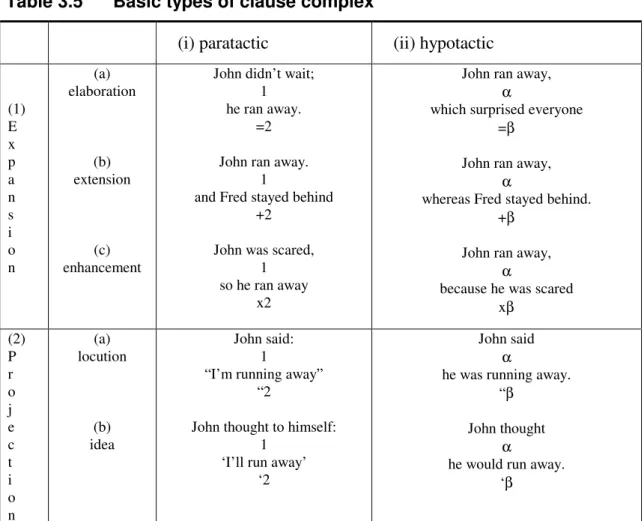
The clause complex, in the present study, refers to an independent clause which may be followed or preceded by one or more dependent clauses, i.e. a clause complex with either an alpha ^ beta (α^β) or a beta ^ alpha (β^α) structure in the notation introduced by Halliday (1994). In a clause complex where there are two or more paratactic clauses, for example an alpha ^ alpha (α^α), or alpha ^ beta^ alpha (α^β^α), each alpha clause has been analysed separately for its thematic structure. In this study, following Fries and Francis, the approach taken is to “ignore the Themes of hypotactically related (subordinate clauses)” (1992:47) if they follow the independent clause, as shown in Example 3.10:
Example 3.10
Alternative arrangements
must be considered
if the unit cannot service their needs. independent clause α dependent clause β Subject/Theme Rheme
The dependent clause in such a clause complex is considered part of the Rheme. Although of course it still has its own thematic structure, in practice the reason for not analysing the dependent clause is that, as Fries and Francis (1992:47) point out, “the structure of beta clauses, including their thematic structure, tends to be constrained by the alpha clauses”, and we are thus justified in ignoring a dependent clause following the independent clause on which it depends. Halliday’s claim that “the main contribution comes from the thematic structure of independent clauses” (Halliday, 1994:61) also supports the position adopted in this study.
On the other hand, in a clause complex where the dependent clause is followed by the independent clause on which it is dependent, i.e. a beta ^ alpha (β^α) structure, the dependent clause plus certain elements of the following independent clause will be identified as Theme, as shown in Example 3.11:
Example 3.11
If the unit cannot service their needs then
alternative arrangements must be considered. dependent clause β independent clause α
extended Theme Rheme
Report 3, clause complex 100
In a β^α clause complex, then, the dependent clause is considered the (marked) Theme of its clause complex, following Halliday (1994) in this regard, and the elements in the following independent clause up to and including the Subject (itself considered an obligatory part of the clause Theme) are considered the Theme of the clause. In support of Halliday, Thompson (1996) points out that the analysis of the text “emerges more clearly if dependent clauses in initial position are taken as the point of departure for the whole clause complex” (Thompson, 1996:132). In this study both the Theme of the clause complex, i.e. the dependent beta clause, and the Theme(s) of the independent alpha clause, i.e. Subject and any marked clause elements preceding it, (including Circumstantial Adjunct,
Complement, conjunctives and relatives), are considered ‘one’ Theme, and identified as ‘extended Theme’, as shown in Example 3.11.
In analysing the Theme of independent or alpha clauses, one exception is made to the way in which projecting and projected clauses are analysed. Projecting clauses found in initial position in the clause complex, it is argued, should be considered as interpersonal Themes in the clause complex because such clauses are seen to be construing writer viewpoint. It should be noted that this thesis is only concerned with discussing projecting clauses which are in initial position and which are hypotactically related to the projected clause. Therefore, from this point onward, unless stated otherwise, all references to projecting clauses refer to projecting clauses in initial position which are followed by a hypotactic projected clause. When a projectingclause is followed by the projected clause, the projecting clause and the Subject (and anything preceding the Subject) of the projected clause constitute the Theme of the clause complex, as shown in Example 3.12:
Example 3.12
I can assure you that the Government share your concern about violence at football matches
projecting Theme Subject of projected
Theme Rheme
extended Theme
Letter 12, clause complex 2
The rationale and justification for this is presented in detail in Chapter Six.
In the case of a clause which has no relation to any other clause in an orthographic sentence or clause complex, the Theme is considered to include all elements up to and including the Subject, as shown in Examples 3.13 and 3.14:
Example 3.13
The library cannot meet the present increasing level of demand from existing resources.
Subject/Theme Rheme
Example 3.14
As part of our internal library study
a questionnaire was sent out to UK Higher Education libraries.
Circumstantial Adjunct Subject
marked Theme Subject/Theme Rheme
extended Theme
Report 3, clause 68
Following the approach taken with a single clause, in the case of paratactic clause complexes each clause will be analysed with respect to its own thematic structure, as shown in Example 3.15:
Example 3.15
The County Council are now appealing on the decision of the Court of Appeal to the House of Lords [sic]
and the hearing is scheduled for 12th June 1995.
Theme Rheme
Report 4, clauses 52 and 53
Clauses 52 and 53 in Example 3.15 are independent but linked paratactically, and are thus analysed as each having their own Theme.
In this study, therefore, the unit of analysis is:
− a single clause structurally unrelated to any other
− where the clause complex comprises of two or more independent clause (α^α
structure), the Theme of each independent clause will be analysed for its own thematic structure
− where the clause complex comprises a dependent clause preceding an independent clause (β^α structure), both clauses, i.e. β and α clauses
− where the clause complex comprises an independent clause followed by one or more dependent clause(s) (α^β structure), only one clause, i.e. α clause
− where projecting clauses of a hypotactic nature are found in the Theme position, the projecting clause and the Subject of the projected clause
Both the clause and the clause complex have thematic structures appropriate for analysis. The departure in this study from some other approaches lies in analysing a dependent clause in a β^α clause complex as part of a larger Theme that encompasses both the independent β clause and the independent α clause on which the β clause is dependent, such a Theme being defined as ‘extended Theme’. In this way it is hoped that thematic patterns of interest for pedagogy may be revealed.
3.4 Textual, interpersonal and topical Themes 3.4.1 Textual and interpersonal Themes
The Theme of a clause includes an obligatory topical Theme and may also include optional features such as textual and interpersonal Themes. Textual Themes help structure the text by developing links to other clauses and are realised by Conjunctive Adjuncts, e.g. and,
however, conjunctions, e.g. before, after and relatives, e.g. how, which. Interpersonal Themes function to explicitly construe writer viewpoint and are realised by Modal Adjuncts, e.g. unfortunately, in my opinion, generally. The one feature they have in common, Halliday notes, is that they do not exhaust the potential of Theme and cannot be counted on their own as the Theme of a clause.
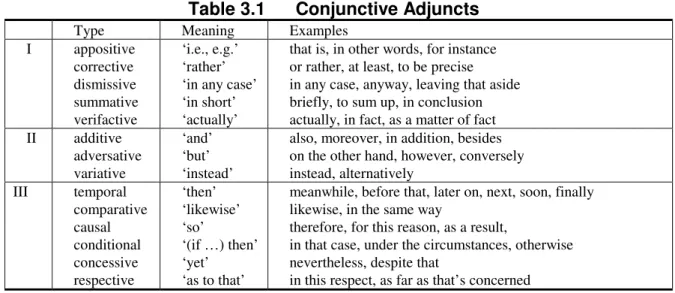
Textual Themes are typically thematic since they relate the clause to the preceding text and thus usually come first in order to realise this linking role. Textual Themes such as Conjunctive Adjuncts (however, in conclusion, as a result) are typically thematic, although they can occur other than in initial position in a clause. They signal the coherence of the text, being concerned with the way in which the meaning expressed in one clause is related to that expressed in another, and are thus textual in nature. Halliday (1994:49) presents a list of Conjunctive Adjuncts, together with text examples, as shown in Table 3.1. In the first column, Halliday groups the Conjunctive Adjuncts into three groups: I, II and III. Although he does not explicitly state the rationale for this numbering, from the grouping it can be inferred that the three groups realise elaboration (I), extension (II), and enhancement (III).
Table 3.1 Conjunctive Adjuncts
Type Meaning Examples
I appositive corrective dismissive summative verifactive ‘i.e., e.g.’ ‘rather’ ‘in any case’ ‘in short’ ‘actually’
that is, in other words, for instance or rather, at least, to be precise in any case, anyway, leaving that aside briefly, to sum up, in conclusion actually, in fact, as a matter of fact II additive adversative variative ‘and’ ‘but’ ‘instead’
also, moreover, in addition, besides on the other hand, however, conversely instead, alternatively III temporal comparative causal conditional concessive respective ‘then’ ‘likewise’ ‘so’ ‘(if …) then’ ‘yet’ ‘as to that’
meanwhile, before that, later on, next, soon, finally likewise, in the same way
therefore, for this reason, as a result,
in that case, under the circumstances, otherwise nevertheless, despite that
in this respect, as far as that’s concerned
Textual Themes also include conjunctions and relatives, which commonly occur in thematic position. Conjunctions are different from Conjunctive Adjuncts as they not only establish semantic relationships between meanings, but are grammatical in that they “construct two parts into a single structural unit” (Halliday, 1994:50). Relatives also relate one clause to the previous clause, and may function as Subject, Adjunct or Complement within the clause. They are not a separate word class; they are nouns or adverbs.
Modal Adjuncts are intrinsically interpersonal in nature, adding information that reflects the writer’s or speaker’s judgement. Interpersonal Themes are not necessarily obligatory elements of Theme as they can occur in other positions in the clause. However, as Halliday points out, they are commonly in thematic position because “If the speaker includes within the message some element that presents his or her own angle on the matter, it is natural to make this the point of departure: ‘I’ll tell you what I think’” (Halliday, 1994:49). Modal Adjuncts have two sub-types, Comment Adjuncts and Mood Adjuncts. Comment Adjuncts are realised by expressions which comment on the clause as a whole, such as generally,
unfortunately (this can be compared to the traditional term ‘disjuncts’ by Quirk et al. (1985:612-31)). Mood Adjuncts are more commonly linked to the Finite within the clause, for example of course, in my opinion, in general. Examples of Modal Adjuncts following the list outlined by Halliday (1994:49, Table 3(3)) can be found in Table 5.3, Section 5.2.
If a textual Theme, Modal Adjunct, Conjunctive Adjunct, conjunction or relative occurs thematically, it “may not exhaust the thematic potential of the clause” (Halliday, 1994:52), and is thus considered only part of the Theme in the clause. Therefore a Theme may comprise several Themes, i.e. textual, interpersonal and topical Themes, and such a composite Theme is referred to as ‘multiple Theme’ by Halliday (1994).
The present study follows Halliday (1994) in that Modal Adjuncts, Conjunctive Adjuncts and relatives occurring thematically are not considered marked Themes (what is meant by marked Theme is discussed in Section 3.5). Following Halliday (1994:54), Conjunctive Adjuncts and relatives are considered to add textual value, and are thus considered textual Themes, while Modal Adjuncts are considered interpersonal Themes within a multiple Theme. While these Adjuncts may be part of the Theme, they do not exhaust the potential of Theme; instead, along with the Subject, they are considered to be a part of a ‘multiple Theme’ comprising textual, interpersonal and topical Themes.
A topical Theme is an obligatory part of Theme. Following Halliday (1994), Theme will include everything up to the first topical (ideational) element. In the present study, as previously noted, Theme will include everything up to and including the Subject. A topical Theme can be realised by a Circumstantial Adjunct, e.g. in October, after the meeting,
tomorrow, etc., a participant, e.g. The Director of Housing, the programme, or a process, e.g. decide, to be examined, obtain. Generally for a process to be the Theme, i.e. for a process to be the first ideational feature in a clause, it is part of an imperative structure, e.g.
please ensure. In this example, as is usual in imperative clauses, the Finite will and Subject
you have been ellipsed. Topical Theme is a term used to refer to any or all of the above features which are found in the Theme of a clause or clause complex.
3.4.2 Is the Theme interpersonal or topical?
In many cases, topical and interpersonal Theme are realised simultaneously by the same word or phrase. For instance, we typically represents the views of the participant, an animate Subject, as in we - the company, where we is experiential and topical Theme. On the other hand, if we refers to both author and reader, i.e. it is an inclusive we, then it should be considered interpersonal in nature, as suggested by Berry (1995, 1996). Personal pronouns which refer to both the reader and the writer, such as you and we, which are commonly analysed as topical Theme if in initial clause position, could also be analysed as interpersonal Theme (Berry, 1995:64).
Personal pronouns commonly straddle the line between the interpersonal and the ideational metafunction; examples of either ambiguity or true double encoding are you,
your, our and us in let’s. Here both the intended reader and the writer are the topic and are thus functioning as ideational elements, but simultaneously the pronouns contribute to the development of an interpersonal strand in the text.
Other grammatical choices also play an interpersonal role in the linguistic realisations of shared knowledge; the use of imperatives, for example, is inherently interpersonal. In the present study, it is argued that projection is also functioning in an interpersonal manner, by construing writer viewpoint either in an explicit manner, e.g. I believe, where the personal pronoun I explicitly marks the writer’s viewpoint, or in a more implicit manner, e.g. it is believed, where the it, to some extent, appears to be more objective. Projection and its relationship to interpersonal meaning is discussed in depth in Chapter Six. This study aims
to discuss in detail the way in which the writer influences the intended meaning of a text through their choice of Subject – not only through the use of personal pronouns but also through other features chosen as Subject.
For the purpose of the present analysis, although it is understood that these personal pronouns construe interpersonal meanings, these items have been coded as meta-functionally ideational and thus as topical Theme. For example, when personal pronouns are the Subject of an independent clause, they function both ideationally and inter-personally within the clause complex. The interpersonal characteristics of such linguistic choices are returned to in the discussion of the texts and the findings in Section 5.3. It is noted that these personal pronouns are seen to be performing two functions at the same time, namely realising both the interpersonal features and the ideational topic.
In addition, as pointed out by Thompson and Thetela (1995), personal pronouns not only subsume both interpersonal and ideational meanings, they also ‘project’ and ‘enact’ roles for the reader. Personal pronouns are one method of assigning certain roles to the two (or more) people involved in the text. These assigned roles are called ‘enacted roles’ by Thompson and Thetela (1995:108). The writer, through their choice of declarative, inter-rogative or imperative, and depending on the context, establishes the role for the speaker / reader, i.e. whether the clause and the clause participants are giving/demanding information or giving/demanding services. In a memo, for example, the participants could be placed either in the role of giver or demander of information by the writer’s selection of a declarative or interrogative clause. Projected roles refer to the explicit labelling of the interlocutors. In Thompson and Thetela’s (1995:108) example you can use it to guarantee cheques up to £100, the enacted and projected roles combine in that the you is a participant both in the clause and the language event, i.e. you is the reader and also the Actor in the process of guaranteeing a cheque. This clearly demonstrates that the writer may choose both the type of role they wish to project for the reader and who will be enacting the role instantiated in the clause.
3.4.3 Subject/Theme
The enacted role and projected role chosen as the Subject/Theme are influential in deter-mining the inscribed meaning and the interpreted meaning of a text. The Subject/Theme, as established above, refers to the grammatical Subject of the α clause (with the exception of
projecting Themes). Subject/Theme may include realisations such as personal pronouns, e.g. I, you, we, they; reference items, such as demonstratives and anaphoric nouns, e.g. this,
that; Subjects that have been ellipsed from the clause, such as in imperative clauses, e.g.
you, in [you should], see Appendix II; Subjects, such as what in What is the best way forward?; and nominal groups, e.g. the Landlord, the incinerator.
Included in the analysis of Subject/Theme is its possible expansion through resources which add further descriptive information to it, e.g. through post-modification. Some examples of post-modification are: the role of the unit [[in serving the teaching needs of faculties not based at the Frenchay Campus]], the amount of waste [[disposed of via this route]], the Hotel owners, [[Messrs Cheung and Foo]]. The double square brackets here show that the information inside these brackets is postmodifying the noun. The Subject/Theme can include any or all of the following functions: Deictic, e.g. any in any of the institutions; Numerative, e.g. all in all gain on capital tax;Epithet, e.g. fantastic, great, Classifier, e.g. the school association in the school association of Nicholas Comprehensive
and Qualifier, e.g. splendid, fantastic can all modify the noun chosen as Subject (Downing and Locke, 1992:438-449; Halliday, 1994:180-186). The Subject/Theme can be modified by both pre- and postmodifiers, with both adding supplementary information about the Subject/Theme but not new information (Halliday, 1994:191-196). Modification can be used to encode the writer’s viewpoint in their choice of Subject, as in the following example:
Example 3.16
some very important issues
Deictic Epithet Classifier Thing Subject/Theme
If this were the Subject/Theme of a clause, it would be clear that the writer was encoding a particular viewpoint in this message. Martin (1997, 2000a) proposes an ‘appraisal system’ to interpret the interpersonal linguistic features of a text. In this study the interpretation of interpersonal features of the Theme draws to a limited extent on the work on appraisal.
The range of lexis realising Subject/Themeis extensive. A closer examination of the type of lexis used to realise Subject/Theme of the main clause in workplace texts may reveal interesting information which can aid our understanding of this particular genre. As argued by Iedema, meanings can be distanced from the here and now through various linguistic
resources and, as they become more distanced, they become “less-negotiable” (Iedema, 1995:134). The choice of Subject/Theme reflects this move of dislocating the proposal from the here and now. Table 3.2 shows how the Subject/Theme choice moves the modal responsibility from the personal I and the less personal the company, where it is clear who is doing the requiring, to the proposee in you are required. The modal responsibility of a clause is related to the choice of predicated Subject, which in the present study constitutes part of the choice of Theme. Modal responsibility is where the onus of the proposition advanced in the clause is placed on the writer, the institution, and the intended reader. Iedema (1995, 1997, 1999, 2000) discusses how the modal responsibility placed on the Subject affects the meaning and interpretation of a directive. Modal responsibility is there-fore an issue directly relevant to the present study.
Table 3.2 Changing the modal responsibility realised by Theme
Subject/Theme Rheme
I require you to be vigilant with this problem.
The company requires continued vigilance in relation to this problem. You are required to be vigilant with this problem.
The problem requires continued vigilance. (Letter 12, clause 14) The requirement is that you remain vigilant with this problem.
Continuation of vigilance is required with this problem.
In the Subject/Theme examples the problem, the requirement and Continuation of vigilance, the proposer and proposee roles are de-emphasised in the choice of the Theme. Each of these choices represents a different starting point for the message conveyed in the clause or clause complex. In the last two examples in Table 3.2, The requirement and
Continuation of vigilance, the Theme is depersonalised, the modal responsibility of the clause has been ‘objectified’, and the proposer and proposee have been de-emphasised. This de-emphasis is what Iedema (1995, 1997, 1999, 2000) refers to as “demodulation”. Demodulation is used in administrative texts to suppress the proposer (of the proposition) and to make the source of the utterance sound more objective and ‘fact-like’.
Nominalisation is one form of demodulation. Nominalisation is where a congruent verb is used metaphorically and changed into an incongruent noun. For example, in Table 3.1 above, the verb to require, which usually has an Agent (who is asking someone to do something) and an Actor (who is responsible for carrying out the action), is transformed into a noun, the requirement. The participants involved become implicit and the requiring
becomes an objectified packaged statement. Hartnett (1995:206) states that nominalisation is presented in a manner where the writer wants the reader to accept the information “without a challenge”. Halliday (1994) adds that the writer holds greater control over the intended meaning of a text if nominalisation is used as the meaning is clear to the writer, but due to the linguistic complexity of nominalisation the meaning may not necessarily be completely clear to the reader. It is therefore seen as a complex packaging of information which in workplace texts is used as a mark of prestige and power. Iedema argues that
To appreciate the constructive power of administration and its language, we need to ‘unpack’ the discourse, i.e. go into the grammar and show how the features of administrative language contribute to its power over social organisation.
(Iedema, 1995:134) By ‘unpacking’ the influential choice of Subject/Theme, which in some cases may include nominalisation, workplace texts can be understood in relation to the power, identity and status construed in the choice of Subject/Theme.
3.4.4 Existential Themes as one choice of topical Theme
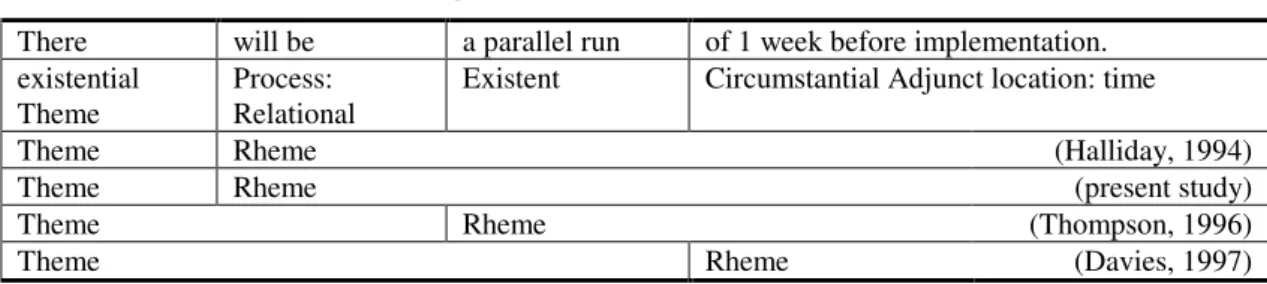
As noted by Thompson (1996), when analysing Theme “you will certainly find that you run up against some problems, some more serious than others” (1996:138). The question of what is the Theme in existential ‘there’ clauses is one such problem. Since there does not realise a participant in the transitivity of an existential clause, i.e. it has “no represent-ational function” (Halliday, 1994:142), the question is whether there can in fact be considered Subject/Theme. In other words, since Halliday (1994) identifies Theme as the first ideational element in a clause, it is difficult to understand why there should be considered Theme. As shown in Table 3.3 below, Halliday adds that there is the starting point of the clause, and that the referent comes later in the clause (Halliday, 1994:44). Martin (1992b) supports this view and adds that there realises the existential feature and sets up the presentation of the Existent later in the clause. Martin adds that
existential clauses… are ideally designed for introducing participants as un-marked news at the end of the clause… and reinforcing their introduction by taking their existence as the point of departure
The Theme there makes prominent the feature that will be introduced later; it makes space, in an unmarked manner, for a referent that will come later.
Thompson (1996) argues that there in existential clauses can be analysed as Theme, but that in existential clauses the Theme should be extended to include the process (Thompson, 1996:138). However, this approach raises the question: if the process is to be included in Theme in existential clauses, then why not in other types of clauses?
Table 3.3 Different interpretations of existential Theme
There will be a parallel run of 1 week before implementation. existential
Theme
Process: Relational
Existent Circumstantial Adjunct location: time
Theme Rheme (Halliday, 1994)
Theme Rheme (present study)
Theme Rheme (Thompson, 1996)
Theme Rheme (Davies, 1997)
Memo 6, clause complex 10
As shown in Table 3.3, Halliday, Thompson and Davies draw the boundary between Theme and Rheme at different places. Davies (1997) suggests that in existential clauses the Theme should include both there and also the Existent that is set up by the introducing
there. Davies (1988) adds that by choosing there as Theme, the writer “presents their own viewpoint as established fact”. The author’s viewpoint becomes hidden and information is presented in an existential manner. Although this appears to be a more convincing argument than Thompson’s, problems persist with this account of existential Themes. If a writer has explicitly chosen an existential there in thematic position, it may be, as Berry (1995) suggests, worth considering there as a ‘negative option’ where the writer chooses as Theme “a pass option, an option not to make use of the thematic slot to foreground any particular type of meaning” (Berry, 1995:66, bold and italics in orig.). By choosing an existential Theme, the writer has chosen to remain ‘hidden’ and to pass over the option of placing something interactional (interpersonal) or informational (topical) in initial position. It should be noted that existential Themes are different from everything else which is referred to as Subject/Themeas they are the grammatical Subject but not the true topic of the main clause in the analysis. However, other alternatives for extending the analysis of existential Themes to include more than just there are not completely convincing and in the present study there will be analysed as Subject/Theme but also considered, following Berry
3.5 Marked Themes and the concept of ‘extended’ Theme
In the typical clause pattern, the Theme is conflated with the Subject. Such a Theme Halliday refers to as ‘unmarked Theme’, stating that “The Subject is the element that is chosen as Theme unless there is good reason for choosing something else” (1994:43). A Theme that is not Subject Halliday (1994) refers to as ‘marked Theme’; the most common types of marked Theme are:
Circumstantial Adjuncts (today, currently, on 13 August, at the meeting) Complements (that meeting we could not attend)
Halliday (1994) posits a cline of markedness, capturing the likelihood of any of these elements occurring in initial position in the clause. The most common form of marked Theme is an adverbial group or prepositional phrase functioning as Circumstantial Adjunct. The least likely, and thus the most marked, is a Complement, which is a nominal group that could have been chosen as Subject but was not (Halliday, 1994:44).
Regardi