NEWS
MAR. 2013
No. 426
3
−The first step to practical use−
06
01
Security Evaluation of
Cryptographic Technology
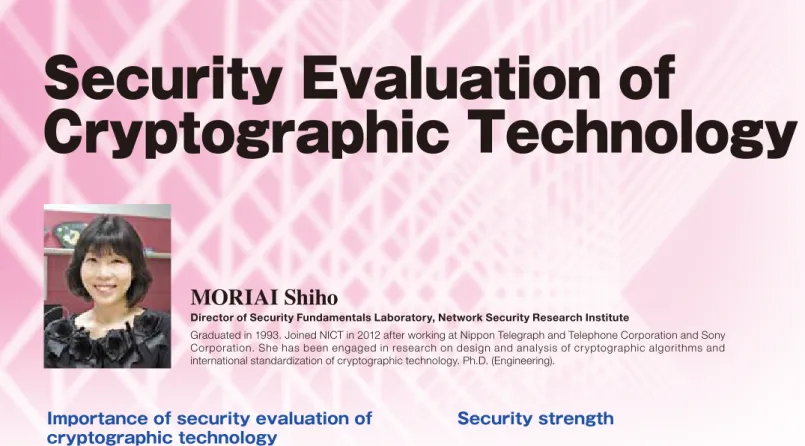
MORIAI Shiho
03
Security Estimation of
Lattice-Based Cryptography
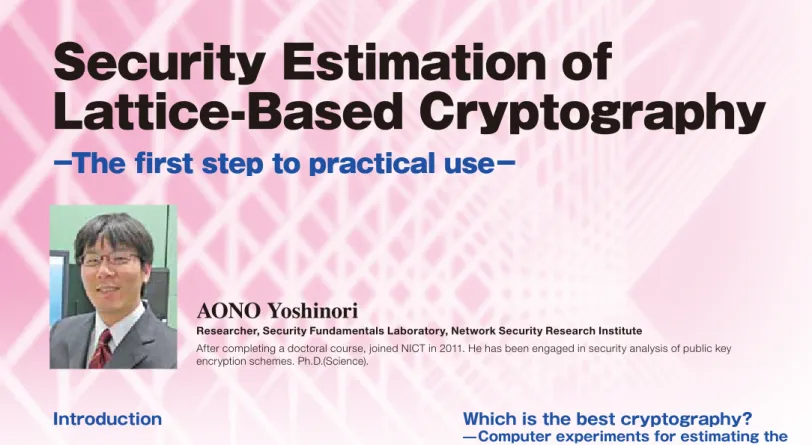
AONO Yoshinori
Cryptanalysis and CRYPTREC
Ciphers List Revision
Security Fundamentals Laboratory,
Network Security Research Institute
07
Awards
09
Report on Space Weather Users’ Forum
10
NICT Entrepreneurs' challenge 2 days
◇Report on The 2nd Kigyouka Koshien
◇Report on The ICT Venture
With advancements in networks, cryptographic technology has become a fundamental technology that sustains the foundations of modern society. The use of cryptographic technology is not just in preserving security of communications on the Internet and mobile phones but also in automatic ticket gate systems for railway passengers, electronic toll collection systems on the highway, content distribution of e-books etc., copyright protec-tion on Blu-ray disks, and IC chip-embedded passports to pre-vent forgery. It is fair to say that safe and secure communica-tions, business, and transportation are now unthinkable without cryptographic technology.
However, cryptographic technology commonly used in today’s society does not maintain permanent security; even once security is confirmed, advancements in cryptanalysis may bring about rapid security deterioration. Therefore, at the Security Funda-mentals Laboratory of NICT Network Security Research Insti-tute, we are conducting continuous research on security evalua-tion of cryptographic technology taking into consideraevalua-tion the improvement of ever-advancing cryptanalysis/computing capa-bilities.
How can we evaluate security of cryptographic algorithms? The security of a cryptographic algorithm is defined as a number associated with the amount of work (that is, the number of opera-tions) that is required to break a cryptographic algorithm with the most efficient algorithm. If the attack complexity was the order of 2k, we say that the cryptographic algorithm’s security is k bits. For example, if the key of Algorithm A is recovered with 2112 times of decryption operations, Algorithm A provides 112 bits of security (Figure 1). When evaluating cryptographic secu-rity, one should find the most efficient attack algorithm and, with that method, it is estimated how much work should be necessary for the attack.
Taking into account the improvement of computing capabili-ties and cryptanalysis advancements, the US National Institute of Standards and Technology (NIST) releases recommendations on what level of security and for how many years certain crypto-graphic technologies should be used for US government procure-ment. Figure 2 shows the recommended key lengths and param-eters that NIST announced in 2007. This shows that one should use cryptographic technology with at least 112-bit security from 2011 and that symmetric key cryptography equivalent to this level is 112-bit key length, public key cryptography based on integer factorization problem such as RSA is 2048-bit key length,
Importance of security evaluation of
cryptographic technology
Security strength
Figure 1 Security evaluation of cryptographic algorithms Figure 2 Security strength
Security Evaluation of
Cryptographic Technology
Graduated in 1993. Joined NICT in 2012 after working at Nippon Telegraph and Telephone Corporation and Sony Corporation. She has been engaged in research on design and analysis of cryptographic algorithms and international standardization of cryptographic technology. Ph.D. (Engineering).
MORIAI Shiho
break - RSA
break - RSA
break - RSA
public key cryptography based on discrete logarithm problem such as DSA is 2048-bit key length, public key cryptography based on discrete logarithm problem on elliptic curves such as ECDSA is 224-bit key length, and hash function is 224-bit hash length. Note that this index was shown by NIST in 2007 based on an asymptotic complexity evaluation and will continue to change based on evaluation results from ever-advancing technol-ogy and actual computer experiments. Besides NIST, research institutes in other countries are also releasing recommendations, some of which show recommended key lengths and parameters different from NIST.
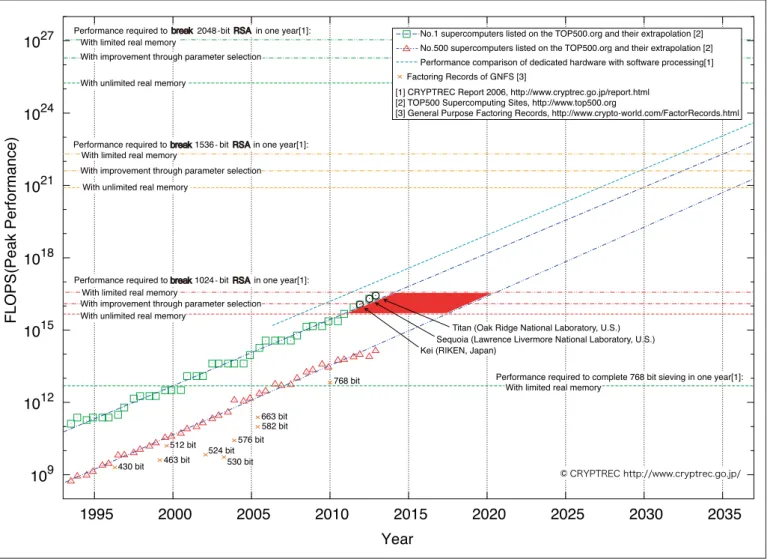
Cryptographic security evaluation performed at the Security Fundamentals Laboratory includes evaluations on elliptic curve cryptography and RSA — currently the most widely used public key cryptography. In particular, breaking 1024-bit RSA has been found to be much easier than previously assumed; today, it has been evaluated that it takes approximately one year for super-computer “Kei” to solve (Figure 3). This evaluation result has been made public through CRYPTREC (Cryptography Research and Evaluation Committees) — a project that observes and evaluates the security of e-government recommended cryptogra-phy of Japan and investigates and reviews appropriate implemen-tation and operating methods for cryptographic technology. At
our laboratory, we are making contributions to CRYPTREC sec-retariat and cryptographic security evaluations for revising the e-Government Recommended Ciphers List. Details are intro-duced on page 6 of this issue.
We are not only performing security evaluations on currently-used cryptographic technology but also, next-generation cryptog-raphy for cloud computing that will allow data processing on encrypted data in order to be able to outsource computing tasks without revealing any content to others. With this evaluation, we can determine what parameters to select to ensure security in next-generation cryptography, which leads to practical use of next-generation cryptography and standardization. Regarding security evaluation of next-generation cryptography, our labora-tory has so far achieved a world record for the decryption of “pairing-based cryptography” that realizes an advanced privacy protection function (published in NICT NEWS September 2012 issue). We also achieved a world record on security evaluation of lattice-based cryptography. Details are introduced on pages 3-5 of this issue.
Security evaluation results on cryptographic algorithms con-ducted by NICT are making vital contributions by providing a technological basis for the e-Government system of Japan and for selecting suitable key lengths and parameters to securely use cryptographic technology that is widely used throughout the world.
Achievements in the Security
Fundamentals Laboratory
Figure 3 Security evaluation of RSA
The vertical axis shows computing performance and the horizontal broken lines in the graph show the performance required to break RSA in one year, from bottom to top, of 768-bit, 1024-bit, 1536-1024-bit, and 2048-bit. Note that this performance varies depending on whether there are real memory limitations̶for example, 1024-bit RSA is shown with several red broken lines. The lines extending from the bottom left to the top right of the graph show the improvement in shifting computing performance year to year, and the performance of supercomputers ranked 1st (□) and 500th (△) place in the TOP500 list, which presented a ranking from 1‒500 of supercomputer computation speed, are shown via the extrapolation lines. The points where the
horizontal and diagonal lines intersect, painted in red, show the period it takes to break 1024-bit RSA in a year using a supercomputer. As of 2013, we have reached the point where 1024-bit RSA can be broken in one year using a supercomputer.
To keep the security of our social activities, several crypto-graphic technologies are used in communication infrastructures and digital equipments; particularly, the RSA cryptography and the elliptic curve cryptography are widely used. However, about 20 years ago, it was proven that these two cryptographies are easily broken by using a quantum computer. After this, research-ers have tried to invent cryptographic schemes resisting both quantum and normal computers, which are usually called post-quantum cryptography.
Several candidates of such cryptographic schemes are now proposed, and efforts are being made to implement them. Researchers found that some of the candidates are not only secure but have various useful properties. For example, they can be used for protecting data in cloud computing and managing information in a large organization, which were hard to realize when using RSA or elliptic cryptography. Proposers of these candidates are claiming the schemes’ advantages and suitability of being the de facto standard of post-quantum cryptography. Now, it must be decided which candidate is best to implement in society.
In order to decide which scheme is best, it needs to compare candidates in a uniform standard. For example, consider a cryp-tographic scheme of short key length and that of long key length. It is clear that the latter one is more secure. However, this idea is not valid when comparing two different schemes. To solve this problem, researchers in cryptographic areas have decided to use computational time for breaking cryptographic schemes of a certain parameter. For example, this is done for each candidate, by estimating the smallest parameter that takes over one year to break the scheme by Supercomputer Kei using the fastest pro-gram in the world, and then comparing the encryption speeds for the parameters.
In fact, because both supercomputers and algorithms for ana-lyzing cryptographic schemes continue to improve, we need to predict the performance of the latest supercomputer in the future and lowest parameters that require a year by such supercomput-ers. The results are drawn in the graph as Figure 2 and 3. Of course, since we cannot use the supercomputer throughout one year in actuality, we perform a computer experiment of smaller scale and extrapolate the results. In order to know which candi-dates are better for post-quantum cryptographies, researchers
have improved the algo-rithms and carried out such preliminary experi-ments. Recently at the Security Fundamentals Laboratory, we estimated the practical hardness of
the shortest vector prob-lem in which the security of lattice-based cryptog-raphy is based, one of the post-quantum candi-dates.
Introduction
Which is the best cryptography?
̶Computer experiments for estimating the practical strength̶
Figure 1 Our research activity helps decide which cryptosystem is the de facto standard of post-quantum cryptography
Security Estimation of
Lattice-Based Cryptography
−The first step to practical use−
After completing a doctoral course, joined NICT in 2011. He has been engaged in security analysis of public key encryption schemes. Ph.D.(Science).
AONO Yoshinori
Figure 4 shows an outline of a lattice-based cryptography.
A lattice is a set of points in a Euclidean space, and it is repre-sented by a set of vectors of which all integer linear combina-tions are equal to the set of points, when we treat the lattice in computers. Here, (A) and (B) in the figure shows examples in the two-dimensional space. The black arrows are the set of vectors.
The communication using a lattice-based cryptography between two persons, the Sender and the Receiver, consists of three steps: 1) generating lattice parameters, 2) encrypting the message, and 3) decrypting the ciphertext.
Brief description of lattice-based
cryptography
Figure 2 Computer experiments for comparing different
cryptographic schemes Figure 3 Comparison of RSA and ECC from experiments for setting recommended parameters
Figure 4 Outline of lattice based cryptography
data representing this lattice to the Sender. However, because the vector set (black) can be used to decrypt the ciphertext, this information must not be sent directly since the eavesdrop-per could recover the message, too. Alternatively, the Receiver sends a transformed vector set that represents the same lattice and cannot be used for decryption; the red vectors in (B) are an example of such set. It is known that if the vectors are nearly parallel, the set has such properties in which it cannot be used for decryption.
(2) Using the received vector set, the Sender computes an integer linear combination of the vectors; from the property of lattice, the combined vector is a point of Receiver’s lattice. The encrypted data is the sum of this vector and the vector corre-sponding message ((C) in Figure 4).
(3) Finally, the Receiver decrypts the vector of ciphertext as follows: compute the nearest lattice point of the vector by using a set of nearly orthogonal vectors, and recover the vector of message ((D) in Figure 4).
(1) After the Sender's request for starting communication, the Receiver generates a set of nearly orthogonal vectors (represented by the black arrows in (B)). Then the correspond-ing lattice is also slightly skewed. Next it needs to send the
To recover the vector corresponding to a message, it needs to find a lattice point closest to the given vector. As in step (3), the computation is easy if one has a set of nearly orthogonal vectors. On the other hand, the researchers expect that a large amount of computations are required if one only has a nearly parallel vector set. Hence, it is also expected to be hard to recover the message if an eavesdropper gets a set of nearly parallel vectors and encrypted vectors. The security of lattice-based cryptography is based on this hardness.
Consider a situation where the eavesdropper recovers a set of a nearly orthogonal vector set from the obtained set. He/she can decrypt any ciphertext encrypted with the nearly parallel vector set which is not secure. Thus, the parameters in the lattice-based cryptography must be chosen so that this recovering computation is not possible in feasible resources. Several researchers have shown that such computation is possible if the number of vectors is less than about 800, which will continue to increase in the future.
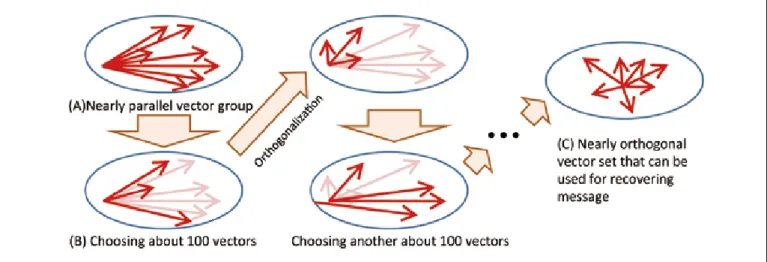
In order to update the practical hardness estimation of lattice-based cryptography, we improved the latest algorithm and con-duct our computer experiments. Recovering a nearly orthogonal vector set from a given nearly parallel vector set is known as quite a difficult problem. Performing this task is not easy with normal resources such as a desktop computer or small computing server. To solve this problem, the latest algorithm transforms the vector set step by step. Figure 5 shows an outline. First, pick a set of about 100 vectors from given set, transform it to a nearly par-allel set, and finally merge the transformed set and the remaining set. Repeating this operation, the entire vector is transformed to a nearly orthogonal set.
It is known that when the vector set is nearly orthogonal, the included vectors are short as (C) in Figure 5, respectively. Hence, the above recovering problem relates to the problem of finding a short vector by transforming the vector set. The latter problem is called the shortest vector problem of lattice, and is also linked to the security of lattice-based cryptography. Technische Univer-sität Darmstadt holds a contest* in which participants challenge lattice based cryptography with published sample problems of
the shortest vector problem. Researchers around the world are competing in solving these problems by their algorithms and computing resources. As one of research activities in the Secu-rity Fundamentals Laboratory, we participated in the competition using the algorithm that is improved from the latest algorithm, whose number of chosen vectors is fixed. We proposed the method to give an optimized value of the number and improve the algorithm. Using our new algorithm, we established a new world record in the 825 dimensional problem.
Currently, major algorithms for analyzing the security of lattice-based cryptography are working with a small amount of memory, whereas they require a large amount of time. On the other hand, it has been known that a general property of algo-rithms, called space-time tradeoff, which is roughly speaking, increasing memory amount makes the computation faster (Figure 6). We expect to create a new faster algorithm by using this property and to evaluate the shortest vector problem again. Moreover, the above algorithm that recovers a nearly orthogonal vector set can be used for analyzing not only lattice-based cryp-tography, but also for other cryptosystems. Updating the known results for these cryptosystems is also in our future activities.
Our computer experiments based
on an improved algorithm
Security of lattice-baced cryptography
Future work
Figure 5 Outline of an algorithm for translating a vector setFigure 6 Concept of space-time tradeoff
* TU Darmstadt Lattice Challenge, is the contest in which participants attempt to solve the shortest vector problem that has been held by Technische Universität Darmstadt since 2008. To estimate the practical hardness of lattice based cryptographic schemes, researchers from around the world are making efforts to solve the sample problems, which are of 500 to 2000 dimensions in 25 steps.
CRYPTREC, short for Cryptography Research and Evaluation Committees, is a project that monitors and evaluates the security of ciphers published on a cipher list (e-Government Recom-mended Ciphers List) that should be referenced for procurement in Japan’s e-government. It also reviews and investigates appro-priate implementation and operation procedures of cryptographic technology. CRYPTREC includes a cryptographic technology investigative commission that is co-run by Ministry of Internal Affairs and Communications, and Ministry of Economy, Trade and Industry and also three sub-commissions co-run by NICT and Information-technology Promotion Agency, Japan (IPA). In CRYPTREC, the Security Fundamentals Laboratory has moni-tored ciphers published thus far in the e-Government Recom-mended Ciphers List and played an important role in providing necessary technical advice as security deteriorates with age. The e-Government Recommended Ciphers List, first published in 2003, was revised in accordance with recent technological devel-opments, and released on March 2013 by the Ministry of Internal Affairs and Communications, and Ministry of Economy, Trade and Industry as CRYPTREC Ciphers List. The Security Funda-mentals Laboratory contributed to this revision work in crypto-graphic security evaluations and head office operations.
Although the e-Government Recommended Ciphers List was selected in 2003 from the standpoint that its ciphers could be safely used for 10 years, in 2013, the “CRYPTEC Ciphers List”, a revised version of the “e-Government Recommended Ciphers List” was created* due to the facts that: (1) 10 years had passed;
(2) security had become weaker due to advancements in crypt-analysis technology and computers; and (3) cipher usage had expanded. The CRYPTREC Ciphers List not only examines from the standpoint of security but various other aspects, such as procurement practicality and domestic cipher promotion, and includes the “e-Government Recommended Ciphers List”, “Can-didate Recommended Ciphers List”, and “Monitored Ciphers List”. Cryptographic technologies whose security and implemen-tation performance have been confirmed are published in the e-Government Recommended Ciphers List and Candidate Rec-ommended Ciphers List. In particular, ones in which procure-ment in CRYPTREC has been determined as practical are pub-lished in the e-Government Recommended Ciphers List (Figure 1). In addition, the Monitored Ciphers List lists cryptographic technologies that have lost their recommendation status such as Hash Function SHA-1 because the actual risk of being decoded is high, among others reasons.
Contributions to CRYPTREC
CRYPTREC Ciphers List revision
* List of ciphers that should be referenced for procurement in e-government (CRYPTREC Ciphers List) http://www.soumu.go.jp/main_content/000206523.pdf
Cryptanalysis and CRYPTREC
Ciphers List Revision
Figure 1 List revision process
Security Fundamentals Laboratory, Network Security Research Institute
Security/Implementation Evaluation Added to Candidate Recommended Ciphers List
Can be added to e-Government Recommended Ciphers List
[Evaluation A]
Evaluation to determine whether its usage results are sufficient so that it can be
safely used in the future.
Satisfies over a certain number of items = its usage results are determined to be sufficient Satisfies over a certain number of items
= determined that the promotion of its utilization is likely
Does not satisfy over a certain number of items Does not satisfy over
a certain number of items
[Evaluation B]
Although usage results are insufficient, evaluation to determine whether future promotion of its utilization is likely.
Comprehensive evaluation of all evaluation items
Not applicable to lists (or Monitored Ciphers List)
Cannot be added to e-Government Recommended Ciphers List
Awards
◎Comment from the Recipient(s):
My research interest lies in understanding the computational processes behind human motor abili-ties and utilizing this understanding to develop flexible motion control and learning in robots. My research believes that integrated research in robot-ics and motor neuroscience is a promising way forward for both of these fields. This ‘Best paper award’ (which is one of the most prestigious yearly robotics award in the world) is in regard to one such project where we investigated the human abilities to adapt their limb trajectory, forces and impedance during interaction with the environment and imple-mented them in robots to achieve similar intelli-gence in robots.
◎Comment from the Recipient(s):
I am deeply grateful to all those involved who led us to receive such a traditional and distinctive award. The research subjected to this award is about the realization and principles of light systems using “small light” called an optical near-field. NICT, The University of Tokyo, Dai Nippon Printing Co., Ltd., and Yokohama National University jointly conducted system design, nanostructure fabrication, optical near-field analysis, and performance evaluation. The awards ceremony was conducted in the pres-ence of Princess Hisako Takamado, and I
was much honored to give a panel exhibit explanation. Thank you for your continued guidance.
◎Comment from the Recipient(s):
With this achievement, which developed power-saving radio technology for smart-meters̶desired by domestic gas companies and meter makers̶as an international standard thanks to NICT contribu-tions, I realized the great significance from NICT’s part as contributor to the development of domestic communications technology and am extremely honored in receiving this award. This technology field is currently in a post-standardized, diffusion phase, and I hope to continue making proper contri-butions as NICT to its future development.
Second from the left: NARUSE Makoto
Recipient(s) ● MATSUO Shin’ichiro / Director of Security Architecture Laboratory, Network Security Research Institute
Recently, we have completed the standardization of security verification methods of security technology in ISO/IEC JTC1. When we use networks, we also use many security technologies as well. It is necessary to verify whether or not these technologies are actually protecting us. This standard gives a measurement in validation. I am grateful to all those who helped support this standard and hope to continue contributing to the dissemination of NICT research results in the future.
◎Comment from the Recipient(s):
◎Award Date: March 19, 2012
◎Name of Award: ◎Details:
◎Awarding Organization:
For editing ISO/IEC29128 (First Edition) Verification of Cryptographic Protocols as a co-editor in ISO/IEC JTC1 and completing publication of the ISO.
International Standards Development Award
Information Technology Standards Commission of Japan
Co-recipients:
MIYAZAKI Kunihiko (Hitachi, Ltd.)
OOTSUKA Akira (The National Institute of Advanced Industrial Science and Technology)
Recipient(s) ● Ganesh Gowrishankar / Research Expert, Brain ICT Laboratory, Advanced ICT Research Institute
(Present: Researcher, Brain Networks and Communication Laboratory, Center for Information and Neural Networks)
◎Award Date: May 17, 2012
◎Name of Award:
◎Details:
◎Awarding Organization:
This award, presented (once a year) for outstanding papers that reflect the purpose of IEEE Transactions on Robotics, was received in recognition of the paper’s technical aspect, originality, potential impact, clarity of presentation and its practical significance for application.
2011 King-Sun Fu Memorial IEEE Transactions on Robotics Best Paper Award
IEEE Robotics and Automation Society
Co-recipients:
Chenguang Yang, Sami Haddadin, Sven Parusel, Alin Albu-Schäeffer, and Etienne Burdet
Recipient(s) ● NARUSE Makoto / Senior Researcher, Photonic Network System Laboratory, Photonic Network Research Institute
◎Award Date: July 24, 2012
◎Name of Award:
◎Details:
◎Awarding Organization:
Research and development of nano-photonic security that uses nano-scale light.
26th (2012 FY) Grand Prize for Advanced Technology Leading in Originality Outstanding Performance Award (FujiSankei Business i Award)
FujiSankei Business i
Co-recipients:
TATE Naoya, The University of Tokyo
SEKINE Yoko; HOGA Morihisa; OHYAGI Yasuyuki, Dai Nippon Printing Co. Ltd.
MATSUMOTO Tsutomu, Yokohama National University OHTSU Motoichi, The University of Tokyo
Recipient(s) ● KOJIMA Fumihide / Senior Researcher, Smart Wireless Laboratory, Wireless Network Research Institute
◎Award Date: July 31, 2012
◎Name of Award:
◎Details:
◎Awarding Organization:
For outstanding contributions to the development of IEEE Standard 802.15.4e-2012; IEEE standard for local and metropolitan area networks- Part 15.4: LR-WPANs, Amendment 1: MAC sublayer
The IEEE Standards
Association acknowledge with appreciation
IEEE-SA
There has been a demand in recent years to redefine the SI second with optical frequency standards, but due to lack of means to verify the accuracy of optical frequency standards, it still has not been implemented. In this paper, we established a comparison means through optical fiber and confirmed
the coincidence between t w o S r c l o c k s w i t h a n uncertainty of 10-16. It is a
g r e a t h o n o r f o r o u r results̶from everyone working together and many work-filled nights̶to be recognized. We would like to thank everyone for their s u p p o r t i n c l u d i n g t h e usage of the optical test bed, JGN2plus.
◎Comment from the Recipient(s):
* ⅰ Senior Researcher, Space-Time Standards Laboratory, Applied Electromagnetic Research Institute
*ⅱ Researcher, Space-Time Standards Laboratory, Applied Electromagnetic Research Institute *ⅲ Planning Manager, Strategic Planning Office, Strategic Planning Department
From left: KUMAGAI Motohiro, YAMAGUCHI Atsushi, IDO Tetsuya, HACHISU Hidekazu, FUJIEDA Miho, LI Ying
Recipient(s) ● ISAWA Ryoichi / Researcher, Cybersecurity Laboratory, Network Security Research Institute
Recipient(s) ● FUJIEDA Miho*ⅰ
KUMAGAI Motohiro
*ⅰHACHISU Hidekazu
*ⅱNAGANO Shigeo
*ⅰLI Ying
*ⅰ
IDO Tetsuya
*ⅲI am extremely happy to have been able to receive this award. In FIT2011, I proposed a one-time password authenti-cation scheme for a client and server to securely verify one another. The proposed scheme’s feature that was praised was its tolerance against “hybrid theft attacks” where an attacker steals information from a server or communication channel and spoofs his/her identity. I would like to thank all those whom I engaged in beneficial discussions with on this research.
◎Comment from the Recipient(s): ◎Award Date: September 5, 2012
◎Name of Award: ◎Details:
◎Awarding Organization:
In recognition of the distinguished paper, titled “One-Time Password Authentication Scheme to Solve
Stolen Verifier Problem” FIT2011 Young Researcher Award
Information Processing Society of Japan
Recipient(s) ● OKAMOTO Takuma / Researcher, Multisensory Cognition and Computation Laboratory, Universal Communication Research Institute
The Awaya Prize Young Researcher Award I received is bestowed upon young researchers by evaluating not only one particular presentation but their comprehensive achievement. I take this award as an incentive to continue research into the future. Using a number of speakers, I proposed a method that generates an area where speech sound can be heard and another area where nothing can be heard. In the future, I hope to develop this method not only for speech privacy but also as ultra-realistic acous-tic communication technology in which one can hear different sounds in various locations.
◎Comment from the Recipient(s): ◎Award Date: September 20, 2012
◎Name of Award: ◎Details:
◎Awarding Organization:
Improvement of masking signals for acoustic privacy area generation using a multichannel loud-speaker array
Awaya Prize Young Researcher Award
The Acoustical Society of Japan
Recipient(s) ● SASAKI Kensuke / Researcher, Electromagnetic Compatibility Laboratory, Applied Electromagnetic Research Institute
Our research presentation in the area of electro-magnetic field theory was recognized and we received the Outstanding Paper Presentation Award. In this research, we proposed and examined exposure assessment technology for human bodies in millimeter waveband, which was formerly consid-ered difficult. I would like to thank the Electromag-netic Compatibility Laboratory and everyone involved for their continuous support and advice during our pursuit of the research.
◎Comment from the Recipient(s): ◎Award Date: September 20, 2012
◎Name of Award:
◎Details:
◎Awarding Organization:
For a presentation in FY 2011 (authors: SASAKI Kensuke, WAKE Kanako, WATANABE Souichi) at The Institute of Electrical Engineers on basic/material/common sections being recognized as an outstanding paper presentation.
The Institute of Electrical Engineers of Japan Outstanding Paper Presentation Award
The Institute of Electrical Engineers of Japan
◎Award Date: September 11, 2012
◎Name of Award:
◎Details:
◎Awarding Organization:
For the outstanding paper on the direct comparison of Sr optical lattice clocks using an NICT-The University of Tokyo optical fiber link, titled “Applied Physics Express Vol. 4 082203 (2011)”
The Japan Society of Applied Physics Academic Paper Award (Outstanding Paper Award)
The Japan Society of Applied Physics
Co-recipients:
YAMAGUCHI Atsushi
(Physikalisch-Technische Bundesanstalt) TAKANO Tetsushi, TAKAMOTO Masao, KATORI Hidetoshi
On February 26, 2013, we held the Space Weather Users’ Forum in the International Conference Room, 4th floor of
Building 1 at NICT headquarters. The event was a huge success reaching almost full capacity with over 90 participants
from public offices, universities, research institutes, and aviation and satellite operations fields. The Forum, which began
with a greeting from KUMAGAI Hiroshi, Vice President
,
Member of the Board of Directors, consisted of two parts. In
the first part, ISHII Mamoru, Director of NICT Space Weather and Environment Informatics Laboratory, held a lecture
where he explained the current state of space weather and talked about NICT’s space weather efforts. In part two, lectures
were held on topics related to space weather in recent years that included: Professor CHO Mengu, Kyushu Institute of
Technology, on the impact of space weather on artificial satellites, SAITO Susumu, Electronic Navigation Research
Insti-tute, on the impact of space weather on air navigation recently using satellite positioning, and MINAMOTO Yasuhiro,
Kakioka Magnetic Observatory, Japan Meteorological Agency, on the impact of immense Geomagnetically Induced
Cur-rent(GIC) that flows during high solar activity.
During the general discussion following the lectures, we received many questions and comments from the participants.
There was much active discussion at the Forum, particularly in aviation-related matters, regarding the significance of
space weather information in ICAO: International Civil Aviation Organization that is being explored due to errors in
satel-lite positioning information mainly caused by ionospheric fluctuations even though the use of this information is being
promoted for air navigation systems. Many audience members also expressed strong interest in the impact of
Geomagneti-cally Induced Current (GIC) on electric power facilities which were previously thought to be insignificant; the result stated
that reexamination is necessary depending on advancements of future research.
After the Forum, more than 30 participants visited the Forecast Room where the Space Weather Forecast Conference at
NICT is held. With a large number of participants receiving daily space weather forecast information via email, many
expressed that they were glad they had a chance to visit the actual site where the forecasts are conducted. We also learned
that there are high levels of interest and anticipation towards our space weather forecasts through the survey in which
par-ticipants wrote what they thought about each lecture, including “easy to understand” and “completely understood.” We
hope to further improve in the future with what we learned about examples of different uses of the space weather
informa-tion NICT provides and the many requests we received.
Participants visited the Space Weather Forecast Room Scene of a lecture
Report on
Space Weather Users’ Forum
ISHII Mamoru, Space Weather and Environment Informatics Laboratory, Applied Electromagnetic Research Institute
NICT provides support towards business expansion of community-based venture businesses in the field of
ICT and the cultivation and discovery of next-generation talent from technical college, university, and graduate
school students around the country who aspire to become involved in businesses that utilize ICT.
As part of this effort, we held “the Kigyouka Koshien” for young people and students to compete with their
business plans and“the ICT Venture Business Plan Contest” where promising venture businesses from around
Japan compete with their business plans as well, promoting business-matching such as fund-raising and market
expansion.
Presentations were held by 9 teams selected from all around Japan, and in addition to the highest award and
special review committee award, other “Special Awards” were bestowed such as one which grants recipients the
privilege to participate in internships provided by 13 supporting businesses. At the exchange event, lively
exchanges ensued with participation from approximately 100 supporting businesses and affiliates.
(Please see the next page for details on the ICT Venture Business Plan Contest.)
This is a social code-reading platform that reads open source (OSS) code and improves technological capa-bilities in your free time. This platform essentially provides applications for free and earns profit from the margin of traded know-how linked to code between users on the platform.
Commemorative photograph after the presentation ceremony Glimpse of the venue
NICT Entrepreneurs' challenge 2 days
“Kigyouka Koshien” and
“ICT Venture Business Plan Contest”
Cyber Agent Ventures, Inc. Startup Base Camp (Akasaka, Minato-ku)
Team☆Hitoride dekirumon (HORIUCHI Kohei, Representative), The University of Electro-Communications “Code-Reading Platform ‘CodeLibrary’ that Will Change the Self-Learning Culture Among Engineers”
Report on The 2nd Kigyouka Koshien
Thursday, March 7, 2013Highest Award
This is a system for resolving the information gap (digital divide) of people who cannot use the Internet. It automatically collects information from the Internet by holding your hand over a newspaper article of interest and displays it on an iPad. When displayed on the iPad, it aims to monetize by embedding advertisements in a newspaper layout. Also, because we can collect data on what related information newspaper subscribers want for which articles, linking other business opportunities using this data is also possible.
ShinBunet (KANESHIRO Shun-Ichiro, Representative), Okinawa National College of Technology “ShinBunet”
NICT Entrepreneurs' challenge 2 days
“Kigyouka Koshien” and
“ICT Venture Business Plan Contest”
After the Highest Award-winning team of “Kigyouka Koshien”, held on the preceding day, gave a
presenta-tion and NICT Outcome Promopresenta-tion Department introduced their efforts of intellectual property and technology
transfer, eight venture businesses gave presentations, and the grand prize as well as the Audience Award newly
established this year were awarded based on audience votes. With approximately 200 participants that day, there
was much lively exchange of opinions and business talk at the information-networking event after the program.
The team aims to construct a platform centered around iOS-linked hardware that is developed as open source hardware, release the developed iOS-linked portfolio as open source and open source hardware and develop its kit sales and kit-generation courses. Its first target is to make an iOS-linked toy and develop a toy market that allows collaboration with the iPhone as Open Source Omocha (oSo).
WTC Conference Center (Hamamatsu-cho, Minato-ku)
GClue Inc. (SASAKI Akira, President) “iOS-Linked Hard Platform”
Report on The ICT Venture Business Plan Contest FY2012
Friday, March 8, 2013Grand Prize
A uniquely developed car sharing system for compact electric automobiles (1‒2 seats) attracting attention as new mobility. This system’s three features are: (1) you can complete required procedures such as member registration, license verification, vehicle reservations, toll payment, etc. all within a smartphone application; (2) supports one-way usage between stations; and (3) can connect with the installation-point and provide customization by adding functions such as sightseeing route directions and local area voice guidance to the in-vehicle display and smartphone applications.
REEVO Inc. (MATSUO Ryoma, President & CEO)
“Provision of the Compact Electric Car Sharing System, ‘codekake’”
Audience Award
(Please see the previous page for the details on the Kigyouka Koushien.)
Presentation scene Glimpse of the venue Commemorative photograph after the awards ceremony
The next issue will feature a strontium optical lattice clock becoming the forefront of optical frequency standards and new research projects.
ISSN 2187-4034 (Print) ISSN 2187-4050 (Online)
NEWS
Published by
Public Relations Department,
National Institute of Information and Communications Technology <NICT NEWS URL> http://www.nict.go.jp/en/data/nict-news/
4-2-1 Nukui-Kitamachi, Koganei, Tokyo 184-8795, Japan Tel: +81-42-327-5392 Fax: +81-42-327-7587
E-mail: [email protected]
<NICT URL> http://www.nict.go.jp/en/