for existing Digital Libraries
G¨unther Specht and Michael G. BauerInstitut f¨ur Informatik Technische Universit¨at M¨unchen Orleansstraße 34, D-81667 M¨unchen, Germany
{specht,bauermi}@in.tum.de
Abstract. Since today more and more complementary information is available in different electronic media there is an increasing demand for the integration of traditional digital library systems and multime-dia systems. In this paper we present the OMNIS/2 system, which is an advanced meta system and enhances existing digital library systems or retrieval systems by additional storing and indexing of user-defined multimedia documents, automatic and personal linking concepts, anno-tations, filtering and personalization.1 The key concept of OMNIS/2 is
that all of the above mentioned features are accomplished without chang-ing the underlychang-ing documents. In our architecture existchang-ing digital library systems, which are established applications, serve as a document stor-age layer, while OMNIS/2 forms the multimedia storstor-age layer, linking layer and personalization layer. This general approach ensures the inte-gration and transparent combination of different digital library systems. Thus with OMNIS/2, even mere retrieval systems - and nowadays most digital library systems are mere retrieval systems - can be enriched to interactive multimedia DL-systems and are combined into one virtual personal digital library.
OMNIS/2 is part of the Global Inventory Project of the G7 countries.
1
Motivation
The information available to the individual increased considerably over the last decade, in quantity as well as in the number of media types. The different kinds of data required different storage and retrieval systems. This led to different dig-ital library systems, which today are powerful tools, but are not transparently connected. It is e.g. not possible to create a user defined link in any document of a digital library system to another document in another digital library although the source document contains a reference (e.g. bibliographic reference or mean-ingful word). Additionally, it is not possible for users to “work” with the libraries (i.e. to annotate books, create own documents, link documents, etc.) as they are retrieval systems only. In this paper we present our OMNIS/2 system which
1 OMNIS/2 is funded by DFG (German Research Foundation) within the research
initiative “V3D2” (“Distributed Processing and Delivery of Digital Documents”)
J. Borbinha and T. Baker (Eds.): ECDL 2000, LNCS 1923, pp. 180–189, 2000. c
enables a user to make use of various information sources, i.e. digital library systems, and which combines them into one virtual personal digital library.
This paper is organized as follows. We start with an overview on missing features in current digital library systems in section 2. Section 3 includes re-lated works on these topics. In section 4 and 5 we present the architecture of OMNIS/2 and explain some of the main internal concepts which are solutions to the mentioned missing features. The paper ends with a summary on further activities (section 6) and a conclusion (section 7).
2
Current State and Demands
Current digital library systems support various ways of retrieving documents, ranging from mere catalog retrieval (OPAC systems) and full text search, to content based search in media libraries like video libraries or music libraries. The following features, however, are available only in parts or are missing at all in current digital library systems:
– The integration of full text retrieval library systems andmultimedia database systems, which may be distributed or remote, into a progressive, interactive, multimedia digital library system, which offers the option of transparently including other systems (with often large collections of data) and even in-troducing cross references among them.
– There is a need for a generic management of metadata, not only for doc-uments which are stored in the multimedia digital library system, but also for any document of additionally connected digital library systems. This is necessary in order to make use of modern filtering and retrieval techniques and also for the transparent linking and processing of documents beyond the boundaries of a single digital library system.
– Automatically generated links between documents inside of a digital library and among documents of different digital library systems. Every retrieved article from a digital library system contains further bibliographic references which are mostly stored in the same digital library system. To retrieve these references the user usually has to initiate another search query, possibly with further restrictions, until the correct result is returned. An automatic linking between documents is not supported today.
– In addition to automatically generated links users want to create and follow personal relevant links to other documents in the same digital library sys-tem or to other syssys-tems. This feature is often asked for by research groups who work with specialized library systems like VD17 (a digital library of all German printings of the 17th century, a former project) [4].
– Current library retrieval systems lack the possibilty of adding personal an-notations to documents, as this would require write permission for all users of the digital library system. Annotations are helpful, though, to explore content for oneself or for a certain user group or to simply discuss a topic. Discussions require annotations on annotations. If various lengths and var-ious types of media annotations are possible, a user friendly authoring tool
and the integration of a multimedia database system for storage purposes are required. Annotations are supported in some newly developed media libraries and personal libraries, but not in catalog and retrieval systems.
– Almost all current digital library systems miss a personalization scheme which every user can feed with personal interests. The personalization can, on the one hand, be used with an existing pull-technology for an additional semantic filtering of information or, on the other hand, as a push-technology to inform a user about new relevant incoming titles. The personalization feature should be adaptive to recognize shifts in the users’ interests, but it should also be a corporate tool to create recommendations.
3
Related Work
The above mentioned missing features show that a simple library or document system is no longer sufficient for a comprehensive scientific work. Therefore sev-eral systems are emerging which search in different sublibraries or collections (e.g. Alexandria Digital Library [7], Stanford Digital Library Project [18], NC-STRL [14], DeLIver [6], Karlsruhe Virtual Catalog [11], Elektra [12], MeDoc [5], etc.). The Karlsruhe Virtual Catalog [11] and Elektra [12] e.g. query several underlying databases or external catalog and full text systems and merge the answers into one result, but they do not support multimedia documents, anno-tations, personal links or an adaptive personalization. The interoperability of digital libraries is an important topic in the Stanford Digital Library Project. Their developed InfoBus especially supports this by providing a general infras-tructure. The commercial product Hyperwave [13], which is a webserver with database functionalities, offers techniques to index, to search, to link and to annotate documents which are storedonthe server.
Today most frameworks and proposals prefer XML as a description and ex-change language for meta data. Several companies extended their database sys-tems recently to support the storage of XML documents. One of these syssys-tems isOracle8i, which can be seen as a database system with integrated functional-ity of a webserver. The special properties of XML as semistructured data have led to the development of database systems which use new graph-oriented data models for semistructured data in contrast to the traditional relational or object-oriented approach. Among them areLore, Stanford University [20] andTamino, Software AG [15].
Metadata is a very important aspect if catalog data is maintained and if queries are exchanged among several systems. Standardized schemes for meta-data are available in the field of libraries (e.g. MARC, MAchine REadable Cat-aloging, or the German MAB-Format). The Dublin Core Metadata Initiative deals especially with the definition of metadata for electronic resources. The recommendation of the Dublin Core Initiative, however, is difficult to use for multimedia applications (1:1 rule). A conceptual model for metadata architec-ture is available with theWarwick Framework. The Warwick Framework is not a technology or a technique but rather a set of principles for metadata. Parts of
the principles of the Warwick Framework are used inRDF(Resource Description Framework), which specifies how to use XML to represent metadata in the form of statements about properties and relationships of items on the Web.
4
Architectural overview
4.1 Design Principles
Our idea is originating from the fact that we can not change or do not want to change the existing digital libraries as they are either well established systems or the effort to change them would be tremendous. We can consider the existing systems however as large containers of documents with a powerful query lan-guage. Therefore our extensions act as a metasystem for these digital library systems, enhancing them by new functionalities. Even if our metasystem will be integrated into one of the digital library systems in the future, this would be just an additional layer on top of the original system. Thus in an abstract view it would still be the same architecture. Our metasystem is able to search in one or various digital libraries and to automatically link their documents, to annotate them, to extend them with multimedia components and to personalize them. The original documents themselves remain in the original database systems and are never modified not even for added anchors. Documents are represented in the meta database simply by their logical addresses and meta data. The linking, including the anchor positions, is stored in the metasystem exclusively and is included dynamically into the retrieved documents at run-time. In the same way documents can be annotated with user-related, group-related or general annota-tions. These annotations can be arbitrary long texts, multimedia annotations or even annotations on annotations. In addition we have developed a concept for personalization (GRAS algorithm), which supports a better filtering and a per-sonal ranking of the results of the underlying digital library systems. The GRAS algorithm unlike other personalization schemes uses Gaussian curves to describe user and object profiles, which results in a better overall quality of retrieval. The personalization feature can also be used as a messaging system about new relevant documents in the library. Both push and pull strategies are possible. The annotations and the data necessary for the personalization feature (i.e. user and object profiles to all documents) are also stored in the meta database. Often users like to create, to store and to retrieve additional personal documents to-gether with the original documents. Since these personal documents may consist of texts, tables, graphics, audio or video the metasystem itself is required to offer all features of an interactive, multimedia database system including user workspaces, full text indexes, etc. For uniformity and consistency reasons the local documents are handled like documents in external digital libraries except for the write permission. If they are annotated or enriched with links, this is again stored outside the document in the meta database. This concept can be seen as an extension of the Amsterdam Hypermedia Model [9], which by itself is an extension of the Dexter Reference Model [8], clearly separating the document layer (within-component layer) from the linkage layer (storage layer). OMNIS/2
supports a more powerful link concept than the currently existing one in the WWW: n:m links, bidirectional links and newly developed temporal links and overlapping links are supported, while the consistency of links is still ensured.
Summarizing, the metasystem can, on the one hand, be seen as an integrated, interactive digital library system with full text, multimedia and hypermedia documents, and on the other hand, as a meta system for existing digital library systems, extending these by hypermedia elements including user workspaces, automatic and personal links, annotations, personal multimedia documents, a transparent access to further library systems, an integrated management of meta data and a unified interactive user interface.
4.2 Integration of External Systems
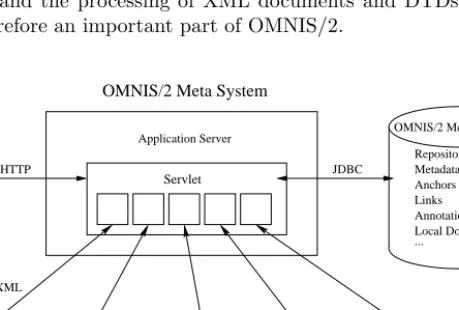
In general we can distinguish two possibilities of integrating an existing digital library system into OMNIS/2: A tight integration and an integration with the help of XML. The tight integration utilizes an internal interface to the relevant systems. Then the systems are directly integrated into OMNIS/2 by using these interfaces. If systems use the XML integration OMNIS/2 manages the shared DTD (document type definition) for XML and additionally uses the tagged in-formation for its management of meta data. Integrity rules which are necessary for the storage and the processing of XML documents and DTDs in database systems are therefore an important part of OMNIS/2.
further - GIS DL e.g. - Video DL Systems - Music DL MultiMAP Links Faculty Library multimedia OMNIS/2 Meta System
XML Servlet Elektra database OPAC Browser ... Repository Metadata Anchors system Annotations Local Documents
Application Server OMNIS/2 Meta Database
system digital journals simple catalog
HTTP JDBC
full text retrieval
5
Implementation
5.1 Implementation Aspects of the Architecture
An important aspect of OMNIS/2 is that neither the integrated digital library systems nor the stored documents need to be modified. It is not even required to update the original documents in order to mark the links, respectively the anchors or the starting points of annotations. This is possible with the help of a three layer architecture similar to the Amsterdam Hypermedia Reference Model [9]. The integrated digital library systems correspond to the within-component-layer, which holds the documents (Fig. 1 shows the overall architecture). The composition, linking and annotation is performed in the meta layer, which con-sists of an application server and a database connection to the meta database. This layer represents the storage-layer of the Dexter and the Amsterdam Refer-ence Model. The third layer is the presentation layer running in the user’s web browser. This is the conceptional view on the architecture, which is shown in Fig. 1 vertically.
The integrated systems shown in Fig. 1 are only examples. In a more technical view on the architecture, which is shown in Fig. 1 horizontally in the upper part of the figure, the so called “three-tier architecture” becomes visible which is the foundation of todays implementations of the web access to the database. In the implementation we have chosen a server-side access to the meta database by using Java servlets and JDBC to lower the load on the clients’s side (to support thin-clients). The servlet extends the webserver to a complete application server which holds the core of the metasystem. The communication of the browser and the webserver is performed via the standard HTTP port or by exchanging java classes, if applets are necessary for the presentation. User input is forwarded by the browser to the servlet and is processed there. All servlets are connected to the meta database with JDBC.
If a query is initiated for one of the coupled digital libraries then the query has to be transformed by the servlet into the URL-format of the relevant library system and sent to it. If a link is followed into a document of one of the coupled databases a corresponding query has to be generated by the servlet with the help of the information in the meta database. In the case of the XML coupling, the metasystem parses the retrieved XML documents with an XML parser and enriches them with the additional information from the meta database (like link anchors, annotations, etc.). To do this, a second query to the meta database is initiated. This query is always necessary. The resulting, enhanced document is currently transformed into HTML containing Java applets or plugin applications and is sent to the WWW browser for presentation.
In this context the architecture of the meta database plays a key role. It has to store metadata, link anchors, annotations of various media types and local documents which can also consist of different media types. The amount of stored data is expected to grow rapidly as anchor and link information has to be stored for every single object that was edited by users. Additionally the personalization feature requires the storage of object profiles for all documents in the meta
database. Except for the anchor values the data is strongly structured. It is important to note though that there is also semi-structured metadata from the underlying digital libraries if these systems use metadata in XML. The aspects which have to be taken care of in the meta database for semistructured data include storage, retrieval, internal representation, fragmentation and indexing. As the metasystem is based on several underlying systems and also maintains its own meta database inter-system consistency of the stored metadata and the underlying digital libraries is a very important aspect.
5.2 Proof of Concept
After the specification of the architecture we developed a demonstrator in order to validate the practical usability of our concepts. We integrated the digital library system of the Faculty for Computer Science at the Munich University of Technology with 80 000 full text documents as an established application to test the external integration via XML. In order to be able to access the retrieved data of the digital library system it had to be extended with an XML output right below its presentation layer. This was the only necessary extension to the digital library system, a surprisingly easy task and implemented within a short time. It is now possible to access the digital library via the OMNIS/2 layer. This results in a personal working environment (with links, annotations, etc.) and enhances the mere retrieval system.
5.3 Meta Database Schema and Efficiency
The meta database of OMNIS/2 is a very important part of the system. It not only contains the anchors and links of the documents, but also the annotations, the personal interests of the users and the metadata for the documents (local and external). As a result the development of the relational scheme of the database was a critical step in the development of OMNIS/2. In addition the database scheme, including the used index structure, decides upon the possible access methods and their efficiency. Especially the queries that deal with link naviga-tion and full text search have to be processed efficiently. Our proposed database scheme can be subdivided into different areas. The areas cover (a) the compo-nents, (b) the linking, (c) the full text search and (d) the user administration.
A component in this context is a storable hypermedia object. The modelling of the links allowsn:mlinks. Due to efficiency they are, however, stored inn∗m 1:1 links and are referenced by a link UID. The full text search covers full texts, all names and contents of all documents with a very efficient index-structure, supporting arbitrary truncations [1]. The user administration supports a user-basedchannelconcept following the Amsterdam Reference Model. A number of different attributes for the presentation can be set globally and locally, thereby enabling a presentation for homogeneous media types.
During the development of the demonstrator the implementation of an effi-cient link navigation was an important point of research. Links are entities and thereby fulfill referential integrity, if they are not external links. The following
types of links are supported: n:m links, bi-directional links, temporal links and overlapping links. The Dexter and the Amsterdam Model are reference models in the sense of postulates. We implemented these models on top of relational and object-oriented database systems and examined the complexity for link navi-gation and a series of optimizations. Altogether the overall complexity of link navigation could be lowered from 3 square addends and 5 linear addends to
O(log(n) +n·log(m)) wherebyn=|links| andm=|anchors|. Thus our result is an efficient operation supporting the full Amsterdam functionality.
5.4 The Personalization and Filtering Feature
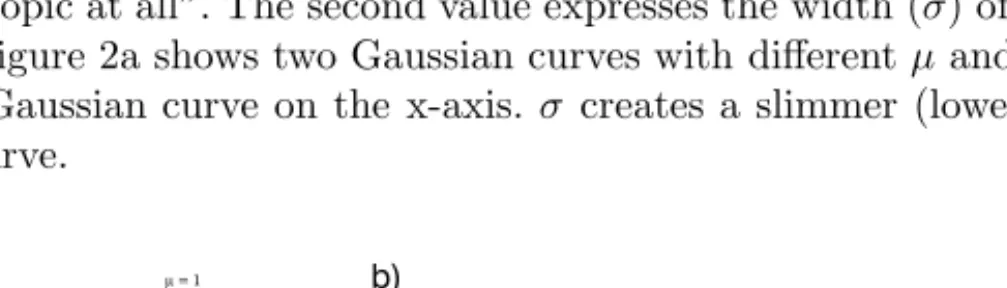
The goal of the personalization is to filter data, which is particularly relevant for the user from a large information base or to sort it according to personal impor-tance or relevance. We have developed the Gaussian Rating Adaption Scheme (from now on referred to as GRAS) which is especially suitable for hyperme-dia documents. GRAS utilizes user and object profiles. Each profile consists of several topic profiles. Each topic profile describes the interest of a user or the contents of an object in a special range of topics. Simple rating schemes use only one evaluation value to describe the interest of a user in a topic. This, however, is not adequate in many cases. GRAS is a technique which uses Gaussian curves for the representation of the topic profiles. A Gaussian curve is characterized by two parametersµ andσ. One value describes the focus or average value (µ) of the interest of user on a scale from “is highly interested in this topic” to “does not like this topic at all”. The second value expresses the width (σ) of the inter-est of user. Figure 2a shows two Gaussian curves with differentµandσ values.
µ shifts the Gaussian curve on the x-axis.σ creates a slimmer (lowerσ value) or broader curve. -2 -1 ,7 -1 ,4 -1 ,1 -0 ,8 -0 ,5 -0 ,2 0,1 0,4 0,7 1 1,3 1,6 1,9 0 0,1 0,2 0,3 0,4 0,5 0,6 0,7 0,8 µ σ= 0= 1 µ σ= 1= 0.5 x y topic1 topic2 topic3 topic4 topic5 topic6 Profile a) b)
Fig. 2.a) example for two Gaussian curves; b) example of a profile consisting of several topic profiles.
The doted curve can be interpreted as the interest profile of a very interested person. A highly positive µ value, combined with a low σ value, represents a high significance and a great interest in objects whose contents meet exactly the special topic. The other curve represents the interest profile of a user, who is
neither very interested in a topic nor completely averse. Therefore theµvalue is 0 and theσ value is 1, which describes no special significance. Figure 2b shows, how several topic profiles represented by Gaussian curves form a user or an object profile.
The intersection of the two Gaussian curves (one for the object profile and one for the user profile) describes the significance of a user’s interest in a certain object for a topic. Detailed analyses show that also negated interestes are mod-elled and treated correctly. The overlapping of the profiles leads to an n-tuple of overlapping values for topics for each object. Different decision models can be used to create an overall ranking: theadditive model, theconjunctive model, the disjunctive modelor theaverage modelwhich we suggested.
The GRAS method was extended by an algorithm for the adaptive gener-ation and adjustment of profiles, so that the user and object profiles correctly adjust themselves with feedback as time passes. For very large quantities of data the objects can therefore also be initialized with the standard Gaussian curve (which represents no special interest). This is a big advantage over methods which require an explicit assignment of topics for each document.
6
Further activities
With the large sets of data available in current digital library systems it is no longer possible to add all links by hand with an authoring tool. An automatic creation of links eliminates this problem. The available options range from key-words, meaningful words or phrases which are stored in the meta database of OMNIS/2 and are matched against words in retrieved documents to heuristics which extract the necessary information from untagged literature references in scanned articles. We consider the further development and improvement of these techniques as a very promising topic for further research. With the development of the GRAS algorithm a powerful tool is available to implement the personal-ization feature. The integration of this tool is planned for the next version. It will then be combined with a planned notification service which enables users to be notified about new documents in the various digital libraries according to their personal interests or if annotations are added to their own annotations. This offers a push technology in addition to the existing pull technology.
7
Conclusion
We presented the concept and the architecture of the OMNIS/2 system. OM-NIS/2 is a meta system for various existing digital library systems and equips users with a tool that enables them to search several systems at once and also to benefit from links between documents of different digital library systems. The links are generated automatically whenever possible but users are also able to add links by themselves. In addition it is possible to annotate external documents without a write permission for the library systems which hold the annotated
documents. The annotations are not limited to text and can consist of multime-dia documents. Users will be able to use the personalization feature to create their own view on the documents and to “work” with digital library systems by themselves. In its current version the system has already access to 80000 docu-ments of the digital library system of the Faculty for Computer Science at TU M¨unchen. This means a clear shift from a mere retrieval system to a personal working environment.
References
1. Bayer R.,The digital library system OMNIS/Myriad, Proc. 18th Australasian Com-puter Science Conference (ACSC’95), Glenelg, South Australia, Feb. 1995. 2. Baldonado M., Chang C. K., Gravano L., Paepcke A.,The Stanford Digital Library
Metadata Architecture, Int. Journal on Digital Libraries, 1(2), 1997, pp. 108-121. 3. Daniel, R., Lagoze, C, Payette, S. D.,A Metadata Architecture for Digital Libraries,
Proc. of ADL’98, Santa Barbara, CA, IEEE Computer Society, 1998, pp. 276-288. 4. D¨orr M., Haddouti H., Wiesener S.,The German National Bibliography 1601-1700: Digital Images in a Cooperative Cataloging Project, Proc. of ADL’97, Washington DC, IEEE Computer Society, 1997, pp. 50-55.
5. Endres A., Fuhr N., The MeDoc Digital Library Operates as a Network of Dis-tributed Servers, Comm. of the ACM, 41(4), 1998.
6. Federated Repositories of Scientific Literature, University of Illinois at Urbana-Champaign, http://dli.grainger.uiuc.edu
7. Frew J. et al., The Alexandria Digital Library Architecture, Proc. of ECDL’ 98, Crete, Greece, Springer Verlag, Sept. 1998, pp. 61-73.
8. Halasz F., Schwartz M., The Dexter Hypertext Reference Model, Comm. of the ACM, 37(2), Feb. 1994, pp. 30-39.
9. Hardman L. et al.,The Amsterdam Hypermedia Model: Adding Time and Content to the Dexter Model, Comm. of the ACM, 37(2), Feb. 1994, pp. 50-62.
10. Kahabka T., Korkea-aho M., Specht G., GRAS: An Adaptive Personalization Scheme for Hypermedia Databases, Proc. of the 2nd. Conference on Hypertext - Information Retrieval - Multimedia (HIM ’97), pp. 279-292.
11. Karlsruhe Virtual Catalog, Karlsruhe University, http://www.ubka.uni-karlsruhe.de/hylib/en/kvk.htm
12. Kowarschick W., Vogel P., Bayer R.,Elektra: An Electronic Article Delivery Ser-vice, Proc. of the 8th Int. Workshop on Database and Expert System Applications (DEXA 97), Toulouse, France, IEEE Press, Sept. 1997, pp. 272-277.
13. Maurer H.,Hyper-G now Hyperwave, Addison-Wesley, 1996.
14. Networked Computer Science Technical Reports Library (NCSTRL), Cornell Uni-versity, http://www.ncstrl.org
15. Software AG,Tamino White Paper, 1999, http://www.softwareag.com/tamino/ 16. Oracle Corporation,XML Support in Oracle8i and Beyond, Technical White Paper
1998, http://www.oracle.com/xml/documents/xml twp
17. Paepcke A., Chang C. K., Garcia-Molina H., Winograd T., Interoperability for Digital Libraries Worldwide, Comm. of the ACM, 41(4), April 1998, pp. 33-43. 18. Stanford Digital Library Project: http://diglib.stanford.edu/
19. Specht G., Complexity Analysis of Link Navigation in Dexter Based Hypermedia Database Systems, Informatica, 8(1), Vilnius, Lithuania 1997, pp. 23-42.
20. Widom J., Data Management for XML, Stanford University, 1999, http://www -db.stanford.edu/lore