Deakin Research Online
This is the published version:
Teo, Tze Luen, Chan, Caroline and Parker, Craig 2004, Factors affecting e-commerce
adoption by SMEs: a meta-analysis
, in ACIS 2004 : Proceedings of the 15th Australasian
Conference on Information Systems
, Australasian Conference on Information Systems,
Hobart, Tas..
Available from Deakin Research Online:
http://hdl.handle.net/10536/DRO/DU:30005434
Reproduced with the kind permission of the copyright owner.
Australasian (ACIS)
ACIS 2004 Proceedings
Association for Information Systems Year 2004
Factors Affecting e-Commerce Adoption
by SMEs: A Meta-Analysis
Tze Luen Teo
Caroline Chan
Deakin University Deakin University
Craig Parker
Deakin University
This paper is posted at AIS Electronic Library (AISeL). http://aisel.aisnet.org/acis2004/54
Factors Affecting e-Commerce Adoption by SMEs: A Meta-Analysis
Tze Luen Teo Caroline Chan Craig Parker
School of Information Systems Deakin University Burwood, Victoria Email: [email protected]
ABSTRACT
There have been a myriad of research studies concerning SME e-Commerce adoption. However, the findings of these studies with regard to adoption factors have often been fragmented and contradictory. This paper analyses the previous research and synthesises the findings into a cohesive model of factors affecting SME adoption of e-Commerce. Eight meta-factors were identified: (1) perceived relative advantage; (2) perceived compatibility; (3) perceived complexity; (4) pressures from trading partners; (5) pressures from competitors; (6) external change agents; (7) knowledge and expertise about e-Commerce; and (8) management attitudes towards e-Commerce. These meta-factors were further grouped into three contexts: technological, environmental and organisational.
Keywords
small and medium sized enterprises, SMEs, electronic commerce, adoption factors
INTRODUCTION
Interest by IS researchers worldwide concerning the adoption and use of e-Commerce by small and medium sized enterprises (SMEs) has been ongoing (for example, Al-Qirim 2003, Grandon and Pearson 2004, Lawson et al 2003, Ramsey et al 2003). This research is especially important in countries such as Australia where SMEs constitute the majority of businesses in the national economy. The common view of these researchers (see McGregor 2003 for a summary) is that SMEs have been slow to adopt e-Commerce despite the benefits these businesses should be able to achieve. However, the existing literature is largely fragmented and therefore does not offer a holistic view of the factors affecting SME e-Commerce adoption. Research in this area has tended to:
x focus on the barriers to SME adoption of e-Commerce (eg, Jones et al 2003a);
x focus on one to four adoption factors (eg, Grandon and Pearson 2004, Hughes et al 2003; Iacovou et al 1995), where the combinations of factors considered vary widely and the studies themselves range from surveys to in-depth case studies; or
x identify a broad range of adoption factors (five or more), typically using surveys examining casual relationships (eg, Riemenschneider et al 2003, Thong 1999) which provide little in-depth insight into the qualitative nature of the factors and their effect on SME e-Commerce adoption;
There have been few meta-analyses of the literature which attempt to bring this breadth of research together to provide a holistic picture of SME adoption of e-Commerce (or IT generally). Empirical papers are unable to provide this kind of in-depth literature analysis because, by necessity, they focus on the empirical results and provide a brief theoretical snap-shot based on the literature. It is therefore essential for this fragmented research (investigating just a few varied factors in more depth, or a range of factors in less depth) to be combined in a more cohesive and comprehensive manner.
There have been notable meta-analyses of the literature on SME adoption of e-Commerce or IT generally. Chambers and Parker (2000) presented a literature review on web-commerce adoption motivators and inhibitors, but they focused specifically on isolated rural businesses and on providing a brief summary of a wide range of potential adoption factors. A more recent study by Premkumar (2003) included a meta-analysis of the factors affecting IT implementation in small businesses. However, this study did not include environmental factors, such as competitor and trading partner pressures, which
are often significant in the context of e-Commerce adoption by SMEs. Further, Premkumar only examined leading IS journals and therefore did not capitalise on findings presented in non-IS journals such as theJournal of Small Business and Enterprise Development.
This paper therefore makes an important contribution by addressing the apparent lack of a holistic, comprehensive meta-analysis of the empirical findings concerning SME e-Commerce adoption. The paper achieves this by identifying, categorising and analysing the factors which have been found consistently to affect SME uptake of e-Commerce using literature from a broad range of sources. The paper will assist in maturing the research on SME e-Commerce adoption because it will highlight specific areas which have been adequately studies and which are well understood. We anticipate that this paper will therefore encourage IS researchers to build upon this established body of research and to explore other facets in more depth. This paper will provide a starting point by proposing some initial suggestions for new research directions.
This paper will:
x analyse the factors affecting SME adoption of e-Commerce by reviewing the available literature;
x discuss main findings resulting from this analysis; and
x provide some initial suggestions for new research directions.
FACTORS AFFECTING THE ADOPTION OF E-COMMERCE IN SMES
The plethora of studies on IS and, in particular, e-Commerce demonstrate that there are a wide range of factors affecting adoption. The literature tends to address this complexity by categorising the factors under more general headings. We considered using Rogers’ (1995) diffusion of innovation theory for the purposes of our meta-analysis, but decided against it because many previous IS adoption studies have included other factors not accommodated by Rogers’ theory (see Henriksen, 2002).
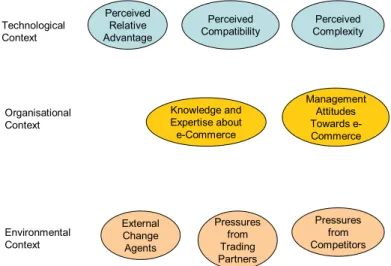
A framework for classifying SME e-Commerce adoption factors which has been used more successfully is Tornatzky and Fleischer’s (1990) model, which has been applied previously in SME studies (see, for example, Chan and Hui, 2001, Gengatharen and Standing, 2004, Scupola, 2003, Scupola, 2004). The model comprises three contexts which influence the adoption of innovations in organisations: (1) organisational; (2) environmental; and (3) technological contexts. The organisational context refers to the factors within the organisation, such as the size of the firm and internal processes. The environmental context refers to the organisation’s business environment, such as competitors, legal issues and customers. The technological context refers to the technologies relevant to the firm, that is, the technology in question, on which the adoption decision is based. Unlike Rogers’ theory, this model is useful for classifying organisational e-Commerce adoption factors because it explicitly acknowledges environmental effects. We therefore decided to use Tornatzky and Fleischer’s framework to analyse and categorise the SME e-Commerce adoption factors as shown in Figure 1.
Perceived Relative Advantage Perceived Compatibility Perceived Complexity Knowledge and Expertise about e-Commerce Management Attitudes Towards e-Commerce External Change Agents Pressures from Competitors Pressures from Trading Partners Technological Context Organisational Context Environmental Context
In the following sections we examine in more detail the three contexts and each of the categories of SME e-Commerce adoption factors in more detail:
Technological Context
The technological context refers to the innovation that is to be adopted by the organisation (Tornatsky and Fleischer, 1990), which in the context of this paper is the potential adoption of e-Commerce solutions by SMEs. Tornatsky and Klein (1982) identified three characteristics of an innovation which would be the most important: relative advantage; compatibility; and complexity. These three characteristics are discussed in the sub-sections below.
Perceived Relative Advantage
One of the most important motivators for the adoption of e-Commerce would be the promise of a relative advantage for the organisation over its competitors through improved efficiencies and cost savings (Chan and Swatman, 2000). However, many studies advocating such a position were focused on large organisations (MacGregor, Waugh and Bunker, 1996). In fact, Daniel and Grimshaw (2002) found that the motivator of improved operational efficiency only affected the larger firms, but did not affect small firms very much.
In the small business context, this motivator of perceived relative advantage is changed somewhat, with MacGregor et al (1996) arguing that the perceptions of management towards the benefits of e-Commerce being the overriding factor. While looking at inhibitors to e-Commence in SMEs, Jones, Benyon-Davies and Muir (2003b) also mention that it is the ignorance about e-Commerce benefits that inhibits SME adoption of e-Commerce, confirming MacGregor et al’s (1996) argument. Chin and Castleman (2002) agree with this, stating that knowledge and awareness about the benefits of e-Commerce motivates small businesses to adopt increasingly sophisticated e-e-Commerce solutions. Iacovou and Benbasat (1995) break down these perceived benefits of e-Commerce into direct and indirect benefits, and argue that small businesses do not have sufficient knowledge about the indirect benefits of e-Commerce, and thus this lack of knowledge would affect perceptions of the usefulness of e-Commerce and, consequently, inhibit small business adoption of e-Commerce. Chau and Hui (2001) appear to agree, stating that direct benefits have a significant impact on e-Commerce adoption, whereas indirect benefits do not motivate the adoption decision due to the focus of small firms on immediate direct benefits rather than long-term indirect benefits.
Perceived Compatibility
The alignment of e-Commerce with the organisation’s strategy and processes needs to be present for an organisation to adopt e-Commerce. Love, Irani, Li, Cheung and Tse (2001) found that small businesses reported that the adoption of an e-Commerce solution was inhibited when not aligned with the organisation’s strategy and processes. Jones et al (2003b) also mention this inhibitor, stating that the e-Commerce solution has to be applicable to the organisation to motivate adoption of e-e-Commerce. Lewis and Cockrill (2002) support this argument of compatibility based on a study of small retail firms, where they found that only when the products of the retail firm were viewed as appropriate to be retailed electronically would the firm be motivated to adopt e-Commerce. This view is also echoed by Hughes, Golden and Powell (2003). However, Poon (1998) found results contrary to Lewis and Cockrill (2002), stating that the product of the SME plays no part in the SME’s view of e-Commerce. In other words, an SME with products that are not easily sold online still viewed e-Commerce with the same optimism as an SME with an information product or a product that can be converted into digital form. It is interesting to note that both Lewis and Cockrill (2002) and Poon (1998) both looked at Internet based e-Commerce, but Lewis and Cockrill (2002) looking specifically at small retail firms, whereas Poon (1998) had a more generic sample. The age of Poon’s 1998 study might play a factor in these contrasting findings, maybe implying that attitudes towards e-Commerce have improved and have become more refined. Over time, small businesses might have become more knowledgeable about e-Commerce and developed more refined and cautious ideas about e-Commerce, rather than the massive optimism towards e-Commerce preceding the dot-com crash of 2000.
Levy, Powell and Yetton (2001) studied the alignment of e-Commerce and the strategic context of the firm, and found that, generally, there was an alignment between the e-Commerce solution adopted and the strategic context of the firm. In other words, the investment in information systems by a firm is determined by the firm’s strategic context. Tetteh and Burn (2001) also emphasised this when giving an example of an Australian winery, which first developed its web site in 1995. The web site was first
developed with the focus of physical awareness, or making users aware of the winery’s location and to encourage customers to visit. This focus then changed to reflect the more global outlook of the winery with more commitment to the global value chain, subsequently developing into a virtual alliance (Tetteh and Burn, 2001). Thus, this implies that an alignment between the organisation’s strategy and the e-Commerce solution is needed to motivate small businesses to adopt e-Commerce.
Van Beveren and Thomson (2002) found that firm size, in relation to the number of employees in the firm, affected the adoption of Commerce. They found that smaller firms were less likely to adopt e-Commerce, probably due to the lack of human resources and expertise to manage e-Commerce. MacGregor (2003) supports this because he found that 75% of SMEs with 20 employees or more adopted some form of e-Commerce, compared to 55% for sole traders. Jones et al (2003) noted that the inhibitors to e-Commerce grew less significant as the firm size, or number of employees, grew. This factor points towards the compatibility of the Commerce technology to the size of the firm. An e-Commerce technology would be compatible to a firm of a certain size.
Interestingly though, Iacovou and Benbasat (1995) found no relationship between the number of employees and the adoption of e-Commerce, but rather found that financial resources affected the firm more. Iacovou and Benbasat (1995) mentioned that on the average, the sales of e-Commerce adopters were larger than that of non-adopters. Iacovou and Benbasat (1995) attributed this to the greater financial resources available to firms with larger sales. Thong (1999) agrees with this, stating that SMEs with more financial resources would stand a higher chance of adopting e-Commerce. These financial resources would definitely overcome financial inhibitors, such as investment risk (Love et al, 2001) and the cost of e-Commerce implementation (Jones et al, 2003). In fact, it is noted by Jones et al (2003) that most SMEs have limited financial resources and that adopting e-Commerce might be priced out of the firm’s financial capabilities, so that the firm might adopt e-Commerce only when funds become available. Thong (1999) states that financial resources within an SME is usually limited, and the investment in an e-Commerce technology would present a high investment risk, so that having enough resources to be able to take this risk would be a necessary first step to adopting e-Commerce. Thus, it can be seen that there needs to be a level of compatibility between the financial resources of the firm and the e-Commerce technology being adopted. A larger firm would be compatible with a different set of e-Commerce technologies than that of a smaller firm, and thus an e-Commerce technology would be compatible to firms with certain amounts of financial resources available. Perceived Complexity
Thong (1999) found that complexity plays a role in the motivation or inhibiting of e-Commerce adoption by SMEs. He found that a motivator of e-Commerce adoption would be ease of use and understanding of the e-Commerce application. In other words, if the e-Commerce application is not complex, there is a higher likelihood of adoption. MacGregor (2003) agrees with this, by identifying that the complexity of e-Commerce is a major inhibitor of the adoption of e-Commerce. This can be seen with a majority of small retailers not adopting sophisticated e-Commerce solutions when compared to large retail chains (Lewis and Cockrill, 2002), due to the high complexity of such e-Commerce solutions. Thong (1999) further states that even if a complex e-e-Commerce solution is adopted by an SME, but employees do not comprehend or understand the solution, then the e-Commerce solution would fall into disuse after adoption.
Al-Qirim (2003) agrees with the authors above, with his findings that complexity can inhibit adoption of e-Commerce. However, Al-Qirim (2003) states that this inhibitor can be overcome through a powerful change agent working towards adoption of e-Commerce within the organisation. Al-Qirim (2003) gave the example of a CEO being involved in e-Commerce development which overcame the complexities of e-Commerce.
Environmental Context
The environmental context is the area in which the firm does business (Tornatzky and Fleischer, 1990), or in other words concerns the surroundings of the organisation, looking at how external influences affect the motivations or barriers to adopt e-Commerce. Trading partners, external change agents and competitors are the three major types of external influences on SME adoption of e-Commerce.
Pressures from trading partners
One of the largest influences on SME adoption of e-Commerce comes from pressure being exerted by larger trading partners (Iacovou and Benbasat, 1995). The level of pressure depends on the SME’s
dependency on the trading partner. Iacovou and Benbasat (1995) found that a firm which is very dependent on the trading partner is more likely to bow to pressures from the trading partner to adopt e-Commerce. Eikebrokk and Olsen (2003) stated that SMEs are influenced by the e-Business strategy of the dominant player in the value chain, and thus experience less autonomy when choosing an e-Business strategy or technology to implement.
Locke (2004) also identified customer demand for e-Commerce as a motivator for e-Commerce adoption, linking the motivator back to the trading partners. An organisation would be motivated to adopt e-Commerce if customers demand it to maintain these existing customers and to to attract more business. But if there were no demand for e-Commerce by the customers and suppliers, the organisation would have very little incentive to adopt e-Commerce (Al-Qirim, 2003).
Contrary to the above studies, Chau and Hui (2001) did not find a link between the adoption of EDI and pressures from external business partners in their study. Instead, they found that it was non-adopters of EDI that felt pressured by external business partners to utilise EDI, but were still unsure whether to adopt EDI or not, whereas businesses who had already adopted EDI noted that pressures from external business partners were not very important when making the adoption decision. Chan and Hui (2001) suggest that it might be the competitors within the industry that influence the adoption, and set an industry standard of the level of adoption of e-Commerce, rather than external trading partners influencing the level of adoption.
Sometimes, adoption might be inescapable, as Chan and Hui (2001) describe. They suggest that some government decisions might force small firms to adopt e-Commerce, such as the Singapore government’s migration from paper-based trade declaration documents to purely electronic declarations. With no choice in the matter, many small firms utilising this declaration process were forced to utilise a level of e-Commerce.
External Change Agents
Another motivator of e-Commerce adoption comes from the influence of change agents external to the firm (de Berranger, Tucker and Jones, 2001). These change agents could be either external vendors trying to sell an e-Commerce technology to the firm, or government and industry bodies trying to initiate growth in the adoption of e-Commerce. de Berranger et al (2001) examined the role of an external change agent in a government sponsored project to encourage e-Commerce and discovered that the change agents were instrumental in providing knowledge about e-Commerce as well as persuading small businesses to adopt e-Commerce. These change agents were most successful after trust had been established, and where knowledge about the business’ characteristics was shown. These change agents gave the small businesses the confidence to adopt e-Commerce. A study by Matlay and Addis (2003) reinforces this, with participants in their study citing that doubts about the SMEs’ consultants’ knowledge and experience about e-Commerce were inhibiting adoption of e-Commerce. This view is echoed by Pollard (2003) in her study of adoption of e-Commerce by small farms in a government sponsored project, in which she found that the provision of training during the project was a very significant motivator of the adoption of e-Commerce. Similar to de Berranger et al’s (2001) findings, the efforts of the change agent to familiarise the SME with e-Commerce resulted in the SME gaining confidence to adopt e-Commerce.
Jones, Hecker and Hollard (2003) provide another example of an external change agent, with their studies of small Tasmanian firms revealing the important role of ISPs or advisers in introducing knowledge about e-Commerce technologies. Lawson, Alcock Cooper and Burgess’ (2003) studies found industry associations lacking and call for more work to be done by industry associations to disseminate knowledge about e-Commerce across the industry.
Jutla and Weatherbee (2002) argue for an integrated approach for external change agents. They propose a strategy called CLEAR (Coordinated Learning for e-Business Adoption, Research and Resource) where external change agents (such as SME associations, local boards of trade, government agencies and universities) coordinate to create an innovation network to integrate the efforts of the external change agents.
The studies above are all in line with Chan and Hui (2001), who mention that support from external sources is very important because many small firms have a lack of IT expertise and therefore rely on external expertise to adopt e-Commerce. This affects the factor of knowledge about e-Commerce within the firm (see below), because external change agents have the ability to bring knowledge about e-Commerce to the firm.
Pressures from Competitors
There is pressure for SMEs to conform to industry standards or to a competitor’s level of technology (Chau and Hui, 2001). Castleman and Chin (2002) found that a majority of SMEs would decide to implement e-Commerce if the level of adoption in the industry was high enough. Castleman and Chin (2002) found that the e-Commerce adopters they studied had adopted e-Commerce to keep up with the times and with shifts in industry practices. This is consistent with the theory of critical mass (Markus, 1987; Rogers, 1991), which states that adoption in an industry would be self sustaining once a certain level of adoption is reached. This can be seen in the findings of Castleman and Chin (2002), with the majority of respondents in their study stating that adoption would take place in the organisation if a high enough level of adoption occurred in the industry. Poon (1998) echoes this view, stating that the percentage of competitors who adopted e-Commerce in an industry had a direct correlation with SME motivation to adopt e-Commerce.
Another reason to adopt e-Commerce is for SMEs to gain a strategic edge over their competitors, or just because it is a strategic necessity to maintain competitiveness in the industry (Al-Qirim, 2003). Daniel and Grimshaw (2002) agree, stating that the desire to respond to competitors plays an important role in the adoption of e-Commerce by SMEs. However, this view is disputed by Thong (1999), who stated that the competitiveness of the environment does not really provide any incentive for an organisation to adopt e-Commerce.
MacGregor (2003) found that being in a strategic alliance affected the barriers to adopting e-Commerce, due to the fact that a strategic alliance would provide the organisation with more technical and business knowledge about e-Commerce, thus softening the impact of adopting e-Commerce. However, strategic alliances only serve to soften the impact of inhibitors, but do not motivate SMEs to adopt e-Commerce (MacGregor, 2004).
Organisational Context
The organisational context refers to the organisation itself (Tornatzky and Fleischer, 1990). This context focuses on the internal factors which motivate or inhibit company adoption of e-Commerce. The two most significant factors from the literature concerned SME knowledge of e-Commerce and the attitude of SME management toward e-Commerce.
Knowledge and Expertise about e-Commerce within the Firm
Chau and Hui (2001) mention that regardless of firm size, it is the experience or knowledge about e-Commerce that plays an important role in the adoption decision. Chan and Hui (2001) state that the firm must perceive itself to have a certain level of expertise in Commerce before it will adopt e-Commerce. This expertise could come about as a result of external change agents, such as government initiatives or external vendors as discussed previously above.
Chaston and Mangles (2002) agree with Chau and Hui (2001), stating that an organisation that has internal e-Commerce competencies will generally perceive e-Commerce as a new source of opportunity. Chaston and Mangles (2002) go further to state that firms have to move beyond recognising that e-Commerce offers an opportunity, and deploy this knowledge and competency across the firm.
Iacovou and Benbasat (1995) agree, but state that although knowledge about e-Commerce is necessary for SME adoption of e-Commerce, a higher level of knowledge or expertise about e-Commerce is not likely to lead to a higher level of adoption. Knowledge about e-Commerce therefore only affects the initial adoption decision but not the extent of adoption.
Jones et al (2003) also mention that it is not just knowledge about e-Commerce, but that it is also important for the SME to gain knowledge about how e-Commerce affects the firm and its environment. However, it appears that a lack of knowledge might not necessarily be a significant inhibitor. For example, Hughes et al (2003) found that SMEs with a deficiency in knowledge about e-Commerce would look upon the possibility to strategically outsource to external vendors to make up the deficiency. This might point towards knowledge that is external to the organisation also playing a role in affecting e-Commerce adoption. In fact, Jones et al (2003) argue that an over reliance on third parties to provide knowledge and expertise would make redundant the need to acquire knowledge, with the firm’s learning and strategy formulation processes being hijacked by external third parties. Chau and Hui (2001) explain that a perception of the availability and quality of external technical support and knowledge (from external sources such as outsourcing vendors or trading partners) was also very important in the adoption decision.
Management Attitudes to e-Commerce
Research shows a strong link between the management or CEO attitudes towards e-Commerce and the level of e-Commerce adoption. Al-Qirim (2003) stated that the characteristics of the CEO play an important part in the level of e-Commerce adoption. Al-Qirim suggested that the involvement and interest of the CEO in Commerce would lead to the deployment of additional resources devoted to e-Commerce implementation. Wagner, et al (2003) concurs because they found that firms with managers keen to exploit e-Commerce exhibited higher rates of e-Commerce adoption. This phenomenon could be due SMEs having a smaller management structure than larger firms, so that it is easier for SME management to influence the adoption of e-Commerce through their involvement and interest.
Thong (1999) appears to agree when he claims that a knowledgeable and committed management would be more willing to invest in e-Commerce. However, Thong (1999) does state that after the initial adoption, the characteristics of management play almost no role in the further adoption of e-Commerce by SMEs. Thong (1999) suggests that organisational knowledge about e-Commerce becomes more important after the initial adoption of e-Commerce, rather than the characteristics of management.
CONCLUSION
It is clear from this meta-analysis that the factors affecting the adoption of e-Commerce by SMEs are highly complex, with various studies providing different lists of factors, or with studies focused on understanding or identifying a particular factor, or groups of factors, but ignoring the bigger picture. The meta-analysis presented in this paper suggests that there is little need for research aimed specifically at identifying SME e-Commerce adoption motivating and inhibiting factors. Despite the fragmented nature of the existing research and the multitude of factors identified, it is possible to synthesise a total of eight all-encompassing meta-factors from this literature: (i) perceived relative advantage; (ii) perceived compatibility; (iii) perceived complexity; (iv) knowledge and expertise about e-Commerce; (v) management attitudes towards e-Commerce; (vi) external change agents; (vii) pressures from trading partners; and (viii) pressures from competitors. These meta-factors fit into the three contexts suggested by Tornatzky and Fleischer (1990): (i) the technological context, (ii) the organisational context and (iii) the environmental context.
Also, there are conflicting reports regarding whether or not a factor affects the adoption of e-Commerce in an SME. For example, Iacovou and Benbasat (1995) found that the number of employees in the firm would not affect the decision to adopt e-Commerce, but MacGregor (2003) found that firms with more employees would tend to adopt e-Commerce more than firms with fewer employees. Another example was where Thong (1999) found that perceived compatibility was a major factor, whilst Chong (2004) found that perceived compatibility was inversely related to adoption. It is not clear at this stage from the literature what contexts or situations might have led to these disparate results. This implies that a factor might impact an SME in different ways, or not at all, depending on the context of the SME.
FUTURE RESEARCH
Figure 1 presents an initial model which depicts the groupings and categorisation of SME e-Commerce adoption factors. The model is intended to provide a starting point for future research examining the SME contexts and the interrelationships between the various factors.
Take for example the apparent relationship between external change agents or vendors and the level knowledge about e-Commerce within the firm that Chau and Hui (2001) mentioned. Another example is the apparent link between the perceived benefits of Commerce and the level of knowledge about e-Commerce within the firm that Castleman and Chin (2001) discuss. The meta-analysis of the literature presented in this paper certainly suggests that there are interrelationships between the factors affecting the adoption of e-Commerce in SMEs. This suggests the opportunity for research which examines the interrelationships between the factors on a macro scale, or in other words looking at how the full range of adoption factors in Figure 1 influence one another. Many existing studies have already examined relationships between factors on a micro scale (eg, between just two factors), such as de Berranger et al (2001) study of change agents which suggests that external change agents bring in knowledge about e-Commerce into the firm, thus affecting the level of knowledge and expertise about e-e-Commerce in the firm.
The meta-analysis has also raised questions about the exact influence of particular factors, because of the contrasting results found when comparing different SME e-Commerce adoption studies. It appears
that there is considerable opportunity more in-depth case study style research is required to examine the nuances of the particular factors in order to account for these disparate results.
It is also apparent from this meta-analysis that a large body of research in this area has focused on the initial e-Commerce adoption decision by SMEs. Further work is needed, however, to examine continuing or post-adoption issues in order to understand what happens after adoption. Some post adoption studies include:
x Daniel (2003), who examined the level of integration of e-Commerce and IS systems and the perceived benefits post-adoption;
x Matlay and Addis (2003), who examined how, with a consultant, small businesses move through stages of adoption; and
x Prananto et al (2004), who examined the perceptions of adoption factors in a stages of growth model.
However, there is little research on how SMEs continue to adopt e-Commerce after the initial adoption. There have been various stage models proposed (such as Jones et al 2003a, Jones et al 2003b, Matlay and Addis 2003, Prananto et al, 2004), but these models are purely theoretical at this point. Thus, questions regarding continuing adoption arise from this paper, such as how the various factors affect continuing adoption. Riemenschneider and McKinney (2001) stated that benefits would be perceived as greater after the initial adoption, but how does that affect continued adoption, or the different stages of adoption proposed in the literature? Is the initial adoption sustainable? Prananto et al (2004) have conducted preliminary research into identifying the changes in perceptions of adoption factors over time, but they do state that increased understanding of the changes in perceptions is required. More research into how adoption factors would affect the firm on continued adoption would be a worthwhile path to follow.
Although there are many papers and research studies done on the area of SME e-Commerce adoption, this paper has shown that there is still many diverse areas of research opportunities in this area before we will completely understand SME e-Commerce adoption.
REFERENCES
Al-Qirim, N.A.Y, 2003, ‘E-Commerce in the Aerial Mapping Industry: A New Zealand Case Study’,
Journal of Systems and Information Technology,7(1):67-92
Castleman, T and Chin, C., 2002, eCommerce and the Competitiveness of Small Enterprises: A Study of the Restaurant Industry, Working Paper 2002/01, School of Management Information Systems, Deakin University, Melbourne
Chambers, T. A. and Parker, C., 2000, ‘Factors Motivating an Inhibiting the use of Web Commerce by Rural Small Businesses’, Proceedings of ACIS 2004, Brisbane, Australia.
Chan, C., and Swatman, P.M.C., 2000, ‘From EDI to Internet Commerce: The BHP Steel Experience’,
Journal of Internet Research,10(1):72-82
Chan, C., 2002, Understanding B2B e-Commerce Implementation – The Evolving Australian Experience, Unpublished PhD Thesis, Deakin University, Melbourne
Chaston, I and Mangles, T., 2002, ‘E-Commerce in Small UK Manufacturing Firms: A Pilot Study on Internal Competencies’, Journal of Marketing Management,18: 341-360
Chau, P.Y.K. and Hui, K.L., 2001, ‘Determinants of Small Business EDI Adoption: An Empirical Investigation’, Journal of Organizational Computing and Electronic Commerce,11(4):229-252 Chong, S., 2004, ‘Electronic Commerce Adoption by Small and Medium Sized Enterprises in Australia:
An Empirical Study of Influencing Factors’, Proceedings of ECIS 2004, Turku, Finland
Daniel, E.M and Grimshaw, D.J., 2002, ‘An Exploratory Comparison of Electronic Commerce Adoption in Large and Small Enterprises’, Journal of Information Technology,17:133-147 de Berranger, P., Tucker, D and Jones, L., 2001, ‘Internet Diffusion in Creative Micro-Businesses:
Identifying Change Agent Characteristics as Critical Success Factors’, Journal of Organizational Computing and Electronic Commerce,11(3):197-214
Eikebrokk, T.R. and Olsen, D.H, 2002, ‘Understanding e-Business Competencies in SMEs’, in IFIP TC8/WG8.4 Second Working Conference on E-Business: Multidisciplinary Research and Practice, pp. 575-601, June 9-11 2002, Copenhagen, Denmark
Grandon, E.E. and Pearson, J.M., 2004 ‘Electronic commerce adoption: an empirical study of small and medium US businesses’, Information & Management (to appear).
Gengatharen, D.E. and Standing, C., 2004, ‘Regional E-Marketplaces: Towards a Unified Theoretical Framework for Assessing Facilitators and Inhibitors of Success’, Proceedings of ECIS 2004, Turku, Finland
Henriksen, H.Z., 2002, Performance, Pressures and Politics: Motivators for Adoption of Interorganizational Information Systems, Unpublished PhD Thesis, Copenhagen Business School, Copenhagen
Hughes, M., Golden, W and Powell, P., 2003, ‘Inter-Organisational ICT Systems’, Journal of Small Business and Enterprise Development,10(3):277-286
Iacovou, C.L., Benbasat, I. and Dexter, A.S., 1995, ‘Electronic Data Interchange and Small Organizations: Adoption and Impact of Technology’, MIS Quarterly,19:4(465-483)
Jones, C., Hecker, R. and Holland, P., 2003a, ‘Small Firm Internet Adoption: Opportunities Forgone, a Journey Not Begun’, Journal of Small Business and Enterprise Development,10(3):287-297 Jones, P., Beynon-Davies P. and Muir, E., 2003b, ‘EBusiness Barriers to Growth Within the SME
Sector’,Journal of Systems and Information Technology,7(1):1-25
Jutla, D. and Weatherbee, T., 2002, ‘Supporting CLEAR: A Strategy for Small and Medium Size Enterprise Adoption of e-Business Practices in Atlantic Canada’ IFIP TC8/WG8.4 Second Working Conference on E-Business: Multidisciplinary Research and Practice, pp. 575-601, June 9-11 2002, Copenhagen, Denmark
Lawson, R., Alcock, C., Cooper, J. and Burgess, L., 2003, ‘Factors Affecting Adoption of Electronic Commerce Technologies by SMEs: an Australian Study’, Journal of Small Business and Enterprise Development,10(3):265-276
Levy, M., Powell, P and Yetton, P, 2001, ‘SMEs: Aligning IS and the Strategic Context’, Journal of Information Technology,16: 133-144
Lewis, R and Cockrill, A., 2002, ‘Going Global – Remaining Local: The Impact of E-Commerce on Small Retail Firms in Wales’, International Journal of Information Management,22:195-209 Locke, S., 2004, ‘ICT Adoption and SME Growth in New Zealand’, Journal of American Academy of
Business,March 2004:93-102
Love, P.E.D., Irani, Z., Li, H., Cheng, E.W.L. and Tse, R.Y.C., 2001, ‘An Empirical Analysis of the Barriers to Implementing e-Commerce in Small-Medium Sized Construction Contractors in the State of Victoria, Australia’, Construction Innovation,1:31-41
Lyytinen, K and Damsgaard, J., 2001, ‘What’s Wrong with the Diffusion of Innovation Theory? – The Case of a Complex and Networked Technology’, in Proceedings of the IFIP TC8 Working Group 8.6 Conference - Diffusion Software Product and Process Innovations, pp. 173-190, April 7-10 2001, Banff, Canada
MacGregor, R.C, Waugh, P and Bunker, D., 1996, ‘Attitudes of Small Businesses to the Implementation and Use of IT: Are We Basing EDI Design Initiatives for Small Businesses on Myths?’, in Proceedings of the Ninth International Conference on EDI-IOS, pp. 377-388, June 10-12 1996, Bled, Slovenia
MacGregor, R.C., 2003, ‘Strategic Alliance and Perceived Barriers to Electronic Commerce Adoptoin in SMEs’, Journal of Systems and Information Technology,7(1):27-47
MacGregor, R.C., 2004, ‘The Role of Strategic Alliances in the Ongoing Use of Electronic Commerce Technology in Regional Small Business’, Journal of Electronic Commerce in Organizations,
2(1):1-14
Markus, M.L., 1987, ‘Towards a “Critical Mass” Theory of Interactive Media, Universal Access, Interdependence and Diffusion’, Communication Research,14(5):491-511
Matlay, H and Addis, M, 2003, ‘Adoption of ICT and e-Commerce in Small Businesses’, Journal of Small Business and Enterprise Development,10(3):321-335
Paranto A., McKay, J and Marshall, P., 2004, ‘Exploring the Perceptions of Inhibitors and Drivers of E-Business Progression Among SMEs at Different Stages of E-Business Maturity’, Proceedings of ECIS 2004, Turku, Finland
Pollard, C., 2003, ‘E-Service Adoption and use in Small Farms in Australia: Lessons Learned from a Government –Sponsored Programme’, Journal of Global Information Technology Management,
6(2):45
Poon, S., 1998, Small Business Internet Commerce: A Study of the Australian Experience, Unpublished PhD Thesis, Monash University, Melbourne
Premkumar, G., 2003, ‘A Meta-Analysis of Research on Information Technology Implementation in Small Business’, Journal of Organizational Computing and Electronic Commerce,13(2):91-121 Ramsey, E., Ibbotson, P., Bell, J. and Gray, B., 2003 ‘E-opportunities of service sector SMEs: an Irish
cross-border study’, Journal of Small Business and Enterprise Development,10(3): 250-264. Riemenschneider, C.K., Harrison, D.A. and Mykytyn, P.P. Jr., 2003, ‘Understanding IT adoption
decisions in small business: integrating current theories’, Information & Management, 40(4): 269-285.
Rogers, E.M., 1991, ‘The “Critical Mass” in the Diffusion of Interactive Technologies in Organisations’, in: Kramer, K.L. (ed), The Information Systems Research Challenge: Survey Research Methods (3):245-263
Rogers, E.M., 1995, Diffusion of Innovations, 4th ed, The Free Press, New York
Scupola, A., 2003, ‘The Adoption of Internet Commerce by SMEs in the South of Italy: An Environmental, Technological and Organizational Perspective’, Journal of Global Information Technology Management,6(1):52-71
Scupola, A., 2004, ‘Adoption of E-Commerce in Small and Medium Size Enterprises in Australia’,
Proceedings of AMCIS 2004, New York, New York
Sensis, 2003, 2003 Yellow Pages Business Index: E-Business Report, July, Telstra Corporation, Australia.
Tetteh, E and Burn, J., 2001, ‘Global Strategies for SMe-Business: Applying the SMALL Framework,
Logistics Information Management,14(1/2):171-180
Thong, J.Y.L, 1999, ‘An Integrated Model of Information Systems Adoption in Small Businesses’,
Journal of Management Information Systems,15(4):187-215
Tornatzky, L.G and Klein, K.J., 1982, ‘Innovation Characteristics and Innovation Adoption-Implementation: A Meta-Analysis of Findings’, IEEE Transactions on Engineering Management,29(1):28-45
Tornatzky, L.G. and Fleischer, M., 1990, The Process of Technological Innovation, Lexington Books Van Beveren, J. and Thomson, H., 2002, ‘The Use of Electronic Commerce by SMEs in Victoria,
Australia, Journal of Small Business Management,40(3):250-253
Wanger, B.A., Fillis, I and Johansson, U., 2003, ‘E-Business and E-Supply Strategy in Small and Medium Sized Businesses’, Supply Chain Management: An International Journal,8(4):343-354
COPYRIGHT
Tze Luen Teo, Caroline Chan and Craig Parker © 2004. The authors assign to ACIS and educational and non-profit institutions a non-exclusive licence to use this document for personal use and in courses of instruction provided that the article is used in full and this copyright statement is reproduced. The authors also grant a non-exclusive licence to ACIS to publish this document in full in the Conference Papers and Proceedings. Those documents may be published on the World Wide Web, CD-ROM, in printed form, and on mirror sites on the World Wide Web. Any other usage is prohibited without the express permission of the authors.