Frida RAMADINI Universitas Sumatera Utara, North Sumatera, Indonesia Inggrita Gusti Sari NASUTION Universitas Sumatera Utara, North Sumatera, Indonesia
Abstract
This study aimed to identify Batik Small and medium-sized enterprises (SMEs) problems in Medan and provide solution for Batik SMEs’ problems in Medan. Using force field analysis to identify the problems faced Batik SMEs in Medan, it was found that the problems in Batik enterprise development in Medan occurred from: Batik craftsmen, entrepreneurs, materials and equipment, government support and customer. To make Batik enterprise development in Medan optimal, a synergized enterprise-based Batik development model in Medan was required. It involved three elements which were government SME businesspeople, and academicians, so that Batik enterprises in Medan can develop comprehensively.
Keywords: development strategy, Small and medium-sized enterprises, Batik JEL Classification: L22, L26, L67, L81
I. INTRODUCTION
Indonesian Small and Medium Enterprise sector has a strategic role and is a sector which gives large contribution to Indonesia’s economy. Beside providing employment, SMEs also play a part in income distribution and increasing the income of the society, as well as contributing to local economy. The government provides support for financing facilities originating from banks. Support for MSME empowerment is implemented through credit allocation grant allocation in KUR Program. Data from the Ministry of Finance mention that from November 2007 to November 2014, the number of KURs disbursed reached Rp159.2 trillion to 12,145,201 debtors. The development of utilization of KUR facilities for MSMEs through Commercial Bank shows an increase. In 2012, total loans through Credit schemes with Specific Guarantee reached Rp39.7 trillion, increasing to Rp48.3 trillion in 2014. KUR distribution for Micro, Small and Medium Enterprises in 2012 amounted to 43 percent, 51 percent, and 6 percent. In 2014, the KUR program is utilized. To develop local economy to improve public welfare, it’s important to develop local economic potentials (Lutfi et al., 2016; Lubis et al., 2016 & Yahya et al., 2017). SME should be developed to realize local economic development program. This is to develop local potentials and people’s creativity to produce products which have competitive advantage (Sirojuzilam et al., 2016 & Tarmizi et al., 2017). To face globalization era which is characterized by fierce and complex competition, SME is demanded to be able to develop strategy to adapt with dynamic changes in the environment. SME should prepare themselves as well as possible to increase their competitiveness. Competitiveness is an ability to maintain market share. Competitiveness has significant influence on increased company productivity and expansion of market access and will lead to increased sales and profitability. Batik UKM is a rapidly growing UKM subsector in Indonesia. Since United Nations Educational, Scientific, and Cultural Organization (UNESCO) designed Indonesian Batik as a World Heritage, Batik has continued to grow. This makes Indonesia have many types of Batik. Medan Batik is a type of Indonesian Batik di Indonesia with different motives from Javanese Batik. Medan Batik shows various attractive North Sumatran ethnic motives using ornamental motives from various tribes in this region, such as North Tapanuli (Batak Toba), Mandailing, Central Tapanuli, Simalungun, Pakpak Dairi, Karo, Melayu Deli and Nias ornaments. The growth of Medan Batik is interesting to study. Medan Batik businesses started 2009, but a lot of people, especially people of Medan, still don’t know about Medan Batik, and people who know about it don’t want to wear this Batik. Although today the products only reach local market, this business had great potential because it can introduce local culture and become an alternative in the currently booming Batik trend.
To compete, Batik SME businesspeople should act with entrepreneurial orientation. Entrepreneurial orientation is creative and innovative abilities which become the foundation, leverage, and resources to find opportunity for success. With entrepreneurial orientation, SME businesspeople can find out that market continues to grow and consumers keep demanding products and services to meet their needs. An organization won’t know what alternative product customer likes until the organization faces uncertainty (Frishammar & Horte, 2007). In facing uncertainty, businesspeople are expected to have innovative, proactive, risk-taking attitude, competitive aggressiveness, and autonomy to reinforce their business. These are parts of entrepreneurial IDENTIFICATION AND SOLUTION FOR BATIK SMALL AND MEDIUM ENTERPRISES’ (SMEs)
orientation. This study aimed to identify Batik SMEs’ problems in Medan and provide solution for Batik SMEs’ problems in Medan. By determining existing problems, SMEs will be able to prepare themselves as well as possible to compete. Solutions for Batik SMEs were expected to grow Batik enterprises to increase their competitiveness.
II. LITERATURE REVIEW Small and Medium Enterprises
According to Law of Republic of Indonesia No. 20 of 2008 on Micro, Small and Medium Enterprises in Saiman. 2009: “Small Enterprise is a productive economic business which is independent, which is performed by an individual or business entity which is a subsidiary or branch of a company which is owned, controlled, or a part, whether directly or indirectly, of Medium or Large Enterprise which meets the criteria of Small Enterprise as referred to in this Law.” Meanwhile, Medium Enterprise is a productive economic business which is independent, which is performed by an individual or business entity which is a subsidiary or branch of a company which is owned, controlled, or a part, whether directly or indirectly, of Small or Large Enterprise with total net worth or annual sale result as regulated in this Law. The criteria of Small Enterprise are: First, having net worth over Rp.50.000.000,- (fifty million rupiah) to Rp.500.000.000,- (five hundred million rupiah), not including and business premise. Second, having annual sales result over Rp.300.000.000,- (three hundred million Rupiah) to Rp.2.500.000.000,- (two billion five hundred million Rupiah). Although there are several different definitions of small enterprise, it has similar characteristics. First, there is no clear task division between administration and operation. Most small industries are run by individuals who double as owner and manager, and use close relatives as workers. Second, low access to formal credit institutions, so small industries tend to rely on their own capital or other sources, e.g. families, relatives, intermediary traders, and even loan sharks. Third, most small enterprises are characterized by lack of legal entity status (Hindasah, 2011, & Nurzaimah et al., 2016).
According to Demirbag et al., (2006), the success of small and medium enterprises has direct impact on economic development in developed and developing countries. Small and medium enterprises are able to create employment at minimum cost, are pioneers in innovation and have high flexibility which allow them to meet customer needs (Brock and Evans, 1986; ACS and Audretsch, 1990). To be economic activities which have added value and high competitiveness, SMEs require integrated development strategy, so they don’t only have comparative advantage but also competitive advantage. Batik industry should have comparative and competitive advantages to survive and compete in global competition. Considering various problems faced in SME development, there should be a SME development strategy so that SME development in Indonesia happens quickly, the problems faced by SME can be reduced, and SME has competitive advantage (Hafsah, 2004). Competitiveness is an ability to maintain market share. Competitiveness has significant influence on increased company productivity and expansion of market access. Competitiveness will lead to increased sales and profitability. Indicators which can be used to measure competitiveness include growth in value or output volume, product innovation, market sale, sale value, product quality, profit, average educaiton level of worker and businesspeople, total owned standardization certificate and total bought patent, standardization, type of technology used, marketing, production, productivity or efficiency, value of machine and production equipment or asset value, total promotion expense, and business network or cooperation with other party (Megasari,2014; Tarmizi et al., 2016; & Handoko et al., 2017).
According to Tambunan (2002), the characteristics of SME which have competitive advantage are: (a) having high quality human resources; (b) optimal utilization of technology; (c) able to be efficient and increase productivity; (d) able to increase product quality; (e) having large promotion access; (f) having structured high quality management system; (g) adequate capital resources; (h) having expansive business network; and (i) having entrepreneurial spirit.
Entrepreneurial Orientation
Entrepreneurial orientation plays a role in improving business performance. Company with entrepreneurial orientation always tries to create new innovative products and has the courage to face risk (Becherer and Maurer, 1997). Porter (2008) defines entrepreneurial orientation as a corporate benefit strategy to compete more effectively in the same market place. Entrepreneurial orientation refers to process, practice, and decision making which lead to new input and have three aspects of entrepreneurship, which are always innovative, acting proactively, and daring to take risk (Lumpkin and Dess, 1996). Entrepreneurial orientation which is reflected in innovative attitude, proactivity, and courage to take risk, is believed to be able to improve company performance. According to Covin and Slevin in Wiklund (1999), higher entrepreneurial orientation can increase a company’s ability in marketing its product to have better business performance. Miller (1984) states that entrepreneurial orientation can be determined from three dimensions, i.e. proactive, innovative and risk – taking.
According to Lumpkin and Dess (1996), proactive is opportunity to ahead of perspective which involves introducing new product or service before competition and acting in anticipating future demand to make change and shape environment. Entrepreneur must be able to innovate. Without innovation, company won’t last long. This is because customer’s needs, desires, and demands keep changing. Suryana (2003) states that innovation is an ability to implement creativity to solve problem and discover opportunity. According to Lumpkin and Dess (2001), risk taking means tendency to take firm action such as exploring new unknown market, using most resources of business with uncertain result. Risk doesn’t only happen to large enterprises but also SMEs.
Developing Batik Business
Batik Business clothes is a great business opportunity because the clothing is often used by various circles. Even teenagers to many kids who love it. This vast share is a great opportunity to grow the business.
Mental preparation
Mental is the first capital to be prepared by anyone who wants to run the business of batik clothes. Mentions owned by the businessman is different from the employee's mental (Nurzaimah et al., 2016; Erlina et al., 2017 & Yahya et al., 2017). If an employee is happy to spend while receiving a salary, the entrepreneur will invest the funds he or she earns to develop to bring about greater results.
Looking for merchandise
Batik is a tangled industrial product. That is only certain areas that have the production of batik with the best quality. If you want to develop the business of Batik clothes, when shopping merchandise should be directly related to the manufacturer. So the business of batik clothes that run can bring high profit.
Product design
In running the business of batik clothes, you should create your own design. If less able to create a good design can be cooperation with fashion designers. So that the clothes offered to consumers have a more special look than shopping in the form of finished clothing.
Site selection
The business of batik clothes is a type of business whose market share is very wide, but has some kind of special character character. The best location to run batik business is in the sales centers of people's craft production. But if you want to open the business of Batik clothes in modern markets such as malls, it is also not a mistake. Because at this time many upper circles who like to wear Batik clothing. It's just the capital rent place bigger. In addition, the clothing design should be more attractive and tasteful.
Always focus
One type of business that requires serious handling is the business of Batik clothes, because the products are very distinctive and specific. So when running the business, should always focus and do not think of other business areas (Gusnardi et al., 2016). The last, the key to the success of the business of Batik clothes is satisfactory service at the same time the price is cheaper. So give the best service to every customer and do not sell too high. What do you think? Interested to pursue this business opportunity? Please take into account.
III. RESEARCH METHOD
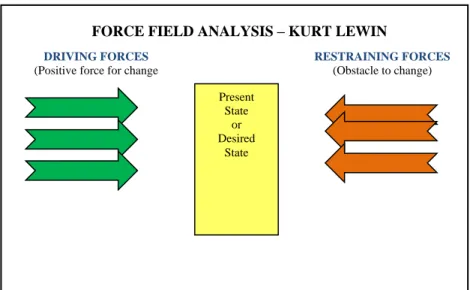
This study used qualitative approach. Qualitative approach allow more detailed collection of information of an object to see the meaning of the object and understand a phenomenon. This study used primary data. The data collection methods were observation, interview, and questionnaire distribution. The research population is all Batik SME businesspeople in Medan, totaling in 5 (five) people. The sampling technique was Non Probability Sampling which is saturated sample or census due to a small population. Therefore, the researcher decided to use the entire population as sample in the present study. The data analysis technique was Force Field Analysis (FFA) which was developed by Lewin and is broadly used to inform decision making, especially in planning and implementing organizational change management program. According to Narayanasamy in Adhanita (2013), FFA is used to find and analyze strength which can influence situation and cause positive change. The main problem in cause and effect analysis (Fishbone) is the objective in FFA analysis. Strength and opportunity and weakness and threat are then classified by scoring based on actual condition. Both factors will be key in analyzing how far we can affect and make change to better situation. Below is Figure 1 which is a diagram of Force Field Analysis:
Figure 1. Diagram of Force Field Analysis
Source: Narayanasamy, in Adhanita (2013)
According to Sianipar and Entang in Fatih (2010), the stages of Force Field Analysis (FFA) are: First, identifying problem by strategic issue. Strategic issue may be about institutional aspect. The aspects can be used
to identify problems in Batik development. The problems are grouped for analysis. Second, analyzing problem
by identifying various driving forces and restraining forces. The driving and restraining factors are scored. Score is give based on the following aspects: First, urgency or weight of factor in achieving performance. Second, support or contribution of each factor in achieving performance. Third, relation between factors in achieving performance.
IV. RESULT AND DISCUSSION Problems of Batik SMEs in Medan
The problems faced by Batik SMEs in Medan include problems of craftsmen, entrepreneurs, materials and equipment, government support and consumers. The problems with craftsmen were in the limited number of craftsmen, lack of skill and creative labor, and lack of understanding of the art of Batik. The problems with entrepreneurs were totality in entrepreneurship, lack of entrepreneurship spirit and motivation, and lack of creativity (Lubis et al., 2016; Sadalia et al., 2017; Azlina et al., 2017 & Nasir et al., 2017). The problems with materials and equipment were difficulty procuring Batik materials and equipment, dependence on materials and equipment from Java and chemical dye. The problems with business network and market penetration were not having any clear market segment and market target, simple distribution line and suboptimal promotion. The government didn’t fully support Batik businesspeople and customers, especially in Medan, didn’t know and like Medan Batik, causing more issues in developing Batik SMEs in Medan.
Supporting and Restraining Factors of Batik SME Development in Medan
Considering the problems of Batik SME development in Medan, the driving factors and restraining factors of Batik SMEs in Medan are identified in table 1 below:
Table 1. Driving Factors and Restraining Factors of the Development of Batik SMEs in Medan
Driving factors Restraining factors
1. Existence of Batik as a cultural heritage
2. Uniqueness of product which uses North Sumatran ethnic motives
3. Promotion 4. Local attraction
1. The number and availability of Batik craftsmen
2. Totality of entrepreneurship 3. Batik materials and equipment 4. Market penetration
5. Government support 6. Customer
7. Competition with Javanese and Malaysian Batik
Source : Processed primary data (2016)
FORCE FIELD ANALYSIS – KURT LEWIN DRIVING FORCES
(Positive force for change
RESTRAINING FORCES (Obstacle to change) Present State or Desired State
Force Field Analysis
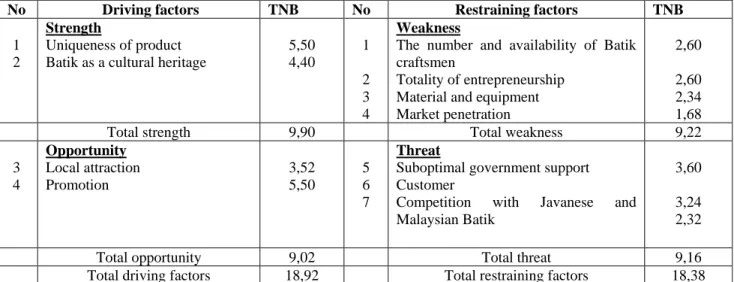
Force Field Analysis (FFA) technique states that a system in balanced condition happens because the factors acting in the system are balanced (Sianipar and Entang in Fatih, 2010). Factors acting in the system consist of driving and restraining factors. Driving factors reinforced balance to the desired, i.e. strength and opportunity. Restraining factors will inhibit balance from the desired by weakness and threat. The descriptions of driving and restraining factors and their driving and restraining values are shown in table 2 below:
Table 2. Identification of Driving Factors and Restraining Factors of the Development of Batik SMEs in Medan
No Driving factors TNB No Restraining factors TNB
1 2
Strength
Uniqueness of product Batik as a cultural heritage
5,50 4,40 1 2 3 4 Weakness
The number and availability of Batik craftsmen
Totality of entrepreneurship Material and equipment Market penetration
2,60 2,60 2,34 1,68
Total strength 9,90 Total weakness 9,22
3 4 Opportunity Local attraction Promotion 3,52 5,50 5 6 7 Threat
Suboptimal government support Customer
Competition with Javanese and Malaysian Batik
3,60 3,24 2,32
Total opportunity 9,02 Total threat 9,16
Total driving factors 18,92 Total restraining factors 18,38
The table above shows driving and restraining factors in force field analysis. Based on analysis of driving and restraining factors, the total weight value (TNB) of all driving factors is 18,92 and the analysis of restraining factors is THB of 18,38. The total of driving factors is 18,92, bigger than the total of restraining factors of 18,38. Therefore, the development was moving toward a positive direction, meaning Batik SMEs in Medan had prospective market opportunity.
The key factors of Batik development in Medan can be determined by determining Key Success Factors (FKK). FKK is obtained from variables of driving factors and inhibiting factors which have the biggest weight. The analysis result showed FKK in Batik development as presented in table 3 below :
Table 3. Key Success Factors of Batik SMEs
Driving factors Restraining factors Strength Uniqueness of product Weakness totality of entrepreneurship Opportunity Promotion Threat Government support Source : Processed Primary Data (2016).
Identification and Solution in Batik Development in Medan
Medan is a city with high diversity and has started to develop ethnic Batik. Although Batik isn’t a native culture of North Sumatera, especially Medan, in the past few years, Batik has started to grow. The uniqueness of Medan Batik is in the ornamental motive combined with ulos motive from various tribes in North Sumatera. Batik motives are customized with five Batak ethnicities in NORth Sumatera which are Mandailing, North Tapanuli (Toba), Simalungun, Karo, Pakpak Dairi and Central Tapanuli. The motives of the five Batak
ethnicities include Batak ulos patterns, such as Hari Hara Sundung Di Langit motive which shows
characteristics of Batak Toba and Pani Patunda motive from Simalungun. There are also Malay motives such as
Pucuk Rebung, Semut Beriring, and Itik Pulang Petang. Toba motives consist of Desa Nawalu, Gorga Sitompi.
Batak Mandailing’s Matahari motive is also developed as a motive of Medan Batik. After seeing four key success factors of Medan Batik development, some solutions and activities were suggested to develop Medan Batik, including: First, product uniqueness was strength to develop Medan Batik. Considering the ethnic motives, Medan Batik already has uniqueness compared with Batik from other regions. However, the motives still looked rigid and the color contrast was high, so it seemed that Medan Batik could only be worn for formal events, such as traditional ceremonies, etc.. Therefore, one of the suggested solutions is modifying color
combination to draw customers’ attention, develop more variations of Batik design, and not only making formal outfits but also fashionable outfits, as well as making home decoration products and handicrafts from Batik.
Second, promotion was an opportunity in developing Medan Batik. So far, the market of Medan Batik is limited
to certain groups, such as government agencies, craftsmen, and some organizations in Medan. There were many people in Medan who didn’t know that Medan has Batik. Lack of public knowledge on Medan Batik was due to lack of promotion. The current promotion was limited to participation in local exhibitions held by related departments of Medan Municipal Govenrment. Promotion by social media was also not optimal. A possible solution for this problem was for SME businesspeople to make promotional programs more actively and diligently, such as joining national scale exhibitions independently and not depending on local government, as well as actively promoting via social media to introduce Medan Batik to the general public. UKM businesspeople also should have permanent sale outlet to promote and help market Medan Batik products. Government support in promoting Medan Batik is also very significant. The government could give opportunity to SME businesspeople to join exhibitions at larger scale nationally and internationally, no only submitting SME products without the businesspeople. Third, totality in entrepreneurship was a weakness in developing Medan Batik. = SME businesspeople must have entrepreneurial orientation by being proactive, innovating, and risk taking. SME businesspeople must have strong entrepreneurial mentality. SME businesspeople must be able to create high value products with good quality. Seriousness and totality in making products by learning to innovate and develop creativity were required. Products must have strong characters and follow current fashion development. SME businesspeople must document the motives well because fashion returns every 10 years, customers will look for past motives. Businesspeople also should actively work with certain parties, such as hotels, restaurants, offices in Medan to offer Batik products not only as clothes but also home décor, etc. Therefore, businesspeople should empower craftsmen to be more creative by recruiting workers from other Batik cities. Craftsman communities should be made and responsible coordinators should be appointed to produce multiplier effect in the local community. Fourth, government support was a threat in Medan Batik development. Suboptimal government support in developing Medan Batik was a treat for Batik SME businesspeople in Medan. Today, government’s support, activeness and attention were poor in developing Batik enterprises in Medan, limited to training and local exhibitions, and there was a lack of coaching by related Regional Work Units (SKPDs). Related departments should support and help craftsmen and businesspeople by providing regular training and follow up, as well as giving opportunities for craftsmen and businesspeople to promote Batik in national/international scale exhibitions, e.g. Inacraft, etc. The government should also support Batik by requiring civil servants, private employees, and students to wear Medan Batik on certain days. The problem of difficult to find skilled craftsman could be solved by training street children to make Batik because they have potentials to work and create. The city government of Bogor does this to solve difficulty to get Batik craftsmen. To realize the solutions and activities above to develop Batik SMEs in Medan, a development model was required. The possible model was entrepreneurial orientation-based synergy model to a strategy and actual step for comprehensive development of Batik SMEs in Medan. Synergy can be performed between government, SME businesspeople and academicians:
Figure 2. Entrepreneurial Orientation-based Synergy Model for the Development of Batik in Medan The development of Batik SMEs could happen if there was good cooperation among 3 (three) elements, i.e. government, businesspeople and academician. The elements must be able to work in SME development. In the start up, Batik SMEs still needed supports from the government and academicians. The government was responsible for optimizing the existing SME potentials. There should be policy to help SMEs develop their businesses. Academicians helped through university tri dharma in research and community service to develop Batik SMEs in Medan, such as scientific discussion which invites academicians and SME businesspeople to share their opinions in brainstorming.
Academician
Government
Pro Active
Innovation
Oriented
SMEs
Calculate Risk
Taking
In business growth and development stage, Batik SMES had grown and developed. This was seen in increased production, increased customers, increased turnover and profit. In this stage UKM SMEs were able to contribute to the government and academicians. Contribution which SMEs could give the government is cooperation in training and coaching new SME businesspeople to create new SMEs to improve ocal economy and solve unemployment issue, especially in Medan. Meanwhile, contribution which SMEs could give academicians was becoming reference to improve knowledge based on SME businesspeople’s concrete experiences. To reach growth stage/level, Batik SMEs required entrepreneurial orientation as a business benefit strategy to compete effectively in the market. Entrepreneurial orientation refers to process, practice and decision making leading to new input by having three entrepreneurial aspects, i.e. proactive, innovative, and risk taking. It’s believed to leverage business performance.
In proactive dimension, Batik SMEs should be able to look ahead, introduce Batik products to compete with other Batik products, and anticipate future market demands. In this case, Batik SMEs should promote themselves more actively using social media to introduce products not only to local community. Currently Batik SME businesspeople only rely on the government to promote their Batik products by joining exhibitions held by the government.
In innovation dimension, Batik SMEs should be able to apply creativity to solve problems and opportunities to improve business. As we have seen, one of the problems faced by Batik SME businesspeople was difficulty acquiring materials for Batik production. By innovation, the material problem could be solved by replacing the materials with natural materials which could be found around them. In risk taking dimension, SME businesspeople tend to take bold moves such as entering new markets by working with local government, office, hotel, etc. so that SME Batik products were accepted and worn by them.
V. CONCLUSION
The conclusions of this study were: First, the problem faced by Batik SME businesspeople in Medan consisted of problems with craftsmen, entrepreneurs, materials and equipment, government support and
customers. Second, as cultural heritage, products with North Sumatran ethnic motives and regional promotions
and attractions drove the development of Batik SMEs in Medan. The number and availability of Batik craftsmen, totality of entrepreneurship, Batik materials and equipment, market penetration, government support, customer and competition with Javanese and Malaysian Batik were restrictive factors of the development of Batik SMEs in Medan. Third, based on force field analysis, the highest score showed four key success factors which become strength, opportunity, weakness, and threat. Fourth, uniqueness of product was strength, promotion was opportunity, entrepreneurial totality was weakness, and government support was threat. Five, entrepreneurial-orientation based synergy model could be used as a strategy and actual steps to comprehensively develop Batik SMEs in Medan. Synergy could be performed among government, businesspeople with entrepreneurial orientation and academicians.
VI. ACKNOWLEDGEMENTS
Thanks to the Ministry of Research and Technology of the Republic of Indonesia that has funded this research, therefore this research has a broad impact on the economy and welfare of the people of Indonesia.
VII. REFERENCES
1. Acs,Z., Audretsch, D. (1990). The Economics of Small Firms : A European Challenge. Kluwer Academic Publishers, MA :
Norwall.
2. Adhanita, Septiara. (2013). Development of Jambi Batik Full River Motive as a Form of Contribution to Development. Journal of
Regional Development & Semarang City, Semarang.
3. Azlina, Nur. Amir Hasan, Desmiyawati & Muda, I. (2017). The Effectiveness of Village Fund Management (Case Study at
Villages in Coastal Areas in Riau). International Journal of Economic Research. 14(12). 325-336.
4. Becherer,Richard C. & Maurer,John G. (1997). The Moderating Effect of Environmental Variables on the Entrepreneurial and
Marketing Orientation of Entrepreneur-led Firms. Entrepreneurship Theory and Practice, Fall
5. Brock,W., & Evans,D. (1986). The Economics of Small Business : Their Roles and Regulations in US Economy. Holmes &
Meier Publishers, Teaneck, NJ.
6. Covin,J & Slevin, D. (1989). Strategic Management of Small Firms in Hostile & Benign Environments. Strategic Management
Journal.
7. Dalimunthe, D.M.J.,Fadli, and Muda, I. (2016). The application of performance measurement system model using Malcolm
Baldrige Model (MBM) to support Civil State Apparatus Law (ASN) number 5 of 2014 in Indonesia. International Journal of Applied Business and Economic Research. 14(11). 7397-7407.
8. Demirbag,M., Tatoglu,E., Tekinsus,M., & Zaim,S.(2006). An Analysis of The Relationship Between TQM Implementation And
Organizational Performance : Evidence From Turkish SMEs. Journal of Manufacturing Technology Management.
9. Erlina, Ari Saputra & Muda, I. (2017). Antecedents of Budget Quality Empirical Evidence from Provincial Government In
10. Erlina. Ari Saputra & Muda, I. (2017). The Analysis of the Influencing Factors of Budget Absorption. International Journal of Economic Research. 14(12). 287-300.
11. Fatih, Cholid. (2010). Strategy of Sea Fishery Agroindustry Development in Tuban Regency. J-SEP 4. 3
12. Frishhammar,J. & Horte,S.A. (2007). The Role of Market Orientation and Entrepreneurial Orientation for New Product
Development Performance in Manufacturing Firms. Technology Analysis and Stretegic Management. 22(3). 251-266.
13. Gusnardi, Riadi, R.M., and Muda, I. (2016). Competency mapping and analysis of students competency based on economics
subject national examination and its alternative solutions in state high schools at Pekanbaru. International Journal of Economic Research. 3(5). 2133-2148.
14. Hafsah, M.J. (2004). Small and Medium Enterprises Development Efforts (SMEs). Infokop, 25 Years XX, Jakarta.
15. Handoko, ,Bagus. Sunaryo & Muda, I. (2017). Difference Analysis of Consumer Perception of Motorcycle Product Quality.
International Journal of Economic Research. 14(12). 363-379.
16. Hindasah, Lela. (2011). Survival Strategies and Specific Factors of Small Industry Survival (Empirical Study of Rash, Kasongan,
Bantul, Yogyakarta Proceedings of International Seminar And Call For Papers "Towards Excellent Small Business", Yogyakarta.
17. Hisrich,Robert D., & Peters,Michael P. (2005). Entrepreneurship : Fifth Edition. McGraw Hill Higher Education, New York.
18. Hutagalung, King Bongsu., Situmorang, Syafrizal Helmi., Ramadini, Frida. (2010). Entrepreneurship. USU Press, Medan.
19. Lubis, A.,Torong, Z.B., and Muda, I. (2016). The urgency of implementing balanced scorecard system on local government in
North Sumatra – Indonesia. International Journal of Applied Business and Economic Research. 14(11). 7575-7590.
20. Lubis, A.F., Lubis, T.A., and Muda, I. (2016). The role of Enterprise Resource Plan (ERP) configuration to the timeliness of the
financial statement presentation. International Journal of Applied Business and Economic Research. 14(11). 7591-7608.
21. Lupiyoadi,Rambat. (2007). Entrepreneurship From Mindset ToStrategy. Salemba Empat, Jakarta.
22. Lutfi, M.,Nazwar, C., and Muda, I (2016). Effects of investment opportunity set, company size and real activity manipulation of
issuers in Indonesia Stock Exchange on stock price in Indonesia. International Journal of Economic Research. 13(5). 2149-2161.
23. M,Porter. (2008). Competitive Strategy. New York. Free Press.
24. Megasari, Kartika Ayu. (2014). Identification of the Readiness of Medium Small Scale Industry Competitiveness (IKM)
Footwear In Mojokerto City Facing Free Market. Faculty of Economics and Business Universitas Brawijaya, Malang.
25. Miller,D., P,Friesen. (1984). Organization: A Quantum View, Englewood Cliifs, NJ: Prentice Hall
26. Nasir, Azwir. Yesi Mutia Basri, Kamaliah & Muda, I. (2017). Effectiveness of Potential Tax Region as the Real Local Revenue
Sources in Riau Coastal Area. International Journal of Economic Research. 14(12). 313-324.
27. Nasution, Inggrita Gusti Sari, Yasmin Chairunisa Muchtar and Frida Ramadini. (2014). Impact of Motivation And Ability on
Performance of Woman Entrepreneurs In Online Business Role of Perception And Situational Factor As Moderators. International Journal of Economics, Commerce and Management. 2(12). 1-12.
28. Nasution, Blue. (2013). Free Flow of Skilled Free Workers 2015: Indonesia Must Increase Competitiveness. Bulletin of
International Trade Cooperation, Ministry of Trade Republic of Indonesia Edition I. Jakarta.
29. Nurzaimah, Rasdianto and Muda, I. (2016). The skills and understanding of rural enterprise management of the preparation of
financial statements using Financial Accounting Standards (IFRs) financial statement on the Entities without Public Accountability (ETAP) framework on the implementation of village administration law. International Journal of Applied Business and Economic Research. 14(11). 7417-7429.
30. Pusparini, Hesti. (2011). Creative Industry Development Strategy in West Sumatra. Article Development Planning Postgraduate,
University of Andalas, Padang.
31. Rizal, HB Achmad. (2012). Study on Optimalization Strategy of Forest Land Utilization in South Sulawesi Province (Study on
Optimalization of Strategy of Private Forest Land Utilization in South Sulawesi). Journal of Social Research and Forestry Economics. 9(4)
32. Sadalia, I. Nur Ahmadi Bi Rahamani & Muda, I. (2017). The Significance of Internet Based Financial Information Disclosure on
Corporates’ Shares in Indonesia. International Journal of Economic Research. 14(12). 337-346.
33. Saiman, Leonardus. (2009). Entrepreneurship, Theory, Practice and Cases. Salemba Empat, Jakarta.
34. Sirojuzilam, Hakim, S., and Muda, I. (2016). Identification of factors of failure of Barisan Mountains Agropolitan area
development in North Sumatera – Indonesia. International Journal of Economic Research. 13(5). 2163-2175.
35. Sugiyono. (2013). Business Research Methods. Bandung. Alfabeta.
36. Sulistyastuti, Dyah Ratih. (2004). The Dynamics of Small and Medium Enterprises (UKM) Analysis of Regional SME
Concentrations in Indonesia 1999-2001. Journal of Development Economics, Jakarta.
37. Suliyanto (2015). The Perception of Young Generation On The Development of Batik Tulis In Purbalingga, 3rd Economics &
Business Research Festival. 18(1).
38. Syamwil, Rodia. (2015). Development of Batik-Based Substance Natural Color To Support Tourism District Kendal (Study Case
In Batik Linggo). Proceedings of IENACO National Ceminar. Semarang.
39. T,Lumpkin G., & G,Dess G. (1996). Clarifying the Entreprenuerial Orientation Construct and Linking it to Performance.
Academy of Management Review. 21(1). 135-172
40. Tambunan, T. (2002). Small and Medium Enterprises in Indonesia; Some Important Issues. Jakarta. Salemba Empat,
41. Tarmizi, H.B.,Daulay, M and Muda, I. (2016). The influence of population growth, economic growth and construction cost index
on the local revenue of tax on acquisition of land and building after the implementation of law no. 28 of 2009. International Journal of Economic Research. 13(5). 2285-2295.
42. Tarmizi, HB., Daulay, M., and Muda, I. (2017). Impact of The Economic Growth and Acquisition of Land to The Construction
Cost Index in North Sumatera. IOP Conference Series : Materials Science and Engineering. 180. doi: 10.1088/1757-899X/180/1/012004.
43. Thomas, Zimmerer W., Norman, Scarborough M. (2008). Entrepreneurship and Small Business Management. Salemba Empat,
Jakarta. Ramadini, Frida & Inggrita Gusti Sari Nasution. (2016). The Development Model Of Small And Medium Enterprises In Textile Sector (Batik, Weaving and Embroidery) With Triple Helix In Medan. Academic Journal of Economic Studies. 2(3). 125–140.
44. Wiklund. (1999). The Sustainability of the Entrepreneurial Orientation-Performance Relationship, Entrepreneurship Theory and
Practice, Baylor University.
45. Yahya, I, Torong, Z.B., and Muda, I. (2017). Influence Behavior in Legislature Budget Development of Regions in the Province