Chalmers University of Technology University of Gothenburg
Optimization of the feeder assignment for PCB
assembly machines
Master of Science Thesis in the Computer science and engineering
The Author grants to Chalmers University of Technology and University of Gothenburg the non-exclusive right to publish the Work electronically and in a non-commercial purpose make it accessible on the Internet.
The Author warrants that he/she is the author to the Work, and warrants that the Work does not contain text, pictures or other material that violates copyright law.
The Author shall, when transferring the rights of the Work to a third party (for example a publisher or a company), acknowledge the third party about this agreement. If the Author has signed a copyright agreement with a third party regarding the Work, the Author warrants hereby that he/she has obtained any necessary permission from this third party to let Chalmers University of Technology and University of Gothenburg store the Work electronically and make it accessible on the Internet.
Optimization of the feeder assignment for PCB assembly machines
KRISTOFFER E. WIKLUND
© KRISTOFFER E. WIKLUND, October 2009. Examiner: DEVDATT DUBHASHI
Chalmers University of Technology University of Gothenburg
Department of Computer Science and Engineering SE-412 96 Göteborg
Sweden
Telephone + 46 (0)31-772 1000
Cover:
Machine layout for mounting components onto a PCB, see page 29 Department of Computer Science and Engineering
REPORT NO. xxxx/xxxx
Optimization of the feeder assignment
for PCB assembly machines
KRISTOFFER WIKLUND
The Department of Computer Science and Engineering CHALMERS UNIVERSITY OF TECHNOLOGY
Abstract
This report is part of a master thesis done at Chalmers University of Technology in Göteborg and in cooperation with Valor Computerized Systems. The purpose with the report was to compare different algorithms performance in solving a subproblem in PCB assembly. PCB assembly is about to balance the PCB production between different production lines in a factory. For each line one need to balance electrical parts’ assembly between the machines in the production line. Finally a minimized sequence of the assembly of components is constructed. The subproblem for this thesis has been the feeder assignment problem, where the problem is come up with setup for how and in which feeder slots the components for the production should be placed, for minimizing the production time. The subproblem has been showed to be NP-hard been proven that the Traveling Salesman problem can be transformed to the subproblem.
We have chosen to compare two versions of Local Search algorithms and two versions of genetic algorithms and a simple heuristic algorithm. To obtain a reliable comparison, the solutions are imported into Valor’s software to solve and model a complete assembly machine. Valor’s software has enabled us to obtain the simulated production times. To be able to use the chosen algorithm a new and simplified cost function has been developed.
Our approach has showed that is possible to lower the production time compared to Valor’s current software. To draw a concussion of which algorithm to use is not possible. All five algorithms have given around one percent improvements. One explanation for that is that the simplified cost function has simplified the problem to much so that it is not possible to separate a good feeder assignment hungry against a less good solution.
Keywords: PCB, Assembly, Optimization problem, Feeder assignment, Local Search, Genetic Algorithm, NP-Hard, TSP
Sammanfattning
Denna rapport är en del av ett examensarbete utfört på Chalmers tekniska högskola i samarbete med Valor Computerized Systems. Syftet med rapporten var att jämföra olika algoritmers förmåga att lösa ett utav delproblemen inom kretskortstillverkning. Kretskortstillverkning handlar om att fördela kretskorts tillverkning mellan olika produktionslinjer i en fabrik. För varje linje handlar det om att fördela komponenternas montering mellan maskinerna i en produktionslinje. Slutgiltigt så ska en minimerad sekvens av montering av komponenter konstrueras. Rapporterns delproblem, matar fördelningsproblemet, har varit att lösa hur och i vilka matare som komponenter ska placeras i, så att produktionstiden är minimerad. Delproblemet är bevisat att vara NP-svårt genom att bevisa att Handelsresandeproblemet kan transformeras till delproblemet.
Vi har valt att jämföra två versioner Local Search algoritmer och två versioner av generiska algoritmer och en enkel heuristik algoritm. För att få en trovärdig jämförelse har lösningarna importeras till Valor’s programvara för att lösa och modellera upp en fullständig monteringsmaskin. Genom Valor’s programvara har vi kunnat erhålla simulerade produktionstider. För att kunna använda valda algoritmer har också en egen förenklad kostfunktion utvecklats.
Vår tillgångavägsätt sätt har visat på att det går att sänka produktionstiden jämföra med Valors nuvarande programvara. Vilken algoritm som ska användas går inte att dra slutsatser ifrån då de alla fem ligger på runt en procents förbättring. En förklaring till detta har varit den förenklade kostfunktionen vilket trors ha förenklat problemet för mycket och gjort att bra lösningar inte kan skiljas från mindre bra lösningar.
Nyckelord: PCB, Kretskort, Tillverkning, Optimerings problem, Local Search, Generiska algoritmer, NP-Hard, TSP
Content
Abstract ... I Sammanfattning ... II Content ... III Preface ... V Notations and definitions ... VI List of Figures, Tables and Equations ... VII
1 Introduction ... 1 1.1 Background ... 4 1.2 Purpose ... 12 1.3 Delimitations ... 14 1.4 Local Search ... 14 1.5 Genetic Algorithms ... 15 1.6 Heuristic ... 19
2 The Traveling salesman problem transformation ... 20
2.1 General TSP ... 20
2.2 Placement TSP ... 20
2.3 Feeder bank assignment ... 20
3 Methods ... 22
3.1 Internal structure ... 22
3.2 Time factors ... 24
3.3 Cost function for evaluating feeder assignments ... 25
3.4 Revolver setup ... 27
3.5 Algorithms ... 27
3.6 Lower bound ... 28
4 Results ... 31
4.1 Performance of the algorithms subject to the cost function ... 32
4.2 Relation between cost function and production time ... 33
4.3 Performance of the algorithms to solve the whole problem ... 37
5 Discussion ... 38
6 Conclusions ... 40
7 Future Work ... 41
8 References ... 42
Preface
This Master Thesis was carried out from April 2009 until October 2009 at the Department of Computer Science and Engineering, Chalmers University of Technology in Göteborg, Sweden. Working place for the thesis has been at the R&D department office in Turku, Finland for Valor Computerized Systems. The work has been formulated and supervised by Ph.D. Mika Johnsson at Valor Computerized Systems. Examiner of the thesis is Prof. Devdatt Dubhashi at Chalmers University of Technology.
A special gratitude is dedicated to Prof. Olli Nevalainen at Turku University who has been helping and supervising me, thanks for reading and correcting my report.
I would like to thank Mika Johnsson and Valor Computerized System for giving me the opportunity to work with this thesis’s subject. It has been an interested problem, I am thankful for getting the help concerning my research topic, books and hardware needed when conducting this study.
I also like to thank my loving wife, Marianne, which have supported me during the work.
Turku October 2009
Abbreviations and definitions
AbbreviationsAI Artificial Intelligence
CAD Computer-aided design
GA Genetic algorithm
LS Local Search
PCB Printed circuit board
PMX Partially mapped crossover
RAM Random-access memory
SMT Surface-mount technology
Definitions
Component An electronic element that has one or more connections.
Part Type definition of components, all components of the same part have the same form and specification
Placement Description that a given component needs to be placed on a given position on the PCB
PCB job Description of a set of parts that will be mounted onto the PCB
Feeder Component supply mechanism in SMT machines
Placement head Mechanical arm of a SMT machine that places the components Spindle Mechanical part attached to the placement head for picking and
placing a single component
List of Figures, Tables and Equations
List of FiguresFigure 1, Example of production line ... 1
Figure 2, Machine layout ... 2
Figure 3, Dual Delivery placement machine ... 6
Figure 4, Turret style placement machine [5] ... 7
Figure 5, Sequential Pick-And-Place Machine [5] ... 7
Figure 6, Multi-Head Placement Machine [5]... 8
Figure 7, Multi-Station Placement Machine [5] ... 9
Figure 8, Hierarchy of the problems found in PCB assembly ... 9
Figure 9, Feeder assignment problem ... 13
Figure 10, Roulette wheel ... 17
Figure 11, Ranked Roulette Wheel ... 18
Figure 12, Flow of the experimental tests ... 22
Figure 14, MachineConfiguration class. ... 23
Figure 13, PCB class ... 23
Figure 15, Algorithms classes ... 24
Figure 16, Graphical presentation of PCB-9 in the developed software ... 29
Figure 17, Relation between procedure S and production time for all PCBs ... 34
Figure 18, Relation between procedure S and production time for PCB-1 ... 35
Figure 19, Relation between procedure S and production time for PCB-2 ... 35
Figure 20, Relation between procedure S and production time for PCB-5 ... 36
Figure 21, Relation between procedure S and production time for PCB-8 ... 36
List of Tables Table 1, PCBs in number ... 31
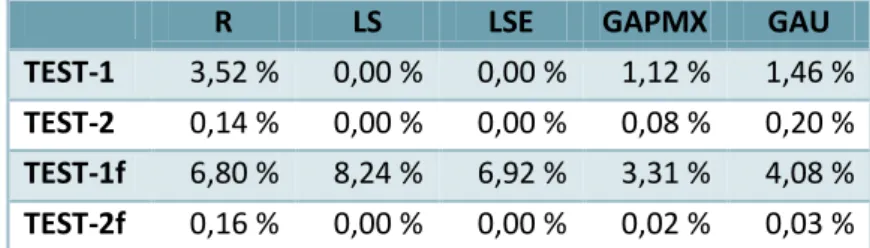
Table 2, TEST results with procedure S ... 32
Table 3, PCB results with procedure S ... 32
Table 4, TSP problem results ... 33
Table 5, Average difference in production time for exact same feeder assignment ... 33
Table 6, Performance of the algorithms solving the final problem ... 37
List of Equations Equation 1, Ranked Roulette Wheel formula ... 17
Equation 2, Total time ... 24
Equation 3, Time for a revolver ... 24
Equation 4, Pick-up phase ... 25
Equation 5, Placement phase ... 25
1 Introduction
Articles about Printed Circuit Board, PCB, [1], [2], almost always discuss the increased demand, new development and increased production volumes in the PCB assembly industry. One common explanation for the rapid development in the field is that citizens own more and more electrical devices and almost each of those devices includes a PCB in it. Design and construction of PCB is very universal and enables almost every possible electrical circuit.
In the early years, the components were assembled manually. But over time, specialized placement machines have taken over the work. Also the way these machines function has changed. In today´s production, the machines often are organized in production lines, where every line comprises of several manufacturing stations.
Figure 1, Example of production line
The stations can include several different or equal assembly machines, inspection stations, oven and more. Duplication of stations can increase the efficiency of production, as shown with the placement machines in Figure 1.
This thesis concentrates on the placement machines and omits the discussion of other machine types. The placement machines can work in different ways, but the main operation principle in all of them is that a mechanical arm picks up an electronic component from the feeder bank and places it on the PCB at a predefined position. To solve this assembly task is a NP-hard problem. The task is to come up with a setup and a placement order for the placement machines such that the production time is minimized.
The mechanical arm could be built in different ways; the most common types are the inline head and the revolver head. On each head there are one or several spindles which are the mechanical parts that pick and place components. In an inline head the spindles are grouped in one or several lines, and in a revolver head the spindles rotate around a center point. In Figure 2 a photo of a common assembly mount machine with revolver head is showed. It is a collect-and place machine with two feeder banks. At position A, one of the feeder banks is located. Another feeder bank is located just below C. At position B the PCB is fixed stationary on the table. The revolver head and how the
spindles are located around it can be seen at C. In the image, the revolver is picking components at the feeder bank and will later go to the PCB at B and place the components and after that go to the feeder bank at A again to pick up some new components.
Placement machines can be classified into 5 categories [3]. The five classes are: Dual Delivery Placement Machine, Multi-Station Placement Machine, Turret Style Placement Machine, Multi-Head Placement Machine, and Sequential Pick-and-Place Machine. Each of these solves the assembly task in a different way. This thesis will discuss how to solve assembly task for Multi-Head Placement Machines.
PCB assembly control problems have been divided into three subproblems in [2]. The first problem is to group the PCBs by the similarity of the components and then choose the machine group/production line. The next problem is to optimally divide the placements of the components between the machines so that there is no big bottleneck machine in the group. The last problem is to decide the feeder, nozzle and placement sequence for each machine.
All these problems depend on each other when one tries to solve them in a total optimal way. In order to know which components a machine should place it is necessary to group the PCBs and machines. For optimal grouping of the PCBs one has to know how to divide the placements between the machines in the group. It is impossible to solve one of these subproblems without considering its relation to the other problems.
This thesis deals with the last subproblem, the feeder arrangement, nozzle arrangement and placement sequence optimization. The problem will be divided into two subproblems. The first problem is to fix the feeder and nozzle bank setting. The second problem is to optimize the placement order with respect to the components and feeder bank. The task in this thesis is to develop, test and compare different algorithms for fixing the feeder and nozzle bank. In order to see how well the solutions really are, one has to solve also the second subproblem. For solving the second subproblem we will use Valor’s planning software to generate a placement sequence and to calculate the total assembly time for that PCB job.
This thesis has the following structure. Chapter 1 explains the background of the PCB assembly research and how PCB assembly works out in the real-life industry. The purpose and delimitations of the thesis is explained and also a description of the algorithms and techniques is given. Chapter 2 will explain how to transform the TSP problem into a PCB assembly problem and show that the PCB assembly problem is NP-hard. Chapter 3 is in detail describing how the problem has been modeled and how we have adapted the algorithms. The heuristics and the formulas we used are presented in this chapter. Chapter 4 describes the results of the practical tests; how well our algorithms run and what works and what does not. Chapter 5 discusses the relation between the methods and the results and how the results relate to the problem. It describes the results and how it refers to the problem. Chapter 6 shows what conclusion one could draw from the results. Chapter 7 discusses how one could do more research on this subject, how to develop the algorithms, how to implement the software tools in the industry and how to improve the algorithms.
1.1 Background
The desire to connect electronic components in an easy way has existed from the early days of electronics. The technique with PCB was invented by Paul Eisler around the Second World War. After the Second World War the technique was released for commercial use. In this technique, copper traces are printed on a non-conductive board, where the traces connect the different components mounted on the board.
A PCB is as the name says a circuit board with a printed electrical circuit. The board is often green in color and has lots of different components mounted on it and it is placed in a machine behind a plastic cover. One can find PCBs in a broad range of customer products including for example computers, cars, phones, dish washer, clocks and more. There are many different types of circuit boards. Components can be attached by through-hole construction or by surface-mount construction/ surface-mount technology (SMT). The material for the board and for the electrical traces can differ. This report focuses not on the construction of PCBs; instead, it focuses on the assembly of components on the PCB. The optimization in this thesis will be made for an SMT-machine, but the results can be applied to through-hole technology as well.
Manual assembly of components on the PCB was the first approach of the technology and it is still used for special cases. As machines have been developed and become more advanced, more and more components can be mounted by the machine with greater accuracy, speed and with fewer faults. As the machines get more and more advanced an optimization problem is risen; how to sequence the component placements in an optimal manner. The same problem exists also for manual assembly, but it is not as critical, instead developing of routines and techniques for lowering the risk of human error have been investigated. [4]
One important thing to keep in mind is the difference between part, component and placement. A component is an electronic element that has one or more connection; this is like an atom for electronics. Part is the type definition for components, all components of the same part has the same form and specification. Placement is a word for describing that a component has a fixed placement position on the board. Therefore a PCB consist of a number of parts that each has one or several placements. A PCB consists of the same number of components that it has placements in total.
Some components that are going to be placed on the board need to be visually verified so that the right component is placed and that the component has the right angle. Therefore machines often have a camera to take a picture of the components. The camera might only take black and white pictures, and many times it just examines the shape of the component. Taking pictures of components can be done in different ways; sometime there is a fixed camera station where the mechanical arm verifies the components before placing them. Other machines can have a moving camera station so
that the verification of components can be done while the arm is moving. There are even more ways of visual verification of the components that the vendors use.
The mechanical arm, the placement head, can be constructed in several different ways but in most cases they are either of inline or revolver type. A placements head has one or several spindles. Spindles are the mechanics for picking up a single component, but in order for the spindle to be able to pick up the component it needs a griping tool. For that purpose the industry has developed different kinds of nozzles for picking and placing the components. It works by using a vacuum of air to suck up a component from the feeder slot and air pressure to place the component on the PCBs. Several kinds of nozzles can pick up the same type of components and nozzles can pick up several different component types. The nozzles have different specifications and they set limitations to the placement head in regard to movement and rotation speed. Special components that are hard to hold also affect the selection of the placement head and give it more limitations. The spindles often have the ability to rotate, which makes it possible to have the right angle of the component when placing it on the PCB.
The difference between inline head and a revolver head is that for an inline head the spindles are grouped in one or more lines. This feature makes it possible to do
gang-picks. In gang-picks several spindles pick up components simultaneous. If two spindles
are picking components at the same time the time is lowered by 50% for that task and if 6 spindles pick their components at the same moment of times the task consumes 16% of the time it would take to pick them up sequentially. In revolver heads the spindles are located in a rotating circle, so that the spindles are rotating around a center point. Some revolver head types have a camera located at the top of the head. This makes it possible to do the camera verification of the component placed on the top spindle while the bottom spindle is picking up a component.
In order to place the components in exactly the right positions there is a set of fiducial marks on the PCBs. After the PCB is loaded to the machine, the head locates the fiducial marks by a camera. This takes some production time at the beginning of processing each PCB but the machines are then able to place components extremely accurately.
SMT machines are equipped with one or several feeder banks. They supply the component to the machine. A feeder bank is divided into several feeder slots which are the mechanical places for holding components. Each slot can be populated with a feeding unit. A common industry feeder unit is the tape feeder. Here the components are attached onto a long tape like a movie theater tape. The placement head picks a component and after this the tape is rotated so that a new component can be picked. There are tapes of different widths, and therefore some parts take up several feeder slots. There are also some feeders that can take two or more parts (i.e. component tape reels) in the same feeder slot.
1.1.1 Machine Classification
As mentioned in the introduction, there are several different types of assembly machines. SMT machines have been classified into five classes [3]: Dual Delivery Placement Machine, Multi-Station Placement Machine, Turret Style Placement Machine, Multi-Head Placement Machine, and Sequential Pick-and-Place Machine. Dual Delivery Placement (Figure 3) has a movable PCB table that can move in x- and y-direction. In the machine there are two placement arms, located on the opposite sides of the table. They can move in y-direction between the placement position and the pickup position over a movable feeder bank. When one arm is placing components the PCB table is moved to its side, and the other arm is picking up components. After the component has been placed, the PCB table moves to the other side there the other arm places its component.
Figure 3, Dual Delivery placement machine
A Turret Style Placement Machine (Figure 4) has a big rotating turret with several spindles on it. On one side of the turret there is a moving feeder bank and on the other side is the PCB table, which moves in the x- and y-direction. The feeder bank is situated on the side of the machine, the spindles pick up components and the moving feeder bank is moved in the x-direction so that the correct part is under the spindle. The PCB table is moved so that the placing position for the component in the spindle is under the spindle and then the component is placed to its proper position.
Figure 4, Turret style placement machine [5]
A Sequential Pick-and-Place Machine (Figure 5) consists of a moving arm. The arm can move over a fixed PCB table, a fixed feeder bank and a fixed nozzle bank. The arm has one spindle that picks up and places components. The placements are done in pick-and-place blocks, where the pick-and-placement head first moves to the feeder bank, picks up a component, then goes to the PCB table and places the component on its correct position.
Multi-Head Placement Machine (Figure 6) is almost of the same technology as the Sequential Pick-And-Place machines. But instead of just one spindle on the placement head it has multiple spindles. These machines are sometimes called collect-and-place machines because they collect a number of components from the feeder bank and then place them on the PCB. Spindles can be arranged into one or several rows or they can be on a rotating revolver. For the revolver head the head needs to rotate the head before picking and placing. Inline heads can perform gang-picks.
Figure 6, Multi-Head Placement Machine [5]
A Multi-Station Placement Machine (Figure 7) consists of several modules or stations. Each module has an arm that can move in x- and y-directions. The arm is picking and placing a limited set of components on the fixed PCB board. When a station has placed all of its components for a certain PCB, the PCB is moved to the next station. This machine is like several Sequential Pick-and-Place Machines in one.
Figure 7, Multi-Station Placement Machine [5]
1.1.2 PCB assembly problem
Mika Johnsson and Jouni Smed [6] have done a hierarchical classification of the PCB assembly problems by looking at it as a combination of one or several machines and one or several PCB jobs.
Figure 8 shows how they have classified the problem, and how it can be broken down into subproblems. This differs to the classification made before [3] and is another way to describe the PCB assembly task.
One PCB job and one machine (1-1). In this problem we have one machine and want to produce one type of PCB as effectively as possible. The goal is to minimize the assembly time. For this setup we have four subproblems. The feeder assignment problem is to organize the parts to the feeder slots in an optimal way so that the travel time is minimized and gang-picks or other techniques can be used. The placement sequence problem is to solve the order to place the components such that the head movement time is minimized. The nozzle assignment problem is to choose the nozzles to be used. The component retrieval problem exists if the machine has duplications of parts in several feeder slots, and it is optimized how the picks should be done.
Many PCB jobs and one machine (M-1). The goal in this problem is to minimize the time for production, but compared to the Single-machine problem one now has to consider the time to setup the machines. There are two possible way to minimize the setup time, either one minimizes the time it takes to setup the machine or minimizes the number of needed setups. The minimizing of setup time for one machine is about hardware and organization on the factory floor. The second problem has been researched and is about grouping and balancing [7]. As Johnsson and Smed [6] write there are different strategies to solve that problem; unique setup strategy, minimum setup strategy, group setup strategy, and partial setup strategy.
The One PCB job and many Machines problem (1-M) deals with load balancing. The goal is to divide the parts between the different machines such that the production time is as equal and low as possible, because the time to produce a PCB is determined by the machine taking the longest time, the bottleneck machine. For each machine there is the (1-1) problem to be solved with the set of parts that the machine should produce.
Many PCB jobs and many machines (M-M) is the most advanced and difficult version of the problem but it is also the problem that is most common in the industry. Here one has to decide the jobs to the different lines and to decide which PCB jobs each line should produce.
The classification that Johnsson and Smed [6] have done is to classify the problem but M Ayob, P Cowling and G Kendal [3] has done a machine classification. The five machine classification can be described into the hierarchy by looking how they work for a single PCB job. Dual Delivery Placement Machine, Sequential Pick-and-Place Machine, Multi-Head Placement Machine and Turret Style Placement Machine are only facing the (1-1) problem as a single machine. For the Multi-Station Placement Machine there is always the need to solve the (1-M) problem, because every PCB is processed by several stations and each stations is like its own machine.
This thesis concentrates on the one machine and one PCB job (1-1) problem for a Multi-Head Placement Machine. There are many parameters and settings for this problem as mention before, but the goal is here to minimize the production time for a single PCB job. Either one could improve the machine with better hardware, like more feeder slots, faster moving/rotating placement heads or maybe more placements head in the machine. This approach is pushed by the machine vendors and it is often the more expensive way. The other way is that one tries to improve the usages of the available resources. There are studies that show that by optimizing the placement sequence or the planning of production one could get an improvement on 10% and up over 50% [8].
To do a realistic model of the problem can be very hard. This is because the machines can differ in many ways between each model and vendor. The movements made by the machine are also very complex; acceleration and deacceleration are non-linear. The arm movement from point A to point B cannot be expressed by a simple formula, neither do the machine vendors have any movement graph to hand out, as it is treated as a trade secret or they simply don’t have it.
But some type of model of the machine is required to solve the problem, and to test the solutions. An important thing to think at is that all machine operations consumes some time. Many times several operations can be done simultaneously which makes that the time for a group of operations is determined by the operation that takes the longest time. As an example; if the placement head needs to moves 4 steps in x-direction and 5 steps in y-direction this movement is done by two moving parts in the machine, one in x-direction and the other in y-x-direction. The time for this is the maximum of the time to move in the two directions.
One need to do some simplification of the problem but if the simplification is done without research, the results of the model could be really bad, so that a solution of the model seems to be very good but in reality it does not work in practice.
Here is a short list of common tasks in SMT machines that take some time: Placement of a component on the PCB
Pick up of a component in feeder bank Movement of the arm into correct position
Movement of the PCB table (for the machine that have it) Rotation of the head
Preparation of the component in feeder slot Changing of the nozzle
Loading and reading fiducial marks of the PCB Rotation of components
assembly. The company has a software tool specialized for line balancing and assembly optimization. In their software one can build up a model of one or several production lines, each line with machines of the markets most common models. Then a production line is created, one or several CAD-drawing of PCB jobs what wants to assembly can be imported. With the help of that software the assembly tasks and components are distributed between the lines and machines. There is also the possibility for letting the software to optimize the distribution of components so that the production time is minimized. The production schedule along with the necessary machine instructions can be sent directly to the SMT machines. The software also produces lists that state there each component is needed. These lists are useful for the workers on the production floor.
In Valor’s software one can optimize different segments of the production. One can optimize the production on a particular line by redistributing the components over the production line. Or one can optimize the allocation of the nozzles and the placement order for each machine. Valor is not solving their tasks to optimally, as they are too time consuming/difficult. But they optimize the production step by step for finding better solutions. For knowing when to stop they have some criteria when a final solution is good enough, like; if the improvement after one minute of searching is less than half percent the search is stopped.
1.2 Purpose
The purpose of the thesis is to examine and evaluate different algorithms and heuristics for a Multi-Head Placement Machine with a rotating head, like the Universal Instruments, Genesis GC60 [10]. The focus of the thesis is on the single machine problem (1-1), one machine and one PCB job. The goal is to minimize the total time it takes to process a specific PCB job with a specific machine. The algorithms are evaluated for several PCB jobs.
The task is graphically showed in Figure 9. There is one PCB with a number of parts and each of them with a number of placements. Each part is supplied in a feeder slot. There could be one or several feeder banks. There can be one or several placement head and each of them has a number of spindles. The spindles need a nozzle from the nozzle bank in order to pick components. Each component type needs a specific nozzle type for picking. The task is to minimize the travel time.
We will not try to solve all subproblems, Nozzle arrangement, Feeder assignment, Placement sequence, Component retrieval. We consider the nozzle arrangement and the feeder assignment problems, only. But to know how well our solutions are we need to solve the placement sequence and component retrieval for calculation the total production time, because it is the total production time for a PCB job that’s interesting and relevant.
We use Valor’s software to solve the placement sequence and the component retrieval and to simulate the total assembly process. We will import a feeder assignment and a nozzle bank setup that the proposed algorithms find, into Valor’s software, then the placement sequence and component retrieval is solved, the production time is calculated thru Valor’s software. Valor’s software also has the possibilities to solve the assignment problem and the proposed algorithms are compared to Valor’s solution.
We will not be able to use Valor’s software to evaluate each solution candidate as Valor’s software takes around 1-10 min to solve the placement sequence and the component retrieval. It is not possible to use so long time in a Local Search algorithm that tests thousands of candidates.
We will therefore develop a simplified cost function for the feeder assignment problem. The cost function should give similar results as the final modeling but it should be faster to calculate. An important thing with the cost function is not that its outcome is precisely the same as the result from the final model, but it should reflect the relation between a good and a bad solution. So that a good final solution will have low value and a bad final solution will have high value of the cost function. One task in creating solution algorithms for feeder assignment problem is therefore to design a good cost function.
This means that this thesis has two goals. The main goal is to compare different algorithms for the nozzle and feeder bank setup. But to get good results a good cost function is needed.
1.3 Delimitations
For not letting the task be too big and hard to examine there is some delimitations. The simplified cost function is one thing, as it models the problem in a simplified way. We will only work with Multi-Head Placement Machine with a revolver head. The assembly is modeled in a perfect world with no miss picks (the nozzle fails in pick up a component), tool malfunction or component shortage. The time for loading a PCB and reading fiducial marks is omitted and we thus support that the PCB is already properly fixed on the table. Rotating of components is also not considered.
The algorithms and models will be just for revolver head machines and not for inline head machines, as production time for inline head machines are very affected by gang-picks which the revolver head model don’t capture.
We will just exanimate the situation with only one PCB job at a time. So the minimizing is just for one PCB at time not a group of PCB’s.
1.4 Local Search
Local search algorithms improve a candidate solution of the problem by looking into “nearby” solutions. It is a very general technique that could be used for solving almost any computationally hard problem, [11]. This technique can be found out in real world where it is quite common to improve a solution just by doing small changes that improve the overall performance. For an example, one can make an initial plan of the day and then during the day one can realize that if one buys the food before one picks up the kids from daycare one could earn five minutes of time. Here we did a local search step. It is the same for computationally hard problems. The algorithms work by starting with some initial solution, and then they try different solutions that are just small modifications of the current solution. In some cases the total fitness don’t have to be calculated again, like in the day planning example, if the change saves five minutes the whole day don’t need to be recalculate to see that the plan is five minutes shorter. But in some other problems this is not as easy as this fitness calculation may be very complicated. Nevertheless this technique has worked very well and it is able to produce good solution in short time. [2].
One problem with local search algorithm is to know what a nearby solution is. When a minimum on a graph is to be found the nearby solution is the position before and after the current position. In other cases the solution may be a list of numbers or a matrix of data that is encoded in different way and a nearby solution might sounds strange. The definition of nearby solution is not strict so one is able to define it as it fits the problem. In the case there the solution is described as a list of number a nearby solution could be
the case there the solution is a matrix a nearby solution could be a rotation of a group of cells.
With local search the solution eventually reach a local minimum, where every nearby solution is worse than the current one. There is no way for knowing that the solution of a local search algorithm is a global minimum. There are different approaches to get out of local minimum in order to find the global minimum. The easiest way and a rather powerful technique are to run the local search algorithm several times with different initial solution and chose the best local minimum found. Another technique is to give the solution potential energy, where the solution gets more kinetic energy as it moves to better solutions. The algorithm is also able to take a worse solution if it has enough kinetic energy, but in that case the kinetic energy of the solution is decreasing. This is a model how a ball is rolling down a hill and how it comes over some small obstacle in its way to find its lowest potential energy. A more common and used technique is the simulated annealing that Metropolis, Rosenbluth, Rosenbluth, Teller and Teller presented 1953 [12]. The report describes how to model steel annealing and how the energy is described. The key formula is the Boltzmann factor; . In local search algorithm that adapts this thought, a better solution is always accepted. A worse solution is accepted with the Boltzmann factor, [13], where E is the solutions fitness, k is a constant and T is the “temperature” that decreases by time.
One problem when choosing nearby solution is to know how many solutions are nearby solutions. If more solutions are examined in every step the algorithms are more likely not to end up in a local minimum. As more solutions are checked it takes more time. 2-opt search or k-opt search is used commonly in local search algorithms. It is an easy technique where the optimal solution is just a permutation of a working solution. The 2-opt search works by switching two nodes/tasks/points, and this can be done for every combination of two nodes/tasks/points. If one has a list of values as the solution a 2-opt step is to swap each pair of two values. The k-opt search is similar to 2-opt search but instead of testing every combination of 2 values, k different values are check in every combination. For some problems a higher k could give better result but for some problems 2-opt search works better because there are possibilities to exanimate more initial solutions in the same amount of time.
1.5 Genetic Algorithms
Genetic algorithm, GA, is used to imitate the nature and its amazing way to adapt to the environment. The technique is to convert a solution into a chromosome like a DNA sequence. After that the genetic algorithm simulates how a population is evolving by letting good solutions survey and bad solutions die.
This is a description on how a standard GA is build [14], but variation often occurs.
For a number of generation
For a number of new chromosomes
Select two parents according to a parent selection formula
Let the two parents breed a new chromosome thru crossover Mutate the new chromosome
Add the new chromosome to population
End for
Select which chromosomes that survives until next generation based on theirs
fitness
End for
Return best chromosome as the algorithm solution
GA has been mathematically characterized by Holland [15]. He gives the so-called schema theorem. It states that GA is looking thru different combinations of solution space. He also shows how GA finds more fitted schemas over time, but he cannot prove that an optimal solution will be found.
GA is widely used in solving AI problems. It has often been proven to give good experiential results. It has been used for solving assembly mount problem before, [16]. It almost every time has the capacity to find the optimal solution but for the most times it also takes the longest time, therefore it is not perfect for every situation.
1.5.1 Fitness function
GA needs a way to measure its chromosomes and different a good solution and a bad solution. Therefore there is a need of a fitness function, which takes a chromosome and gives a value of how well it works. Sometimes there is a simple function to calculate it but if the GA’s task is to find a good chess player the fitness value may be the result then solutions play against other chess players. The fitness value could be on a fixed scale or it could be scaled so that the fitness values for all chromosomes are between fixed values.
1.5.2 Initialization
The first step in GA is initialization. The goal for the initialization is to create a starting population that contains as various chromosomes as possible, because it is from the starting population the optimal solutions is evolving from. New chromosomes are often created purely on random way with no logic; this guarantees that the population is diverse. But a purely randomized chromosome population will in most cases give very bad fitness and it takes more generations for the chromosome population to contain good solutions. Therefore the created chromosome can be made by some greedy approach or heuristics.
1.5.3 Parent selection
For choosing which parents that should be mated there are different approaches. Just picking parents randomly is not working so well, it has been shown that if the better
fitted chromosomes are picked with higher probability the genetic algorithm find the good solutions faster. Roulette wheel is one way to capture this. Each chromosome gets a percent of a roulette wheel according to its percent of the total sum of fitness. This is graphically showed in Figure 10, and now a ball is rotating for a randomized length round the roulette wheel and where it stops that parent is selected. Here a good parent is chosen with a higher probability than others. This technique works well for many applications but it has problems to make difference between chromosomes if the fitness values are close to each other. Further, if one chromosome takes up all space in the Roulette Wheel the diversity is lost. Ranked Roulette Wheel is therefore constructed. Instead of using percent of total the fitness, Equation 1 is used where p is the percent of roulette wheel, r is the rank of the chromosome in the population and n is the number of chromosomes in the population.
Figure 10, Roulette wheel
If the same chromosomes as in Figure 10 are used for Ranked Roulette Wheel the wheel looks like Figure 11. There, the worst chromosome 7 to 10 doesn’t get so much percent in the ranked roulette wheel and the top solutions get more percent. This approach is also suited if the chromosomes vary very much. If a chromosome takes up 90% of a Roulette Wheel in the first method, it will get much lower percent in Ranked Roulette Wheel so that more diverse chromosomes can be produced.
Equation 1, Ranked Roulette Wheel formula
Roulette Wheel
Chromosome 1 Chromosome 2 Chromosome 3 Chromosome 4 Chromosome 5 Chromosome 6 Chromosome 7 Chromosome 8 Chromosome 9 Chromosome 10Figure 11, Ranked Roulette Wheel
Tournament selection is another method of selection. As it is describe in [17] the chromosome in the current population is competing to be in the mating pool. A number of chromosomes (usually 2) are selected randomly from the population and the best one of these is added to a mating pool. The same action is repeated until the mating pool is full, and then the parents for mating are selected by random from the pool.
1.5.4 Crossover function
The actually breeding is done in the crossover function. How the crossover is done depends on how the chromosomes are encoded. If the chromosomes are permutations it is a little bit tricky to get permutations as new chromosomes. If the chromosomes are not permutations the easiest way to breed new chromosome is the single point crossover. Take a position by random and for the positions before the random position take the genes from first parent and for the genes after the random position take the genes from the second parent. For example if we breed two parents, P1 = {11101101} and P2 = {01010111} and have the single point at three the new child is C = {11110111}, but there is also simple to breed a second child as {01001101}. Instead of a single point crossover, there could be two (or more) point crossover, and for each point switch between the parents. For example with a 2-point crossover with the prior parents the result for crossover point at 2 and 5 would be C1 = {11010101} and C2 = {01101111}. Uniform crossover chooses for each position a gene by random choosing which parent it will be copied from. This makes it possible for every type of combinations of two parents to be found. For the single (and more) point crossover there is a limit. For example the single point crossover could just generate 16 different outcomes from two parents with 8 genes and the Uniform crossover could generate 256 different outcomes. This number is smaller than the two parents have some genes in
Ranked Roulette Wheel
Chromosome 1 Chromosome 2 Chromosome 3 Chromosome 4 Chromosome 5 Chromosome 6 Chromosome 7 Chromosome 8 Chromosome 9 Chromosome 10
common. But with Uniform crossover it is more likely that the method destroys a sequence of genes that are good as a group.
The algorithms above don’t work if the chromosome is a permutation. For example if P1 = {12345678} and P2 = {345678123} and a single point crossover at position four the new chromosomes would be C1 = {12348123} and C2 = {34565678}, and this is not a permutation of the solution. A way to overcome this is the Partially Mapped Crossover, PMX, describe in Goldberg and Lingle [18]. This is how it works:
Randomly select a span of genes from P1 and copy them directly to the new chromosome. Note the indexes of the segment
Looking in the same segment positions in P2, select each value that hasn't already been copied to the child.
For each of these values (a):
(i) Note the index of this value in P2. Locate the value, V, from P1 in this
same position.
Locate this same value in P2
If the index of this value in P2 is part of the original span
Go to step i. using this value.
Else
Insert (a) value into the chromosome in this position.
End for
Copy any remaining positions from P2 to the chromosome.
1.5.5 Mutation
Mutation is sometimes necessary in order to find new chromosomes and nature is using this. It is a simple step where the new chromosome undergoes a small change. So by random a small part is changed or swapped.
1.5.6 Survival
The way to choose which chromosomes survive until the next generation can be done in different ways. One way is that only the two children after each reproduction survive. But a more effective way is the elitism. It says that the best chromosomes always survive. So, if the new chromosomes are worst than the parents, the parents are kept in the population. With the elitism the best (and sometime the optimal) solution is kept to the end.
1.6 Heuristic
Heuristic is the method to do choices based on experience rather than proof [19]. This knowledge is based on knowing the problem and the experiment of what works and don’t. This could be used in chess playing to assume that some opening is better than other. For solving the feeder assignment problem heuristic way stats that is better to pack the components in the feeder bank, because that will lower the placement heads movements.
2 The Traveling salesman problem transformation
When this problem was investigated and constructed, two different approaches for transforming the travel salesman problem (TSP) into assembly mounted problem were found. TSP is known to be a NP-hard problem [20]. The following description proves that the surface mounted PCB problem is NP-hard in two different aspects.
2.1 General TSP
The TSP problem is an old problem about a salesman’s travel. It is not known when it was first introduced but there are writings about the problem from the 1800 century [20]. The problem is to visit n different cities where the distance between the cities are known and the goal is to minimize the total length to visit every city once and only once and then back to the starting city.
2.2 Placement TSP
For transforming a TSP problem into a placement problem the revolver capacity is set to n, so that the revolver has n spindles. Now, locate a feeder slot at the first cities position, for the rest of the positions set them as a placement position for one particular part. The assembly problem is now to pick n-1 components in the feeder slot and then place the components in the different placement positions. If the problem can be solved optimally in the assembly problem the solution could easily be transformed back as a solution to the TSP problem. Therefore if it exist a polynomial time algorithm for the assembly problem, a TSP could be solved in polynomial time, this shows that the assembly problem is at least as hard as TSP, in other word it is NP-hard.
2.3 Feeder bank assignment
In assembly mount problem, a revolver needs to pick-up components in different feeder slots and then place them at the PCB. Each component has a required nozzle that needs to be in the revolver head in order for the revolver to pick up the component.
In order to transform the TSP problem to a feeder bank assignment problem create n
components each with a unique part number and one placement each. Each of the components has a unique nozzle which means that the revolver head will be populated with n nozzles. Make the revolver head fixed so that the nozzles in the spindles are always the same which leads to that the pickup order of the components will be the same for ever feeder assignment. Create n feeder slots and give the feeder slots the same positions as the cities. There will therefore be n feeder slots spread out as the cities. With the assembly cost function there is a small modification. The calculation for the placements of components will not be included, just the pickups. So the pickup order and cost is calculated as:
Move head to feeder banks slot for the components which requires the nozzle in the last spindle head
Find feeder slot that have the component that require the nozzle that’s in the current head
Increase the Cost with the Euclidean 2D distance between previous position
and position for the feeder slot related to current head.
Update position to the current feeder slot
End for loop
With this procedure the cost of a TSP problem is possible to calculate. Each feeder slot has a component that indicates in which order it will be visit. So instead of a list in which the cities should be visit (as usually with the TSP) each feeder slot will have a component (number) which tells in which order it will be visit.
Therefore if an optimal solution is found in the feeder bank assignment problem the result can be transformed back to a TSP solution. The assignment problem is NP-hard because it is as hard as TSP to solve.
3 Methods
The algorithms for feeder assignment problem are compared by making a set of experimental tests. These tests follow the flow of Figure 12.
Figure 12, Flow of the experimental tests
The first four steps are done in the new proposed optimizing program and the last three steps are preformed in the existing software from Valor. The whole test procedure is scripted in Valor’s software but the actually feeder optimizing is done thru a binary file outside Valor’s software. This test procedure of the system model is repeated for every setting of the parameter.
3.1 Internal structure
The model of the problem instances consists of three blocks / classes. The MachineConfiguration model contains all the information needed to describe a machine. Second the PCB model describes the PCBs. Third the Optimizing is a class that is inherited by each algorithm. Figure 14 shows how the MachineConfiguration is modeled. MachineConfiguration is the main class that implements a machine having a number of NozzleBanks, Revolvers and FeederBanks, each with its own attributes. MachineConfiguration contains the information on how to populate the feeder banks for Valor’s software.
Import Valor Machine data and
PCB setup
Choose the feeder assignment algorithm and its
parameters Optimize the feeder assignment according to the cost function Write feeder assignment into setup file
Load Setup file into Valor's
software Optimize
placement order Write the total
production time into file
Figure 14, MachineConfiguration class.
The PCB structure is described in Figure 13. A PCB has several components and each of them is of a specified Part type. Each component can be described as a placement and all components have a RefDes, Reference Description, which is the unique name for its placement. This description is sometimes printed in text on the PCB. The algorithms are build around an Optimizer class from where they inherit functions and also overload the optimize function, see Figure 15. Each algorithm is loaded with a MachineConfiguration for description the setup to optimize. If a certain part already has been placed in the feeder slots or the revolver head is populated, this is considered by the proposed algorithms. After the optimization is done the results are exported. Except for these classes there is also a data structure that records static relations and lookup tables. That data structure states what type of nozzle each part needs to be picked with, what kind of feeder group a part is stored in and also some other look up tables for speeding up the optimization. The cost function has its own class for calculating the feeder assignment cost. The cost function takes a MachineConfiguration as parameter and calculated the cost for determinate how well a solution is. How the cost is calculated is described below.
Figure 13, PCB class 1 * 1 * +Name +Profile PCB +Location : Position +Angle +RefDes Component +IPN : TPart Part * 1 *1 1 * 1 * 1 * * 1 * 1 * 1 +Import() +Export() +Name : String +TablePosition : Position +TableHeigth : Integer +TableWidth : Integer +Camers : Position MachineConfiguration +Name : String NozzleBank +Nozzle : TNozzle +Location : Position +Name : String NozzleBankSlot +Name : String FeederBank +Name : String +PickTime : Integer +PlacementTime : Integer +MovementTime : Integer
Revolver +Location : Position
+Width : Integer +Feeder : String +FeederGroup : String +Name : String +ComponentCapacity : Integer +Fixed : Boolean FeederSlot -Nozzle : String -Count AvailableNozzle +Nozzle : TNozzle +Name : String Spindle +IPN : TPart Parts * 1 * 1
3.2 Time factors
As mention in the introduction, there are several time factors in an assembly machine model to consider. This is a list of known time factors.
Loading of the bare PCB Head movements
Recognition of the fiducial marks Component Pick-up
Component Checking Component Placements Change time for nozzles
In the model of this thesis there are some simplifications, but the core thoughts originates from Kallio et al. [21] on a realistic simulator of placement machines. Loading of the PCB and the recognitions of fiducial marks are not considered as this is the same operation for every setup. The total production time for a machine setup is given by Equation 2. Here we recognize that the slowest revolver is the bottleneck of the
Equation 2, Total time
production time. For the calculation of time used by a revolver head, let G be the number of task blocks, number of times the revolver goes from picking components in feeder bank to placing components on the PCB, CCj the time for picking components
+Optimize() : MachineConfiguration
+LoadMachineConfiguration(in MachineConfig : MachineConfiguration) +LoadPCB(in PCB : PCB) Optimizer +Optimize() : BankConfiguration Algorithm1 +Optimize() : BankConfiguration Algorithm2
for task block j, and CPj the time of placing components for task block j. Then, the time for each revolver can be calculated as Equation 3. CCj can be given as Equation 4 where
A is number of components to place, MPij is the time to move to the pickup position of component i in task block j and Pij is the pick-up time for component i in task block j.
CPj can be describe as Equation 5 where A is number of components to place, MIij is the movement time to the placement position for component i of task block j and Iij is the placement time for component i in task block j.
Equation 4, Pick-up phase
Equation 5, Placement phase
3.3 Cost function for evaluating feeder assignments
The quality of the feeder assignment is evaluated by a cost function. As the main focus of this thesis is the solution of the feeder assignment problem the cost function looks on that part of the PCB assembly problem. Therefore the cost function considers the feeder setup, the settings of the revolver heads and the PCB and calculates a cost for it. The cost function does not suppose that the placement problem has been solved optimally. In contrast to that a greedy approach is used. This simple procedure creates a placement order and then calculates the cost for it using the time functions mention above. The reason to trust on a greedy approach for placement order is sufficient due to the simple nature of the cost function. The procedure for evaluating the cost is described as the following pseudo-code and is called S.
ComponentToPlace = Number of components to place for revolver
Cost = 0
CurrentPosition = Center of PCB
While ComponentToPlace is greater than zero
For every spindle in Revolver If first spindle then
F = Component, with matching nozzle as spindle, in feeder bank with most
placements left Else
F = Closest feeder bank with matching nozzle between spindle and component End if
Increase Cost with pick-up time for component in F
Increase Cost with placement time for component in F
Increase Cost with an average time for moving between placements Update CurrentPosition to feeder slot F.
Decrease ComponentToPlace
End for
If revolver needs to verify some components in a camera station Increase Cost with movement to camera Station
Update CurrentPosition to camera station
End if
Increase Cost with movement to average position for component in the first
Nozzle
Update CurrentPosition to average position for component
Increase Cost with movement to center of PCB
Update CurrentPosition to center of PCB
End while
As can be seen there is no consideration of the placement position in S except for the first component in every task block. This is because the placements can be done in many different ways and therefore that sequence is excluded. The average time for moving between placements is analyzed by Valor’s software using several different PCB job.
The time for placements head movements is determinate by the longest axial distance, because the head moves independently in the x- and y-directions. The time in millisecond for the particular machine is the distance in millimeters times 0.5 plus 132. This has been verified from the movement graphs given by Valor, it is not a perfect match but close in the general case.
For evaluating the performance of the algorithms in solving the TSP problems an optimized version of the cost function was developed, named STSP. It is almost the same as the previous cost function, S, but there are some simplifications and the distance calculation are modified to reflect the TSP. The pick-up order in procedure STSP is same as procedure S for TSP problems. The cost is calculated as this:
Find component that needs the nozzle for the last spindle in revolver
Set CurrentPosition to that component’s feeder slot
Set Cost to zero
For every spindle in head
Find component that needs the nozzle for current spindle
Set F to feeder slot for that component
Increase Cost with Euc2D between CurrentPosition and F Update CurrentPosition to F
Distance between positions is calculated with Euclidean distance function for 2D, which
is based on Pythagorean formula, which is used in
general TSP problems.
3.4 Revolver setup
How to populate the revolver head with nozzles in an optimal way is a hard problem, because this depends on two NP-hard problems, the placement problem and the feeder assignment problem. The task in this thesis is to evaluate the performance of our proposed algorithm in Valor’s software. Therefore, the nozzle to head assignment technique that is used in this thesis is the same as in Valor’s software. The technique aims at minimizing the number of task blocks. The algorithm works in following ways:
Populate revolver with one nozzle of each type that is needed for placing the
components
While space left in revolver
Find nozzle with highest ratio, placements with that nozzle / nozzles of that type already in revolver
If two or more nozzle has the same ratio choose the one with the most
placements
Add that nozzle to Revolver
Decrease space left in revolver
End while
Sort revolver by first nozzle type count and second nozzle name
For an example, if a revolver with 10 spindles should place 12 components with nozzle
A and 5 components with nozzle B and 7 components with nozzle C and 1 component with nozzle D the revolver will look like this; 4 of A, 3 of C, 2 of B, 1 of C.
This algorithm does not guarantee the finding an optimal placement order. It is said that it will minimize the number of task blocks to the optimal but this has not been proven.
3.5 Algorithms
Three different algorithms have been developed for solving the feeder assignment problem and also a variation of two of them is tested. The first algorithm is a simple randomized setup algorithm with heuristics, the second applies local search technique and the last one is a genetic algorithm. In order to do a fair comparison of the algorithms, they are run for a limited period of time. This will be achieved by adjusting the number of generations and the number of new starts.
3.5.1 Randomized
The algorithm consist of a loop to generate a randomized feeder assignment and then the feeder banks are packed, meaning that every component is moved towards the center of the feeder bank so that no spaces exist between the components. After that the cost
for the feeder setup is calculated and the best solution is kept. See Appendix 1 for pseudo-code.
3.5.2 Local Search
Local search is performed in a straight forward manner. The neighborhood is rather large; swapping of each pair of feeder slots is tested. If a better solution is found it is kept and the same is iterated until no more single swaps produce a better solution. After that the local search is restarted from a new randomized feeder setup. The algorithm is terminated when the given time limit of the running time is reach. A pseudo-code of the algorithm can be found in Appendix 1. An extended version of local search was also developed, it has the same basic idea as the ordinary local search but after no improvement could be found by swaps, the algorithm tries to invert the order of the components of a group of feeder slots. For an example if we have components in the order <1,2,3,4,5,6,7,8> and we invert the order of components from position 2 to 5 the result should be <1,5,4,3,2,6,7,8>. This operation is done for every position and the length from two to the end of feeder bank.
3.5.3 Genetic Algorithm
The genetic algorithm applies the PMX crossover and ranked roulette wheel selection method. The mutation step consists of randomized swapping of components. One problem that was discovered with an ordinary PMX is that it could not handle the situation where several parts can be stored in the same feeder slot. Therefore a modification of PMX was developed, see Appendix 1. The idea is to use the PMX crossover method and if this creates conflicts they are postponed and solved later. The Uniform crossover method was also tested as a second version. The Genetic Algorithms are run with a population of 100 and with 80 children. The mutation rate is set to 5%.
3.6 Lower bound
For knowing how well the results are, a lower bound algorithm has been developed. The goal was to produce a lower bound function that gives as high value as possible. Let n
be the number of components to place, pp the time to rotate revolver head one step plus the minimum time to place a component, t the number of needed task blocks, c the closest distance between a feeder slot and the center of board, r the number of revolver heads and m the number of placements for the part that have most placements. Then the lower bound can be calculated as in Equation 6.