Constrained Role Mining
Carlo Blundo
DI, Università degli studi di Salerno 84084 Fisciano (SA), Italy
[email protected]
Stelvio Cimato
DTI, Università degli studi di Milano 26013 Crema (CR), Italy
[email protected]
ABSTRACT
Role Based Access Control (RBAC) is a very popular ac-cess control model, for long time investigated and widely deployed in the security architecture of different enterprises. To implement RBAC, roles have to be firstly identified within the considered organization. Usually the process of (auto-matically) defining the roles in a bottom up way, starting from the permissions assigned to each user, is called role mining. In literature, the role mining problem has been for-mally analyzed and several techniques have been proposed in order to obtain a set of valid roles.
Recently, the problem of defining different kind of constraints on the number and the size of the roles included in the result-ing role set has been addressed. In this paper we provide a formal definition of the role mining problem under the cardinality constraint, i.e. restricting the maximum number of permissions that can be included in a role. We discuss formally the computational complexity of the problem and propose a novel heuristic. Furthermore we present experi-mental results obtained after the application of the proposed heuristic on both real and synthetic datasets, and compare the resulting performance to previous proposals.
1.
INTRODUCTION
Complex organizations need to establish access control poli-cies in order to manage access to restricted resources. A simple way to accomplish this task is to collect set of per-missions in roles and then assign roles according to the re-sponsibilities and qualifications of each employee. The Role Based Access Control (RBAC) is a well known paradigm to define and organize roles and permissions in an efficient way. Introduced in the early ’90 years [4, 7],such a paradigm has been investigated for long time and has become recently used in different commercial systems to manage identities and accounts [2]. The goal of RBAC is to collect set of per-missions in roles and define a complete and efficient set of roles that can be assigned to users in order to access re-stricted resources. The advantage is that access control can
be centralized and decoupled from users and the costs and the overhead of the security management can be reduced. The correct definition of the set of roles which satisfies the needs of the organization is the most difficult and costly task to be performed during the implementation of a RBAC sys-tem. Such an activity is often referred to asrole engineering and includes the correct identification of roles from the cur-rent structural organization of the enterprise. Mainly this task, i.e. the extraction of a complete and efficient set of roles, can be performed using two approaches: top-down or bottom-up role engineering. In the first case, roles are de-fined after that the functionalities of the organization have been well defined and studied, and elicitation activities have been performed. The top down approach usually is labor in-tensive and involves a large amount of work and time done by humans especially in large enterprises with a large num-ber of business processes, as reported in some case study are available in the literature [18]. On the other hand, the bottom-up process, often denoted also asrole mining starts from the analysis of the current set of permissions assigned to users, and tries to aggregate them in order to extract and define roles. Obviously, hybrid approaches can exist in which both directions, top-down and bottom-up, can be used in subsequent steps of the analysis in order to refine the returned set of roles.
Bottom-up approach to role mining has been more inves-tigated, since many techniques borrowed from data mining can be applied in an automatic way to the existing config-uration of user-permission assignments. A RBAC system can be easily constructed in this way and a starting set of roles can be fastly generated. The problem with such an approach, is that the quality and the number of returned roles often are not so good, since no semantics is taken into consideration when the role mining process is started. In many situations the returned set of roles might not match any functional organization within the analyzed enterprise and the existing business processes might not be adequately represented. An accurate analysis of the returned results is needed to better tune the retrieved representation of roles to the current organizational requirements of the enterprise. A formal definition of the Role Mining Problem (RMP) and some of its variants has been given and deeply analyzed in [23]. There, the NP-completeness of the (decisional) RMP problem has been proved, and the formulation of RMP as a graph covering problem has been done in [6, 26].
The problem of imposing constraints on the set of roles re-sulting after the role mining process has been considered in the past. Statically or dynamically mutually exclusive roles constraints have been included in RBAC models [19] and in the NASI/NIST standards [7]. According to these con-straints, for examples, no user can be assigned contemporary a given set of mutually exclusive roles, or no user can acti-vate simultaneously a set of roles in the same session. Such constraints are often used as mechanisms to achieve separa-tion of duty principles, preventing one user from having a large number of roles to complete a task, or imposing restric-tions on the minimum number of users needed to perform a critical activity [14].
Recently, a simple classification of the constraints on the cardinality of the number of roles, users and permissions for a given RBAC system has been proposed [15]. The first heuristic taking into account a cardinality constraint on the number of permissions contained in a role has been pro-posed by [13]. In its work, however, the propro-posed results have been compared only on other heuristics which were not able to consider constrained roles. In this work we propose a novel heuristic for mining RBAC roles under cardinality constraint. The algorithm is based on a previous proposal [1], where an initial candidate role set was constructed by considering one role for each user on the basis of the current assignment of permissions. The role set is then refined and updated by eliminating the roles obtained as union of other roles already included in the set and ensuring that the car-dinality constraint is respected. Finally, an optimization of the role set is performed by running a lattice reduction pro-cedure, previously described in [6]. The resulting procedure is very efficient in terms of computation time and quality of returned role set. To this aim we present the results ob-tained by running our heuristics on different datasets, some available over the network, some artificially created. The results are compared with our implementation of the algo-rithm presented in [13] and analyzed in terms of the metrics presented in [17].
The remainder of this paper is organized as follows. In the next section we discuss related works. Section 2 contains the preliminary concepts needed to define the constrained role mining problem and the discussion on its complexity. In section 4 we introduce our heuristics and compare the solution with related work in section 5. Finally Section 6 presents our conclusions and ongoing work.
2.
CONSTRAINED RMP
In this section we introduce theConstrained Role Min-ing Problem and analyze its computational complexity showing that it is NP-complete while its optimization ver-sion is NP-hard.
2.1
Basic Definitions
The notation we use is borrowed from the NIST standard forCore Role-Based Access Control (Core RBAC) [7] and it is adapted to our needs.
We denote with U = {u1, . . . , un} the set of users, with
P = {p1, . . . , pm} the set of permissions, and with R =
{r1, . . . , rs}the set of roles, where, for anyr∈ R, we have
r⊆ P. We also define the following relations.U RA ⊆ U ×R
is a many-to-many mapping user-to-role assignment rela-tion. RPA ⊆ R × P is a many-to-many mapping role-to-permission assignment relation. U PA ⊆ U × P is a many-to-many mapping user-to-permission assignment re-lation. RH ⊆ R × R is a partial order over R, which is called a role hierarchy. When (r1, r2) ∈ RH, we say that
the roler1 is senior tor2.
When needed, we will represent the assignment relations by binary matrices. For instance, by UPA we denote the
U PA’s matrix representation. The binary matrixUPA satis-fiesUPA[i][j] = 1 if and only if (ui, pj)∈ U PA. This means that user ui possesses permission pj. In a similar way, we define the matricesURA,RPA, andRH.
Given the n×m users-to-permissions assignment matrix
UPA, the role mining problem (see [23], [6], and [8]) con-sists in finding an n×k binary matrix URA and a k×m binary matrix RPA such that,UPA =URA⊗RPA,where, the operator ⊗ is such that, for 1 ≤ i ≤ n and 1 ≤ j ≤ m,
UPA[i][j] =Wk
h=1(URA[i][h]∧RPA[h][j]).Therefore, in solving
a role mining problem, we are looking for a factorization of the matrixUPA. The smallest valuek for whichUPAcan be factorized asURA⊗RPAis referred to as the binary rank of
UPA. Acandidaterole consists of a set of permissions along with a user-to-role assignment. The union of the candidate roles is referred to ascandidate role-set. A candidate role-set is calledcomplete if the permissions described by anyUPA’s row can be exacltycovered by the union of some candidate roles. In other words, a candidate role-set is complete if and only if it is a solution of the equation URA⊗RPA. In this paper we consider only complete candidate role-set. By adding a contraintton the number of permissions that can assigned to any roles, thet-constrained role mining prob-lem can be defined, as follows. Given an n×m users-to-permissions assignment matrix UPA and a positive integer t >1, find ann×kbinary matrixURAand ak×mbinary matrixRPAsuch thatUPA=URA⊗RPAand, for any 1≤i≤k, one has |{j:RPA[i][j] = 1}| ≤t. The computational com-plexity of the above define problem will be discussed in the next section.
2.2
NP-Completeness
The computational complexity of theRole Mining Prob-lem (and of some of its variants) was considered in several papers (see, for instance, [23], [3], [6], and [24]). In this sec-tion we define the decisional version of thet-Constrained Role Mining Problemand we show that it is NP-complete (its optimization version is NP-hard). Next we recall the de-cisional version of theRole Mining Problem.
Problem 2.1. (Role Mining Decision Problem)Given a set of users U, a set of permissionsP, a user-permission assignmentU PA, and a positive integerk <min{|U |,|P|}, are there a set of rolesR, a user-to-role assignmentU RA, and a role-to-permission assignmentRPAsuch that|R| ≤k and UPA= URA⊗RPA?
In [23] it was shown that Problem 2.1 is NP-complete. This has been proved by reducing it to theSet Basis Decision
Problem(problem SP7 in Garey and Johnson’s book [9]) which was shown to be NP-complete by Stockmeyer in [22]. The decisional version of thet-constrained role mining prob-lem can be defined, as follows.
Problem 2.2. (t-Constrained Role Mining Decision Problem)Given a set of usersU, a set of permissionsP, a user-permission assignmentU PA, and two positive integers tand k, with t >1 andk < min{|U |,|P|}, are there a set of rolesR, a user-to-role assignment U RA, and a role-to-permission assignmentRPAsuch that|R| ≤k,UPA =URA ⊗RPA, and, for anyr∈ R, |r| ≤t?
To prove that the above defined problem is NP-complete we have to show that it is in NP, that another NP-complete problem, say Π, can be reduced to it (i.e., any instance of the problem Π can be transformed into an instance of the t-Constrained Role Mining Decision Problem), and that the reduction can be done in polynomial time. The problem Π used in our simple proof, is theRole Mining Decision Problem(i.e, Problem 2.1).
Theorem 2.1. The t-Constrained Role Mining De-cision Problemis NP-complete.
Proof. The problem is in NP. Indeed the setRand the matricesURAandRPAconstitute a certificate/witness verifi-able in polynomial time.
Assume we are given an instance of theRole Mining De-cision Problem consisting of a set of users U0
, a set of permissionsP0
, a user-permission assignmentU PA0
, and a positive integerk0<min{|U0|,|P0|}. We show how to trans-form it into an instance of thet-Constrained Role Min-ing Decision Problem. The reduction is trivial. Indeed, it is enough to set U = U0, P = P0, U PA= U PA0, and k=k0 and define
t= max ui∈U
|{pj∈ P:UPA[i][j] = 1}|.
It is immediate to see that the above reduction can be done in polynomial time and that a solution to thet-Constrained Role Mining Decision Problemdirectly provides a solu-tion to the Role Mining Decision Problem. Thus, the theorem holds.
Next we define the optimization version of thet-Constrained Role Mining Problemand we show that it is NP-hard.
Problem 2.3. (t-Constrained Role Mining Optimiza-tion Problem)Given a set of usersU, a set of permissions
P, a user-permission assignmentU PA, and a positive inte-gert, what is the smallest integerk for which there is a set of rolesR, a user-to-role assignment U RA, and a role-to-permission assignmentRPAsuch that|R|=k,UPA =URA ⊗RPA, and, for anyr∈ R, |r| ≤t?
Theorem 2.2. The t-Constrained Role Mining Op-timization Problemis NP-hard.
Proof. The t-Constrained Role Mining Optimiza-tion Problem is NP-hard, because there exists a trivial polynomial time reduction from the t-Constrained Role Mining Decision Problem to thet-Constrained Role Mining Optimization Problem. Indeed, we can use an algorithm solving the optimization problem as an oracle to solve the decision problem simply by checking whether the solution of the associated optimization problem has cardi-nality less than or equal tok.
In [22], Stockmeyer proved that the Set Basis Decision Problem is NP-complete by reducing to it the Vertex Cover Decision Problem(one of Karp’s 21 NP-complete problems [11], see also problem GT1 in [9]). The Vertex Cover Optimization Problemis APX-complete [5], that is, it cannot be approximated within any constant factor in polynomial time unless P=NP. Therefore, we have the following simple non-approximability result:
Theorem 2.3. The t-Constrained Role Mining Op-timization Problem cannot be approximated within any constant factor in polynomial time unless P=NP.
3.
RELATED WORKS
Role engineering has been firstly introduced by Coyne et al in [4] where the definition of a top down process for the def-inition of roles has been discussed. Along the same research line, several other works have been presented [18], but re-cently, the focus of role engineering has turned to consider more automated techniques, based on the bottom up ap-proach, where data mining techniques are applied for the definition of roles [12]. Role mining algorithms have been presented based on set covering [3], graph theory [6, 26], subset enumeration [25], database tiling [23]. The theoret-ical aspects of the RMP have been considered in [24, 23, 3], where the complexity of the problem has been analyzed and its equivalence to other known optimization problem showed. Another interrelated problem, i.e. dealing with the semantic meaning of roles, has been addressed in [16]. Cardinality constraints on the number of permissions in-cluded in a role have been firstly considered in [13], and a heuristic algorithm called Constrained Role Miner (CRM) has been proposed. The CRM algorithm takes in input the UPA matrix and returns a set of roles, each one satisfying the given cardinality constraint. CRM is based on the idea of clustering users having the same set of permissions and se-lecting, as candidate roles, the roles composed of the set of permissions satisfying the constraint and having the high-est number of associated users. In [13], the performances of the algorithm are evaluated on real world datasets con-sidering different metrics (such as the number of returned roles, the sum of the size of the user assignment and permis-sion assignment matrices and so on), with respect to other previously proposed algorithms. However the comparison is performed without considering constraints, since the other algorithms return a complete set of roles but have not the capability of managing constraints. In section 5 we evaluate our proposal against the result obtained after our implemen-tation of the CRM algorithm, considering both real world and synthetic datasets. A different kind of cardinality con-straints, considering the number of user-role assignments,
have been considered in [10]. Such constraints can be useful when the number of persons that can be assigned to a given role (e.g. the number of directors, managers, etc) in a given organization is known or can be fixed. In the paper, three algorithms have been proposed based on a graph approach, where the role mining problem is mapped to the problem of finding minimum biclique cover of the edges of a bipartite graph. The three heuristics are obtained by modifying the basic greedy algorithm proposed in [6], and experimental re-sults on real world datasets are reported considering some constraints on the number of users that can be assigned to any role. Finally cardinality constraints have also been con-sidered in [15] where a representation of the constraints in terms of association rules is proposed: permissions are re-garded as attributes, and each user-permission assignment as a transaction. To generate mutually exclusive permissions constraints, i.e. set of permissions that cannot be assigned to the same role, an algorithm is proposed, based on known techniques for mining association rules in databases, and its performance evaluated on synthetically generated datasets
4.
HEURISTICS
In this section we present a family of heuristics. Each heuris-tic takes as input the matrixUPAand returns a complete role set satisfying the cardinality constraint (i.e., at mostt per-missions are associated to each role). We borrow the ideas from the heuristics presented in [1] and we adapt them to handle the cardinality constraint.
The basic idea is to select from UPA all rows having less thant permissions in an order that will be defined below. Such rows will correspond to candidate roles that will be added to the candidate role-set. If there is no row having at mosttpermissions, then a row is selected and, t of the permissions included in the row are chosen (the way we select such row and permissions gives rise to different heuristics). The selected permissions induce a role that is added to the candidate role-set. Then, all rowscovered by the candidate row-set are removed fromUPAand the procedure is iterated until theUPAmatrix contains some rows.
The above sketched procedure is more formally described by Algorithm 1 where we use the following notation. Given an a×b binary matrixM, for 1 ≤i ≤a, withM[i] we denote the M’s i-th row; while, with |M[i]| we denote the number of ones appearing inM[i]. The proceduresnumCols(M) and numRows(M), return the number of columns and rows, re-spectively, of the matrixM. For a setSand an integerh, the procedurefirst(S, h) returns the firsthelements listed in the setS. Given a user-permission assignment matrixUPA, a new candidate role is generated by selecting a UPA’s row having the least number of permissions with ties broken at random (Lines 6-8 of Algorithm 1). If the number of per-missions associated to the selected row (i.e., the number of ones in UPA[selectedRow]) is at most t, then a new role is created (Line 9 of Algorithm 1). The new role, containing all permissions associated to the selected row, is then added to the candidate role-set (Line 21 of Algorithm 1). In this algorithm, the matrixuncoveredP represents the users’ per-missions that are not covered by the roles incandidateRoles. Once we discover a role (i.e,newRole) to be added to the candidateRolesset, runningsetToZero(see Algorithm 2) we update the matrixuncoveredP according tonewRole.
All rows whose permissions are covered by the candidate roles are removed from both matricesuncoveredP andUPA
(Lines 22-23 of Algorithm 1). removeCoveredUsers’s pseudo-code is quite similar to the pseudo-code for set-ToZero, hence we omit it1. Algorithm 1 halts when all
UPA’s rows have been removed (Line 5 of Algorithm 1). If the number of permissions exceeds the cardinality con-straint, then two possible ways of selecting the role to be added to the candidate role-set have been considered . These two possibilities gave rise to two heuristics referred to ast -SMAR-0 andt-SMAR-1, respectively. Int-SMAR-0 (i.e., whenselectionis set to 0 in Algorithm 1), the new role will simply contain the first tpermissions associated to the se-lected row (Lines 10-11 of Algorithm 1). While, int-SMAR -1 (i.e., whenselectionis set to 1 in Algorithm 1) we select a row (Lines 13-16 of Algorithm 1) of the matrixuncoveredP having the least number of permissions, ties broken at ran-dom. In other words, we select a row (i.e, a users) having the least number of permissions still uncovered. If the selected row is associated to more thantpermissions, then the new role will only include its first tpermissions (Lines 17-19 of Algorithm 1).
Algorithm 2setToZero(UPA, uncoveredP, newRole) 1: np←numCols(UPA)
2: nr←numRows(UPA) 3: fori= 1 tonrdo
4: permissions← {pj: 1≤j≤npandUPA[i][j] = 1} 5: if newRole⊆permissionsthen
6: for alljsuch thatpj∈newRoledo 7: uncoveredP[i][j]←0
8: end for 9: end if 10: end for
11: Remove fromuncoveredP all-zeroes rows 12: return uncoveredP
Algorithm 1 returns a set of roles (i.e., rows and subsets of rows) exactly covering the UPA matrix. As described in [1], instead of covering the matrix UPA using its rows we could use its columns. We refer to such a new heuristic based on columns ast-SMAC. The only difference between heuristicst-SMAR andt-SMAC is the way a role is com-puted. Heuristict-SMAC selects a permissionp(i.e., aUPA column) associated to the least number of users. Setting
U(p) ={u∈ U : (u, p)∈ U RA} (i.e, all users having per-missionp), the rolerpinduced by permissionpis defined as
rp={p0:U(p)⊆ U(p0)} ∪ {p}. If|rp| ≤t, then we add it to the candidate role-set; otherwise, we add to the candidate role-set a role comprising the “first”tpermissions inrp. As for heuristics t-SMAR, rows covered by roles in the candi-date role-set are removed. We iterate this process until the
UPA matrix contains some rows. t-SMAC’s pseudo-code is quite similar to the one fort-SMAR, hence we omit it.
5.
EXPERIMENTAL RESULTS
In this section we evaluate the proposed heuristic by pre-senting some experimental results obtained executing our
1Actually, in our implementation
setToZeroupdates both uncoveredP and UPA, but in Algorithm 1, for the sake of clarity, we prefer to keep separate the updating of such ma-trices.
Algorithm 1t-SMAR(UPA, t, selection) 1: candidateRoles← ∅
2: uncoveredP←UPA
3: np←numCols(UPA)/∗npis equal to the number of permissions∗/ 4: nr←numRows(UPA)/∗nris equal to the number of users∗/ 5: whilenumRows(UPA)>0do
6: m←min{|UPA[i]|: 1≤i≤nr}
7: candidateRows← {i: 1≤i≤nrand|UPA[i]|=m}
8: selectedRow←RcandidateRows
9: newRole← {pj: 1≤j≤npandUPA[selectedRow][j] = 1} 10: if |newRole|> tandselection== 0then
11: newRole←first(newRole, t)
12: else if |newRole|> tandselection== 1then 13: m←min{|uncoveredP[i]|: 1≤i≤nr}
14: candidateRows← {i: 1≤i≤nrand|uncoveredP[i]|=m}
15: selectedRow←RcandidateRows
16: newRole← {pj: 1≤j≤npanduncoveredP[selectedRow][j] = 1} 17: if |newRole|> tthen
18: newRole←first(newRole, t) 19: end if
20: end if
21: candidateRoles←candidateRoles∪ {newRole}
22: uncoveredP←setToZero(UPA, uncoveredP, newRole) 23: UPA←removeCoveredUsers(UPA, candidateRoles)
24: end while
25: return candidateRoles
Dataset #Users #Perms |UPA| min#Perms max#Perms Density
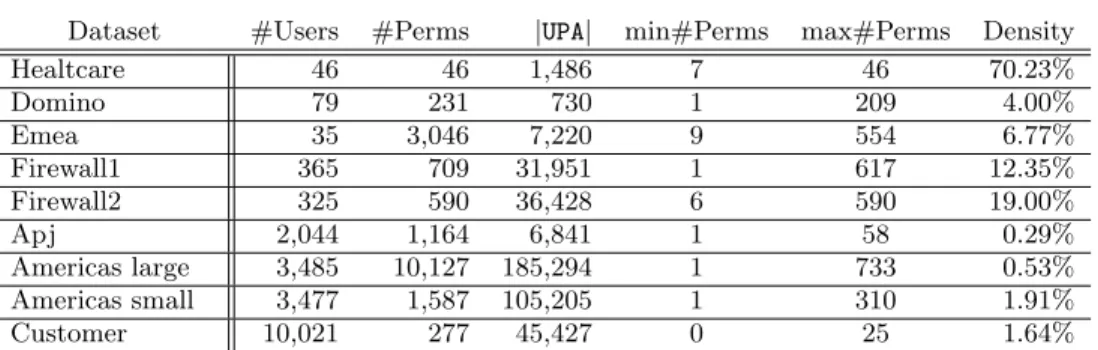
Healtcare 46 46 1,486 7 46 70.23% Domino 79 231 730 1 209 4.00% Emea 35 3,046 7,220 9 554 6.77% Firewall1 365 709 31,951 1 617 12.35% Firewall2 325 590 36,428 6 590 19.00% Apj 2,044 1,164 6,841 1 58 0.29% Americas large 3,485 10,127 185,294 1 733 0.53% Americas small 3,477 1,587 105,205 1 310 1.91% Customer 10,021 277 45,427 0 25 1.64%
Figure 1: Real-world datasets
heuristics on several input test cases and report some com-parisons of their performance to previous proposals. We compare our heuristics with the one described in [13] (from now on denotedCRM). As far as we know, [13] is the only paper to have considered the problem of constructing a role set under cardinality constraints on the roles. In this sense, that is the first comparison between two heuristics dealing with cardinality constraints, since in [13] much of the discus-sion of the experimental results focused on the comparisons with other heuristics having no limitations on the size of the roles.
The comparison takes into account the metrics introduced in [17]. The goal is to validate our proposal, by showing that its performance, regarding both the execution speed and the quality of the returned role set, is equivalent or better than the one returned by CRM. We would like to point out that, using our implementation ofCRM, in some cases we obtained different values from the ones presented in [13]. This could be due to different choices in the two
implementations (for instance, in our implementation, ties broken at random while it is not clear how they are handled in [13]). Moreover, we had to resolve some ambiguities we found in the description of Algorithm 2 in [13].
All heuristics have been implemented by using Scilab [21] Version 5.3.0 on a MacBook Pro running Mac OS X 10.6.7 (2.66 Ghz Intel Core i7, 4GB 1067Mhz DDR3 SDRAM). In the next section, we compare our heuristics with respect to CRM over available real-world datasets; while, in Section 5.2, we present the results obtained running the implementa-tion of the heuristics over synthetically generated datasets.
5.1
Real-world datasets
In this section we compare, on real-world datasets described in Table 1,CRM heuristic with ourt-SMAR andt-SMAC heuristics. Such real-world datasets are available online at HP Labs [20] and have been used for evaluation of several other role mining heuristics [6, 17, 13]. The datasets ameri-cas small andamericas largehave been obtained from Cisco
Parameters
Dataset Heuristic N R |RH| |URA| |UPA| S1 S2 CPU time
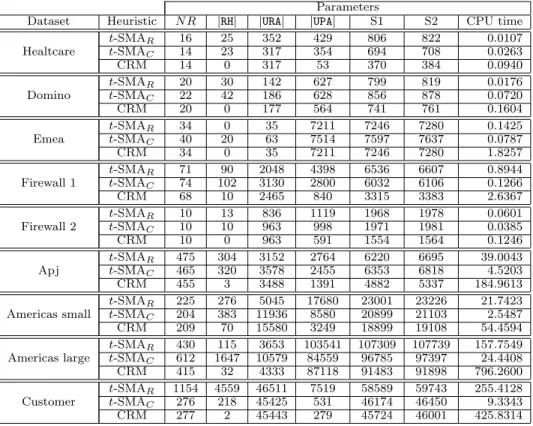
Healtcare t-SMAR 16 25 352 429 806 822 0.0107 t-SMAC 14 23 317 354 694 708 0.0263 CRM 14 0 317 53 370 384 0.0940 Domino t-SMAR 20 30 142 627 799 819 0.0176 t-SMAC 22 42 186 628 856 878 0.0720 CRM 20 0 177 564 741 761 0.1604 Emea t-SMAR 34 0 35 7211 7246 7280 0.1425 t-SMAC 40 20 63 7514 7597 7637 0.0787 CRM 34 0 35 7211 7246 7280 1.8257 Firewall 1 t-SMAR 71 90 2048 4398 6536 6607 0.8944 t-SMAC 74 102 3130 2800 6032 6106 0.1266 CRM 68 10 2465 840 3315 3383 2.6367 Firewall 2 t-SMAR 10 13 836 1119 1968 1978 0.0601 t-SMAC 10 10 963 998 1971 1981 0.0385 CRM 10 0 963 591 1554 1564 0.1246 Apj t-SMAR 475 304 3152 2764 6220 6695 39.0043 t-SMAC 465 320 3578 2455 6353 6818 4.5203 CRM 455 3 3488 1391 4882 5337 184.9613 Americas small t-SMAR 225 276 5045 17680 23001 23226 21.7423 t-SMAC 204 383 11936 8580 20899 21103 2.5487 CRM 209 70 15580 3249 18899 19108 54.4594 Americas large t-SMAR 430 115 3653 103541 107309 107739 157.7549 t-SMAC 612 1647 10579 84559 96785 97397 24.4408 CRM 415 32 4333 87118 91483 91898 796.2600 Customer t-SMAR 1154 4559 46511 7519 58589 59743 255.4128 t-SMAC 276 218 45425 531 46174 46450 9.3343 CRM 277 2 45443 279 45724 46001 425.8314
Figure 2: Results of the three heuristics over the real-world datasets
firewalls granting access to the HP network to authenti-cated users (users’ access depends on their profiles). Similar datasets areapj andemea. Thehealthcare dataset was ob-tained from the US Veteran’s Administration; thedomino data was from a Lotus Domino server; customer is based on the access control graph obtained from the IT depart-ment of an HP customer. Finally, thefirewall1 andfirewall2 datasets are obtained as result of executing an analysis algo-rithm on Checkpoint firewalls. The main characteristics of the nine datasets are reported in Table 1, where we list the number of users and permissions (second and third columns, respectively), the overall number of permissions (i.e.,|UPA|), the minimum and maximum number of permissions assigned to a user (sixth and seventh column, respectively), and the
UPA’s density (i.e., the ratio between|UPA|and theUPAsize – #Users×#Perms).
The considered metrics are: the number of roles (N R), the size of the role hierarchy (|RH|), the size of the user-to-role assignment matrix (|URA|), the size of the role-to-permission assignment matrix (|RPA|), the sum|URA|+|RPA|+|RH| de-noted byS1, the size of N R+|URA|+|UPA|+|RH|denoted byS2, and the execution time expressed in seconds. This is not at all equivalent to real-world time, but we used those data to compare CPU usage among different heuristics as it is irrespective of background processes that might slow down the execution.
We first tested the heuristics when there is no constraint on the role size (i.e., we sett equal tomax#P erms). In this case, in Algorithm 1, setting the parameterselectioneither to 0 or to 1 has no effect on the returned candidate
role-set. The results we obtained by running the three heuristics are listed in Figure 2 where both heuristicst-SMAR-0 and
t-SMAR-1 are denoted byt-SMAR. Both our heuristics be-have pretty well on the nine datasets. Considering the size of the candidate role-set generated by the heuristics, in four cases out of nine (i.e.,Healtcare, Domino, Emea, and Fire-wall 2) our heuristics provide the same results asCRM. In four cases out of nine (i.e.,Firewal 1, Apj, Americas small, andAmericas large)CRM returns a (not so much) smaller role-set. Finally, for theCustomerdatasett-SMAC returns the smallest role-set. Considering the CPU time, our heuris-tics outperformCRM with improvements ranging from 50% to 90%. If we look at parametersS1 andS2 we see that, ex-cept for theEmea dataset,CRM has a better performance. To improve the results we could reduce the size of the role hierarchyRHby running thelattice-basedpostprocessing pro-cedure defined in [6]. According to this propro-cedure, each role r ∈ R containing some other roles is substituted with the roler0, where
r0=r [ rc:rc⊂r
rc.
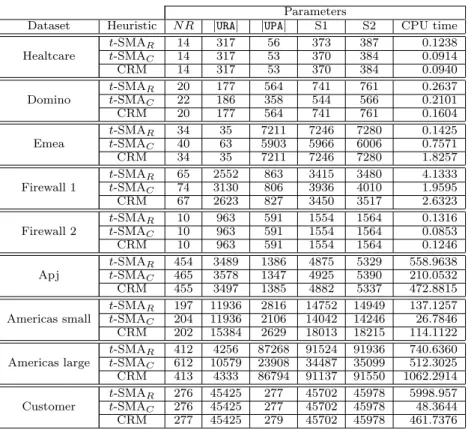
Ifr0is empty, then the number of roles is reduced. The sub-stitutions continue until the lattice is completely flat (i.e., no role contains any other role). After running this procedure, the role hierarchyRHwill be empty implying|RH|= 0. The results obtained by running the lattice-based postprocess-ing processpostprocess-ing are shown in Figure 3. Notice that the above mentioned procedure has not been applied when in Figure 2 we have |RH| = 0. As one can see,CRM never computes a smaller role-set than the one returned by our heuristics. Moreover, considering the parametersS1 andS2, our heuris-tics in three cases out of nine (i.e.,Healtcare,Firewall 2, and
Parameters
Dataset Heuristic N R |URA| |UPA| S1 S2 CPU time
Healtcare t-SMAR 14 317 56 373 387 0.1238 t-SMAC 14 317 53 370 384 0.0914 CRM 14 317 53 370 384 0.0940 Domino t-SMAR 20 177 564 741 761 0.2637 t-SMAC 22 186 358 544 566 0.2101 CRM 20 177 564 741 761 0.1604 Emea t-SMAR 34 35 7211 7246 7280 0.1425 t-SMAC 40 63 5903 5966 6006 0.7571 CRM 34 35 7211 7246 7280 1.8257 Firewall 1 t-SMAR 65 2552 863 3415 3480 4.1333 t-SMAC 74 3130 806 3936 4010 1.9595 CRM 67 2623 827 3450 3517 2.6323 Firewall 2 t-SMAR 10 963 591 1554 1564 0.1316 t-SMAC 10 963 591 1554 1564 0.0853 CRM 10 963 591 1554 1564 0.1246 Apj t-SMAR 454 3489 1386 4875 5329 558.9638 t-SMAC 465 3578 1347 4925 5390 210.0532 CRM 455 3497 1385 4882 5337 472.8815 Americas small t-SMAR 197 11936 2816 14752 14949 137.1257 t-SMAC 204 11936 2106 14042 14246 26.7846 CRM 202 15384 2629 18013 18215 114.1122 Americas large t-SMAR 412 4256 87268 91524 91936 740.6360 t-SMAC 612 10579 23908 34487 35099 512.3025 CRM 413 4333 86794 91137 91550 1062.2914 Customer t-SMAR 276 45425 277 45702 45978 5998.957 t-SMAC 276 45425 277 45702 45978 48.3644 CRM 277 45425 279 45702 45978 461.7376
Figure 3: Results of the of lattice-based postprocessing procedure
Customer) achieve the same results as CRM; while, in the remaining six cases they return better results. Sometime, the CPU time needed by our heuristics is larger than the one forCRM but still comparable.
Figure 4: Generated roles forAmerica small We have also evaluated our heuristics by varying the thresh-old constraint. We performed tests on all the nine datasets, but due to space limitation we only report the results for the America small dataset witht∈ {22 + 12·i|0≤i≤24}. The reported results (see Figures 4–6) do not include the ap-plication of the lattice-based postprocessing procedure. In general, there are few differences between the behavior of t-SMAR-0 andt-SMAR-1. Indeed, the graphics associated to them almost overlap. As expected, the number of roles increases (see Figure 4) when the constraint value decreases, i.e. when few permissions can be assigned to each role. Our heuristics always return a smaller role-set than the one com-puted byCRM. According to Figure 5, the value of the
con-strainttdoes not affect much the computation time of our heuristics (the same happens toCRM unlesst <46). Any-way, CRM’s computation time is 2.5 times larger than the one oft-SMAC and about 20 times larger thant-SMAR-0’s (t-SMAR-1) computation time.
Figure 5: Running time forAmerica small Considering the parameterS2, according to Figure , we see that in our heuristics as the value oftdecreases, the param-etersS2 decreases as well. For heuristicCRM, the value of the parameterS2 does not change much unlesst <46. For 310≤t≤166,CRM generate solutions with smaller value ofS2 with respect to our heuristics; while, for 166< t≤22, our heuristics have a better performance.
5.2
Synthetic datasets
In this section, we report the performance evaluation on syn-thetic datasets of our heuristics compared toCRM. We fol-lowed the approach suggested in [25] generating the datasets
Figure 6: Value ofS2 forAmerica small
by a synthetic data generator. Such a generator takes as in-put five parameters: the number of rolesN R, the number of usersN U, the number of permissionsN P, the maximal number of rolesM RU that can be assigned to each user, and the maximal number of permissions M P R each role can have. To generate the role-to-permission assignment, for each role r, the generator chooses a random number Nr ∈ [1, M P R], then it randomly chooses Nr permissions from P and assign them to r. In this way, we construct the RPA matrix. To obtain the URA matrix, the generator, for each useru, chooses a random numberMr∈[1, M RU], then it randomly choosesMr roles from the generated ones and assign them to u. Then, the UPA matrix is implicitly defined. NR NU NP MRU MPR 100 2000 100 3 10 100 2000 500 3 50 100 2000 1000 3 100 100 2000 2000 3 200
Figure 7: Test parameters with fixed NP/MPR ratio We generated datasets using the parameters summarized in Figure 7. As the synthetic data generator is randomized, for each set of parameters, we run it ten times. On each randomly generated dataset (i.e. for each UPA matrix we created) both our heuristics and CRM were run. For a specific parameter set, all reported results are averaged over the ten runs.
Figure 8: Role-set size for fixed NP/MPR ratio In all our experiments we set the value of the cardinality con-straint equal to the maximum number of permissions that
can be assigned to each role (i.e.,t=M P R). We tested the heuristics on several different dataset obtained by keeping constant some parameters while others ranged over differ-ent values. For the sake of brevity, we report here only the results of the experiments on the test parameters in Figure 7, where the maximum number of permission per roles ranges from 10 to 200 (and then the same holds for the value of con-straint parametert), while the ratioN P/M RP is constant and equal to 10.
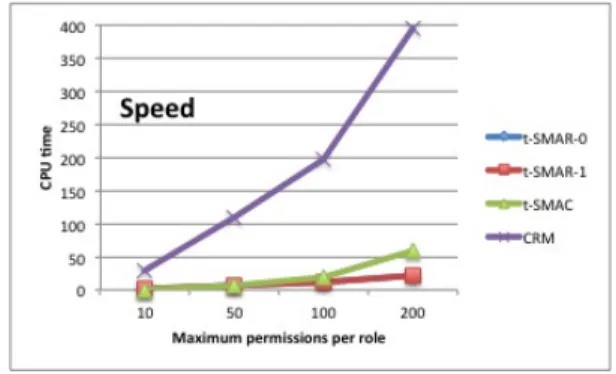
Figure 9: CPU time for fixed NP/MPR ratio For each set of parameters we report the size of the complete role-set generated running the heuristics (see Figure 8) as well as the CPU time need to compute the complete role-set (see Figure 9). We consider alsoAccuracy andDistance.
Figure 10: Accuracy for fixed NP/MPR ratio
Figure 11: Distance for fixed NP/MPR ratio Accuracy (see Figure 10) is defined as the ratio between the number of generated roles exactly matching the orig-inal roles and the size of role sets generated by the syn-thetic data generator (i.e., we measure the percentage of
Parameters
MPR Heuristic N R |RH| |URA| |UPA| S1 S2 CPU time
10 t-SMAR-0 99.8 59.9 5548.6 503.4 6111.9 6211.7 1.245 t-SMAR-1 99.8 59.9 5548.6 503.4 6111.9 6211.7 1.261 t-SMAC 99.6 15.3 16611.3 115.5 16742.1 16841.7 0.299 CRM 126.1 70.6 18274.9 171.3 18516.8 18642.9 28.223 50 t-SMAR-0 101.9 17.5 3673.5 2550.4 6111.9 6343.3 5.735 t-SMAR-1 102.2 21.3 3677 2550.4 6111.9 6350.9 5.735 t-SMAC 490.5 502 82506.2 1035.9 84044.1 84534.6 5.845 CRM 269.4 383 30337.3 2292.6 18516.8 33012.9 110.091 100 t-SMAR-0 101.4 12.3 3622.6 4820.7 8455.6 8557.0 11.809 t-SMAR-1 101.5 13.8 3622.9 4820.7 8457.4 8558.9 11.807 t-SMAC 924.6 1674.4 152401.2 2978.7 157054.3 157978.9 19.383 CRM 289.9 393.0 31625.3 4564.0 36582.3 36872.2 195.959 200 t-SMAR-0 100.0 3.1 3451.1 9914.5 13368.7 13468.7 21.838 t-SMAR-1 100.0 3.1 3451.1 9914.5 13368.7 13468.7 21.806 t-SMAC 1634.0 4301.4 270813.9 7924.0 283039.3 284673.3 59.069 CRM 329.5 476.1 34188.6 9741.2 44405.9 44735.4 393.904
Figure 12: Results of the four heuristics over synthetic datasets
original roles found by the heuristics). Given a complete role-set generated by any of the heuristics, theDistance pa-rameter (see Figure 11) measures howdifferent is the role-set generated by the heuristic from the original one (i.e., if RG is the role-set generated by the synthetic data genera-tor andRF is the role-set computed by the heuristic, then
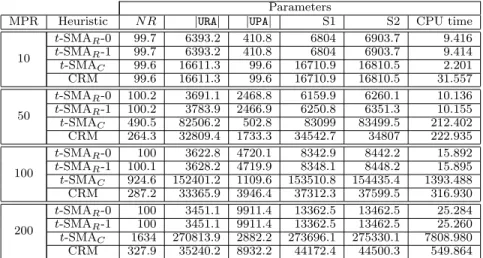
Distance =|RF\RG|). According to data summarized in Figures 8–11, results returned byt-SMAR-0 andt-SMAR-1 are identical and the graphics associated to them overlap. Both heuristics are much better than CRM. Indeed, they compute in few seconds a role-set having 100% Accuracy and nullDistancemeaning that the role-set generate by the synthetic data generator is completely reconstructed for all the considered test cases. Notice that CRM’s Accuracy is less than 20% andDistance and CPU time increases as the maximum number of permissions per role does. Our heuris-ticst-SMAR-0 andt-SMAR-1 always return a role-set con-taining about 100 roles; whileCRM returns a much larger role-set (i.e., 4 to 15 times larger).
We also evaluated all heuristics using the metrics considered in Section 5.1. Results are summarized in Figures 12 and 13. We can see that, although in some caseCRM returns good value for|UPA|, in general its performances are not very good. We also applied the lattice-based postprocessing procedure to the role-set obtained by running the four heuristics. In Figure 13 we report its results. The procedure improves some of the parameters, flattening, as expected, the role hierarchy and increasing the total CPU time. Even with the postprocessing, the results achieved byCRM are not so accurate. Only for the datasets constructed using the first test parameters (i.e., whenM P R= 10),CRM returns the original number of roles (with a lowAccuracy, anyway); while, in the other test cases it remains far from the expected number. Postprocessing has few influence ont-SMAC, since the number of roles does not change, while only the |UPA|
values improve and in the same measureS1 andS2, too.
6.
CONCLUSIONS
The role mining process, usually, returns a role infrastruc-ture on the basis of the relationships among users and per-missions contained in theUPAmatrix. However, the defini-tion of a role-set really reflecting the internal funcdefini-tionalities
of the examined organization remains a challenging task. The need for managing different kind of constraints in role engineering has recently been the focus of many works in literature [13, 10, 15]. The definition and the management of constraints in role mining are very important aspects in role mining, since they allow the role engineer to control the automatic process and introduce some rules that can have impact on the retrieved structure. In this paper, we have proposed a heuristic capable of returning a complete role-set satisfying constraints on the maximum number of permissions included in each role. The comparisons made show how the results in terms of accuracy, distance, size, and computation time improve on a previously presented algorithm [13]. Our simple algorithm is easily extensible to consider other kinds of cardinality constraints, such as max-imum number of users assigned to a role or mutually ex-clusive permissions or roles [15]. Furthermore, it is possible to investigate on the definition of other kinds of constraints regarding the role hierarchy and the semantic associated to each role [16], and try to adapt the proposed algorithm in order to return a role set satisfying the newly defined con-straints.
7.
REFERENCES
[1] C. Blundo and S. Cimato. A simple role mining algorithm. InProceedings of the 2010 ACM Symposium on Applied Computing, SAC ’10, pages 1958–1962, New York, NY, USA, 2010. ACM. [2] A. Bucker. Identity management design guide with
ibm tivoli identity manager, 2005.
[3] L. Chen and J. Crampton. Set covering problems in role-based access control. InESORICS 2009,
Proceedings of 14th European Symposium on Research in Computer Security, volume 5789 ofLNCS, pages 689–704. Springer-Verlag, 2009.
[4] E. J. Coyne. Role engineering. InACM Workshop on Role-Based Access Control, 1995.
[5] I. Dinur and S. Safra. On the hardness of approximating minimum vertex cover.Annals of Mathematics, 162:2005, 2004.
[6] A. Ene, W. Horne, N. Milosavljevic, P. Rao, R. Schreiber, and R. E. Tarjan. Fast exact and
Parameters
MPR Heuristic N R |URA| |UPA| S1 S2 CPU time
10 t-SMAR-0 99.7 6393.2 410.8 6804 6903.7 9.416 t-SMAR-1 99.7 6393.2 410.8 6804 6903.7 9.414 t-SMAC 99.6 16611.3 99.6 16710.9 16810.5 2.201 CRM 99.6 16611.3 99.6 16710.9 16810.5 31.557 50 t-SMAR-0 100.2 3691.1 2468.8 6159.9 6260.1 10.136 t-SMAR-1 100.2 3783.9 2466.9 6250.8 6351.3 10.155 t-SMAC 490.5 82506.2 502.8 83099 83499.5 212.402 CRM 264.3 32809.4 1733.3 34542.7 34807 222.935 100 t-SMAR-0 100 3622.8 4720.1 8342.9 8442.2 15.892 t-SMAR-1 100.1 3628.2 4719.9 8348.1 8448.2 15.895 t-SMAC 924.6 152401.2 1109.6 153510.8 154435.4 1393.488 CRM 287.2 33365.9 3946.4 37312.3 37599.5 316.930 200 t-SMAR-0 100 3451.1 9911.4 13362.5 13462.5 25.284 t-SMAR-1 100 3451.1 9911.4 13362.5 13462.5 25.260 t-SMAC 1634 270813.9 2882.2 273696.1 275330.1 7808.980 CRM 327.9 35240.2 8932.2 44172.4 44500.3 549.864
Figure 13: Results of the four heuristics over synthetic datasets after lattice-based postprocessing
heuristic methods for role minimization problems. In SACMAT ’08: Proceedings of the 13th ACM
symposium on Access control models and technologies, pages 1–10. ACM, 2008.
[7] D. F. Ferraiolo, R. S. Sandhu, S. I. Gavrila, D. R. Kuhn, and R. Chandramouli. Proposed NIST standard for role-based access control.ACM Transaction on Information System Security, 4(3):224–274, 2001. [8] M. Frank, D. A. Basin, and J. M. Buhmann. A class
of probabilistic models for role engineering. InACM Conference on Computer and Communications Security, pages 299–310. ACM, 2008.
[9] M. R. Garey and D. S. Johnson.Computers and Intractability, A Guide to the Theory of NP-Completeness. W.H. Freeman and Company, 1979. [10] M. Hingankar and S. Sural. Towards role mining with
restricted user-role assignment. InWireless
Communication, Vehicular Technology, Information Theory and Aerospace Electronic Systems Technology (Wireless VITAE), 2011 2nd International Conference on, pages 1 –5, 28 2011-march 3 2011.
[11] R. M. Karp. Reducibility Among Combinatorial Problems. In R. E. Miller and J. W. Thatcher, editors, Complexity of Computer Computations, pages 85–103. Plenum Press, 1972.
[12] M. Kuhlmann, D. Shohat, and G. Schimpf. Role mining - revealing business roles for security administration using data mining technology. In Proceedings of the eighth ACM symposium on Access control models and technologies, SACMAT ’03, pages 179–186, New York, NY, USA, 2003. ACM.
[13] R. Kumar, S. Sural, and A. Gupta. Mining rbac roles under cardinality constraint. InProceedings of the 6th international conference on Information systems security, ICISS’10, pages 171–185, Berlin, Heidelberg, 2010. Springer-Verlag.
[14] N. Li, M. V. Tripunitara, and Z. Bizri. On mutually exclusive roles and separation-of-duty.ACM Trans. Inf. Syst. Secur., 10, May 2007.
[15] X. Ma, R. Li, Z. Lu, and W. Wang. Mining
constraints in role-based access control.Mathematical and Computer Modelling, 2011.
[16] I. Molloy, H. Chen, T. Li, Q. Wang, N. Li, E. Bertino, S. Calo, and J. Lobo. Mining roles with semantic meanings. InSACMAT ’08: Proceedings of the 13th ACM symposium on Access control models and technologies, pages 21–30. ACM, 2008.
[17] I. Molloy, N. Li, T. Li, Z. Mao, Q. Wang, and J. Lobo. Evaluating role mining algorithms. InSACMAT’09, pages 95–104, 2009.
[18] H. Roeckle, G. Schimpf, and R. Weidinger. Process-oriented approach for role-finding to implement role-based security administration in a large industrial organization. InProceedings of the fifth ACM workshop on Role-based access control, RBAC ’00, pages 103–110, New York, NY, USA, 2000. ACM. [19] R. S. Sandhu, E. J. Coyne, H. L. Feinstein, and C. E.
Youman. Role-based access control models.Computer, 29:38–47, 1996.
[20] R. Schreiber. Datasets used for role mining experiments.http:
//www.hpl.hp.com/personal/Robert_Schreiber/. [21] Scilab Consortium. Scilab: The Free Software for
Numerical Computation.http://www.scilab.org/, Ver. 5.3.0 (for Mac OS X 10.6.7).
[22] L. J. Stockmeyer. The minimal set basis problem is NP-complete. Technical Report RC 5431, IBM Research, May 1975.
[23] J. Vaidya, V. Atluri, and Q. Guo. The role mining problem: finding a minimal descriptive set of roles. In SACMAT ’07: Proceedings of the 12th ACM
symposium on Access control models and technologies, pages 175–184. ACM, 2007.
[24] J. Vaidya, V. Atluri, and Q. Guo. The role mining problem: A formal perspective.ACM Trans. Inf. Syst. Secur., 13(3), 2010.
[25] J. Vaidya, V. Atluri, and J. Warner. Roleminer: mining roles using subset enumeration. InCCS ’06, pages 144–153. ACM, 2006.
[26] D. Zhang, K. Ramamohanarao, and T. Ebringer. Role engineering using graph optimisation. InSACMAT ’07: Proceedings of the 12th ACM symposium on Access control models and technologies, pages 139–144. ACM, 2007.