NOTE: This is a draft version of the current governing policies and
guidelines for the Master of Fine Arts effective as of the
2010/2011 Calendar Year. Editorial changes may be required.
Master of Fine Arts Program:
Policies and Guidelines
Faculty of Fine Arts
Master of Fine Arts (M.F.A.) Degree:
Major in Art
Major in New Media
Master of Fine Arts (M.F.A.) Program: Policies and Guidelines
The University of Lethbridge, Lethbridge, Alberta, Canada © 2005 by The University of Lethbridge
of Fine Arts effective as of the 2010/2011 Calendar Year. Editorial changes may be required.
M.F.A. Program: Policies and Guidelines
PART 1: PROGRAM INTRODUCTION AND OVERVIEW ... 1
1. Program Introduction and Overview ... 1
PART 2: ADMISSION ... 2
2. Applying for Admission ... 2
3. Application Review, Admission Criteria / Decisions ... 4
PART 3: REGISTRATION AND DEGREE REQUIREMENTS... 5
4. Registration ... 5
5. Master of Fine Arts Degree Requirements ... 6
PART 4: FINANCIAL ASSISTANCE ... 8
6. Financial Support Guidelines ... 8
7. Course Instruction ... 10
PART 5: STUDENTS, SUPERVISORS AND FACULTY ... 11
8. M.F.A. students ... 11
9. Supervisors ... 12
10. Members of The School Of Graduate Studies ... 14
PART 6: COMMITTEES ... 15
11. Departmental Graduate Studies Committee ... 12. Faculty of Fine Arts Graduate Studies Committee ... 13. M.A./M.F.A./M.Mus. Program Committee ... 15
14. Supervisory Committee ... 15
15. Examination Committee ... 16
PART 7: THESIS REGULATIONS ... 18
16. Submission of the Thesis Proposal ... 18
17. Purpose & Requirements of the Thesis ... 18
18. Support Paper Format Regulations ... 19
PART 8: EXAMINATION AND ASSESSMENT ... 24
19. Thesis Oral Defence ... 24
20. After the Thesis Oral Defence ... 28
PART 9: GRADUATION ... 30
21. Applying for Graduation ... 30
22. Confirming the Graduation ... 30
APPENDIX ONE: SAMPLE SUPPORT PAPER TITLE PAGE AND APPROVAL/SIGNATURE PAGE ... 31
Contents
Arts effective as of the 2010/2011 Calendar Year. Editorial changes may be required.
Part 1: Program Introduction and Overview
1. Program Introduction and Overview
The Master of Fine Arts (M.F.A.) degree program offers students the opportunity to pursue graduate study in Art, New Media, and Theatre and Dramatic Arts. The Art, New Media, and Theatre and Dramatic Arts majors each combine an emphasis on theory and practice relevant to the discipline. Faculty, comprised of artists and scholars, foster an environment of active engagement with material and conceptual production and
performance. The M.F.A. program allows graduate students to concentrate in their chosen disciplines and to synthesize their research into a unique and challenging Thesis. State-of-the-art facilities, integrated technical support, a lively community of arts and culture, and a commitment to academic and creative excellence are integral qualities of the Faculty of Fine Arts.
The M.F.A. in Art
The M.F.A. in Art degree program gives those wishing to pursue graduate education in Art Studio the
opportunity to be part of a community of highly active faculty practitioners and scholars. M.F.A. students pursue disciplinary excellence through integrated study in theory and practice, encompassing material, critical and conceptual investigations in contemporary art.
Located in the University of Lethbridge Centre for the Arts, the Department of Art is supported by excellent studios and resourced with a wide range of outstanding technical workshops and digital facilities. Lethbridge is home to dynamic arts community with nationally recognized artists and galleries. A lively and extensive Visiting Speakers in the Arts Program enriches the M.F.A. experience by creating regular opportunities for studio visits and discussion with a spectrum of practicing artists, curators and critics.
The M.F.A. in New Media
With an intensive concentration on the evolving theoretical contours of a discipline in an inherent state of dynamic flux, the program also provides graduate students with practical and innovative expertise in cutting-edge technologies. Students will have the opportunity to develop and hone their creative talents by way of access to first-rate design and animation software, motion-capture technology, and digital video production equipment. Under the supervision of first-class researchers and practitioners within new media arts, students will be encouraged to produce collaborative and interdisciplinary creative work in one or more potential areas of concentration, including: 3D art and animation; digital video, film and the moving image; interactive arts; new media theory and culture; and visual design for digital and electronic media.
The M.F.A. in Theatre and Dramatic Arts
The liberal education orientation of our undergraduate Drama program is complemented by the more
specialized focus of the M.F.A. in Theatre and Dramatic Arts graduate degree. Launched in 2009, the M.F.A. in Drama accepts only one or two students each fall, for an individualized and fully integrated experience within the Department.
Supervised and instructed, mentored and guided by faculty and staff who are practicing artists, dedicated scholars, and experienced professionals, the student completes course work and studio-based activity. The Thesis is comprised of both creative work and a written statement, balancing the active acquisition of practical skills with academic inquiry. State-of-the-art theatre facilities and a lively community of arts and culture provide the student with excellent opportunities to study broadly and to find their own creative voice.
effective as of the 2010/2011 Calendar Year. Editorial changes may be required. Part 2: Admission
Note: For complete admission requirements, see the University of Lethbridge School of Graduate Studies Calendar (www.uleth.ca/ross/calendar/sgs)
2. Applying for Admission
NOTE: The capacity of the M.F.A. program is limited by both space and availability of faculty. Not all students meeting the general admission requirements can be admitted.
Admission Eligibility
The normal minimum academic requirements for consideration for admission are a baccalaureate
(undergraduate) degree, or its academic equivalent from a recognized institution, in the discipline of interest or a closely cognate discipline, with a minimum grade point average of 3.00 (based on a 4.00 scale) on the last 20 graded university-level semester courses.
Applications are considered on a case-by-case basis. Admission is competitive.
Application Deadline
The M.F.A. program commences studies in the Fall (September) semester only. Application Deadline: March 1.
Applications and all supporting documentation (with the possible exception of final semester grades for those currently enrolled) must be submitted and received by the Registrar‘s Office and Students Services with the application fee by the March 1 deadline.
Application Fee
The application fee for the M.F.A. is $60.00 in Canadian funds. Refer to the Graduate Studies Calendar for current application fees (www.uleth.ca/ross/calendar/sgs/index.html).
Application Procedure
The application package for the M.F.A. program is available from the School of Graduate Studies (discover.ulethbridge.ca/graduate/) and includes the following forms:
Application for Admission - Master of Fine Arts Degree Program Letter of Recommendation Form (to accompany each supporting letter)
No application can receive formal consideration until all documentation is received. All documents received in support of an application become the property of the University and will not be released or copied except to other officers of the University as required by University procedures.
NOTE: Students who are graduates of non-Canadian universities must provide notarized English translations of all documents not in the English language.
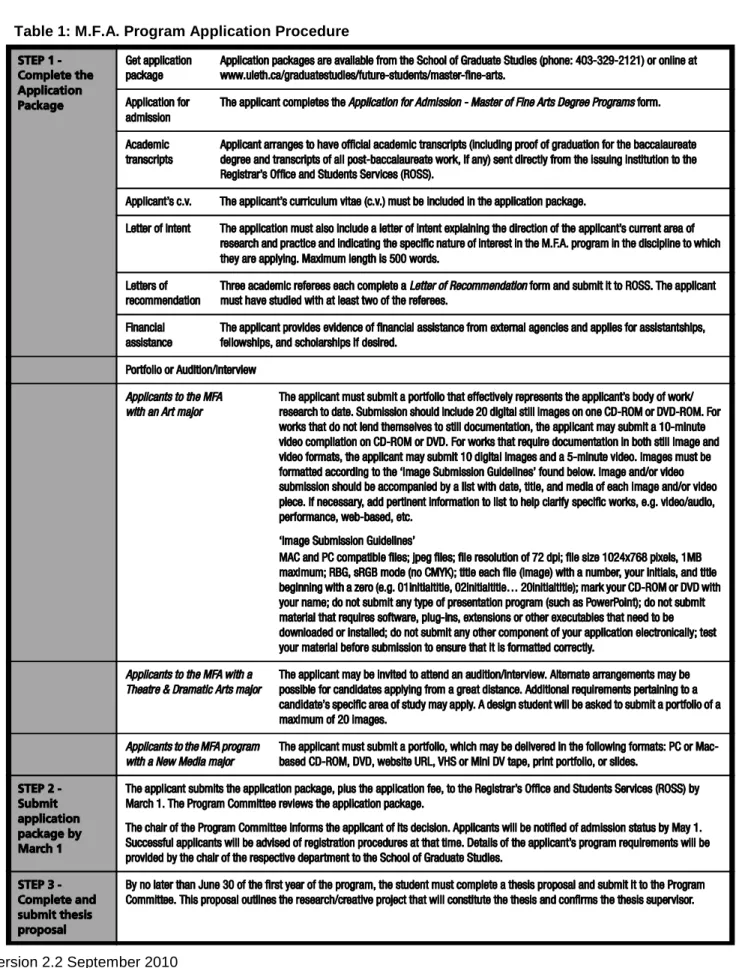
Eligible applicants must apply for admission by following the process outlined in the Table 1 on the following page.
effective as of the 2010/2011 Calendar Year. Editorial changes may be required. Part 2: Admission
effective as of the 2010/2011 Calendar Year. Editorial changes may be required. Part 2: Admission
3. Application Review, Admission Criteria / Decisions
All completed applications will be reviewed by the Departmental Graduate Studies Committee in each
respective department (Art, Theatre & Dramatic Arts, and New Media). The criteria used during the review will include:
The applicant‘s record and letters of academic recommendation;
The applicant‘s body of creative work, which may include exhibition/performance/reviews, and publishing record;
The feasibility of the project in light of available resources; Financial support for the student;
For the Theatre and Dramatic Arts major: an audition/interview.
Following the departmental reviews, each Departmental Graduate Studies Committee will forward its recommendations to the Faculty of Fine Arts Graduate Studies Committee which, in turn, will send the recommendations on to the School of Graduate Studies M.A./M.F.A./M.Mus. Program Committee, where the final admission decisions will be made.
Applicants will be informed of admission decisions, successful or otherwise, by the School of Graduate Studies. Unless alternative arrangements have been made, a student receiving an offer of admission to the program must register in the program no later than the last day of Add/Drop in September of the same year. Failing to register in this way may result in the student forfeiting admission status. Refer to the Academic Schedule for specific dates (www.uleth.ca/ross/deadlines).
effective as of the 2010/2011 Calendar Year. Editorial changes may be required.
Part 3: Registration and Degree Requirements
Note: For complete degree requirements, see the University of Lethbridge School of Graduate Studies Calendar (www.uleth.ca/ross/calendar/sgs)
4. Registration
Graduate students register for their program every semester (Fall, Spring and Summer) throughout the tenure of their program.
Registration Process
a) Complete the Registration Form
To register, the Faculty of Fine Arts Student Program Services Office will provide each student with an ―Approved Program of Studies‖ form to be signed by the Supervisor and the Dean of the School of Graduate Studies or designate. Students are required to take the form to the Registrar‘s Office each semester. Changes to the Approved Program of Studies must be recommended by the Supervisor to the School of Graduate Studies for approval by the Dean of Graduate Studies or designate.
NOTE:
Students in the M.F.A. program cannot register using the Bridge (the University of Lethbridge web information system).
In addition, students must complete an Independent Study form if they register in an Independent Study course identified as 5990. Check with the School of Graduate Studies Office for more details.
b) Submit the Registration Form
Students submit their Approved Program of Studies form in person to the Office of the Registrar. See the Calendar for details.
c) Fees
Full-time students pay fees in three installments for each of the first three semesters. In their second year students are also assessed a continuation fee for each subsequent semester in which they are registered. For full details on fees, see the University of Lethbridge Graduate Studies Calendar
(www.uleth.ca/ross/calendar/sgs)
Deadlines
Graduate students must register every semester no later than the last day of add/drop. There are three semesters:
Fall, beginning in September.
Spring, beginning in January;
Summer, beginning in May;
For the last day of registration for each semester, check the Academic Schedule in the University of Lethbridge Calendar http://www.uleth.ca/ross/calendar/calendar.html.
effective as of the 2010/2011 Calendar Year. Editorial changes may be required.
Part 3: Registration and Degree Requirements
Failure to Register
Students who fail to register for any term and who do not have permission for a Leave of Absence are considered by the University to have withdrawn from their program. To re-enter their program, they must get written permission from the School of Graduate Studies.
5. Master of Fine Arts Degree Requirements
Program Structure
The M.F.A. program combines required coursework with an extensive research culminating in the defence of a Thesis in an oral examination. The program is a minimum 2 years (24 months) in length. Students are registered as full-time students in the Fall, Spring and Summer semesters in both years during their residency.
Coursework
Students in the M.F.A. program complete their coursework in their first year, typically in two semesters as follows:
Art Theatre & Dramatic Arts New Media
Fall Art 5020 - Information Literacy for the Fine Arts
Drama 5020 - Information Literacy for the Fine Arts
New Media 5020 - Information Literacy for the Fine Arts Art 5048 - Graduate
Studio I
Drama 5150 - Graduate Theatre Studies
New Media 5048 - Graduate Studio I
Art 5261 - Art NOW Graduate Seminar I
Drama 5990 - Independent Studies in Dramatic Arts
Spring Art 5049 - Graduate Studio II Drama 5211 - Graduate Seminar in Theories of Theatre
New Media 5049 - Graduate Studio II
Art 5262 - Art NOW Graduate Seminar II
Drama 5600 - Theatre Studio Performance
New Media Elective at the 5000-level
Art History/Museum Studies 5150 - Art History Graduate Seminar
Drama Elective at the 5000-level
In each semester (Fall, Spring and Summer in both years) M.F.A. students are also enrolled in the following course as part of their Thesis work:
effective as of the 2010/2011 Calendar Year. Editorial changes may be required.
Part 3: Registration and Degree Requirements
Art Theatre & Dramatic Arts New Media
Art 6002 - Thesis Drama 6002 - Thesis New Media 6002 - Thesis
Thesis
The student must complete a Thesis proposal and submit it to the School of Graduate Studies no later than June 30 of the first year of the program. This proposal outlines the research/creative endeavour that will constitute the Thesis and confirms the Thesis Supervisor.
In the second year of the program, M.F.A. students focus on the research and production of the Thesis. The M.F.A. Thesis is composed of two parts: the Research Project and the Support Paper:
The Research Project represents the accomplishments of a one-year investigation and results in a performance, production, exhibition, or original work relative to the student‘s particular field of study;
The Support Paper, of no less than 30 pages (approximately 10,000-15,000 words), accompanies the Research Project and positions the student‘s production within a contemporary framework. Once the Supervisor approves the Research Project and the Support Paper, and the student is prepared to defend both parts of the Thesis, the final oral examination is scheduled by the Supervisor. A Thesis Examination Committee is appointed to conduct the final oral examination. Once the Thesis is final (assessed and corrected, if necessary), the Support Paper must be submitted in both print and electronic formats, along with documentation of the Research Project as determined appropriate by the Supervisory Committee. For complete details see Part 7: Thesis Regulations and Part 8: Examination and Assessment below.
Residency Requirement and Time Limit
A minimum of 24 months of continuous full-time registration is the M.F.A. Program requirement. The M.F.A. Program has a time limit of a maximum of 36 months of continuous full-time registration
Academic Standards
A student must receive a minimum grade of ‗B-‘ (2.70 on a 4.0 scale) in all courses which are graded and which count toward the degree. A student who receives more than two grades below a ‗B-‘ may be asked to withdraw from the program. A student must obtain a minimum cumulative program GPA of 3.0 in order to graduate from the program. A student whose performance in the program is judged unsatisfactory by the M.A./M.F.A./M.Mus. Program Committee may be placed on probation; continued unsatisfactory performance may result in the student being required to withdraw from the program.
effective as of the 2010/2011 Calendar Year. Editorial changes may be required.
Part 4: Financial Support
6. Financial Support Guidelines
This section contains general guidelines for the financial support of M.F.A. students at the University of Lethbridge. It is not intended to provide prescriptions for every situation, but is a framework within which the Faculty of Fine Arts can operate. Specific interpretation and implementation of these guidelines rests with the Supervisor and the Dean (or designate) of the Faculty of Fine Arts.
Principles
Financial support for eligible M.F.A. students may consist of one or more of the following: fellowships, scholarships, Graduate Teaching Assistantships (GTA), Research Assistantships (RA), external research support, and other sources. The financial support package for graduate students is based on the following principles.
Financial support:
is offered to all eligible M.F.A. students;
is provided by those who engage M.F.A. students in university teaching and research/creative programs;
reflects the importance of the services M.F.A. students provide.
Financial Support Guidelines for the M.F.A. Program
Overview
The M.F.A. program at the University of Lethbridge supports active, ongoing research and creative activity by students and faculty members and, by close mentoring relationships between faculty members and students; help the students develop strong research and creative abilities.
Financial support for M.F.A. students is made available on the basis that the students assist their Supervisors in pursuing research and scholarly activities (Research Assistantship (RA)), and assist the appropriate Faculty by providing teaching and teaching-related services (Graduate Teaching Assistantship (GTA)).
Students who are funded by external sources are also expected to provide some teaching or teaching-related services in return for financial support (Graduate Teaching Assistantships GTA)) from the University of Lethbridge.
Financial Support Package
The School of Graduate Studies recommends a financial support package in the amount of $15,000 per year for a maximum of two years for M.F.A. students admitted unconditionally to the program.
Of the $15,000 target, $7,000 per year is provided as a GTA by the University in return for which the student provides services in support of teaching as assigned by the Dean of Fine Arts. The remaining $8,000 per year is provided as an RA by the University in return for which the student provides services as approved by the Dean of Fine Arts in consultation with the Supervisor and Department Chair.
effective as of the 2010/2011 Calendar Year. Editorial changes may be required.
Part 4: Financial Support
The Dean of Graduate Studies announces these awards at the time of admission of the student.
Continuation of the Awards is contingent upon the satisfactory academic performance of the student and the fulfillment of the awards criteria. Each semester the School of Graduate Studies reviews each student‘s performance based on the Supervisor‘s report, and the Dean of Graduate Studies confirms the award based on a successful review.
Graduate Teaching Assistantship (GTA)
Eligibility
To receive the GTA, the student must be a full-time registered student. Duties
In return for the GTA, full-time graduate students are expected to provide 120 hours per year of service in support of teaching, consisting of one or more of the following duties:
Studio teaching/supervision/tutorials Marking
Assisting in the development of courses, studio supervision
Other teaching-related duties (e.g., leading discussion groups, assisting in Gallery work, Technical support)
The Dean of the Faculty of Fine Arts assigns the GTA duties in consultation with the Supervisor(s) and Department Chair where appropriate.
The specific duties assigned to the M.F.A. students will vary depending on the discipline, but the duties should be compatible with a student‘s program of study and research, with the needs of the department (where appropriate) and with those of the faculty.
The total amount of work for all duties includes allowance for preparation, delivery, and marking.
The range of duties varies from discipline to discipline. For example, students in Art may have more studio related duties. To meet demands of the student‘s various roles, duties will be carefully balanced bearing in mind that the position is one of assistantship to, but not substitution for, faculty‘s duties.
M.F.A. students are expected to provide some teaching and teaching-related services in return for the support they receive. The obligation to teach or provide teaching-related services is based on the need to give students the opportunity to develop skills in communication and pedagogy. Such skills are essential, for those who do plan to pursue academic or teaching careers, and careers in the Fine Arts.
For funding opportunities, both internal and external, please contact the School of Graduate Studies Graduate Awards Advisor or visit the SGS website at http://www.uleth.ca/graduatestudies/funding.
Research Assistantship (RA)
The duties of the RA awarded to an M.F.A. student are determined by the Dean of the Faculty of Fine Arts in consultation with the Supervisor and the Department Chair.
In the event that a graduate student is paid from a Supervisor‘s grant, the Supervisor assigns the duties that the student must perform in return. The Supervisor must provide the Dean of School of Graduate Studies with the RA contract for the student‘s file.
Advantage Award
The Advantage Award is intended for students who are in good standing in their graduate program and who have limited sources of funding and income. The purpose is to assist full-time students by
effective as of the 2010/2011 Calendar Year. Editorial changes may be required.
Part 4: Financial Support
guaranteeing a minimum level of income. For M.F.A. students the award will guarantee $1,000/month (Cdn) NET calculated as all income sources minus tuition and fees during the first 24 months of study.
Profiling Alberta’s Graduate Students Award
Valued at $1,500, these 33 graduate awards are intended to showcase the high quality research being done by Alberta graduate students who are full-time Canadian/Permanent Residents who present their research at nationally and internationally recognized academic conferences.
To be considered for the award, students must be registered at the time of the conference in a full-time master‘s program at any point in second year of study. Normally, students will be eligible for the award once during their program of study. (http://www.uleth.ca/graduatestudies/funding)
Research Dissemination Award
Valued at a maximum of $1,000, there are a variable number of awards intended to aid M.F.A. students in travelling to nationally and internationally recognized academic conferences. Priority is given to
international students who are registered at the time of the conference in a full-time master‘s program at any point in their second year of study. (http://www.uleth.ca/graduatestudies/funding)
Graduate Student Association (GSA)
Contact the Graduate Student Association for financial support information provided by the GSA (http://www.gsaulethbridge.ca).
7. Course Instruction
From time to time, opportunities arise for teaching a course. The duties are assigned by the Dean of the Faculty the Faculty of Fine Arts in consultation with the Supervisor and Department as appropriate.
effective as of the 2010/2011 Calendar Year. Editorial changes may be required.
Part 5: Students, Supervisors and Faculty
8. M.F.A. Students
All M.F.A. students are full-time students. M.F.A. students register continuously throughout the tenure of their program (Fall, Spring and Summer) and are engaged in coursework or research towards their program
M.F.A. Student Responsibilities
NOTE: Graduate students‘ rights and responsibilities are legislated from time to time by the University of Lethbridge and outlined in the Calendar. Contact the School of Graduate Studies for up-to-date legislation related to the rights and responsibilities of M.F.A. students.
In studying at the graduate level, students must strive for high levels of academic achievement, and contribute to the intellectual life of the University. M.F.A. students must devote full time to the efficient completion of the program. The responsibilities of M.F.A. students at the University of Lethbridge include the following:
Regulations and Requirements
1. Meet all degree requirements in a timely manner;
2. Meet all deadlines and regulations associated with registration, award applications, and degree requirements;
3. Conform to all University, departmental, and program requirements, legislation, and policies; 4. Meet the performance standards and deadlines of funding organizations;
5. Meet the terms and conditions of fellowships, teaching assistantships, and research assistantships.
Knowledge and Skills
6. Develop the knowledge and skills needed to successfully pursue the academic and research program.
Academic and Ethical Standards
7. Uphold ethical standards in research methodology, scholarship, and the reporting of research results;
8. Acknowledge the contributions of the Supervisor, funding agencies, and others to presentations and publications, including joint authorship if appropriate;
9. Uphold the academic and non-academic standards outlined in the University of Lethbridge Calendar.
Communication
10. Keep regular, open communication with, and seek advice from, the Supervisor and Supervisory Committee;
11. Regularly inform the Supervisor about the progress in the program. At a minimum, this involves a progress report at least twice an academic year;
12. Inform the Supervisor of any absences, and follow the University of Lethbridge guidelines for requesting a leave of absence.
effective as of the 2010/2011 Calendar Year. Editorial changes may be required.
Part 5: Students, Supervisors and Faculty
13. In consultation with the Supervisor, develop a realistic work schedule for the program, with specific milestones.
Research/Creative Environment
14. Help ensure a creative research environment free from harassment, discrimination, and conflict.
Ownership Of Information & Equipment
15. Respect the University of Lethbridge‘s policies regarding intellectual property and the ownership of information and equipment;
16. If applicable, follow the contractual agreements with other agencies or individuals regarding the ownership of information, and equipment;
17. If appropriate, upon finishing the program, provide the Supervisor with documentation that allows others to continue the research or creative work.
Graduate Student Entitlements
M.F.A. students are entitled to the following:
Dental and Health Plans: Students‘ families can also be included in these plans. Contact the Graduate Students‘ Association (http://www.gsaulethbridge.ca/) for more information
Inter-Library Loan Privileges. Contact the Library for more details.
Use of all University Facilities. (For example, the Library, computer labs, exercise rooms, and gymnasium.)
The Right to Appeal Academic Matters.
Academic Performance
For expected standards of academic performance for M.F.A. students refer to the University of Lethbridge Calendar Part Four: Academic Regulations, Policies and Program Requirements
(http://www.uleth.ca/ross/calendar/calendar.html).
Non-Academic Performance
See the University of Lethbridge Calendar – Part Four Academic Regulations, Policies and Program Requirements (http://www.uleth.ca/ross/calendar/calendar.html.
Leave of Absence
When circumstances prevent students from continuing their research program as approved, in consultation with their Supervisor a request may be made for a leave of absence to the School of Graduate Studies for approval. For example, those wishing to take maternity or paternity leave can request a leave of absence. A leave of absence can be a maximum of one year. Fees are not assessed during the leave
9. Supervisors
NOTE: The following policies and guidelines apply to both Supervisors and Co-Supervisors.
Criteria for Supervisors
Supervisors must:
effective as of the 2010/2011 Calendar Year. Editorial changes may be required.
Part 5: Students, Supervisors and Faculty
Have a record of distinguished and ongoing active research/activity in their field of expertise; Be currently active in a research/creative area related to the student‘s research interest. Possess research/creative expertise in the student‘s research area.
Role and Responsibilities of the Supervisor
The Supervisor‘s responsibilities include:
Commitment
1. Make a commitment to supervise the student throughout his or her program.
Mentorship and Respect
2. Give the student ongoing guidance on expected academic and professional standards and the nature of research;
3. Be open and accessible to the student;
4. Give the student advice and constructive criticism, in support of high academic and professional standards;
5. Respect the student as a junior colleague in research;
6. Acknowledge the student‘s contributions to presentations, exhibitions, performances, and publications, including collaborative work and/or joint authorship, if appropriate;
7. Respect the University of Lethbridge‘s policies on intellectual property and the ownership of data and information.
Regulations and Requirements
8. At the start of the program share with the student the expectations of the Supervisor, the program, and the School of Graduate Studies;
9. Ensure all School of Graduate Studies and program regulations and requirements are met, including those related to coursework, funding, Thesis examination, and Thesis oral defence.
Communication
10. Keep in contact with the student, and meet with the student and Supervisory Committee according to the program requirements;
11. Regularly communicate with the Supervisory Committee and M.A./M.F.A./M.Mus. Program Committee regarding the student‘s progress;
12. Supervisors will notify the student and Supervisory Committee members of any anticipated change and subsequent approved change of the structure of the M.A./M.F.A./M.Mus. Program Committee by the School of Graduate Studies.
Planning
13. In consultation with the student, establish a realistic work schedule for the program, with specific milestones.
14. Fulfil all duties related to completing the Statement of Progress and Standing.
15. Help ensure there are sufficient financial and material resources to perform the research and support the student. Where required, write statements of commitment of financial support for the student.
effective as of the 2010/2011 Calendar Year. Editorial changes may be required.
Part 5: Students, Supervisors and Faculty
Research Environment
17. Help ensure an environment conducive to research and intellectual growth.
18. Help ensure a research environment free from harassment, discrimination, and conflict.
Conflicts
Students and Supervisors must make every effort to maintain the student/supervisor relationship. As graduate programs are very specialized, there may not be another faculty member qualified to act as a Supervisor. Both the student and their Supervisor must commit to completing the program of studies.
When there is a conflict that jeopardizes the student/supervisor relationship, and it cannot be resolved by discussion between both parties, then the student or faculty member should contact the School of Graduate Studies. The School will attempt to resolve the problem through mediation and discussion.
10. Members of the School of Graduate Studies
For the regulations regarding criteria for membership, processes for membership, and duties and
responsibilities of members of the School of Graduate Studies, see the Governance of the School of Graduate Studies document http://www.uleth.ca/graduatestudies/forms-and-guidelines
effective as of the 2010/2011 Calendar Year. Editorial changes may be required. Part 6: Committees
11. Departmental Graduate Studies Committee
Each Department (Art, New Media and Theatre and Dramatic Arts) will determine an appropriate process for the internal review of applications to their discipline. The Departmental Graduate Studies Committee is responsible for reviewing the M.F.A. submissions for their own disciplines and for making recommendations of potential candidates in order of priority to the Faculty of Fine Arts Graduate Studies Committee. The
Departmental Graduate Studies Committee, which may be ad hoc, may also determine internal departmental policy with regard to its graduate studies program.
12. Faculty of Fine Arts Graduate Studies Committee
The Faculty of Fine Arts Graduate Studies Committee is comprised of all Faculty of Fine Arts Department Chairs, on additional member from each Department (chosen by the Department), the Faculty of Fine Arts Assistant Dean of Student Program Services, and the Dean of the Faculty of Fine Arts (Chair). The Faculty of Fine Arts Graduate Studies Committee meets regularly to review, assess and revise M.F.A. and M.Mus. Graduate Program structures and processes, vets potential M.F.A. and M.Mus.candidates presented by each Departmental Graduate Studies Committee, and recommends potential candidates to the M.A./M.F.A./M.Mus. Program Committee.
NOTE: The Faculty of Fine Arts Graduate Studies Committee is a committee of the Faculty of Fine Arts and not of the School of Graduate Studies.
13. M.A./M.F.A./M.Mus. Program Committee
The M.A./M.F.A./M.Mus. Program Committee is responsible for managing the day-to-day operations of the M.A., M.F.A., and M.Mus. graduate program.
NOTE: For the complete regulations regarding the M.A./M.F.A./M.Mus. Program Committee see Appendix Two: Governance of the School of Graduate Studies. (http://www.uleth.ca/graduatestudies/forms-and-guidelines/governing-principles).
The responsibilities of the M.A./M.F.A./M.Mus. Program Committee includes the following: Reporting to Graduate Council on all matters related to its operation, at least annually; Recommending to Graduate Council policy and program changes;
Recommending student admissibility;
Reporting on students‘ progress to the Graduate Council;
Approving and, where necessary changing, individual student programs and student supervision; Recommending graduands for Graduate Council approval;
Awarding credit for any previous courses or graduate work; Hearing any form of student appeals other than grade appeals. Membership of the M.A./M.F.A./M.Mus. Program Committee is as follows:
Program Committee Chair, appointed by Graduate Council;
effective as of the 2010/2011 Calendar Year. Editorial changes may be required. Part 6: Committees
Three faculty members who are members of both the School of Graduate Studies and the faculty or faculties in question, appointed by the Graduate Council;
One member of the School of Graduate Studies who is not a member of the faculty or faculties in question, appointed by the Graduate Council;
The Dean of the School of Graduate Studies, ex officio.
14. Supervisory Committee
Establishing the Supervisory Committee
The Supervisor is identified by the home department at the application review stage and the other members of the Supervisory Committee are identified and approved within the first semester of study.
The Supervisor, in consultation with the student, develops the proposed program of studies within the first semester of study. The M.A./M.F.A./M.Mus./Program Committee appoints the Supervisory Committee. With delegated authority by the Program Committee the Dean of Graduate Studies approves changes to
membership.
Membership of Supervisory Committee
The Supervisory Committee consists of the following members: Supervisor (Chair).
A minimum of two members of the School of Graduate Studies who may be internal or external to the home department or to the University of Lethbridge are required:
o One from the same discipline as the program. o One from another cognate area.
In cases where there is a Co-Supervisor, two additional members (who are members of the SGS) are required. This structure means that a committee could have an administratively external committee member but one is not required.
Up to two additional members can be added. These additional members must be members of the School of Graduate Studies. All Supervisory Committee members must be approved by the M.A./M.F.A./M.Mus. Program Committee and the Dean, School of Graduate Studies.
Role & Responsibilities of the Supervisory Committee
The overall role of the Supervisory Committee is to support the graduate student by providing academic and research advice and to assess a student‘s progress. The Supervisory Committee‘s responsibilities are to:
Meet at least twice an academic year with the student to discuss progress and issues, and report to the School of Graduate Studies (see Statement Of Progress And Standing, below);
Provide constructive criticism of the student‘s ideas, methods, and performance; Be accessible to the student for ongoing consultation and discussion;
Be a member of the Thesis Examination Committee.
The School of Graduate Studies recommends that each member make every effort to remain part of the student‘s Supervisory Committee until the student exits the program.
effective as of the 2010/2011 Calendar Year. Editorial changes may be required. Part 6: Committees
Students are required to meet with their Supervisory Committee at least twice per academic year. The Supervisory Committee completes a simple form that identifies critical milestones in the student‘s program that, if not reached by the student, flag the need for some remediation process. These milestones would include: completion of Thesis proposal, completion of individual courses with grades noted, completion of data collection, teaching performance, etc.
After the Progress and Standing Report form is completed, the Supervisor, Supervisory Committee members, and student must all sign it. The Supervisor then forwards the form to the School of Graduate Studies. The form is used to determine the student‘s eligibility for continued funding. If the Supervisory Committee recommends either probation or withdrawal of the student, then the Program Committee must review these recommendations, and decide how to proceed. Some funding sources require three progress reports per academic year.
In the M.F.A. program, the two required Progress and Standing Reports are due December 15 and April 15.
15. Examination Committee
Membership
There are at least four members on the Thesis Examination Committee: All members of the student‘s Supervisory Committee;
A Chair: The home Department Chair or a faculty member and member of the SGS designated by the department, except where the individual concerned is also a member of the supervisory committee. In the latter case, another faculty member and member of the SGS must be selected to serve as Exam Chair. Department Chairs (and/or Graduate Coordinators) increasingly play a role in developing and coordinating graduate programs in their units. Exam Chairs are expected to help ensure consistency in both quality and procedures. Exam Chairs are expected to be appointed and serve on a continuing basis for a significant period of time (2-3 year terms, where possible);
An External Examiner (optional). The Supervisory Committee may choose to include an External Examiner, either external or internal to the University, but external to the home department. The External Examiner must have no academic relationship with the student or the Supervisor that
constitutes conflict of interest. An External Examiner may also participate remotely, for example using videoconferencing, teleconferencing or Skype technology.
All members are voting members, except the Chair, who may vote only to break a tie. The Dean of the School of Graduate Studies approves the membership of the Thesis Examination Committee.
Role and Responsibilities of the Examination Committee
The overall responsibility of the Thesis Examination Committee is to assess the completed Thesis by reviewing the Thesis and conducting the Thesis oral defence in accordance with the procedures developed by the School of Graduate Studies (described in the Thesis Oral Defence section).
The committee‘s specific responsibilities include the following:
Reviewing and assessing the completed Thesis in accordance with the guidelines described in Assessing the Thesis.
Questioning of the student during the Thesis oral defence;
Assessing the student, based on the Thesis and the student‘s responses and performance during the Thesis oral defence.
effective as of the 2010/2011 Calendar Year. Editorial changes may be required. Part 6: Committees
Chairing the Thesis oral defence to ensure procedural fairness and to assist the Thesis Examination Committee to reach a unanimous decision;
Informing the student of the results of the Thesis oral defence and reporting the results to the Dean of the School of Graduate Studies.
effective as of the 2010/2011 Calendar Year. Editorial changes may be required.
Part 7: Thesis Regulations
16. Submission of the Thesis Proposal
The student must complete a Thesis proposal and submit it to the School of Graduate Studies no later than June 30 of the first year of the program. This proposal outlines the research/creative project that will constitute the Thesis and confirms the Thesis Supervisor.
17. Purpose and Requirements of the Thesis
Purpose of the Thesis
All M.F.A. students are required to present a Thesis. The Thesis must make a significant, original contribution to the body of knowledge in a given discipline. It must show that the student:
Is familiar with the published literature in the Thesis‘s subject area;
Has demonstrated insight and original recent contribution within their chosen field. Has used appropriate research methods;
Has applied appropriate levels of critical analysis;
Is competent to complete independent research and present the findings.
The material in the Thesis must, in the judgement of the Thesis Examination Committee, be suitable for publication and/or exhibition.
Thesis Requirements
The Thesis is composed of two parts: the Research Project and the Support Paper.
The Research Project is the main component of the Thesis, and represents the accomplishments of a two-year investigation and results in a performance, production, exhibition, or original work relevant to the particular field of study in which the student is engaged.
The Support Paper of no less than 30 pages accompanies the Research Project and positions the student‘s production within a contemporary discourse.
The Graduate Council specifies the following requirements for the Thesis: The student must work independently to produce the Thesis.
The student must orally defend the Thesis. The Examination Committee assesses the Thesis, and conducts the oral defence.
The Thesis remains the intellectual property of the student.
The student grants the University of Lethbridge permission to use the Thesis for further research, study, documentation and promotion.
The Research Project should be documented in the appropriate medium. Students should consult with their Supervisor and Supervisory Committee to ensure appropriate form and style. The M.F.A. Research Project should be exhibited at an appropriate venue as determined by the student in consultation with the Supervisor.
NOTE: The Research Project cannot be exhibited in the University of Lethbridge Art Gallery.
effective as of the 2010/2011 Calendar Year. Editorial changes may be required.
Part 7: Thesis Regulations
The Support Paper must be presented as per the regulations in 16. Support Paper Format Regulations, below.
18. Support Paper Format Regulations
This section presents the regulations for the format of the Support Paper component. All Support Papers must abide by these regulations and, if they do not, can be rejected by the Thesis Examination Committee.
For spelling, punctuation, and bibliographic citations, use a style guide. The University of Lethbridge does not mandate a single style guide, though it recommends the style guide published by the American Psychological Association.1 Consult with the Supervisor and the School of Graduate Studies to select an appropriate style guide and follow it consistently. Formal approval for changes in guidelines is required from the Dean of the School of Graduate Studies
Use the style guide in conjunction with the following Support Paper format regulations. Where there is a conflict between the style guide and the Support Paper format regulations below, these regulations take precedence. The Support Paper format regulations are organized alphabetically, by topic.
Approval/ See Appendix.
Signature Page:
Bibliography: Follow the bibliographic citation format in the approved style guide that you are using. Use this format consistently. List the bibliographic entries in alphabetical order, then in chronological order within that. List many works by the same author in chronological (or reverse chronological) order, by date of publication.
Changes: Corrections or changes made after the Thesis Oral Defence must conform to the original format and style of the Support Paper. All corrections must be retyped.
Chapters: New chapters must always begin on a new page.
Copyrighted Material: Support Papers that use previously copyrighted material must include letters of permission from the people or publishing company holding the copyright. These letters of permission must accompany the Support Paper when the final copies are submitted.
If a Support Paper includes a section that the author of the Support Paper published previously, then the author must get permission from the copyright holders.
If the Support Paper includes material that the writer of the Support Paper co-authored, then a letter of permission from the copyright holder is required. If the author cannot get permission from the copyright holder, and omitting this material will not detract from the sense of the text, then the author must remove the copyrighted material, and in its place insert a page that explains:
that the material has been removed of unavailable copyright permission. what information the omitted material contained, and its original source. If the author cannot get permission from the copyright holder, and omitting this material would detract from the sense of the text, then the author has two options:
do not finish or publish the Support Paper until the copyright holder provides permission.
1
effective as of the 2010/2011 Calendar Year. Editorial changes may be required.
Part 7: Thesis Regulations
rewrite that section of the Support Paper, so removing the copyrighted material does not change the sense of the text.
NOTE: Getting letters of permission can take considerable time, so begin this process well in advance of the Support Paper completion.
Epigraph: An epigraph is a quotation that comes before a chapter or the body of the Support Paper. The epigraph should be indented approximately 20 spaces from the left margin. The author and title must be cited below the quotation, with the title underlined. The epigraph should be single spaced, with one space between the quotation and the author/title.
Font: Any standard serif font is acceptable.2 The font size must be from 10 to 12 point. The font has to be solid and black.
One font size and style must be used consistently throughout the Support Paper. However, text in tables or figures can be a different font from the rest of the Thesis. Headings can be in bold text, and italics can be used for emphasis.
Footnotes: Footnotes can be:
at the foot of the page (Footnotes) grouped at the end of a chapter (Notes)
grouped at the end of the Support Paper, before the bibliography (Endnotes)
Choose one type (footnotes, notes, or endnotes), and use it consistently throughout the Support Paper. Use single spacing for all types of footnotes.
Graphs: Use labels and symbols, not colours, to identify graph lines or bars. An example is cross-hatching.
Headers: The Support Paper can contain page headers, but a horizontal line must separate the header from the page text.
Headings: Headings must be in the same font style and size as the rest of the Support Paper text, but can be in bold text.
Justification: A Support Paper can be left-justified, or fully-justified. The justification must be consistent throughout the Support Paper.
Language: The Support Paper must be written in the English language.
Line Spacing: Lines in the Abstract, Acknowledgement, and body of the Support Paper must be double-spaced.
Use single spacing in footnotes, long quotations, and appendices. In the Table of Contents, Bibliography, and the List of Tables, List of Figures, List of Plates, List of Symbols, etc., use single spacing between entries.
Margins: Left margin—1½"
effective as of the 2010/2011 Calendar Year. Editorial changes may be required.
Part 7: Thesis Regulations
Right, top, and bottom margins—1"
The margins must be the same on all pages of the Support Paper.
Page Numbering: Prefatory pages:
The prefatory pages include the Title Page, Approval/ Signature Page, Table of Contents, etc. (see Sequence of Materials).
Numbered consecutively, beginning with the Title Page, which does not have the page number on it. The remaining prefatory pages are numbered with a small Roman numeral, at the bottom of the page, centred.
Main body pages:
The main body pages begin at the Introduction or first chapter, and include the remainder of the document.
Numbered consecutively with Arabic numerals, at the bottom of the page, centred. Numbering starts at ―1.‖
The Appendices are part of the main body, and so must be numbered consecutively with the preceding main body pages. Do not number Appendix pages A1, B1, etc.
Page Orientation: The pages must be portrait orientation. Illustrations must fit onto the portrait-oriented pages.
Paper Size: The paper must be 8½" × 11" (21.5cm × 28cm).
The Support Paper can include oversize pages (larger than 8½" × 11") as foldouts, folded so they are no more than 8" wide.
Paper Type & Weight: The paper must be white bond, 16lb or 20lb weight. Recycled paper is acceptable if it is as white as bond paper, and has no flecks. Use one paper type and weight, conforming to these guidelines, consistently throughout the Support Paper.
Photographs, Coloured: If a Support Paper contains colour photographs, then replace the photos in the copy for the National Library with black and white photographs.
Quotations: On long quotations, use single spacing. Indent all single-spaced quotations.
Sequence of
Materials: 1. Non-exclusive Licence to
Reproduce Thesis.
A form, not included in the binding of the Support Paper.
2. Permission to Photocopy and Lend Thesis.
A form, not included in the binding of the Support Paper.
3. Title Page. Has no page number but is page i of the prefatory pages.
Must include the universal copyright notice. For example: © John A. Smith 2001
effective as of the 2010/2011 Calendar Year. Editorial changes may be required.
Part 7: Thesis Regulations
4. Approval/Signature Page.
Signed by all members of the Thesis Examination Committee. Accompanies the original, unbound Support Paper that goes to the Library.
Has no page number but is page ii of the prefatory pages.
5. Dedication Page (Optional).
Page number = lower case Roman numeral, bottom of page, centred.
6. Abstract. Page iii of prefatory pages (or page iv if there was a Dedication Page).
Maximum of 150 words, mandated by University Microfilming Inc.
7. Preface (Optional). Prefatory page. (Page numbering as for 5. Dedication Page.)
8. Acknowledgements (Optional).
As above. 9. Table of Contents. As above. 10. List of Tables (if
any).
As above. 11. List of Figures (if
any). As above. 12. List of Abbreviations (if any). As above.
13. Main Body. Beginning of the body of the Support Paper. Page number = Arabic numeral, bottom of page,
centred. Restart page numbering (i.e., start at page one).
14. References. Main body pages. (Page numbering as for 13. Main Body.)
15. Appendices. As above.
Single Sided Paper: All Support Papers must be printed on one side of the paper only, on the recto (right-hand) side.
Special Characters: Special characters, such as superscripts and mathematical symbols, can be neatly handwritten with black ink or fine felt pen, if they are unavailable on word
processor.
Spelling: British or American spelling is acceptable. Whichever form is chosen, it must be used consistently throughout the Support Paper.
effective as of the 2010/2011 Calendar Year. Editorial changes may be required.
Part 7: Thesis Regulations
Numbering: numbers. The numbering must be in Arabic numerals, and can be either 1, 2, 3, etc., or by chapter (e.g., 1.1, 1.2, 1.3…).
Tables & Figures–Size Tables and figures must fit within the prescribed margins. Those that are larger than the 8½" × 11" page must be reduced or folded so they fit within the margins of the page.
Tables & Figures– Centre all table headings above the table. Centre figure captions below the figure.
Headings & Captions:
Title Page: See Appendix.
Translated Passages: For long passages of translation, use two columns side-by-side, comparing the original and the translation.
Unusual Format: To use an unusual format for the Support Paper, the student must get written permission from the Dean of the School of Graduate Studies, before submitting the Support Paper for the Thesis Oral Defence.
effective as of the 2010/2011 Calendar Year. Editorial changes may be required.
Part 8: Examination and Assessment
19. Thesis Oral Defence
Requesting an Thesis Oral Defence
When students have completed both components of the Thesis (Research Project and Support Paper), they must inform their Supervisor that they are ready to defend. Students who have successfully completed all the program requirements have the right to submit and defend a Thesis even if their Supervisor recommends otherwise.
NOTE: If students do not submit their completed Thesis by the end of the semester, they must register for the next semester.
Forming the Examination Committee
After the student notifies the Supervisor he or she is ready to defend, he or she gives the Supervisor a copy of the Support Paper. The Supervisor completes the Request for Final Thesis Examination form. This form recommends:
The composition of the Thesis Examination Committee, including, if applicable, written rationale for the choice of External Examiner, and the External Examiner‘s curriculum vitae.
The tentative schedule of the Thesis Oral Defence. The format of Thesis Oral Defence.
In order to have the degree requirements met by the end of the semester it is recommended that the Request for Final Thesis Examination form should be completed by the following deadlines:
To Complete Within: Submit By:
Fall semester: November 15 Spring semester: March 15 Summer session: July 15
The Supervisor submits the form together with a copy of the Thesis to the Dean of the School of Graduate Studies for review and approval.
Scheduling the Thesis Oral Defence
The Thesis oral defence should be scheduled for no later than five weeks before the deadline for receiving the official copies of the Support Paper. These deadlines are:
Final degree requirements for spring convocation: April 30 (Application for Convocation is March 1st
http://www.uleth.ca/ross/convocation/index.html );
Final degree requirements for fall convocation: August 31 (Application for Convocation is August 1st
http://www.uleth.ca/ross/convocation/index.html).
Approving the Thesis Oral Defence
effective as of the 2010/2011 Calendar Year. Editorial changes may be required.
Part 8: Examination and Assessment
The Dean of the School of Graduate Studies reviews the Request for Final Thesis Examination form and the Thesis. If the Dean does not approve the form it is usually because she or he feels that the External Examiner is not suitable. In cases where the External Examiner is not suitable, the Dean of the School of Graduate Studies will contact the Supervisor and if necessary recommend an External Examiner.
If an External Examiner is required the Supervisor contacts him or her to make tentative travel arrangements.
Notice of Thesis Oral Defence
The School of Graduate Studies completes and signs the Notice of Final Thesis Examination form. The School of Graduate Studies sends copies of the Notice to the Thesis Examination Committee, the Dean of the Faculty or School, the Department, and the student.
A cover memo for this form instructs the student to give copies of the Thesis to the Thesis Examination Committee. The Thesis Examination Committee, except the Chair, is responsible for reviewing and assessing the Thesis for readiness to defend. They have a minimum of three weeks to complete the review and
assessment.
The Dean of the Faculty of Fine Arts posts a copy of the form outside the main office of the Faculty. The Supervisor informs the interested faculty and staff of the Thesis defence. The Dean of the School of Graduate Studies sends a letter to the Supervisor, student, and Thesis Examination Committee Chair outlining the next steps, beginning with the Thesis review and assessment.
Assessing the Thesis
The Examination Committee must assess if the student‘s Thesis meets or exceeds the academic standards for an M.F.A. Thesis. This includes ensuring that the Thesis:
Addresses related public literature; Acknowledges contributing scholars;
Uses methodology that ensures the conclusions are valid and supported; Has originality and substance;
Is written in a clear and intelligible manner;
Conforms to the Thesis style and format regulations; Shows significant knowledge and grasp of the field; Is free from major errors.
In assessing the Thesis, the Committee must recognize that even an excellent Thesis is not necessarily perfect in all respects. Only some parts of the Thesis could be suitable for a publication. Taken as a whole, the Thesis has to be a sound piece of scholarship.
Thesis Assessment Report
When the assessment of the Thesis is complete each member of the Examination Committee, except the Chair, completes a Thesis Project Assessment Report form. This form is a recommendation on the student’s readiness to defend the Thesis.
The members submit their completed form to the Chair of the Thesis Examination Committee. This must be done at least one week before the ThesisOral Defence.
effective as of the 2010/2011 Calendar Year. Editorial changes may be required.
Part 8: Examination and Assessment
Assessment: Next Steps:
Advance to the Thesis oral defence as scheduled
Student advances to the scheduled Thesis Oral Defence.
Not ready to proceed to the scheduled Thesis oral defence
The Chair of the Thesis Examination Committee contacts the Dean of the School of Graduate Studies immediately. The Dean discusses how to proceed with the Supervisor and the student.
NOTE: Students have a right to defend the Thesis in the oral defence, regardless of the assessment.
Preparing for the Thesis Oral Defence
Before the Thesis oral defence, the Supervisor ensures that:
Seating, audio-visual equipment, and other necessary equipment are appropriate in the room where the defence is being held;
The Thesis Examination Committee understands how the oral defence will be run;
The School of Graduate Studies and the Thesis Examination Committee is aware of the date, time, and place of the oral defence.
Conducting the Thesis Oral Defence
Both the public presentation and the defence are open to other students and faculty and to members of the community. The defence is two hours in duration. The procedure for conducting the Thesis oral defence is as follows.
a) Introduction
The Chair:
Welcomes all in attendance;
States that this Thesis oral defence is a senior academic event in the School of Graduate Studies and is a formal examination before awarding the degree of Master of Fine Arts;
Introduces the student;
Asks the Thesis Examination Committee members to introduce themselves in this order: the External Examiner (if applicable), the faculty members of the Supervisory Committee, and the Supervisor;
States that all members of the Thesis Examination Committee have thoroughly reviewed the Thesis, and have submitted an assessment report;
States that the student will present the essence of his or her Thesis.
b) Thesis Presentation
In a maximum of 20 minutes, the student summarizes the Thesis‘s major objectives, content, results, and conclusions.
effective as of the 2010/2011 Calendar Year. Editorial changes may be required.
Part 8: Examination and Assessment
The Chair invites the Examiners to pose their questions. Before the questioning begins the Chair states the procedures for questioning, which are (Note: the public audience are observers and are not part of the examination):
Each Examiner will pose their questions, as desired;
Comments and discussion not directly related to the questions must be saved for the post-defence meeting of the examiners;
The order of questioning is:
1. External examiner, if applicable;
2. The members of the Supervisory Committee; 3. Supervisor;
The Chair does not normally ask questions;
After one initial round of questions, the examiners may ask additional questions in a second round, and so on.
d) Making A Decision
After questioning has finished, the Chair excuses the student and asks him or her and the audience to leave the room so that the Thesis Examination Committee can meet in private. Both the oral and written components are assessed. When the student has left:
The Chair outlines the two options for the Oral component for a decision—
o Pass
o Fail (retake at a later date; students may retake one time)
The Chair outlines the five options for the Thesis component for a decision— o Pass as submitted (i.e., no changes needed)
o Pass With Minor Revisions–The Thesis is passed on the condition that the student makes
revisions to the satisfaction of the Supervisor or another as authorized by the Thesis Examination Committee.
o Pass With Major Revisions - The Thesis requires substantial revisions that must be completed to the satisfaction of the entire Supervisory Committee.
o Defer–The Thesis Examination Committee defers a decision until the student makes major
changes to the Thesis. The student may be required to go through the thesis oral defence process a second time.
o Fail–The Thesis is failed and the student must withdraw from the University of Lethbridge.
The Chair asks a Committee Member to make a motion that Oral component is Pass/Fail. For the thesis, using the Thesis Assessment Report decisions as a guide, the Chair asks a Committee Member to make a second motion that the decision be Pass, Pass With Revisions, Defer, or Fail. The Chair asks for a vote on the motions. The Thesis evaluation options require the Thesis Examination Committee reach a unanimous decision. The Examination Chair has no vote but should help the other members of the Thesis Examination Committee to reach a unanimous decision in cases where there is any uncertainty. In the event that a failed Thesis defence represents the second attempt to defend the Thesis the student must withdraw from the program, and the Thesis Examination Committee must provide a written justification for the decision to fail
effective as of the 2010/2011 Calendar Year. Editorial changes may be required.
Part 8: Examination and Assessment
the Thesis defence. When the decision has been made the Thesis Examination Committee then discusses, if applicable, whether the student must retake the oral component and the nature of the required revisions to the Thesis and how the student will complete them.
Students have the right to appeal the decision to the Dean of the School of Graduate Studies.
e) Informing the Student
After the Examination Committee has made their decision and finished their discussion, the Chair: Invites the student back into the room;
Informs the student of the committee‘s decision;
If necessary, tells the student of the Thesis revisions required, and the plan for the student to complete them;
Reminds the student of the copies of the Thesis they must provide after completing the revisions; If the student passes, congratulates the student, and thanks the Thesis Examination Committee members;
If the student passes, ensures the Examination Committee signs the Approval/Signature form; Adjourns the Thesis oral defence.
Public Presentation
The University recommends that the student conduct a public Thesis presentation before or after the Thesis oral defence. However, this is not compulsory. At the public presentation, the student summarizes, in approximately 20 minutes, the Thesis work for interested students, faculty members, and others.
20. After the Thesis Oral Defence
a) Immediately following the Thesis oral defence, the Chair completes the Thesis Project Examination Report Form and forwards this form, plus the Thesis Project Assessment Reports, to the Dean of the School of Graduate Studies.
b) The student completes the required Thesis revisions, and informs the Supervisor when this is done. c) When the Supervisor is satisfied with the Thesis, he/she completes and signs the Recommendation of the
Award of the Degree form. (This form has two signature blocks, one for the Supervisor and one for the Dean of the School of Graduate Studies.)
d) Before binding, the student or the Supervisor brings a copy of the Recommendation of the Award of the Degree form and a final copy of the Thesis to the Dean of the School of Graduate Studies for final approval.
e) The Dean of the School of Graduate Studies completes a brief review of the Thesis and if there are no further revisions required signs the Recommendation of the Award of the Degree form. The student will be contacted for approval for Thesis binding.
If there are revisions required, then the School of Graduate Studies will contact the student. After the student completes the revisions, the School of Graduate Studies contacts the student and gives approval for Thesis binding.
effective as of the 2010/2011 Calendar Year. Editorial changes may be required.
Part 8: Examination and Assessment
g) The student provides to the School of Graduate Studies the required documentation as listed below: One bound copy of the Thesis for the Office of the School of Graduate Studies;
One up-to-date copy of the student‘s C.V. for the School of Graduate Studies; One bound copy of the Thesis for the Supervisor;
For the University of Lethbridge Library—Students bring the following to the School of Graduate Studies; SGS will submit the package to the Library;
o One unbound original Thesis, with the original Signature page; o One e-version of the approved Thesis copied to a CD;
o The completed Non-Exclusive Licence to Reproduce Thesis and Permission to Photocopy and Lend Thesis forms (graduation requirement).
All forms are available from the School of Graduate Studies Office or at http://www.uleth.ca/graduatestudies/forms-and-guidelines.
NOTE: The student must provide the final Thesis copies and required documentation no later than April 30 for spring convocation and
August 31 for fall convocation. Once the student has submitted the final copies, her or his name will be added to the convocation list. If a student does not meet all degree requirements (including the submission of the bound Thesis) within the last semester, then he or she must register in the following semester.
Binding Guidelines
General: Good quality binding, with a hard cover
On the front cover: Either blank (no lettering), or with the Thesis title
On the spine: Thesis title, author, year of convocation. The title may need
to be abbreviated if more than 41 characters.
Binding colour: For M.F.A. theses: Charcoal Grey
Lettering: Gold. Can be all capital letters, or title case
SUGGESTED BINDERIES
IMAGinE Printing University of Calgary, EDT 01 Contact: Tracy Hitchings
Telephone (403) 220-3891
[email protected] www.imagine.ucalgary.ca www.asbindery.com Calgary Bookbindery
6327 Bowness Road NW Calgary AB T3B 0E4 Telephone (403) 288-2442 Octavia & Co. Press www.octaviapress.com [email protected] Illuminata Books 1107 - 17th Ave SW Calgary Alberta (403) 228-3933