A Distributed and Robust SDN Control Plane
for Transactional Network Updates
Marco Canini
1Petr Kuznetsov
2Dan Levin
3Stefan Schmid
41
Universit´e catholique de Louvain, Belgium
2T´el´ecom ParisTech, France
3TU Berlin, Germany
4TU Berlin & T-Labs, Germany
Abstract—Software-defined networking (SDN) is a novel paradigm that outsources the control of programmable network switches to a set of software controllers. The most fundamental task of these controllers is the correct implementation of the network policy, i.e., the intended network behavior. In essence, such a policy specifies the rules by which packets must be forwarded across the network.
This paper studies a distributed SDN control plane that enables concurrent and robust policy implementation. We introduce a formal model describing the interaction between the data plane and a distributed control plane (consisting of a collection of fault-prone controllers). Then we formulate the problem of consistent composition of concurrent network policy updates (termed the CPC Problem). To anticipate scenarios in which some conflicting policy updates must be rejected, we enable the composition via a natural transactionalinterface with all-or-nothing semantics.
We show that the ability of an f-resilient distributed control plane to process concurrent policy updates depends on the tag complexity,i.e., the number of policy labels (a.k.a.tags) available to the controllers, and describe a CPC protocol with optimal tag complexityf+ 2.
I. INTRODUCTION
The emerging paradigm of Software-Defined Networking (SDN) promises to simplify network management and enable building networks that meet specific, end-to-end requirements. In SDN, the control plane (a collection of network-attached servers) maintains control over the data plane (realized by programmable, packet-forwarding switches). Control applica-tions operate on a global, logically-centralized network view, which introduces opportunities for network-wide management and optimization. This view enables simplified programming models to define a high-level network policy,i.e., the intended operational behavior of the network encoded as a collection of forwarding rulesthat the data plane must respect.
While the notion of centralized control lies at the heart of SDN, implementing it on a centralized controller does not provide the required levels of availability, responsiveness and scalability. How to realize a robust, distributed control plane is one of the main open problems in SDN and to solve it we must deal with fundamental trade-offs between different consistency models, system availability and perfor-mance. Designing a resilient control plane becomes therefore a distributed-computing problem that requires reasoning about interactions and concurrency between the controllers while preserving correct operation of the data plane.
In this paper, we consider the problem of consistent installa-tion of network-policyupdates(i.e., collections of state modifi-cations spanning one or more switches)—one of the main tasks any network control plane must support. We consider a multi-authorship setting [1] where multiple administrators, control applications, or end-host applications may want to modify the network policy independently at the same time, and where a conflict-free installation must be found.
We assume that we are provided with a procedure to assemble sequentially arriving policy updates in one (seman-tically sound) composed policy (e.g., using the formalism of [2]). Therefore, we address here the challenge of composing concurrentupdates, while preserving a property known as per-packet consistency [3]. Informally, we must guarantee that every packet traversing the network must be processed by exactly one global network policy, even throughout the interval during which the policy is updated—in this case, each packet is processed either using the policy in place prior to the update, or the policy in place after the update completes, but never a mixture of the two. At the same time, we need to resolve conflicts among policy updates that cannot be composed in a sequential execution. We do this by allowing some of the update requests to be rejectedentirely, and requiring that no data packet is affected by a rejected update.
Our Contributions. Our first contribution is a formal model of SDN under fault-prone, concurrent control. We then focus on the problem of per-packet consistent updates [3], and introduce the abstraction of Consistent Policy Composition (CPC), which offers a transactional interface to address the issue of conflicting policy updates. We believe that the CPC abstraction, inspired by the popular paradigm of software transactional memory (STM) [4], exactly matches the desired behavior from the network operator’s perspective, since it captures the intuition of a correct sequential composition combined with optimistic application of policy updates. We term this approachsoftware transactional networking [5].
We then discuss different protocols to solve the CPC prob-lem. We present FIXTAG, await-freealgorithm that allows the controllers to directly apply their updates on the data plane and resolve conflicts as they progress installing the updates. While FIXTAG tolerates any number of faulty controllers and does not require them to be strongly synchronized (thus improving concurrency of updates), it incurs a linear tag complexity in the number of possible policies and their induced paths (which
may grow to super-exponential in the network size).
We then present a more sophisticated protocol called REUSETAG, which uses the replicated state-machine approach to implement a total order on to-be-installed policy updates. Given an upper bound on the maximal network latency and assuming that at most f controllers can fail, we show that REUSETAGachieves an optimal tag complexityf+ 2.
Our work also informs the networking community about what can and cannot be achieved in a distributed control plane. In particular, we derive a minimal requirement on the SDN model without which CPC is impossible to solve. From the distributed-computing perspective, we show that the SDN model exhibits concurrency phenomena not yet observed in classical distributed systems. For example, even if the controllers can synchronize their actions using consensus [6], complex interleavings between the controllers’ actions and packet-processing events prevent them from implementing CPC with constant tag complexity (achievable using one reliable controller).
Novelty. To the best of our knowledge, this work initiates an analytical study of a distributed and fault-tolerant SDN control plane. We keep our model intentionally simple and focus on a restricted class of forwarding policies, which is sufficient to highlight intriguing connections between our SDN model and conventional distributed-computing models, in particular, STM [4]. One can view the data plane as a shared-memory data structure, and controllers can be seen as read/write processes, modifying the forwarding rules applied to packets at each switch. The traces of packets constituting the data-plane workload can be seen as “read-only” transactions, reading the forwarding rules at a certain switch in order to “decide” which switch state to read next. Interestingly, since in-flight packets cannot be dropped (unless explicitly intended) nor delayed, these read-only transactions must always commit, in contrast with policy update transactions. This model hence introduces an interesting new kind of atomicity requirement.
Put in perspective, our definition of concurrent and consis-tent composition of policy updates can be seen as an instance of transactional network management. Indeed, in a dynamic system, where both control and data plane are subject to changes (policy modifications, workload variations, failures), it is handy for a control application to have operations with atomic (all-or-nothing) guarantees. This way control applica-tions may “program” the network in a sequential manner, maintain consistent evaluations of network-wide structures, and easily compose network programs [7].
Roadmap. Section II introduces our model. In Section III we formulate the CPC problem. Section IV describes our CPC solutions and their complexity bounds. Section V shows that under weaker port models, it is impossible to solve CPC. We discuss related work in Section VI and conclude in Section VII.
II. MODELINGSOFTWARE-DEFINEDNETWORKS
We consider a setting where different users (i.e., policy authors or administrators) can issue policy update requests to
the distributed SDN control plane. We now introduce our SDN model as well as the policy concept in more detail.
Control plane. The distributedcontrol planeis modeled as a set ofn≥2controllers,p1, . . . , pn. The controllers are subject
to crashfailures: a faulty controller stops taking steps of its algorithm. A controller that never crashes is called correct and we assume that there is at least one correct controller. We assume that controllers can communicate among them-selves (e.g., through an out-of-band management network) in a reliable but asynchronous (and not necessarily FIFO) fashion, using message-passing. Moreover, the controllers have access to a consensus abstraction [8] that allows them to implement, in a fault-tolerant manner, any replicated state machine, provided its sequential specification [6].1
Data plane. Following [3], we model thedata planeas a set
P ofportsand a setL⊆P×P of directedlinks. A hardware switch is represented as a set of ports, and a physical bi-directional link between two switchesAandB is represented as a set ofdirectionallinks, where each port ofAis connected to the port of B facing A and every port of B is connected to the port ofA facingB.
We additionally assume that P contains two distinct ports, World and Drop, which represent forwarding a packet to the outside of the network (e.g., to an end-host or upstream provider) and dropping the packet, respectively. A port i /∈ {World,Drop} that has no incoming links, i.e., @j ∈ P:
(j, i) ∈ L is called ingress, otherwise the port is called internal. Every internal port is connected to Drop (can drop packets). A subset of ports are connected to World (can forward packets to the outside). World and Drop have no outgoing links:∀i∈ {World,Drop}, @j ∈P: (i, j)∈L.
The workload on the data plane consists of a set Π of packets. (To distinguish control-plane from data-plane com-munication, we reserve the termmessagefor a communication involving at least one controller.) In general, we will use the term packet canonically as a type [3], e.g., describing all packets (the packet instances or copies) matching a certain header; when clear from the context, we do not explicitly distinguish between packet types and packet instances.
Port queues and switch functions. Thestateof the network is characterized by aport queue Qi and aswitch functionSi
associated with every port i. A port queue Qi is a sequence
of packets that are, intuitively, waiting to be processed at port
i. A switch function is a map Si : Π → Π×P, that,
intuitively, defines how packets in the port queueQiare to be
processed. When a packet pk is fetched from port queueQi,
the correspondinglocated packet,i.e., a pair(pk0, j) =Si(pk)
is computed and the packetpk0 is placed to the queue Qj. We represent the switch function at porti,Si, as a collection ofrules. Operationally, a rule consists of a pattern matching on packet header fields and actions such as forwarding, dropping or modifying the packets. We model a ruleras a partial map 1The consensus abstraction can be obtained, e.g., assuming eventually
synchronous communication [9] or theeventual leader(Ω) andquorum(Σ) failure detectors [10], [11].
r : Π → Π×P that, for each packet pk in its domain dom(r), generates a new located packet r(pk) = (pk0, j),
which results in pk0 put in queue Q
j such that (i, j) ∈ L.
Disambiguation between rules that have overlapping domains is achieved through a priority level, as discussed below. We assume that every rule matches on a header field called thetag, which therefore identifies which rules apply to a given packet. We also assume that the tag is the only part of a packet that can be modified by a rule.
Port operations. We assume that a port supports anatomic execution of aread,modify-ruleandwriteoperation: the rules of a port can be atomically read and, depending on the read rules, modified and written back to the port. Formally, a port
i supports the operation: update(i, g), where g is a function defined on the sets of rules. The operation atomically reads the state of the port, and then, depending on the state, usesg
to update it and return a response. For example,gmay involve adding a new forwarding rule or a rule that puts a new tag τ
into the headers of all incoming packets.
Policies and policy composition. Finally we are ready to define the fundamental notion of network policy. A policyπ
is defined by a domain dom(π)⊆Π, apriority level pr(π)∈ N and, for each ingress port, a unique forwarding path,i.e.,
a loop-free sequence of piecewise connected ports that the packets in dom(π) arriving at the ingress port should follow. More precisely, for each ingress port iand each packet pk∈
dom(π) arriving at port i, π specifies a sequence of distinct ports i1, . . . , is that pk should follow, where i1 = i, ∀j =
1, . . . , s−1,(ij, ij+1)∈Landis∈ {World,Drop}. The last
condition means that each packet following the path eventually leaves the network or is dropped.
We call two policies π and π0 independent if dom(π)∩
dom(π0) = ∅. Two policies π and π0 conflict if they are not
independent and pr(π) = pr(π0). Now a set U of policies is conflict-free if no two policies in U conflict. Intuitively, the priority levels are used to establish the order in between non-conflicting policies with overlapping domains: a packet
pk ∈dom(π)∩dom(π0), where pr(π)>pr(π0), is processed by policyπ. Conflict-free policies in a setU can therefore be composed: a packet arriving at a port is treated according to the highest priority policy π∈U such thatpk∈dom(π).
Modeling traffic. The traffic workload on our system is modeled using injectandforward events defined as follows:
• inject(pk, j): the environment injects a packet pk to an ingress port j by addingpk to the end of queueQj,i.e., replacingQj withQj·pk (i.e., we addpk to the end of the queue).
• forward(pk, j, pk0, k), j ∈ P: the first packet in Qj is processed according to Sj, i.e., if Qj = pk·Q0 (i.e.,
pk is the first element of the queue), thenQj is replaced withQ0 andQ
k is replaced withQk·pk0, wherer(pk) =
(pk0, k) andr is the highest-priority rule inSj that can
be applied to pk.
Algorithms, histories, and problems. Each controller pi
is assigned an algorithm, i.e., a state machine that (i)
ac-cepts invocations of high-level operations, (ii)accesses ports with read-modify-write operations, (iii) communicates with other controllers, and (iv) produces high-level responses. The distributed algorithm generates a sequence of executions consisting of port accesses, invocations, responses, and packet forward events. Given an execution of an algorithm, ahistory is the sequence of externally observable events, i.e., inject and forwardevents, as well as invocations and responses of controllers’ operations.
We assume an asynchronous fair scheduler and reliable communication channels between the controllers: in every infinite execution, no packet starves in a port queue without being served by aforwardevent, and every message sent to a correct controller is eventually received.
A problem is a set P of histories. An algorithm solves a problem P if the history of its every execution is in P. An algorithm solvesP f-resilientlyif the property above holds in everyf-resilient execution,i.e., in which at mostf controllers take only finitely many steps. An(n−1)-resilient solution is calledwait-free.
Traces and packet consistency. In a history H, every packet injected to the network generates a trace, i.e., a sequence of located packets: each event ev = inject(pk, j)
in E results in (pk, j) as the first element of the sequence, forward(pk, j, pk1, j1) adds (pk1, j1) to the trace, and each
next forward(pkk, jk, pkk+1, jk+1) extends the trace with
(pkk+1, jk+1), unlessjk ∈ {Drop,World} in which case we
extend the trace with (jk) and say that the trace terminates. Note that in a finite network an infinite trace must contain a cycle.
Let ρev,H denote the trace corresponding to an inject
event ev = inject(pk, j) in a history H. A trace ρ = (pk1, i1),(pk2, i2), . . . is consistent with a policyπ if pk1 ∈
dom(π)and(i1, i2, . . .)∈π.
Tag complexity. It turns out that what can and what cannot be achieved by a distributed control plane depends on the number of available tags, used by data plane switches to distinguish packets that should be processed by different policies. Throughout this paper, we will refer to the number of different tags used by a protocol as the tag complexity. Without loss of generality, we will typically assume that tags are integers {0,1,2, . . .}, and our protocols seek to choose low tags first; thus, the tag complexity is usually the largest used tag number x, throughout the entire (possibly infinite) execution of the protocol and in the worst case.
Monitoring oracle. In order to be able to reuse tags, the control plane needs some feedback from the network about the active policies,i.e., for which policies there are still packets in transit. We use an oracle model in this paper: each controller can query the oracle to learn about the tags currently in use by packets in any queue. Our assumptions on the oracle are minimal, and oracle interactions can be asynchronous. In practice, the available tags can simply be estimated by assuming a rough upper bound on the transit time of packets through the network.
III. THECPC PROBLEM
Now we formulate our problem statement. At a high level, the CPC abstraction of consistent policy composition accepts concurrent policy-update requests and makes sure that the requests affect the traffic as a sequential compositionof their policies. The abstraction offers a transactional interface where requests can be committed or aborted. Intuitively, once a request commits, the corresponding policy affects every packet in its domain that is subsequently injected. But in case it cannot be composed with the currently installed policy, it is aborted and does not affect a single packet. On the progress side, we require that if a set of policies conflict, at least one policy is successfully installed. We require that each packet arriving at a port is forwarded immediately; i.e., the packet cannot be delayed,e.g., until a certain policy is installed.
CPC Interface. Formally, every controllerpiaccepts requests applyi(π), where π is a policy, and returns acki (the request
is committed) ornacki (the request is aborted).
We specify a partial order relation on the events in a history
H, denoted<H. We say that a requestreq precedesa request
req0in a historyH, and we writereq<H req0, if the response of req appears before the invocation ofreq0 inH. If none of the requests precedes the other, we say that the requests are concurrent. Similarly, we say that an inject eventevprecedes (resp., succeeds) a requestreqinH, and we writeev <H req (resp., req<Hev), ifev appears before the invocation (resp., after the response) ofreqinH. Two inject eventsevandev0
on the same port inH are related byev <H ev0ifevprecedes
ev0 inH.
An inject eventevis concurrent withreqifev6<Hreqand req6<Hev. A historyH issequentialif inH, no two requests are concurrent and no inject event is concurrent with a request. Let H|pi denote thelocalhistory of controller pi,i.e., the subsequence of H consisting of all events of pi. We assume that every controller is well-formed: every local historyH|pi
is sequential, i.e., no controller accepts a new request before producing a response to the previous one. A request issued by
pi is completeinH if it is followed by a matching response (ackiornacki); otherwise it is calledincomplete. A historyH
is complete if every request is complete inH. A completion of a history H is a complete history H0 which is like H
except that each incomplete request in H is completed with ack(intuitively, this is necessary if the request already affected packets) or nackinserted somewhere after its invocation.
Two histories H and H0 are equivalent if H andH0 have the same sets of events, for all pi, H|pi=H0|pi, and for all
inject events ev inH andH0,ρ
ev,H =ρev,H0.
Sequentially composable histories. A sequential complete history H is legal if these two properties are satisfied: (1) a policy is committed in H if and only if it does not conflict with the set of policies previously committed in H, and (2) for every inject eventev=inject(pk, j)inH, the traceρev,H
is consistent with the composition of all committed policies that precede ev inH.
Definition 1 (Sequentially composable history):We say that
a complete history H is sequentially composable if there exists a legal sequential historyS such that (1)H andS are equivalent, and (2)<H⊆<S.
Intuitively, Definition 1 implies that the traffic in H is processed as if the requests were applied atomically and every injected packet is processed instantaneously. The legality property here requires that only committed requests affect the traffic. Moreover, the equivalent sequential history S must respect the order in which non-concurrent requests take place and packets arrive inH.
Definition 2 (CPC): We say that an algorithm solves the problem of Consistent Policy Composition (CPC) if for its every history H, there exists a completion H0 such that:
1) Consistency: H0 is sequentially composable.
2) Termination:Eventually, every correct controllerpithat accepts a requestsapplyi(π), returnsackiornackiinH.
Note that, for an infinite history H, the Consistency and Termination requirements imply that an incomplete request in H can only cause aborts of conflicting requests for a finite period of time: eventually it would abort or commit in a completion of H and if it aborts, then no subsequent conflicting requests will be affected. As a result we provide an all-or-nothing semantics: a policy update, regardless of the behavior of the controller that installs it, either eventually takes effect or does not affect a single packet. Figure 1 gives an example of a sequentially composable history.
IV. CPC SOLUTIONS ANDCOMPLEXITYBOUNDS
We now discuss how the CPC problem can be solved and analyze the complexity its solutions incur. We begin with a simple wait-free algorithm, called FIXTAG, which implicitly orders policies at a given ingress port. FIXTAG incurs a linear tag complexity in the number of all possible paths that the proposed policies may stipulate; this is the best we can hope for any protocol without feedback from the network. Then we present REUSETAG, an f-resilient algorithm with tag complexity f + 2, which is based on an estimate on the maximal packet latency. We also show that REUSETAG is optimal, i.e., no CPC solution admits smaller tag complexity for all networks.
A. FIXTAG: Per-Policy Tags
The basic idea of FIXTAGis to assign a distinct tag to each possible forwarding path that any policy may ever use. Letτk
be the tag representing thekth possible path. FIXTAGassumes that, initially, for each internal portixthat lies on thekth path, a rulerτk(pk) = (pk, ix+1) is installed, which forwards any packettaggedτk to the path’s successive portix+1.
FIXTAG works as follows. Upon receiving a new policy requestπand before installing any rules, a controllerpisends
a message to all other controllers informing them about the policy π it intends to install. Every controller receiving this message rebroadcasts it (making the broadcast reliable), and starts installing the policy on pi’s behalf. This ensures that every policy update that started affecting the traffic eventually completes.
switch 1
switch 3 switch
2
apply(π1) apply(π2) apply(π3)
p1 p2 p3 (a) sw 1 sw 2 sw 3 p1 p2 p3 [ ] [ ] [ ] apply(π1) apply(π2) apply(π3) nack ack ack Time [ ] [ ] apply(π1) apply(π2) ack ack Time
=
~
H H' (b)Fig. 1. Example of a policy composition with a3-controller control plane and3-switch data plane (a). The three controllers try to concurrently install three different policiesπ1,π2, andπ3. We suppose thatπ3 is conflicting with bothπ1andπ2, soπ3 is aborted (b). Circles represent data-plane events (aninject event followed by a sequence of forward events). Next to the historyH (shown on (b)left) we depict its “sequential equivalent”HS(shown on (b)right).
In the sequential history, no two requests are applied concurrently.
Let i1, . . . , is be the set of ingress ports, and πj be the
path specified by policy π for ingress port ij, j = 1, . . . , s. To install π, FIXTAGadds to each ingress portij a rule that tags all packets matching the policy domain dom(π)with the tag describing the path πj. However, since different policies
from different controllers may conflict, we require that every controller updates the ingress ports in a pre-defined order. Thus, conflicts are discovered already at the lowest-order ingress port,2 and the conflict-free all-or-nothing installation of a policy is ensured.
The use of reliable broadcast and the fact that the ingress ports are updated in the same order imply the following:
Theorem 3: FIXTAG solves the CPC problem in the wait-free manner, without relying on the oracle and consensus objects.
Observe that FIXTAG does not require any feedback from the network on when packets arrive or leave the system. Controllers only coordinate implicitly on the lowest-order ingress port. Ingress ports tag all traffic entering the network; internally, packets are only forwarded according to these tags. However, while providing a correct network update even under high control plane concurrency and failures, FIXTAGhas a large tag complexity. Namely, this depends in a linear fashion on the number of possible policies and their induced network paths, which may grow to exponential in the network size. Note that this is unavoidable in a scenario without feedback— a tag may never be safely reused for a different path as this could always violate CPC’s consistency requirement.
In practice, rules may be added lazily at the internal ports, and hence the number of rules will only depend on the number of different and actually used paths. However, we show that it is possible to exploit knowledge of an upper bound on the packet latency, and reusetags more efficiently. Such knowledge is used by the algorithm described in the next section to reduce the tag complexity.
B. REUSETAG: Optimal Tag Complexity
The REUSETAGprotocol sketched in Figure 2 allows con-trollers to reuse up to f + 2 tags dynamically and in a coordinated fashion, given a minimal feedback on the packets in the network, namely, an upper bound on the maximal network latency. As we show in this section, there does not 2Recall that in our model failures do not affect the data plane; therefore,
ports do not fail.
exist any solution with less thanf+ 2 tags. Note that in the fault-free scenario (f = 0), only one bit can be used for storing the policy tag.
State machine. The protocol is built atop a replicated state machine (implemented, e.g., using the construction of [6]), which imposes a global order on the policy updates and ensures a coordinated use and reuse of the protocol tags. For simplicity, we assume that policies are uniquely identified.
The state machine we are going to use in our algorithm, and which we call PS (for Policy Serialization), exports, to each controllerpi, two operations:
• push(pi, π), whereπ is a policy, that always returnsok; • pull(pi) that returns ⊥ (a special value interpreted as “no policy tag is available yet”) or a tuple(π,tag), where πis a policy andtag∈ {0, . . . , f+ 1}.
Intuitively, pi invokes push(pi, π) to put policy π in the queue of policies waiting to be installed; and pi invokes pull(pi)to fetch the next policy to be installed. The invocation
ofpullreturns⊥if there is no “available” tag (to be explained below) or all policies pushed so far are already installed; otherwise, it returns a tuple(π,tag), informingpi that policy πshould be equipped with tag tag.
The sequential behavior of PS is defined as follows. Let S be a sequential execution of PS. Let π1, π2, . . . be
the sequence of policies proposed in S as arguments of the push() operations (in the order of appearance). Let
(πi,1, τi,1),(πi,2, τi,2), . . .be the sequence of non-⊥responses
to pull(pi) operations in S (performed by pi). If S contains
exactlyknon-trivial(returning non-⊥values)pull(pi)
opera-tions, then we say thatpi performedk non-trivial pulls inS.
If S contains pull(pi) that returns(π, t)6=⊥, followed by a subsequent pull(pi), then we say thatπ isinstalled inS.
We say that τk isblocked at the end of a finite history S
if S contains pull(pi) that returns(πk+1, τk+1) but does not
contain a subsequentpull(pi). In this case, we also say thatpi
blockstagτk at the end ofS. Note that a controller installing
policyπk+1blocks the tag associated with thepreviouspolicy πk (or the initially installed policy in case k = 0). Now we
are ready to define the sequential specification of PS via the following requirements onS:
• Non-triviality: If pi performed k non-trivial pulls, then a subsequentpull(pi)returns⊥if and only if the pull operation
Initially: seq:=⊥;cur:=⊥ uponapply(˜π) 1 cur:= ˜π 2 PS.push(pi,π˜) do forever
3 wait untilPS.pull(pi)returns(π, t)6=⊥ 4 if(seqandπconflict)then
5 res:=nack
6 else
7 seq:=compose(seq,(π, t)) 8 wait untiltag(|seq| −1)is not used 9 install(seq)
10 res:=ack
11 ifπ=curthenoutputresto the application;cur:=⊥
Fig. 2. The REUSETAGalgorithm: pseudocode for controllerpi.
is preceded by at mostkpushes orf+ 1or more policies are blocked in S. In other words, the kth pull of pi must return some policy if at least kpolicies were previously pushed and at most f of their tags are blocked.
• Agreement:For allk >0, there existsτk ∈ {0, . . . , f+ 1}
such that if controllerspiandpjperformedknon-trivial pulls,
then πi,k =πj,k =πk and τi,k = τj,k =τk. Therefore, the kth pull of any controller must return the kth pushed policy
πk equipped withτk.
• Tag validity: For all k > 0, τk is the minimal value in
{0, . . . , f + 1} − {τk−1} that is not blocked in {0, . . . , n−
1} when the first pull(pi) operation that returns (πk, τk) is performed. Here τ0 denotes the tag of the initially installed
policy. The intuition here is that the tag for the kth policy is chosen deterministically based on all the tags that are currently not blocked and different from the previously installed tag
τk−1. By the Non-triviality property, at mostf tags are blocked
when the first controller performs itskth non-trivial pull. Thus,
{0, . . . , f+ 1} − {τk−1}contains at least one non-blocked tag.
In the following, we assume that a linearizable f-resilient implementation of PS is available [12]: any concurrent history of the implementation is, in a precise sense, equivalent to a sequential history that respects the temporal relations on operations and every operation invoked by a correct controller returns, assuming that at most f controllers fail. Note that the PS implementation establishes a total order on policies
(π1,tag1),(π2,tag2), . . ., which we call thecomposition order
(the policy requests that do not compose with a prefix of this order are ignored).
Algorithm operation. The algorithm is depicted in Figure 2 and operates as follows. To install policy π˜, controllerpi first pushesπ˜ to the policy queue by invoking PS.push(pi,π˜).
In parallel, the controller runs the following task (Lines 3-11) to install its policy and help other controllers. First it keeps invoking PS.pull(pi)until a (non-⊥) value(πk, τk)is returned (Line 3); here k is the number of non-trivial pulls performed by pi so far. The controller checks if πk is conflicting with
previously installed policies (Line 4), stored in sequenceseq. Otherwise, in Line 8,pi waits until the traffic in the network
only carries tag τk−1 (the tag τk−2 used by the penultimate
policy inseq, denotedtag(|seq| −1)). Herepiuses theoracle
(described in Section II) that produces the set of currently active policies.
The controller then tries to installπk on all internal ports
first, and after that on all ingress ports, employing the “two-phase update” strategy of [3] (Line 9). The update of an internal port j is performed using an atomic operation that adds the rule associated with πk equipped withτk to the set of rules currently installed on j. The update on an ingress portj simply replaces the currently installed rule with a new rule tagging the traffic withτk, which succeedsif and only if the port currently carries the policy tag τk−1 (otherwise, the
port is left untouched). Once all ingress ports are updated, old rules are removed, one by one, from the internal ports. If πk
happens to be the policy currently proposed by pi, the result
is returned to the application.
Intuitively, a controller blocking a tag τk may still be
involved in installing τk+1 and thus we cannot reuse τk for
a policy other than πk. Otherwise, this controller may later
update a port with an outdated rule, since it might not be able to distinguish the old policy with tag τk from a new one using the same tag. But a slow or faulty controller can block at most one tag; hence, there eventually must be at least one available tag in {0, . . . , f+ 1} − {τk−1} when the first
controller performs its k-th non-trivial pull. In summary, we have the following result.
Theorem 4: REUSETAG solves the CPC Problem f -resiliently with tag complexity f + 2 using f-resilient con-sensus objects.
Proof.We study the termination and consistency properties in turn.
Termination: Consider any f-resilient execution E of REUSETAG and let π1, π2, . . . be the sequence of policy
updates as they appear in the linearization of the state-machine operations in E. Suppose, by contradiction, that a given process pi never completes its policy update π. Since our state-machine PS is f-resilient, pi eventually completes its push(pi, π)operation. Assumeπhas orderkin the total order on push operations. Thus, pi is blocked in processing some policyπ`,1≤`≤k, waiting in Lines 3 or 8.
Note that, by the Non-Triviality and Agreement properties of PS, when a correct process completes installingπ`, eventu-ally every other correct process completes installingπ`. Thus, all correct processes are blocked while processing π. Since there are at most f faulty processes, at most f tags can be blocked forever. Moreover, since every blocked process has previously pushed a policy update, the number of processes that try to pull proposed policy updates cannot exceed the number of previously pushed policies. Therefore, by the Non-Triviality property of PS, eventually, no correct process can be blocked forever in Line 3.
Finally, every correct process has previously completed installing policyπ`−1 with tag τ`−1. By the algorithm, every
injected packet is tagged withτ`−1and, eventually, no packet
with a tag other than τ`−1 stays in the network. Thus, no
correct process can be blocked in Line 8—a contradiction, i.e., the algorithm satisfies the Termination property of CPC.
Consistency: To prove the Consistency property of CPC, let S be a sequential history that respects the total order of policy updates determined by the PS. According to our algorithm, the response of each update in S is ack if and only if it does not conflict with the set of previously committed updates in S. Now since each policy update in
S is installed by the two-phase update procedure [3] using atomic read-modify-write update operations, every packet injected to the network, after a policy update completes, is processed according to the composition of the update with all preceding updates. Moreover, an incomplete policy update that manages to push the policy into PS will eventually be completed by some correct process (due to the reliable broadcast implementation). Finally, the per-packet consistency follows from the fact that packets will always respect the global order, and are marked with an immutable tag at the ingress port; the corresponding forwarding rules are never changed while packets are in transit. Thus, the algorithm
satisfies the Consistency property of CPC.
Optimizations and Improvements.A natural optimization of the REUSETAGalgorithm is to allow a controller to broadcast the outcome of each complete policy update. This way “left behind” controllers can catch up with the more advanced ones, so that they do not need to re-install already installed policies. Note that since in the algorithm, the controllers maintain a total order on the set of policy updates that respects the order, we can easily extend it to encompass removalsof previously installed policies. To implement removals, it seems reasonable to assume that a removal request for a policy πis issued by the controller that has previously installed π.
Tag Complexity: Lower Bound. The tag complexity of REUSETAG is, in a strict sense, optimal. Indeed, we now show that there exists no f-resilient CPC algorithm that uses
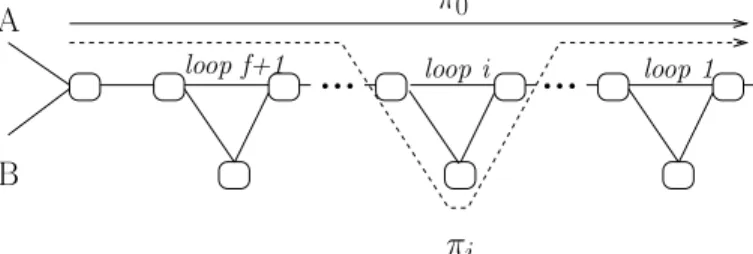
f + 1 or less tags in every network. By contradiction, for any such algorithm we construct a network consisting of two ingress ports connected to f consecutive loops. We then present f + 2 composable policies, π0, . . . , πf+1, that have
overlapping domains but prescribe distinct paths. Assuming that only f + 1tags are available, we construct an execution of the assumed algorithm in which an update installing policy
πi invalidates one of the previously installed policies, which contradicts the Consistency property of CPC.
Theorem 5: For each f ≥ 1, there exists a network such that anyf-resilient CPC algorithm usingf-resilient consensus objects has tag complexity at least f+ 2.
Proof.Assume the networkTf of two ingress portsAandB, andf+1“loops” depicted in Figure 3 and consider a scenario in which the controllers apply a sequence of policies defined as follows. Let πi,i= 1, . . . , f+ 1, denote a policy that, for each of the two ingress ports, specifies a path that in every
π
0...
...
A
B
loop i loop 1 loop f+1π
iFig. 3. The(f+ 1)-loop network topologyTf.
loop`6=itakes the upper path and in loopi takes the lower path (the dashed line in Figure 3). The policyπ0specifies the
path that always goes over the upper parts of all the loops (the solid line in Figure 3).
We assume that for all i ∈ {0, . . . , f}, we have pr(πi)<
pr(πi+1) and dom(πi) ⊃ dom(πi+1), i.e., all these policies
are composable, and adding policy πi+1 to the composition π0·π1· · ·πi makes the composed policy more refined. Note
that, assuming that only policiesπi,i= 0, . . . , f+ 1, are in
use, for each injected packet, the ingress port maintains one rule that tags and forwards it to the next branching port.
Without loss of generality, let 0 be the tag used for the initially installedπ0. By induction oni= 1, . . . , f+ 1, we are
going to show that anyf-resilient CPC algorithm onTf has a finite executionEiat the end of which (1) a composed policy
π0·π1· · ·πi is installed and (2) there is a set of i processes, q1, . . . , qi, such that eachqj, j= 1, . . . , i, is about to access
an ingress port with an update operation that, if the currently installed rule uses j−1 to tag the injected packets, replaces it with a rule that usesj instead.
For the base case i = 1, assume that some controller proposes to installπ1. Since the network initially carries traffic
tagged 0, the tag used for the composed policy π0·π1 must
use a tag different from0, without loss of generality, we call it1. There exists an execution in which some controllerq1has
updated the tag on one of the ingress port with tag 1 and is just about to update the other port. Now we “freeze” q1 and
let another controller complete the update of the remaining ingress port. Such an execution exists, since the protocol is
f-resilient (f >0) and, by the Consistency and Termination properties of CPC, any update that affected the traffic must be eventually completed. In the resulting execution E1,q1 is
about to update an ingress port to use tag 1instead of 0 and the network operates according to policyπ0·π1.
Now consider 2 ≤ i ≤ f + 1 and, inductively, con-sider the execution Ei−1. Suppose that some controller in
Π− {q1, . . . , qi−1} completes its ongoing policy update and
now proposes to install πi. Similarly, since the algorithm is f-resilient (and, thus, (i−1)-resilient), there is an extension ofEi−1 in which no controller in{q1, . . . , qi−1}takes a step
afterEi−1 and eventually some controllerqi∈ {q/ 1, . . . , qi−1}
updates one of the ingress ports to apply π0· · ·πi so that
instead of the currently used tag i−1 a new tag τ is used. (By the Consistency property of CPC,πishould be composed with all policies π0, . . . , πi−1.)
Naturally, the new tagτ cannot bei−1. Otherwise, while installing π0· · ·πi, eitherqi updates port i before porti−1
and some packet tagged iwould have to take lower paths in both loops i and i−1 (which does not correspond to any composition of installed policies), or qi updates port i−1
before i and some packet would have to take no lower paths at all (which corresponds to the policyπ0later overwritten by π0· · ·πi−1).
Similarly, τ /∈ {0, . . . , i−2}. Otherwise, once the installa-tion ofπ0· · ·πibyqiis completed, we can wake up controller qτ+1that would replace the rule of tagτwith a rule using tag τ+ 1, on one of the ingress ports. Thus, every packet injected at the port would be taggedτ+ 1. But this would violate the Consistency property of CPC, becauseπ0· · ·πiusing tagτ is
the most recently installed policy.
Thus, qi, when installing π0· · ·πi, must use a tag not in {0, . . . , i−1}, say i. Now we let qi freeze just before it is about to install tag i on the second ingress port it updates. Similarly, since π0· · ·πi affected the traffic already on the
second port, there is an extended execution in which another controller in Π− {q1, . . . , qi} completes the update and we
get the desired execution Ei. In Ef+1 exactlyf + 2tags are
concurrently in use, which completes the proof.
V. IMPOSSIBILITY FORWEAKERPORTMODEL
It turns out that it is impossible to update a network consis-tently in the presence of even one crash failure, which justifies our assumption that SDN ports support atomic read-modify-write operations. To prove this impossibility, we assume here that a port can only be accessed with two atomic operations: readthat returns the set of rules currently installed at the port andwritethat updates the state of the port with a new set of rules.
Theorem 6: There is no solution to CPC using consensus objects that tolerates one or more crash failures.
Proof. By contradiction, assume that there is a 1-resilient CPC algorithmAusing consensus objects. Consider a network including two ingress ports, 1 and 2, initially configured to forward all the traffic to internal ports (we denote this policy byπ0). Let controllersp1andp2 accept two policy-update
re-questsapply1(π1)andapply2(π2), respectively, such thatπ1is
refined byπ2,i.e.,pr(π2)>pr(π1)anddom(π2)⊂dom(π1),
and paths stipulated by the two policies to ingress ports1and
2 satisfyπ(1)1 6=π(1)2 andπ1(2)6=π2(2).
Now consider an execution of our 1-resilient algorithm in which p1 is installing π1 and p2 takes no steps. Since
the algorithm is 1-resilient, p1 must eventually complete the
update even if p2 is just slow and not actually faulty. Let us
stopp1after it has configured one of the ingress ports, say1,
to use policyπ1, and just before it changes the state of ingress
port 2to use policy π1. Note that, sincep1 did not witness a
single step ofp2, the configuration it is about to write to port
2 only contains the composition ofπ0 andπ1.
Now let a given packet indom(π1)arrive at port1 and be
processed according to π1. We extend the execution with p2
installingπ2until both ports1and2are configured to use the
composition π0·π1·π2. Such an execution exists, since the
algorithm is1-resilient andπ1has been already applied to one
packet. Therefore, by sequential composability, the sequential equivalent of the execution, both apply1(π1)and apply2(π2)
must appear as committed in the equivalent sequential history. But now we can schedule the enabled step of p1 to
overwrite the state of port2with the “outdated” configuration that does not contain π2. From now on, every packet in
dom(π2)injected at port2 is going to be processed according
toπ1—a contradiction to sequential composability.
VI. RELATEDWORK
Distributed SDN Control Plane.We are not the first to study distributed designs of the logically centralized SDN control plane. Indeed, the perception that control in SDN is centralized leads to concerns about SDN scalability and resiliency, which can be addressed with distributed control plane designs [13]. Onix [14] is among the earliest distributed SDN controller platforms. Onix applies existing distributed systems techniques to build a Network Information Base (NIB), i.e., a data structure that maintains a copy of the network state, and abstracts the task of network state distribution from control logic. However, Onix expects developers to provide the logic that is necessary to detect and resolve conflicts of network state due to concurrent control. In contrast, we study concurrent policy composition mechanisms that can be leveraged by any application in a general fashion. There are also several studies on the design of spatially distributed control planes, where different controllers handle frequent and latency critical events closer to their origin in the dataplane, in order to improve scalability and latency [15]–[17]. ElastiCon [18] proposes an elastic distributed controller architecture. We in this paper, in contrast, do not consider spatial optimizations but focus on robustness aspects.
Network Updates and Policy Composition. The question of how to consistently update networks has recently attracted much attention. Reitblatt et al. [3] formalized the notion of per-packet consistency and introduced the problem of con-sistent network update for the case of a single controller. Mahajan and Wattenhofer [19] considered weaker transient consistency guarantees, and proposed more efficient network update algorithms accordingly. Ludwig et al. [20] studied algorithms for secure network updates where packets are forced to traverse certain waypoints or middleboxes. Ghorbani et al. [21] recently argued for the design of network update algorithms that provide even stronger consistency guarantees. Finally, our work in [5] introduced the notion of software transactional networking, and sketched a tag-based algorithm to consistently compose concurrent network updates that fea-tures an exponential tag complexity not robust to any controller failure.
Distributed Computing.There is a long tradition of defining correctness of a concurrent system via an equivalence to a
sequential one [12], [22], [23]. The notion of sequentially composable histories is reminiscent of linearizability [12], where a history of operations concurrently applied by a collection of processes is equivalent to a history in which the operations are in a sequential order, respecting their real-time precedence. In contrast, our sequentially composable histories impose requirements not only on high-level invocations and responses, but also on the way the traffic is processed. We require that the committed policies constitute a conflict-free sequential history, but, additionally, we expect that eachpath witnesses only a prefix of this history, consisting of all requests that were committed before the path was initiated. The trans-actional interface exported by the CPC abstraction is inspired by the work on speculative concurrency control using software transactional memory (STM) [4]. Our interface is however intended to model realistic network management operations, which makes it simpler than recent dynamic STM models [24]. Also, we assumed that controllers are subject to failures, which is usually not assumed by STM implementations.
VII. CONCLUDINGREMARKS
We believe that our paper opens a rich area for future research, and we understand our work as a first step towards a better understanding of how to design and operate a robust SDN control plane. As a side result, our model allows us to gain insights into minimal requirements on the network that enable consistent policy updates:e.g., we prove that consistent network updates are impossible if SDN ports do not support atomic read-modify-write operations.
Our FIXTAGand REUSETAGalgorithms highlight the
fun-damental trade-offs between the concurrency of installation of policy updates and the overhead on messages and switch memories. Indeed, while being optimal in terms of tag com-plexity, REUSETAG essentially reduces to installing updates sequentially. Our initial concerns were resilience to failures and overhead, so our definition of the CPC problem did not require any form of “concurrent entry” [25]. But it is important to understand to which extent the concurrency of a CPC algorithm can be improved, and we leave it to future research. For instance, it may be interesting to combine FIXTAG and REUSETAG, in the sense that the fast FIXTAGalgorithm could be used in sparse areas of the network, while the dynamic tag reuse of REUSETAG is employed in dense areas.
Another direction for future research regards more complex, non-commutative policy compositions: while our protocol can also be used for,e.g., policy removals, it will be interesting to understand how general such approaches are.
As was recently suggested by Casadoet al.[7], maintaining consistency in network-wide structures and distributed up-dates, as well as providing the ability of modular composition and formal verification of network programs, are becoming principal SDN challenges. Our suggestion to provide control applications with atransactionalinterface [5] appears to be an adequate way to address these challenges: transactions provide the illusion of atomicity of updates and reads, can be easily composed, and allow for automated verification.
Acknowledgments
This research is (in part) supported by the EIT project Mobile SDN, by the ARC grant 13/18-054 from Communaut´e franc¸aise de Belgique, and by European Union’s Horizon 2020 research and innovation programme under the ENDEAVOUR project (grant agreement 644960). We would like to thank Yehuda Afek and Roy Friedman for interesting discussions.
REFERENCES
[1] A. D. Ferguson, A. Guha, C. Liang, R. Fonseca, and S. Krishnamurthy, “Participatory Networking: An API for Application Control of SDNs,” inSIGCOMM, 2013.
[2] C. J. Anderson, N. Foster, A. Guha, J.-B. Jeannin, D. Kozen, C. Schlesinger, and D. Walker, “NetKAT: Semantic Foundations for Networks,” inPOPL, 2014.
[3] M. Reitblatt, N. Foster, J. Rexford, C. Schlesinger, and D. Walker, “Abstractions for Network Update,” inSIGCOMM, 2012.
[4] N. Shavit and D. Touitou, “Software transactional memory,”Distributed Computing, 1997.
[5] M. Canini, P. Kuznetsov, D. Levin, and S. Schmid, “Software Transac-tional Networking: Concurrent and Consistent Policy Composition,” in
HotSDN, 2013.
[6] M. Herlihy, “Wait-free Synchronization,”ACM Trans. Program. Lang. Syst., vol. 13, no. 1, 1991.
[7] M. Casado, N. Foster, and A. Guha, “Abstractions for Software-Defined Networks,”Commun. ACM, vol. 57, no. 10, 2014.
[8] M. J. Fischer, N. A. Lynch, and M. S. Paterson, “Impossibility of Distributed Consensus with One Faulty Process,” vol. 32, no. 2, 1985. [9] D. Dolev, C. Dwork, and L. Stockmeyer, “On the Minimal Synchronism
Needed for Distributed Consensus,” vol. 34, no. 1, Jan. 1987. [10] T. D. Chandra, V. Hadzilacos, and S. Toueg, “The Weakest Failure
Detector for Solving Consensus,” vol. 43, no. 4, Jul. 1996.
[11] C. Delporte-Gallet, H. Fauconnier, and R. Guerraoui, “Tight Failure Detection Bounds on Atomic Object Implementations,”J. ACM, vol. 57, no. 4, 2010.
[12] M. Herlihy and J. M. Wing, “Linearizability: A Correctness Condition for Concurrent Objects,” ACM Trans. Program. Lang. Syst., vol. 12, no. 3, pp. 463–492, 1990.
[13] S. Yeganeh, A. Tootoonchian, and Y. Ganjali, “On Scalability of Software-Defined Networking,” Communications Magazine, IEEE, vol. 51, no. 2, 2013.
[14] T. Koponen, M. Casado, N. Gude, J. Stribling, L. Poutievski, M. Zhu, R. Ramanathan, Y. Iwata, H. Inoue, T. Hama, and S. Shenker, “Onix: A Distributed Control Platform for Large-scale Production Networks,” inOSDI, 2010.
[15] S. Hassas Yeganeh and Y. Ganjali, “Kandoo: A Framework for Efficient and Scalable Offloading of Control Applications,” inHotSDN, 2012. [16] B. Heller, R. Sherwood, and N. McKeown, “The Controller Placement
Problem,” inHotSDN, 2012.
[17] S. Schmid and J. Suomela, “Exploiting Locality in Distributed SDN Control,” inHotSDN, 2013.
[18] A. Dixit, F. Hao, S. Mukherjee, T. Lakshman, and R. Kompella, “Towards an Elastic Distributed SDN Controller,” inHotSDN, 2013. [19] R. Mahajan and R. Wattenhofer, “On Consistent Updates in Software
Defined Networks,” inHotNets, 2013.
[20] A. Ludwig, M. Rost, D. Foucard, and S. Schmid, “Good Network Updates for Bad Packets: Waypoint Enforcement Beyond Destination-Based Routing Policies,” inHotNets, 2014.
[21] S. Ghorbani and B. Godfrey, “Towards Correct Network Virtualization,” inHotSDN, 2014.
[22] C. H. Papadimitriou, “The Serializability of Concurrent Database Up-dates,”J. ACM, vol. 26, 1979.
[23] L. Lamport, “How to Make a Multiprocessor Computer that Correctly Executes Multiprocess Programs,” vol. 28, no. 9, 1979.
[24] M. Herlihy, V. Luchangco, M. Moir, and W. N. Scherer, III, “Software Transactional Memory for Dynamic-sized Data Structures,” inPODC, 2003.
[25] Y.-J. Joung, “Asynchronous group mutual exclusion,”Distributed Com-puting, vol. 13, no. 4, 2000.