Open Research Online
The Open University’s repository of research publications
and other research outputs
The process of discursive institutional work in creating
an innovative degree development practice: an
institutionalisation approach to innovation
Thesis
How to cite:
Gunn, Frances Elizabeth (2014). The process of discursive institutional work in creating an innovative degree development practice: an institutionalisation approach to innovation. PhD thesis The Open University.
For guidance on citations see FAQs.
c
2014 Frances Elizabeth Gunn
Version: Version of Record
Copyright and Moral Rights for the articles on this site are retained by the individual authors and/or other copyright owners. For more information on Open Research Online’s data policy on reuse of materials please consult the policies page.
The Process of Discursive Institutional Work in Creating an Innovative Degree Development Practice: An Institutionalisation Approach to
Innovation
A dissertation presented by
Frances Elizabeth Gunn, M. A., B. Commerce
to
The Open University Business School
in partial fulfilment of the requirements for the degree of
Doctor of Philosophy in the subject of
Business
Open University
ProQuest N um ber: 13889400
All rights reserved INFORMATION TO ALL USERS
The qu ality of this repro d u ctio n is d e p e n d e n t upon the q u ality of the copy subm itted. In the unlikely e v e n t that the a u th o r did not send a c o m p le te m anuscript and there are missing pages, these will be note d . Also, if m aterial had to be rem oved,
a n o te will in d ica te the deletion.
uest
ProQuest 13889400
Published by ProQuest LLC(2019). C op yrig ht of the Dissertation is held by the Author. All rights reserved.
This work is protected against unauthorized copying under Title 17, United States C o d e M icroform Edition © ProQuest LLC.
ProQuest LLC.
789 East Eisenhower Parkway P.O. Box 1346
© 2 0 1 4 - Frances Elizabeth Gunn
All rights reserved.
t
1 5 SEP 2014
G 0 1 The Library d o n a t i o nT
3 7 S . 1 0 3
.
t-o ft&xhXkze&AO
f t c
Abstract
Developing sector-specific university degrees is a challenging process for
universities and sectoral members. The development of these degrees needs to incorporate industry-specific resources whilst satisfying the universities’
institutional degree requirements. The process is particularly problematic when there has not previously been a degree devoted to the sector and when there has not been sector-wide communication about the need for a degree. This study provides an empirical investigation of the development of Canada’s first retail management degree and examines how discursive processes constituted an innovative practice of sector-specific degree development in a fragmented, occupational field. These processes were innovative because they involved a corporate-university partnership, multiple collaborations of institutional and corporate embedded actors, and particular forms of legitimating discursive work. Given the institutional nature of the university, this practice represents a process of institutionalisation, whereby the innovative practice becomes a legitimate means of degree development. By examining this unique case, this study develops an analytic framework to analyse discursive institutionalisation through archival documentation and qualitative interviews. The discursive work performed through the data is characterised by the prominence of generalised issues, and by the nature of its synchronicity, recursiveness and convergence. The resulting institutionalisation processes perform discursive institutional work that is
purposive, synchronised, recursive and convergent. This study therefore provides an understanding of how discursive processes institutionalise an innovative practice of retail management degree development.
Dedication
I dedicate this to the dear people I lost during the writing of this thesis -Joan Elizabeth Stewart, Dr. Patricia Grundy Gunn, Cheryl Anne Wills,
Acknowledgements
I could not have written this thesis without the help of many people and organisations.
For the past 5 years, I’ve been thinking about how to adequately thank my
supervisors - words are not enough - you always made it so much better! Thank you, Dr. Anne Smith. You have been with me from the beginning, steering me through the many iterations of the research, always providing insights and
inspiration, and making the process work! Thank you, Dr. Sarah Robinson. Your feedback took me to places I didn’t know existed and I’m so grateful. Thank you Dr. Fiona Ellis-Chadwick. You showed me how to frame my thoughts and make them real. Thank you, Dr. Wendy Cukier, for jolting the framing of the research into place - twice! And thank you, Dr. David Martin for starting the process with me and having the grace to hand me over to Wendy when the focus shifted. You’re the best supervisors ever!!!
This PhD process could not have happened without the financial and moral support of the Ted Rogers School of Management at Ryerson University. In particular, the Doctors 2B group, Dr. Ojelanki Ngwenyama (who shepherded me through his Research Methods course twice!), and my co-workers in the Ted Rogers School of Retail Management have been a constant source of encouragement. I have been inspired by their dedication and abilities.
My family and friends continuously provided me with the strength to continue, sometimes they listened, sometimes they provided distraction and relief, and sometimes they provided inspiration. Thank you Dad, Rob, Stewart, Amelia, my brothers and their families, Gayle, Sandy, Linda, Taylor, and my roommates -Jessi, Paul, Keith and Laura (!!). In particular, thanks to those of you who read parts of the thesis as it developed - Dad, Rob, Gayle, Sandy and Linda. Dr. Jim Ryan from the Ontario Institute for Studies in Education generously provided his input and an opportunity to participate in his Qualitative Research class - both helped to clarify my direction. And thanks to the Range Road community - what a great place to write a PhD.
Jim Chestnutt’s archive was the inspiration and focus for this PhD. I’ll be forever grateful for his generosity and for his dedication and commitment to the important work of the Eaton School of Retailing project. Phil Schalm’s work also deserves special mention as it was integral to the progression of the project to becoming the current degree. And this PhD thesis recognises the late Tony LaMantia as a true educational visionary.
Finally, thank you to my medical and recovery teams, who enabled me to acquire two new hips in addition to a PhD thesis - Drs. Benfayed and Stern, the
Table of Contents
Introduction...1
Description of the Thesis Chapters... 12
Chapter 1: The Context - The Canadian Retail Management Education Field...17
1.1 Introduction... 17
1.2 Regulative Influences on Canadian Retail Management Degree Development ... 18
1.3 Normative Influences on Canadian Retail Management Degree Development 22 1.4 Cultural-cognitive Influences on Canadian Retail Management Degree Development... 26
1.4.1 Professionalising Dimensions: Jurisdictional Claims... 27
1.4.1.1 Social Aspects of the Retail Management Occupational Jurisdiction...28
1.4.1.2 Economic Aspects of the Retail Management Occupational Jurisdiction...31
1.4.2 Professionalising Dimensions: A Specific Body of Knowledge ....32
1.4.3 Professionalising Dimensions: Specific Educational Requirements.34 1.4.4 Profess.ionalising Dimensions; The Canadian Retail Management Education F ie ld ...36
1.5 A Description of the Case Study: The Development of Canada’s Retail Management D e g re e ... 41
1.6 Chapter One Summary... 44
Chapter 2: Literature Review - Institutionalisation of New Practices through Collaborative and Discursive Work... 47
2.1 Introduction... 47
2.2 Theoretical Foundations of Institutionalisation... ..48
2.3 Processes of Institutionalisation...51
2.4 Fields and Institutionalisation... 56
2.4.1 Field Development... 57
2.4.2 Strategic Action Fields... 61
2.5 Actors and Their Agency in Institutionalisation ...64
2.5.1 Institutional Entrepreneurs...65
2.7 Practice W ork... 80
2.8 Institutional Work Theory... 83
2.8.1 Institutional Work: Creating Institutions...85
2.8.2 Institutional Work: Maintaining Institutions... 89
2.8.3 Institutional Work: Disrupting Institutions... 90
2.8.4 Multiple Forms of Institutional W ork...91
2.9 Institutionalising Discursive W ork... 96
2.10 Institutional Legitimation... 99
2.11 Professionalisation...102
2.12 Institutional Research in Retail Management and Management Education...107
2.13 The Formulation of Research Objectives, Conceptual Framework and Research Questions... 110
3: Methodology I - Developing the Analytical Framework... 120
3.1 Introduction...120
3.2 Methodological Perspectives - Ontological and Epistemological Underpinnings ... 123
3.3 Methodological Approach... 125
3.3.1 Organisational Discourse Analysis (ODA)...127
3.3.1.1 Theoretical Assumptions of Organisational Discourse Analysis... 128
3.3.1.2 Key Concepts of Organisational Discourse Analysis 132 3.3.2 Forms of Organisational Discourse Analysis Studies...134
3.3.2.1 Forms of Discourse Patterns... 135
3.3.2.2 Forms of Discourse Evidence... 138
3.3.2.3 Forms of Organisational Phenomenon... 139
3.4 Methodological Framework...141
3.4.1 Dimensions of the Discursive Institutional Work Analytic Framework 145 3.4.1.1 Strategic Action Fields... 146
3.4.1.2 Actors - Interorganisational Collaborations... 146
3.4.1.3 IW Actions...147
3.4.1.4 Discursive W ork... 148
3.4.1.5 Texts...149
3.4.1.6 Institutionalisation... 149
Chapter Four: Methodology II - The Case Study Design... 152
4.1 Introduction... 152
4.2 Rationale for the Application of a Case Study Approach...153
4.3 Case Selection... 157
4.4 Research Design and Protocols... 159
4.5 Data Collection Strategy...162
4.5.1 Archival Documentation Data... 164
4.5.2 Interview Data... 167
4.5.2.1 Thematising... 167
4.5.2.2 Designing... 168
4.5.2.3 Interviewing... 169
4.5.2.4 Transcribing... 171
4.5.3 Justification of Data Sources... 171
4.6 Analytic Method... 173
4.6.1 Stages of Analysis: Archival Documentation...174
4.6.2 Stages of Analysis: Interview Transcripts... 184
4.7 Data Management Process... 186
4.8 Verifying Research Quality... 187
4.8.1 Construct Validity... 189
4.8.2 Internal Validity... 191
4.8.3 External Validity...196
4.8.4 Reliability...197
4.9 Ethical Considerations... 198
4.9.1 Preliminary Informed Consent...198
4.9.2 Role of the Researcher... 199
4.10 Chapter Four Summary... 201
Chapter 5: Data Analysis... 202
5.1 Introduction... 202
5.2 Analysis of Patterns in Strategic Action Field Characteristics ...205
5.2.1 Threats... 207
5.2.2 Available Resources... 208
5.2.3 Innovative Actions... 213
5.3 Analysis of Patterns in Characteristics of Actors... 215
5.3.1 Collective Identities of Collaborations... 225
5.3.2 Involvement and Embededdness of Collaborations...229
5.4 Analysis of Patterns in Discursive Institutional W ork ...235
5.5 Analysis of Patterns in Discursive Work... 5.6 Analysis of Patterns in Texts... 5.6.1 Marketing Genres... 5.6.2 Technical Genres... 5.6.3 Field Genres... 5.6.4 Popular Genres... 5.6.5 Policy Genres... 5.6.6 Reflective Purposive Genres... 5.7 Analysis of Patterns of Institutionalised Dimensions...
5.7.1 Patterns in Regulative Institutional Dimensions 5.7.2 Patterns in Normative Institutional Dimensions. 5.7.3 Patterns in Cultural-Cognitive Dimensions...
5.8 Patterns in Relationships between Actors, Discursive Institutional Work and
Institutional Dimensions... 298
5.9 Explanatory Analytic Model... 299
5.9 Chapter Five Summary... 302
Chapter 6: Discussion of Findings... 304
6.1 Introduction... 304
6.2 Research Objective # 1 ... 305
6.3 Research Objective # 2 ... 315
6.4 Research Objective # 3 ...336 6.5 Chapter Six Summary.
Chapter 7: Conclusions of the Thesis: Contributions, Limitations, Recommendations for Future Research, and Reflections...
7.1 Introduction... 7.2 Theoretical Contributions... ... 7.3 Empirical Contributions... 7.4 Methodological Contributions... 7.5 Practical Contributions... 7.6 Limitations of the Research... 7.7 Recommendations for Future Research...
7.9 Chapter Seven Summary... 361
R eferences...363 A ppendix A: Table 2.2 Empirical studies utilising Institutional Work theory
(Lawrence and Suddaby, 2006), n=70... 393 Appendix B: Table 4.2 Catalogue of Archival Documents over Tim e... 402 Table 4.8 Analytic Code Book...406
Tables
Table 2.1 Institutional Work Model... 84
Table 2.2 Empirical studies utilising institutional work theory... 379
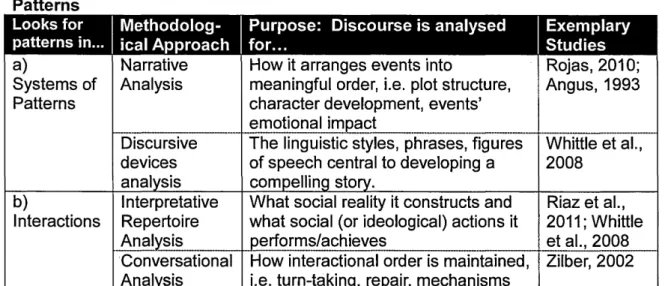
Table 3.1 Discourse Analysis Approaches to Forms of Discourse Patterns ...135
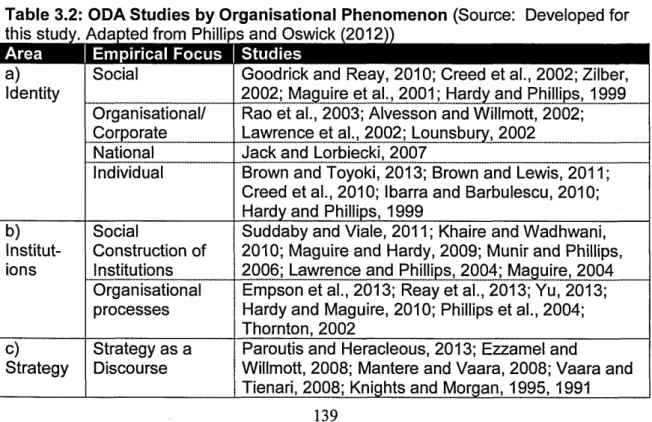
Table 3.2 ODA Studies by Organisational Phenomenon... 139
Table 3.3 Key Features of Discursive Institutional Work Analytic Framework.... 143
Table 4.1 ESR Case Study Protocols... 159
Table 4.2 Catalogue of Archival Documentation over Tim e... 388
Table 4.3 Data Sources... 171
Table 4.4 Justification for Data Sources...172
Table 4.5 Data Analysis Stages... ... 175
Table 4.6 Chronological Event List...178
Table 4.7 Emergent Themes Codebook...180
Table 4.8 Analytic Codebook...392
Table 4.9 Case Study Tests and Techniques for Establishing Validity and Reliability...188
Table 5.1 Strategic Action Field Characteristics...206
Table 5.2 Actors: Individual Organisations and Interorganisational Collaborations over Tim e...217
Table 5.3 Institutional Work Categories and Related Discursive Themes 237 Table 5.4 IW Actions: Discursive Themes over Tim e... 243
Table 5.5 Support from Broader Discourses... 257
Table 5.6 Genres of Texts producing Discursive W ork... 265
Table 5.7 Marketing Genres over Tim e... 267
Table 5.8 Technical Genres over Tim e...271
Table 5.9 Field Genres over Time... 274
Table 5.10 Policy Genres over Tim e...280
Table 5.11 Summary of Funding... 283
Figures
Figure 1: Institutionalisation Process as Operationalised in this Study... 10
Figure 2.1 Conceptual Framework of Discursive Institutionalisation Process...118, 342 Figure 3.1: Key Aspects of this Study 122, 152 Figure 3.2 Discursive Institutional Work (DIW): An Analytic Framework 143 Figure 4.2 Discursive Institutional Work (DIW): An Analytic Framework.... 161, 203 Figure 4.3 Interview Guide... 170
Figure 5.1 Institutional Work (IW) Discursive Themes... 236
Figure 5.2 Explanatory DIW Analytic Model...300
Figure 7.1 Characteristics of Relationships Between DIW Dimensions... 344
Pictures
Picture 5.1: Document #32, CRMEP Overview... 232
Picture 5.2: Document #19, NSAS Educational materials... 269
Picture 5.3 Document #27, Retailing as a Career Newsletter... 277
The Process of Discursive Institutional Work in Creating an Innovative Degree Development Practice: An Institutionalisation Approach to
Innovation
Introduction
This thesis focuses on a challenge that faces universities and members of the retail industry concerned with retail management education: how to integrate industry input in the development of retail management degrees. This challenge exists because universities have well-established and regulated processes about degree development, that do not typically involve industry in the development of curriculum (Marshall, 2004), and because the retail sector is not uniformly
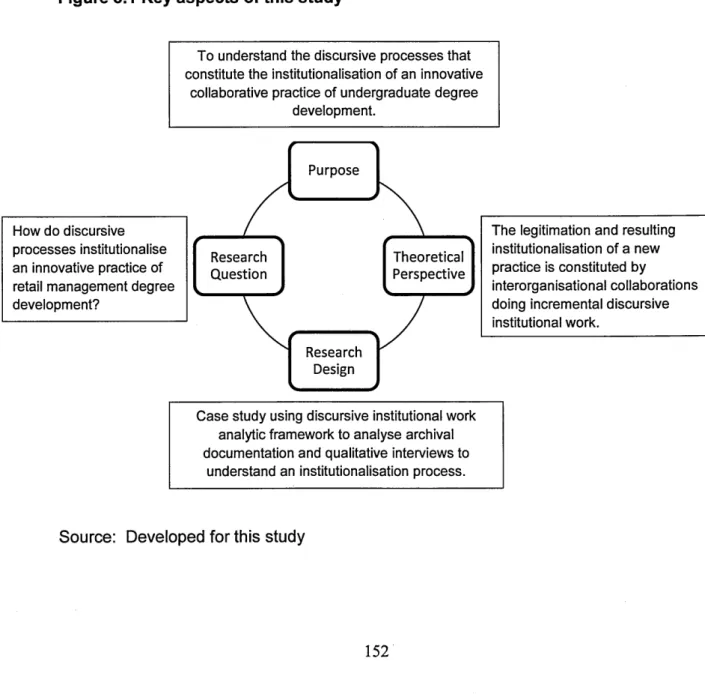
committed to participating in retail management education (Bernhardt, 1999). This situation is particularly problematic when there has not been a previous degree devoted to the sector, and when there has not been sector-wide communication focused on retail management education. Universities and members of the sector are, therefore, challenged to develop new degree development processes that integrate the universities’ institutional requirements and the interests of the industry’s diverse members. This study, therefore, aims to contribute to understanding the complexities related to this challenge by answering the research question:
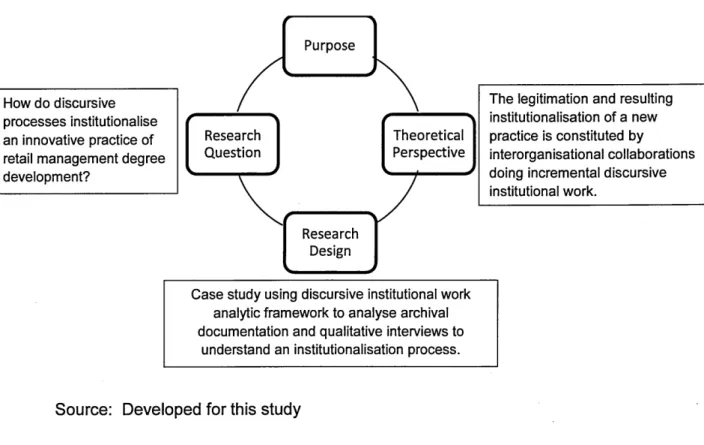
How do discursive processes institutionalise an innovative practice of retail management degree development?
In order to answer this question, this study provides an empirical investigation of the development of Canada’s first university degree in retail management. This particular case involved innovative processes that originated with a
corporate-university partnership, mobilised multiple interorganisational collaborations, and utilised diverse forms of discursive work.
This Introduction will provide a discussion of the reasons for studying this particular challenge. It will also provide definitions of the central concepts that informed the study’s development. The structure and content of each Chapter is then described.
Retail Management Education in Canada: An Innovative Degree Development Practice
The development of this retail management degree occurred between 1993 and 1999, and prior to that time, retail management degrees had not been offered by Canadian universities. Although Canadian retailing is an economically and socially significant sector (Industry Canada, 2010), Canadian universities had not focused on research or educational linkages with the retail consumer service sector, which this study defines as “a set of business activities that add value to the products and services sold to consumers” (Levy et al., 2011, p.6).
Since the 1990s, there have been tensions between increased demands for Canadian university programming and decreased government funding (Marshall, 2004). In response, Canadian universities have implemented strategies for increasing programming options and resulting enrollments, while containing costs. In particular, they have developed partnerships and collaborations with other post secondary institutions, industry, governments, agencies, community groups and corporations (Crocker and Usher, 2006; Marshall, 2004). In addition to increased programming options, these collaborations have brought many benefits to
2006; Elmuti et al., 2005; Snowdon, 2005; Marshall, 2004). For example,
Canadian universities implemented innovative degree development processes that delivered all or parts of degrees through community colleges and non-traditional delivery mechanisms (i.e. distance education) (Crocker and Usher, 2006;
Marshall, 2004). However, this study examines a process that originated with a corporate-university collaboration, rather than previous processes which had featured collaborations with colleges or innovative delivery mechanisms (Crocker and Usher, 2006).
Prior to this degree development process, corporate-university collaborations were prevalent within sectors like technology and medicine that relied on applied
research knowledge from science and engineering and were not common with consumer service sectors, like retailing (Marshall, 2004). In addition, the majority of corporate-university partnerships had been directed at developing research goals and not at the development of undergraduate degrees (Crocker and Usher, 2006). Correspondingly, studies of corporate-university partnerships had
generally been aimed at research-oriented collaborations and few studies had examined the dynamics and processes of corporate-university collaborations aimed at undergraduate degree development.
At the same time, corporate-university collaborations related to degree development raised concerns about the possibility that universities may lose control of the creation and administration of curricula (Slaughter and Leslie, 1997; Buchbinder and Newson, 1990). These concerns were related to beliefs about universities’ roles as public institutions, responsible for the legitimacy of higher education credentials (Trank and Rynes, 2003; Slaughter and Leslie, 1997;
corporate-university collaborations, this study will also determine how these processes are legitimated.
An Institutionalisation Approach to Innovation
The collaborative process constitutes an innovative practice in Canadian universities. These universities are regarded as institutions of higher learning (Crocker and Usher, 2006). Institutions are “multifaceted, durable social structures made up of symbolic elements, social activities, and material resources” (Scott, 2001, p.49), which have a rule-like, factual quality, and are embedded in formal structures, like university degree development processes. Furthermore, this study defines an institutional innovation as a change in an institution’s quality or
structures “that is a novel or unprecedented departure from the past.” (Hargrave and Van de Ven, 2006, p.866). In particular, when applied to university practices, the term “innovation” means changes in general practices at a university that are “designed to position an institution at the forefront of some area of teaching and learning or knowledge mobilization and, hence, to differentiate the institution in some way from other similar institutions.” (Crocker and Usher, 2006, p. 1). This study therefore takes an institutional approach to examining the creation of an innovative degree development practice.
Institutions are composed of cultural-cognitive, normative, and regulative elements that, together with “associated activities and resources, provide stability and
meaning to social life.” (Scott, 2001, p.48). Regulative elements are imposed by institutions of the state (i.e. governments) which provide rules that regulate processes. Normative elements arise from commonly held expectations about
perceptions of meaning (Scott, 2001). The legitimacy of these elements contributes to their institutionalising nature. Legitimacy is defined as “a
generalized perception or assumption that the actions of an entity are desirable, proper, or appropriate within some socially constructed system of norms, values, beliefs, and definitions” (Deephouse and Suchman, 2008, p. 52; Suchman 1995, p. 574). Legitimacy is a key characteristic of any institution (Hurley and Sa, 2013; Scott, 2001), in that is a socially constructed, cultural-cognitive condition that deems organisational actions as appropriate (Scott, 2001).
Institutional elements include structures, actions and roles which legitimate other elements, and a university degree development process is an institutional element. This study asserts that institutional elements confer legitimacy, and thereby claims that generation of new institutional elements is the main process of
institutionalisation. As stated by Zucker (1987, p.446) “Institutional elements are easily transmitted to newcomers, are maintained over long periods of time without further justification or elaboration, and are highly resistant to change”. Therefore, by culminating in a newly formed institutional element, the collaborative
development practice constitutes an innovative process of institutionalisation.
In particular, this study examines how discourses about professionalisation carry the necessary legitimation of the degree development practice. Scott (2008,
p.223) defines institutional carriers as “definers, interpreters, and appliers of institutional elements”, and professionalisation is viewed in institutional research as a carrier of institutional elements (Muzio et al., 2013; Scott, 2001; Reed, 1996).
Institutional theories focus on how institutionalised structures affect processes in organisations and consequently highlight the processes by which structures become established as legitimate guides for social behaviour (Scott, 2004). Viewing legitimacy as a socially constructed condition reflects an ontological perspective of a world continually in flux. This perspective thereby provides this study’s foundation for viewing the creation of innovative institutional practices as multiple organisational processes. The epistemological perspective taken by this study is that these institutionalising processes are constituted by the discursive agency of organisational actors situated within a common field of interest. Their discursive work is influenced by cognitive, normative and regulative pressures and guided by legitimated institutional elements (Phillips et al., 2004). By taking this epistemological perspective, this study claims that the discourses produced by these actors legitimise the development of new institutional elements, and thereby constitute an institutionalising process (Phillips et al., 2004).
Ultimately, this study provides a process model of institutionalisation that
illuminates new practice origins. This process model provides a way to understand how innovative institutional practices emerge and develop over time (Langley et al., 2013; Hargrave and Van de Ven, 2006), and includes the characteristics of a process theory: a clear sequence, focal actors, a point of view, an evaluative frame of reference, and indicators of context in which the process occurs (Langley etal., 2013; Pentland, 1999).
This process model incorporates dimensions of institutional work theory as the lens through which the discursive work involved with the degree development processes is examined. Institutional work is defined as “the purposive action of individuals and organizations aimed at creating, maintaining, and disrupting
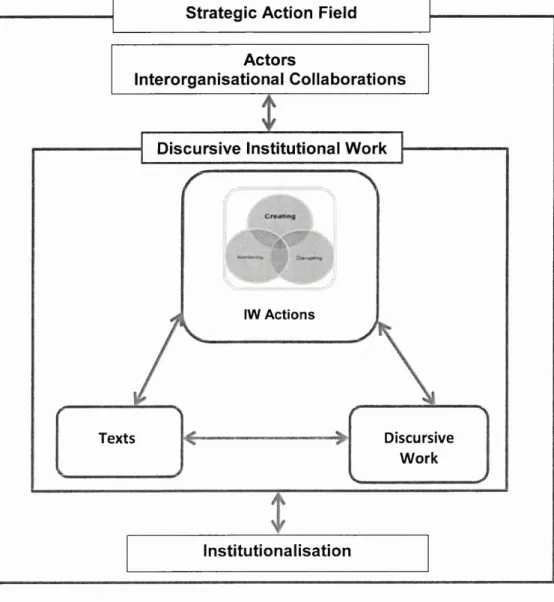
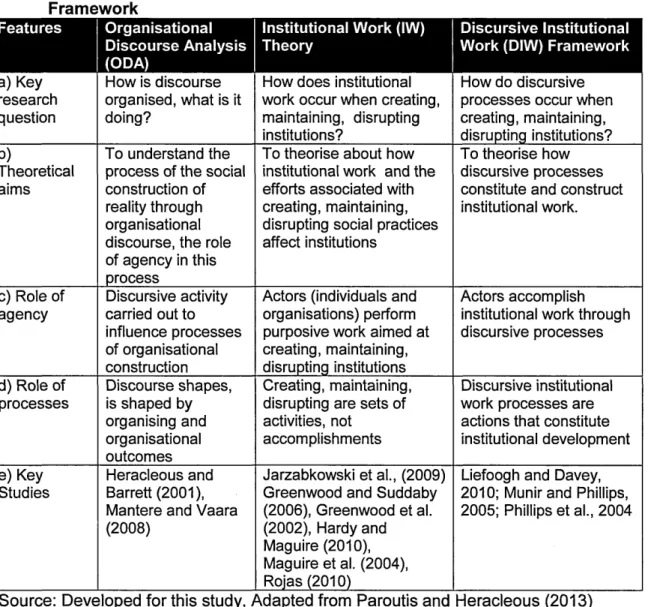
institutions” (Lawrence and Suddaby, 2006, p. 216). Institutional work therefore provides a way to examine the organisational processes and the roles of actors associated with developing discursive work. This model of institutionalisation processes is therefore a conceptual framework of discursive institutional work (DIW).
Given that this study’s approach regards institutionalisation as a socially
constructed process, the roles that the constituent organisational actors play within a field are central to the approach. DiMaggio and Powell define a field as "sets of organizations that, in the aggregate, constitute an area of institutional life." (1983, p. 148). The area of institutional life examined in this study is constituted by “knowledgeable actors (who) interact with common understandings about the field’s purposes, relationships and rules” (Fligstein and McAdam, 2012, 2011). Specifically, this study examines the Canadian retail management education field. By virtue of its geographic setting and national state, this is an institutional field that corresponds to “the populations, organizations, and markets located in a geographic territory and sharing, as a result of their common location, elements of local culture, norms, identity, and laws” (Marquis and Battilana, 2009, p. 286).
This study examines the organisational actors within this field, claiming that these actors are organisations that have the capacity and responsibility to act on behalf of others (Meyer and Jepperson, 2000). These organisational actors exist as agents “who are socially constituted as active and acting in the field under consideration by the fact that they possess the necessary properties to be effective, to produce effects, in this field.” (Bordieu and Wacquant, 1992, p. 107). In other words, these organisational actors have agency by virtue of their capacity for action and to “reproduce and transform an environment’s structures” (Battilana
and D’Aunno, 2009, p.46). These actors’ agency is influenced by common understandings of the institutional pressures influencing the innovative process (see Chapter 1, Sections 1.2, 1.3. 1.4).
At the same time, by adopting an institutional perspective, this study
acknowledges that the agency of actors embedded (i.e. situated) within fields is influenced by the nature and related influences of their institutional fields and by their locations within those fields (Friedland and Alford, 1991). This study investigates how this notion o f ‘embedded agency’ (DiMaggio and Powell, 1983) contextualises the roles of the corporate actors in the various collaborations involved with the processes.
The role of actors in creating and diffusing innovations has been addressed by institutional researchers through the concept of institutional entrepreneurs
(Greenwood and Hinings, 1996; DiMaggio, 1988). Institutional entrepreneurs are individual actors with sufficient resources to generate new institutions when they see worthwhile opportunities (Leca et al., 2008; Seo and Creed, 2002; DiMaggio, 1988). However, this study focuses on the collective agency of collaborative organisational actors, arguing that institutionalising processes were mobilised by their heterogeneous interests and resources (Lounsbury and Crumley, 2007; Maguire et al., 2004). This study’s process model of institutionalisation therefore features distributed agency, involving diverse actors working in a coordinated way, and building on the interpretive work of others (Delbridge and Edwards, 2008; Garud and Karnoe, 2002; Perkmann and Spicer, 2007).
The Case of Canadian Retail Management Education
To aid in the theoretical building dimension of this thesis, which is central to its theoretical contribution, the study draws on the empirical case of the development of Canada’s first Retail Management degree, which is situated at Ryerson
University in Toronto. The case began in 1993, with a partnership between the T. Eaton Company Ltd., which, at the time, was a dominant Canadian department store chain, and Ryerson University. This study examines the degree
development process starting with the inception of this partnership, named the Eaton School of Retailing (ESR). This inception phase evolved to include multiple interorganisational collaborations, which then engaged in multiple forms of
institutional work during the second formation phase of the degree. Finally, the process culminated in the instantiation phase which featured the University’s institutional approval of the degree. These three phases constituted the
institutionalisation processes engaged in by the multiple collaborations involved with the degree development. Figure 1 presents how the phases of the empirical case operationalise the dimensions of institutionalism that constitute this study’s process model of institutionalisation.
u re 1: In s ti tu ti o n a li s a ti o n P ro c e s s as O p e ra ti o n a li s e d in th is St u dy . o> CD 0 0 CO O) o o o ■° Q. 0 > C to i w> C O) o 9 - c 1 3 ! = S g < T3 .E -L g 2 E E a ^ 3 (0 i=
_
^ *5 “ ^ c ® 0"'—■- co c o > > CD c .2 ■§ ~ > .2 -t; e- J5 0 .-t; 3 0 3 E 4—» (— D) l—0) 4—1 „ W C 0 O O W C D 0 £ o K Z O . E c " 0 c 0 3 4—» 0 C v c 0 C 0 E 0 0 ^3 0 c o .2 c 0 to c n O 0 .*£ 0 O > . 0 ) 0 3 > o C C CO T3 0 W n 0 £ c . 2 T3 ~ 0 = » E ■S 05 0 =50 c o Q II br 0 O _ C ^ 0 O •2 £ 3 < 0 0 I I 0 > '0i_ 3 ^ 0 E 0 o 0 0 i_ C 0 o 3 ^ ~ > CD O i= -E > Q > b~ ,0 to o — • » -•o c 0 O) t O) 0 0 0 o ^ X ^ c\T crT 0 0 g J ■S3 0 3 C ■S 0 H 0 S o 5> 0 S= < LL D) O ™ T3 -!= 0 C h: "D O) iZ O O O) £ to 5 0 I— c 3 ^ ^ O Q ^ co co x 0 2 T- O C CM T3 Q. 00 CT Q. 0 L_ 0 "2 0 0 D) 0 C P O rl -Q C c 0 >, -O 0 3 £ W 2 f 5 0 r-0 O 0 0 m 0 0 0 o 0 .2 /— 4->As outlined above, the case is set in the Canadian retail management education institutional field, which is constituted by heterogeneous institutional influences. Within the Canadian university sector, universities are public institutions that have legal authority to grant degrees. The Canadian constitution assigns responsibility for university education to the provincial level of government. University education policy is decentralised and there is no federal university policy framework (Canadian Council on Learning, 2010).
The specific innovation examined in this study is the collaborative degree
development process that generated the Retail Management degree. This innovative practice was specifically designed to position Ryerson at the forefront of Canadian retail management education. It therefore constitutes an innovative change to the typical Ryerson degree development processes which originate in the traditional teaching and research faculties. The genesis of this innovative degree development practice is a partnership between a corporation (Eaton’s) and Ryerson’s Continuing Education (CE) Faculty. The process then progresses through multiple,
interorganisational, discursive collaborations. Most Canadian universities have CE departments that develop cost recovery programs, and generate revenue for the university while meeting needs for upgrading and specialised training. They offer vocational certificate and diploma programs, but do not usually offer degree programs (Jones, 2009).
This study utilises a case study methodological approach and adopts the
epistemological perspective that the discourses produced by the actors in the case are the processes which constitute the new degree development practice. This study
defines discourse as a set of interrelated texts that, along with the related practices of text production, distribution, and consumption, brings an object or idea into being (Phillips et al., 2004; Fairclough, 1995; Parker, 1992). The texts examined in the study include written or spoken language, and visual representations (Grant et al., 2001). Discursive work is defined as “discursive activity carried out to influence processes of social construction” (Phillips and Lawrence, 2012, p. 225). This study argues that, when produced in an institutionalisation process, this discursive activity constitutes discursive institutional work (DIW). This current study, thus, examines the incremental discursive institutional work involved with the process of
institutionalisation in the development of the degree.
The following section describes how this thesis is organised. Ultimately, the chapters are ordered to present a comprehensive discussion of the development of a
discursive institutional work (DIW) model through the examination of an empirical case. The model forms the institutionalisation process involved with the creation of a new institutional practice.
Description of the Thesis Chapters
The first chapter sets the context for this study. This chapter discusses the
regulative, normative, and cultural-cognitive institutional pressures influencing retail management education in Canada. The chapter provides a discussion of the
characteristics of the Canadian university sector (Crocker and Usher, 2006; Marshall, 2004), focusing on corporate-university processes and retail management education. A discussion of the normative influences of US and UK retail management degree
programs and of corporate universities follows. The chapter then explains how the legitimacy of retail management as a career is related to dimensions of
professionalism (Muzio et al., 2011). The specific conditions related to the Canadian retail environment are then discussed. The chapter proceeds to a discussion of the origins of the case, presenting an overview of the corporate and academic partners that instigated the process.
Chapter Two develops the conceptual framework for the study through an
investigation of the literature related to institutionalisation processes. The chapter begins with a discussion of the theoretical foundations of institutional work theory, including traditional and neo-institutionalism, fields, agency, and processes of
institutional change. A discussion of processes of institutional change and the notion of practice work provide a bridge to a review of studies based on institutional work theory. This theory focuses on the actions involved with creating, maintaining, and disrupting institutions. The Chapter then provides an examination of discursive work involved with institutionalisation including a focus on legitimation and
professionalising discursive strategies. A review of empirical institutional research in retail management and management education follows. The chapter concludes with a discussion of the gaps and the research objectives that are identified through the review, culminating in the institutionalisation process model featuring discursive institutional work (DIW), and the study’s over-arching research question.
Chapter Three presents the methodological approach which provides the analytical framework for this study. The work in this chapter moves from the conceptual phase in Chapter Two to the justification of the methodological approach and links to the
justifications for and practicalities of the case study methodology in Chapter Four. Chapter Three begins with a statement of the study purpose and the research question, followed by a discussion of the philosophical underpinnings of the study. The chapter then discusses the methodological approach which is organisational discourse analysis. Finally, the chapter describes the discursive institutional work (DIW) analytic model that frames this thesis’ research approach. This model presents how the DIW theoretical framework is operationalised in the case study analysis.
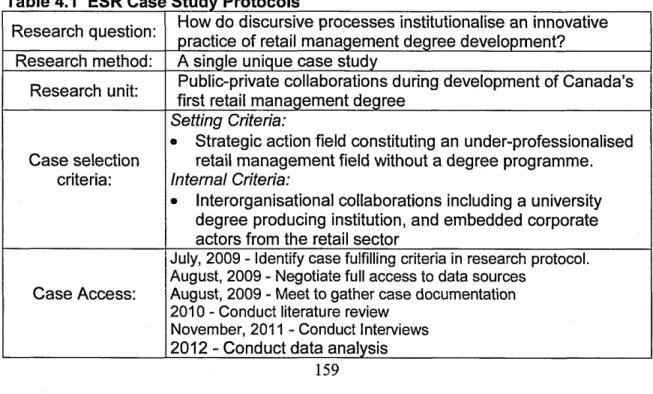
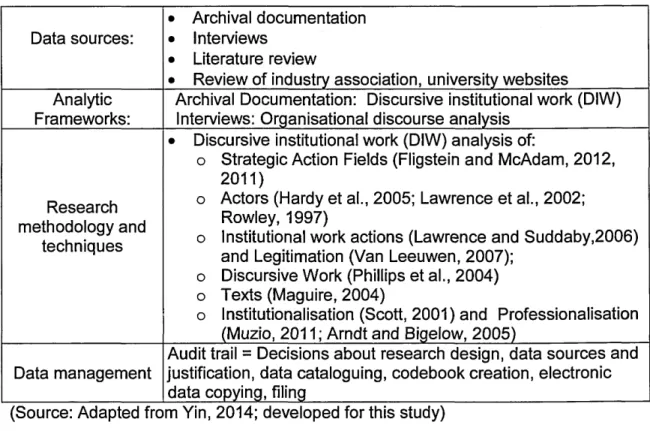
Chapter Four presents the Eaton School of Retailing (ESR) case study, which provides the setting for the research. The chapter discusses the justification of the case selection for the purposes of this study. The details of the research design, including the research protocols and data collection processes, are then discussed. A step-by-step description of the analysis process follows, including an event listing (Miles and Huberman, 1999) that provides a context for the actions, texts, and discourses produced in the case. The Chapter also provides a discussion of the quality and ethical considerations related to the unique nature of the case, including a reflection of the decisions made throughout the inductive research process.
The purpose of Chapter Five is to analyse the data presented by the case study. The analysis provides a thick description of the case through a comprehensive data
analysis. The analysis includes focused discursive examples oriented to patterns and themes in the data and data displays that summarise the analysis results. The
Chapter culminates in an explanatory analytic model which captures the distinctive methodological approach developed through this study. As a result, Chapter Five provides a comprehensive basis for the discussion of the results in Chapter Six.
Chapter Six presents a discussion of the findings from the analysis presented in Chapter Five. In particular, the discussion focuses on how the findings of the analysis satisfy the study’s three research objectives. The patterns and themes discovered in the analysis are synthesised and related to each of the objectives, thereby providing the basis for the discussion of the study’s contributions, which are presented in Chapter Seven.
The contributions of the study are discussed in Chapter Seven, including theoretical, empirical, methodological and practical contributions. Firstly, from a theoretical perspective, it provides a process model of discursive institutional work (DIW), which is applicable to explanations of innovation-in-action. It provides a way to explain how practitioners draw upon discursive resources in the context of particular activities for purposes of institutional structuration. Secondly, this study provides an empirical example of institutionalisation that provides evidence of the phases of new institutional practice development. Notably, the empirical example of institutional work is set in a previously unexamined consumer service sector, thereby making empirical contributions to retail research. Thirdly, the methodological contribution of this study is its original discursive institutional work (DIW) analytic method. The model provides a methodological approach that operationalises institutional work through discursive analytical processes. Finally, the practical contribution of this study is the insights it provides for educators involved with collaborative degree development, for retail practitioners, and for other occupational sectors who are interested in the processes of professionalisation through degree development.
This final chapter then provides a discussion of suggestions of potential areas for further research, of the limitations of the study, and of the researcher’s reflections on the thesis process. Finally, the study concludes by determining the answers to the study’s research question:
H ow do discursive processes institutionaiise an innovative practice o f retail m anagem ent degree development?
Chapter 1: The Context: The Canadian Retail Management Education Field 1.1 Introduction
The context for this study is the institutional environment in which the empirical case of the Eaton School of Retailing (ESR) is set. The case is situated in the Canadian retail management education field which was an emergent field, given that there was a dearth of retail management degree programmes in Canada.
This chapter highlights the institutional pressures which influenced how the field emerged and how actors in the field were able to perform the institutional work involved with creating a new degree development practice. Specifically, the chapter is organised around the regulative, normative and cultural-cognitive influences on the organisational actors in the case.
The chapter begins with a discussion of the nature of the Canadian university sector, corporate-university partnerships, and retail university programming. The discussion centres on how the nature of the Canadian university sector presented regulative influences on the development of the retail management degree.
The chapter then discusses how retail management education in the US and UK produced normative influences on the Canadian retail management education field, and particularly, on the development of the degree. These influences affected how the degree development processes integrated collaboration in the degree’s curricular structure.
The actors in the field also experienced cultural-cognitive influences about the
legitimacy of a retail management degree. The next section in this Chapter discusses these influences in terms of how perceptions about retail management as a
professional career affected the degree development. In particular, this section highlights retail management’s claims to a specific occupational jurisdiction (i.e. claims about membership), a specific body of knowledge, and requirements for specific educational credentials.
The chapter then presents a description of the case that is the focus of this empirical study. The origins of the case are discussed, presenting an overview of the corporate and university partners that instigated the innovative degree development process.
1.2 Regulative Influences on Canadian Retail Management Degree Development
This study’s focal case occurred between 1993 and 1999. At that time, Canadian universities were experiencing institutional pressures to develop increased access to and alternative forms of degree programmes (Snowdon, 2005). As a result, degree development practices were influenced by regulative influences related to shifts in government and university requirements.
Population growth and increased awareness of the importance of higher education fuelled increased participation in Canadian post-secondary education (Snowdon, 2005; Marshall, 2004; Oleksiyenko, 2002). Between 1980 and 2000, full-time
university enrolment increased from 390,000 to 630,000 (Junor and Usher 2002). At that time, demand for university education was also affected by increasing
credentialism, as accrediting bodies increasingly required a degree for entry into a profession or for employment (Marshall, 2008). For example, the Certified General Accountants of Ontario (CGA) instituted degree requirements for the CGA
designation during this period. Changes in the workplace and related learning expectations increased demands for the types of undergraduate degrees required in technical, professional and vocational workplaces including consumer service sectors like retailing (Marshall, 2004).
While universities across Canada encountered increased demands for university education, they also faced reduced government funding (Hurley and Sa, 2013; Usher and Potter, 2006; Snowdon, 2005). University education is a provincial jurisdiction in Canada and, as stated by Dave Marshall (2004), then President of Nipissing
University, “No province in Canada has been able to completely absorb the cost of providing unfettered access to the traditionally delivered university degree credential and, consequently has sought out cheaper alternatives.” (p. 78). Consequently, government cutbacks also generated pressures in universities to become more industry oriented (Trank and Rynes, 2003; Fisher and Rubenson, 1998; Buckbinder and Newson, 1990).
As a result, there were calls for university education that combined a focus on
industry with the university academic environment (Marshall, 2008; Trank and Rynes, 2003). The Canadian university system responded by expanding the supply of
university offerings. Capacity was increased in a number of ways, including university transfer (from college programmes in Alberta and British Columbia) and
Applied Arts and Technology (CAATs) were viewed as potential degree granting sites and unique universities with differentiated missions were introduced. One such university was Ryerson University, which originated as Ryerson Institute of Technology in 1948 and became Ryerson Polytechnic Institute in 1964, providing applied diplomas and degrees. The Institute was granted full university status in 1993, thereby becoming Canada’s first career or vocationally-focused university (Doucet, 2007; Marshall, 2008, 2004). Ryerson University is the university actor in this study’s focal case.
Although Canadian education is a provincial responsibility, the federal government also participated in the development of higher education, primarily through its
jurisdiction in research, training and economic development (Usher and Potter, 2006). During the 1990s, the federal government instigated investments in post-secondary education, emphasising partnerships with the private sector (Usher and Potter, 2006).
Corporate-university partnerships were oriented to optimising Canada's resources in research and education while positioning research efforts and university curriculum to the needs of the marketplace (Maxwell and Currie, 1984). The partnerships
represented different types of linkages including research support, knowledge transfer, cooperative research and technology transfer (Crocker and Usher, 2006; Lagiewski and Domoy, 2006). Canadian university presidents supported the linkages and also called for tying university curriculum more closely to the marketplace, as reported by the Corporate-Higher Education Forum, an organisation of Canadian university presidents and corporate executives (Maxwell and Currie, 1984).
There were no Canadian precedents for developing a retail sector-specific degree. Although retailing was a significant contributor to the Canadian economic and social environment (Rinehart and Zizzo, 1995), there were no university programmes focused on retailing. Baccalaureate degrees have always been offered throughout the Canadian university system and they are typically named for the broad area of study they encompass (i.e. Bachelor of Commerce). However, degrees indicating the field of study (i.e. Hospitality Management) have also been offered, particularly in occupational fields (Canadian Council on Learning, 2010), although the university sector did not offer any degrees oriented to retail management occupations. Some Canadian universities structured applied degrees that added an academic component to previous vocational credentials (Marshall, 2008), however there were few post secondary retail credentials (i.e. college diplomas) that could provide such a structural base for an applied retail degree.
Within the Canadian post-secondary system, universities are required to operate with a bicameral institutional structure. “Bicameral governance consists of shared
authority between an academic senate responsible for decisions affecting academic programs and an independent board of governors responsible for the day-to-day management of the institution.” (Canadian Council on Learning, 2010, p. 7). In a bicameral system, degree development and approval processes are instituted through a university Senate and originate with full-time academic faculties. Ryerson University operates with such a structure and new degrees require Senate approval to become instituted (Ryerson University Senate Policies #35 and #112). Degree programmes were typically developed within academic Faculties in order to optimise existing programming and course offerings. The Faculty of Continuing Education
(CE) offered alternate delivery options of existing courses from academic Faculties. As a result, the CE Faculty was not typically involved with degree development processes. An exception is the process involved with the development of the retail management degree programme.
The next section presents discussions of the normative influences that applied to the innovative development of a Canadian retail management degree. Specifically, the section addresses how US and UK degrees and corporate universities influenced the collaborative nature of the degree development practice.
1.3 Normative Influences on Canadian Retail Management Degree Development
Because there had been no Canadian retail management education programmes, Canadian retailers historically recruited qualified managers from the US and the UK (Burns and Rayman, 1995). The retail industries in those countries have drawn upon degree programmes to provide education and credentials for potential managers (Mayer, 1989), and consequently the programmes provided normative influences for the development of Canada’s first retail management degree programme (TRSRM Periodic Program Review, 2009).
Several influences shaped the development of retail management degrees in the US and UK since World W ar II, when the industry in both countries experienced a surge in consumer spending and developed suburban-based retail formats. The resulting degree programmes provided normative influences about curricular structures and collaborations with industry.
a) Norm ative Influences o f US R etail M anagem ent Education: During the 1950s, US retail management education was directed at careers for retail buyers at downtown department stores (Mayer, 1989; Hollander, 1982). Colleges and universities taught retailing in marketing courses and some included retail-specific courses, like retail merchandising. The perspective was that of the department store or small
entrepreneur and the courses were descriptive and ‘how to’ in nature (Mayer, 1989).
During the 1960s, US retail management programmes became broader in scope, more quantitative and analytical and less applied. Retailers, however, still needed graduates with applied skills; food and mass merchandise chains only required high school graduates and the department stores were not offering competitive salaries to university graduates in comparison to other sectors. The 1970s saw the emergence of US academic retail centres and the discipline adopted a focus on measurement, analyses, and behavioural content (Mayer, 1989).
By the end of the 1980s, there was more expansion of retail programmes and
development of retail centres. Academic curricula merged education and practice by including experiential learning and cooperative activities (i.e. expert speaker
programmes). In the 1980s, the emphasis of US retail management programmes evolved and programmes focused on strategic management and marketing.
The resulting curricular structures of US undergraduate degrees constituted
normative influences on the development of the Canadian degree curriculum in terms of content and delivery mechanisms. The UK also provided normative influences,
particularly in terms of collaborative degree development with industry (Longhurst, 2010).
b) Normative Influences o f UK R etail M anagem ent Education: Retailing as an academic area in the UK gained momentum during the 1980s, and related research was generally embedded in the geography and marketing disciplines (Alexander, 2001). The Institute for Retail Studies at the University of Stirling was established in 1983 as a centre for academic excellence in research and management development and for geography and marketing researchers interested in retail issues.
Many UK educational institutions have offered undergraduate and postgraduate programmes in Retail Management. In addition, retailers have engaged in
partnerships with universities with the goal of developing retail management skills (Gambin et al., 2012). For example, Glasgow Caledonian University established the British School of Fashion, providing retail graduate programming that integrated industry input through an innovative teaching structure featuring industry leaders as honorary professors.
University-industry partnerships have also resulted in innovative undergraduate degree programmes based on industry input and curricular participation. In 2000, the UK government launched Foundation degrees, and decreed that these degrees should be developed and delivered through collaborations between universities, employers (i.e. retailers), colleges and Sector Skills Councils (Longhurst, 2010;
Harvey, 2009). Although Foundation degrees were not established until after the time frame of this study’s case, they were developed in response to the National
Committee of Inquiry into Higher Education report in 1997 (also known as the Dearing Report). This Report made recommendations for expanding higher education
opportunities through partnerships with business and industry (Longhurst, 2010). Foundation degrees feature close collaboration between employers and programme providers and ensure the integration of academic and work-based learning. The degrees provide an alternative to bachelor’s degrees, and opportunities to progress to a bachelor’s degree with a further year of study. They often feature innovative
delivery mechanisms. An example of innovative degree delivery is the Foundation Degree in Retail Management offered through the Open University and available through distance education.
This type of innovative degree format provided normative influences for the Canadian degree development experience. The nature of the curriculum and industry
partnerships provided referent examples of potential curricular frameworks and collaborative practices with the retail sector.
Another approach to university collaborations, taken by specific corporations was to create corporate universities. Corporate universities are strategic partnerships initiated by corporations to foster their specific organisational learning needs (Meister, 1998). Corporate universities developed during the 1980s to fill a void between the demands of industry and the supply of management education provided by the public university sector (Blass, 2005; Prince and Stewart, 2000; Meister, 1998).
Collaborations were core to the development of corporate universities (Prince and Stewart, 2002). In particular, the development of these partnerships was
to serve as ground rules for the alliance; 3) created a business plan; and 4) defined a pilot partnership offering/activity (Meister, 1998, pp. 182-186). The nature of the resulting collaborations provided normative influences for the inception phase of the Canadian degree’s development which was constituted by a corporate university partnership.
These normative influences provided references for the processes involved with the degree development practice. The following section discusses the cultural-cognitive influences on the degree development processes. In particular, these influences arose from the ways that retail management was perceived to be a legitimate, professional career.
1.4 Cultural-Cognitive Influences on Canadian Retail Management Degree Development
Given that this study examines the institutionalisation of the development of a retail management degree, the legitimacy of such a credential is central to the process. Perceptions about retail management degrees are linked to perceptions about their career value and about the professionalism of retail management careers (Mobley, 2004).
Perceptions of the professionalism of occupations define their legitimation (Muzio et al., 2013; Scott, 2001; Reed, 1996) and occupations can enhance perceptions of professionalism by raising educational standards for practitioners (Thakor and Kumar, 2000). These professionalising and legitimating influences are central to this study’s examination of degree development practices. The professionalism of occupations is
characterised by three prevalent dimensions: a) the establishment of jurisdictional claims, b) a body of knowledge to guide practice, and c) educational requirements for practitioners (Abbott, 1988; Larson, 1977; Wilensky, 1964). The following sections provide discussions of the influences of these characteristics.
1.4.1 Professionalising Dimensions: Jurisdictional Claims
Perceptions about an occupation’s professionalism are related to its jurisdictional claims which includes claims about membership and occupational requirements - i.e. who can participate and what they can do (Arndt and Bigelow, 2005).
In terms of retail management, the occupation has been affected by the non exclusive, ubiquitous nature of its jurisdiction and membership (Bernhardt, 1999). The jurisdictional boundaries of the retail management occupation have been
amorphous, and have not been conducive to cohesion amongst members (Garud et al., 2002; Bernhardt, 1999). People manage retail operations regardless of whether they have related knowledge or education. Entrants to the workforce have regarded retailing as a source of entry-level management positions, work experience and training, and they do not necessarily view retail management as a full-time career. Many use the acquired management skills to move to more career-oriented work, either in retailing or in other sectors (Bernhardt, 1999). As a result, the occupational requirements, membership conditions and related jurisdictional boundaries for retail management are ambiguous.
Occupations’ jurisdictional claims are related to perceptions about social and economic dimensions of related labour markets. The social aspects of the labour
markets related to the jurisdiction of the retail management occupation are discussed in the following section.
1.4.1.1 Social Aspects of the Retail Management Occupational Jurisdiction
Various social aspects of labour markets influence perceptions about whether retail management is a legitimate career, and thereby worthy of a professionalising degree programme. These aspects are related to human resource dimensions of the career and include social perceptions about career image, recruitment and retention, and career development.
Perceptions about the professional image of retail management careers have been ambiguous (Sparks, 1992). Retail management has been characterised as a poor career choice, rife with related labour issues with recruitment and retention
(Broadbridge et al., 2009, 2007; Commins and Preston, 1997; Swinyard et al., 1991). However, it has also been characterised as a worthwhile career choice in a dynamic industry. The range of descriptions has been reflected in a lack of understanding and awareness amongst potential employees about what to expect from a retail management career (Commins and Preston, 1997). Likewise, the descriptions reflect confusion amongst retailers about how to source knowledgeable/skilled employees (Hart et al., 2007), amongst educational institutions about how to prepare employees (Mobley, 2004), and amongst sectoral associations about how to market and position career opportunities (Retail Council of Canada, 2009).
Studies have identified that there are prevalent negative perceptions about retail management careers. In particular, they report perceptions related to limited