246
International Journal of Bioelectromagnetism www.ijbem.org
Vol. 10, No. 4, pp. 246-260, 2008
Covert and overt face processing in healthy subjects:
an ERP study
Yusniel Santos Rodríguez, Jorge Iglesias Fuster, Maria Antonieta Bobes León Cognitive Neurosciences Department; Cuban Neuroscience Center.
Correspondence: Yusniel Santos Rodríguez. 2612, 27th street, apartment C, Miramar, Havana City, Cuba. E-mail: [email protected]
Abstract. Considerable evidence has been accumulated about covert face recognition in
prosopagnosic patients. However, little is known about such phenomenon in neurologically intact subjects. Our aim was to establish a situation of covert recognition in normal subjects, using ERPs as an electrophysiological index of this process. 20 neurologically healthy colleagues from Cuban Center for Neuroscience, aged from 26 to 40 years, voluntarily participated in our study. Covert face processing was evaluated by using a procedure described by Jenkins et al. [Jenkins et al, 2002]. These authors demonstrated covert processing to faces simultaneously displayed with a superimposed high attentional demand task. In our study the ERPs were elicited by an "oddball" paradigm including familiar (20%) and unfamiliar faces (80%). The subjects were instructed to recognize previously presented faces. EEG was classified accordingly in two groups of segments, corresponding to remembered (overt processing) or missed faces (covert processing). Familiar faces processed both consciously or unconsciously evoked a P300 component. However, only the N200 evoked during covert processing showed differences in amplitude compared with the N200 evoked during conscious recognition. It appears that covert and overt processing of familiar faces is subserved by different neural systems. It confirms the hypothesis that covert and conscious recognition involve two different routes, regardless of the functional reorganization associated with brain damage.
Keywords: ERPs; Prosopagnosia; Covert recognition; Faces; Overt processing; P300; N200
1.
Introduction
Humans have the ability to recognize the identity of each person from a virtually unlimited number of faces. This ability is at the heart of important social transactions. Familiar faces evoke information related to hierarchical level, degree of friendship, personality traits and a lot of biographical details [Bobes et al, 2007].
The term ‘prosopagnosia’ was coined by Bodamer [Bodamer, 1947], when referring to patients with brain damage who developed a disorder characterized by an inability to recognize known individuals though their faces. However, it has been described that some prosopagnosic patients maintain some ability to recognize familiar faces even though they are unaware of that skill. This phenomenon of recognition without conscience has been called "facial covert recognition " [Young and Burton, 1999; O'Reilly and Farah, 1999].
Covert recognition has been evinced either in behavioral studies, especially those of semantic priming, as in some scan pattern works of ocular movement. Young et al. [Young et al, 1988] showed that prosopagnosic subjects responded faster to familiar names preceded by related faces (non-consciously recognized), than to familiar names preceded by unrelated faces. These results suggested the presence of some sort of processing of familiar faces, unconsciously recognized by these patients, as
247
evinced by the presence of semantic priming. In addition, Barton et al. [Barton et al, 2007] showed that when exposed to unconsciously recognized familiar faces some prosopagnosic patients exhibited scan patterns of ocular movements similar to those obtained from normal subjects. Based on the idea that facial memories can influence the patterns of eye movements, the authors concluded that the similarities in those movements between normal subjects and prosopagnosic patients suggest the presence of a residual processing of identity.
Changes in electrodermal skin conductance response (SCR) and event-related potentials (ERPs), especially the P300 waveform, are tools that have also contributed to study this phenomenon. For example, Tranel and Damasio [Tranel and Damasio, 1985] showed that, in prosopagnosic patients, skin conductance response was significantly higher to familiar faces not explicitly recognized when compared to responses evoked to novel faces. Recently Bobes et al. [Bobes et al, 2004], examined a prosopagnosic patient and a group of normal subjects by presenting a sequence of familiar (infrequent) and novel faces, randomly intermixed. The aim of this study was to obtain the P300 component. The authors used a high-density distribution of electrodes to characterize the precise topographic distribution of that potential. Participants were asked to perform a familiarity judgment in every trial. Although the patient failed to explicitly recognize the infrequent familiar stimuli, the presence of the P300 component revealed the occurrence of the covert face recognition. Its latency, similar to control subjects, suggested a fast availability of covert memory. The topographic distribution of this potential showed its maximum extent on central-frontal electrodes, matching the one described for the P3a sub-component. The authors concluded that the neural structures involved in emotional processing could be related to covert processing of familiar faces.
It is worth mentioning, however, that most of the existing data on the processing of different types of information extracted from a face comes from studies including subjects with some extent of brain damage. It is known that brain damage can alter the expression of the electrical potential on the scalp [Bobes et al., 2004]. Among the main causes of these modifications are the processes of brain reorganization, the profound conductivity gradients to be established between the intact brain tissue and the injured tissue after the occurrence of trauma [Kaas et al, 2008], selective damage to sets of brain sources generating a certain component and changes in the skull conductivity because of fractures [Osipov, 1984].
Therefore, it is necessary to characterize the visual processing of familiar faces and their covert recognition in normal subjects. It would validate the theoretical approaches from studies including subjects with brain damage as well as check the predictions made by several models for overt and covert facial recognition. There have already been some reported in literature such as the study by Jenkins et al. [Jenkins et al, 2002]. In this study the authors showed that manipulating the attentional load of the subjects affected explicitly, but not implicitly, the memory for faces. The subjects performed two tasks, one with high perceptual load and the other with low perceptual load, both related with letter-strings discriminations. The memory for faces was evaluated using an unexpected test of recognition of celebrity names. The repetition priming was evaluated through familiarity judgments of the faces. The results suggested that manipulating the perceptual load heavily influenced the memory for explicit recognition, but had no effect on repetition priming of the same stimuli. More importantly, the faces included in trials
248
with high perceptual load produced the same amount of priming, whether they were explicitly remembered or not. These results provide evidence of unconscious recognition of the identity of faces in healthy subjects.
In this experiment we explore the electrophysiological markers of covert recognition in normal subjects by recording ERPs with a task similar to Jenkins et al. [Jenkins et al, 2002] . We intend to find changes in latency or amplitude in the N200 or P300 waveforms elicited by the status of recognition and familiarity of the stimuli.
2. Material and Methods
Subjects.
Twenty subjects participated voluntarily in our experiment. They were all colleagues from the Cuban Centre for Neurosciences, 9 of them were men. All subjects were aged between 26 to 40 years old, had normal or corrected to normal vision and were right-handed. None of them had any history of psychiatric or neurological disorders.
Stimulus and design.
Three-hundred and fifteen (315) faces were used as stimuli, 90 of them were from colleagues of the Cuban Centre for Neurosciences (familiar faces) and the rest (225 faces) from complete strangers. In addition, 30 different letter strings were used. Each letter string consisted of six Arabic characters, including a target character X or N, in a 50:50 proportion and five other angular letters (A, E, F…) in a random order. Regardless, the letter strings with a specific target character could be red or blue, in a proportion (50:50).
All faces were presented on a grey background in an SVGA monitor holding visual angles of 90 and 60 in the vertical and horizontal axes respectively. All images were converted to grayscale and their luminance was homogenized.
Procedure.
The experiment consisted of three stages, each one separated by 5 min intervals.
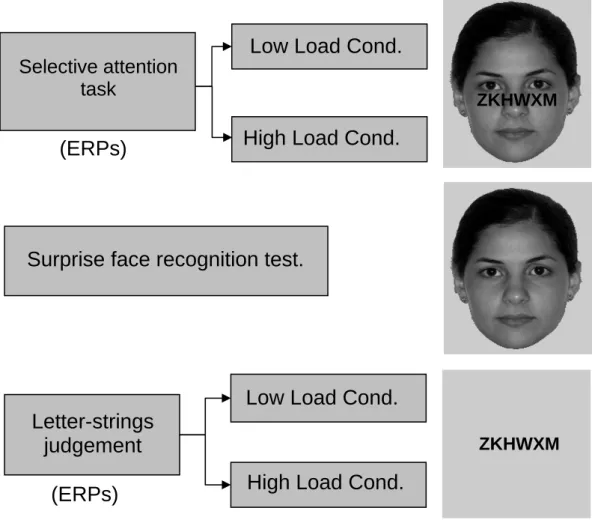
Stage 1: It consisted of a selective attention task, which included two conditions: low and high perceptual load. This evaluation responds to the attentional demands required by the subject to perform the task efficiently. Every trial consisted of a central letter string superimposed over a face that could be familiar or unfamiliar to the subject and was displayed on the center of the screen during 200 ms. Every trial was triggered by pressing the spacebar on the computer’s keyboard (Fig. 1). In the low perceptual load condition subjects were asked to identify, as quickly as possible, the color of the letter string. All subjects faced 120 trials involving 30 familiar faces and 90 novel faces that were presented in random order. In the high perceptual load condition, there were 120 trials consisting of 30 new familiar faces and 90 new novel faces were presented in random order. In these trials, subjects were asked to discriminate as quickly as possible the presence of the characters X or N in the letter string.
249
Figure 1. Sequence of the task in the paradigm used: Stage 1. Selective attention task; Stage 2. Surprise face recognition test; Stage 3. Letters-strings judgement. It also specifies the conditions of high and low perceptual load, as well as a representation of stimulation screens.
Stage 2: It consisted of an unexpected face recognition test that included 315 faces, without superimposition of letter strings (Fig. 1). All faces included in Stage 1 were used here, along with 75 new faces (30 familiar faces and 45 novel faces). Every face was displayed for 200 ms and the next trial was triggered by pressing the spacebar of the computer’s keyboard. The participants were required to discriminate if each stimulus had been displayed or not on Stage 1. The subjects’ response was further used to reclassify the faces of Stage 1 as perceived consciously or not.
Stage 3: All letter strings included in Stage 1 were presented without faces on the background. In addition and similarly to Stage 1, two types of trials were defined according to the perceptual load: high (speeded discrimination of the presence of the characters X or N) and low (speeded identification of the color of the letter strings) (Fig. 1). In both conditions 30 letter strings were displayed twice (total = 60)
Low Load Cond.
High Load Cond.
(ERPs)
Surprise face recognition test.
(ERPs)
Selective attention
task
Low Load Cond.
High Load Cond.
Letter-strings
judgement
1.)
ZKHWXM
ZKHWXM
3.)
2.)
250
randomly intermixed. Every stimulus was presented during 200 ms and the next trial was triggered by pressing the spacebar of the computer’s keyboard.
Recording and analysis of ERPs.
The recording of the EEG was carried out simultaneously during stages 1 and 3 of the experiment. All subjects were instructed to minimize eye and body movements during electrophysiological recording.
EEG was recorded using Ag/AgCl electrodes in 5 active derivations (Fp1/Fp2, Fz, Cz, Pz,) included in the 10/20 international system [Jasper, 1958] referenced to nose, in a MEDICID 5 system (Havana,
NEURONIC SA). In addition, 4 derivations were used for EOG recordings (Pg1/Pg2, Cb1/Cb2), two in the external edge of both eyes (horizontal movements) and two 1 cm above and below the left eye (vertical movements). A Notch filter peaking at 60 Hz was used, the signal was amplified by a factor of gain = 1000 and filtered between 0.05 Hz and 30 Hz. The inter-electrode impedance was always kept below 5 kΩ. All recordings were obtained at a sampling rate of 200 Hz.
Data analysis was performed with EP Workstation v 1.4 (Havana, Neuronic SA). EEG was segmented offline in epochs of 1000 ms duration (-300 to 700 relative to stimulus presentation). All segments were visually inspected and those containing non-stereotyped artifacts (e.g., swallowing, cable movement, etc.) or eye blinks occurring during target presentation were discarded.
The EEG activity recorded for each condition in the selective attention task was differentially processed. For the EEG recorded in Stage 1 all segments from both high and low perceptual load conditions were separated according to the criterion of whether the face associated with these segments was explicitly remembered or not on stage 2 and averaged independently. It provided evidence of both conscious face processing and covert face recognition.
The EEG relative to Stage 3 in every subject was analyzed and averaged separately according to high and low perceptual load trials. Those averages were subtracted to the corresponding condition in Stage 1 in order to isolate the electrophysiological response to the faces displayed in Stage 1. Grand averages were calculated from these difference waveforms for each condition. The amplitude of the ERPs was corrected by subtraction of the mean amplitude value of the pre-stimulation period.
Three different and non-overlapping time windows were defined on the grand average waveforms for analyzing the experimental effects on the N200, P300a and P300b event-related potentials. The individual mean values of amplitude within these time windows were exported to the software Statistica v6.0 (StatSoft Inc.), where a repeated measures ANOVA was conducted. The subjects whose values exceeded the variance criterion of 1.5 were removed from the analysis. The factors that were taken into account were: type of processing (2 levels: conscious and covert), familiarity of the stimulus (2 levels (familiar and novel) and electrodes (5 levels: Fp1/Fp2, Fz, Cz, Pz).
251
3. Results
Behavioral results.
The mean reaction times for classifying letter strings in both conditions of the selective attention task are shown in figure 2. The subjects were significantly slower in their response in trials with high perceptual load (t(17)=10.19, p=0.0001), demonstrating an effective manipulation of the perceptual load in our experiment.
Figure 2. Mean reaction times in both conditions in the selective attention task.
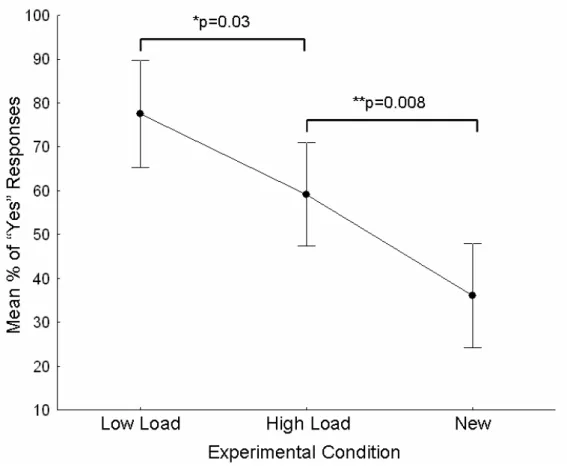
The mean percentage of affirmative answers in the unexpected face recognition test (Stage 2) differed according to the presentation status of every face in Stage 1 (F (2, 44) = 12194, p = 0001), as shown in figure 3. The planned comparisons showed that, as expected, the subjects responded affirmatively more often to familiar faces in the high and low perceptual load conditions than to newly presented familiar faces (p=0,001 and p=0,008 respectively). More importantly, there was a significant effect of the perceptual load on the performance of the recognition’s memory. Subjects responded positively more often to familiar faces previously displayed in Stage 1 under low perceptual load conditions when compared with those displayed under high perceptual load conditions (p=0.03).
252
Figure 3. Mean percentages of “yes” responses in the unexpected face recognition test (Stage 2). The performance in the explicit recognition of familiar faces was based on the experimental condition; low load, high load, or new. The probability values shown are results of planned comparison tests in the rmANOVA.
ERPs.
The grand average ERPs elicited by the presentation of familiar and novel faces, conscious or covertly processed, are shown in figure 4. The presence of the P300 component is evident as well as a previous negativity waveform between 360 and 450 ms. This negativity showed a higher amplitude in trials where familiar faces were displayed, compared with novel faces, both consciously processed, in the electrodes Cz and Pz (p=0.03 and p=0,001, respectively). The amplitude modulation observed for this component is possibly due to optimal perceptual conditions for processing the emotional information coupled with each of the familiar faces.
253
Figure 4. Evoked potentials elicited by familiar and novel faces, both conscious and covertly processed by normal subjects. The cursor marks the N200 component, P3a and P3b.
The P300 waveform was generated only by familiar faces both consciously and covertly processed, suggesting their recognition by the visual system. In addition, the identification of two sub-components, P3a and P3b, was also possible (Fig. 4). The P3a sub-component was larger on the electrodes Fz, Fp1 and Fp2 and showed a shorter latency than the P3b. This component has been related to the availability of emotional information, associated in the facial recognition system to the identity of a familiar person. The amplitude and latency of the component P3b proved to be the same for all conditions under consideration, although it was larger than the one recorded in classic "oddball" paradigms with acoustic stimuli.
In the P3a sub-component, despite the fact that the amplitude was greater for familiar faces processed consciously as compared to the P3a generated by familiar faces covertly processed; this difference was not significant on any of the electrodes considered (Fig. 5).
254
Figure 5. Evoked potentials elicited by familiar and novel faces, both conscious and covertly processed by normal subjects. The time window considered for the assessment of the differences found in the N200 between the two types of processing is shown.
On the other hand, the above mentioned negativity, located between 360 and 450 ms, showed a higher amplitude when generated by familiar faces consciously perceived, compared to the one elicited by covertly processed familiar faces (Fig. 5). This difference was significant only in the Pz derivation (p=0.04) (Fig. 6). These results suggest that this potential could be used as an electrophysiological index of covert face recognition in normal subjects.
255
Figure 6. Comparison between the average voltage differences in the N200 recorded from each of the derivations considered.
4. Discussion
In our experiment the perceptual load of the task was efficiently manipulated. Specifically, the conscious recognition of familiar faces was heavily influenced by the perceptual load of the letter string task. The subjects recalled less familiar faces in the high load condition compared to the low load condition. The presence of the P300 component, divided into the P3a and P3b sub-components, indicates that conscious and covertly processed familiar faces were identified by the facial recognition system. Even though the P3b component was not modulated by the recognition factor, this modulation was obvious in the N200 waveform. The differences in amplitude of the N200 observed for conscious and covertly processed familiar faces permit the differentiation between the processes of conscious and covert recognition in healthy subjects.
The obtained behavioral results largely replicate those presented by Jenkins et al. [Jenkins et al, 2002] and are fully consistent with the perceptual load theory of selective attention proposed by Lavie [Lavie, 2000]. According to this theory, perceptual processing has a limited capacity. Within these limits,
processing occurs automatically starting with relevant stimuli and followed by the subsequently irrelevant stimuli until the available capacity is exhausted. Such approach infers that the amount of processing dedicated to an irrelevant task is influenced by the perceptual load of the relevant task. In our
256
study, color judgment of the letter strings (low perceptual load task) only requires small amounts of attentional resources for its efficient performance [Treisman, 1993]. In this case, there are sufficient neural resources to process faces presented simultaneously to the letter strings. However, the identification of a target letter among the similarly-shaped letters in a given string (high perceptual load task) demands focused attention, a condition in which a reduced online distracter processing is evinced in previous studies [Lavie, 1995]. In this situation, the subjects don’t have enough neural resources for
processing the faces and they, therefore, fail repeatedly in the recognition of the identity of the face. The above described dissociation between conscious and covert recognition of identity recreates in normal subjects the state experienced by some prosopagnosic patients. Several patients are able to discern the faces of relatives but do not have access to the semantic information associated with them [Renault et al, 1989; Bobes et al, 2004; Bobes et al, 2007; Barton et al, 2007]. In our experiment, even though all of our subjects may perceive a simultaneous display of letter strings and faces, they can not perform an explicit recognition of the identities due to the attentional manipulations. This situation differs from the situation recreated by the paradigms of perceptual masking. In these experiments, the situation of explicit recognition is generated by the subliminal presentation of familiar stimuli that are finally masked [Stone et al, 2001; Balconi, 2006; Morris et al, 2007]. In these cases, the subjects involved in the study, unlike prosopagnosic patients, can not even perceive the nature of the masked stimuli.
On the other hand, the presence of the P300 component, specifically the P3b sub-component, suggests that covert processing of familiar faces is relatively deep and involves access to the person’s identity. The parieto-central P300 (P3b) component exhibits a delay in latency during very informative trials (especially when something unexpected happens) and is generated only when subjects pay attention to the stimulus [Ruchkin et al, 1990; Picton, 1992]. Additionally, the amplitude of P3b has been directly linked to the confidence of the subject during decision-making [Squires et al, 1973]. Still, a much debated, accepted interpretation suggests that the P3b sub-component reflects the update of the working memory regarding the explicit recognition of stimuli [Donchin and Coles, 1988; Verleger, 1988]. In our work, the presence of the P3b sub-component for covert facial recognition matches earlier records in literature [Bobes et al, 2004] and constitutes a fact, even without an acceptable explanation.
The central-frontal P3a sub-component was also elicited in our results. This waveform may reflect a more automatic and less attention-dependent processing [Escera et al, 1998; Schroger et al, 2000; Bledowski et al, 2004; Volpe et al, 2007]. Recent studies have also linked this component with the availability of emotional information, attached by the facial recognition system to a familiar person's identity [Bobes et al, 2007]. According to this idea, it’s logical to expect that this component is activated during conscious and covert recognition of familiar faces [Bobes et al, 2004]. However, in accordance to our results, an alternative explanation is possible. While patients with some kind of brain damage exhibit a different functional status possibly due to the neural reorganization of their cognitive systems, in absence of such injuries the P3a component is modulated by consciousness in healthy individuals. It would explain the reduction in amplitude shown during covert processing of familiar faces, although in our study these differences were not significant. Among the main causes of this lack of significance must be considered the small number of electrodes analyzed here. It is possible that the widest differences in
257
amplitude of P3a waveform could be recorded by electrodes not included in our study. In addition, because of the paradigm used in our study, our ranking of the state of consciousness of the subjects during the selective attention task relays on inferences made from the stored information in the explicit recognition memory of the participants. According to a study by Hannula et al. [Hannula et al, 2005], the use of subjective reports for making inferences about the state of consciousness provides, at best, a weak support for implicit perception. The subjective records of consciousness are often based on either sensitivity to the presence of the stimulus, like the participant's decision criterion. More importantly, it has been described that in most cases the observers do not fully trust their perceptual experience [Bjorkman et al, 1993] when dealing with situations of uncertainty as lack of perception. That possibility applied to our study represents a potential source of noise within the signal recorded for familiar faces unconsciously processed, even though in our case we are not interfering with the perception of stimuli but with their recognition.
Finally, several studies described in literature examine the electrophysiological response generated directly by emotional stimuli and have found that the amplitude of the P300 component is modulated mainly by the stimulus’ valence [Amrhein et al, 2004; Rozenkrants et al, 2008]. Even though the contribution of individual variance on the P300 caused for the emotional information attached to familiar faces was not considered in our study, it is necessary to emphasize that such source of noise should not make a significant contribution within the signal recorded for unconsciously processed familiar faces. Despite the fact that the known faces used here are highly familiar to the participants, being faces from colleagues, they are not relatives of each participant and therefore, the emotional information is possibly weaker.
On the other hand, despite the fact that relatively little is known about what kind of cognitive processes are actually reflected by the N200, its sensitivity to facial stimuli indicates that probably it is related to a categorical processing (where a face is perceived as a face) [Halgren et al, 2000]. Another studies described in the literature have shown that the N200 is not affected by the familiarity [Rosburg et al, 2005], a fact that might seem surprising because facial features such as eye gaze direction [Puce et al, 2000], the number or type of facial attributes [McCarthy et al, 1999] and emotional judgements [Pizzagalli et al, 2002] modulate this component both in latency and amplitude. In the specific case of our study the differences in amplitude of the N200 waveform elicited by familiar faces in both low and high perceptual load conditions of the relevant task, allow a distinction between processes of conscious and covert face recognition in healthy subjects. Recently, Breen et al. [Breen et al, 2000] have changed the model for facial recognition proposed by Bruce and Young [Bruce and Young, 1986], including an independent route from the facial recognition units (FRUs) towards an emotional system, which would be responsible for the covert face recognition.
According to these authors, there is a primary structural encoding of different facial attributes as well as its configuration. Subsequently, the facial representation obtained is compared to stored information in the facial recognition unit. From this point originate two separate neural pathways: one of them runs directly towards the personal identity nodes (PIN). From there, the pathway continues until the recollection of the person’s name whose face was shown. The activation of this system would lead to conscious recognition of the identity and involves brain structures such as the lower occipital gyrus and
258
the lateral fusiform gyrus. The second route is directed toward a neural system responsible for the generation of an affective response to the observed familiar face. This system would be responsible for the covert face recognition incorporating structures such as the amygdala, ínsula, orbit-frontal cortex and the limbic system.
We can conclude that the results obtained here are evidence supporting the perceptual load theory for explaining selective attention processes proposed by Lavie [Lavie, 2000]. Additionally, the
differences observed for the N200/P300 complex obtained for conscious and covertly processed familiar faces, constitute electrophysiological evidence for the dissociation of conscious face processing and covert face processing in neurologically intact individuals.
REFERENCES
Amrhein C, Muhlberger A, Pauli P, Wiedemann G. Modulation of event-related brain potentials during affective picture processing: a complement to startle reflex and skin conductance response? International Journal of Psychophysiology, 54 (3):231-240, 2004.
Balconi M. Exploring consciousness in emotional face decoding: an event-related potential analysis. Genetic, social, and general psychology monographs, 132 (2):129-150, 2006.
Barton JJ, Radcliffe N, Cherkasova MV, Edelman JA. Scan patterns during the processing of facial identity in prosopagnosia. Experimental brain research, 181 (2):199-211, 2007.
Bjorkman M, Juslin P, Winman A. Realism of confidence in sensory discrimination: the underconfidence phenomenon. Perception & Psychophysics, 54 (1):75-81, 1993.
Bledowski C, Prvulovic D, Hoechstetter K, Scherg M, Wibral M, Goebel R, Linden DE. Localizing P300 generators in visual target and distractor processing: a combined event-related potential and functional magnetic resonance imaging study. The Journal of neuroscience, 24 (42):9353-9360, 2004.
Bobes MA, Lopera F, Díaz-Comas L, Galan L, Carbonell F, Bringas ML. Brain potentials reflect residua face processing in a case of prosopagnósia. Cognitive Neuropsychology, 21 691-718, 2004.
Bobes MA, Quinonez I, Perez J, Leon I, Valdes-Sosa M. Brain potentials reflect access to visual and emotional memories for faces. Biological Psychology, 75 (2):146-153, 2007.
Bodamer J. Prosopagnosia. Journal of Neuropsychology, 7 81-105, 1947.
Breen N, Caine D, Coltheart M. Models of face recognition and delusional misidentification: A critical Review. Cognitive Neuropsychology, 17 55-72, 2000.
Bruce V, Young A. Understanding face recognition. British Journal of Psychology, 77 ( Pt 3) 305-327, 1986.
Donchin E, Coles MGH. Is the P300 component a manifestation of context updating? TheBehavioral and Brain Science, 11 357-374, 1988.
Escera C, Alho K, Winkler I, Naatanen R. Neural mechanisms of involuntary attention to acoustic novelty and change. Journal of Cognitive Neuroscience, 10 (5):590-604, 1998.
Halgren E, Raij T, Marinkovic K, Jousmäki V, Hari R. Cognitive Response Profile of the Human Fusiform Face Area as Determined by MEG. Cerebral Cortex, 10 (1):69-81, 2000.
259
Hannula DE, Simons DJ, Cohen NJ. Imaging implicit perception: promise and pitfalls. Nature Reviews, 6 247-255, 2005.
Jasper HH. The ten-twenty electrode system of the International Federation of Societies for Electroencephalography: Appendix to report of the committee on methods of clinical examination in electroencephalography. Electroencephalogry of Clinical Neurophysiology, 10 371-375, 1958.
Jenkins R, Burton AM, Ellis AW. Long-term effects of covert face recognition. Cognition, 86 (2):B43-B52, 2002.
Kaas JH, Qi HX, Burish MJ, Gharbawie OA, Onifer SM, Massey JM. Cortical and subcortical plasticity in the brains of humans, primates, and rats after damage to sensory afferents in the dorsal columns of the spinal cord. Experimental Neurology, 209 (2):407-416, 2008.
Lavie N. Perceptual load as a necessary condition for selective attention. Journal of Experimental Psychology Human Perception and Performance, 21 (3):451-468, 1995.
Lavie, N. Selective attention and cognitive control: dissociating attentional functions through different types of load. In: Control of cognitive processes. Attention and performance. (Eds. Monsell S, Driver J). Cambridge: 2000; 175-194.
McCarthy G, Puce A, Belger A, Allison T. Electrophysiological Studies of Human Face Perception. II: Response Properties of Face-specific Potentials Generated in Occipitotemporal Cortex. Cerebral Cortex, 9 (5):431-444, 1999.
Morris JP, Pelphrey KA, McCarthy G. Face processing without awareness in the right fusiform gyrus. Neuropsychologia, 45 3087-3091, 2007.
O'Reilly RC, Farah M. Simulation and explanation in neuropsychology and beyond. Neuropsychology, 16 49-72, 1999.
Osipov VI. [Thermographic data and skin electric conductivity in mandibular fractures]. Stomatologiia (Mosk), 63 (2):35-37, 1984.
Picton TW. The P300 wave of the human event-related potential. Journal of Clinical Neurophysiology, 9 (4):456-479, 1992.
Pizzagalli DA, Lehmann D, Hendrick AM, Regard M, Pascual-Marqui RD, Davidson RJ. Affective Judgments of Faces Modulate Early Activity (160 ms) within the Fusiform Gyri. NeuroImage, 16 663-672, 2002.
Puce A, Smith A, Allison T. ERPs evoked by viewing facial movements. Cognitive Neuropsychology, 17 ((1/2/3)):221-239, 2000.
Renault B, Signoret JL, Debruille B, Breton F, Bolgert F. Brain potentials reveal covert facial recognition in prosopagnosia. Neuropsychologia, 27 (7):905-912, 1989.
Rosburg T, Trautner P, Dietl T, Kral T, Elger ChE, Kurthen M. The Influence of Repetition and Famousness on the Intracranially Recorded Temporobasal N200. Behavioral Neuroscience, 119 (4):876-883, 2005.
Rozenkrants B, Olofsson JK, Polich J. Affective visual event-related potentials: Arousal, valence, and repetition effects for normal and distorted pictures. International Journal of Psychophysiology, 67 114-123, 2008.
Ruchkin DS, Johnson R, Jr., Canoune HL, Ritter W, Hammer M. Multiple sources of P3b associated with different types of information. Psychophysiology, 27 (2):157-176, 1990.
Schroger E, Giard MH, Wolff C. Auditory distraction: event-related potential and behavioral indices. Clinical Neurophysiology, 111 (8):1450-1460, 2000.
260
Squires KC, Hillyard SA, Lindsay PL. Vertex potentials evoked during auditory signal detection: Relation to decision criteria. Perception & Psychophysics, 14 265-272, 1973.
Stone A, Valentine T, Davis R. Face recognition and emotional valence: processing without awareness by neurologically intact participants does not simulate covert recognition in prosopagnosia. Cogn Affect Behav Neurosci, 1 (2):183-191, 2001.
Tranel D, Damasio AR. Knowledge without awareness: an autonomic index of facial recognition by prosopagnosics. Science, 228 (4706):1453-1454, 1985.
Treisman, A. The perception of features and objects. In: Attention: awareness, selection and control. (Eds. Baddeley, A. D. and Weiskrantz, L.). Oxford: Oxford University Press., 1993;
Verleger R. A critique of the context updating hypothesis and an alternative interpretation of P3. The Behavioral and Brain Science, 11 343-427, 1988.
Volpe U, Mucci A, Bucci P, Merlotti E, Galderisi S, Maj M. The cortical generators of P3a and P3b: a LORETA study. Brain Research Bulletin, 73 (4-6):220-230, 2007.
Young AW, Burton AM. Simulating face recognition: Implication for modelling cognition. Cognitive Neuropsychology, 16 1-48, 1999.
Young AW, Hellawell D, De Haan EH. Cross-domain semantic priming in normal subjects and a prosopagnosic patient. The Quaterly Journal of Experimental Psychology A, Human Experimental Psychology, 40 (3):561-580, 1988.