Categorizing Communication Errors
in Integrated Hospital Information
Systems
S. Saboor; E. Ammenwerth
Institute for Health Information Systems, UMIT, Hall in Tyrol, Austria
Keywords
Classification, HIS management, systems architecture, information system
Summary
Objectives: Hospital information systems (HIS) are the hospital’s nervous system. The HIS are mostly grown over several years, dedicated to specific needs and comprise indi-vidual workarounds. Changes to such complex systems may cause a variety of differ ent negative side-effects. In order to under-stand the nature of incorrect communication in integrated HIS, a concise structured cat -egorization of common communication problems and their reasons is essential. The ob -jective of this paper is to present such a categorization, its development and verifica -tion.
Methods: We used a combined approach for the development of the error categorization: We started with a qualitative content analysis on available literature in PubMed. In order to ensure the validity and completeness of the
Methods Inf Med 2009; 48: 203–210 doi: 10.3414/ME9220
prepublished: February 18, 2009 Correspondence to:
Samrend Saboor
University for Health Sciences, Medical Informatics and Technology (UMIT)
Eduard-Wallnöfer-Zentrum 1 6060 Hall in Tyrol Austria
E-mail: [email protected]
results, we chose the method of centered expert interviews.
Results: The resulting categorization of com-munication problems is represented as a five-level hierarchy. It comprises 81 problems that are related to the electronic communication. Further, it contains in total 229 entries that are either the reasons of these problems or rec-ommendation for avoiding the problems. Conclusion: To our knowledge there is no similar summary that concisely summarizes common communication problems and also refers to their underlying reasons. Equivalent content is mostly published in experience re-ports that just concentrate on single aspects. We used the details of such references in order to compile our categorization – it thus can be regarded as an intersection of relevant experiences. The categorization can raise a basic awareness on potential problems and supports the understanding of the underlying reasons. An evaluation in a real environment must prove whether the content of the cat-egorization is correct.
1. Introduction
The main tasks of hospital information sys-tems (HIS) are the processing and communi-cation of required information between all involved actors and departments [1]. Com-monly accepted definitions (e.g. [2]) refer to the HIS as the hospital’s nervous system. Es-pecially the electronic application systems of
the HIS have gained importance within the last two decades [3] – amongst others, be-cause of the increased amount and variety of data that has to be transmitted but also be-cause of the shift from centralized to decen-tralized organizations of healthcare institu-tions.
This trend also emphasizes the great im-portance of the adequate communication for
healthcare processes [4]. It is therefore necessary that the electronic application sys-tems ensure the correct transmission of required information objects. For this pur-pose, all involved application systems must agree upon a common communication con-vention [5–7]. This concon-vention is specific for the respective HIS. It includes specifications of the organization of information objects (e.g., as sets of identifier-attributes pairs), the definition of the meaning of each attribute and consequently detailed specifications re-garding each application system’s communi-cation interfaces. It further must be stressed that current HIS are composed of a variety of specialized electronic sub-systems and appli-cation systems from different vendors – see for instance Dwyer’s subdivision of a pic ture archiving and communication system (PACS) [8]. We therefore also refer to them as integrated HIS.
Established communication standards (i.e., DICOM (Digital Imaging and Com-munications in Medicine [9]) and HL7 (Health Level 7 [10])) shall ensure the inte-gration of the different application systems. But even the usage of just one of the standards requires careful implementations [6, 7]. A main difficulty here is that standard defini-tions still allow misinterpretadefini-tions – which leads to errors using just one of the standards (e.g. [11, 12]). Most integrated HIS however require the implementation and incorpora -tion of several standards which comprises ad-ditional difficulties (e.g. [13–15]). Here, the coordinating framework of the international initiative for Integrating the Healthcare En-terprise (IHE) [16, 17] has clearly helped to improve the integration of application sys-tems.
Nevertheless, integrated HIS are mostly grown architectures – for instance, acquisi-tion modalities can be used up to 20 years which might make it necessary to integrate very old systems (e.g., VAX [18] or PDP-11
[19]). Thus, most integrated HIS comprise a variety of local workarounds which make the HIS’s architecture unique and complex. The complexity aggravates the anticipation of negative side-effects in a reasonable amount of time.
In order to understand the nature of in-correct communication in integrated HIS, a concise structured collection of common communication problems and their reasons is essential. Such a collection still seems to be missing.
This paper describes the development and verification of a categorization that contains concrete communication problems, their reasons and recommendations for avoiding the problems.
2. Methods
The communication error categorization was developed in the following two main steps.
2.1 Inductive Collection of
Common Communication Problems
and their Reasons
In order to collect communication problems and their reasons, we chose the method of subsuming qualitative content analysis (ac-cording to Mayring [20, 21]. This type of con-tent analysis aims to filter the main interest-ing details of the reviewed literature by the abstraction and dynamic declaration of cat-egories. For this, we conducted a systematic
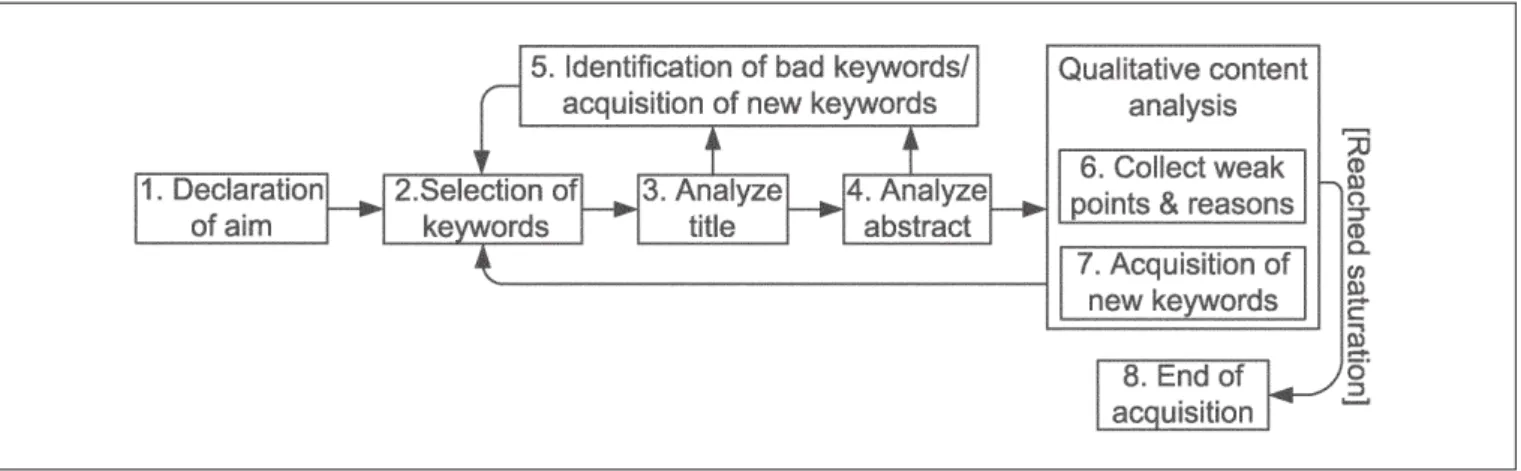
review of the available literature in PubMed. Here, we made use of the experiences from earlier projects in the area of process assess-ment (e.g. [22]). The inductive approach that we chose is shown in 씰Figure 1.
First, an initial set of search phrases (e.g., “quality information processing”) was de-clared according to the aim of the review. In steps three and four, the title and abstract of all the references that resulted from the search phrases were reviewed and ranked. In step five, we adjusted and augmented our search phrases according to the adequateness of the resulting references. In this way we found 4188 references. These references dealt with, among others, information management (e.g. [2]), reports on integration projects in the field of HIS, radiology information sys-tem (RIS) and PACS (e.g. [23, 24]). From this set we dropped all of those references that were older than 20 years, which dealt with the implementation of very specialized software development topics or with organizational issues. In the sixth step, we performed the actual qualitative content analyses on the re-maining 426 references. In this step, further keywords were also found, which we used in step seven to adjust our set of search phrases. The process is stopped when the saturation of new errors is reached.
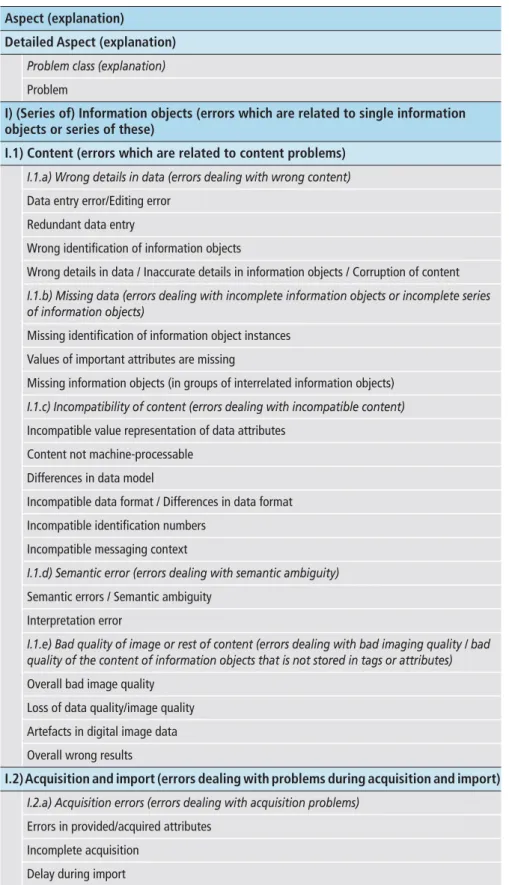
Relevant excerpts from the references were first collected in an unsorted list. During transcription, the formulations of similar entries were assimilated and grouped. In this way a categorization of communication problems and their reasons was created. Please see 씰Table 1 in Section 3.
2.2 Expert Interviews
for Verification
We chose the method of problem-centered expert interviews in order to check the results of the literature analysis (i.e., the communi-cation problems and their reasons). This step was performed in order to ensure that: 1. the developed categorization contained all
relevant communication problems and that no important reason was missing; 2. the relationships between communication
errors and reasons were correct. We contacted experienced hospital informa-tion managers, integrainforma-tion engineers (i.e., software engineers specialized on the imple-mentation of medical communication stan-dards such as HL7 and DICOM) and members of working groups dealing with in-tegration issues. All participating experts re-ceived an electronic copy of the error rization. We asked them to review the catego-rization before the actual interview. For this purpose, we also provided a guideline that clarified the focus of the interview. The actual interview was mainly performed via tele-phone in an open semi-structured way.
The inclusion criteria for the selection of the experts were:
1. At least two years’ (preferably five years) working experience in implementing clinical application systems that com-municate via HL7 or DICOM.
2. At least two years’ (preferably five years) working experience in administrating HIS, PACS or RIS databases (i.e., database
Fig. 1 Iterative literature review process – According to the review’s aim, appropriate keywords are selected and references are searched iteratively. Adequate results are analyzed for communication problems and their respective reasons. The process stops after a saturation is observable.
is filled with data from HL7 and/or DICOM messages).
3. At least two years’ (preferably five years) practical experience in projects introduc-ing or updatintroduc-ing clinical application sys-tems that communicate via HL7 or DICOM.
4. At least two years’ (preferably five years) practical experience in implementing IHE profiles.
In total, we invited 42 experts that met at least one of the mentioned criteria. Twenty-eight experts responded and were willing to review the categorization. In the end, 17 experts were actually interviewed:
● Twelve software developers with 3–15
years of working experience in imple-menting HL7 and DICOM applications. Three of the interviewed developers stated explicitly to have at least three years of practical experiences in implementing IHE profiles. Three developers are also working in standardization boards.
● One product manager of a health care
company who supervises the development of new HL7 and DICOM applications and who is also responsible for integration issues for 10 years.
● Four project managers from hospitals and
healthcare companies with 5–14 years of working experience in introducing or up-grading DICOM or HL7 infrastructures. One of them is also working for a national IHE board.
3. Results – A Categoriza
-tion of Common
Communi-cation Problems
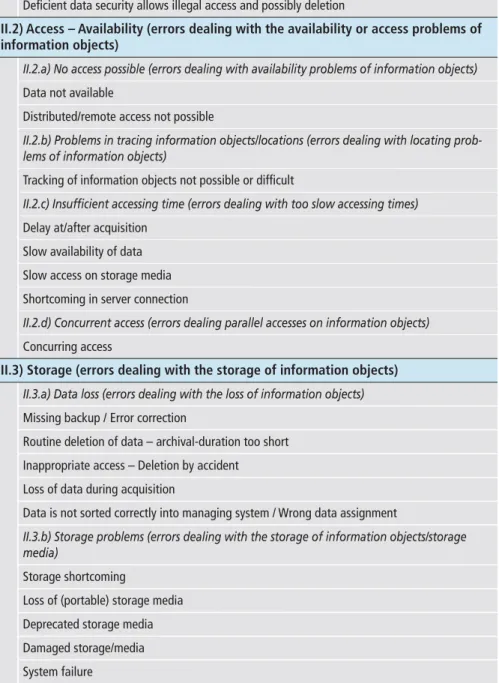
씰Table 1 shows the current version of the developed communication error categoriza -tion. It is organized in the following five hier-archy levels:
● The first and most abstract level is called
“Aspect”: It differentiates whether a prob-lem concerns the information objects, their administration or their transfer be-tween application systems.
● The second level is called “Detailed
aspect”: It differentiates the rough categori -zation of the first level according to more concrete aspects such as “Content” or
“Ac-Table 1 Excerpt of the categorization of communication errors (i.e., column “Problem”)
Aspect (explanation)
Detailed Aspect (explanation)
Problem class (explanation)
Problem
I) (Series of) Information objects (errors which are related to single information objects or series of these)
I.1) Content (errors which are related to content problems)
I.1.a) Wrong details in data (errors dealing with wrong content)
Data entry error/Editing error Redundant data entry
Wrong identification of information objects
Wrong details in data / Inaccurate details in information objects / Corruption of content
I.1.b) Missing data (errors dealing with incomplete information objects or incomplete series of information objects)
Missing identification of information object instances Values of important attributes are missing
I.2) Acquisition and import (errors dealing with problems during acquisition and import)
I.1.c) Incompatibility of content (errors dealing with incompatible content)
Incompatible value representation of data attributes Content not machine-processable
Differences in data model
Incompatible data format / Differences in data format Incompatible identification numbers
Incompatible messaging context
I.1.d) Semantic error (errors dealing with semantic ambiguity)
Semantic errors / Semantic ambiguity Interpretation error
I.1.e) Bad quality of image or rest of content (errors dealing with bad imaging quality / bad quality of the content of information objects that is not stored in tags or attributes)
Overall bad image quality Loss of data quality/image quality Artefacts in digital image data Overall wrong results
I.2.a) Acquisition errors (errors dealing with acquisition problems)
Errors in provided/acquired attributes Incomplete acquisition
Delay during import
quisition and import”. This level com-prises 10 entries.
● The third level is called “Problem class”: It
groups similar concrete problems. For in-stance, the entry “Content” on the second level contains amongst others the classes “Wrong details in data” and “Missing data”. The categorization contains 28 of these classes.
● The fourth level is called “Problem”: It
contains the 81 problems that resulted from the qualitative content analysis and the experts interviews.
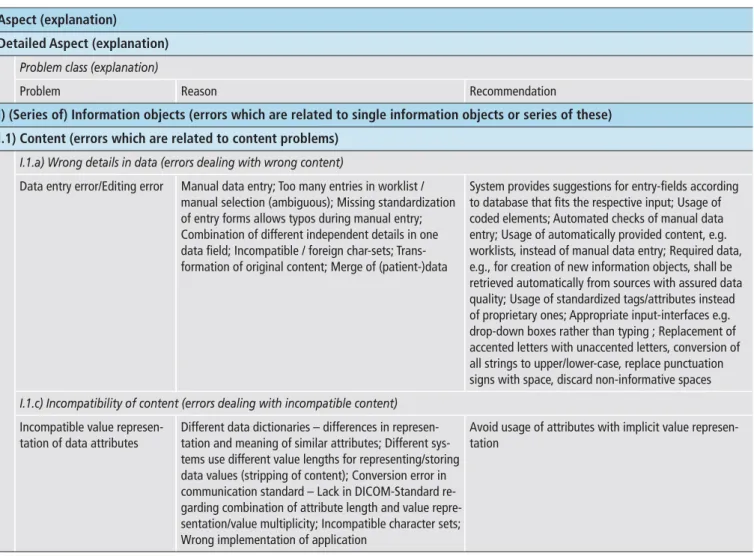
● The fifth level is subdivided into “Reason”
and “Recommendation”: It contains rea-sons for the errors on level four along with recommendations that the authors gave in order to avoid those problems. This level comprises 229 entries.
Note: The columns “Reason” and “Recom-mendations” are independent although they are both assigned to the related entry in col-umn “Problem”. However, the inclusion of the content of these two columns would signifi-cantly increase the size of this paper. There-fore they are not included. In case of interest, please contact the authors for a copy of the full table. Some example entries for these two columns can be found in 씰Table 2.
4. Discussion
The electronic communication of informa-tion objects in hospitals requires an adequate integration of all involved electronic appli-cation systems in the HIS. In general, this requires that the application systems must transmit, store and process information ob-jects without losing or deleting them, cor-rupting their structure or content or any other possible problem. However, most of the integrated HIS are historically grown archi-tectures and therefore comprise a lot of indi-vidual workarounds. In consequence changes to their architecture may cause negative side-effects (although the existing HIS might work perfectly for most of the current purposes). The efficient anticipation of these problems is aggravated due to the aforementioned com-plexity. A main drawback in this context is that a summary of the distinct reasons for the possible problems is missing.
II) Data management (errors dealing with the management (database/management system) of information objects)
II.1) Access – Permissions and Security (errors dealing with the access on informa-tion objects / securing an informainforma-tion objects content)
II.2) Access – Availability (errors dealing with the availability or access problems of information objects)
II.3) Storage (errors dealing with the storage of information objects)
II.1.a) Authorization problems (errors dealing with access restrictions)
Missing authorization
Deficient data security allows illegal access and possibly deletion
II.2.a) No access possible (errors dealing with availability problems of information objects)
Data not available
Distributed/remote access not possible
II.2.b) Problems in tracing information objects/locations (errors dealing with locating prob-lems of information objects)
Tracking of information objects not possible or difficult
II.2.c) Insufficient accessing time (errors dealing with too slow accessing times)
Delay at/after acquisition Slow availability of data Slow access on storage media Shortcoming in server connection
II.2.d) Concurrent access (errors dealing parallel accesses on information objects)
Concurring access
II.3.a) Data loss (errors dealing with the loss of information objects)
Missing backup / Error correction
Routine deletion of data – archival-duration too short Inappropriate access – Deletion by accident Loss of data during acquisition
Data is not sorted correctly into managing system / Wrong data assignment
II.3.b) Storage problems (errors dealing with the storage of information objects/storage media)
Storage shortcoming
Loss of (portable) storage media Deprecated storage media Damaged storage/media System failure Aspect (explanation)
Detailed Aspect (explanation)
Problem class (explanation)
Problem
4.1 The Content of the Problem
Categorization
The categorization that we are presenting in this paper is such a structured summary. To our knowledge there is no similar summary that concisely summarizes common com-munication problems and also refers to their underlying reasons. Also the IHE Technical Framework, although it can be regarded as the best practice of hospital application sys-tem integration, is not meant to name con-crete problems and their reasons. The other contributions just focus on single aspects and are just meant to share the respective experi-ences – thus it is up to the reader to identify the essential details and to match the de-scribed setting with their own situation. For instance, Lian et al. describe in [25] the ex-periences they gained during their IHE pro-ject. Blado et al. deal in [26] with the possible causes of discrepancies between databases which lead to inconsistencies. In contrast, Kuzmak et al. write about wrongly selected worklist entries and the consequences [27]. König et al. describe shortcomings in the standard definitions and see them as reasons for possible integration difficulties [28]. We used the details of such references in order to compile our categorization – it thus can be regarded as an intersection of relevant ex -periences (see also Sections 2 and 4.2).
4.2 The Acquisition of the Problem
Categorization
The problem categorization’s details were ac-quired through a subsuming qualitative con-tent analysis [21] on available literature that describes experiences regarding integration projects and the implementation of common communication standards (i.e., HL7 and DICOM). The qualitative approach strongly depends on the selected literature references and contains a certain degree of subjectivity (i.e., due to the subjectively selected search phrases). This can affect the validity and com-pleteness of our categorization. In order to re-duce subjectivity and to ensure that no valu-able reference was overseen, the iterative pro-cess started with sensitive search phrases which were stepwise refined. Subsequent problem-centered expert interviews ensured the com-pleteness and validity of the collected
prob-Table 1 Continued
II.4) Organization (all errors dealing with the structured sorting/organization infor-mation objects in archive/management system)
III) Communication and Transfer (errors related to the transfer of information objects) III.1) Application systems errors (errors dealing with application systems)
II.4.a) Assignment (errors dealing with the interrelation of information objects and their relations in hierarchies (in relation to patient/study-information)
Wrong / missing assignment of information objects to patient Assignment errors of related information objects
II.4.b) Database alignment (errors dealing with the matching of different/separate databases)
Missing error notification Not synchronized databases Redundant data management
II.4.c) Database content errors (errors dealing with incorrect data in databases)
Redundancies in database content Missing data cleansing
High latency failure correction Missing version management Uncoordinated data entry Wrong data transmission Leaking database integrity
Syntactic errors within database-entries
II.4.d) Completeness of database (errors dealing with incomplete databases)
Incomplete databases
II.4.e) Continuity of database (errors dealing with the continuity of databases)
Leaking continuity of stored data
III.1.a) Insufficient support of services/Incompatible services (errors dealing with the services implemented by application systems)
Unsupported services
Insufficient information for services Different communication interfaces Incompatible service identification
III.1.b) Wrong communication content (errors dealing with the content of communications)
Unsupported content Aspect (explanation)
Detailed Aspect (explanation)
Problem class (explanation)
Problem
II) Data management (errors dealing with the management (database/management system) of information objects)
lems and reasons. Comments of the experts only pertained to some of the reason entries. But the categorization’s structure and most of its content were accepted. This convinces us that our approach is adequate and sound. Of course an evaluation in a real environment must prove whether the content of the catego-rization is correct. But for this purpose, an adequate operationalization is necessary which is still an open issue (see also Section 4.4).
4.3 Anticipated Usage
of the Categorization
The categorization can raise a basic awareness of potential problems (i.e., “What can go wrong? What should be considered?”) and supports the understanding of the under-lying reasons. Moreover, several of the interviewed experts suggested that the categoriza -tion could support the crea-tion or com -pletion of their Failure Mode and Effects Analysis (FMEA [29, 30]. This would apply to the hospital’s information management as well as vendors of healthcare application sys-tems. In the latter case, the mandatory stan-dard ISO 13485 [31] provides a basic classifi-cation of possible risks that can arise for the patient due to errors of the respective ap -plication system. However, the matching between the standard risk classification and our problem categori zation would require further efforts. As far as we know, no com-parable mapping of problems on risk classes does currently exist.
4.4 Open Issues
The content of the categorization could be used for examining an entire communication process of interest for the occurrence of any of the collected problems (i.e., screening for potential problems). But there are currently some open issues that must be solved for that purpose:
The amount of the collected entries and their various interrelations make the catego-rization extensive. Especially in the current table-oriented form it only seems feasibly to use the categorization for looking up the rea-sons of specific problems. Also the current formulations of the reason and recommen-Table 1 Continued
III.2) Network (errors dealing with the (physical) network infrastructure)
III.3) Transcription (errors dealing with the transcription of information objects)
III.4) Security (errors dealing with the secure communication of information objects) No communication establishment
Requested system denies access or connection
III.1.e) Incompatible communication interfaces (errors dealing with the communication inter-faces of application systems)
Too many different communication interfaces
III.1.f) Leaking availability of systems (errors dealing with the availability of application systems)
System is (temporarily) down Blocked system
III.1.g) Instable software (errors dealing with the (software-)implementation of the appli-cation systems)
Unstable software versions Software-Crash
III.2.a) Errors in infrastructure (errors dealing with the network)
Malfunctions of network
Network-infrastructure is not uniform Insufficient degree of electronic communication
III.2.b) Insufficient capacities (errors dealing with capabilities of the network)
Insufficient network bandwidth
III.3.a) Transcription errors (errors dealing with the transcription of information objects)
Transcription error
III.4.a) I,nsecure communication (errors dealing with securing communication links)
Violation of privacy policy
Insecure communication of critical contents
III.1.c) Errors in the communication of information objects (errors dealing with the forward-ing or processforward-ing of information objects)
Missing or incomplete processing rules Stagnant processing
Communication disruption / Incomplete communication Communication with wrong partner
No communication possible Aspect (explanation)
Detailed Aspect (explanation)
Problem class (explanation)
Problem
III) Communication and Transfer (errors related to the transfer of information objects) III.1) Application systems errors (errors dealing with application systems)
Table 2 Excerpt of the categorization that also contains entries for the problem reasons (column “Reason”) and recommendations in order to avoid the respective problem (column “Recommendation”)
Aspect (explanation)
Detailed Aspect (explanation)
Problem class (explanation)
Problem Reason Recommendation
I) (Series of) Information objects (errors which are related to single information objects or series of these) I.1) Content (errors which are related to content problems)
I.1.a) Wrong details in data (errors dealing with wrong content)
Data entry error/Editing error Manual data entry; Too many entries in worklist / manual selection (ambiguous); Missing standardization of entry forms allows typos during manual entry; Combination of different independent details in one data field; Incompatible / foreign char-sets; Trans-formation of original content; Merge of (patient-)data
System provides suggestions for entry-fields according to database that fits the respective input; Usage of coded elements; Automated checks of manual data entry; Usage of automatically provided content, e.g. worklists, instead of manual data entry; Required data, e.g., for creation of new information objects, shall be retrieved automatically from sources with assured data quality; Usage of standardized tags/attributes instead of proprietary ones; Appropriate input-interfaces e.g. drop-down boxes rather than typing ; Replacement of accented letters with unaccented letters, conversion of all strings to upper/lower-case, replace punctuation signs with space, discard non-informative spaces
I.1.c) Incompatibility of content (errors dealing with incompatible content)
Incompatible value represen-tation of data attributes
Different data dictionaries – differences in represen-tation and meaning of similar attributes; Different sys-tems use different value lengths for representing/storing data values (stripping of content); Conversion error in communication standard – Lack in DICOM-Standard re-garding combination of attribute length and value repre-sentation/value multiplicity; Incompatible character sets; Wrong implementation of application
Avoid usage of attributes with implicit value represen-tation
dation entries still are too abstract and require background information for their correct understanding – i.e., a single entry comprises several underlying atomic aspects (e.g., the term “incompatible value represen-tation” implies amongst others that at least two application systems are involved and ex-change information. Further, each of the ap-plication systems uses a specific value repre-sentation. Consequently, an incompatibility exists if the involved systems use different value representations). Of course, breaking down the problem reasons results in even more details that must be considered. How-ever, such a step helps to clarify which con-crete details of the communication process are required for an adequate description. These details could then be used to support the correct data acquisition and to create a database. For each of the problems specific
database queries could be developed on the basis of the already collected reason de -scriptions. Such an operationalization could also help to evaluate the problem catego -rization with examples from a real environ-ment.
5. Conclusion
Understanding the reasons for errors in the electronic communication of integrated HIS is difficult. The complexity of most HIS aggra-vates an efficient anticipation of negative side-effects that might be caused by changes. A consolidated categorization of common com-munication problems and their underlying reasons is an essential prerequisite for solving this difficulty. This paper describes such a categorization and explains the combined
qualitative process it was acquired with. In its current form, the categorization can raise a basic awareness on potential problems and helps to understand the underlying reasons. It can be used to look up the reasons for a spe-cific problem of interest. Further it contains some recommendations the authors of the analyzed experience reports found useful for the avoidance of the respective problem. However, for screening an entire communi-cation process for the occurrence of any of the communication errors an adequate opera -tionalization is still required. It would then be possible to evaluate the categorization with communication processes from real environ-ment.
References
1. Winter A, Brigl B, Wendt T. Modeling hospital in-formation systems. Part 1: The revised three-layer graph-based meta model 3LGM2. Methods Inf Med 2003; 42 (5): 544–551.
2. Haux R, Winter A, Ammenwerth E, Brigl B. Stra-tegic Information Management in Hospitals. New York, USA: Springer-Verlag; 2004.
3. Haux R. Health information systems – past, present, future. Int J Med Inform 2006; 75 (3–4): 268–281. 4. Coiera E. When conversation is better than
compu-tation. JAMIA 2000; 7 (3): 277–286.
5. Brazhnik O, Jones JF. Anatomy of data integration. J Biomed Inform 2007; 40 (3): 252–269. 6. Giuse DA, Kuhn KA. Health information systems
challenges: the Heidelberg conference and the future. Int J Med Inform 2003; 69 (2–3): 105–114. 7. Kun L. Interoperability: the cure for what ails us.
IEEE Eng Med Biol Mag 2007; 26 (1): 87–90. 8. Dwyer S. A personalized view of the history of PACS
in the USA. In: Blaine G, Siegel E, editors. Proceed-ings of the SPIE: Medical Imaging 2000: PACS Design and Evaluation: Engineering and Clinical Issues; 2000; San Diego, CA, USA; 2000. pp 2–9. 9. ACR/NEMA. DICOM Homepage. 2008 (cited Sep
2008). Available from: http://medical.nema.org 10. HL7. Health Level 7. 2008 (cited Sep 2008).
Avail-able from: http://hl7.org
11. Gross-Fengels W, Miedeck C, Siemens P, Appel R, Muckner K, Finsterbusch J, et al. PACS: from project to reality. Report of experiences on full digitali-sation of the radiology department of a major hos-pital. Radiologe 2002; 42 (2): 119–124.
12. Matthews JW, Bosch WR. Explicit-VR transfer syntax limits the value multiplicity of DICOM data
elements with decimal string (DS) value represen-tation. Phys Med Biol 2006; 51 (5): L11–2. 13. Hammond KW, Helbig ST, Benson CC,
Brathwaite-Sketoe BM. Are electronic medical records trust-worthy? Observations on copying, pasting and duplication. AMIA Annu Symp Proc 2003. pp 269–273.
14. Khorasani R. Medical management: expanding ra-diologists’ role using information technology to im-prove the quality of care. Semin Roentgenol 2003; 38 (3): 282–286.
15. Nissen-Meyer S, Holzknecht N, Wieser B, Francke M, Küttner B, Adelhard K, et al. Produktivitätsver-besserung durch klinikweite RIS und PACS: eine Fallstudie. Der Radiologe 2002; 42: 351–360. 16. HIMMS/RSNA. IHE – changing the way healthcare
connects. 2008 (cited Sep 2008). Available from: http://www.ihe.net
17. Mildenberger P, Wein B, Bursig HP, Eichelberg M. Current developments in DICOM and IHE. Ra -diologe 2005; 45 (8): 682–689.
18. Marlow SP, Mackenzie DA, Tomlinson JB. PC/VAX or standalone PC-based general purpose biological data collection system. Med Biol Eng Comput 1993; 31 (1): 22–30.
19. Sieving A, Billquist J, Smith R, Müller D. The PDP-11 FAQ. Technical report, Usenet, 2000 (cited Sep 2008). Available from: http://www.village.org/ pdp11/faq.html
20. Mayring P. Einführung in die qualitative Sozial -forschung: eine Anleitung zu qualitativem Denken. 5th revised edition. Weinheim: Beltz, Psychologie-Verl.-Union; 2002.
21. Mayring P. Qualitative Inhaltsanalyse – Grundlagen und Technik. 8th edition. Weinheim und Basel: UTB; 2003.
22. Saboor S, Chimiak-Opoka J, Ammenwerth E. Sup-porting the Systematic Assessment of Clinical Pro-cesses: the MedFlow Method. Methods Inf Med 2007; 46 (5): 586–594.
23. Kotter E, Langer M. Integrating HIS-RIS-PACS: the Freiburg experience. Eur Radiol 1998; 8 (9): 1707–1718.
24. Mongkolwat P, Bhalodia P, Gehl JA, Channin DS. Validating DICOM content in a remote storage model. J Digit Imaging 2005; 18 (1): 37–41. 25. Lian JD, Lin IC, Wu HC. Case report: Taiwan’s
ex-perience in adopting IHE technical framework to integrate systems. Stud Health Technol Inform 2006; 122: 877.
26. Blado ME, Tomlinson A. Monitoring the accuracy of a PACS image database. J Digit Imaging 2002; 15 (Suppl 1): 87–95.
27. Kuzmak PM, Dayhoff RE. Minimizing Digital Im-aging and Communications in Medicine (DICOM) Modality Worklist patient/study selection errors. J Digit Imaging 2001; 14 (2 Suppl 1): 153–157. 28. König H, Klose KJ. Modelling of radiological
ser-vices in the context of a hospital information sys-tem: does the DICOM standard meet the require-ments? Radiologe 1998; 38 (10): 872–882. 29. Spath PL. Using failure mode and effects analysis to
improve patient safety. Aorn J 2003; 78 (1): 16–37; quiz 41–4.
30. Stalhandske E, DeRosier J, Patail B, Gosbee J. How to make the most of failure mode and effect analy-sis. Biomed Instrum Technol 2003; 37 (2): 96–102. 31. ISO. ISO 13485:2003 – Medical devices – Quality
management systems – Requirements for regu
-latory purposes. 2008 (cited Sep 2008). Available from: http://www.iso.org/iso/iso_catalogue/cata logue_tc/catalogue_detail.htm?csnumber= 36786