Evidence-based Software Process
Recovery
by
Abram Hindle
A thesis
presented to the University of Waterloo in fulfillment of the
thesis requirement for the degree of Doctor of Philosophy
in
Computer Science
Waterloo, Ontario, Canada, 2010
c
I hereby declare that I am the sole author of this thesis. This is a true copy of the thesis, including any required final revisions, as accepted by my examiners.
Abstract
Developing a large software system involves many complicated, varied, and inter-dependent tasks, and these tasks are typically implemented using a combination of defined processes, semi-automated tools, and ad hoc practices. Stakeholders in the development process — including software developers, managers, and customers — often want to be able to track the actual practices being employed within a project. For example, a customer may wish to be sure that the process is ISO 9000 compliant, a manager may wish to track the amount of testing that has been done in the current iteration, and a developer may wish to determine who has recently been working on a subsystem that has had several major bugs appear in it.
However, extracting the software development processes from an existing project is ex-pensive if one must rely upon manual inspection of artifacts and interviews of developers and their managers. Previously, researchers have suggested the live observation and in-strumentation of a project to allow for more measurement, but this is costly, invasive, and also requires a live running project.
In this work, we propose an approach that we call software process recovery that is based on after-the-fact analysis of various kinds of software development artifacts. We use a variety of supervised and unsupervised techniques from machine learning, topic analysis, natural language processing, and statistics on software repositories such as version control systems, bug trackers, and mailing list archives. We show how we can combine all of these methods to recover process signals that we map back to software development processes such as the Unified Process. The Unified Process has been visualized using a time-line view that shows effort per parallel discipline occurring across time. This visualization is called the Unified Process diagram. We use this diagram as inspiration to produce Recovered Unified Process Views (RUPV) that are a concrete version of this theoretical Unified Process diagram. We then validate these methods using case studies of multiple open source software systems.
Acknowledgements
I would like to recognize my coauthors on much of this work: • Michael W. Godfrey (PhD Supervisor)
• Richard C. Holt (PhD Supervisor) • Daniel German (Masters Supervisor)
• Neil Ernst (Fellow PhD Student and collaborator)
I would also like to acknowledge those who awarded me with scholarships: • NSERC, as I was funded by a NSERC PGS-D Scholarship
• David Cheriton and the David Cheriton School of Computer Science for the David Cheriton scholarship I received.
I would like to thank all the people who helped motivate this work: • Lixin Luo
• Ron and Faye Hindle
Dedication
This is dedicated to my loving wife Lixin and to principles of Free Software as prescribed by the Free Software Foundation.
Contents
List of Tables xii
List of Figures xv
1 Introduction 1
1.1 Relationship to Mining Software Repositories . . . 2
1.2 Application of Software Process Recovery . . . 3
1.2.1 Stakeholders . . . 4
1.3 Conceptual View of Software Process Recovery . . . 6
1.4 Summary . . . 9
2 Related Research 11 2.1 Stochastic Processes, Business Processes and Software Development Processes 11 2.1.1 Stochastic Processes . . . 12
2.1.2 Business Processes . . . 12
2.1.3 Software Development Processes . . . 13
2.1.4 Process Summary . . . 15
2.2 Data Analysis . . . 15
2.2.1 Statistics . . . 15
2.2.2 Time-series analysis . . . 16
2.2.3 Machine Learning and Sequence Mining . . . 18
2.2.5 Social Network Analysis . . . 23
2.2.6 Data Analysis Summary . . . 23
2.3 Mining Software Repositories . . . 23
2.3.1 Fact extraction . . . 24
2.3.2 Prediction . . . 24
2.3.3 Metrics . . . 25
2.3.4 Querying Repositories . . . 27
2.3.5 Statistics and Time-series analysis . . . 28
2.3.6 Visualization . . . 28
2.3.7 Social Aspects . . . 31
2.3.8 Concept Location and Topic Analysis . . . 31
2.3.9 MSR Summary . . . 32
2.4 Software Process Recovery . . . 32
2.4.1 Process Mining: Business Processes . . . 32
2.4.2 Process Discovery . . . 33
2.4.3 Process Recovery . . . 33
2.4.4 Software Process Recovery Summary . . . 34
2.5 Summary . . . 34
3 Software Process Recovery: A Roadmap 36 3.1 Software Artifact Perspective . . . 40
3.1.1 Source Control Systems . . . 40
3.1.2 Mailing list and Bug Trackers . . . 41
3.2 Process Perspective . . . 41
3.2.1 Evidence of Software Development Processes . . . 42
3.2.2 Concurrent Effort . . . 43
3.2.3 Process and Behaviour . . . 43
3.3 Software Development Perspective . . . 43
3.3.1 Requirements and Design . . . 44
3.3.2 Implementation, Testing, and Maintenance . . . 44
3.3.3 Deployment, Project Management, and Quality Assurance . . . 45
4 Evidence of Process 47 4.1 Release Patterns . . . 48 4.1.1 Background . . . 49 4.1.2 Terminology . . . 50 4.2 Methodology . . . 51 4.2.1 Extraction . . . 52 4.2.2 Partitioning . . . 53 4.2.3 Aggregates . . . 53 4.2.4 Analysis . . . 54 4.2.5 STBD Notation . . . 55 4.3 Case Study . . . 55
4.3.1 Questions and Predictions . . . 56
4.3.2 Tools and Data-sets . . . 56
4.4 Results . . . 58
4.4.1 Indicators of Process . . . 61
4.4.2 Linear Regression Perspective . . . 61
4.4.3 Release Perspective . . . 62
4.4.4 Interval Length Perspective . . . 62
4.4.5 Project Perspective . . . 63
4.4.6 Revision Class Perspective . . . 64
4.4.7 Zipf Alpha Measure . . . 65
4.4.8 Answers to Our Questions . . . 65
4.4.9 Validity Threats . . . 67
4.5 Possible Extension . . . 68
4.6 Conclusions . . . 69
5 Learning the Reasons behind Changes 70 5.1 What About Large Commits? . . . 71
5.2 Methodology . . . 72
5.3 Results . . . 77
5.3.1 Themes of the Large Commits . . . 77
5.3.2 Quantitative Analysis . . . 79
5.4 Analysis and Discussion . . . 88
5.4.1 Threats to Validity . . . 90
5.5 Conclusions . . . 90
6 Classifying Changes by Rationale 92 6.1 On the Classification of Large Commits . . . 93
6.2 Previous Work . . . 94
6.3 Methodology . . . 95
6.3.1 Projects . . . 95
6.3.2 Creating the training set . . . 95
6.3.3 Features used for classification . . . 95
6.3.4 Machine Learning Algorithms . . . 96
6.4 Results . . . 97
6.4.1 Learning from Decision Trees and Rules . . . 98
6.4.2 Authors . . . 101 6.4.3 Accuracy . . . 101 6.4.4 Discussion . . . 105 6.5 Validity Threats . . . 106 6.6 Possible Extension . . . 107 6.7 Conclusions . . . 107
7 Recovering Developer Topics 108 7.1 Latent Dirichlet Allocation and Developer Topics . . . 109
7.1.1 Topics of Development . . . 109
7.1.2 Background . . . 111
7.1.4 Methodology . . . 114
7.1.5 Results . . . 119
7.1.6 Validity Threats . . . 123
7.1.7 Conclusions . . . 124
7.2 Labelling Developer Topics . . . 125
7.2.1 What’s in a Name? . . . 125
7.2.2 Background . . . 127
7.2.3 Methodology . . . 129
7.2.4 Observations and evaluation . . . 133
7.2.5 Related work . . . 140
7.2.6 Conclusions and future work . . . 141
7.2.7 Appendix . . . 141
8 Synthesizing Recovered Unified Process Views 146 8.1 Investigating Development Processes . . . 147
8.1.1 Motivation . . . 149 8.2 Previous work . . . 149 8.3 Methodology . . . 151 8.3.1 Source Acquisition . . . 152 8.3.2 Extraction . . . 153 8.3.3 Unsupervised Analysis . . . 155 8.3.4 Annotation . . . 156 8.3.5 Supervised analysis . . . 157
8.3.6 Signal Mapping and Reporting . . . 158
8.4 Signals . . . 158
8.4.1 Signal Visualization . . . 158
8.4.2 Signal Similarity . . . 159
8.5 Recovered Unified Process Views . . . 159
8.6 FreeBSD Case Study . . . 163
8.7 SQLite Case Study . . . 164
8.8 Discussion . . . 166 8.8.1 Threats to validity . . . 167 8.9 Conclusions . . . 167 8.9.1 Possible Extension . . . 168 9 Conclusions 169 9.1 Threats to validity . . . 171
9.1.1 Evidence and Observability . . . 171
9.1.2 Detail of Fine Grained Artifacts . . . 172
9.1.3 Validating with Case Studies . . . 172
9.1.4 Cost of Machine Learning . . . 172
9.1.5 Summary . . . 172
9.2 Future Work . . . 173
9.3 Summary . . . 173
List of Tables
1.1 Definitions used throughout the rest of the thesis . . . 3 1.2 Stakeholders who could benefit from Software Process Recovery . . . 4 4.1 Total number of releases per project (Note MaxDB and MySQL fork their
repositories so each repository contains most of the releases) . . . 51 4.2 Total Number of Revisions per class per project . . . 52 4.3 Summary of the four major project’s revision frequencies before and after a
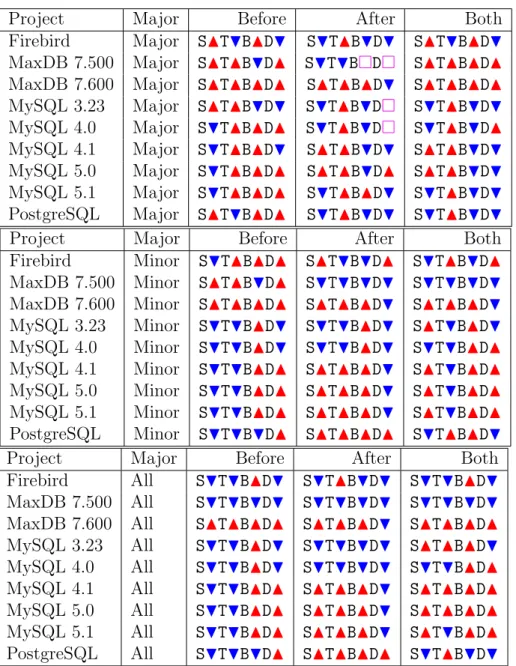
release with majority voting across the branches, where ?is when no major-ity is found,H means revisions are more frequent before,N means revisions are more frequent after. S - source, T - test, B - build, D - documentation 56 4.4 A STBD notation summary table of project revision frequencies across
re-lease types, and interval lengths. Hmeans revisions are more frequent before a release, Nmeans revisions are more frequent after a release. means re-visions were equally frequent before and after a release. S - source, T - test, B - build, D - documentation . . . 57 4.5 Summary of Table 4.4 using majority voting where ? means no majority.
H means revisions are more frequent before a release, N means revisions are more frequent after a release. means revisions were equally frequent before and after a release. S - source, T - test, B - build, D - documentation 58 4.6 Linear Regressions of daily revisions class totals (42 day interval): H
indi-cates a positive slope, N indicates a negative slope, indicates a slope of 0 . . . 59 4.7 Comparison of average of total number of revisions before and after a release.
H indicates more revisions before a release,Nindicates more revisions after a release. . . 60 4.8 The Zipf α parameters for each class of revision. . . 66
5.1 Software projects used in this study. . . 72 5.2 Our categorization of maintenance tasks; it extends Swanson’s
categoriza-tion [149] to include feature addicategoriza-tion and non-funccategoriza-tional changes as separate categories. We refer to this as the Extended Swanson Categories of Changes. 73 5.3 Types of Commits used to annotate commits. These types attempt to
capture the focus of the commit rather than every detail about it; for in-stance Token Replacement that affected 1 build file and 10 source files will not be labelled Build. A commit could be labelled with one or more types. Their abbreviation is used in the figures in this chapter. . . 74 5.4 An attempt at classifying types of changes according to the Extended
Swan-son Categories of Change. Some of the types of change do not fit only one category; for example, a documentation change might be adaptive or per-fective. See Table 5.3 for a legend of types. . . 75 5.5 Categories of Large Commits. They reflect better the types of large commits
we observed than those by Swanson. . . 76 5.6 Classification of the types of commits using the Categories of Large Commits 77 5.7 Distribution of commits belonging to each Type of Change over all projects
(1 commit might have multiple types). . . 83 5.8 Proportion of changes belonging to each Extended Swanson Maintenance
Category for all projects (1 commit might belong to multiple ones). . . 88 5.9 The percent of commits belonging to each Large Maintenance Category over
all projects (1 commit might belong to multiple categories). . . 88 6.1 Best Learner Per Project for Word Distributions . . . 102 6.2 Best Learner Per Project for Authors and Modules . . . 103 6.3 Best Average Learner for each data-set. As expected, the more information,
the better. However, the Frequency of Words and the Authors appear to be the most significant contributors. . . 104 7.1 Sampled topics from MySQL 3.23, some with continuous topics. These
tokens were pulled from the top 10 most common words found in LDA extracted topics. Each token is a summary of one LDA generated topic from MySQL 3.23 commit comments. . . 114 7.2 NFRs and associated word-list words used in exp2. These words were used
7.3 Automatic topic labelling for MaxDB 7.500. This table shows how many topics from MaxDB 7.500 were named by the word-list topic-labeller and how many were not for experiments exp1, exp2, and exp3. . . 133 7.4 Results for automatic topic labelling. F1 = f-measure, MCC = Matthew’s
correlation coeff., ROC = Area under ROC curve . . . 135 7.5 Per label, per project, the best learner for that label. ROC value rates
learner performance, compared with the ZeroR learner ( a learner which just chooses the largest category all of the time). F1 is the F-measure for that particular learner. . . 136 7.6 MySQL and MaxDB Mulan results per Multi-Label learner . . . 137 8.1 Symbol table for describing the composition of RUPV signals in Section
8.5.1. Each symbol represents a signal that is made available by previous analysis, these signals can be thought of as time-series. In Section 8.5.1 we combine these signals as linear combinations in order to proxy effort associated with UP related disciplines. The subscripts symbols are meant to specify which artifacts these signals are derived from. . . 161
List of Figures
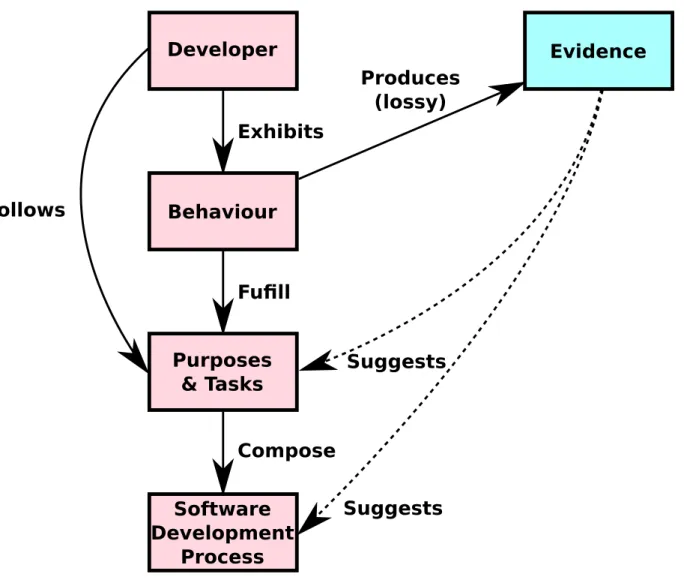
1.1 The relationship between developers and software development processes and the evidence that we rely on to recover software development processes. Developers exhibit behaviour as they attempt to complete tasks for a vari-ety of purposes. These behaviours, tasks and purposes form the underlying software development process. Evidence is a side effect of the developer’s behaviour. Using this evidence we attempt to infer the purpose and pro-cesses of software development. Thus software process recovery attempts to recover the actual development by inferring behaviour, purpose, and process from evidence. . . 7 2.1 Unified Process diagram: this is often used to explain the division of labour
within the Unified Process [86]. This diagram is also referred to as the UP “Hump diagram” [63]. . . 13 2.2 A project’s change history split into four streams: source changes, test code
changes, build system changes, documentation changes. . . 17 2.3 Proportion of large commits per project per Swanson Maintenance Category 19 2.4 A manual example of topic analysis applied to MySQL 3.23 revisions. [80] . 21 2.5 Automatic topic analysis applied to MaxDB 7.500. This compact-trend-view
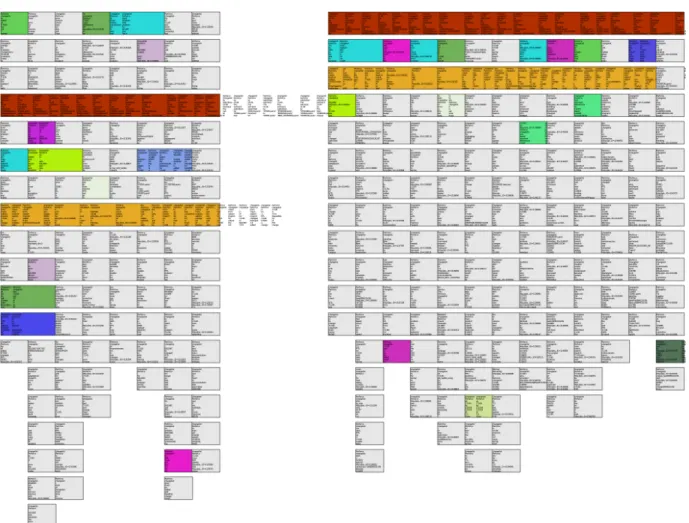
shows topics per month for MaxDB 7.500. The x-axis is time in months, the y-axis is used to stack topics occurring at the same time. Trends that are continuous are plotted as continuous blocks. Trends with more than one topic are coloured the same unique colour, while topics that do not recur are coloured grey. The top 10 words in the topics are joined and embedded in box representing the topics. No stop words were removed. [80] See Section 7.1.5. . . 22 2.6 How indentation metrics are extracted and measured. . . 26
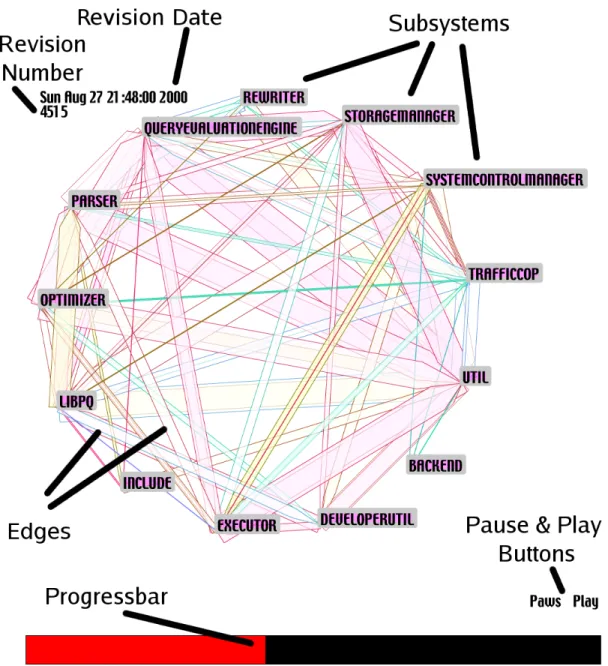
2.7 YARN Ball: PostgreSQL module coupling animation, the thickness of the arc and direction indicates how many times one module calls another. Mod-ules are the boxes along the edge of the circle [82]. . . 30 3.1 An illustration of the reality of development versus what we can infer from
evidence left behind. Developers exhibit behaviour as they attempt to meet goals that compose the software development processes they follow. Evi-dence is a side effect of the developer’s behaviour. Using this eviEvi-dence we infer the behaviours that the developer followed as well as the purpose be-hind this behaviour. By combining both recovered purpose and behaviour we can infer the recovered process. Thus software process recovery attempts to recover the actual development by inferring behaviour, purpose, and pro-cess from evidence. . . 37 5.1 Distribution of Types of Changes by project. Each bar corresponds to 100%
of commits of that type and it is divided proportionally according to their frequency in each of the projects. . . 81 5.2 Distribution of Types of Change of the aggregated sum of all projects. . . 82 5.3 Distribution of changes per project, organized using Extended Swanson
Maintenance Categories. . . 84 5.4 Distribution of changes for all projects, organized using Extended Swanson
Maintenance Categories . . . 85 5.5 Distribution of commits per project, classified according to the Categories
of Large Commits. . . 86 5.6 Distribution of commits for all projects, classified according to the
Cate-gories of Large Commits. . . 87 6.1 Text Cloud of tokens used by the J48 learner to classify commits. The
size of the text indicates how many instances of the word occurred in trees produced for the union of all the projects’ commits. . . 99 6.2 Text Clouds of Tokens used in J48 trees for each project . . . 100 7.1 Example of topics extracted from MySQL 3.23. The horizontal axis is time
by month examined. The vertical axis is used to stack topics that occur at the same time. Longer topics are topics which recur in adjacent windows. Colours are arbitrary. . . 114
7.2 How commits are analyzed and aggregated into topics and trends: commits are first extracted, then abstracted into word counts or word distributions which are then given to a topic analysis tool like LDA. LDA finds indepen-dent word distributions (topics) that these documents are related to (the numbers indicate similarity between documents and topics). . . 115 7.3 Topic similarity demonstrated by clustering topics by the transitive closure
(connectedness) of topic similarity. Nodes are topics and arcs imply some notion of similarity, e.g., topics share 8 out of top 10 words. . . 117 7.4 A zoomed-in slice of compact-trend-view of topics per month of MaxDB
7.500. The topic text is visible in each topic box. Trends are plotted across time continuously. . . 118 7.5 Trend-time-line: Trends plotted per month of MaxDB 7.500. Time in
months are plotted along the X-axis, each row on the Y-axis is associated with a trend ranked by size in descending order. . . 120 7.6 The top part of a trend-histogram of MaxDB 7.500, ordered by topic
oc-currence. X-axis determines the number of continuous months of a trend. Trends are ranked by the number of topics that a trend contains in descend-ing order. . . 142 7.7 This figure depicts MaxDB 7.500 topics analyzed with global topic
analy-sis, 20 topics (each row) and their document counts plotted over the entire development history of MaxDB 7.500 (26 months). The shade of the topic indicates the number of documents matching that topic in that month rel-ative to the number of documents (white is most, black is least). . . 143 7.8 MaxDB 7.500: Labelled topics related to non-functional software qualities
plotted over time, continuous topics are trends that occur across time . . . 144 7.9 MySQL 3.23: Labelled topics related to non-functional software qualities
plotted over time, continuous topics are trends that occur across time . . . 145 8.1 Methodology flow chart, describes how artifacts are extracted, analyzed,
annotated and reported about. . . 152 8.2 Recovered Unified Process Views: These are the Recovered Unified Process
Signals of FreeBSD (on the left) and SQLite (on the right): business mod-elling, requirements, analysis and design, implementation, testing, deploy-ment, configuration managedeploy-ment, project managedeploy-ment, environment and build revisions. . . 165
Chapter 1
Introduction
Software process recovery is the extraction and recovery of software development processes from the software development artifacts that developers create and leave behind. These artifacts are found in software repositories such as source control, mailing lists, user docu-mentation, developer document and bug trackers. Some of these artifacts include: changes to source code, source code, bugs, bug reports, bug discussions, mailing list discussions, patches, user documentation, design documentation, requirements, developer documenta-tion. These artifacts act as evidence that software process recovery analyzes in order to infer to the behaviours, the purposes, the goals, and the underlying software development process of a project.
In this thesis, we describe the area of software process recovery by describing methods and tools one can use to recover software development processes from existing software development projects. We combine many of these techniques and use them to extract software development process related events and artifacts. These events are aggregated in order to create Unified Process diagram like visualizations (sometimes called the RUP hump diagram [63]), such as our Recovered Unified Process Views which is described in detail in 8. In essence we use a variety of techniques to analyze the repositories of existing software systems and then present views of the underlying processes and behaviours that occur within these systems.
As developers work on a software project their efforts, their behaviours, produce evi-dence. This evidence usually is in the form of software artifacts such as incremental changes to source code and documentation. Often each change is recorded and annotated with a change message. Sometimes communications about the development or current use of a software project is recorded, developers and users often take part in these discussions on mailing lists and in bug reports within bug trackers. As developers create software, a dig-ital trail of “bread crumbs” is left behind. We expect that if we can recover these trails,
made by developers, that we can determine the changes they have made, infer the pur-poses behind such changes, and perhaps recover some aspects of the software development process these developers are following.
This extraction and recovery of software development serves multiple purposes:
• To recover and understand development processes that occurred within a software project.
• To reconcile the prescribed software development processes with the observed soft-ware development processes.
• To elicit process related information and developer behaviour without interviewing developers or relying on their perceptions and judgement.
These purposes are not unique to software process recovery. Other fields such as mining software repositories, process mining, and process discovery are concerned with similar issues, as we will explain in the following section.
1.1
Relationship to Mining Software Repositories
The field of mining software repositories (MSR) [88] is dedicated to exploiting and un-derstanding software repositories and their artifacts of development, as well as inferring the relationships between them. Process recovery is a sub-field of MSR, that combines MSR research with process mining [156], the mining business processes via instrumenta-tion, and process discovery [29, 31, 30], the mining software development processes via instrumentation.
We propose to improve the state of the art of process recovery by extending it with current mining software repositories research. The purpose of process recovery is to be able to retroactively recover process from project histories without having to rely on a process that has been heavily instrumented as suggested by Cook and Wolf [29, 31, 30]. Process recovery is the elicitation of underlying behaviours, informal processes, and for-mal processes that developers follow while building and maintaining a software project, based on evidence recovered from the artifacts that these developers leave behind. This thesis attempts to describe and execute process recovery from information left behind by developers and not rely on modifying the actual development at run-time.
Process recovery relies on the underlying artifacts to describe the development processes that have taken place. These processes and behaviours are documented within the project and recovered from artifacts such as source code, documentation, build and configuration
Process Mining Mining of business processes at run-time Process Discovery Mining of software processes at run-time Process Recovery Mining of software processes after-the-fact
Table 1.1: Definitions used throughout the rest of the thesis
management scripts, test scripts, mailing lists, bug trackers, and revisions to all of these artifacts. The behaviours discovered and the underlying processes recovered from these behaviours can be used to characterize the processes used to develop a software project. Some of the methods used for process recovery are already used to mine business processes. Process mining in the context of business processes, processes that define business tasks, has been heavily investigated by Van der Aalst et al. [156]. Process mining is the run-time investigation of and recovery of business processes. With respect to software engineering, and mining software for processes, Cook et al. [29, 30, 29] attempted to discover underlying processes from software projects, referred to as process discovery, by recording developer actions at particular times. Cook took an existing project being developed, and inserted measurement devices (instrumentation) into the process in order to record process-related information, as the project was being developed. In contrast, process recovery does not require tooling an existing process, it involves mining artifacts left behind for evidence of underlying processes. In this particular case, we respect that some projects have documented their processes, but we hope that we can help validate that these processes are being executed by recovering evidence of their use from the artifacts left behind. Thus process recovery seeks to expose and uncover processes after-the-fact, or in an ex post facto fashion. Table 1.1 provides a quick reference to the difference between process mining, process discovery and process recovery. In the next section we will motivate this after-the-fact process analysis by suggesting possible applications.
1.2
Application of Software Process Recovery
The usefulness of process recovery lies mainly in reporting and validating existing knowl-edge about a particular project. Process recovery could be used to analyze past behaviours and processes within a software project, and determine what methods of development took place. One could produce reports of the observable and recorded behaviours that occurred within an iteration and show how close these behaviours follow existing development pro-cesses and project prescribed development propro-cesses. Process recovery would give some semblance of what actions developers were taking as well was what work was done in the past. Process recovery could also aid in extracting and describing the processes and behaviours that occurred within successful projects. These processes might be useful for
New Developers Discover a project’s process without bothering co-workers. Fixer Developers Integrate with projects that they are loosely associated with.
Managers Validate the software processes being followed by their team. ISO 9000 certifiers Recover process in order to document the process they have.
Acquisitions Determine what went into building a project. Table 1.2: Stakeholders who could benefit from Software Process Recovery
there is a correlation between unsuccessful projects and the processes they use. Thus an application of process recovery can be the elicitation and validation of what processes are being followed, and what the underlying observable process is.
When we refer to theobservability of a process we refer to the evidence that is provided and what inferences we can make about evidence. A behaviour would not be observable and its related processes would have poor observability if there was no record or evidence of such a behaviour. Behaviours such as face to face meetings or telephone conversations are often poorly recorded, thus associated processes to these behaviours might have poor observability. If a process is observable, interested stakeholders stand a chance of recovering it.
Users of process recovery would be those stakeholders who are interested in how the de-velopment of the project was executed. Potential users of process recovery are developers, managers, consultants, and those responsible for acquisitions. Developers could use pro-cess recovery to review how their coworkers were developing their current software project. Managers could verify what processes their developer’s were following. Consultants could determine the effort and quality of processes used within a project, they could then de-termine how much work it took to implement the project. Process recovery is useful for process verification. Managers could investigate the development artifacts of outsourced components and try to validate if the outsourced team was following the processes they had agreed to follow. Process recovery can provide stakeholders with evidence based sug-gestions about what the underlying and observable processes in a project are. In the next section we will discuss various kinds of stakeholders.
1.2.1
Stakeholders
While software process recovery might not be immediately useful to each and every de-veloper it is potentially useful for a wide variety of stakeholders ranging from managers, to new developers, to those responsible for technology acquisition. In this section we will flesh out some of the stakeholders described in Table 1.2.
Managers can benefit from software process recovery as they can use it to extract, recover and then verify if the process they prescribed is being followed by the programmers that they manage. Managers might not be as intimately involved with a software project as their developers are and might enjoy the introspection that software process recovery could provide to them, especially if it was automated. Managers care if their processes are being followed, they also care about the topics of development as well as the emphasis of development. Managers might want to understand how much work is maintenance and how much is new implementation.
Process documenters — those employees who are woefully assigned the task of doc-umenting current processes whether it is for ISO 9000 certification, where processes are defined and documented, or the Capability Maturity Model ranking where a team is ranked on their level of process maturity. In either case the process documenter must go forth and determine the processes being followed. If they have to take part in many interviews, this will increase the costs of process documentation. Much of this work can be automated, augmented or assisted by software process recovery as software process recovery can help elicit the observable and recorded software development processes being followed.
Green developers — those who are new to a project, might want to determine what the actual software development processes and practices of a particular project are. They might want to get up to speed on the processes and methods employed by their coworkers. While they can interview their coworkers this becomes more of an issue in a globally distributed team. Perhaps software process recovery can help show new developers how development is done on the projects they have been assigned to.
Fixer developers or star programmers are often assigned to different projects and given relatively short time-spans to adjust and produce results. Often fixer developers have to jump between many projects that their valuable time is divided amongst. Often fixers become the new developer and need to orient themselves within a project. Potentially soft-ware process recovery can help them as they can quickly analyze a project and determine what the underlying culture within a project is and what observable processes do the other developers follow. Often fixers lack the luxury of being able to interview other developers and coworkers.
Investors, acquisitions consultants, and out-sourcers might be concerned about the quality of development and adherence to the software development process of a par-ticular project. When investing in or purchasing a company with software assets it might
built as well as who built it. With respect to out-sourcing, one might wish to verify that the software development process that was prescribed in the contract was actually being followed. Perhaps process validation, via software process recovery, could be used to ensure that contractual obligations were met.
Thus all of these stakeholders can utilize software process recovery for their own pur-poses. The commonality among stakeholders is that they are not intimately familiar with the concrete implementation of the software project. These stakeholders are not necessar-ily the developers but the next section shows why developers are central to understanding the software development process of the project.
1.3
Conceptual View of Software Process Recovery
Software process recovery is the recovery of software development processes by interpreting evidence and inferring behaviours, purposes, goals, tasks and finally software development processes based on this evidence. In contrast other methods such as process mining and process recovery rely on the developers and managers to help us infer what processes they are following.
Figure 1.1 describes how software processes are composed and how developers interact with these processes. As each part of a development process has a purpose, each part is executed by a developer. When a developer implements or executes a process step relative to a goal or purpose, that developer performs a behaviour. Often behaviours produce evidence, whether the behaviour creates development artifacts or causes records to be made. We rely on this evidence to infer or suggest the related and possible behaviours, goals and software development processes. This means that without the help of developers we are trying to leverage the evidence that leave behind. This also implies that the majority of concepts in this diagram are only suggested and inferred from the evidence itself. Any behaviour that does not produce evidence is not observed, but maybe inferred by other evidence.
What this thesis is about is inferring the behaviours, purposes, and software devel-opment processes that developers followed or performed in order to develop the software development project being analyzed.
Our evidence of behaviour, purpose and process is extracted from software repositories such as source control systems, mailing list archives and bug trackers. We extract facts from this evidence, the artifacts of software development left behind. These facts are used to reason about the behaviours performed, the purposes behind the behaviours and the processes followed.
Figure 1.1: The relationship between developers and software development processes and the evidence that we rely on to recover software development processes. Developers exhibit behaviour as they attempt to complete tasks for a variety of purposes. These behaviours, tasks and purposes form the underlying software development process. Evidence is a side effect of the developer’s behaviour. Using this evidence we attempt to infer the purpose and processes of software development. Thus software process recovery attempts to recover the actual development by inferring behaviour, purpose, and process from evidence.
Evidence, behaviours and purposes can be related to disciplines, activities, workflows and stages. In this thesis disciplines, workflows and stages refer to roughly the same concept as they are different kinds of behaviours used to build software. Some example disciplines include: requirements, design, maintenance, implementation, testing and many others. Since our case studies in the following chapters demonstrate that these disciplines are not staged sequentially but are mixed in different proportions, we feel that discipline is more appropriate than stage, as stage implies a singular focus.
In terms of evidence and behaviour, our Chapter 4 is about release time behaviour and demonstrates that the evidence left behind is sufficient to infer release time behaviours and processes. While Chapter 5 and 6 describe maintenance categories of changes, they also demonstrate that the evidence provides enough clues to recover the purpose or goals of a source control system(SCS) change based on the language in the commit message. Chapter 7, which is about extracting developer topics, leverages this evidence to demonstrate the shifting focus in a project. While Chapter 8 is about the Recovered Unified Process Views that integrate the results of the previous chapters in order to summarize the software development processes being followed.
With respect to the purpose, goal or tasks that artifacts are related to, Chapter 5 is about maintenance categories and demonstrates how the purposes behind changes are often observable based on the evidence provided. Chapter 6 takes the manual effort of determining purpose in Chapter 5 and automates it. Chapter 7 discusses developer topics and explores purpose in the sense of related developer topics by recovering common de-velopment threads through topic analysis of commit messages. Some of these topics are related to non functional requirements such as portability or reliability. These different methods of determining purpose are useful when trying to associate events with disciplines and workflows in software development, as described in Chapter 8.
Process related work includes Chapter 4, which studies the release time processes of multiple software projects and demonstrates that there is internal consistency within a project. This consistency is indicative of a software development process. Chapter 8 summarizes many of the other chapters and integrates their efforts into a process overview that looks like a concrete or recovered version of the Unified Process diagram shown in Figure 2.1.
From the perspective ofsoftware development artifacts, Chapter 4, 5, 6, 7, and 8 focus on SCS changes. Chapter 7 and 8 focus on mailing list and bug tracker related events.
Chapters that addressprocess observability include Chapter 4 on release patterns, and Chapter 8 on recovered unified process views. These chapters show that there are software development processes that are recoverable based on evidence. We found that there was concurrent effort across disciplines, as demonstrated in case studies from Chapter 4 and Chapter 8. Chapter 7 demonstrates that topics of development often recur across the entire
lifetime of a project, indicating that there is some repeating behaviour within software development projects.
Thedisciplines of software development are addressed across all of the chapters to differ-ing degrees. Requirements and design disciplines are dealt with in Chapters 7 and 8 as both chapters address recovering requirements-related and non-functional requirements-related events. Chapter 4 and Chapter 5 address identifying implementation related changes whether by file type or commit log message. Testing is addressed in Chapter 4 and 8. Deployment and project management are addressed with our overview visualizations and summaries described within Chapter 8.
Thus the structure of this thesis is that if we have evidence, we can observe it and infer behaviour and processes from it (Chapter 4). Then we elaborate on this and try to annotate events by their purpose or developer topic (Chapters 5, 6, 7). Then in Chapter 8 we integrate the chapters previous to provide a general overview of the underlying software development process that we can observe based on the evidence recovered from the software repositories that we analyzed. For a more comprehensive discussion of software process recovery see Chapter 3.
1.4
Summary
In this chapter, we have proposed software process recovery and demonstrated the need for it. We related software process recovery to process mining and mining software repositories research fields. We have shown that software process recovery is valuable to a wide variety of stakeholders. Then we described how this thesis relates to the recovery of evidence from software repositories in order to infer behaviours, purposes and processes.
Our contributions in this thesis include
• A proposal for a field of research called software process recovery.
• A demonstration that we can extract some software development processes of existing software systems without instrumentation.
• The proposal, evaluation and validation of many methods of analyzing revisions, revision messages, mailing list messages and bug reports.
• An extraction of a Unified Process-like diagram called the Recovered Unified Process Views.
Our goal will be to integrate this research in order to recover underlying software pro-cesses that are observable based on the evidence recovered from the artifacts that developers
Next in Chapter 2 we will provide a survey of the groundwork for software process recovery. Afterwards we propose a line of research within process recovery which hinges primarily on the integration of already existing techniques and the refinement of these techniques into a relatively holistic framework for process recovery.
Chapter 2
Related Research
Our research will focus on methods, tools and techniques to aide software process recovery that are either automatic and unsupervised, semi-automatic and supervised, or manual. There is much previous relevant work related to this goal of software process recovery. This work builds upon four main areas: process, the formal and adhoc steps behind development; data analysis, the tools that we can rely on when we extract data from artifacts; mining software repositories, the field and the associated methods and tools that are focused on extracting information from repositories and artifacts created during development; soft-ware process recovery, how previous authors have attempted softsoft-ware process recovery and software process recovery related tasks. First off we must address what process is.
2.1
Stochastic Processes, Business Processes and
Soft-ware Development Processes
Development processes, or simply processes, guide the development of software, whether they be informal and adhoc, or formal and regimented. Process is a very general word which has multiple meanings depending on the field. While our process focus is on software development processes, in this thesis we will use the term process to refer to three related concepts: software development processes, business processes, and stochastic processes. We describe each kind of process in the following subsections. Software process recovery attempts to model these processes based on the evidence left behind by developers.
2.1.1
Stochastic Processes
Stochastic processes [3] produce values or measurements that exhibit some random be-haviour. These are processes that have probabilistic variation, and whose sequences of behaviour can be modelled probabilistically. Stochastic processes are much lower level than software development processes, but often represent the observed statistical proper-ties of a data-set, such as time between changes. Stochastic processes can be described by parametrized probability distributions, such as the Poisson distribution or the Pareto distribution [65], since they involve randomness and error. The processes could be sim-ple relationships between inputs such as time and effort and measured values like growth. With respect to software development these processes are sometimes used to model the growth of a software project.
Growth models of software, and some models of software evolution are stochastic pro-cesses as well. Lehman [98, 100, 99] described laws of software evolution relating to life cycle processes. In general Lehman’s laws suggest that growth cannot persist in the long-term without control because complexity caused by growth will increase and slow down development. This was confirmed by Turksi et al. [155], who found that on some large systems growth was sub-linear. Counter examples arose in subsequent studies by Tu et al. [51] who showed that Linux in particular had super-linear growth and did not follow the laws of evolution as laid out by Lehman. Herraiz et al. [65] mined many software project and modelled growth with various software metrics and found that the distribution of the metrics used to measure growth usually followed Pareto distributions. This knowledge of underlying distributions allows us to expect certain behaviours when we measure and include these behaviours into our models.
Stochastic processes are useful as they help model underlying data, allowing us to pre-dict or reason more effectively about what will be observed. Some processes can be mod-elled by well known distributions, which we discuss in Section 2.2. Stochastic processes are relevant to software process recovery because they are used to model the underly-ing behaviours based on evidence mined from software repositories. Stochastic processes are usually too low-level, thus they need to be abstracted and aggregated into business processes and software development processes to be useful to software process recovery.
2.1.2
Business Processes
Business processes are sequences of related tasks, activities, and methods combined, but often within the context of a business operation. These processes can be executed by actors, such as employees or software, with or without the help of software. Generally business processes describe a kind of collaboration of tasks that occur between actors. Van der Aalst et al. [156] describes business process mining as the extraction of business processes at
Figure 2.1: Unified Process diagram: this is often used to explain the division of labour within the Unified Process [86]. This diagram is also referred to as the UP “Hump dia-gram” [63].
run-time from actual business activities. Business processes can be fine-grained. Example business processes are: handling customer returns at a retail store, authenticating clients over the phone, and creating a client record. Van der Aalst deferred to Cook and Wolf when it came to process mining software projects. Software development is a kind of information work, like research, and thus is not easy to model so formally and so fine grained. While process is still important to software, we feel that the business processes described by frameworks like BPEL [157] (business process elicitation language) do not model software development well, as software development is often viewed as information-work. Business processes are related to software process recovery because tools such as sequence mining [89] can produce processes that are quite similar.
2.1.3
Software Development Processes
Software engineering makes use of software development processes. Software development processes are processes dedicated to analyzing a problem and designing a software solution to that problem. These are processes modelled after industrial work processes, such as the assembly line. Some researchers and practitioners hoped that software development processes would enable teams to produce software in a repeatable manner, akin to how many other engineered products were produced and designed. Software development pro-cesses are often software development methodologies. The tasks in a software development process can include just about everything: requirement elicitation, design, customer in-teraction, implementation, testing, configuration management, bug tracking, etc. Some
ware development processes are seen as a way to control the evolution of a software project in order to ensure that requirements are met and the project is successful.
Software development processes are a method of control to enable the production of quality software in a reliable manner. In this thesis our definition of software development processes is:
Software development processes are the composition of structured behaviours, and their purposes and intents, used to build a software system.
For example, posing software process as the behaviour of developers with respect to testing near a milestone would match this definition. Another example would be the proportion-ality of the efforts spent on each development-discipline over time would be a software development process. This differs from the software development life-cycle [144] as our focus is on behaviour and the SDLC’s focus is broader.
The SDLC describes how software is often built, maintained, supported and managed. Most software development processes relate to some if not all of the various aspects of the SDLC. Classic models of software development processes include the Waterfall model [138] and the spiral model [20]. More recent software development processes include the Unified Process [86], Extreme Programming (XP) [10], SCRUM [140], and many methodologies related to Agile development [66]. See Figure 2.1 for a diagram of the Unified Process workflows over time. Most of the recent development processes focus on smaller iterations, such that design and requirements can be updated as they become more clear with each iteration. Software development processes and life cycles seek to manage the creation and maintenance of software.
Meta-processes, such as the Capability Maturity Model (CMM) [126, 1], attempt to model the processes used to create software, much like ISO standard 9000 [147] attempts to model and document how processes are executed, tracked, modelled and documented. The CMM tries to model, track, and rank software process adherence. Software process recovery could aide ISO 9000 certification and CMM adherence.
Software development models described in the literature are typically high level, they do not have many tiny fine-grained sub-tasks, but companies often have much more detailed home-brew processes. There are some processes which can be modelled in a fine grained manner though, for instance researchers have modelled how bug reports are created and handled with in a bug tracker. Their end process was essentially a state diagram of bug states [135]. Software development processes are what software process recovery tries to recover from the evidence left behind by developers. Thus software development processes model software development at a relatively high level when contrasted with finer-grained processes such as business processes.
2.1.4
Process Summary
We have covered three kinds of processes each increasing in their level of granularity and generality. At the low level we have stochastic processes that seek to describe the processes behind the measurements and the data itself. At the intermediate level we have business processes which describe fine grained actions and tasks taken to fulfil a goal. Then at the high level we have software development processes which group together different efforts into a general process. We seek to extract all three of these kinds of processes from existing artifacts in an effort to recover the underlying processes that were executed to build the software project.
2.2
Data Analysis
In order to automate process recovery we will need to extract and process the data recov-ered from the software development environment. This data comes in many forms, from many repositories, as described by the mining software repositories community [88]. The main tools we use and describe include: statistical analysis, time-series analysis, machine learning, sequence mining, natural language processing, and social network analysis.
2.2.1
Statistics
Statistics [3] help us describe data and model data, and they are an integral part of data mining. In the rest of this section, we will summarize some commonly used statistical methods; the reader may choose to skip over this. The main statistical tools we use are distributions and summary statistics. Distributions are characterizations of how values, such as measurements, are spread out across their possible range. Distributions describe the relative frequency of values occurring or having occurred within a data-set. Some distri-butions have been modelled as functions or shapes. These distridistri-butions are parametrized, so we can generate them from a function and a set of parameters. Some common dis-tributions include: the normal distribution (bell curve), exponential distribution, Poisson distribution, Pareto distribution, power-law distribution, Zipf distributions, etc. Distri-butions can be summarized or characterized by summary statistics. Summary statistics are metrics that describe aspects of a distribution such as the average, the median, the variance, skew, kurtosis, etc. These summary statistics can be used to describe the shape and expected range of values of a distribution without the need to show the distribution itself. Quartiles are another useful measure, quartiles are a set of four ranges of elements that share an equal number of elements, quartiles help define the range and spread of a dis-tribution. The value between the middle two quartiles is about the median of the data-set.
Distributions and summary statistics tell us about the underlying data and help us model the data. In order to better model the data it is useful to see how similar distributions or models are to each other.
The statistical tools we use for comparing distributions include: the t-test, theχ2 test, Kolmogorov Smirnov test, the Lilifors test, cosine distance and Euclidean distance. These distribution similarity tests can be used to indicate if underlying distributions are similar or if a distribution matches a well known distribution like a exponential distribution, a Poisson distribution, a power law distribution, etc. The Lilifors and Kolmogorov Smirnov tests are especially useful for dealing with software-related data because they are non-parametric, which means that they can be used to compare data distributions that are not Gaussian (normal); this can be contrasted with the t-test and chi2 tests, which can
be sensitive to other kinds of distributions. Lilifors and Kolmogorov Smirnov tests are based on measuring the largest distance between two cumulative distribution functions (the integral of the probabilistic distribution function). These tests allow us to compare distributions to each other, but sometimes we want to search for distributions that are similar in order to compare models to the underlying data.
One common way to compare models is to use linear regression. Linear regression tries to model the data by finding the best fitting line through our data; this is accomplished by trying to minimize theR2 values, which indicate how much unexplained variance there is in our data compared to our best matching linear model [79]. These statistical methods allow us to compare and reason about data-sets, create model of the data-sets, and validate these models against the data-sets.
2.2.2
Time-series analysis
A time-series is a set of data points plotted over time. MSR research often deals with time-series, and much of the data collected from software repositories is data that occurs across time, which means the data has temporal components. The underlying data could be an event, it could be an aggregate of events, it could be a measurement at a certain time. The analysis of this data is called time-series analysis. Hindle et al. [69] discussed spectral analysis applied to time-series. Spectral analysis, using Fourier transforms, allows for underlying periodicities to be recovered from signals such as changes per day. What this means is that if a behaviour recurs regularly, such as weekly, that it might be detectable with spectral analysis. This spectral analysis is similar to theauto-correlationused in time-series analysis [64]. Auto-correlation attempts to look for underlying repeating behaviour by comparing a signal to time-shifted versions of itself. Much of the analyzed data from repositories is time-series data, utilizing these tools allows us to deal with time and look for potentially repeating patterns across time.
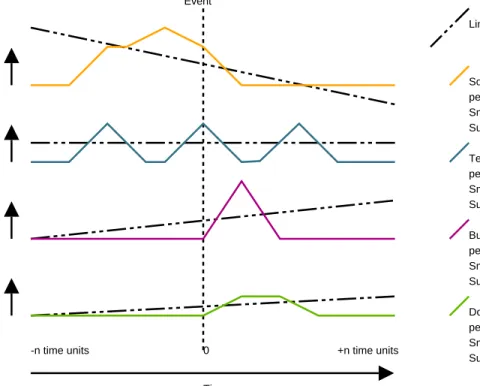
Revisions per Time Unit summed per time unit before and after a release
-n time units 0 +n time units
Source Code Revisions per Time Unit (day) Smoothed
Summed Near Release Test Revisions per Time Unit (day) Smoothed
Summed Near Release Build Revisions per Time Unit (day) Smoothed
Summed Near Release Documentation Revisions per Time Unit (day) Smoothed
Summed Near Release Release
Event
Linear Regression
Time
Figure 2.2: A project’s change history split into four streams: source changes, test code changes, build system changes, documentation changes.
Time-series analysis also relates tolongitudinal studies [141]. These are studies of data and measurements over time. Longitudinal studies can employ multilevel modelling, which is a mixture of statistics and time-series analysis. Multilevel modelling first requires that we model measurements of entities (e.g., changes to a file, changes made by an author) over time. These are our first-level models. Then we can aggregate the parameters of these models and produce a second-level model which generally describes all of the underlying entities and the variances of each parameter. A common scenario for longitudinal data analysis is to model the performance of children in a classroom. The first-level models are those of the children and their performance throughout the school year. The second level model is the general model of the children altogether, the average rate of change of performance and the variance within the children’s models. Longitudinal studies and multilevel modelling allow us to reason about general events like the major releases of a project, but also about the instances such as a single major release of a project.
We have used a rudimentary form of multilevel modelling [75] to describe how individ-ual releases behave compared to the general trend of release behaviour within a software project. Figure 2.2 gives an example of how we analyzed behaviour around release time. Thus we have already utilized time-series data, Fourier analysis, and multilevel modelling in our own research [75, 69]. All three of these methods are valuable for process recovery because they allow us to describe patterns that occur over time, find periodic behaviours, and model individuals and groups of entities. This allows us to recover stochastic processes and identify processes by mining repeating behaviours.
2.2.3
Machine Learning and Sequence Mining
Machine learning [84] provides a powerful set of tools that helps process recovery by en-abling automatic classification of entities based on historical facts. Machine learning is attractive because it can often utilize training data (the past) to classify the new data. It also enables bootstrapping, where one invests some work classifying changes manually and then delegate the rest of the work to the machine learner. Machine learning is a broad topic and we have used many machine learners to analyze and classify the maintenance purposes of large revisions [73]. See Figure 2.3 for an example of distribution of large changes in multiple open-source projects.
Sequence mining [89] attempts to find repeating sequences in streams of discrete en-tities. Sequence mining is valuable in process recovery because it can be used to find common chains of actions or events that occur within a project. Sequence mining can be used to mine processes at different levels of aggregation from fine grained events to the common sequences of phases of an iteration. Related to sequence mining is item-set partitioning [142], where similar behaviours are grouped along time in order to partition a time-line by observed self-similar behaviours. Thus machine learning, sequence mining
0 100 200 300 400 500 600 700 800 900
Corrective Adaptive Perfective
Non Functional Implementation
Count
Extended Swanson Categories
Distibution of Extended Swanson Maintenance Classes
Boost EGroupware Enlightenment Evolution Firebird MySQL 5.0 PostgreSQL Samba Spring Framework
and item-set partitioning help us infer new facts that not yet expressed. Machine learning can be used to help identify phases, while sequence mining can be used to find business processes inside of stochastic processes, and item-set partitioning can help identify when discontinuities occur thus perhaps helping us discover the end of a phase or an iteration.
In this thesis we utilize machine learning to attribute certain classes of behaviours to certain artifacts, or to relate concepts by classification to artifacts such as bug reports and source code changes. Often machine learning relies on natural language processing to produce learner friendly training-sets from textual data.
2.2.4
Natural Language Processing
We often have to analyze text and source code. Text is generally unstructured. One method to analyze text and even source code is to leverage techniques used in the field of Natural Language Processing (NLP) [90]. The most common NLP technique to analyze text is to abstract it as a word distribution. A word distribution is a word count, with optional stop word removal. Word counting produces a word distribution per each entity. These word distributions allow various other tools to process the natural language text, whether they act as input to a machine learner, or are used to represent entities in topic analysis.
Natural language processing (NLP) [90, 145, 67] deals with processing language in the form of speech or text into a computer-based representation of that speech or text. This processing might be used to better understand the underlying message, or it can be used to discriminate between low-level natural language entities like words in a sentence or discriminate between high level entities like documents and sets of documents. For the purposes of this research we utilize NLP tools and methods in order to relate and process text messages left behind by developers. We also use similar structures and tools to process source code as well.
The basic NLP tools that we use are word distributions, stemming, and stop word filtering. Word distributions are a method of abstracting a block of text into counts of words, which can be further normalized by the size of the message. Word distributions are useful because one can apply a distance metric such as Euclidean distance, cosine distance, or the difference in cumulative distribution function (CDF) (derived from the Kolgoromov Smirnov test) in order to compare two messages. Stemming transforms words into their root forms. For instance a gerund like biking could be reduced to bike, and dragged to drag. Stemming cleans up tenses and modifiers to words, in an effort to make word distributions smaller and more similar if they cover similar concepts. Stop word filtering is another technique which removes words that are not important to the current analysis. For instance stop words, that could be removed when we are mining for concepts
Figure 2.4: A manual example of topic analysis applied to MySQL 3.23 revisions. [80] or modules, could be definite articles like the, other modifiers, or language keywords like else. Word distributions also serve as inputs for other NLP related techniques like topic analysis using LDA [17], LSI [109, 128], or ICA [34, 52].
Topic analysis or concept analysis is the automatic discovery and mining of topics, usually modelled as word distributions, that pervade a set of messages. For instance, a newspaper is often organized into sections by overall topic, and if a topic analysis algorithm were applied to all articles within a newspaper, we might expect that topic analysis tech-niques might suggest topics that matched the main sections of a newspaper, such as life, entertainment, international, local, national, etc. Latent Dirichlet Allocation (LDA) [17] is an unsupervised topic analysis tool that is popular within the mining software reposito-ries community [146, 103, 104, 102]. Other similar topic analysis techniques include latent semantic indexing (LSI) [109, 129], independent component analysis (ICA) [52], principle component analysis (PCA) [34], probabilistic Latent Semantic Indexing (pLSI) [83], se-mantic clustering [95, 96], etc. Sometimes source code and bug reports often serve as input to topic analysis tools, where as our own work used LDA to mine topics from commit comments [80] (an example of extracted topics appears in Figures 2.4 and 2.5). Figure 7.2 describes how one could use a tool like LDA or LSI to analyze commits.
NLP techniques are useful to process recovery because they recover information and as-sociations from unstructured text data or data that is being treated as unstructured. These associations allow us to associate artifacts with different kinds of topics and potentially work-flows such as requirements, design, testing, or bug fixing.
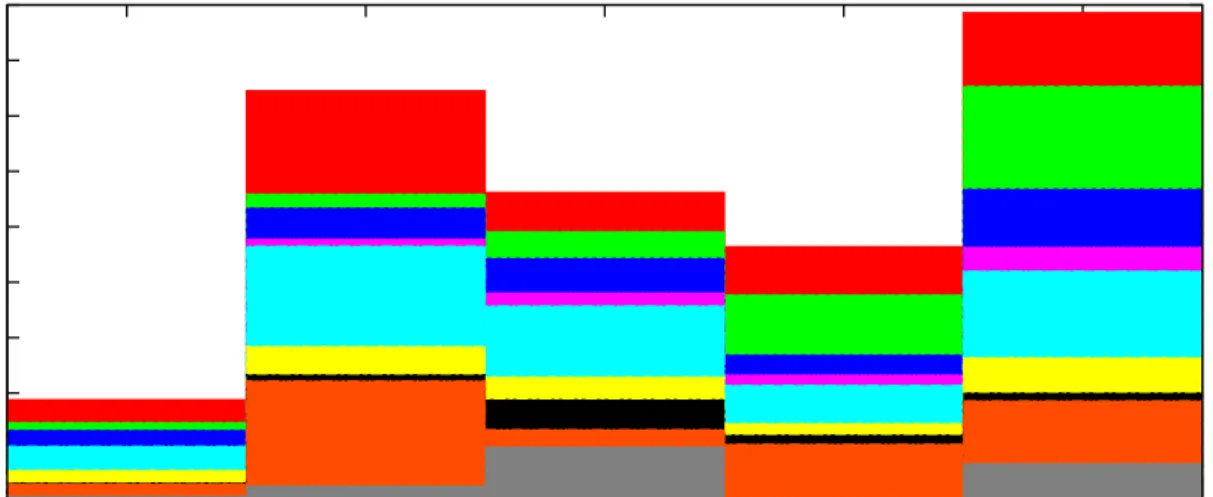
Figure 2.5: Automatic topic analysis applied to MaxDB 7.500. This compact-trend-view shows topics per month for MaxDB 7.500. The x-axis is time in months, the y-axis is used to stack topics occurring at the same time. Trends that are continuous are plotted as continuous blocks. Trends with more than one topic are coloured the same unique colour, while topics that do not recur are coloured grey. The top 10 words in the topics are joined and embedded in box representing the topics. No stop words were removed. [80] See Section 7.1.5.
2.2.5
Social Network Analysis
Social network analysis [158] is the structural analysis of social interactions between people or actors. A social network models the interactions between people and entities as a graph with entities as nodes and their relationships as arcs. These graphs and their interactions between nodes are measured using a wide variety of graph metrics such as centrality, connectedness, whether or not a node bridges two clusters, etc. The mining of social networks from software repositories is a popular field of research, whether it be social networks extracted from emails [13, 16] or other source code related artifacts [159, 15]. Social network analysis allows to study the structure of interaction, thus it can aid in process recovery by elucidating the relationships between developers, which might help us associate developers with project roles.
2.2.6
Data Analysis Summary
In this section we provided an overview of the tools that can be used to recover processes from artifacts left behind by developers. Statistics aides in modelling underlying data so we can describe the data and reason about it. Time-series analysis lets us reason about data that has temporal qualities. Machine learning and sequence mining allows software tools to make decisions and extract new facts based on the past. Natural language processing helps us deal with the large amount of unstructured and semi-structured natural language artifacts (such as messages or bug reports) that developers and users leave behind. Social network analysis lets us see the social interactions between actors and entities, allowing us to discover developer roles. All of these data analysis techniques have been leveraged in the field of mining software repositories and thus are quite relevant to process recovery.
2.3
Mining Software Repositories
Software process recovery relies on software related artifacts left behind by developers. These artifacts often appear in software repositories. Mining software repositories [88, 92] refers to the investigation and mining of data within software repositories such as source control, mailing lists, bug trackers, wikis, etc. Kagdi et al. [88] provide a survey and taxonomy of approaches and studies that exist within the mining software repositories (MSR) community [60]. Work in this area seeks to answer questions such as: which changes induce bugs or fixes [143], what information do software repositories tell us, how could new repositories be more useful, and what are the underlying properties of software, software evolution, and changes to software. Software process recovery is a sub-field of
MSR because it relies on the repositories and the mining techniques that MSR literature employs in order to reason about underlying processes.
Much of the software and the software repositories that are mined in MSR literature is Free/Libre Open Source Software (FLOSS), this is due to the availability of FLOSS. Since FLOSS development artifacts are typically freely available, we can have repeatable studies on the same corpus, thus allowing researchers to validate their results against the results of others, and to compare different approaches easily. Some researchers have studied and measured the general characteristics of Open Source Projects [23]. Mockus et al. [121] described the underlying methodology of FLOSS projects such as Apache and Mozilla. Much of the information they used was gleaned by mining the source control repositories of these projects. Thus much MSR research is executed on FLOSS.
2.3.1
Fact extraction
When one approaches a software repository often one has to reason about the data inside of it. An important first step is to extract this data from the repository. This step is called fact extraction. Many researchers have covered various details of how to extract facts from a SCS and store them into a database to be queried later [105, 49, 46, 41, 160, 61, 162]. Some issues that fact extracting handles: data cleansing, tracking identities, grouping revisions into commits, resolving symbols, etc. Fact extraction allows us to export a fact-base from a repository so we can reason about it in other contexts. Fact extraction is necessary for process recovery because one needs to build up a fact-base in order to reason about underlying processes.
2.3.2
Prediction
We can use these extracted facts to help predict the future. Some developers and managers seek to predict what will happen next. Much work has been done on prediction by Girba et al. [50], where they attempt to predict effort much like how weather is predicted, based on past information. Others such as Hassan [62] attempt to model change propagation in software systems via measures such as co-change. Herraiz et al. [65] attempted to correlated various metrics with lines of code (LOC) and growth. These metrics provided a power-law-like distribution which could be could used to predict metric values. One potential use of MSR research is to use past data to predict the future in order to aid project planning. Much work has gone into bug prediction, whether predicting buggy changes [94], buggy files, or bug-prone functions, there are entire conferences essentially dedicated to bug pre-diction [139]. Much research in these conferences utilizes MSR related data to reason about the locations of future bugs. Many of these predictions rely on software metrics.
![Figure 2.1: Unified Process diagram: this is often used to explain the division of labour within the Unified Process [86]](https://thumb-us.123doks.com/thumbv2/123dok_us/1715061.2739525/30.918.111.807.183.408/figure-unified-process-diagram-explain-division-unified-process.webp)
![Figure 2.4: A manual example of topic analysis applied to MySQL 3.23 revisions. [80]](https://thumb-us.123doks.com/thumbv2/123dok_us/1715061.2739525/38.918.145.793.164.384/figure-manual-example-topic-analysis-applied-mysql-revisions.webp)