J
ust a few years ago, purchasing a new car was often a lopsided affair. A buyer might know what kind of car he wanted to buy and how much he could afford, but the sellers held all the cards because they controlled the situation with infor-mation. They knew cost details – sticker price, invoice, incentives, kickback num-bers – all of which provided them tremendous advantage in the transaction. They had information on how specific features were priced and which ones gen-erated the most profit. A buyer might ask for power seats and windows, a CD play-er, antilock brakes, and passenger side air bags, and the salesperson might give a price of $5,000. How was the buyer to know whether or not that price was too high or if it was a great deal? And what if the seller offered to throw in the spe-cial undercoating and super-absorbent floor mats – which the buyer does not need – for free? It was very difficult for a buyer to understand if he was getting the features for which he asked and needed at a fair price. He might be able to shop around, but in the end, not having good information as a point of reference, it was difficult to assess if the transaction was fair.These days, however, information is more readily available for car buyers. Car pricing internet sites have become valu-able sources of information for con-sumers. Car buyers can now prepare more effectively for the acquisition process by arming themselves with independent, comparative cost information before the assessment and negotiation activities begin. Overall, consumers are much more
likely to be able to buy the car of their choice – with the features wanted and needed – at a fair price.
In many ways, acquiring software or software development services compares to the old way of buying cars. Access to information is rarely equal, and it typically does not favor the buyer. Once an RFP for software development is released, a program office can become completely dependent upon vendors’ estimates of cost and schedule. Or, a program might have a limited budget or schedule but not a clear understanding of what amount of development is actually feasible within these limitations. When assessing propos-als from vendors, programs are faced with several of the following questions: • Have we been offered a reasonable
price?
• Has this project been deliberately underbid?
• Is the proposed schedule realistic? • How do we know we are getting the
functionality we have asked for and need?
With these kinds of uncertainties, how can a program make informed decisions when purchasing software or software development services? A program must take control of the situation to more effectively assess whether submitted pro-posals are realistic while having a clear understanding of what functionality should be included in the delivery.
The purpose of this article is to pro-vide an approach that can help buyers of software objectively evaluate software development proposals, select the best value for their needs, and effectively
man-age acquisition costs from kickoff to product delivery. The foundation of this methodology is the ability to objectively size the developed software and to under-stand the potential ranges of cost and schedule that could result.
This article proposes a particular methodology to estimating software development cost and schedule in the con-text of independent evaluation of vendor propos-als. It is not the only valid software esti-mation methodology available to organi-zations, but experience has shown that this specific methodology is very well-suit-ed for this particular situation, for reasons that are discussed later.
Methodology
The following five-step approach (Figure 1) is designed to be as objective as possible: • Step 1: Define Functional
Require-ments.
• Step 2:Conduct Function Point Analysis (FPA).
• Step 3: Assess Key Project Para-meters.
• Step 4: Develop and Refine Esti-mation Model.
• Step 5:Evaluate Proposals in Context of Estimates.
Generating cost and schedule esti-mates without intimate knowledge of a development organization’s historical per-formance can be extremely challenging. This methodology combines standardized software measurement techniques with structured, well-documented estimation tools to enable true independent estima-tion. The goal is not to produce the right answers in terms of cost and schedule, but
Controlling Software Acquisition Costs With
Function Points and Estimation Tools
Too often, organizations that contract for software development services are at the mercy of vendors for cost and schedule esti-mates. Once a program office releases a request for proposal (RFP) for software development, it must somehow evaluate the validity of cost and schedule estimates that come back with the proposals. Or, a program might have a limited budget or sched-ule but not a clear understanding of what amount of development is actually feasible within these limitations. This article proposes an approach that can help buyers of software take control of this situation by providing the ability to objectively evaluate software development proposals, select the best value for their needs, and effectively manage acquisition costs from kick-off to product delivery.
Ian Brown Booz Allen Hamilton
Conduct Function Point Analysis Assess Key Project Parameters Develop and Refine Estimation Model Evaluate Proposals in Context of Estimates Define Functional Requirements
Step 1 Step 2 Step 3 Step 4 Step 5
Assess Key Project Parameters Evaluate Proposals in Context of Estimates Develop and Refine Estimation Model Define Functional Requirements Conduct Function Point Analysis
rather to understand what a reasonable range of answers might be and how ven-dor responses to a RFP (typically submit-ted as point estimates) fit within that range. Additionally, this methodology can help a program understand the relative cost and schedule risk it accepts by select-ing one proposal over another.
Step 1 – Define Functional Requirements
Although this article focuses on software estimation for acquisition, requirements definition must be included as a critical step. Functional software requirements have to be defined, documented, and baselined. This is an essential foundation of the acquisition process. Requirements fidelity is key to ensuring that vendors understand what must be delivered.
Requirements documentation should be provided to all potential bidders along with time for review and clarification. Requirements definition should happen before anything else. The importance of this step cannot be over-emphasized, as requirements are an integral part of near-ly every aspect of delivery of the project, and they are necessary to conduct an ini-tial FPA.
Step 2 – Conduct FPA
In order to estimate the cost and schedule of a development effort, one has to know the size of the intended software. Software size, too frequently overlooked in estimation exercises, is often expressed in source lines of code (SLOC). Many organizations have success with this size measure as a basis of estimate, but this
measure has some inherent difficulties associated with it, especially in the context of the methodology proposed here [1]. Different organizations count SLOC dif-ferently – there are no industry-defined standards that identify what should be counted and what should not. This makes an accurate, independent assessment of SLOC size difficult to produce. So, although it is a valid measure of software size, SLOC does not lend itself to the nature of this particular type of estimate and independent analysis.
Function points, on the other hand, are a standardized unit of measure as rec-ognized by the International Organization for Standardization 20926:2003. The func-tion point standard is maintained by the International Function Point Users Group (IFPUG) in a voluminous counting prac-tices manual; IFPUG offers a certification program that recognizes experts in the field as certified function point specialists. Function points measure software size independently of technology, platform, or programming language. In short, function points objectively define the size of an application that is to be developed based on defined functional requirements. They can also help identify gaps in requirements analysis, avoiding early introduction of defects [2].
To take this a step further, if an FPA is conducted prior to releasing the RFP, the results can be provided to all interested vendors to provide a common assumption of size so that all bidders can work from consistent information in developing their responses.
Step 3 – Assess Key Project Parameters
Key project parameters define character-istics of important cost and schedule dri-vers for the development effort. These parameters include high-level assump-tions, such as the platform, programming languages, application type, reuse, devel-opment standards, commercial off-the-shelf (COTS) use, and staffing approach. If known, more precise parameter values for specific product and performance attributes can be identified in order to tai-lor the estimate to more specific project characteristics, such as development envi-ronment, personnel skills, organizational process maturity, security requirements, and system volatility. These inputs should be expressed as ranges (low, middle, high) to account for uncertainty and potential variation among bidding organizations. The less that is known about these more specific factors, the wider the range of assumptions should be.
0 10 20 30 40 50 60 70 80 90 99% 90% 80% 70% 60% 50% 40% 30% 20% 10% 1%
Cost Range
C o s t ( $ M il li o n s ) Certainty Level 0 10 20 30 40 50 60 99% 90% 80% 70% 60% 50% 40% 30% 20% 10% 1%Schedule Range
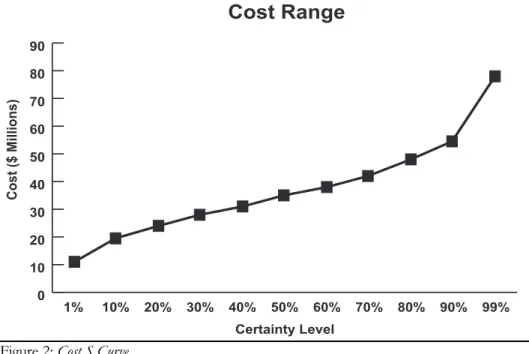
D u r a t io n ( M o n t h s ) Certainty LevelFigure 2:Cost S Curve
Conduct Function Point Analysis Assess Key Project Parameters Develop and Refine Estimation Model Evaluate Proposals in Context of Estimates Define Functional Requirements 0 10 20 30 40 50 60 70 80 90 99% 90% 80% 70% 60% 50% 40% 30% 20% 10% 1%
Cost Range
C o s t ( $ M il li o n s ) Certainty Level 0 10 20 30 40 50 60 99% 90% 80% 70% 60% 50% 40% 30% 20% 10% 1%Schedule Range
D u r a t io n ( M o n t h s ) Certainty LevelStep 1 Step 2 Step 3 Step 4 Step 5
Assess Key Project Parameters Evaluate Proposals in Context of Estimates Develop and Refine Estimation Model Define Functional Requirements Conduct Function Point Analysis
Step 4 – Develop and Refine Estimation Model
The outputs of steps 1 through 3 are rela-tively meaningless on their own. Only when they are combined as inputs to an estimation tool do they produce relevant, useful information. In this type of estima-tion exercise, leveraging a parametric tool to generate cost and schedule estimates is particularly important. Other estimation methodologies (analogy, wideband Delphi, cost estimating relationships, etc.) do not provide the flexibility needed to establish this proposal assessment framework. An estimation tool provides the flexibility to apply generalized assumptions where nec-essary and specific assumptions where appropriate. A trained, experienced user should be involved to make sure that the tool is used properly and the results are interpreted correctly. This methodology does not lend itself strictly to COTS acqui-sition, as most estimation tools are best suited for estimating effort on projects with custom development.
The model should be constructed with a work breakdown structure (WBS) that reflects the components of the software. For example, if the application will have a user interface with an Oracle back-end, then these two components should be modeled as separate WBS elements in the parametric tool. The WBS should also reflect any expected modular or incremen-tal development strategies that might be proposed. Function points should then be allocated to the appropriate WBS elements or increments as accurately as possible.
Step 3 identified ranges of key project parameters. Applying these inputs to the estimation model will generate cost and schedule ranges with corresponding prob-abilities. Estimates in this form can be expressed as S graphs and are the linchpin of this evaluation structure. Using ranges in this way, as illustrated in Figures 2 and 3, provide the context and framework for evaluation of different bids from different vendors.
The estimates produced by the tool, however, should not just be accepted without consideration. Analysts should apply cross-checks, known analogies, or expert opinions to test the outputs for rea-sonability. The estimates should also be compared to the expected or known bud-get or schedule for the project. Ideally, those numbers will fall somewhere within the estimated ranges, preferably in the higher certainty levels. However, if the budget or schedule falls outside of the rel-evant range, the program office should review the model and key project parame-ters. Oftentimes this exercise can highlight
some assumptions that might be incorrect. For example, the initial model may have assumed the project would be staffed to minimize the development schedule. This staffing approach generally increases effort and cost (as well as the associated risk), so if the estimated range is too high for the known project budget, perhaps the project should be modeled to optimize the effort (resulting in fewer staff, lower cost, and longer schedule).
If this reviewstillresults in an estimat-ed range that does not include the neces-sary budget or schedule, then the project scope must be evaluated. Too often, a pro-gram office will set a project up for failure by demanding that the full set of software requirements be developed within a bud-get or period of performance that is
sim-ply unrealistic and unattainable. This methodology can help to avoid these situ-ations by raising a red flag early in the process. Requirements should be evaluat-ed and prioritizevaluat-ed, and then the overall scope of the proposal should be reduced or phased in such a way to more likely fit the required budget and schedule. The powerful combination of function points (linked directly to requirements) and a parametric estimation tool make these what if scenarios possible.
Step 5 – Evaluate Proposals in Context of Estimates
This is the payoffstep. Steps 1 through 4 prepare a program office for proposal evaluation. The cost and schedule esti-mates represented by the S curve charts
0 10 20 30 40 50 60 70 80 90 99% 90% 80% 70% 60% 50% 40% 30% 20% 10% 1%
Cost Range
C o s t ( $ M il li o n s ) Certainty Level Proposal C Proposal B Proposal A 0 10 20 30 40 50 60 99% 90% 80% 70% 60% 50% 40% 30% 20% 10% 1%Schedule Range
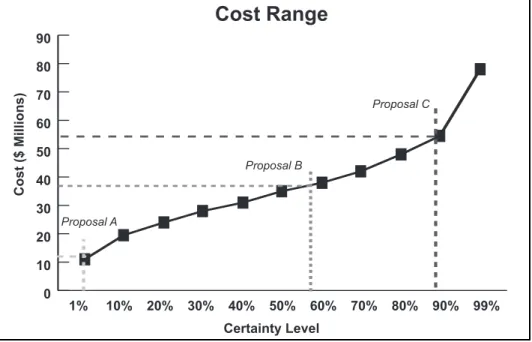
D u r a t io n ( M o n t h s ) Certainty Level Proposal C Proposal B Proposal A Figure 4:Cost Evaluation Framework0 10 20 30 40 50 60 70 80 90 99% 90% 80% 70% 60% 50% 40% 30% 20% 10% 1%
Cost Range
C o s t ( $ M il li o n s ) Certainty Level Proposal C Proposal B Proposal A 0 10 20 30 40 50 60 99% 90% 80% 70% 60% 50% 40% 30% 20% 10% 1%Schedule Range
D u r a t io n ( M o n t h s ) Certainty Level Proposal C Proposal B Proposal Aprovide the framework against which actu-al proposactu-als can be compared. When ven-dor responses are received, the cost and schedule proposed by each vendor can be mapped to a point on the independent cost and schedule curves (see Figures 4 and 5, page 11). Comparing certainty levels across the estimate continuum provides a more informed understanding of the rela-tive value or risk of any given proposal.
Any given certainty level is interpreted as the likelihood that the project can be completed at or below that cost or sched-ule. The higher the certainty level, the more likely the project can be completed within that estimated cost and schedule. This comparative analysis can provide a
tremendous amount of information to a program office. It can help identify price to winproposals that are overly optimistic as well as more conservative proposals that might be overpriced. This framework allows the program to control the amount of cost and schedule risk it accepts when awarding the work by providing a context to the winning bid that is based on robust quantitative analysis.
Other Critical Considerations
When evaluating the submitted proposals within this framework, there are several items that absolutely must be kept in mind. These critical considerations can signifi-cantly impact the value of the analysis andthe quality of the information that results. • Width of Cost and Schedule Rang-es. These should increase with more uncertainty in an acquisition. How much is reallyknown about the project should be carefully evaluated at any given point.
• Contract Type. The nature of the contract type may influence the pro-posals received in response to the RFP. Time and materials or cost plus award fee contracts are more likely to be priced aggressively (lower certainty levels) than fixed price proposals. • Cost Versus Effort. Parametric tools
actually calculate effort and then mul-tiply effort by labor rates to arrive at cost estimates. Evaluating proposals based on effort estimates normalizes for differences in labor rates and high-lights which vendor is actually propos-ing the most efficient solution. Note, however, that highly skilled and experi-enced vendors will likely have higher hourly rates.
• COTS Usage/Software Reuse.Some proposals may have assumed more software reuse or COTS applications than others. In this situation, the pro-gram office may want to run multiple scenarios with varying levels of COTS components or other software reuse assumptions. This produces multiple evaluation frameworks but allows for more appropriate apples-to-apples comparisons.
Post-Contract Award
The main purpose of this methodology is to enable more informed decisions when evaluating and awarding the initial devel-opment contract. The benefits, however, do not have to end there. The same esti-mation methodology can be applied in an iterative fashion throughout the entire contract life cycle to manage the project with quantitative data. The baseline FPA can serve as the basis of the initial con-tract, establishing threshold delivery rates or other relevant performance metrics. The contract could also implement a pro-gressive fee structure for functionality added or changed in later development phases.
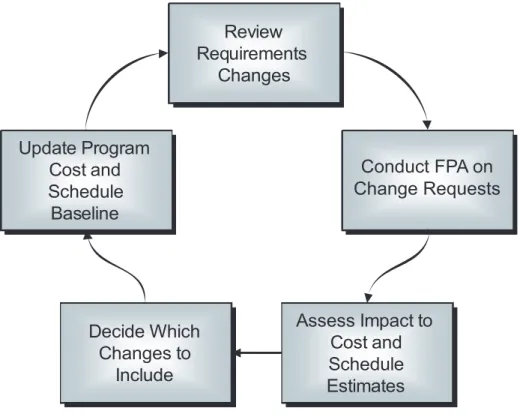
As part of a change control process, recurring FPA, coupled with updates to the estimation model, can evaluate the potential impact of proposed changes to functional or technical requirements on the project cost and schedule. The estima-tion process at this point should become cyclical in nature, reviewing change request, and revising size, cost, and sched-ule estimates based on the methodology
Review
Requirements
Changes
Assess Impact to
Cost and
Schedule
Estimates
Decide Which
Changes to
Include
Update Program
Cost and
Schedule
Baseline
$0 $20 $40 $60 $80 $100 $120 $140 $160 $180 99% 90% 80% 70% 60% 50% 40% 30% 20% 10% 1% Certainty Level Vendor B: $4.7 M 26% Certainty Vendor A: $6.6 M 58% Certainty C o s t ( M il li o n s )Conduct FPA on
Change Requests
Figure 6:Iterative Cost Estimation Process
Review
Requirements
Changes
Assess Impactto
Cost and
Schedule
Estimates
Decide Which
Changes to
Include
Update Program
Cost and
Schedule
Baseline
$0 $20 $40 $60 $80 $100 $120 $140 $160 $180 99% 90% 80% 70% 60% 50% 40% 30% 20% 10% 1% Certainty Level Vendor B: $4.7 M 26% Certainty Vendor A: $6.6 M 58% Certainty C o s t ( M il li o n s )Conduct FPA on
Change Requests
(see Figure 6).Go/no go decisions regard-ing these changes can be based on quanti-tative analysis instead of guesswork. This approach is one way to help keep require-ments volatility and scope creepunder con-trol. Finally, function points and a robust estimation model can provide the data essential to earned value management by establishing well-documented baseline cost and schedule plans, providing the ability to update these plans when require-ments change, and effectively assessing percent complete or the value that has been delivered at any point in time.
Example
A client organization desired to merge multiple financial management systems with overlapping functionality into a sin-gle, consolidated system. The business owners developed a master set of require-ments that any solution would have to meet, then released an RFP for open bids. Two vendors responded, both of whom assumed they would be able to leverage some amount of functionality from exist-ing proprietary systems. Vendor A bid a significantly higher price than Vendor B, but the contracting organization was unsure which would provide the best value and was wary of the risk of focusing on the low bid.
Consultants completed an FPA of the master requirements to establish the base-line size, then conducted an independent gap analysis of each vendor’s existing sys-tems. Then, following the methodology set forth in this article, the consultants set up the RFP analysis framework that enabled the client to put each bid into context.
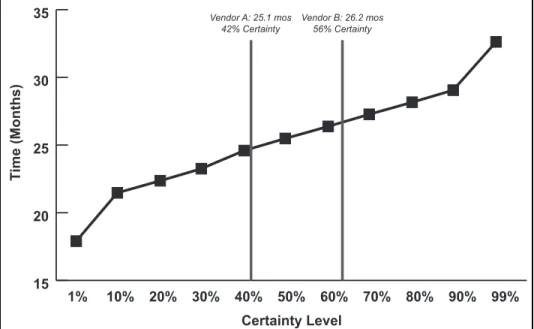
As the client suspected, Vendor B did offer a rather aggressive price bid, driven lower by an assumption that significant legacy reuse would be possible (see Figures 7 and 8). The probability of deliv-ery for the bid amount was lower than desired (~26 percent certainty). Vendor B’s schedule estimate was actually more conservative, but the client identified the lower cost estimate and the high reuse assumption as a potential risk for the pro-ject. Vendor A provided an estimate that fit into the evaluation framework at a more conservative level (~58 percent). Vendor A’s schedule estimate was more aggressive than Vendor B’s, but it was still within a reasonable range in the framework. Cost risk was more critical to the client organi-zation than schedule risk. This approach allowed the client to make an informed decision to award the contract to Vendor A based on quantitative analysis. The client could justify the higher price bid while understanding where critical risk
areas were in the acquisition strategy.
Summary
The more information a program office has during the software acquisition process, the better the chances are for having the answers to the questions that the beginning of this article laid out. The reasonableness of the proposed price will be known, thanks to the context provided by the independent estimate. Proposals that are intentionally low-bid in order to win the contract can be identified and fil-tered prior to award. Conducting an FPA will help ensure completeness of require-ments to improve the probability of deliv-ery of full functionality. The methodology also allows a program office to conduct a self-examination to make sure that the planned budget and duration are reason-able and do not doom the project for cost and schedule overruns before it even starts. This methodology enables the con-tracting program office to more effective-ly control the balance of information and, in turn, produce acquisition results that benefit all stakeholders – program office, user community, and vendor alike.◆
References
1. Schofield, Joe. “The Statistically Un-reliable Nature of Lines of Code.”
CrossTalk Apr. 2005 <www.stsc. hill.af.mil/crosstalk/2005/04.html>. 2. Dekkers, Carol, and Mauricio Aguiar.
“Applying Function Point Analysis to Requirements Completeness.” Cross-Talk Feb. 2001 <www.stsc.hill.af.mil/ crosstalk/2001/02.html>.
Additional Reading
1. Boehm, Barry W., Ellis Horowitz, Ray
Madachy, and Donald Reifer. Software Cost Estimation With COCOMO II. Prentice Hall, 2000.
2. Galorath, Daniel D., and Michael W. Evans. Software Sizing, Estimation, and Risk Management. Auerbach, 2006. 3. IFPUG. IT Measurement: Practical Advice from the Experts. Addison-Wesley Professional, 2002.
4. Jones, Capers. Estimating Software Costs. McGraw-Hill, 1998.
5. McConnell, Steve. Software Estima-tion: Demystifying the Black Art. Microsoft Press, 2006. 15 20 25 30 35 99% 90% 80% 70% 60% 50% 40% 30% 20% 10% 1% Certainty Level Vendor A: 25.1 mos 42% Certainty Vendor B: 26.2 mos 56% Certainty T im e ( M o n t h s )
Figure 8:Financial Management System Consolidation Schedule Framework
About the Author
Ian Brown is a senior associate with Booz Allen Hamilton. With 10 years of experience in software measurement and analysis, he leads the firm’s Quantitative Software Analysis capability. Brown is a member of the board of directors of the IFPUG, has spoken at several international software conferences, and is a Certified Function Point Specialist. Brown earned a bache-lor’s degree from Cornell University and a master’s degree in public policy from Harvard University.
Booz Allen Hamilton 8283 Greensboro DR Booz 2036 McLean,VA 22102 Phone: (703) 902-4971 Fax: (703) 902-3634 E-mail: [email protected]