The Effect of Parents’ Education on the Union Formation Process of Young Adults
Casey E. Copen, MPH Doctoral Candidate Department of Sociology University of Southern California
Paper prepared for Population Association of America New Orleans, LA
Introduction
Fifty years ago, the decision to marry a romantic partner was often proscribed by one’s family of origin. Many young adults chose to marry a person who matched their parents’ preferences for a suitable life partner. Parents’ education and income were status markers by which these union formation decisions were made. Mate selection also followed religious and cultural norms as well (Kalmijn, 1994). A half-century later, the ascriptive processes that defined the search for a spouse has widely dissipated. Today, marriage is increasingly seen as a personal decision, rather than influenced by normative family pressures (Cherlin, 2004). In particular, the rise in cohabitation has altered the timing and sequence of young adult life transitions. Many young adults are choosing to cohabit with one or several romantic partners (Casper & Bianchi, 2002). Experiences in school and the labor force are tightly coupled with these union formation decisions (Guzzo, 2006). Young adults may delay marriage and childbearing until finishing school and obtaining a career. Others balance work and family responsibilities which requires juggling multiple life roles (Sayer, Cohen & Casper, 2004). Rather than follow an age-graded normative path, the life course today is increasingly guided by individual choices and preferences (Lesthaeghe, 1983). The current study examines the effects of ascribed family background--namely parents’ education--on union formation relative to young adults’ school experiences.
Although young adults have more autonomy as to the timing and type of
relationships they enter, union formation decisions are anchored within a family context. Studies on family formation have often used intergenerational models to explain patterns of marriage, cohabitation and childbearing (Axinn & Thornton, 1993; Barber, 2000; Cherlin, Kiernan & Chase-Landale, 1995; Teachman, 2003; Wolfinger, 2003). Status inheritance is one avenue of intergenerational transmission. Parents’ economic resources situate children within a particular social location that largely determines their future economic success (Sewell & Shah, 1968). Similarly, children may delay leaving home and starting a family when adequate economic resources are available at home (Axinn & Thornton, 1992; Wu, 1996). Socialization is another route by which parents influence their children’s family formation attitudes and behaviors. From an early age, young
adults receive important messages from their parents and other adults about the appropriate ages to get married and have children (Axinn & Thornton, 1992; Barber, 2000). Attitudinal congruence between parents and children is also important for educational attainment, a life course transition tightly linked to union formation.
Children’s educational attainments are closely related to the expectations of their parents (Sewell & Hauser, 1980). Parental involvement in their child’s schooling, such as assistance with homework and interaction with teachers has shown to increase children’s educational success (Astone & McLanahan, 1991; Lareau, 2003). Parents’ educational aspirations also influence the timing of their children’s unions. In particular, mothers’ aspirations for their offspring’s educational attainments delays marriage and cohabitation, an effect that is independent of young adults’ own educational expectations (Axinn & Thornton, 1992; Thornton, Axinn & Xie, 2007). Despite rapid changes in the occupational structure of American society, parents still have a significant influence on the economic standing of their offspring through their children’s educational attainments (Warren, Hauser & Sheridan, 2002). However, the effect of parents’ education on the timing of their children’s marriages has declined over time (South, 2001). Parents have less influence on their offspring’s marital decisions because young adults are less responsive to parental pressures as they age (South, 2001). Similarly, the rise of cohabitation has introduced a new set of attitudes about romantic unions which more liberal minded cohorts of young adults are likely to adopt (Treas, 2002; Ryder, 1965).
Past research has estimated the effects of young adults’ education on marriage and cohabitation without taking into account how the intergenerational transmission of educational attainment between parents and children influences the union formation process (Clarkberg, 1999; Thornton, Axinn & Teachman, 1995; but see Axinn & Thornton, 1992). There are two central contributions of my analyses. First, I measure the effects of parents’ education on their offspring’s first union relative to young adults’ educational experiences. Although this paper focuses on the relationship between parents’ educational attainment and their children’s union formation, I also include mother’s religiosity and parents’ marital transitions as additional measures of family background. By including young adult’s family background and school experiences in the same model, this study
examines how both ascribed and achieved characteristics of young adults
influence the union formation process. Second, I test how the effects of parents’ education and young adults’ school experiences in union formation vary by gender. The effect of parents’ educational attainment on delaying marriage has shown to be stronger for men than women (Axinn & Thornton, 1992). Early age at first marriage among women may curtail their educational attainment, thereby reducing intergenerational transmission of education from parents to their daughters compared to sons (Marini, 1978). However, a growing number of women are marrying at later ages and this effect is due, in part, to the high college graduation rates among women (DiPrete & Buchmann, 2006). This study builds on existing literature by exploring how parents’ education influences young adults’ decision to marry or cohabit with a partner and how these effects vary by gender.
My research draws on the National Survey of Families and Households (NFSH), which contains detailed union histories of parents and children. The paper first outlines previous research on the relationship between parents’ education and young adults’ union formation, then posits several hypotheses about intergenerational influences on young adults’ first union experiences and whether gender differences exist. After the data and measures are explained, hazard ratios from Cox regression models are presented.
Background and Hypotheses The influence of status attainment on union formation
Parents provide economic and social resources for children which have a large impact on their future educational attainments (Sewell & Shah, 1968). Parents’ education is the strongest predictor of children’s educational attainment (Blau & Duncan, 1967). However, parents’ educational aspirations for their children have the largest direct effect on children’s educational outcomes (Sewell & Hauser, 1980; Teachman & Paasch, 1998). Parents’ invest in their children’s school success by helping with homework and providing financial resources for higher education (Astone & McLanahan, 1991). Through parents’ own
expectations for their later achievements, children develop their own attitudes about the importance of academic success.
Highly educated parents are likely to have children who delay marriage for three reasons. First, highly educated parents are likely to invest more in their children’s education, encouraging them to leave home at later ages (Goldscheider & Goldscheider, 1998). Second, young adults with highly educated parents often adopt their parents’ educational expectations (Axinn & Thornton, 1992). Due to high educational aspirations, young adults are more likely to attend college and less likely to marry while in school (Thornton, Axinn & Teachman, 1995). Third, parents’ education leads to greater economic resources, which plays a large role in the development of high aspirations for material goods among children (Axinn & Thornton, 1992). Adolescents with high consumption aspirations report the desire to marry and have children at later ages once an adequate standard of living is reached (Crimmins, Easterlin & Saito, 1991).
Parents’ education also influences the type of union formed among young adults in two ways. Although cohabitation is most frequent among the less educated (Bumpass & Lu, 2000), the increasing numbers of individuals without children who cohabit at some point in their lives suggest the practice is increasing among young adults who are college-educated. In turn, young adults with highly educated parents are likely to cohabit because they choose to delay marriage. In turn, these highly educated young adults may see cohabitation as a step in the marriage process, as well as an alternative to being single (Smock & Gupta, 2002). Second, cohabitors have a distinctly different set of attitudes and beliefs about the division of household labor, as well as other family and non-family related attitudes than the married (Clarkberg, Stolzenberg & Waite, 1995). For example, young adults who choose cohabitation over marriage have more
egalitarian gender role attitudes (Cunningham, Beutel, Barber & Thornton, 2005). These attitudes are developed, in part, from young adults’ educational
experiences, which are closely linked to that of parents.
The father’s occupational status was originally used as a proxy for social background and was considered the best indicator of social mobility (Blau & Duncan, 1967). However, mothers’ education also has a strong influence on the educational attainment of offspring through their educational expectations for children (Thornton, Axinn & Xie, 2007). Both men and women are likely to achieve higher occupational status if their parents also have high education (Featherman & Hauser, 1978). However, the transmission of educational attainment from parents to their offspring varies by young adults’ gender. In particular, status transmission is strongest in same-sex family
relationships. Fathers’ education has the strongest effect on their sons’ occupational status, while mothers’ education has the strongest effect on the occupational status of daughters (Hauser, Warren, Huang & Carter, 2000). In turn, gender congruence is important for the transmission of social status within families.
Similar to status attainment, union formation behaviors are also influenced by gender. Attitudes toward family-related behaviors, such as cohabitation and divorce, are more likely to be shared between mothers and daughters (Axinn & Thornton, 1993; Kapinus, 2004). Similarly, mothers have different preferences for their daughters’ family-formation behaviors, which then influence the rate at which they marry and become parents (Barber, 2000). Young adults’ decisions to cohabit and/or marry a partner are closely linked to status attainment processes within the family. The current study tests how the effect of parents’ education on their offspring’s union formation decisions varies by child’s gender. These findings contribute to other studies which examine the intergenerational transmission of attitudes and family-formation behaviors (Axinn & Thornton, 1992; Barber, 2000; Cunningham & Thornton, 2006).
More specifically, I examine the effects of parents’ college education on union formation of their offspring to determine whether these intergenerational transmission processes vary by gender of both parent and child. It is expected both mother and father’s education will have the same effect on delaying marriage among sons and daughters. One explanation why parents’ education would reduce son and daughter’s odds of marriage at about the same rate is because college degree attainment is an important precursor for marriage among men and increasingly among women (Goldstein & Kinney, 2003; Oppenheimer, 2003;
Sweeney, 2002). Given marriage rates are increasing among highly educated men and women, I suggest the transmission of education between parents and children influences the rate of marriage among daughters and sons at a similar rate. However, it is important to note parents’ marital disruption negatively influences the status attainment process in families and may result in gender differences in educational attainment (Astone & McLanahan, 1991; Biblarz & Raftery, 1999; Cavanagh, Schiller & Rigle-Crumb, 2006). These models take parents’ union transitions into account when measuring the effect of parents’ education on young adults’ first union.
Unlike marriage, I predict the effects of parents’ education on their
offspring’s rate of cohabitation will differ by gender of parent and child. Fathers’ college education will delay their son’s likelihood of cohabitation to a greater degree than daughters. Likewise, mothers’ education will delay their daughter’s likelihood of cohabitation to a greater degree than sons. The effect of parents’ education is likely to be gender-specific is because attitudes about family-formation behaviors, such as cohabitation and childbearing, are most similar among gender congruent family pairs (Axinn & Thornton, 1993; Barber, 2000). The value attributed to the importance of education is also more likely to fall along gender lines (Muller, 1998). I argue parents’ college degree attainment influences the cohabitation rate of offspring differently by gender because
attitudinal transmission within families is strongest among same-sex family pairs.
Hypotheses
Several hypotheses have been posited to explain the relationship between parents’ education and children’s union formation. Hypothesis 1 and 2 examine the relationship between parents’ education on union formation once controlling for child’s educational experiences. Hypothesis 3 and 4 assess how the effects of parents’ education on union formation differ by gender. Hypothesis 5 tests the extent to which mother’s educational expectations for children influence the union formation process and whether this effect differs between daughters and sons.
Hypothesis 1: Parents’ college education has a weaker effect on delaying union formation among young adults who are enrolled in school or complete a college degree.
Hypothesis 2: Parents’ college education has a stronger effect on delaying union formation among young adults who marry as a first union, compared to those who cohabit, once controlling for their educational enrollment and college degree attainment.
Hypothesis 3: Parents’ college education reduces the odds of marriage as a first union. The effect of parents’ education on first marriage rates is similar for sons and daughters, once controlling for their educational enrollment and college degree attainment.
Hypothesis 4: Parents’ college education reduces the odds of cohabitation as a first union. The effect of parents’ education on delaying cohabitation is gender-specific. Fathers’ education has the strongest effect on delaying sons’ cohabitation and mothers’ education has the strongest effect on delaying daughters’
cohabitation, once controlling for young adults’ educational enrollment and college degree attainment.
Hypothesis 5: Mothers’ expectation that their child will attain a college degree reduces the likelihood of union formation among men and women. Daughters who share their mothers’ high educational aspirations are less likely to enter a romantic union compared to sons.
Sample
This study measures the effect of family structure and parental marital transitions on young adults’ union formation using the detailed union histories of the National Survey of Families and Households (NSFH). Data for the first wave of NSFH were collected in 1987 and 1988 and involved interviews with over 13,000 respondents, including a main cross-section and an over-sample of minorities, single-parent families, families with stepchildren, cohabiting couples and recently married persons. In each household, an adult was randomly selected as the primary respondent and the spouse or cohabiting partner was asked to complete a shorter, self-administered questionnaire. The second wave of data (NSFH2) was fielded between 1992 and 1994. Recently, data collection was completed on a third wave of data (2001-2002) and extensive interviews were conducted of the focal children of the main respondent, ages 18-34. Detailed union history data among Wave 3 respondents make the NSFH a rich source for analyzing union formation.
The sample for this analysis consists of children who were interviewed at both Time 2 and Time 3 (N=1,515). Children who had formed any union before
the Wave 2 interview date were deleted from the sample (N=197). Ten children did not have the date of their first union available, leaving a sample of N=1,308 children, ages 10-24 at Wave 2. Approximately 93 percent of these children are the biological child of the main respondent, 4 percent are stepchildren and 3 percent are adopted, foster children or the child of the respondent’s partner.
Measures Union Formation
At Wave 3, main respondents and their children were asked a series of questions about each union experience, including how the union began
(cohabitation or marriage), how it ended (separated, divorced, widowed, intact) and the date of union entry and exit. Among women, 63 percent had experienced either a cohabiting or marital union during the study period. Fifty-three percent of men experienced either type of union. Approximately 41 percent of young adults (N=537), remained single during the study period. For women, 16 percent had married their partner without ever cohabiting and 47 percent exited single life through cohabitation. A smaller percentage of men married without first cohabiting (12 percent), while 43 percent cohabited with a romantic partner. About 35 percent of men and women whose first union was cohabitation went on to marry that partner. Since the focus of this paper is on the transition into a first
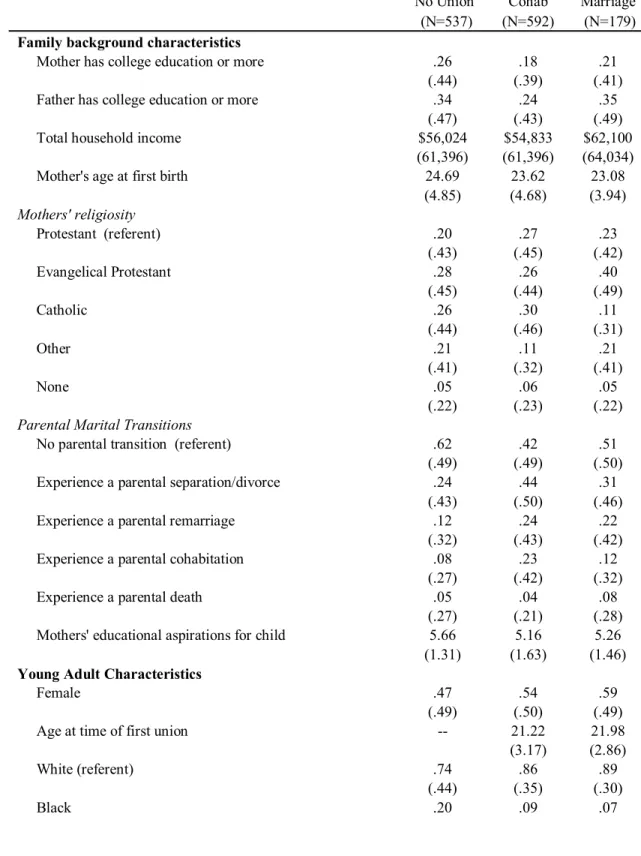
union, those who experienced a marital union or cohabitated during the study period were analyzed separately as competing risks: 1) those that married as a first union (N=179); and 2) those that cohabitated as a first union (N=592). The total union formation rate, or those who formed either a marriage or cohabitation relative to being single is also examined (N=771). Table 1 provides summary statistics for the variables used in these analyses, comparing those who
experienced a union with those who remained single during the study period.
Family transitions
Parents’ union transitions are constructed from the main respondent’s detailed union history reports at Time 3. These transitions include the experience of 1) a parental separation or divorce (N=445); 2) parental remarriage (N=248); 3) parental cohabitation (N=204) and 4) parental death (N=66). Because men and women may experience more
than one family transition during the study period, these categories are not mutually exclusive. These variables are coded so that the marital event occurs during the child’s lifetime and while the child was living at home. At Time 3, the child was asked, “Have you ever lived on your own, away from your parents’ household, for four months or longer?” Children were asked to give dates of home-leaving on four different occasions. Care was taken to ensure the family transition did not occur before the date of the child’s birth or when the child reported leaving the household. A variable that includes family transitions which occurred before the child’s birth and when the child did not live in the household was also included in the analyses, in order to ensure the reference category was children who did not experience any family transitions (N=671).
Parent income and education
Parents’ income is log of total household income at Time 1.
Approximately 21 people were missing on the income variable. Mother and father’s education is a summary measured constructed at Time 1, which is an extraction of the primary respondents’ formal educational attainment from their detailed educational attendance and degree history. Education is a measured in years of formal education completed from 0-20, where education of 16 years or more is considered “At least a college degree”, which is coded into a dichotomous variable. The spouse’s educational attainment is also obtained from Time 1, where available. Thirteen percent of spouses in the study sample did not participate at Time 1. In this case, a question which asks the main respondent about any previous spouse’s education is used. If these two variables are missing, as in nearly 10 percent of cases, the constructed education variable for spouses at Time 2 is used. If these three steps still result in missing values for spouse’s education (5%), a variable asking the main respondent the highest education the spouse had received at the time of the child’s birth is used. At the end of these four steps, n=9 are missing on spouses education, eight of which are male spouses. For these values, the main respondent’s education is imputed for the spouse’s education. For some models, mothers’ and fathers’ college education is combined into one variable, where “1” is coded as one or both parents have a college degree and the reference category is neither parent has a college degree.
Mothers’ religiosity
The religiosity of mothers was derived from the female respondent’s report of their religious affiliation at Time 1, which was divided into four categories.: 1) Evangelical Protestant; 2) Catholic 3) Other and 4) No Religious Affiliation. The “Other” category denotes those who are Mormon (3.7%), Jewish (2.3%), as well as several other religious groups1 These categories were compared to mainline Protestants, who were the reference category. Female spouse’s religiosity is obtained from their religious affiliation at Time 1. Where missing (5%), the religion of the first spouse, if female, is used. At the end of these two steps, n=30 were still missing on spouse’s religion. In this case, the religious affiliation of male respondents is used. Ancillary tests of mothers’ religious affiliation, with and without these imputed values, reveal no significant differences in the regression results.
Mother’s age at first parity
Mother’s age at first parity is measured by a question which asks what year her first birth occurred subtracted from her birth year.
Young adult demographic characteristics
The analysis includes controls for gender (1=female) and two dummy variables for race (Black, Other; White is referent) and a linear variable for age at Time 2. The age at which the young adults first left the household for four months or more, asked at Time 3, was dummy coded to represent those who first left at age 16 or earlier (=1), with those leaving later than age 16 as the reference category.
Young adults’ attainment of a college degree was measured at Time 3 using one item which asks young adults if they have received a bachelor’s degree or higher. Attainment of bachelor’s degree is coded “1” if young adults report attaining a bachelor’s, master’s or doctoral degree and “0” otherwise. Also
measured at Time 3, enrollment in school is measured by a series of questions that
1 Religious affiliation is grouped in accordance with literature on classifying religious traditions that distinguish between mainline and fundamental/evangelical Protestants, as well as other religious traditions (Steensland, Park, Regnerus et al, 2000).
ask the young adult if they have ever been enrolled in a 1) vocational/technical school, 2) a junior/community college, 3) a four-year college or university, 4) a professional/graduate school, and/or 5) a business college/nursing school and the year of entry and exit from each spell of schooling. School enrollment is added as a time-varying covariate to the model. Thus each person contributes one record for each year in the study until a union occurs, and receives a “0” or “1”
according to whether they were enrolled in school either full or part time, in any year during the study period. The person is censored on school enrollment once a union occurs. The variable for enrollment was lagged by one year in order to assess the effects of school enrollment before a union occurs.
Mother/child educational aspirations
Mothers’ aspirations for child’s education and child’s education
aspirations were both measured at Time 2. Given the high correlation of mother and fathers’ educational aspirations for children (.76), mother’s aspirations were selected as a composite measure of parents’ educational aspirations for children. Mothers were asked the educational aspirations for children between the ages of five to seventeen. Likewise, children ages ten to seventeen were asked their educational aspirations. Since about 35 percent of the sample is older than seventeen, the sample used to measure the effect of parents’ and children’s education aspirations on union formation is reduced to 417 (Table 6). Mothers were asked the question, “How much education do you think (focal child) will eventually get?” Responses range from not finishing high school (=1) to completing a master’s or doctoral degree (=7). Children were asked a similar question, “How much education do you think you will probably get?” with the responses of not finish high school (=1) to complete master’s or doctoral degree (=5). Mother and child’s educational aspirations are highly skewed toward higher education. These variables are dummy coded where “1” is expect to graduate from college/four-year university or higher, and “0” is expect to complete less than a college degree.
Plan of Analysis
The analysis models the effects of parents’ education and other
explanatory variables on the transition into first marriage or cohabitation using a Cox competing risks model (Cox, 1972). The unit of analysis is the occurrence of the first union, measured from the beginning of the observation period at Time 2 (1992-1994) to the Time 3 interview (2001-2002). In the model, the hazard or rate of entering a union, hij(t), is defined as the conditional probability that the probability of event occurrence occurs between t and t+∆t and the event is of type
j, given the person has not experienced the event by time t : hij(t) = lim Pr{t < Tj<t + ∆t, Ji=j|Ti >t } , j=1…5.
In the case of type-specific hazards, the occurrence of one type of event removes the individual from risk of other event types (Allison, 1995). In other words, men and women whose first co-residential union is a marriage are
censored from the analysis at time of marriage. Likewise, those who cohabit as a first union are censored from the analysis at time of the cohabitation. Finally, children who remained single during the study period are right-censored because they did not experience either type of union during the study period. Due to the addition of a time-varying covariate, school enrollment, each person receives a separate record for each year during the ten-year study period, creating 4,266 person-years of observation for men and 4,214 person-years for women from which the analysis is conducted.
Most competing risks models are based on the assumption that alternative states, or events, are stochastically independent. This assumption for studying cohabitation and marriage is a tenuous one since individuals who are more likely to form a union may be more similar to one another than those who remain single. Methods to control for shared unobserved risk factors between the two groups have been conducted using multinomial logistic regression (Hill, Axinn & Thornton, 1993) and those who have employed these techniques have found that it does not significantly change their results (Barber & Axinn, 1998). In one study, however, accounting for unmeasured heterogeneity diminishes the effect of
cohabitation on non-marital fertility, suggesting non-marital fertility is markedly similar to childbearing within marriage (Musick, 2006). For these analyses, I will assume conditional independence between cohabitation and marriage, which falls in line with the view that cohabitation and marriage are family building behaviors, not necessarily independent events (Brein, Lillard & Waite, 1999; Hachen, 1988).
Model Specification
Before a proportional hazard model can be estimated, a test for proportionality is performed since the model assumes a constant hazard ratio over time. Interactions of all covariates with analysis time (ln t) were not significant. This indicates the effect of the variables do not change in their effect on union formation over time. Proportionality of hazard rates indicates the effect of parents’ education on young adults’ union formation does not change over time. Figure 1 displays Kaplan-Meier survival curves for the probability of cohabitating among young adults where at least one parent has a college degree and young adults where neither parent has a college degree. These survival curves are adjusted for all variables displayed in Table 1. This graph indicates young adults who have at least one parent with a college degree are less likely to cohabit, at any age, compared to young adults where neither parent has a college degree. These lines do not intersect, suggesting the effect of parents’ education on young adults’ cohabitation rate is proportional over time. Age is the only variable that changes in its effect on union formation; the hazard of marriage and cohabitation increase for each year of age, by 16 percent and 30 percent, respectively.
--Fig 1 about here--
Results
Table 1 displays the descriptive characteristics of men and women who remain single and those who enter a cohabitation or marital union. Young adults who cohabit as a first union have parents who are less likely to be
college-educated than young adults who remain single or marry. Parents of young cohabitors also earn considerably less than young adults who marry as a first union. These differences indicate young adults who cohabit come from a lower SES background than the first married. Rather than delay marriage, (Axinn & Thornton, 1992; Thornton, Axinn & Xie, 2007), higher parents’ income and
fathers’ education increases the rate of their children’s marriage. In turn, those with less financial resources are likely to cohabit or remain single. Young adults with highly educated mothers are the least likely to form any union during the study period.
--Table 1 about here--
Family transitions also shows important differences between young adults who cohabit versus those who marry as a first union. Almost half of cohabitors experience a parental marital dissolution, compared to one-third of married young adults and one-quarter of those who remain single. Further, cohabiting young adults are almost twice as likely to have parents who also cohabited compared to those who marry, indicating a pattern of socialization and/or modeling of parents’ union formation behaviors. Those who cohabit or marry as a first union are also more likely to experience a parental remarriage than young adults who remain single. This finding corroborates another study which shows an increase in cohabitation among young adults who spend some portion of their lives living with stepparents (Teachman, 2003). Overall, the experience of parents’ union transitions while living in the household, except for parental death, increases the likelihood of union formation among young adults.
Young adults who cohabit as a first union are more likely to leave home at age 16 or younger compared to those who marry. This finding supports another study that shows early residential independence increases the likelihood of
cohabitation unions (Waite, Goldscheider & Witsberger, 1986). Singles are more likely to be ever been enrolled in college, compared to those who marry or
cohabit during the study period. However, the first married are more likely to have obtained at least a college degree than the cohabiting group, suggesting the attainment of a bachelor’s degree increases the rate of marriage.
Last, parents’ and young adults’ educational aspirations show significant differences by union status. Mothers have significantly higher educational aspirations for their children who remain single during the study period and have the lowest educational aspirations for children who cohabit with a partner.
have significantly lower educational aspirations than young adults who marry or remain single. This finding suggests educational aspirations are closely linked to the type of first union selected among young adults.
The coefficients presented in the following tables indicate relative risk (eB). Thus, a coefficient of 1.0 indicates no relationship with the rate of union formation. A coefficient less than 1.0 indicates a slower rate of union formation, and a coefficient greater than 1.0 indicates a faster rate of union formation. The percent change in the rate of union formation associated with a one-unit change in the variable under consideration is equal to (eB-1) X 100. Effect sizes of
coefficients between event types and by gender are tested with the Wald chi-square statistic: (b1-b2)2/[s.e.(b1)]2 + [s.e(b2)]2. The exact partial method is used to control for the number of ties.
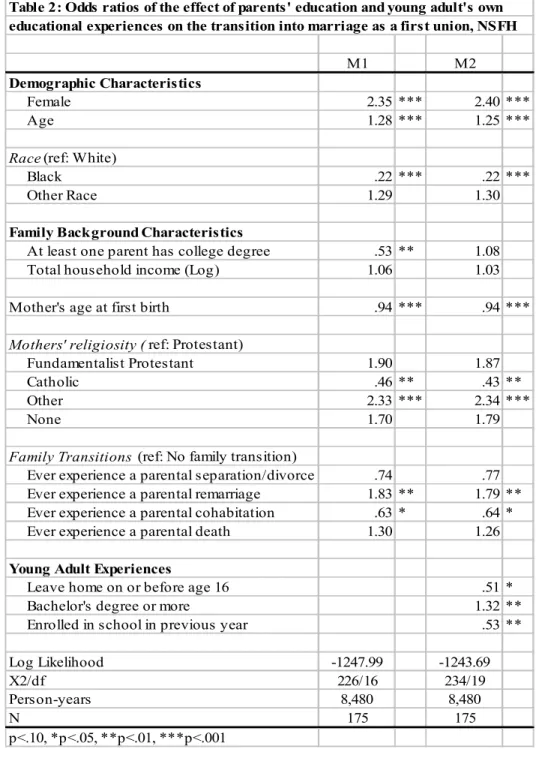
Table 2 shows the effects of family background and young adults’ educational experiences on the rate of marriage as a first union. Looking first at Model 1 shows young adults with college-educated parents have only a 53 percent chance of marrying compared to young adults where neither parent has a college education. Put another way, young adults who do not have college-educated parents are almost two times as likely to marry as a first union compared to young adults where at least one parent has a college degree. This finding suggests parents’ college education delays marriage among young adults. However, the effect of parents’ education on reducing their children’s likelihood of marriage becomes non-significant once adding young adults’ school enrollment and college degree attainment. This finding supports my first hypothesis that the effect of parents’ education on their children’s marriage rate weakens with the addition of young adults’ educational experiences. The observed change in coefficients between models indicates college-educated parents have children who also graduate college and/or pursue some type of higher education. In this case, the transmission of educational attainment reduces the direct effect of parents’ education on their children’s rate of marriage.
Table 3 presents results concerning the rate of nonmarital cohabitation, treating marriage as a competing risk. Young adults with college-educated
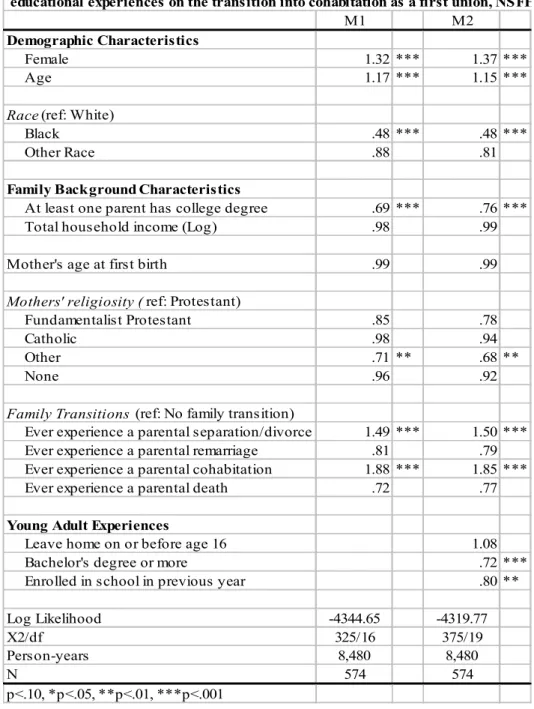
parents are 69 percent as likely to cohabit as those without college-educated parents. Comparing Model 1 in Tables 2 and 3 indicate the effect of parents’ education delays marriage to a larger degree than cohabitation, and this difference is statistically significant between event types. Looking again at Model 2 in Table 3 shows the effect of young adults’ school enrollment and college degree
attainment reduces the effect of parents’ education on the cohabitation rate by 8 percent. However, parents’ education remains significant after controlling for young adults’ school experiences. These findings lend strong support for my second hypothesis that parents’ education reduces young adults’ odds of marriage to a greater degree than the odds of cohabitation. Thus the effect of parents’ education on young adults’ rate of cohabitation is not totally explained by the addition of young adults’ education to the model. In this case, it may be the transmission of education from parents to children is higher among young adults who marry as a first union, compared to those who cohabit.
The attenuation of educational transmission between parents and children who cohabit is one reason why the coefficient for parents’ education is significant after adding young adult’s own school experiences. An alternative explanation is young adults’ schooling is less likely to delay entry into cohabitation compared to marriage. Looking at Model 2, college graduates are less likely to cohabit as a first union. In this case, young adults with college-educated parents have lower odds of cohabiting because they are more likely to marry as a first union. In contrast, school enrollment reduces the odds of cohabitation. However, the effect of school enrollment is smaller among cohabiting than married young adults. Young adults enrolled in school are 80 percent as likely to cohabit as young adults not in school, compared to 53 percent among the first married. The difference between event types is statistically significant. This finding suggests cohabiting young adults are more likely to be enrolled in school than married young adults.
Findings from Table 3 suggest parents’ college education represents a measure of social status in addition to the transmission of educational attainment from parents to children which delays union formation among young adults. Before exploring other parental characteristics which mediate the effect of
parents’ education on children’s union formation, gender differences in the effect of parents’ education on union formation are presented. Table 4 displays these gender differences by looking at the effects of parents’ education with and
without adding young adults’ own educational experiences on whether they marry as a first union. The sample sizes for these models are small, so parents’
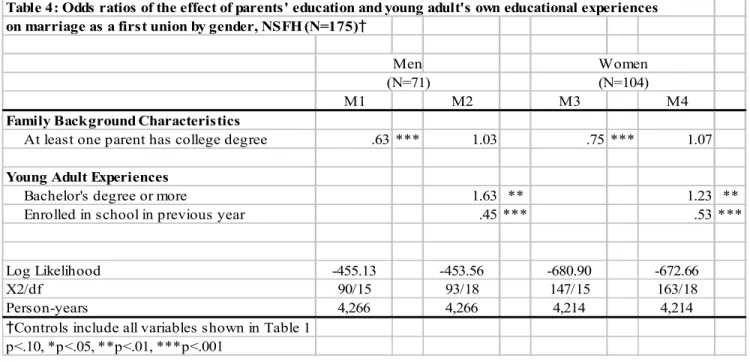
education is not separated by gender. Looking first at Model 1 shows parents’ college education reduces the odds of marriage among men and women. After young adults’ educational experiences are added in Model 2, the effect of parents’ education becomes non-significant. The marked diminution between models suggests strong transmission of educational attainment between parents and children, which reduces their likelihood of marriage as a first romantic union. Significance tests across these models were not conducted due to the small sample sizes. However, educational transmission between parents and children on odds of first marriage does not appear to be gender-specific. That is, mothers and fathers have similar effects on the marriage rates of daughters and sons. The similar process of educational transmission between parents, sons and daughters supports the hypothesis there are no gender differences in parents’ education on the rate of first marriage among young adults.
Table 5 displays separate gender models for the rate of cohabitation as a first union among young adults. Mother and father’s education are included separately in these models. Despite the high correlation of mother and father’s college degree attainment (.46), multicollinearity does not appear to affect the results. Parents’ college education delays cohabitation among men and women. However, the effects of parents’ education on their children’s rate of cohabitation are gender-specific. Fathers’ college education reduces the likelihood of their sons’ cohabitation and has no effect on daughters’ cohabitation rate. Similarly, mothers’ college education reduces the likelihood of daughters’ cohabitation and has no effect on their sons’ cohabitation rate. After adding young adults’
educational experiences, fathers’ education has a stronger effect on reducing their son’s odds of cohabiting relative to mother’s effect on their daughters. In other words, sons whose fathers are college graduates are 44 percent as likely to cohabit
as those whose fathers have less than a college education. Daughters whose mothers are college graduates are 67 percent as likely to cohabit compared to those whose mothers have less than college. These gender differences are
statistically significant and confirm my hypothesis the effect of parents’ education on cohabitation is strongest among same-sex family pairs. Status attainment processes are highly gendered, and the transmission of educational attainment within families results in different rates of cohabitation among young men and women.
These results also confirm there are significant gender differences in the effect of young adults’ college degree attainment and school enrollment on the rate of cohabitation. As shown in Table 4, young adults who have a college degree are more likely to marry as a first union. However, Table 5 indicates men with a college degree are as likely to cohabit as those without a college degree. In contrast, women who are college graduates are more likely to marry than cohabit as a first union. School enrollment shows a similar pattern: men enrolled in school are more likely to cohabit than women who are enrolled. It is not readily apparent why college degree attainment and school enrollment have different effects for men and women. However, one explanation given is men may choose cohabitation over marriage until they find a steady job and attain an adequate standard of living (Clarkberg, 1999). Cohabitation may be an adaptive strategy for the economic uncertainty that often accompanies leaving school and entering the labor force (Oppenheimer, 2003). In turn, men who are in school or obtain a college degree may be more likely to cohabit than women because their earnings are the strongest predictor of entry into marriage (Smock, Manning & Porter, 2005; but see Sweeney, 2002).
Table 6 examines the extent to which the effect of parents’ education on young adults’ total union formation rate is mediated by mothers’ educational expectations for children. Educational aspirations have shown to have a strong direct effect on the education obtained, as well as mediating the effects of parents’ education on children’s educational attainment (Sewell & Hauser, 1980; Sewell & Shah, 1968; Teachman & Paasch, 1998). The purpose of this table is to determine
whether mothers’ educational expectations influence the total union formation rate of their offspring. That is, higher maternal aspirations should delay the occurrence of any union among young adults and this effect should be stronger among daughters than sons. As stated in the methods section, high maternal and child’s aspirations are coded as the expectation to graduate from a four-year college/university or higher, and the low category being less than a college degree. The total union formation rate, or whether the child marries or cohabits during the study period, is examined here because the small sample size (N=417) warrants the inclusion of both event types.
Mothers’ education has a direct effect on delaying union formation among both men and women (Model 1). Interestingly, mothers’ high educational
aspirations for children reduce the odds of forming a union to a greater degree than the child’s own high educational expectations. Ancillary analyses were conducted (not shown) and reveal young adults’ high educational aspirations do not reduce the rate of cohabitation when treating marriage as a competing risk. Said another way, young adults with the expectation to graduate college are as likely to cohabit as young adults who do not expect to graduate college. Model 2 includes an interaction which tests whether the congruence of mother and child’s aspirations reduce the odds of forming a romantic union. This interaction is significant and negative for young women, but not men. Thus mothers’ and daughters who both share the expectation to graduate college will be 27 percent less likely to form a romantic union during the study period. This finding
supports my hypothesis that educational aspirations have a strong, direct effect on the union formation rate of both women and women. As expected, mothers and daughters who share the expectation to graduate college are less likely to marry or cohabit with a partner, compared to sons.
Discussion & Conclusion
The current investigation provides several new insights as to how status attainment within families influences the union formation process. By including parents’ and children’s educational experiences in the same model, my research show parents’ education has a strong effect on delaying union formation among
young adults after controlling for young adults’ educational experiences. Second, these results suggest the effect of parents’ education differs by union type. Results from Table 3 suggest intergenerational transmission of education may be stronger among parents and children who marry compared to those who cohabit. Though more widely accepted, cohabitation remains an incomplete institution because of fewer socially proscribed rules for behavior within such unions (Nock, 1995). Parents and their cohabiting children may be more likely to have sharp attitudinal differences and strained relationships (Eggebeen, 2005). In turn, cohabiting young adults may be less likely to follow in their parents’ footsteps regarding their educational attainment compared to married young adults.
The analyses presented here also add to the understanding of how gender influences the status attainment process within families. As shown in Table 5, fathers who have a college degree are likely to delay their sons’ cohabitation and the process operates similarly for mothers and daughters. In addition to gender congruence, shared educational aspirations between mothers and children is also a strong predictor of union formation. Looking at Table 6, mothers who have high educational aspirations for their daughters and daughters who share these
aspirations are less likely to form a romantic union compared to mothers and daughters with incongruous educational aspirations. These findings suggest the process of status attainment has different implications for family-formation decisions among women and men.
The study has several limitations concerning the sample and the measures used. First, young adults who married without ever cohabiting are a select group (N=175) which prevented more accurate tests of gender differences on the rate of first marriage to be conducted. The analyses on the effects of mother and child’s educational aspirations on union formation also required a considerable truncation of the sample (Table 6). Third, it is important to mention parents’ education may not adequately reflect the transmission of social status from parents to their children. There are several variables, many of which are available in the NSFH, which may have better captured parents’ social status, such as items that measure parental involvement in child’s educational achievement and supervision of
child’s activities. Measures of parents’ economic resources could have also been included, such as parents’ welfare receipt and asset accumulation. This paper is a first pass at understanding the relationship between status attainment and
children’s union formation. Since my findings show parents’ education is a strong predictor of delaying young adults’ union formation, my future research will incorporate more detailed measures of the family’s economic status to further confirm this relationship.
In conclusion, my findings demonstrate the link between young adults’ social origins and their future life course decisions. Though young adults have more autonomy as to the timing and type of romantic unions they enter, their partnering decisions are directed by parents’ economic status and aspirations toward college completion. The transitions in and out of educational institutions are increasingly varied and often stretch long into the life course (Jacobs & King, 2002). Given these changes, the relationship between educational attainment and union formation should be further examined. A second area for future inquiry is to explore why parents’ education delays union formation. As I have shown, high educational aspirations between parents and children are one explanation for the delay in union formation. However, the relationship between material aspirations and union formation is another important area of research where studies on recent cohorts of young adults are sorely needed. The intergenerational transmission of attitudes and behaviors within families is a burgeoning area of family research. This study is a first attempt to uncover how young adults fare in a world of increasingly varied childhood circumstances and complex life choices.
References
Allison, P.D. (1995). Survival analysis using SAS: A practical guide. Cary, N.C.: SAS Institute, Inc.
Astone, N.M. & McLanahan, S.S. (1994). Family structure, residential mobility and school drop out: A research note. Demography. 31(4): 575-84.
Axinn, W.G. & Thornton, A.(1993). Mothers, children and cohabitation: The
intergenerational effects of attitudes and behavior. American Sociological Review. 58(2): 233-46.
Axinn, W.G. & Thornton, A. (1992). The influence of parental resources on the timing of the transition to marriage. Social Science Research. 21: 261-85.
Barber, J.S. (2000). Intergenerational influences on the transition into parenthood: Mothers’ preferences for family and nonfamily behavior. Social Forces. 79(1): 319- 48.
Barber, J.S. & Axinn, W.G. (1998). The impact of parental pressure for grandchildren on young people’s entry into cohabitation and marriage. Population Studies. 52(2): 129- 44.
Biblarz, T.J. & Raftery, A.E. (1999). Family structure, educational attainment and socioeconomic success: Rethinking the “pathology of matriarchy”. American Journal of Sociology. 105(2): 321-65.
Blau, P.M. & Duncan, O.D. (1967). The American Occupational Structure. New York: John Wiley & Sons, Inc.
Brien, M.J., Lillard, L.A. & Waite, L.J. (1999). Interrelated family-building behaviors: Cohabitation, marriage and nonmarital conception. Demography. 36: 535-551.
Bumpass, L.L. & Lu, H.H. (2000). Trends in cohabitation and implications for children’s family contexts in the United States. Population Studies, 54: 29-41.
Casper, L.M. & Bianchi, S.M. (2002). Continuity and change in the American family.
Thousand Oaks, CA: Sage.
Cavanagh, S.E., Schiller, K.S. & Riegle-Crumb, C. (2006). Marital transitions, parenting and schooling: Exploring the link between family structure history and adoelscents’ academic success. Sociology of Education. 79(4): 329-54.
Cherlin, A. (2004). The deinstitutionalization of American marriage. Journal of Marriage and Family. 66: 848-61.
Cherlin, A., Kiernan, K. & Chase-Lansdale, L. (1995). Parental divorce in childhood and demographic outcomes in young adulthood. Demography. 32: 299-318.
Clarkberg, M. (1999). The price of partnering: The role of economic well-being in young adults’ first union experiences. Social Forces. 77: 945-68.
Clarkberg, M., Stolzenberg, R.M. & Waite, L. (1995). Attitudes, values and entrance in cohabitational unions. Social Forces. 74: 609-32.
Cox, D.R. (1972). Regression models and life tables. (with discussion). Journal of the Royal Statistical Society. B34: 187-220.
Crimmins, E.M., Easterlin, R.A. & Saito, Y. (1991). Preference changes among American youth: Family, work and goods aspirations 1976-86. Population and Development Review. 17: 115-33.
Cunningham, M. & Thornton, A. (2006). The influence of parents’ marital quality on adult children’s attitudes toward marriage and its alternatives: Main and moderating effects. Demography. 43(4): 659-72.
Cunningham, M., Beutel, A., Barber, J. and Thornton, A. (2005). Reciprocal relationships between attitudes about gender and social contexts during young adulthood. Social Science Research. 34:862-892.
DiPrete, T.A. & Buchmann, C. Gender-specific trends in the value of education and the emerging gender gap of college completion. Demography. 43(1): 1- 24.
Eggebeen, D.J. (2005). Cohabitation and exchanges of support. Social Forces. 83(3): 1097-1110.
Featherman, D.L. & Hauser, R.M. (1978). Opportunity and Change. New York: Academic Press.
Goldscheider, F. & Goldscheider, C. (1998). The effects of childhood family structure on leaving and returning home. Journal of Marriage and Family. 60:745-56.
Goldstein, J.R. & Kinney, C.T. (2001). Marriage delayed or marriage forgone? New cohort forecasts of first marriage for U.S. women. American
Sociological Review. 66(4): 506-19.
Guzzo, K.B. (2006). The relationship between life course events and union formation. Social Science Research. 35: 384-408.
Hachen, D.S. (1988). The competing risks model: A method for analyzing processes with multiple types of events. Sociological Methods and Research. 17(1): 21-54.
Hauser, R.M., Warren, J.R., Huang, M.H. & Carter, W.Y. (2000). Occupational status, education and social mobility in the meritocracy. (pp. 179-229). In K.Arrow, S.
Bowles, & S. Durlauf (Eds). Meritocracy and inequality. Princeton: Princeton University Press.
Hill, D.H., Axinn, W.G. & Thornton, A. (1993). Competing hazards with shared unmeasured risk factors. Sociological Methodology. 23: 245-77.
Jacobs, J.A. & King, R.B. (2002). Age and college completion: A life history analysis of women aged 15-44. Sociology of Education. 75(3): 211-30.
Kalmijn, M. (1994). Assortative mating by cultural and economic occupational status. American Journal of Sociology. 100(2): 422-52.
Kapinus, C.A. (2004). The effects of parents’ attitudes toward divorce on offspring’s attitudes: Gender and parental divorce as mediating factors. Journal of Family Issues. 25: 112-35.
Lareau, A. (2003). Unequal Childhoods: Class, Race and Family Life. Berkeley: University of California Press.
Lesthaeghe, R. (1983). A century of demographic and cultural change in Western Europe: An exploration of underlying dimensions. Population and Development Review. 9(3): 411-35.
Marini, M.M. (1978). The transition to adulthood: Sex differences in educational attainment and age at marriage. American Sociological Review. 43(4): 483-507.
Muller, C. (1998). Gender differences in parental involvement and adolescents’ mathematics achievement. Sociology of Education. 71(4): 336-56.
Musick, K. (2006). Cohabitation, nonmarital childbearing and the marriage process. Working Paper. California Center for Population Research.
Nock, S.L. (1995). A comparison of marriage and cohabiting relationships. Journal of Family Issues. 15: 53-76.
Oppenheimer, V.K. (2003). Cohabiting and marriage during young men’s career development process. Demography. 40(2): 127-49.
Ryder, N.B. (1965). The cohort as a concept in the study of social change. American Sociological Review. 66(3): 843-61.
Sayer, L., Cohen, P.N. & Casper, L.M. (2004). Women, men and work. In The American People: Census 2000. Published by the Russell Sage Foundation and the Population Reference Bureau.
Sewell, W.H. & Hauser, R.M. (1980). The Wisconsin longitudinal study of social and psychological factors in aspirations and schievements. Research in Sociology of Education and Socialization. 1: 59-99.
Sewell, W.H. & Shah, V.P. (1968). Parents’ education and children’s educational aspirations and achievements. American Sociological Review. 33(2): 191-209.
Smock, P.J., Manning, W.D. & Porter, M. (2005). “Everything’s there except money”: How money shapes decisions to marry among cohabitors. Journal of Marriage and Family. 67: 680-96.
Smock, P.J. & Gupta, S. (2002). Cohabitation in contemporary North America. In A. Booth & A. Crouter (Eds.) Just Living Together: Implications for Children, Families and Public Policy (pp. 53-84). Lawrence-Erlbaum.
South, S.J. (2001). The variables effects of family background on the timing of first marriage: United States, 1969-1993. Social Science Research 30, 606-626.
Steensland, B., Park, J.Z. Regnerus, M.D., Robinson, L.D., Wilcox, B. & Woodberry, R.D. (2000). The measure of American religion: Toward improving the state of the art. Social Forces. 79(1): 291-318.
Sweeney, M.M. (2002). Two decades of family change: The shifting economic foundations of marriage. American Sociological Review. 67(1): 132-47.
Teachman, J.D. (2003). Childhood living arrangements and the formation of coresidential unions. Journal of Marriage and Family. 65: 507-24.
Teachman, J.D. & Paasch, K. (1998). The family and educational aspirations. Journal of Marriage and the Family. 60(3): 704-14.
Thornton, A., Axinn, W.G. & Xie, Y. (2007). Marriage and Cohabitation. Chicago: University of Chicago Press.
Thornton, A., Axinn, W.G & Teachman, J.D. (1995). The influence of school enrollment and accumulation on cohabitation and marriage in early adulthood. American
Sociological Review. 60(5): 762-74.
Treas, J. (2002). How cohorts, education and ideology shaped a new sexual revolution on American attitudes towards non-marital sex, 1972-1998. Sociological
Perspectives. 45(3): 267-83.
Waite, L., Goldscheider, F. & Witsberger, C. (1986). Nonfamily living and the erosion of traditional family orientations among young adults. American Sociological Review. 51:541-554.
Warren, J.R., Hauser, R.M. & Sheridan, J.T. (2002). Occupational stratification across the life course: Evidence from the Wisconsin Longitudinal Study. American
Sociological Review. 67: 432-65.
Wolfinger, N.H. (2003). Parental divorce and offspring marriage: Early or late? Social Forces. 82(1): 337-53.
Wu, L.L. (1996). Effects of family instability, income and income instability on the risk of a premarital birth. American Sociological Review. 61: 386-406.
Table 1: Unweighted Descriptive Statistics for Variables Used in Analysis of the Rate of Union Formation: National Survey of Families and Households (N=1,308)
No Union Cohab Marriage
(N=537) (N=592) (N=179)
Family background characteristics
Mother has college education or more .26 .18 .21
(.44) (.39) (.41)
Father has college education or more .34 .24 .35
(.47) (.43) (.49)
Total household income $56,024 $54,833 $62,100
(61,396) (61,396) (64,034)
Mother's age at first birth 24.69 23.62 23.08
(4.85) (4.68) (3.94) Mothers' religiosity Protestant (referent) .20 .27 .23 (.43) (.45) (.42) Evangelical Protestant .28 .26 .40 (.45) (.44) (.49) Catholic .26 .30 .11 (.44) (.46) (.31) Other .21 .11 .21 (.41) (.32) (.41) None .05 .06 .05 (.22) (.23) (.22)
Parental Marital Transitions
No parental transition (referent) .62 .42 .51
(.49) (.49) (.50)
Experience a parental separation/divorce .24 .44 .31
(.43) (.50) (.46)
Experience a parental remarriage .12 .24 .22
(.32) (.43) (.42)
Experience a parental cohabitation .08 .23 .12
(.27) (.42) (.32)
Experience a parental death .05 .04 .08
(.27) (.21) (.28) Mothers' educational aspirations for child 5.66 5.16 5.26
(1.31) (1.63) (1.46)
Young Adult Characteristics
Female .47 .54 .59
(.49) (.50) (.49)
Age at time of first union -- 21.22 21.98
(3.17) (2.86)
White (referent) .74 .86 .89
(.44) (.35) (.30)
No Union Cohab Marriage
(N=537) (N=592) (N=179)
(.40) (.28) (.23)
Other race .06 .05 .04
(.24) (.23) (.21) Leave home to be on own age 16 or younger .07 .10 .06
(.26) (.30) (.23)
Ever enrolled in college .69 .54 .55
(.48) (.49) (.50)
Bachelor's degree or more .18 .20 .32
(.38) (.40) (.47)
Educational aspirations 4.06 3.93 4.18
(.85) (.96) (.84)
Standard deviation in parentheses
Table 2: Odds ratios of the effect of parents' education and young adult's own educational experiences on the transition into marriage as a first union, NSFH
M1 M2
Demographic Characteristics
Female 2.35 *** 2.40 ***
Age 1.28 *** 1.25 ***
Race(ref: White)
Black .22 *** .22 ***
Other Race 1.29 1.30
Family Background Characteristics
At least one parent has college degree .53 ** 1.08
Total household income (Log) 1.06 1.03
Mother's age at first birth .94 *** .94 ***
Mothers' religiosity (ref: Protestant)
Fundamentalist Protestant 1.90 1.87
Catholic .46 ** .43 **
Other 2.33 *** 2.34 ***
None 1.70 1.79
Family Transitions (ref: No family transition)
Ever experience a parental separation/divorce .74 .77
Ever experience a parental remarriage 1.83 ** 1.79 **
Ever experience a parental cohabitation .63 * .64 *
Ever experience a parental death 1.30 1.26
Young Adult Experiences
Leave home on or before age 16 .51 *
Bachelor's degree or more 1.32 **
Enrolled in school in previous year .53 **
Log Likelihood -1247.99 -1243.69
X2/df 226/16 234/19
Person-years 8,480 8,480
N 175 175
Table 3: Odds ratios of the effect of parents' education and young adult's own educational experiences on the transition into cohabitation as a first union, NSFH
M1 M2
Demographic Characteristics
Female 1.32 *** 1.37 ***
Age 1.17 *** 1.15 ***
Race(ref: White)
Black .48 *** .48 ***
Other Race .88 .81
Family Background Characteristics
At least one parent has college degree .69 *** .76 ***
Total household income (Log) .98 .99
Mother's age at first birth .99 .99
Mothers' religiosity (ref: Protestant)
Fundamentalist Protestant .85 .78
Catholic .98 .94
Other .71 ** .68 **
None .96 .92
Family Transitions (ref: No family transition)
Ever experience a parental separation/divorce 1.49 *** 1.50 ***
Ever experience a parental remarriage .81 .79
Ever experience a parental cohabitation 1.88 *** 1.85 ***
Ever experience a parental death .72 .77
Young Adult Experiences
Leave home on or before age 16 1.08
Bachelor's degree or more .72 ***
Enrolled in school in previous year .80 **
Log Likelihood -4344.65 -4319.77
X2/df 325/16 375/19
Person-years 8,480 8,480
N 574 574
Table 4: Odds ratios of the effect of parents' education and young adult's own educational experiences
on marriage as a first union by gender, NSFH (N=175)†
Men Women
(N=71) (N=104)
M1 M2 M3 M4
Family Background Characteristics
At least one parent has college degree .63 *** 1.03 .75 *** 1.07
Young Adult Experiences
Bachelor's degree or more 1.63 ** 1.23 **
Enrolled in school in previous year .45 *** .53 ***
Log Likelihood -455.13 -453.56 -680.90 -672.66
X2/df 90/15 93/18 147/15 163/18
Person-years 4,266 4,266 4,214 4,214
†Controls include all variables shown in Table 1 p<.10, *p<.05, **p<.01, ***p<.001
Table 5: Odds ratios of the effect of mothers' and fathers' education and young adult's own educational experiences
on cohabitation as a first union by gender, NSFH (N=574)†
Men Women
(N=263) (N=311)
M1 M2 M3 M4
Family Background Characteristics
Mother has college degree or more 1.01 1.13 .65 ** .67 **
Father has college degree or more .42 *** .44 *** .96 .94
Young Adult Experiences
Bachelor's degree or more .82 .73 *
Enrolled in school in previous year .80 .72 **
Log Likelihood -1845.98 -1843.23 -2133.13 -2128
X2/df 198/16 203/19 169/16 179/19
Person-years 4,266 4,266 4,214 4,214
†Controls include all variables shown in Table 1 p<.10, *p<.05, **p<.01, ***p<.001
Table 6: Odds ratios of the effect of mothers' education, mothers' and child's aspirations and young adult's own educational experiences
on total union formation by gender, NSFH (N=417)
Men Women
(N=158) (N=259)
M1 M2 M3 M4
Family Background Characteristics
Mother has college degree 1.04 1.04 .55 ** .55 **
Mothers' educational aspiration (1=College degree or more) .66 * .84 .70 ** .52 *
Child's educational aspiration (1=College degree or more) 1.08 1.19 1.05 .93
Mothers' educational aspiration X child's educational aspiration .80 .71 *
Young Adult Experiences
Bachelor's degree or more .80 .81 .58 ** .58 **
Enrolled in school in previous year .65 ** .64 ** .57 ** .57 **
Log Likelihood 1105.19 - -1105 1732.03 - 1731.61
-X2/df 125/20 125/21 201/20 201/21
Person-years 3,218 3,218 3,486 3,486
†Controls include all variables shown in Table 1 p<.10, *p<.05, **p<.01, ***p<.001
Figure 1: Kaplan-Meier survival estimates of young adults’ rate of cohabitation by
parents' education, adjusted for young adults' gender, educational history, parents’ marital transitions and other family background characteristics, NSFH (N=592)
0 1
15 20 25 30 35 40
Age, in years Neither parent has
college degree
One or both parents have college degree
6