A Maturity Model for Implementing ITIL v3
Rúben Filipe de Sousa Pereira
Dissertação para obtenção do Grau de Mestre em
Engenharia Informática e Computadores
Júri
Presidente:
Professor José Tribolet
Orientador:
Professor Miguel Mira da Silva
Vogais:
Professor Diogo Ferreira
Articles
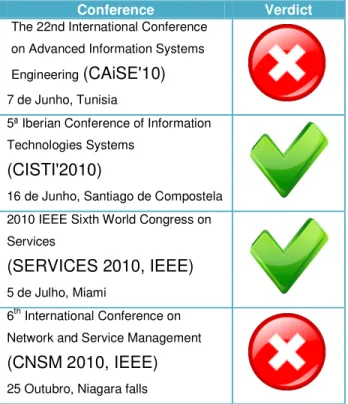
This section will summarize all the papers that were submitted on conferences, as well as the correspondent verdict, on this thesis scope.
We can see at table 1 a historic of the papers submitted during this master thesis, it were four papers with at least two of them accepted.
Only first paper (CAiSE’10) was submitted during thesis project, the rest of the papers were submitted during the dissertation.
All papers feedbacks helped me to complete and improve the methodology and maturity model developed.
Table 1. Papers submitted to conferences
Conference Verdict
The 22nd International Conference on Advanced Information Systems Engineering (CAiSE'10) 7 de Junho, Tunisia
5ª Iberian Conference of Information Technologies Systems
(CISTI'2010)
16 de Junho, Santiago de Compostela 2010 IEEE Sixth World Congress on Services
(SERVICES 2010, IEEE)
5 de Julho, Miami6th International Conference on Network and Service Management
(CNSM 2010, IEEE)
25 Outubro, Niagara fallsi
Acknowledgements
I would like to thanks all the support given by my girlfriend as well as my friends and classmates, during this thesis.
I also like to thanks Professor Mira da Silva by all the help and guidance provided during this thesis as well as the availability to clarify any questions at any time.
I specially would like to thank the opportunity given to me by Professor Mira da Silva to evolve my proposal in his class as well as my classmates that helped me in the collection of the results. I was able to collect much more results and consequently draw much more conclusions and improve the model.
iii
Resumo
Information Technology Infrastructure Library (ITIL) é a framework de “boas práticas” mais popular para gestão de serviços de tecnologias de informação (TI). Contudo, implementar ITIL não só é uma tarefa extremamente complicada como não existem boas práticas para tal. Como resultado disso, as implementações de ITIL são geralmente bastante longas, dispendiosas, e de elevado risco. Esta tese propõe um modelo de maturidade para avaliar a implementação do ITIL nas organizações e fornecer um roadmap para melhoramento baseado em prioridades e dependências do ITIL. O modelo de maturidade proposto foi aplicado na prática através de questionários para os processos Incident Management, Configuration Management e para a função Service Desk. Os questionários foram executados em 7 organizações onde no total foram feitas 17 avaliações.
Foi também desenvolvido um protótipo, tendo a metodologia desenvolvida este tese como base, para que as organizações possam avaliar o seu ITIL de forma mais profissional e eficiente.
v
Abstract
Information Technology Infrastructure Library (ITIL) is the most popular “best practices” framework for managing Information Technology (IT) services. However, implementing ITIL is not only very difficult but also there are no best practices for implementing ITIL. As a result, ITIL implementations are usually long, expensive, and risky. This thesis proposes a maturity model to assess an ITIL implementation and provide a roadmap for improvement based on priorities, dependencies and guidelines. Then it is demonstrate a practical application of the proposed model with a questionnaire to assess the Incident Management and Configuration Management processes as well as the Service Desk Function. We also evaluated the questionnaires in 17 assessments in seven Portuguese organizations and then implemented a prototype to support the assessments.
vii
Table of contents
Acknowledgements _________________________________________________________________ i Resumo _________________________________________________________________________ iii Abstract _________________________________________________________________________ v Figures Index ____________________________________________________________________ ix Tables Index _____________________________________________________________________ xi Acronyms ______________________________________________________________________ xiii 1 INTRODUCTION ... 1 1.1 MATURITY MODELS ... 1 1.2 PROBLEM ... 1 1.3 RESEARCH METHODOLOGY ... 3 2 RELATED WORK ... 5 2.1 ITIL... 5 2.1.1 Service Strategy ... 6 2.1.2 Service Design ... 6 2.1.3 Service Transition ... 7 2.1.4 Service Operation ... 7 2.1.5 Continual Improvement ... 8 2.2 MATURITY MODELS ... 8 2.2.1 CMM ... 8 2.2.2 Trillium ... 9 2.2.3 Bootstrap ... 112.2.4 Process Maturity Framework ... 12
2.2.5 IT Service CMM ... 12
2.2.6 CMMI for Services ... 15
2.3 COMPARISON ... 17 3 PROPOSAL ... 19 3.1 OBJECTIVES ... 19 3.2 PROCESSES DEPENDENCIES ... 20 3.3 SELECTED MODELS ... 23 3.4 MAPPING PROCESSES ... 23
viii 4 RESULTS ... 29 4.1 PROCEDURE ... 29 4.2 ORGANIZATION 1 ... 29 4.3 ORGANIZATION 2 ... 31 4.4 ORGANIZATION 3 ... 33 4.5 ORGANIZATION 4 ... 35 4.6 ORGANIZATION 5 ... 35 4.7 ORGANIZATION 6 ... 36 4.8 ORGANIZATION 7 ... 39 5 EVALUATION ... 41 6 PROTOTYPE ... 45 7 CONCLUSION ... 47 REFERENCES ... 49 APPENDIXES ... 51
A.1 NON INCREMENTAL PATH ... 51
A.2 INCREMENTAL PATH ... 52
A.3 LEVEL OF THE ITIL PROCESSES ON PROPOSAL MATURITY MODEL ... 53
A.4 RELATIONSHIP BETWEEN ITIL,CMMI-SVC AND ITSCMM PROCESSES ... 54
Figures Index
FIGURE 1. ACTION RESEARCH METHODOLOGY 3
FIGURE 2. ITIL V3 5
FIGURE 3. MAP OF DEPENDENCIES 20
FIGURE 4. APPLICATION HOME PAGE (DASHBOARD) 45
xi
Tables Index
TABLE 1. PAPERS SUBMITTED TO CONFERENCES 5
TABLE 2. ROAD MAPS FOR EACH CAPABILITY AREA OF TRILLIUM 10
TABLE 3. PMF LEVELS AND DESCRIPTION 12
TABLE 4. KEY PROCESS AREAS ASSIGNED TO PROCESS CATEGORIES 14
TABLE 5. LEVELS FOR STAGE AND CONTINUOUS MODELS 15
TABLE 6. COMPARISON OF THE DIVERSE MODELS 17
TABLE 7. SUMMARY OF APPENDIX A.3 24
TABLE 8. SUMMARY OF APPENDIX A.5 25
TABLE 9. STAGED MODEL AND CONTINUOUS MODEL RELATIONSHIP 27
TABLE 10. ORGANIZATION 1, INCIDENT MANAGEMENT ASSESSMENT RESULT 29
TABLE 11. ORGANIZATION 1, CONFIGURATION MANAGEMENT ASSESSMENT RESULT 30
TABLE 12. ORGANIZATION 1, SERVICE DESK ASSESSMENT RESULT 31
TABLE 13. ORGANIZATION 2, INCIDENT MANAGEMENT ASSESSMENT RESULT 32
TABLE 14. ORGANIZATION 2, SERVICE DESK ASSESSMENT RESULT 32
TABLE 15. ORGANIZATION 3, CONFIGURATION MANAGEMENT ASSESSMENT RESULT 33
TABLE 16. ORGANIZATION 3, INCIDENT MANAGEMENT ASSESSMENT RESULT 34
TABLE 17. ORGANIZATION 3, SERVICE DESK ASSESSMENT RESULT 34
TABLE 18. ORGANIZATION 4, INCIDENT MANAGEMENT ASSESSMENT RESULT 35
TABLE 19. ORGANIZATION 5, INCIDENT MANAGEMENT ASSESSMENT RESULT 36
TABLE 20. ORGANIZATION 6, TEAM 1, INCIDENT MANAGEMENT ASSESSMENT RESULT 37
TABLE 21. ORGANIZATION 6, TEAM 1, SERVICE DESK ASSESSMENT RESULT 37
TABLE 22. ORGANIZATION 6, TEAM 1, CONFIGURATION MANAGEMENT ASSESSMENT RESULT 38
TABLE 23. ORGANIZATION 6, TEAM 2, INCIDENT MANAGEMENT ASSESSMENT RESULT 38
TABLE 24. ORGANIZATION 6, TEAM 2, SERVICE DESK ASSESSMENT RESULT 39
TABLE 25. ORGANIZATION 7, INCIDENT MANAGEMENT ASSESSMENT RESULT 40
TABLE 26. ORGANIZATION 7, SERVICE DESK ASSESSMENT RESULT 40
xiii
Acronyms
ITSM - Information Technology Service Management
IT - Information Technology
ITIL - Information Technology Infrastructure Library
OGC - Office of Government commerce
UK - United Kingdom
IS - Information Systems
CEO - Chief Executive Officer
CMM - Capability Maturity Model
SEI - Software Engineering Institute
PMF - Process Maturity Framework
ITSCMM - Information Technology Service Capability Maturity Model
CMMI - Capability Maturity Model Integration
CMMI-SVC - Capability Maturity Model Integration for Services
1
1
Introduction
IT Service Management (ITSM) is the discipline that strives to better the alignment of information technology (IT) efforts to business needs and to manage the efficient providing of IT services with guaranteed quality [1]. Although there are many other frameworks, the Information Technology Infrastructure Library (ITIL) has become the most popular for implementing ITSM [1,2] and, as a result, the framework of choice in the majority of organizations [3]. With ITIL, organizations aspire to deliver services more efficiently and effectively, with more quality and less costs [2,3,4]. Furthermore, preliminary results have shown that ITIL works in practice [4].
ITIL was launched by the Central Computer and Telecommunications Agency (now OGC) in the United Kingdom (UK) with the aim of providing technology-related services in a cost-efficient and reliable manner, by offering a systematic approach to the delivery of quality IT services [5]. ITIL presents a comprehensive set of guidelines for defining, designing, implementing and maintaining management processes for IT services from an organizational (people) as well as from a technical (systems) perspective [6].
Many organizations that decide to implement ITIL completely fail. Many others keep implementing ITIL long after the planned deadline. Empirical evidence shows that most organizations underestimate the time, effort, and risks – not to mention the cost – of implementing ITIL. The problem is that implementing ITIL is not easy [7].
1.1
Maturity models
Maturity models in IT management have been proposed at least since 1973 [8]. More than one hundred different maturity models have now been proposed [9] but most are too general and, as a result, not well defined and documented [10]. The Process Maturity Framework (PMF) is the only maturity model specifically designed for ITIL but, in a few pages, cannot provide enough information to help an ITIL implementation.
The maturity model proposed in this thesis is more descriptive, detailed, and useful because it was designed specifically for ITIL and contains comprehensive questionnaires for each ITIL process. This model can be used to help an ITIL implementation step-by-step by assessing the maturity of the existing processes and suggesting what to improve or implement next.
1.2
Problem
ITIL is a methodology to improve delivery service efficiently and effectively,with highquality, based on the best practices of service. Every year more organizations desire implementing ITIL. However a
2
considerable percentage of them fail and some organizations collapse trying it [7, 11]. Some of the most common mistakes made by organizations when implementing ITILare [11]:
• Lack of management commitment
• Spend too much time on complicated process diagrams • Not creating work instructions
• Not assigning process owners
• Concentrating too much on performance • Being too ambitious
• Failing to maintain momentum • Allowing departmental demarcation • Ignoring constantreviewing of the ITIL • Memorizing selfITIL books
Certainly, many other reasons cause ITIL implementations to fail. In particular, reasons that cause information system (IS) projects in general to fail – such as organizational resistance to change, unproven business value, strong organizational culture, and so on – are also to blame, as ITIL implementations are usually based on complex IT platforms. But these other reasons can be dealt with general techniques for implementing projects in general.
ITIL implementation is too expensive and Chief Executive Officer (CEOs) think twice before go forward with the implementation. Combine that with unrecoverable money losses in many known ITIL implementation failures and this, certainly, becomes a problem. The key is making the ITIL implementation easier, understandable and secure.
As can be seen above the ITIL implementation is hard and complex. The organizations recurrently fall in the same mistakes. ITIL dictates organizations “what they should do” but is not clear in “how they should do it” based on a large number of tightly integrated processes. Faced with so many processes, the majority of organizations have no idea which process to implement first and/or how far they should go with that first process. Then the problem is repeated for the second process, and so on, until they get lost and start looking for help. But since each ITIL implementation is unique there are no “silver bullets” to solve this problem. This is the problem that this thesis will try to solve. All the other reasons, previously appointed, also to blame for ITIL implementation failure won’t be consider in the scope of this thesis.
1.3
Research Methodology
The chosen research methodology for this thesis is Action Research Methodology. Toward the end of the 1990s it began growing in popularity for use in sch
The method produces highly relevant research results, because it is grounded in practical action, aimed at solving an immediate problem situation whil
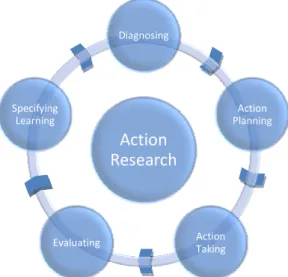
stages (as shown in Fig. 1):
• Diagnosing - Diagnosing corresponds to the identification of the primary problems that are the underlying causes of the organization’s desire for change.
• Action Planning - This activity specifies organizational actions that should relieve or improve these primary problems. The discovery of the planned actions is guided by the theoretical framework, which indicates both some desired future state for the organizatio
changes that would achieve such a state.
• Action Taking – Is the implementation of the planned action. The researchers and practitioners collaborate in the active intervention into the client organization, causing certain changes to be made.
• Evaluating –includes determining whether the theoretical effects of the action were realized, and whether these effects relieved the problems. Where the change was successful, the evaluation must critically question whether the action undertaken, among the
and non-routine organizational actions, was the sole cause of success.
• Specifying Learning - While the activity of specifying learning is formally undertaken last, it is usually an ongoing process. The knowledge gained in the action researc
to three audiences: Specifying Learning Figure 3
Research Methodology
The chosen research methodology for this thesis is Action Research Methodology. Toward the end of the 1990s it began growing in popularity for use in scholarly investigations of information systems. The method produces highly relevant research results, because it is grounded in practical action, aimed at solving an immediate problem situation while carefully informing theory [12]. Composed
Diagnosing corresponds to the identification of the primary problems that are the underlying causes of the organization’s desire for change.
This activity specifies organizational actions that should relieve or improve these primary problems. The discovery of the planned actions is guided by the theoretical framework, which indicates both some desired future state for the organizatio
changes that would achieve such a state.
Is the implementation of the planned action. The researchers and practitioners collaborate in the active intervention into the client organization, causing certain
includes determining whether the theoretical effects of the action were realized, and whether these effects relieved the problems. Where the change was successful, the evaluation must critically question whether the action undertaken, among the
routine organizational actions, was the sole cause of success.
While the activity of specifying learning is formally undertaken last, it is usually an ongoing process. The knowledge gained in the action research can be directed
Action
Research
Diagnosing Action Planning Action Taking Evaluating Specifying LearningFigure 1. Action Research Methodology
The chosen research methodology for this thesis is Action Research Methodology. Toward the end of olarly investigations of information systems. The method produces highly relevant research results, because it is grounded in practical action,
]. Composed by 5
Diagnosing corresponds to the identification of the primary problems that are
This activity specifies organizational actions that should relieve or improve these primary problems. The discovery of the planned actions is guided by the theoretical framework, which indicates both some desired future state for the organization, and the
Is the implementation of the planned action. The researchers and practitioners collaborate in the active intervention into the client organization, causing certain
includes determining whether the theoretical effects of the action were realized, and whether these effects relieved the problems. Where the change was successful, the evaluation must critically question whether the action undertaken, among the myriad routine
While the activity of specifying learning is formally undertaken last, it h can be directed
4
• First the restructuring of organizational norms to reflect the new knowledge gained by the organization during the research.
• Second, where the change was unsuccessful, the additional knowledge may provide foundations for diagnosing in preparation for further action research interventions. • Finally, the success or failure of the theoretical framework provides important
knowledge to the scientific community for dealing with future research settings.
According to this methodology it will be designed a maturity model and then chosen an organization to assess their ITIL (or part of ITIL) in which we could test the model. After the assessment, the results will be studied, conclusions will be taken and then the model improved according to the conclusions. Finally, the learnings of the new experience of assess an organization with the proposed model will be described. Each ITIL assessment will be a complete action research cycle with the correspondent application and improvement.
2
Related Work
After studying the ITIL and understanding all the processes, goals and dependencies relations between ITIL processes bec
dependencies map. It doesn’t have all the possible communications between them, only the most important ones, otherwise it was impossible to represent it graphically or to understand it.
With a map of dependencies it was possible to have a perception of the priority of each process and then understand which processes need to be implemented together. With this, it was possible to precede to the study of the existing maturity models.
As mentioned earlier, there are many maturity mod focuses in maturity models related with
substantiated by a comparison with existing ones.
But with so many models it’s important to ch
be, currently, the most important and interesting models
2.1
ITIL
ITIL (Information Technology Infrastructure Library) is a standard that was introduced and distributed by the Office of Government Commerce (OGC) in the UK and includes all IT parts of organizations.
At present, ITIL is the most widely accepted approach
an iterative, multidimensional and lifecycle form structure [3]. ITIL has an integrated approach as required by the ISO/IEC 20000 standard, with the compo
5
and understanding all the processes, goals and dependencies,
became clear. Therefore, it was important to develop a proce . It doesn’t have all the possible communications between them, only the most important ones, otherwise it was impossible to represent it graphically or to understand it.
With a map of dependencies it was possible to have a perception of the priority of each process and then understand which processes need to be implemented together. With this, it was possible to
to the study of the existing maturity models.
tioned earlier, there are many maturity models but few have succeeded. This thesis mainly in maturity models related with ITSM. The development of a new maturity model must be substantiated by a comparison with existing ones.
els it’s important to choose the right ones, therefore, those that be, currently, the most important and interesting models were selected.
ITIL (Information Technology Infrastructure Library) is a standard that was introduced and distributed by the Office of Government Commerce (OGC) in the UK and includes all IT parts of organizations.
At present, ITIL is the most widely accepted approach to IT Service Management in the
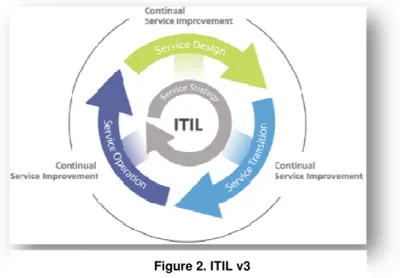
an iterative, multidimensional and lifecycle form structure [3]. ITIL has an integrated approach as required by the ISO/IEC 20000 standard, with the components that we can see in Fig. 2
Figure 2. ITIL v3
, the extensive . Therefore, it was important to develop a processes . It doesn’t have all the possible communications between them, only the most important ones, otherwise it was impossible to represent it graphically or to understand it.
With a map of dependencies it was possible to have a perception of the priority of each process and then understand which processes need to be implemented together. With this, it was possible to
els but few have succeeded. This thesis mainly . The development of a new maturity model must be
we consider to
ITIL (Information Technology Infrastructure Library) is a standard that was introduced and distributed by the Office of Government Commerce (OGC) in the UK and includes all IT parts of organizations.
to IT Service Management in the world. It has an iterative, multidimensional and lifecycle form structure [3]. ITIL has an integrated approach as
6
2.1.1 Service Strategy
Service Strategy provides guidance on how to design, develop, and implement service management not only as an organizational capability but also as a strategic asset. Topics covered in Service Strategy include the development of markets, internal and external, service assets, Service Catalogue, and implementation of strategy through the Service Lifecycle.
Financial Management, Service Portfolio Management, Organizational Development, and Strategic Risks are among other major topics [13].
Organizations already practicing ITIL may use this publication to guide a strategic review of their ITIL-based service management capabilities and to improve the alignment between those capabilities and their business strategies.
Include the processes: • Financial Management • Service Portfolio Management • Demand Management
2.1.2 Service Design
Service Design provides guidance for the design and development of services and service management processes. It covers design principles and methods to convert strategic objectives into portfolios of services and service assets.
The scope of Service Design is not limited to new services. It includes the changes and improvements necessary to increase or maintain value to customers over the life cycle of services, the continuity of services, achievement of service levels, and conformance to standards and regulations. It guides organizations on how to develop design capabilities for service management [14].
Include processes:
• Service Level Management • Service Catalogue Management • Supplier Management
• Availability Management • Capacity Management • IT Service continuity • Information Security
7
2.1.3 Service Transition
Service Transition provides guidance for the development and improvement of capabilities to transition new and changed services into operations. It provides guidance on how the requirements of Service Strategies encoded in Service Design are realized effectively in Service Operation while controlling the risks of failure and disruption. It provides guidance on managing the complexity related to changes in services and service management processes, preventing undesired consequences while allowing for innovation [15].
Include processes:
• Change Management
• Service asset and Configuration Management • Release and Deployment Management • Knowledge Management
• Transition Management and Support • Evaluation
• Service Validation and Testing
2.1.4 Service Operation
Service Operation provides guidance on achieving effectiveness and efficiency in the delivery and support of services so as to ensure value for the customer and the service provider.
Guidance is provided on ways to maintain stability in Service Operations, allowing for changes in design, scale, scope, and service levels. Managers and practitioners are provided with knowledge that allows them to make better decisions in areas such as managing the availability of services, controlling demand, optimizing capacity utilization, scheduling operations, and fixing problems.
Guidance is provided on supporting operations through new models and architectures such as shared services, utility computing, Web services, and mobile commerce [16].
Include processes: • Incident Management • Problem Management • Request Fulfillment • Access Management • Event Management
8
2.1.5 Continual Improvement
This provides instrumental guidance in creating and maintaining value for customers through better design, introduction, and operation of services. It combines principles, practices, and methods from Quality Management, Change Management, and Capability Improvement.
Organizations learn to realize incremental and large-scale improvements in service quality, operational efficiency, and business continuity.
Guidance is provided to link improvement efforts and outcomes with service strategy, design, and transition [17]. Include processes: • Service Measurement • Service Reporting • Service Improvement
2.2
Maturity Models
This section will describe all the maturity models studied to build a solid base for the ITIL maturity model proposed. All the important features of each model will be identified.
2.2.1 CMM
The Capability Maturity Model (CMM) was developed by the Software Engineering Institute (SEI) of Carnegie Mellon University and specifies five maturity levels to assess an organization’s process capability by measuring the degree to which processes are defined and managed:
• Level 1: Initial. At the initial level, an organization typically does not provide a stable environment for developing and maintaining software. It’s called ah-doc or chaotic, at this level capability is a characteristic of individuals, not organizations.
• Level 2: Repeatable. Policies for managing a software project and procedures to implement those policies are established. The planning and management of new projects is based on experiences with similar projects.
• Level 3: Defined. A typical process for developing and maintaining software across the organization is documented, including both software-engineering and management processes, and these processes are integrated as a whole.At this level organizations can be summarized as standard and consistent because both software-engineering and management activities are stable and repeatable.
9
• Level 4: Managed. An organization sets quantitative quality goals for both products and processes and uses processes with well-defined and consistent measurements. These measurements establish the quantitative foundation for evaluating a project’s processes and products.
• Level 5: Optimizing. The entire organization is focused on continuous process improvement. The organization has the means to identify weaknesses and strengthen the process proactively, with the goal of preventing defects. Organizations analyze defects and determine their causes.
The CMM presents sets of recommended practices in a number of key process areas that have been shown to enhance software-development and maintenance capability [18].
Each maturity level consists in some key process areas that are classified in goals and common features. In each key process area several goals are defined to represent the desired outcomes of the process. To fulfill the goals, practices are provided in order to lead to the transition of an organization’s process to the next higher maturity level. This maturity model doesn’t solve this thesis problem because it was designed to guide and assess software development projects and not service delivery or ITIL projects.
2.2.2 Trillium
Trillium is a model that covers all aspects of software development life cycle and was designed to be applied to embedded systems like telecommunications [19]. It was based on:
• CMM version 1.1 • ISO 9001 • ISO 9000-3
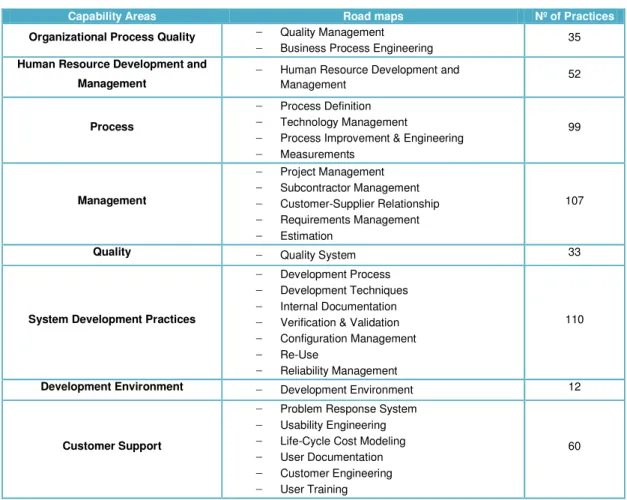
It’s composed by 8 capability areas, each one having one or more associated road maps and, in turn, each roadmap has associated practices, as shown in Table 2. For a given road map, the level of practices is based on their respective degree of maturity. The fundamental practices are at the lower levels, whereas more advanced ones are at the higher levels. In order to increase effectiveness of higher level practices, it is recommended that the lower level practices be implemented and sustained [20].
Trillium consists of five levels of maturity that can be described in the following way:
• Level 1: Unstructured. The development process is ad-hoc. Projects frequently cannot meet quality or schedule targets. Success, while possible, is based on individuals rather than on organizational infrastructure.
10
• Level 2: Repeatable and Project Oriented. Individual project success is achieved through strong project management planning and control, with emphasis on requirements management, estimation techniques, and configuration management.
• Level 3: Defined and Process Oriented. Processes are defined and utilized at the organizational level, although project customization is still permitted. Processes are controlled and improved. ISO 9001 requirements such as training and internal process auditing are incorporated.
• Level 4: Managed and Integrated. Process instrumentation and analysis is used as a key mechanism for process improvement. Process change management and defect prevention programs are integrated into processes, as well as CASE tools.
• Level 5: Fully Integrated. Formal methodologies are extensively used. Organizational repositories for development history and process are utilized and effective.
Table 2. Road maps for each capability area of Trillium
Capability Areas Road maps Nº of Practices
Organizational Process Quality - Quality Management - Business Process Engineering
35 Human Resource Development and
Management
-Human Resource Development and
Management 52
Process
- Process Definition - Technology Management
- Process Improvement & Engineering - Measurements 99 Management - Project Management - Subcontractor Management - Customer-Supplier Relationship - Requirements Management - Estimation 107 Quality - Quality System 33
System Development Practices
- Development Process - Development Techniques - Internal Documentation - Verification & Validation - Configuration Management - Re-Use - Reliability Management 110 Development Environment - Development Environment 12 Customer Support
- Problem Response System - Usability Engineering - Life-Cycle Cost Modeling - User Documentation - Customer Engineering - User Training
60
To achieve a Trillium level, an organization must satisfy a minimum of 90% of the criteria in each of the 8 Capability Areas at that level. Levels 3, 4 and 5 require the achievement of all lower Trillium levels [19].
11
2.2.3 Bootstrap
The Bootstrap methodology for software process, assessment and improvement, originated in a European Community project, with a focus on evaluating investments in technology was based on [20]:
• CMM
• ISO 9001 • ISO 9000-3 • ISO 15504
The Bootstrap process architecture rests on a triad of process categories in the areas of organization, Methodology and Technology. These three major categories consist of several process areas. Each process area specifies several key practices and activities [20].
Bootstrap was developed through a European Project (ESPRIT Project) in order to provide a method for assessing and improving the software process. It was the base for SPICE (now ISO 15504), was extended over time and adopted to include guidelines in the ISO 9000 [21].
• Level 0: Incomplete • Level 1: Performed • Level 2: Managed • Level 3: Established • Level 4: Predictable • Level 5: Optimizing
The Bootstrap reference model includes all processes and base practices of the ISO 15504 reference model. However on process-level, some process names are different, and a few ISO 15504 processes are divided into two or more Bootstrap processes.
Software Process Improvement programs are implemented in many organizations. A frequently used and successful methodology for improving the software process is the Bootstrap methodology [22].
This maturity model doesn’t solve this thesis problem because it was designed to improve and assess software development projects and not service delivery or ITIL projects.
12
2.2.4 Process Maturity Framework
Process Maturity Framework (PMF), is described in the ITIL book. It can be used either as a framework to assess the maturity of the ten Service Management processes individually, or to measure the maturity of the overall Service Management process as a whole [23].
However PMF is only described in ITIL v2 books and not on ITIL v3 books and this creates some doubts about its usefulness and success.
The PMF is useful for examining the entire Continuous Service Improvement Program (CSIP) and all implemented ITIL processes, or justan individual process. It is defined in 5 levels as shown in Table 3.
Each level is characterized by a combination of five elements:
• Vision and steering • Process
• People • Technology • Culture
Table 3. PMF levels and description
Level PMF Focus Comments
1 Initial Technology Technology excellence/experts
2 Repeatable Product/Service Operational processes (e.g., Service Support) 3 Defined Customer
Focus
Proper service level management
4 Managed Business Focus Business and IT aligned
5 Optimizing Value Chain Seamless integration of IT into the business and strategy making
Each element has one or more goals that the organization needs to implement to achieve the correspondent level. Focus in ITIL, this maturity model doesn’t solve this thesis problem. Is a small model, very simple (6 pages), and as we saw before, the ITIL implementation is a complex project, it’s unrealistic to think that someone could implement ITIL, based on such maturity model.
2.2.5 IT Service CMM
The IT Service CMM described in this document originates from two multi-partner research projects, partly supported by the Dutch Ministry of Economic Affairs. Partners in these projects – ‘Concrete Kit’
13
and ‘Kwintes’ – were Cap Gemini, Twijnstra Gudde, the Tax and Customs Computer and Software Centre of the Dutch Tax and Customs Administration, the Technical Universities of Delft and Eindhoven, and the Vrije Universiteit Amsterdam. These projects were aimed at developing a method to specify and control IT services.
The IT Service CMM is a capability maturity model that describes different maturity levels for organizations that provide IT services.
The main focus of the model is on the maturity of the service provided by theorganization. The model does not measure the maturity of individual services, projects or organizational units [24]. The model covers the service delivery process.
The main goals are:
1. To enable IT service providers to assess their capabilities with respect to the delivery of IT services
2. To provide IT service providers with directions and steps for further improvement of their service capability
The IT Service CMM is based on the Software CMM for two reasons:
1. The Software CMM is a widely used and well-known software process improvement model. Its structure is generic enough to facilitate other areas besides software processes.
2. They wanted to provide organizations with a mechanism with which they can perform step-wise improvement. Improvement should be an integral part of the framework. This is the case with the CMM where the framework functions as a prescriptive model and assessments are used to compare the actual situation with the model.
It’s composed by 22 process areas and each one is structured using common features. Common features are practices that, when performed together, guarantee that the key process area is implemented and institutionalized. Common features consist of key practices that describe activities that have to be performed or infrastructures that have to be present. These common features are:
• Commitment to Perform • Ability to Perform • Activities Performed • Measurement and Analysis • Verifying Implementation
Among the 22 process areas there are few key processes, for IT Service CMM to reside on a certain maturity level, it needs to implement all key processes for that maturity level (Table 4) – and those for
14
lower levels [24]. It’s a complete and detailed model that provides several good practices to improve the service.
It consists of five maturity levels, which are:
• Level 1 Initial: The IT service delivery process is characterized as ad hoc, and occasionally even chaotic. Few processes are defined and success depends on individual effort and heroics.
• Level 2 Repeatable: Basic service management processes are established. The necessary discipline is in place to repeat earlier successes on similar services with similar service levels. • Level 3 Defined: The IT service processes are documented, standardized, and integrated into standard service processes. All services are delivered using approved, tailored versions of the organization’s standard service processes.
• Level 4 Managed: Detailed measurements of the IT service delivery process and service quality are collected. Both the service processes and the delivered services are quantitatively understood and controlled.
• Level 5 Optimizing: Continuous process improvement is enabled by quantitative feedback from the processes and from piloting innovative ideas and technologies.
Table 4. Key process areas assigned to process categories
Process Categories Levels Management Service planning Enabling Support and standardization Delivery
Actual service delivery
Optimizing Technology Change Management
Process Change Management Problem Prevention Managed
Quantitative Process Management
Service Quality Management Financial Service
Management
Defined Integrated Service Management
Organization Process Focus Organization Process Definition Organization Service Definition Training Program Intergroup Coordination Resource Management Problem Management Service Delivery Repeatable Service Commitment Management
Service Delivery Planning Service Tracking and Oversight
Subcontract Management
Configuration Management Service Request and Incident Management
Service Quality Assurance
15
This maturity model doesn’t solve this thesis problem, although designed to guide and assess service delivery; it does not take in consideration ITIL culture.
2.2.6 CMMI for Services
The Capability Maturity Model Integration for Services (CMMI-SVC) provides guidance for the application of CMMI best practices by the service provider organization. Best practices in the model focus on activities for providing quality services to the customer and end users. CMMI-SVC integrates bodies of knowledge that are essential for a service provider. It was designed to improve mature service practices and contribute to the performance, customer satisfaction, and profitability of the economic community [25].
CMMI-SVC draws on concepts and practices from several service-focused standards and models, including:
• Information Technology Infrastructure Library (ITIL)
• ISO/IEC 20000: Information Technology—Service Management • Control Objects for Information and related Technology (CobiT) • Information Technology Services Capability Maturity Model (ITSCMM)
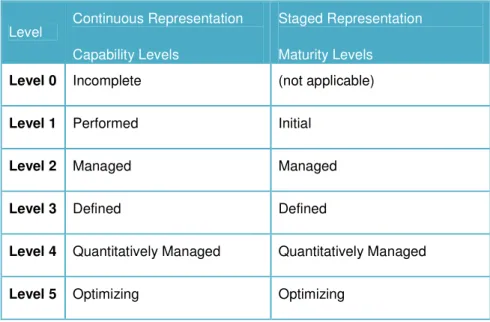
CMMI-SVC provides two ways of assessment: it can assess the whole organization (staged) or each process (continuous). There are 24 processes that are characterized by specific goals and specific practices; however there are some generic goals and generic practices used for all the processes.
Table 5. Levels for Stage and Continuous models
Level Continuous Representation Capability Levels
Staged Representation Maturity Levels
Level 0 Incomplete (not applicable)
Level 1 Performed Initial
Level 2 Managed Managed
Level 3 Defined Defined
Level 4 Quantitatively Managed Quantitatively Managed
16
The continuous representation is concerned with selecting both a particular process area to improve and the desired capability level for that process area [25].
Description of Continuous representation levels:
• Level 0: Incomplete. One or more of the specific goals of the process area are not satisfied and no generic goals exist.
• Level 1: Performed. Satisfies the specific goals of the process area. It supports and enables the work needed to provide services.
• Level 2: Managed. It is planned and executed in accordance with policy; employs skilled people who have adequate resources to produce controlled outputs; involves relevant stakeholders; is monitored, controlled, and reviewed; and is evaluated for adherence to its process description.
• Level 3: Defined. The standards, process descriptions and procedures for a project are tailored from the organization’s set of standard processes to suit a particular project or organizational unit and therefore are more consistent, except for the differences allowed by the tailoring guidelines.
• Level 4: Quantitatively Managed. Process is controlled using statistical and other quantitative techniques. Quantitative objectives for quality and process performance are established and used as criteria in managing the process.
• Level 5: Optimizing. Process that is improved based on an understanding of the common causes of variation inherent in the process and continually improves the range of process performance through both incremental and innovative improvements.
The staged representation is concerned with the overall maturity of the organization, whether individual processes are performed or incomplete is not the primary focus [25].
Description of Staged representation levels:
• Level 1: Initial. Processes are usually ad hoc and chaotic
• Level 2: Managed. Projects establish the foundation for an organization to become an effective service provider. The service provider ensures that processes are planned in accordance with policy.
• Level 3: Defined. These standard processes are used to establish consistency across the organization. Projects establish their defined processes by tailoring the organization’s set of standard processes according to tailoring guidelines.
• Level 4: Quantitatively Managed. Service providers establish quantitative objectives for quality and process performance and use them as criteria in managing processes. Quantitative objectives are based on needs of the customer, end users, organization, and process implementers.
• Level 5: Optimizing. Process that is improved based on an u
causes of variation inherent in the process and continually improves the range of process performance through both incremental and innovative improvements.
It’s proved that the adoption of CMMI by companies brings good results time and the reduction of defects and costs [26
problem, although designed to guide and assess service ITIL culture.
2.3
Comparison
There isn’t much difference between the models, all have levels, goals, practices, b important aspects to take into account to make the
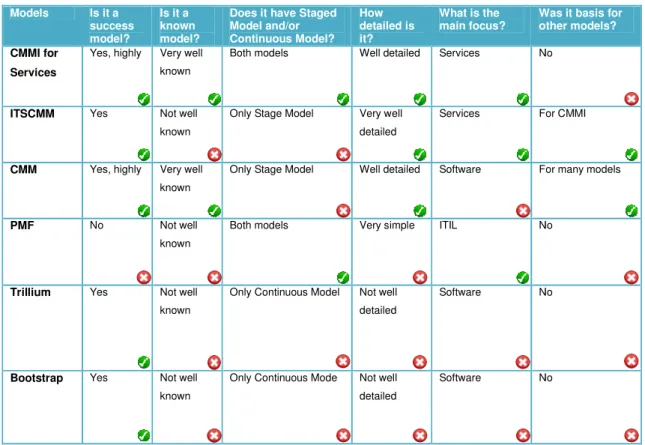
At this point is important a comparison between the diverse models in order to select the one t offers the most. In Table 6 we can see a comparison of the models, based on the main features.
Table Models Is it a success model? Is it a known model? CMMI for Services
Yes, highly Very well known
ITSCMM Yes Not well
known
CMM Yes, highly Very well known
PMF No Not well known
Trillium Yes Not well known
Bootstrap Yes Not well known
17
Process that is improved based on an understanding of the common causes of variation inherent in the process and continually improves the range of process performance through both incremental and innovative improvements.
It’s proved that the adoption of CMMI by companies brings good results with the regard to delivery f defects and costs [26]. This maturity model doesn’t solve this thesis problem, although designed to guide and assess service delivery; it does not take in consideration
isn’t much difference between the models, all have levels, goals, practices, b into account to make the selection.
At this point is important a comparison between the diverse models in order to select the one t we can see a comparison of the models, based on the main features.
Table 6. Comparison of the diverse models
Does it have Staged Model and/or Continuous Model? How detailed is it? What is the main focus?
Was it basis for other models?
Both models Well detailed Services No
Only Stage Model Very well detailed
Services For
Only Stage Model Well detailed Software For many models
Both models Very simple ITIL No
Only Continuous Model Not well detailed
Software No
Only Continuous Mode Not well detailed
Software No
nderstanding of the common causes of variation inherent in the process and continually improves the range of process
with the regard to delivery This maturity model doesn’t solve this thesis it does not take in consideration
isn’t much difference between the models, all have levels, goals, practices, but there are
At this point is important a comparison between the diverse models in order to select the one that we can see a comparison of the models, based on the main features.
Was it basis for other models?
No
For CMMI
For many models
No
No
18
Trillium and Bootstrap are good and successful models, but are mainly based and focus in software development and quality and not in service delivery and quality, which is the main focus of ITIL. They both follow a continuous model and don’t have a stage model. This could be seen unfavorable for organizations that want to be more aggressive in the improvement. Besides, they are old models and they are not enough description details.
CMM is a model very well known worldwide and used as basis by a set of many other models. It’s consistent, coherent and complete; however, it was made for software development and only has staged model representation.
PMF is a small model, resumed to 6 pages in the book of ITIL, with few goals by level. In the reality of the business world, it is surreal to think that some organizations could improve efficiently and effectively their ITIL maturity with this model. On the other hand PMF describes the continuous and staged model and that is an important feature for the proposed model.
ITSCMM is a very interesting model based on service delivery; it is detailed and complete; so interesting, that the author was invited to join the team that would develop the CMMI-SVC. The processes are similar to the ITIL process and the practices could be very useful.
CMMI-SVC is known worldwide, is a very complete model, focuses on service and contains concepts of CMMI and the most known standards like inITIL, Cobit and others. It’s also a very detailed model. Describes both models continuous and staged andthat is excellent. Besides, the evolution of CMM is focused on services.
19
3
Proposal
This thesis proposes a complete maturity model that organizations could use as guidelines to assure that they don’t fall in any of the most common mistakes made by organizations in ITIL implementation.
Today many organizations spenda lot of money in ITIL implementation projects and fail. A maturity model will solve this problem as it will allow not only assessing the level of ITIL in organizations but also will guide them and will tell them what they miss or need to achieve the level they want.
Nowadays there isn’t any complete and detailed maturity model for ITIL that could guide organizations in ITIL implementation or assuring that they will do it correctly.
3.1
Objectives
The main goal is to design a model that provides a roadmap to help the organizations in ITIL implementation, in a correct way and avoiding errors that already made other organizations failed and collapsed. For that we need to accomplish a few objectives:
• Global vision of ITIL: The study of ITIL is essential to realize a good work, understand the process, dependencies, relation, goals, etc. Only with a good knowledge of ITIL it is possible to design a model to evaluate it.
• Processes dependencies: The processes dependencies are important to understand which process should be implemented, when, with which other process, how high, etc. Therefore a dependencies map should be done. It can be seen in [Appendix 1.5].
• Study maturity models: Comparing existing maturity models is an important goal in order to identify the most reliable model(s).
• Chose the right maturity models: Select the advantages of each maturity model studied to design a good maturity model that could be applied to ITIL.
• Mapping processes: Mapping the processes between the maturity model(s) selected and ITIL to identify the relevantgoals and practices of the model(s).
• Design staged model: Based on the model(s) selected, on dependencies map and on the mapping of processes made before, design a staged model leveling the processes with coherence.
• Create questionnaire for the largest number of ITIL processes: After identifying the processes of the selected models that correspond to each ITIL process a questionnaire for each process should be created and leveled by a maturity scale. If possible test each questionnaire in organizations.
• Design continuous model: After creating a questionnaire for each ITIL process, collect them all and design the continuous model.
20
• Assess organizations: With the questionnaires we’ll be able to assess organizations and get results in order to demonstrate the potential of the designed maturity model.
• Results: Collect the results of the several assessments performed, get a conclusion and improve the model.
3.2
Processes Dependencies
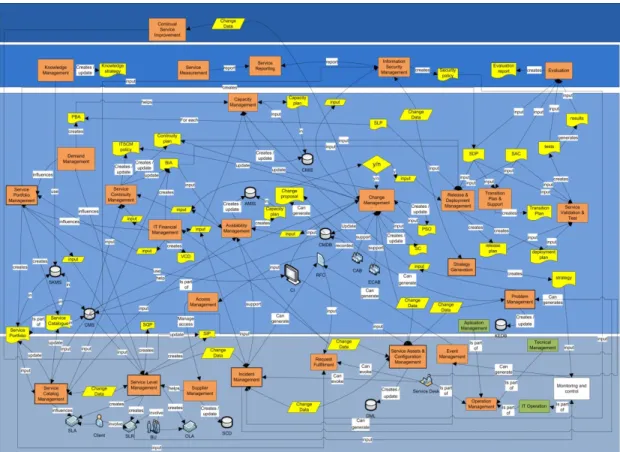
After the initial ITIL bibliographic research it was important to understand how complex and deep were the dependencies among ITIL processes. Fig. 3 shows the map of dependencies designed and highlights the complexity of dependencies and connections among ITIL processes.
This result matches the initial statements on this thesis about the huge problems faced by the organizations in ITIL implementation, such complexity isn’t obviously easy to implement.
21 Legend:
AMIS availability management information system BIA business impact analyses
BU business units
CAB change advisory board CI configuration items
CMDB configuration management data base CMIS capacity management information system CMS configuration management system DML definitive media library
ECAB emergency change advisory board KEDB known Error Database
OLA operation level agreement PBA pattern of business activity PSO projected Service Outage SAC service acceptance criteria SC schedule of change
SCD supplier contract database SDP service design package SIP service improvement plan
SKMS service knowledge management system SLA service level agreement
SLP service level package SLR service level requirement SQP service quality plan VCD variable cost dynamics
Process
Function
Operation
Plan / Policy / Document
Exchanged Information / Data
22
There are processes that connect with almost all the other processes and the representation of all these connections would be graphically redundant. Therefore, not all connections between ITIL processes are represented on Fig. 3 otherwise it would be much more complicated to understand the map and the utility of the map would be lower.
Fig. 3 was design in conformity with the Levels of Maturity of the Staged Model and it could be seen by each layer color with the lower level on bottom and the higher level of maturity on top. This is useful to better understand the flux of information, as well as the complexity of dependencies among the levels.
As the most used framework to implement ITSM and with IT as the scope, ITIL should be seen by inside as an aggregation of processes each one with their activities, tasks, actors, responsibilities, etc. All these processes are related and depend of each other. The IT, as part of IS, intends to help manage the information with the most appropriate technology. ITIL, as a framework of best practices for IT and defined by processes, should be specific in how the processes are related. The conceptual map designed (Fig. 3) is a useful tool to understand how, by ITIL rules, the information flows among the processes, what are the responsibilities of each process, what are the inputs and outputs of each process, etc.
All the symbols and boxes in Fig. 3 represent important features of ITIL, and with the conceptual map we easily understand why so many organizations keep failing ITIL implementation as well as lose money and other resources trying to implement ITIL. ITIL, as shown by Fig.3, is a complex connection of several processes with several dependencies of each others. Without a guide it becomes hard to believe in organization’s success.
As mentioned at the beginning, there are other kinds of problems that could originate ITIL implementation failure, but we are just considering the lack of guide of a complex framework as ITIL that will create recursive mistakes and consequently ITIL implementation failure, as proved before. All the other reasons, previously appointed, also to blame for ITIL implementation failure won’t be consider in the scope of this thesis.
Summarizing, a guide to help organizations in such complex framework as ITIL is crucial and with this map of dependencies we easily understand it and see how the organization should work according to ITIL best practices. We can see the flux of information between processes, the tasks to accomplish, the crucial activities, processes, in some cases people and hardware and the sequential relationships among all these features. This map provides a macro vision of how organization’s ITIL should be and will be very helpful in the next steps of this thesis.
23
3.3
Selected Models
Section 3.7 shows that the most interesting models are CMM, CMMI-SVC, ITSCMM and PMF. However CMMI-SVC is an evolution of CMM with the advantage of being focused on services, than it makes no sense consider CMM.
PMF is a simple model and it’s the only one that was made for ITIL purpose, so it will be taken in consideration but the main focus will be on ITSCMM and CMMI for services.
Next step was mapping all processes of ITSCMM and CMMI-SVC with ITIL processes and design a Staged model, then collect all the goals and practices of each process of ITIL (and similar processes of the models) and create the questionnaire that will assess the correspondent process in the organization. At the end, with all questionnaires, it’s supposed to have a Continuous model.
3.4
Mapping processes
At [Appendix A.4] we can see a mapping of all the ITIL processes with ITSCMM and CMMI-SVC processes. As it shows, some ITIL processes have more than one process of each other models, but there are cases where an ITIL process apparently doesn’t have any match process of the other models.
With this it’s possible start analyzing the goals and practices of each process, collect them and try transform it in a realistic questionnaire based on CMMI-SVC and ITSCMM but applicable to ITIL.
3.5
Staged model and Continuous Model
In our maturity models research we identified two kinds of models: staged model and continuous model, both useful in different occasions. While Staged Model is more useful for organizations with no idea of their priority processes, Continuous Model is more useful for organizations that are conscientious of their priority processes. However, to design a complete maturity model both models must be taken in consideration and should be present. With Staged Model the organizations have a global vision about the main processes to implement while Continuous Model enables the assessment of each ITIL process.
As told before, we based our maturity model in CMMI – SVC and ITSCMM. In order to assign a Staged Model level to each ITIL process a process mapping between the studied maturity models processes and ITIL processes was needed.
Therefore we used the process mapping explained in the previous topic (3.4), as well as the description of each Staged maturity level to assign a maturity level to each ITIL process. It was
24
important to build a reliable Staged Model based on successfully maturity models and this procedure ensure that statement.
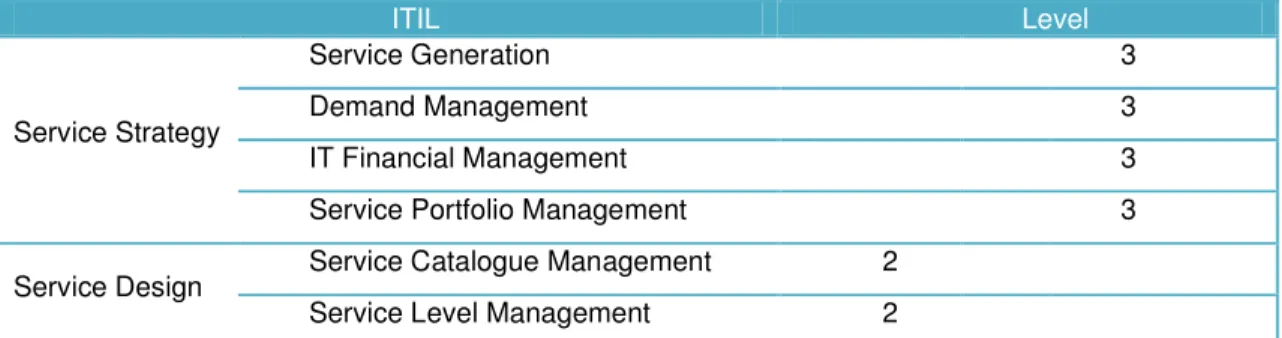
We can see at [Appendix A.3] all the Staged Model levels assigned to each ITIL processes and a summary of it at Table 7.
Table 7. Summary of Appendix A.3
ITIL Level
Service Strategy
Service Generation 3
Demand Management 3
IT Financial Management 3
Service Portfolio Management 3
Service Design Service Catalogue Management 2
Service Level Management 2
The Staged model will be classified by five levels of maturity:
• Level 1. Initial: Characterized as ad hoc, and occasionally even chaotic. Success depends on individual effort and heroics.
• Level 2. Managed: Basic service management processes are established. The service provider ensures that processes are planned in accordance with policy. Processes related to service operation are addressed in this level because they support day-to-day activities and are critical to keep the organization IT operational.
• Level 3. Defined: The IT service processes are documented, standardized, and integrated into standard service processes. Most IT processes are included up to this level to allow high levels of performance in the management of IT.
• Level 4. Quantitatively Managed: Service providers establish quantitative objectives for quality and process performance and uses them as criteria in managing processes. Quantitative objectives are based on needs of the customer, end users, organization, and process implementers.
• Level 5. Optimizing: Continuous process improvement is enabled by quantitative feedback from the processes and from piloting innovative ideas and technologies.
When an organization try to implement more than one or two processes at the same time could not be the rightist choice and some organizations may not be prepared for the effort. It becomes important design a Continuous model that allows organizations to implement and assess only a particular process.
25
Each ITIL process will be assessed by a questionnaire, so, in order to have a complete Continuous Model we must have the questionnaires for all ITIL processes. Once we just made three questionnaires over this thesis, the Continuous Model won’t be complete.
The questionnaires must be complete, detailed, with solid bases and focused on ITIL scope. To build each questionnaire we studied all the practices and goals of correspondent process of CMMI-SVC and ITSCMM to see if they are focused in ITIL scope. Then we studied the ITIL books and deeply analyzed all ITIL processes.
The first questionnaire created was for “Incident Management”, because it is one of the most popular processes between the organizations that implement ITIL and we already had an organization to test it.
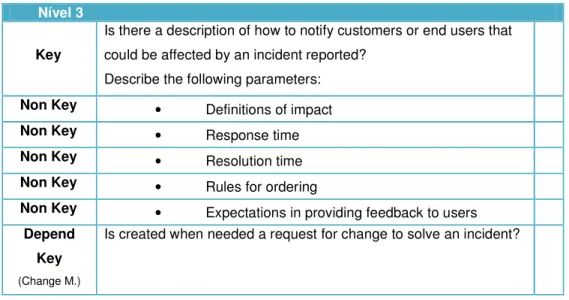
We can see part of one questionnaire in Table 8 and a little more at [Appendix A.5].
Table 8. Summary of Appendix A.5
Nível 3 Key
Is there a description of how to notify customers or end users that could be affected by an incident reported?
Describe the following parameters:
Non Key • Definitions of impact
Non Key • Response time
Non Key • Resolution time
Non Key • Rules for ordering
Non Key • Expectations in providing feedback to users Depend
Key (Change M.)
Is created when needed a request for change to solve an incident?
The questionnaire will have three kinds of questions, classified as follows:
• Key The main questions that really need to be implemented • Non Key The questions that don’t need to be all implemented
• Depend Key The questions that only need to be implemented if the related process also is implemented
The questions will be classified as “Key” questions that must always be implemented to achieve the correspondent level. Regarding the “Non Key” questions the organization must satisfy at least 75% of
26
them to achieve the correspondent level. If there is any “Depend Key” question and the correspondent process is implemented too than the “Depend Key” question becomes a “Key” question and to achieve the correspondent level it must be implemented.
The assignment of the one of these classifications to each question was made by the importance of each question. The importance was measured during the research work by the relevance of each topic that was addressed.
Each questionnaire will have 5 levels and to achieve one of them the organization must have all levels before correctly implemented, all “Key” questions of the level implemented and at least 75% of “Non Key” questions implemented (e.g.: to achieve the level 2 the organizations must have all “key” questions of level 2 implemented and at least 75% of “Non Key” questions implemented but to achieve the level 3 the organization must have level 2 correctly implemented and “Key” questions of level 3 implemented and at least 75% of “Non Key” questions implemented).
Both CMMI-SVC and ITSCMM, as well as the other maturity models that were studied but not adopted, have the particularity of achieve the next level only if all the processes of the level below are fully implemented. This implies that to achieve a certain level, the organization should totally implements a set of processes and this is a huge effort to the organization.
Therefore, an innovative feature of this proposal is the incremental effort of the Staged Model. For example, to achieve the level 2 of Staged Model an organization must have all the processes for level 2 of Staged Model at level 2 of Continuous Model, and to achieve level 3 of Staged Model must have all the processes for level 3 of Staged Model at level 3 of Continuous Model and all processes of level 2 of Staged Model at level 3 of Continuous Model also, and the same for the rest of the levels.
We can see in [Appendix A.2] that in incremental Staged Model the organizations have an incremental level of effort on the implementation and in [Appendix A.1], a non incremental Stage Model, the effort at the beginning is huge. Obviously the first option is a better choice because the organizations avoid a huge first impact effort that will avoid some mistakes.
It is visible that in [Appendix A.2] to achieve Level 2 the company must reach 10 processes at Level 2 and in [Appendix A.1] to achieve Level 2 the company must reach 10 processes at Level 5 that is obviously much effort.
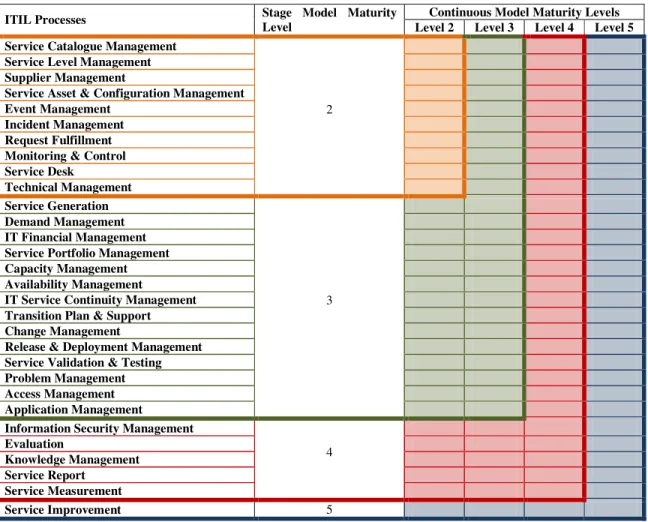
The staged Model and Continuous Model are correlated. As we can see at Table 9 the different colors identify the relation between the staged Model levels and Continuous Model levels
27
Table 9. Staged Model and Continuous Model relationship
ITIL Processes Stage Model Maturity
Level
Continuous Model Maturity Levels
Level 2 Level 3 Level 4 Level 5
Service Catalogue Management
2 Service Level Management
Supplier Management
Service Asset & Configuration Management Event Management
Incident Management Request Fulfillment Monitoring & Control Service Desk Technical Management Service Generation 3 Demand Management IT Financial Management Service Portfolio Management Capacity Management Availability Management
IT Service Continuity Management Transition Plan & Support Change Management
Release & Deployment Management Service Validation & Testing Problem Management Access Management Application Management
Information Security Management
4 Evaluation Knowledge Management Service Report Service Measurement Service Improvement 5