A Thesis
Submitted to the Faculty of
Drexel University by Ritu Khare
in partial fulfillment of the requirements for the degree
of
Doctor of Philosophy December 5, 2011
Dissertation / Thesis Approval Form
This form is for use by all doctoral and master’s students with a dissertation/thesis requirement. Please print clearly as the library will bind a copy of this form with each copy of the disserta-tion/thesis. All doctoral dissertations must conform to university format requirements, which is the responsibility of the student and supervising professor. Students should obtain a copy of the Thesis Manual located on the library website.
Dissertation/Thesis Title: A Framework for Mapping User-designed Forms to Relational Databases
Author: Ritu Khare
This dissertation/thesis is hereby accepted and approved.
Signatures: Examining Committee Chair Members Academic Advisor Department Head
Office of Graduate Studies•3141 Chestnut St.•Randell Hall 240•Philadelphia, PA 19104
This work is licensed under the terms of the Creative Commons Attribution-ShareAlike license Version 3.0. The license is available at
Dedications
ToSunny andMeethi. ToDadi’s faith andNani’s prayers.
Acknowledgments
This dissertation is by no means an individual effort, and would not be possible without the collab-oration of many.
First and foremost, I want to express my gratitude toward Dr. Yuan An, my committee Chair. I can’t thank him enough for devoting his precious time to develop and train me as a researcher. Under his guidance, I have developed several critical research skills, including problem identification, writing, presentation, experiment design, conduction of user studies, and out-of-the-box thinking. His vision and expertise in data integration and healthcare have been pivotal in shaping my entire dissertation work. I am delighted to have been his first Ph.D. student.
I want to thank Dr. Il-Yeol Song for greatly contributing to this dissertation work. Dr Song helped design the gold standard databases used for evaluating the mapping algorithms proposed in this work. With his expertise and experience in conceptual modeling, and systems analysis, he has helped in improving the literature review and the result dissemination style of this work. He has also advised me in terms of effectively planning out the entire dissertation work in a span of four years. I also want to thank Dr Song for being my foremost inspiration in pursuing a Ph.D. degree.
I want to thank Dr. Jason Li for enhancing this work to a large extent. Dr. Li, with his expertise in data mining and machine learning, gave several suggestions in choosing an appropriate learning model for designing the term annotation module. This work has greatly benefited from the insightful and intelligent questions, raised by Dr. Li during the candidacy examination and the proposal defense meeting.
I want to thank Dr. Christopher Yang for helping improve the work in many aspects. With expertise in artificial intelligence and information retrieval, Dr. Yang has provided many useful comments that helped in formalizing the research focus, enhancing the metrics and terminology, and finding motivational examples in defining the problems.
Dr Song’s expertise in information extraction and Hidden Markov models has been instrumental in devising and improving the form understanding approach proposed in this work. Also, I have used Dr Song’s thesis report as a reference in writing this dissertation.
I have been fortunate enough to participate in several other projects that helped in widening the horizon of my dissertation work. For this, I want to thank Dr. Tony Hu, Dr. Weimao Ke,Dr. Prudence Dalrymple,Dr. Michelle Rogers, andDr. Susan Gasson. I also want to thank my friends, colleagues, and staff members at the iSchool for the excellent support system.
Finally, I would like to thank God for being with me all the while, and for blessing me with a beautiful family without which I could not even harbor the Ph.D. dream. Words are hardly enough to thank my loving husbandSiddharth for staying by my side in all kinds of weather; my Didi for being my ultimate source of strength and creativity; myPapa for teaching me important lessons in time-management and organization; and myMummy for her empathetic listening and unconditional love.
Table of Contents
List of Tables . . . xi
List of Figures . . . xii
Abstract . . . xv I Introduction . . . 1 1. Motivation . . . 2 2. Research Problems . . . 5 2.1 Form Understanding . . . 5 2.2 Correspondence Discovery . . . 7 2.3 Form Integration . . . 10
2.3.1 Merging into an Existing Database . . . 10
2.3.2 Birthing a New Database . . . 13
2.4 Research Questions and System Goals . . . 14
3. Research Methods . . . 16 3.1 Formalism . . . 16 3.1.1 Form . . . 16 3.1.2 Database . . . 17 3.1.3 Mapping . . . 18 3.2 Approaches . . . 21 3.3 Evaluation . . . 22 4. Contributions . . . 24 4.1 New Problems . . . 24 4.2 New Solutions . . . 24
4.3 Results and Implications . . . 25
II Literature Review . . . 29
6. Review: Understanding Form Semantics . . . 30
6.1 Modeling . . . 30 6.2 Parsing . . . 31 6.3 Segmentation . . . 32 6.4 Segment Processing . . . 34 6.5 Evaluation . . . 35 6.6 Review Conclusion . . . 36
7. Review: Form-driven Database Design . . . 39
7.1 EDDS . . . 39 7.2 FOBFUDD . . . 40 7.3 IIS*Case . . . 40 7.4 Zohocreator . . . 40 7.5 Deklarit . . . 41 7.6 InfoPath . . . 41 7.7 REDCap . . . 41 7.8 FormAssembly, etc. . . 42 7.9 Review Conclusion . . . 42
8. Review: Toward Database Integration . . . 44
8.1 Integration of New Forms . . . 44
8.1.1 Review Conclusion . . . 45 8.2 Standardization of Terms . . . 46 8.2.1 Review Conclusion . . . 48 III Solutions . . . 49 9. Overall Approach . . . 50 10.Form Understanding . . . 51
10.1 Form Tree Generation . . . 51
10.1.1 On-the-fly Capturing of the Form Tree . . . 53
10.1.2 Automatic Tree Extraction Algorithm . . . 57
10.2 Term Annotation with SNOMED CT . . . 62
10.2.1 Solution Premises and Representations . . . 66
10.2.2 Solution: Mapping Terms to Concepts . . . 68
11.Mapping Discovery and Validation . . . 73
11.1 Discovering Correspondences . . . 73
11.1.1 With Raw Form Terms . . . 74
11.1.2 With Concept Annotated Terms . . . 76
11.2 Validating Correspondences . . . 78
12.Database Design and Evolution. . . 83
12.1 Birthing Algorithm . . . 84
12.2 Merging Algorithm . . . 93
IV Evaluation . . . 104
13.Objectives . . . 105
14.Data and Gold Standard Benchmarks. . . 107
15.Experiment Prototype & Settings . . . 110
15.1 DIY Form Design Module . . . 110
15.2 The Automatic Tree Generation Module . . . 110
15.3 The Annotation Module . . . 111
15.4 Mapping Discovery . . . 112
15.5 Birthing and Merging Algorithms . . . 112
16.Experimental Design . . . 113
16.1 Experiment 1: Automatic Form Understanding . . . 113
16.2 Experiment 2: SNOMED CT Annotation . . . 113
16.3 Experiment 3: Mapping Forms to Database . . . 115
17.Results and Findings . . . 119
17.1 Automatic Form Understanding . . . 119
17.2 SNOMED CT Term Annotation . . . 119
17.3 Mapping Form to Database . . . 122
17.3.1 General Results . . . 122
17.3.2 Measuring Principle Compliance . . . 124
17.3.3 Measuring User Interventions . . . 130
17.4 Experiment Summary and Implications . . . 132
17.4.1 Form Semantics Experiments . . . 132
17.4.2 Mapping Experiments . . . 133
V Final Remarks . . . 136
18.Contributions and Conclusions . . . 137
19.Limitations . . . 141
19.1 Techniques . . . 141
19.2 Technique Evaluation . . . 142
19.3 Experimental Design . . . 142
19.4 Study . . . 142
20.Future Research Directions . . . 144
20.1 Health Informatics . . . 144
20.2 Computer Science . . . 145
Bibliography . . . 147
VI Appendix . . . 154
Appendix A: Sample Clinical Forms . . . 155
Appendix B: Sample Database for a Walk-in Clinic . . . 164
List of Tables
10.1 Feature Statistics of 51 Healthcare Data-entry Forms . . . 57
10.2 Observation Space T HMM . . . 60
10.3 State Space T HMM (Also Observation Space S HMM) . . . 60
10.4 State Space S HMM . . . 60
10.5 Descriptions of a SNOMED CT Concept . . . 67
10.6 SNOMED CT Relationships . . . 68
14.1 Experiment Datasets . . . 107
14.2 Experiment Datasets Descriptions . . . 108
15.1 Extraction Accuracy (%) for the T HMM States . . . 111
17.1 Tree Extraction Results . . . 119
17.2 Intervention Results (Outliers in bold or italics) . . . 131
C.1 Medical Acronym List Part 1 . . . 166
C.2 Medical Acronym List Part 2 . . . 167
C.3 Medical Acronym List Part 3 . . . 168
List of Figures
1.1 A Form and the Associated Database . . . 3
1.2 A New and Interrelated Form . . . 3
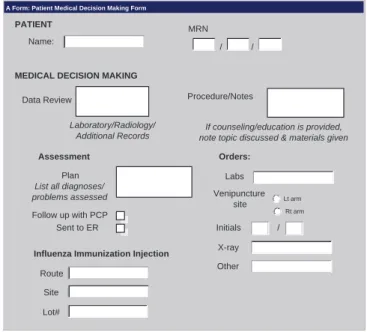
2.1 A Form from Source A . . . 6
2.2 A Form from Source B . . . 6
2.3 A Form from Source C . . . 6
2.4 Resident Admission Form . . . 8
2.5 Communication Form . . . 9
2.6 An existing relational database . . . 9
2.7 Table Merging Conflicts . . . 11
2.8 Column Merging Conflicts . . . 12
2.9 Structure Conflicts . . . 13
2.10 Some Complex Form Patterns: Please enter ... represents a miscellaneous label,BP is a subcategory ofHealth Status,Obesity is an extended radiobutton option,Do you smoke... andIf yes are conditionally related fields . . . 14
3.1 A Form and its Associated Form Tree . . . 18
6.1 Segmented Search Form . . . 32
6.2 2-D Representation of Form Understanding Approaches . . . 36
6.3 Simple and Sophisticated Queries . . . 37
9.1 Overall Approach . . . 50
10.1 Form Understanding and Semantics Extraction Approach . . . 51
10.2 DOM Tree Vs Semantic Form Tree . . . 52
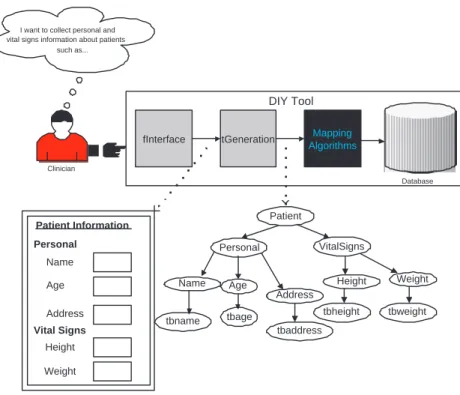
10.3 The do it yourself tool to design data-entry forms and capture form trees . . . 54
10.4 A form representing an advanced need. Please enter accurate ..., Elaborate in a ... are Supporting Texts,Obesity is anextended radiobutton option,bpm is aunit,Do you smoke andHow many times ... make acondition . . . 55
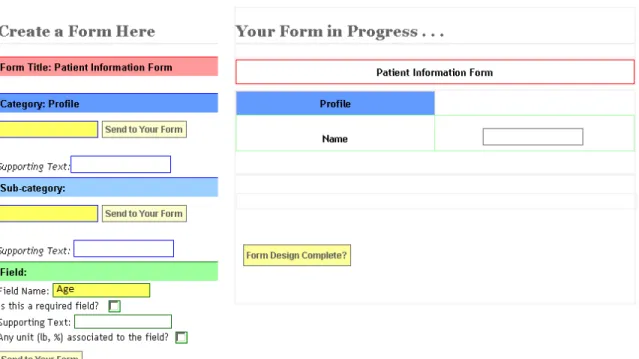
10.5 A screen-shot of the fInterface at step 5 . The left division is a placeholder for the clinician to enter various form components. There are 3 concept gateways in this case: Category, Sub-category, and Field; and the clinician decides to enter the Field gateway. The right
division shows the form being designed . . . 56
10.6 Tree Generation Approach . . . 59
10.7 Tree Generation Steps . . . 59
10.8 User-designed Forms. Tags represent the SNOMED CT semantic categories . . . 62
10.9 Mapping the term “eyes” to SNOMED CT. (a) general mapping (b) category-specific mapping . . . 63
10.10A Form Tree and the associated SNOMED CT semantic categories . . . 67
10.11SNOMED CT Mapping . . . 69
11.1 Correspondence Discovery and Validation . . . 73
11.2 Correspondence Discovery between Form Tree Elements and Database Elements . . . . 74
11.3 A Validation Form for User Intervention . . . 79
11.4 Correspondence Validation . . . 79
11.5 Correspondence State Transitions . . . 80
11.6 Validation Heuristic 1 . . . 81
11.7 Validation Heuristics 2 and 3 . . . 82
12.1 Database Design and Evolution: Overall Approach . . . 83
12.2 Birthing Databases using Forms: Multiple Techniques . . . 84
12.3 Examples: Database Birthing . . . 86
12.4 A Typical Form in the Healthcare Domain . . . 87
12.5 Birthing Cases . . . 89
12.6 Birthing Cases More . . . 89
12.7 Merging Scenario 1: Table to Table . . . 98
12.8 Merging Case 2: Column to Column (Different Tables) . . . 99
12.9 Merging Case 3: Table to Column . . . 101
12.10Merging Case 4: Column to Table . . . 103
13.1 Evaluation Goals . . . 105
15.1 User Interaction and More Patterns . . . 110
16.1 Experiment 1: Automatic Extraction of Semantic Form Trees . . . 113
16.2 Experiment 2A: SNOMED CT Term Annotation . . . 114
16.3 Experiment 2B: SNOMED CT Term Annotation with Term Processing . . . 115
16.4 Experiment 3a: Linguistic-based Discovery . . . 116
16.5 Experiment 3b: Concept-based Discovery . . . 117
16.6 Experiment 3c: Hybrid Discovery . . . 118
17.1 Annotation Performance . . . 120
17.2 Impact of the term processing component . . . 121
17.3 Database Scale . . . 123
17.4 Time Taken for Mapping Forms(in seconds) . . . 124
17.5 Compactness of Databases . . . 125
17.6 Dataset 4: Variety of Forms . . . 126
17.7 Table Comparison - System Generated Vs Gold Databases . . . 128
17.8 Discrepancy Scenarios - System Vs Gold Standard Databases . . . 129
A.1 Dataset 1: Form 1 . . . 155
A.2 Dataset 1: Form 2 . . . 156
A.3 Dataset 1: Form 3 . . . 157
A.4 Dataset 2: Form 1 . . . 158
A.5 Dataset 2: Form 2 . . . 159
A.6 Dataset 2: Form 3 . . . 159
A.7 Dataset 2: Form 4 . . . 160
A.8 Dataset 3: Form 1 . . . 161
A.9 Dataset 3: Form 2 . . . 162
A.10 Dataset 3: Form 3 . . . 163
B.1 Part the Database Generated Using the Forms in Figures A.1, A.2, A.3 . . . 164
Abstract
A Framework for Mapping User-designed Forms to Relational Databases Ritu Khare
Yuan An, Ph. D.
In the quest for database usability, several applications enable users to design custom forms using a graphical interface, and forward engineer the forms into new databases. The path-breaking aspect of such applications is that users are completely shielded from the technicalities of database creation. Despite this innovation, the process of automatically integrating a new form into an existing database remains unexplored. At large, databases continue to remain unusable. This dissertation focuses on investigating the problem of mapping multiple forms into an existing relational database. We seek a framework that automatically detects and merges the semantically matching elements between forms and databases. Upon encountering the unmatched form elements, the framework creates new database elements and integrates them with the underlying database. The technical goal is to ensure that the resultant database is compliant with “high quality” principles defined in terms of form semantics. The usability goal is to ensure minimalism in the user interventions required to discover correspondences.
We introduce a model, theform tree, to represent the user’s semantic intentions represented by a form. We design two anchor approaches to extract the form tree from an arbitrarily-designed form, and to further disambiguate the form semantics by annotating its terms using standard concepts. Thereon, we formulate the following mapping solution: (i) Leverage linguistics and semantics to discover and validate semantic correspondences between the form tree and the existing database. (ii) Devise mapping algorithms that create a new high-quality database for a given form tree, and merge it with the existing database while fusing the semantically equivalent elements. We evaluate the entire framework by developing a prototype, and experimenting in the healthcare domain. We collect 52 clinical forms from different medical institutions, and map them to 6 databases of varying scales. The anchor approaches generate form trees with 98% accuracy, and annotate the form terms
with a precision of 0.89. The framework helps in producing up to 74% principle compliant databases in terms of compactness, and in reducing user interventions by 61%. The experiment results imply that the use of annotation helps in improving the quality of the evolved database.
Part I
Chapter 1: Motivation
Research in “database usability” continually strives to bridge the gap between users and databases1.
A popular aspect of database usability involves the information retrieval (IR) algorithms that en-able users to “search”2–4 and “query”5–10 across complex databases. Another aspect that involves enabling users to “build” databases has only lately gathered some attention11. Recently, certain Do-It-Yourself (DIY)12and What You See Is What You Get (WYSIWYG)13paradigms have been
developed for enabling the non-technical users to build databases on their own. Applications in these paradigms are form-driven, i.e., they leverage the facts that knowledge of data-entry forms is already ingrained in the users14;15, and that the forms contain important information about
databases14;16. These applications enable users to design custom forms, and automatically translate
forms into underlying databases while shielding users from the technical details for database creation and code generation. Example applications include Formassembly17, Zoho Creator18, Jotform19, and Wufoo20.
Despite this innovation in database birthing, most databases remain inflexible with respect to the changing needs of the users21, and hence remain largely unusable from an integration point of
view. The following example from the healthcare domain illustrates the problem.
Example 1.0.1 Clinicians are dependent on the health information technologies (HIT) in their daily activities such as collecting customized data related to patients, diseases, treatments, etc. Figure 1.1 shows a form and an associated back-end healthcare database. The application maintains a mapping between the form and the back-end database.
Suppose a new form as in Figure 1.2, reflecting a new data collection need, is designed to collect data into the same database. The aim is to collect multiple kinds of needs into a holistic model that would provide an integrated view of the clinical information to the users. A technical developer would first link theName,Sex,Date of Birth, and Marital Statusitems on the form to the existing Patient
items under the Social Activitiesgroup on the new form.
Materialization of this problem entails the following: (i) the building of new forms, wherein a technical developer collaborates with the domain experts (i.e., the clinicians) in order to understand the new needs. (ii) the integration of new forms over the existing back-end database, wherein a technical developer directly accesses the database system; studies the existing, possibly complex, schema; and writes the appropriate application code.
Patient Information Patient Name: Sex: Date of Birth: Marital Status: F M HPI: Vital Sign BP: Height: Weight: BMI: Married single Submit
pid name sex dob maritalStatus
hid HPI
vid height weight BP BMI
HPI: History of Present Illness BP: Blood Pressure BMI: Body Mass Index
Patient HPI VitalSign gid code 001 F 002 M sex Date:
piid patient hpi vitalSign date PatientInformation
Figure 1.1: A Form and the Associated Database
Healthy Living Program
Patient Name: Sex: Date of Birth: Marital Status: Social Activities Hours Watching TV: Smokes: Alcolhol:
Hours Exercise: Submit
Date:
Figure 1.2: A New and Interrelated Form
Let us study the scenario from the usability standpoint. The form building task can be improved by using the existing DIY solutions that enable non-technical users for creating forms and databases
while leveraging the users’ intuitive knowledge of data entry forms. This would also help reduce the impedance mismatch between the clinicians’ needs and the back-end databases that may exist as a result of the miscommunication between the non-technical and technical users21. Improving the
integration task, however, is complicated. There is a lack of appropriate solutions to make this more usable to the non-technical users, primarily, because these users do not possess the necessary skills to understand a database schema and write a suitable application code to extend the schema. Even for a technical expert, the integration process is quite tedious, error-prone, and time-consuming22 and often leads to unintended consequences21;23;24.
This motivation makes it desirable to develop a system that automatically maps the user-designed forms to the underlying databases. Upon encountering the form elements that do not correspond to any elements in the database, the system should automatically create new elements and merge them with the existing database. This dissertation focuses on investigating the problem of automatically mapping and integrating multiple forms into an existing structured database.
Chapter 2: Research Problems
We are interested in building a start-to-finish framework that allows users to build forms on their own, and that automatically maps and merges the user-designed form into the hidden relational databases. Since many DIY solutions exist that allow users to build complicated forms, we assume that a user-designed form is already acquired, and that it needs to be mapped to an existing, possibly complex, relational database. As we walk through the sketches of possible solutions, we come across the following problems in that order.
2.1
Form Understanding
The first step in developing a solution to the mapping and integration process is to understand the semantics of user-designed forms. A form contains a sequence of form elements, i.e., text-labels and input elements (textbox, selection list, etc.). We assume that the data-entry form is in a popular machine readable format such as the HTML. Some example forms are shown in the Figures 1.1 and 1.2. A form is primarily designed for human understanding and reflects the semantic intentions of the designer, in particular, the hierarchical parent-child relationships. For instance, the element Height falls under the Vital Sign category in the Figure 1.1.
While humans easily perceive a data-entry form based on past experiences and visual cues, machine processing of a form is challenging. There is an infinite number of possible form layout patterns25, and the forms collected from different sources, possibly designed by different designers,
are even more diverse (See Figures 2.1, 2.2, 2.3). Given this diversity, a machine can only read the syntactic structure of a form, which includes the elements, their sequential order, and the associated formatting. There is no standard convention that associates a certain layout pattern with a certain semantic intention. Since mapping is a semantic problem, we are interested in the semantic structure that captures the semantic intentions associated with the form elements. This semantic structure, however, is not directly readable as it is not captured in a form’s source code.
A Form: Patient Medical Decision Making Form
Name:
PATIENT MRN
MEDICAL DECISION MAKING
Data Review
Assessment Plan
List all diagnoses/ problems assessed Follow up with PCP Sent to ER Orders: Labs Venipuncture site Lt arm Rt arm Initials X-ray Other Procedure/Notes
Influenza Immunization Injection Route
Site Lot#
If counseling/education is provided, note topic discussed & materials given Laboratory/Radiology/
Additional Records
/ / /
Figure 2.1: A Form from Source A
Figure 2.2: A Form from Source B
Figure 2.3: A Form from Source C
2.2
Correspondence Discovery
Once the form’s semantic structure has been extracted, the next step is to link the form elements to the corresponding semantically matching elements in the existing database. We refer to this as the correspondence discovery problem.
At first glance, the problem of correspondence discovery may appear as yet another flavor of the longstanding problems of schema and ontology matching problems26–30. One may wonder whether existing mapping techniques are sufficient to discover the correspondences between forms and databases. The main roadblock in doing so is that so far no fully automatic solutions are avail-able for the schema mapping problem. If we simply adopt a semi-automatic solution to the form to database mapping problem, then the system would require users to examine the intermediate results. The examination would in turn need technical knowledge and background. Such a require-ment would diminish the value and usefulness of the DIY form to database mapping tool that we have envisioned. Also, there are certain conceptual differences between schema mapping and form to database mapping problems. We briefly point out these differences as we enlist the challenges associated with the discovery problem.
• Heterogeneity: Unlike schema mapping, form to database mapping is a case of mapping two heterogeneous structures. Semantically merging two heterogeneous resources is a complex problem31.
• Term Variations: Different users may use different terms to specify the same semantic concept on the form. Reconciliation of this term variety can be accomplished by using existing linguistic similarity based techniques such as exact match, substring, tokenize, stemming, thesaurus, abbreviation, synonyms, etc. Some form specific challenges include handling multi word terms, handling long terms, and identification of relevant concepts from the long terms.
• Correspondence Combinations and Validation: The results of schema mapping are relation-ships between elements in different schemas, while mappings between forms and databases involve not only schema elements but also data values. This just leads to more number of
sible combinations of correspondences, and hence more complications. The initially identified correspondences fall under the following categories.
Form 1: Resident Admission Form
Name: Admitted Form RESIDENT Med. Rec# Admission Date Vital Signs T P PO Enteral DIAGNOSIS Allergies Diet R Past Medical History Notes Regular Liquids Thickened liq BP Ht Wt
Figure 2.4: Resident Admission Form
– 1-1: A form element could match with a single database element. However, certain form terms may match linguistically but may differ semantically from one another, e.g., the form elementVision in Figure 2.5 linguistically matches the with database element, column Eyes in Figure 2.6 but this correspondence is not valid. Therefore, a validation procedure is needed to eliminate the semantic mismatches.
– 1-M: A form element could match with multiple database elements. In this case, either none or one of the correspondences could be valid. An example of 1-M correspondence is the form elementR(as in “respiratory”) in Figure 2.4 that matches with the database elements, the column RRand the tableRespiratory.
– M-1: Several form elements could match with a single database element. In this case, none or many correspondences could be valid as certain elements are repeated in the
Form 4: Communication Form Admitted Form RESIDENT Med. Rec# Admission Date COMMUNICATION Hearing intact impaired R intact impaired L Name: R Hearing Aid L Vision adequate impaired R Mod. impaired Highly impaired Severe impaired L adequate impaired Mod. impaired Highly impaired Severe impaired R Glasses L Contact R Lenses L Speech clarity Yes No Ability to understand Simple commands Simple directives Simple requests Ability to be understood Simple commands Simple directives Simple requests
Figure 2.5: Communication Form
ID Constitutional Eyes ENMT Respiratory
ReviewOfSystems
ID T Wt P Ht BP Respiratory
Constitutional
ID SymChestExpansion NormalRespratoryEffort NormalPalpation
Respiratory
ID Options
1 Adequate 2 Impaired
Vision
Figure 2.6: An existing relational database
form. For example, both the form elements labeled asadequate in the Figure 2.5 match with the database elementAdequatein the Figure 2.6 and both the correspondences are semantically valid.
In sum, once the initial correspondences are identified, using certain linguistic techniques, the next challenge is to eliminate the invalid correspondences possibly by analyzing the structures of both the forms and the databases. The heterogeneity between the structures makes this more challenging.
• Evolution Requirement: Schema mapping, in itself, does not consider the problem of schema and database evolution when there are elements that cannot be matched. Form to database mapping is more sophisticated in that the resultant correspondences are used for evolving the database for the unmapped elements in the form, and the mapping discovery process has to consider this requirement well in advance.
2.3
Form Integration
Once the semantic correspondences between form elements and database elements have been discov-ered, the next problem is to integrate the form elements to the database, i.e., to physically merge the mapped form elements with the semantically matching database elements, and to evolve the database with respect to the new, i.e., unmapped, form elements.
2.3.1
Merging into an Existing Database
We merge the matching form elements with the corresponding database elements so that the same concept is not duplicated in the database, and the database remains compact. The problem at hand is to merge a form into a database given the set of validated semantic correspondences. When a semantic correspondence is created between a form element and a database element, the problem is to merge the elements along with the respective local structures. Merging challenges are similar to the database integration challenges32. However, since the local structures are heterogeneous,
existing solutions can only provide a guideline and cannot be directly applied. Merging a form into an existing database often leads to some conflicting structures26; these are described next.
1. Table Merging Conflicts: These conflicts occur when a form element is mapped to a database table. The Figure 2.7 demonstrated two of such scenarios. In the Form A, the elementResident needs to be merged with the tablePatient. The form element comes with its own context, i.e., the fields Name,Med. Rec. #, etc. Hence the question is whether to create a separate table for the Resident element, and make the 4 child elements as its columns, or to merge all the form elements into the existingPatienttable. The first option would lead to duplication of the same concept, and the latter option would however lead to a larger number of NULL values due to the past mappings. Another merging situation is demonstrated for the Form B wherein the element Vision corresponds to the database table Vision. However, the form element is associated with more specialized semantics (like the elements R and L) as compared to the one reflected in the existing database. Accommodating such elements is challenging.
Form B Form A Name: Admitted Form RESIDENT Med. Rec# Admission Date
ID Name Gender DOB MRN
Patient ID Options 1 Adequate 2 Impaired Vision Vision adequate impaired R Mod. impaired Highly impaired Severe impaired L adequate impaired Mod. impaired Highly impaired Severe impaired
Figure 2.7: Table Merging Conflicts
The goal of the merging process is to retain the contextual information associated with the form element. A challenge is how to merge the elements while accurately escalating all the semantic form element information into the database. In traditional schema integration, it is suggested that a higher abstraction level should be chosen when there is a conflict in the representation of a concept32.
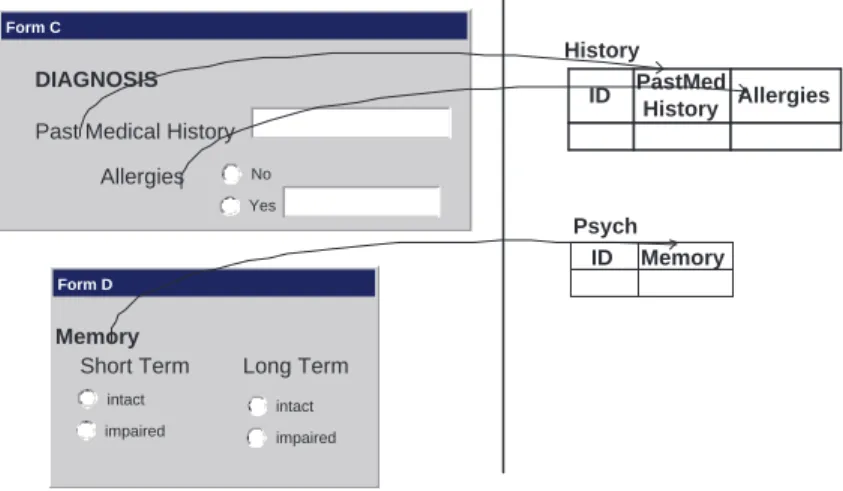
2. Column Merging Conflicts: These conflicts occur when a form element is mapped to a database table column. The Figure 2.8 presents a couple of such scenarios. In the Form C, the element Past Medical History corresponds to the database column History.PastMedHistory. The chal-lenge is to accommodate the parent form element, i.e., Diagnosis; i.e., whether to merge and connect the matching elements through foreign keys, or to duplicate the elements in separate tables. Similarly, for the case of Form D, the question is how to reflect the form elements asso-ciated withMemory in the database while retaining the association between the form element Memory, and the database column Psych.Memory. Overall, similar to the previous conflict,
Form C DIAGNOSIS
Past Medical History
ID PastMed History Allergies History Allergies No Yes ID Memory Psych Form D Memory
Short Term Long Term intact
impaired
intact impaired
Figure 2.8: Column Merging Conflicts
the goal is to resolve the difference in structures while accurately reflecting the form semantics in the final integrated database.
3. Structure Conflicts: Also known as geometric conflicts, such conflicts arise due to the structural differences between the form and the database. A special case of such conflicts are the cardi-nality conflicts. Consider the database in the Figure 2.9, the referential integrity constraint suggests that a physician can be associated with multiple patients. In contrast, the Form E clearly states that a patient can have multiple physicians associated with her. To resolve this, we cannot simply remove the foreign key as it may affect the previous mappings. One solution is to create a join table that reconciles both the structures. While this is a simple example, the structural conflicts are likely to get very complicated as the database scales up. In database
Form E Patient ID Physician Patient Physician 1 ID Physician Physician 2
Figure 2.9: Structure Conflicts
integration, such conflicts are resolved by taking the less constraining structure as the final structure32, however this is not feasible in integrating forms into databases, because all the structures need to be stored in the database, other it would disrupt the previous mapping.
In addition, there are some data-level conflicts33 and term conflicts that are beyond the scope
of the problem in focus. Overall, the goal of conflict resolution is (i) to reconcile the differences between the local structures of both the mapped elements, (ii) to maintain the original semantics of both the form element and database element in the evolved database, and (iii) to do so while considering the database design principles like minimize null values, and avoid duplicating the same concept.
2.3.2
Birthing a New Database
During form integration, some form elements are likely to not match with any of the existing database elements. This may happen when either the form to be mapped is unrelated or partially related, or when the database is empty. Given this, the form to database mapping framework should be able to merge the matching elements, and also to extend the hidden database for the unmatched elements on the form. We call the process of generating new database elements out of the form elements as birthing. Birthing comes with its own set of challenges such:
1. How to automatically derive the basic ingredient of relational database design, i.e., the func-tional dependencies, among the form elements?
2. How to automatically derive cardinalities among the form elements?
3. How to handle the complex design patterns on forms such that one shown in the Figure 2.10.
Health Information Form
HR* BP Do you smoke? Yes No Health Status bpm
(Please enter accurate information)
Systolic Diastolic Current Problems Obesity Depression None Problem Area
If yes, how may times a week?
Figure 2.10: Some Complex Form Patterns: Please enter ... represents a miscellaneous label,BP is a subcategory ofHealth Status,Obesity is an extended radiobutton option,Do you smoke... andIf yes are conditionally related fields
4. For a given form pattern, how to evaluate multiple design alternatives and choose one?
2.4
Research Questions and System Goals
Given the challenges associated with the aforementioned problems, the key research questions are: • Form Understanding:
– What could be an appropriate model to accurately capture the semantic structure of a given user-designed form?
– How to automatically extract this semantic model from an arbitrarily designed form? • Correspondence Discovery:
– How to represent the form and the database into equivalent and compatible structures such that correspondences can be built?
– How to determine the semantically equivalent database elements for the given form ele-ments?
– How to incorporate the form database evolution requirement during the correspondence discovery process?
• Form Integration:
– How to resolve the merging conflicts while maintaining the original semantics of forms in the database?
– How to automatically derive a relational database corresponding to an arbitrary pattern of form elements?
In this thesis, we seek the answers to these research questions through the development of a system that automatically maps a user-designed form to an existing database. The first goal of the system is to ensure that the resultant database accurately maintains the semantics of the mapped form, and is principled from the context of the classic database design theories. The second goal of the system is the ensure the minimality of the required user intervention during the process of correspondence discovery.
Chapter 3: Research Methods
To answer the research questions associated with the mapping problem, we propose several algo-rithms leveraging, in particular, the rich semantics embedded in user-designed forms. We adopt a systems-based empirical approach to evaluate the entire framework. In this chapter, we con-ceptualize the terminology adopted in the subsequent sections, throw some light on the proposed approaches, and describe the empirical methods.
3.1
Formalism
We now formally describe the terminology and concepts that were briefly touched upon in the previous sections and that will be adopted in the subsequent sections.
3.1.1
Form
The primary object of this study, a form, is formally defined in Definition 3.1.1. A form consists of a collection of form elements laid out in a particular way. Example form elements includetext label, text box, radio buttons, select list, and check boxes. The data type of an element can be extracted from the source code of a form, for example,Datefor calendar input. Furthermore, the source code of a form often provides constraint information, e.g., whether an input is required or optional. In the subsequent sections, we adopt a semantic representation of a form known as theform tree, formally described in Definition 3.1.2. The form tree is a hierarchical tree structure, e.g., Figure 3.1 shows a form and its corresponding form tree. A form tree captures the semantic intentions of the designer. Each node in the tree represents a form element. Graphically, we use different shapes to represent the different types of nodes. Each edge in the tree represents a semantic association between any two form elements.
Definition 3.1.1 (Form) A Form is a sequence of form components where each component is either a text-label or a form-input such that
1. A form-input is one of the followingformats: textbox,textarea,radiobutton group,checkbox group, or dropdown listsimilar to their specification in HTML 4.0.
2. A text-label is one of the following:
• field, the label associated with one or more form-inputs.
• category, the group label that semantically covers one or morefieldsand their associated
formats.
• subcategory, the sub-group label that is laid under the semantic scope of a category and that further contains (sub-)fieldsand associatedformats.
Definition 3.1.2 (Form Tree) A form tree is defined as a labeled, directed and ordered tree, F T = (N, E, <sib, root), where N = I ∪ E ∪ V is a finite set of nodes, E is a finite set of edges,
<sib is the next-sibling relation between children of a tree node, androot∈N is the root of the tree.
Moreover,
• I is a finite set of input elements (or inputs), where items ofI are drawn from the following set of inputs: {text box,text area,radio buttons,check boxes,drop-down list,calendar} ;
• E is a finite set of logical elements. Each e ∈ E has a label l =λ(e), a data type t = τ(e), and a constraint k=κ(e), where the function λ(e) returns the label l of e, the function τ(n) returns the data typet of e, and the functionκ(e)returns the constraintkof e.
• V is a finite set of values;
• For an edge (ni−→nj)∈E,ni, nj∈N,ni is calledparentandnj is calledchild.
3.1.2
Database
Definition 3.1.3 (Database) A (relational) databaseD= (I, R,Σ)is a 3-tuple, where
A New Form dob Symptoms Name Insurance Patient Delivery Information Delivery# Date PNC Provider WCC CNM root Patient Delivery Information tb_name tb_ins Name dob insurance symptoms
: element node : format node
: value node tb_dob tb_sym date Delivery# PNCProvider tb_date tb_delivery# rb_pnc tb: text box rb: radio button WCC CNM
Figure 3.1: A Form and its Associated Form Tree
• I is a set of relations. A relationT consists of a set of tuples conforming to its schema. tTinT
represents a tuple in table T and tT.Ai refers to all the values under the attribute Ai of table
T andtT.vAi refers to a specific valuev under the attributeAi.
• R is the schemas of the relations. The schema for a relation specifies the name of the relation, the name of each column (or attribute or field), and the type of each column. We use the notationT(A1, A2, ..., An)to represent the schema of a relationT with attributesA1, A2, ..., An,
and we use the notationT.Ai to refer to the attribute Ai of the relationT.
• Σ is a set of integrity constraints imposed on the relations. The integrity constraints impose conditions that the tuples in relations must satisfy. Here, we consider the key and foreign key constraints. A key in a relation is a subset of the attributes of the relation that uniquely identifies a tuple. A foreign key in a relation T is a set of columnsF that referencesthe key of another table T0, and imposes a constraint that the projection ofT on F is a subset of the projection ofT0 on the key ofT0.
3.1.3
Mapping
Definition 3.1.4 (Mapping) A (transformation) mappingMfrom a form tree F T = (N, E, <sib
, root)to a databaseD= (I, R,Σ)is a set of correspondences and predicates such that
• a correspondence F T:P/e D:D.drelates a nodee∈N of the form tree reached by a simple path P to an element din the database componentD where
– A simple path P is always relative to the root of the form tree, in which “/” is used to represent a parent/child relationship.
– A database component could be either a tuple in a table T or the schema of the table. • Based on various mapping scenarios, we identify two kinds of correspondences:
– Regular: the element nodee∈ F T.E maps onto a table T in the database, or onto to the attribute T.Ai in the database, or onto a valuevAi of an attribute T.Ai in the database.
– Data Binding: the element node e∈ F maps onto the attribute T.Ai such that the node
e is a container for the values stored inT.Ai.
• A predicate specifies the reference edges in the database graph DG. Each predicate is an edge (mi, mj)∈ DG.D,mi∈ C, mj∈ T in the database graph, such that the column nodemi reflects
a foreign key column in a referencing table in the database, andmj reflects the referenced table
in the database.
While studying the mapping problem, we realize that there are certain common principles that need to be taken into account to effectively carry out the processes of form understanding, corre-spondence discovery, and form integration. We formally present the principles in the form of the mapping principles. Overall these principles ensure that the resultant mapping and the database are high quality and optimized so that eventually the data collected through these forms is also high quality34. We borrow the ideas from the standard database textbooks (e.g.,35) contain rich content about designing normalized databases with “good” properties including avoiding logical inconsistency and update anomaly. These are summarized next.
Quality: A database expert, while designing databases, aims for certain “good” properties of a database as recommended by the standard database textbooks (e.g.,35–37.). In the same lines, we
summarize the properties for deriving mappings in the following manner.
• P1 Correctness.Given a form tree F T = (N, E, <sib, root) and a database D = (I, R,Σ).
The mapping Mfrom form to database is correct, if and only if each correspondence F T:P/e
D:D.dis correct, i.e., both elements P/e andD.d contextually represent the same concept in the application domain. Correctness can be assessed based on label matching and context matching. The context of a node refers to the connections, i.e., edges, among various form elements in the tree/graph. Overall, the correctness of a database generated out of a form tree stipulates that the structure of the form tree is accurately maintained in the database.
• P2 Completeness.Given a form treeF T = (N, E, <sib, root)and a database D= (I, R,Σ).
The mapping Mfrom form to database is complete, if and only if for each data item collected on the form, there is a correspondence in a mappingMiwhich maps the data item to a database
element.
• P3Compactness.Given a form treeF T = (N, E, root). A databaseD= (I, R,Σ)is compact in terms of storing data collected on the form, if and only if there is at most one correct mapping M: {F T:P/e D:D.d}for any node e∈N of the form tree.
• P4 Normalization. We say the databaseDis a normalized database with respect to the form tree F T if the databaseDis in 3NF with respect to all functional dependencies associated with the F T.
Optimization: Given a form, there could be several mapping alternatives that comply with the aforementioned quality principles. A professional designer selects the alternative that minimizes any potential query processing issues in the evolved database. Along the same lines, we describe some optimization principles38 as presented next.
• P5 Minimize foreign-key NULL values. This principle stipulates that the mappings should minimize the possibility of having NULL values in a foreign key column of the database to avoid any loss of information while performing the JOIN queries.
• P6 Minimize non-key NULL values. This principle stipulates that the mappings should minimize the possibility of having NULL values in a any non-key column, particularly a numeric
column, to avoid retrieving inapplicable results while performing queries involving aggregate functions such as SUM and AVERAGE.
• P7Minimize database elements and joins. In case of multiple mapping alternatives each satisfying the above principles, P1-P6, the alternative that leads to fewer number of tables, columns, or foreign key references should be selected.
3.2
Approaches
We propose a framework that maps an arbitrarily designed data-entry form into an existing relational database. The steps involves and the approaches proposed are described next.
1. Form Understanding: The first step is to understand the designer’s semantic intentions that are implicitly embedded in the form. To represent the intentions, we introduce a semantic structure known as the form tree. We develop a machine learning technique based on layered Hidden Markov Models(HMMs). Using this, the system is able to simulate the process through which a human being understands the form semantics, and thus able to extract the form tree from an arbitrarily designed form.
2. Form Tree Annotation: To overcome the challenges encountered in the subsequent steps, we further disambiguate the semantics of the terms, i.e, the label elements, in the form. Once the form tree is retrieved, the framework annotates each node with an appropriate standard concept from a popular terminology. To perform the annotation, we develop a machine learning technique based on Naive Bayes Classifier that exploits the semantic structure of the form to derive a unique standard concept for a given tree node. The annotated node represents the precise semantics of the contained term, thereby overcoming many challenges associated with correspondence discovery and form integration.
3. Correspondence Discovery: The next step is to discover the correspondences between the form tree elements and the existing database elements. To accomplish this, we adopt a hybrid technique leveraging both the term linguistics and the semantic annotations of the form and the database elements.
4. Correspondence Validation: Once the correspondences are discovered, the next step is to ensure their correctness. A naive method is to present all the correspondences to the user for further validation. However, this would lead to a large number of user interventions especially when mapping to a large scale database. Hence, we devise a validation algorithm, that automatically validates or eliminates certain correspondences. The algorithm is designed in a decision tree fashion that evaluates the correspondences based on the local structure of the form tree and the database. The correspondences that are yet unvalidated are forwarded for user intervention.
5. Database Birthing: After the form tree has been derived and the correspondences have been discovered, the framework generates a new database corresponding to the form tree to rec-oncile the structural differences between the form and the database. The birthing algorithm is designed while considering various quality and optimization mapping principles, i.e., P1 through P7. The algorithm is based on the assumption that the parent-child association in the semantic form tree accurately reflects the functional dependency information required to design a normalized database. The birthing algorithm works in an incremental manner while translating each form pattern into equivalent database elements, and eventually generates a complete database.
6. Database Evolution: Finally, the discovered correspondences are transferred to the new database, and are used as anchors for merging the new database with the existing database. We design a merging algorithm to accomplish the final integration step. The algorithm merges the equiva-lent elements together in the final database while establishing a configurable trade-off between the compactness principleP3 and the minimize NULL-value principleP6.
3.3
Evaluation
We adopt an empirical approach to evaluate the framework. The modular design of the framework gives an opportunity to design multiple experiments for assessing various aspects. We develop a functional prototype of the framework and perform experiments with forms currently being used to collect clinical data in various healthcare institutions. Through the experiments, we measure how
each part of the framework facilitates in accomplishing the primary goals of principle compliance and user intervention minimization. In particular, we design the following experiments.
1. Automatic Form Understanding: This experiment is conducted to measure the performance of the HMM-based form understanding module. We measure the accuracy of the generated form trees by comparing with the “gold” form trees that capture the actual semantic intentions of the designer. The results contribute to the compliance of the final results with the correctness P1, the completenessP2, and the normalizationP4 principles.
2. Concept Annotation of Form Terms: This experiment is designed to measure the performance of the concept annotation module. We design multiple variations of this module with differ-ent combinations of semantic structural information and linguistic information of the form elements. We select the variation that produces the best performance in terms of recall and precision, and use it for further experiments. The annotation module helps in extracting more precise semantics from the individual form elements, and thus also contributes to the overall correctness (i.e., principle P1) of the resultant database.
3. Form to Database Mapping: This set of experiments is designed to measure the performance of the entire mapping framework. The experiment begins with a given form tree and an existing database, followed by correspondence discovery and validation, and database birthing and evolution. We design three variations of the experiments: (i) when the form tree is raw, i.e., unannotated, and the correspondence discovery is performed using linguistic match (ii) when the form tree is concept annotated, and the correspondence discovery is performed using exact concept matching, (iii) when the form tree is concept annotated, and the correspondence discovery is performed using hybridization of concept and linguistic matching techniques. We measure several aspects of the framework, including the number of user interventions, relevance of the intervention screens, percentage of approved mergers, extent of annotation, etc. Overall, we measure the compliance to design principles, in particular, the compactness principle, P3, and the number of required user interventions across different variations.
Chapter 4: Contributions
This thesis work makes several contributions including discovering new research problems, devising successful solutions, drawing implications for further research, and identifying the limitations of the proposed methods and experiments.
4.1
New Problems
There are many existing tools that enable users to design forms and forward engineer the forms to new relational databases. However, the problem of integration and mapping of new forms to existing databases has never been proposed or studied in the past. In this thesis, we formally conceptualize the problem of mapping user-designed forms into databases. This problem is comparable and yet different from the longstanding schema matching problem in several aspects. A solution to this problem would enable the users to automatically integrate and induce new needs into the existing databases, and thereby evolve the databases on their own.
In the process of developing a solution to the mapping problem, we discover another novel problem of annotating form terms, instinctively supplied by the users, using standard terminology concepts. We focus on the healthcare domain and study the problem of finding an equivalent SNOMED CT concept for a given user-defined form term. There have been several works on annotating the clinical artifacts such as free-form notes written by nurses. However, the problem of standardizing form terms has never been studied before. We believe that a solution to this problem is likely to facilitate the process of integrating new forms to relational databases.
4.2
New Solutions
While addressing the mapping problem, we identify several issues arising in the development of a viable solution. We elucidate the possibilities and limitations, and develop the following novel approaches.
• Form Tree Extraction Algorithm: To address the much explored problem of automatic form understanding, we develop a novel solution to extract a semantic structure, i.e., the form tree, from an arbitrarily designed data-entry form. The solution is a machine learning based approach that comprises a layered Hidden Markov Model and certain tree design rules.
• SNOMED CT Annotation Algorithm: To annotate a given form using SNOMED CT concepts, we develop a machine learning based solution that leverages the semantic structure as well as linguistic of a form term to derive the equivalent concept in the SNOMED CT. The key component is a Naive Bayes classifier that analyzes the semantic structure of a form and classifies each term with respect to a semantic category in the SNOMED CT.
• Correspondence Validation Algorithm: We develop a heuristic-based solution to automatically validate the initial discovered correspondences between forms and databases and minimize the need for user intervention. Given a form term and a database element, the approach analyzes the local semantic structure of the form term and the database element and decides whether the correspondence is plausible or not.
• Birthing Algorithm: Given a semantic form tree, we develop a birthing solution to develop a new database corresponding to the form tree. The significance of the algorithm is that it is inspired by the quality and optimization principles. For any given form pattern, the algorithm ensures the compliance of the resultant database with these principles.
• Merging Algorithm: Given the new database corresponding to a given new form, an existing database, and the discovered correspondences, we develop a merging solution to merge the two databases while establishing a trade-off between the quality and the optimization principle.
4.3
Results and Implications
We conduct extensive experiments in the healthcare domain using 52 highly complex data-entry forms collected from 6 medical institutions. These forms are mapped to evolve 6 databases of varying scales, with at least 35 and at most 450 tables. The empirical analysis makes the following contributions and implications.
• The form extraction solution accomplishes up to 98% accuracy in representing any arbitrarily designed form. The algorithm takes less than a second to derive a semantic tree of average scale, i.e., with 135 edges.
• The concept annotation solution achieves an average precision of up to 0.89 and an average recall of up to 0.76. It takes at least 1 and at most 11 seconds to annotate a given form tree. Compared to an existing linguistic-based annotation solution, the proposed approach achieves 43% improvement in terms of precision, and 29% improvement in terms of recall.
• We devise 3 versions of the validation algorithm leading to up to 18 situations with different databases. The algorithm reduces the user interventions by an average 61% for all the situa-tions. The 3 versions required 10, 8, and 13 interventions per form, respectively, in discovering and validating the correspondences.
• On being compared with the expert-designed databases corresponding to 3 datasets, the birthing solution produces databases that are 84.5% identical or superior to the expert-designed ones, wherein, superiority is defined in terms of the compliance with the quality and the op-timization principles. The merging algorithm preferred compactness over opop-timization, and merged the semantically matching elements, in at least 70% of the merging scenarios, in 11 out of the 18 cases. The final version of the framework helped the merging algorithm in ensuring the compactness of the evolved database in 74% of the merging scenarios.
Overall, we draw the following key implications for further research.
• In order to achieve a high annotation performance, it is desirable to design hybrid annotation methods that leverage both the semantic structure as well as the linguistic properties of the form elements.
• The use of annotation has a far-reaching impact on the quality, in particular, the compactness, of the resultant database. The use of annotation led to at least 19% improvement in identi-fication of merging situations and at least 13% improvement in compactness. This however came at the cost of increasing the number of required user interventions.
• Both the validation and birthing algorithms could be improved by further expanding the observation set of form patterns and mapping scenarios. This is likely to further improve the database compactness, and minimize user interventions.
The proposed approaches do contain certain limitations. Both the proposed form understanding and the form annotation approaches are based on supervised learning techniques, i.e., require manual tagging of forms for training the employed machine learning models. Also, other machine learning models, such as Support Vector machines, Classification Association rules, that could also be used for designing the algorithms have not been tested in this study. The evaluation is based on the assumption that the user-supplied correspondences are 100% correct, which may be far from reality. The gold results used for evaluating the experiment results are only an approximation of the ideal results. Moreover, the compliance of the birthing algorithm with the design principles is yet to be theoretically verified.
Chapter 5: Thesis Organization
The rest of the thesis is organized into the following parts.
• Part II presents the literature review. Chapter 6 reviews the literature related to understanding the form semantics. Chapter 7 reviews the literature related to form-driven database design. Chapter 8 reviews the literature related to database integration.
• Part III presents our solutions for the framework proposed in this dissertation. Chapter 9 de-scribes the overall approach. Chapter 10 presents the proposed form understanding techniques. Chapter 11 presents the mapping discovery and validation approach. Chapter 12 presents the algorithms proposed for database design and evolution.
• Part IV presents the evaluation of the proposed framework in the healthcare domain. Chapter 13 describes the objectives of the evaluation. Chapter 14 describes the data and gold stan-dards. Chapter 15 describes the experiment prototype and settings. Chapter 16 presents the experimental design, and Chapter 17 presents the experimental results and findings.
• Part V presents the final remarks on the dissertation study. Chapter 18 describes the con-tributions and the thesis conclusions. Chapter 19 describes the limitations, and Chapter 20 presents the future work.
Part II
Chapter 6: Review: Understanding Form Semantics
Forms are commonplace objects14, and are organized based on longstanding conventions which are
already encoded within users15. Therefore, forms make an excellent communication medium for
non-technical users. A form template provides a simple abstraction over the relational database schema or an entity relationship model, which are otherwise difficult to comprehend by a user.
There are two kinds of forms: data-entry forms and search forms. Both reflect a portion of the underlying database. While search forms help in “determining” the underlying database39,
data-entry forms might help in “designing” a prospective database16. Form understanding is not a new
problem, and has been studied in the past in the context of search forms. We conducted a survey40
on various search form understanding techniques. Form understanding is a multi-staged process that involves modeling, parsing, segmentation, and segment processing. the following sections present the survey results in the light of the various stages of the form understanding process.
6.1
Modeling
In this stage, a form is modeled into a formal structure suitable for machine processing. This stage was studied under the two dimensions: information on implied queries, and information on constraints.
A form contains multiple segments, each corresponding to an implied query. The surveyed works use a variety of segment labels to refer to a segment. The segment label adopted by LITE41 and
LEX42 is “logical attribute.” These works model a form as a list of queries, each specific to an
underlying database table attribute. The segment contents for LITE include a form element, and a text-label. LEX models a segment to have a text-label, multiple form elements, and an optional text-label associated with each form element. It assigns the semantic labels “attribute-label,” “do-main/constraint element,” and “element label,” respectively, to these components. The work on Hidden Syntax Parser (HSP)43adopts “conditional pattern” as the segment label. Each conditional
pattern represents a specific query capability of the underlying database. A conditional pattern consists of a text with a semantic label “attribute name,” a form element with label “operator,” and a form element with label “value.” The model adopted by Khare and An44is also similar in that it
represents a form as a sequence of segments, and uses “attribute-name,” “operator,” and “operand,” as the semantic labels. In addition to modeling segments corresponding to implied queries, Bensli-mane et al.39 also create groups of segments, known as the“structural units.” Each structural unit
corresponds to a logical entity in the database schema. Certain works do not explicitly assign any labels to segment or segment components, but do mention the segment contents. Kaljuvee et al.45, LabelEx46, andDEQUE47model a segment to consist of a text-label and one or more form elements.
Dragut et al.48 and ExQ49 present a novel way of modeling a form as a tree structure having
ar-bitrary number of levels. Both these works create groups and sub-groups of related form elements and text-labels, and hypothesize a hierarchical structure. Each internal node of the tree represents a text-label and has a group of related form elements as its descendants. Hereafter, the works by Kaljuvee et al.45, Benslimane et al.39, Khare and An44, and Dragut et al.48, are referred to as
CombMatch,FormModel,HMM, andSchemaTree, respectively.
In terms of constraints, HSP and LabelEx model a form element to have a domain of values. DEQUE models a form element to have domain, and invisible and visible values. LEX models a segment to have a domain type, and a default value. It models a form element to have domain type (finite, infinite, Boolean), and a unit ($, grams, days, seconds). FormModel includes the rela-tionship among structural units, constraints, and the underlying source information. HMMmodels miscellaneous texts which might include information on constraints.
6.2
Parsing
Parsing marks the beginning of automatic processing, and brings the form into a workable physical structure. While the modeling stage provides a logical image to a form, the parsing stage physically reads the form components. Parsing strategies were studied under the following dimensions: input mode, description, and purgation. The input to the parsing stage can be in two modes: HTML source code of a form, and its visual counterpart, i.e., a form as viewed on a Web browser. CombMatch,
LEX,FormModel, andHMMuse HTML code as the primary input. Along with HTML code,LabelEx, LITE,HSP,DEQUE,ExQ, andSchemaTreeuse layout engines to extract the visual features, such as pixel distances between components.
Description refers to the tasks performed while parsing a form. LITEparses a form in the “Prun-ing” stage wherein the components that directly affect the layout and labels of form elements are isolated from the rest. CombMatch, in its “Chunk Partitioning” stage, segments an interface into chunks delimited by HTML and TABLE cell tags. LEXdevelops an “interface expression” that looks like ’teeeteeetteeeet.’ HSP parses a page into a set of tokens using its module, “Tokenizer,” and stores information such as name, layout position, etc. HMMcreates a DOM tree of form components and traverses the tree in depth-first order. SchemaTree, in its “Token Extraction” module, creates lists of text tokens, field tokens, and image tokens, and also stores the information about their bound-ing boxes. Purgation denotes the components that are removed while parsbound-ing to avoid information overload on subsequent stages. LITEdiscards images and text styling information. FormModeland CombMatchremove stop words and text formatting tags. DEQUEignores the components that cor-respond to font size, typefaces, and styling information. HMM ignores all the components except the form elements and the text-labels.
6.3
Segmentation
After a suitable logical representation and a physical structure are accomplished, the form is seg-mented, i.e., the information regarding the implied queries is extracted from the form. Figure 6.1 shows a segmented form having 2 queries.
A Data Entry Form
Marker Range use current symbols
between and
e.g., between D19Mit32 and Tbx10 cM Position
e.g., 10.0-40.0
between
Figure 6.1: Segmented Search Form
Segmentation can be visualized as a 3-task process. The first task, text-label assignment, involves associating a form element with a surrounding text-label. The second task is grouping where the related form components are grouped together to form a segment. In the third task, semantic labeling, labels or query roles are assigned to individual components of a query. Automatic text-label assignment and grouping are difficult due to diversity in Web design. Automatic semantic labeling is difficult as Web designers usually do not assign explicit labels in the HTML source code. A majority of the works (LITE,CombMatch,DEQUE,LabelEx) only address the text-label assignment problem. LEXgroups related text-labels and form elements together into “logical attributes.” HSPfinds groups of “conditional patterns.” LEX, HSP, and HMM, perform grouping as well as semantic labeling. LEX also identifies the “exclusive attributes” on a form based on a domain-specific vocabulary. SchemaTreeperforms text-label assignment and creates segments and sub-segments resulting into a tree of form tokens. ExQextracts the grouping information of a form into an unlabeled tree structure and then performs text-label assignment to generate a labeled tree.
Segmentation techniques, i.e., the mechanisms to segment a form, belong to 3 categories: heuris-tics, rules, and machine learning. Heuristic-properties are of 3 kinds: textual, styling and layout. Textual properties include text length, no. of words, string similarity, element’s HTML name, etc. Styling properties include font size, font type, form element format, etc. Layout properties include position of a component, distance between two components, etc. To perform text-label assignment LITE exploits all 3 kinds of heuristics. CombMatch uses a combination of 8 different algorithms leveraging the 3 kinds of heuristics to assign text-label to a form element. DEQUEandLEXperform text-label assignment based on the textual and layout properties of components. In LEX, all the form elements associated with same text and the text itself are assigned to one segment. Based on heuristics, it also assigns the semantic labels, “attribute label,” “constraint element,” “domain element,” and “element label” to the components.
A rule is a formalized heuristic. Rule-based techniques rely on regular expressions, grammar, or finite state methods; and create rules for associating a form element with a surrounding text. HSP assumes that a hidden syntax guides the presentation of form components on a form template. The