Incorporated in Rule 6A‐14.095, Site Determined Baccalaureate Access Effective ____, 2015
BACCALAUREATE
PROPOSAL
APPLICATION
Form
No.
BAAC
‐
02
Section
1007.33(5)(d),
Florida
Statutes,
and
Rule
6A
‐
14.095,
F.A.C.,
outline
the
requirements
for
a
Florida
College
System
baccalaureate
program
proposal.
The
completed
Proposal
form
shall
by
submitted
by
the
college
president
to
the
Chancellor
of
the
Florida
College
System
at
[email protected].
In
addition,
a
printed
version
shall
be
mailed
to
the
Division
of
Florida
Colleges
at
325
West
Gaines
Street,
Suite
1544,
Tallahassee,
Florida
32399
‐
0400.
The
proposal
requires
completion
of
the
following
components:
Program
summary
Program
description
Workforce
demand
and
unmet
need
Planning
process
Enrollment
projections
and
funding
requirements
Student
costs:
tuition
and
fees
Program
implementation
timeline
Facilities
and
equipment
specific
to
program
area
Library
and
media
specific
to
program
area
Academic
content
Program
termination
Appendix
tables
Supplemental
materials
Florida
College
System
Institution
Name:
Santa
Fe
College
Florida
College
System
Institution
President:
Dr.
Jackson
Sasser
PROGRAM
SUMMARY
1.1
Program
Name:
Information
Systems
Technology
1.2
Degree
type:
☐
Bachelor
of
Science
X
Bachelor
of
Applied
Science
1.3
How
will
the
program
be
delivered
(check
all
that
apply):
X
Face
‐
to
‐
face
X
Hybrid
X
Online
1.4
List
the
counties
in
the
college’s
service
district:
Alachua,
Bradford
1.5
Degree
CIP
code
(6
digit):
11.0103
1.6
Anticipated
program
implementation
date:
January
2016
1.7
What
is
the
primary
associate
degree
pathway
for
admission
to
the
program?
Associate
of
Science
(AS)
in
Networking
Services
Technology
&
AS
in
Programming
and
Analysis
1.8
Is
the
degree
a
STEM
focus
area?
X
Yes
☐
No
1.9
List
program
concentration(s)
(if
applicable):
1.10
Will
the
program
be
designated
such
that
an
eligible
student
will
be
able
to
complete
the
program
for
a
total
cost
of
no
more
than
$10,000
in
tuition
and
fees?
☐
Yes
X
No
PROGRAM
DESCRIPTION
2.1
Describe
the
program.
Santa
Fe
College
(SF)
proposes
offering
a
Bachelor
of
Applied
Science
(BAS)
in
Information
Systems
Technology
(IST)
beginning
in
the
Spring
of
2016,
according
to
the
authority
granted
in
Florida
Statute
sections
1007.33.
The
proposed
degree
will
prepare
students
to
be
proficient
at
a
higher
level
of
application
and
system
programming,
network
design
and
management,
and
database
design
and
management,
as
well
as
provide
the
necessary
professional
development
necessary
for
the
sophisticated
workforce
demanded
by
the
growing
local
information
technology
industry.
The
new
bachelor's
degree
is
specifically
designed
to
articulate
with
Santa
Fe
College’s
Associate
of
Science
(AS)
in
Networking
Services
Technology
and
AS
in
Programming
and
Analysis.
WORKFORCE
DEMAND
AND
UNMET
NEED
3.1
Describe
the
career
path
and
potential
employment
opportunities
for
graduates
of
the
program.
A
wide
variety
of
computer
‐
related
jobs
are
currently
in
high
demand
in
Alachua
and
Bradford
Counties.
Graduates
from
the
proposed
program
will
be
able
to
build
upon
the
skill
sets
they
developed
in
our
AS
in
Networking
Services
Technology
and
AS
in
Programming
and
Analysis
and
complete
upper
‐
division
courses
in
management;
computer
operating
systems;
information
system
design
and
analysis,
database
administration;
and
other
courses
related
to
web
design,
mobile
devices,
and
computer
networks.
This
more
specialized
training
will
enable
graduates
from
the
proposed
BAS
to
find
employment
as
computer
and
information
systems
managers,
computer
systems
analysts,
computer
programmers,
software
developers,
web
developers,
database
administrators,
and
network
and
computer
systems
administrators
or
specialists.
The
job
prospects
for
graduates
of
this
proposed
program
is
excellent.
3.2
Describe
the
workforce
demand,
supply
and
unmet
need
for
graduates
of
the
program
that
incorporates,
at
a
minimum,
the
shaded
information
from
appendix
tables
A.1.1
to
A.1.3.
The
Florida
Department
of
Economic
Opportunity
(FDEO)
estimates
that
there
were
2175
jobs
in
Alachua
and
Bradford
Counties
during
2014
for
computer
specialists
and
computer
information
system
managers.
An
estimated
75
jobs
per
year
will
become
available
in
Alachua
and
Bradford
counties
from
2014
‐
2022
for
these
types
of
professionals.
Although
the
University
of
Florida
offers
undergraduate
programs
in
Computer
Engineering
and
Computer
Science,
its
graduates
are
being
recruited
on
a
national
scale,
and
no
college
or
university
in
North
Central
Florida
provides
a
baccalaureate
program
in
information
technology
to
meet
immediate
regional
workforce
needs.
Seminole
State
College
of
Florida
(SSCF)
and
Indian
River
State
College
(IRSC)
are
the
two
closest
public,
higher
education
institutions
providing
baccalaureate
training
in
information
technology.
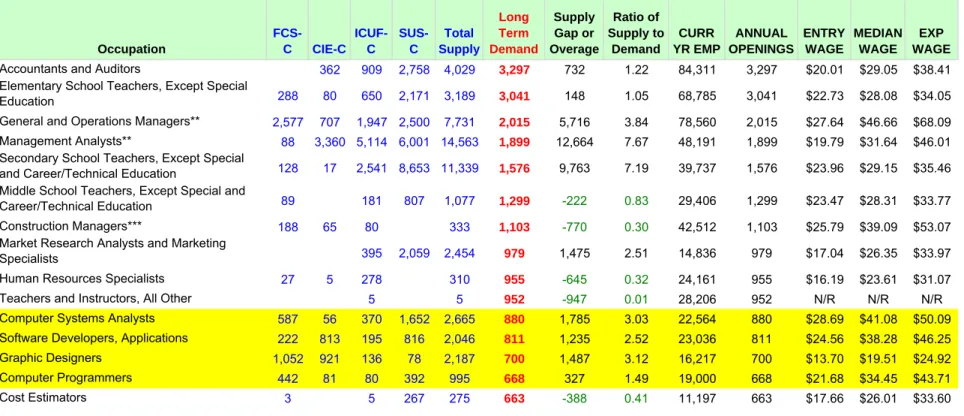
Computer
systems
analysts,
software
developers,
and
computer
programmers
have
been
determined
to
be
three
of
the
fifteen
occupations
in
Florida
demanding
bachelor’s
‐
trained
professional
that
have
the
greatest
gap
between
supply
and
demand
(Appendix
D2).
Computer
specialists
and
computer
information
system
managers
earned
$70,000
‐
$134,000
on
average
throughout
Florida
in
2014
(Appendix
D3).
3.3
Describe
any
other
evidence
of
workforce
demand
and
unmet
need
for
graduates
as
selected
by
the
institution,
which
may
include
qualitative
or
quantitative
data
information,
such
as
local
economic
development
initiatives,
emerging
industries
in
the
area
or
evidence
of
rapid
growth,
not
reflected
in
the
data
presented
in
appendix
tables
A.1.1
to
A.1.3.
For
proposed
programs
without
a
listed
SOC
linkage,
provide
a
rationale
for
the
identified
SOC
code(s).
The
University
of
Florida
is
the
only
university
in
Alachua
and
Bradford
County.
It
offers
a
BS
in
Computer
Engineering
(CIP
14.0901)
and
a
BS
in
Computer
Science
(CIP
11.0101),
not
a
degree
in
Information
Technology
(CIP11.0103),
the
baccalaureate
program
proposed
by
Santa
Fe.
During
the
2013
‐
2014
academic
year,
67
computer
engineering
and
70
computer
science
majors
earned
a
bachelor’s
degree
at
this
university.
However,
as
Dr.
Cammy
Abernathy,
Dean
of
the
University
of
Florida’s
College
of
Engineering,
acknowledges
in
her
letter
of
support,
most
of
these
graduates
are
placed
in
national
and
international
firms
(Appendix
B9).
Moreover,
these
academic
programs
are
different
in
content
and
focus
from
the
BAS
proposed
here.
UF’s
curriculum
for
the
BS
in
Computer
Engineering
and
the
BS
in
Computer
Science
focuses
on
computer
systems,
hardware,
and
software
as
well
as
theory
and
application
(Appendix
D4).
Students
must
demonstrate
a
strong
foundation
in
advanced
calculus,
chemistry
and
physics
as
prerequisites
to
program
admission.
By
contrast,
the
curriculum
for
the
BAS
in
IST
proposed
here
incorporates
advanced
courses
in
programming,
project
management,
IT
operations,
and
other
practical
topics
identified
by
local
employers
as
the
most
essential
for
their
continued
growth
and
success.
These
courses
are
designed
for
AS
‐
trained
individuals
who
possess
good,
technical
knowledge
of
computer
programming
and
networking,
and
whose
professional
development
needs
are
more
applied
and
less
theoretical
(Appendix
D5).
Employers
in
our
workforce
region
have
repeatedly
expressed
a
need
for
graduates
proficient
at
a
higher
level
of
application
and
system
programming,
network
design
and
management,
and
database
design
and
management
than
what
our
college’s
existing
AS
programs
can
provide.
Entry
level
positions
like
software
developers,
web
developers,
database
administrators,
and
network
and
computer
systems
architects
that
normally
require
an
associate
degree
according
to
the
CIP
to
SOC
crosswalk,
require
a
higher
level
of
expertise
in
our
service
district.
Employers
explain
this
as
product
of
the
growing
“sophistication”
of
the
local
job
market
(Appendices
B3
and
B5)
which
needs
baccalaureate
‐
trained
workers
who
can
program,
develop
and
test
software,
administer
computer
databases,
oversee
networking
and
computer
systems,
analyze
computer
systems,
and
manage
computer
and
information
systems.
In
other
words,
employers
have
asked
for
an
advanced,
workforce
‐
oriented
program
that
can
provide
them
with
the
level
of
expertise
that
the
evolved
local
information
technology
job
market
requires
in
skills
that
are
introduced
in
our
existing
AS
programs.
This
has
been
expressed
repeatedly
in
our
conversations
with
employers,
the
GIT
forums,
and
the
letters
of
support
that
have
been
submitted.
Currently,
the
primary
way
for
local
employers
to
cover
the
growing
gap
between
available
job
openings
and
available
trained
personnel
is
to
import
the
needed
professionals
or
outsource
the
work
to
other
countries
or
regions
of
the
United
States.
Our
local
employers
have
asked
for
a
four
year
program
that
will
provide
our
AS
graduates
with
the
extra
training
that
will
bring
them
up
to
the
local
needs
level,
both
technically
and
professionally,
that
is
currently
being
filled
with
imported
talent
or
outsourced
jobs.
Our
AS
students
and
graduates,
even
those
with
a
high
level
of
expertise,
are
aware
that
they
are
often
excluded
from
candidate
pools
for
many
positions
because
they
lack
a
bachelor’s
degree
(Appendices
A11
and
A12).
This
was
not
always
the
case.
But
in
order
for
our
ITE
program
to
remain
relevant
locally,
it
must
provide
baccalaureate
‐
level
training
to
our
students.
The
proposed
BAS
program
is
necessary
not
only
to
cover
the
need
for
skills
commonly
associated
with
baccalaureate
degrees,
but
in
our
area
to
cover
the
needs
normally
associated
with
an
AS
degree.
3.4
If
the
education
level
for
the
occupation
identified
by
the
Florida
Department
of
Economic
Opportunity
presented
in
appendix
table
A.1.1
is
below
a
bachelor’s
degree,
provide
justification
for
the
inclusion
of
that
occupation
in
the
analysis.
Employers
in
our
workforce
region
have
repeatedly
expressed
a
need
for
graduates
proficient at a higher level of application and system
programming, network design and management, and database design and
management. In other words, they need
baccalaureate
‐
trained
workers
who
can
program,
develop
and
test
software,
administer
computer
databases,
oversee
networking
and
computer
systems,
analyze
computer
systems,
and
manage
computer
and
information
systems.
PLANNING
PROCESS
4.1
Summarize
the
internal
planning
process.
The
possibility
of
offering
a
baccalaureate
program
in
Information
Systems
Technology
was
first
discussed
in
an
Information
Technology
Education
faculty
meeting
on
August
24,
2012.
The
matter
was
then
addressed
with
other
Santa
Fe
administrators
during
the
Fall
of
2012.
Those
involved
in
this
initial
discussion
included
Dr.
Jackson
Sasser,
President
of
Santa
Fe
College
Dr.
Ed
Bonahue,
Provost
and
Vice
President
for
Academic
Affairs
Dr.
Vilma
Fuentes,
Assistant
Vice
President
for
Academic
Affairs
Mr.
Jorge
Ibañez,
Information
Technology
Education
Director
The
group
discussed
the
possibility
of
offering
a
new
BAS
in
Information
Systems
Technology,
local
workforce
need
for
this
degree,
internal
capacity,
and
the
proposal
process.
All
agreed
that
one
baccalaureate
degree
with
two
tracks
of
specialization
in
programming
and
networking
but
shared
competencies
would
be
most
desirable
in
our
service
area.
In
order
to
expedite
our
work,
it
was
decided
that
we
would
form
a
task
force
comprised
of
a
representative
from
each
discipline
chaired
by
Jorge
Ibanez,
the
Information
Technology
Education
Director,
to
design
and
manage
the
project
as
well
as
report
to
and
consult
with
the
respective
departments.