Selected Computing Research Papers
Volume 7
June 2018
Published by
the
University of Sunderland
The publisher endeavours to ensure that all its materials are free from bias or discrimination
on grounds of religious or political belief, gender, race or physical ability.
This material is copyright of the University of Sunderland and infringement of copyright
laws will result in legal proceedings.
© University of Sunderland
Authors of papers enclosed here are required to acknowledge all copyright material but if
any have been inadvertently overlooked, the University of Sunderland Press will be pleased
to make the necessary arrangements at the first opportunity.
Edited, typeset and printed by
Dr. S Kendal
University of Sunderland
David Goldman Informatics Centre
St Peters Campus
Sunderland
SR6 0DD
Tel: +44 191 515 2756
Fax: +44 191 515 2781
Contents
Page
Critical Evaluation of Arabic Sentimental Analysis and Their Accuracy on
Microblogs (Maha Al-Sakran) ... 1
Evaluating Current Research on Psychometric Factors Affecting Teachers in ICT
Integration (Daniel Otieno Aoko) ... 9
A Critical Analysis of Current Measures for Preventing Use of Fraudulent Resources
in Cloud Computing (Grant Bulman) ... 15
An Analytical Assessment of Modern Human Robot Interaction Systems (Dominic
Button) ... 23
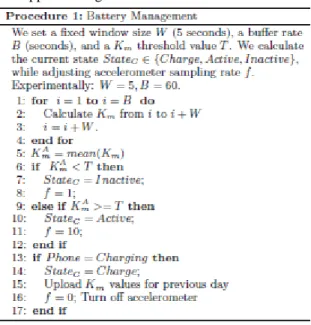
Critical Evaluation of Current Power Management Methods Used in Mobile Devices
(One Lekula) ... 31
A Critical Evaluation of Current Face Recognition Systems Research Aimed at
Improving Accuracy for Class Attendance (Gladys B. Mogotsi) ... 39
Usability of E-commerce Website Based on Perceived Homepage Visual Aesthetics
(Mercy Ochiel) ... 47
An Overview Investigation of Reducing the Impact of DDOS Attacks on Cloud
Computing within Organisations (Jabed Rahman) ... 57
Critical Analysis of Online Verification Techniques in Internet Banking
1
Critical Evaluation of Arabic Sentimental Analysis and Their
Accuracy on Microblogs
Maha Al-Sakran
Abstract
This research paper will focus on Arabic sentimental analysis and the different methodologies used in experiments, to determine accuracy levels as well as improve the accuracy of translating social media posts through analysis and comparison of results conducted on datasets using a variety of translation tools. Translation system’s tools such as classifiers and word stemming will be compared to categorize emotions and opinions in terms of positivity or negativity for both Modern Standard Arabic and Colloquial Arabic.
1
Introduction
Sentimental analysis are used widely in social media to understand opinions and emotions of user’s posts and reviews, the most morphological rich Semitic language is Arabic as it’s also one of the most popular languages on twitter.
In the last few years not much research has focused on sentimental analysis in Dialectal Arabic as majority of research has focused on Modern standard Arabic. Most of the work focused on analysing English texts, as such expansion of sentimental analysis needs to reach other languages including Arabic.
As stated by Santosh et. al. (2016) “Arabic text contains diacritics, representing most vowels, which affect the phonetic representation and give different meaning to the same lexical form.” This can make sentimental analysis challenging, in addition to other complications such as the unavailability of words with capital letters. Related research focused on classifying tweets by applying subjectivity, there has also been focus on classifying posts into categories such as news, events, opinions and deals. Different approaches have been applied from extracting features from texts and metadata to the use of generative models.
Recent research has mainly concentrated on the retrieval of opinionated posts against specific subjects in terms of relevance using machine
learning. Many translation systems rely on word stemming, datasets, and pre-processing, they also rely on sentiment analysis tools (Walid et. al. 2016).
Related research includes testing of classifiers by providing individual judgements through the use of expert and volunteer labellers in order to evaluate the data as well as using it as a good source for future training (Amal 2016).
As stated by Alok et. al. (2013) that they have “achieved relatively high precision, recall still requires improvement” this is in regards to sentimental analysis of micro-blogs in twitter.
This research paper will analyse experiments of which have been conducted on sentiment analysis on Arabic in social media. This research will evaluate and compare the result for the experiments in order to reach good scientific conclusions on classifiers such as SVM, Naives Bayes and N-gram training models.
This research paper will also evaluate lexicon, negation and emoticons as they require considerations in the sentiment analysis. There are challenges for example when translating English to Arabic there is a lack of resources due to the morphological and complex language being used.
Emoticons play a part as they can cause confusion, for example some sentences may seem negative but their definition could be
2
positive. In addition, writing from right to left making the position of the brackets () in the opposite direction in emoticons can also have an impact (Ahmad et. al. 2013).
2 Sentiment Analysis on Arabic
Tweets Using Classifiers and Datasets
Two types of classifiers, SVM and Naïve Bayes were used as a preparation for the preprocessing to experiment with different stemming methods (Talaat et. al. 2015).
The methods that they have proposed were Dataset1, Dataset2, and Dataset3 along with CNB, MNB and SVM classifiers in order to identify which combination is best. Although, which configuration worked better is still not identified (Talaat et. al. 2015).
Unigrams, stemming, bigrams, filterations, word counts and IDF were used in the experiments and a percentage of the accuracy of which they have achieved for each of the datasets (D1, D2 and D3).
Bag of words model was used through datasets to detect the accuracy of the informal texts in tweets. This was tested by using three different types to identify the most suitable combination, these were N-gram training models, text pre-processing, machine learning algorithms and classifiers (Talaat et. al. 2015).
Bag of words model was tested for text classification, each of the terms is scored as ones or zeros by the vector and based on this, accuracy is determined through CNB, MNB and SVM (Talaat et. al. 2015).
Table 1 Datasets Distribution (Talaat et. al. 2015)
Three different types of datasets were tested in the experiment (Talaat et. al. 2015). In the first dataset, 6000 Egyptian tweets were gathered, annotated and then categorized. The results were 2750 words for training and 686 words for testing.
In the second dataset some of the tweets were not found and this resulted in 724 positive, 1565 negative and 3204 neutral.
The third dataset was of educational terms, 1414 tweets were used for testing and the rest, 9656 tweets were used for training.
3
Table 2 Datasets Classifiers (Duwairi et. al. 2014)
The results show unigrams and bigrams worked best together in terms of accuracy. CNB performed much better in comparison with MNB and SVM. Where-as SVM with word counts produced increased accuracy. And Naïve Bayes had the best accuracy with IDF. Accuracy was not affected when simple text cleaning and filtration were applied.
Different datasets were used as well as three machine algorithms which allowed variety. The data collections included 6000 tweets which is a large quantity. Appropriate terms such as educational terms were used in the tests.
Each of the three machine algorithms were selected based on previous experiments which prove that these machines outperformed other classifiers. This research has no bias as the accuracy’s score is based on scientific calculations. Therefore, making the research quantitative and the tests valid.
Tweets were filtered based on number of characters and other specific criteria (Duwairi et. al. 2014). The tweets were then reduced in size through pre-processing by using
(http://rapidminer.com) tokens were then separated by adding commas and spaces
in order for normalization to take place (Duwairi et. al. 2014).
A dictionary was created which converted Jordanian dialect to MSA to help with the translation process in addition to two different dictionaries, Negation dictionary and Arabism dictionary (Duwairi et. al. 2014).
Different types of classifiers were used through the experiment such as NB, SVM and KNN. Each of the settings gave results of accuracy and whether stop-word filters, stemming or folds were used as well gave a score of each (Duwairi et. al. 2014).
4
Table 3 KNN Classifiers (Nourah et. al. 2016)
When comparing the results of NB, SVM and KNN. NB had 76% of accuracy when stop-word filters and stemming were excluded and this is by now the highest accuracy in this specific experiment. An expansion of dictionaries is needed and more advanced classifiers. There was clearly a memory problem in the Rapidminer but this will be considered for future research.
Three different types of dictionaries were used which allowed variety. Crowd-sourcing was also used in order to annotate the tweets in addition to a login option specific for the author and the user. This is a good option as over 25000 tweets were labeled, it would have not been possible for authors alone to annotate.
The data collection is large. Deliberate bias may not have been applied but using a third party website such as Rapidminer in the process has an impact on validity as this website was not tested prior to the experiment or compared with another website that does similar functions. This research has applied quantitative data through providing a score to achieve the results.
The experiment to pre-process social media posts through normalisation for the purpose of consistency through applying stemming and stop-words removals to reduce term space (Nourah et. al. 2016). For example a word can have various meanings but is still spelt the same (Nourah et. al. 2016).
Table 4 Results using Normalised Tweets (Nourah et. al. 2016)
Precise, recall and F1 measure were used in the experiment for the purpose of evaluating accuracy to ensure that each dataset will be in the training and testing set. The experiment was conducted by using raw Tweets, the normalization was then applied followed by the stemmer and then the stop-words.
The results were more accurate using SVM and Naïve Bayes combined without stemmer before the pre-processing phase, as it achieved 89.553% accuracy (Nourah et. al. 2016).
The words used in Arabic had more than one meaning but in the research paper only one meaning was presented. For example the word “نم” was translated as “of” which is correct but it could also mean “from” or “who”.
3500 tweets is a large amount that has been used making the experiment more wide and valuable in terms of data collection. The research was conducted on Modern Standard Arabic and dialectal Arabic but there has been no details of which dialect has been used in the experiment as there are currently 22 Arabic dialects. User details and emoticons were removed. For this specific sentiment analysis, emoticons can have an impact on the results in regards to positivity and negativity. User details remained confidential. The research has no bias as the accuracy results were calculated mathematically using quantitative data. There is no mention of incomplete data. Therefore, no negative impact on the accuracy of the results.
2.1 Comparison of Sentiment Analysis Lexicons Using SVM and NB Classifiers to Determine Accuracy
Accuracy is higher in the research that used NB, this is an achievement as there was still problems with the memory compared with the results of the datasets (Nourah et. al. 2016). The highest
5
accuracy of 89% was achieved when SVM and Naïve Bayes were combined.
The experiment was proposed by Ahmad et. al. (2013) a dictionary was created to convert Tweets that were collected from twitter’s API through “lang:ar” query. A collection of 2300 tweets were sent to two annotators to ensure agreements on each of the tweets. Naïve Bayesians and SVM classifiers were used in the experiment to differentiate between subjective and objective through precision, recall and f-measure (Ahmad et. al. 2013).
Arabsenti lexicon was used but there were errors, which require expansion to reduce them, but surprisingly it had minimal impact on classification.
As stated by Ahmad et. al. (2013) “The expanded lexicon had much broader coverage than the original lexicon”. Ahmad et. al. (2013) also claimed that expansion has improved the sentiment classification. Improvement of classification in terms of subjectivity and sentiments for Arabic tweets was achieved through the expanded lexicon rather than the original lexicon.
Experiment is considered reliable according to the method of which the tweets have been annotated, as annotators had to agree or disagree on the tweets through giving reasoned arguments and then come to an agreement, this process prevents bias. As this research is considered to be qualitative, adding more annotators can be expensive. Annotators had the expertise when choosing which tweets were positive and which were negative, adding the amount of data of which has been used. The use of at least five annotators to prevent bias further is recommended.
Leila et. al. (2016) proposed a technique for deeply mining annotated Arabic reviews. This research demonstrates the extracted features of user reviews.
Table 5 Rules Reviews (Leila et. al. 2016)
200 Arabic reviews were gathered from Facebook, forums, YouTube and Google, rule types were applied in the classification which were then extracted in pairs.
ATKS tool was used to convert colloquial Arabic to MSA. Reviews were first annotated, processed for ATKS and POS Tagging (Leila et. al. 2016). Accuracy was affected in sentiment extraction and gave a percentage of 82.
In the second rule, accuracy was of a good level 80% whereas in the third rule accuracy was 90%, forth rule was 90% included mixed opinions. The fifth rule was not much different in comparison to rule three, four and five.
Figure 1 Accuracy Rules (Leila et. al. 2016)
Accuracy has been high, the results were of reviews written in MSA. The accuracy seemed to slightly decrease on third, fourth and fifth rule. As claimed by Leila et. al. (2016) “an English statement which is written with Arabic letters and negations are challenges for future work”. There is no description of how data was annotated to identify whether good or bad science was used, for example whether there was a professional annotator or how many annotators were used to avoid bias. Datasets were collected from various social media forms and they were specific. Therefore, data collection shows variety. In addition, 200 reviews is a large amount, expansion
6
of terms is recommended. Using reviews of different social media sites is good as it prevents bias for a specific company. Qualitative and quantitative research were applied. A much larger amount of data collection is recommended for improved results.
3
Comparison of ATKS Tool Using
Human Annotators
The experiment proposed by Ahmad et. al. (2013) was qualitative as annotators were used, there was also errors in the Arabsenti lexicon’s tool that was used thus making the research less accurate.
The experiment of Leila et. al. (2016) relied on human annotators as well as a reliable conversion tool which is the ATKS tool. In conclusion human annotators in addition to the ATKS tool presented a greater accuracy as both had reliable results as errors weren’t found in experiment conducted by Leila et. al. (2016).
4
Lexicon-Based and Corpus-Based
Positivity and Negativity
Categorization of Comments and
Reviews
The experiment’s data such as comments, reviews and tweets is gathered for annotation purposes to create a model for classification as well as testing (Nawaf et. al. 2013). The annotation will be conducted by categorizing what type of tweets were used and whether the word is formal or sarcastic.
A collection of 2000 tweets were used for the experiment upon annotation. 1000 of those were negative and 1000 were positive, they were collected from two topics. All of these tweets were in MSA and Jordanian dialect.
In order to identify the semantic orientation of the tweets in order for the extraction to work these consisted of emotions and objectives.
Table 6 Lexicon’s Scalibility Results (Nawaf et. al. 2013)
Two types of experiments were used and these were supervised and unsupervised. Different stemming techniques were applied in the supervised experiment and these were root-stemming, light-stemming and no stemming to identify the effect on the classifier’s performance. Unsupervised techniques were applied on dataset of the collected tweets (2000). This has reported low accuracy. Experiment was conducted gradually, firstly by starting from small size and keeping the original terms and secondly, the number has gone up to 2500 words due to the 300 original stemmed words, and thirdly, the random words were combined including both positive and negative.
The results demonstrated that there is improved accuracy when the lexicon is bigger in size but increasing the lexicon in size doesn’t guarantee improved accuracy, in addition this can save time and effort.
Highest accuracy is given by the light stemmed datasets. An improvement of this would be to widen the polarity case with a neutral class. This will give a more valuable results in terms of accuracy especially sarcasm as it can be misunderstood (Nawaf et. al. 2013).
A large number of datasets of the collected tweets (2000 words) was used. The number of negative and positive words were equal. Formal and informal words were chosen of only two genres. It would have been better to have multiple genres for example four or five to allow for a wider range of words.
There were two expert humans for labelling and one expert to solve any conflicts if the other two experts reached. There is a chance of bias as the expert may take one of the expert labeler’s side. It is recommended to have at least two more expert consultants. It is understandable that this may be expensive. Quantitative research is applied as labelers were used.
7
5
Conclusions
Arabic sentimental analysis of social media posts have been analysed fully in this research paper in regards to accuracy. SVM & Naïve Bayes classifiers achieved higher accuracy (Talaat et. al. 2015). Whereas other experiments of sentimental analysis were conducted during the processing phases to determine the difference of the accuracy levels which eventually resulted of being mostly accurate in the pre-processing phase (Nourah et. al. 2016) which makes the method mostly ideal during the pre-processing phase.
Each type of datasets had its own separate experiment which then resulted in unigrams and bigrams working best together. The author Talaat et. al. (2015) identified which datasets realisticly didn’t seem to work well together.
Rules were compared which then determined that there has been a decrease after the third rule. Filtration supported the experiment through the collection of the samples and ensuring they followed the specified criteria which has been set by the researcher e.g. mixture of topics for the tweets (Leila et. al. 2016) results showed clearly how rules and filtrations had an impact on accuracy levels.
High accuracy has been achieved to a certain extent but it is still not 100% and nowhere near 95%. Sarcasm and emotions are both expressions that don’t seem to have a way of solving at this point in time in sentimental analysis (Nawaf et. al. 2013). Therefore, determining positive, negative and neutral posts still remain a challenge of the sentimental analysis process due to Arabic being a complex language and the issue still lies in accuracy.
Sentimental analysis have been experimented on colloquial Arabic including Egyptian and Jordanian (Nawaf et. al. 2013) but there has not been research on any other colloquial Arabic. For further research, translation tools are currently needed to translate from dialect Arabic to modern standard Arabic.
Development of such tools will allow for an advanced translation system in terms of accuracy. There is a need for different systems to cover multiple dialects, as each dialect has its own complexity and unique rules of which these will
require different methods and approaches to resolve the challenges they have.
There are still 20 more dialects which will need focus on in the future specifically the Moroccan dialect as it faces many challenges.
References
Ahmad Mourad and Kareem Darwish, 2013, ‘Subjectivity and Sentiment Analysis of Modern Standard Arabic and Arabic Microblogs’. 4th Workshop on Computational Approaches to
Subjectivity, Sentiment and Social Media Analysis,
pages 55-64, Atlanta, Georgia, June.
Alok Kothari, Walid Magdy, Kareem Darwish, Ahmed Mourad, and Ahmed Taei, 2013, ‘Detecting Comments on News Articles in Microblogs’. Proceedings of the Seventh International AAAI Conference on Weblogs and
Social Media, pages 293-302, June.
Amal Abdullah AlMansour, 2016, ‘Labeling Agreement Level and Classification Accuracy’. 2016 12th International Conference on Signal-Image Technology & Internet-Based Systems, pages 271-274, Ieee.
Laila Abd-Elhamid, Doaa Elzanfaly, Ahmad Sharaf Eldin, 2016.’ Feature-Based Sentiment Analysis in Online Arabic Reviews’. Computer Engineering & Systems (ICCES), 2016 11th International Conference, pages 260-265, ieee.
Nawaf A.Abdulla, Nizar A. Ahmed, Mohammed A. Shehab and Mahmoud Al-Ayyoub, 2013, ‘Arabic Sentiment Analysis: Lexicon-based and Corpus-based’. Jordan Conference on Applied Electrical Engineering and Computing Technologies (AEEECT), pages 1-6, ieee.
Nourah F.Bin Hathlian, Alaaedin M.Hafezs, 2016, ‘Sentiment - Subjective Analysis Framework for Arabic Social Media Posts’. Information Technology (Big Data Analysis) (KACSTIT), Saudi International Conference, pages 1-6, ieee.
R.M Duwairi, Raed Marji, Narmeen Sha'ban, Sally Rushaidat, ‘Sentiment Analysis in Arabic Tweets’. 2014 5th International Conference on Information and Communication Systems (ICICS), pages 1-6, ieee.
8
Santosh K.Ray, Khaled S. (n.d.). ‘A Review and Future Perspectives of Arabic Question Answering Systems’. Ieee 2016 Transactions on Knowledge and Data Engineering Vol.28, No.12, pages 3169-3190.
Talaat Khalil, Amal Halaby, Muhammad Hammad, and Samhaa R. El-Beltagy, 2015, ‘Which configuration works best? An experimental Study on Supervised Arabic Twitter
Sentiment Analysis’. 2015 First Internaional Conference on Arabic Computational Linguistics, pages 86-93.
Walid Cherif, Abdellah Madani, Mohamed Kissi, 2016, ‘'A combination of Low-level light stemming and Support Vector Machines for the classification of Arabic opinions’. Intelligent Systems: Theories and Applications (SITA) 2016 11th International Conference pages 1-5, ieee.
9
Evaluating Current Research on Psychometric Factors Affecting
Teachers in ICT Integration
Daniel Otieno Aoko
Abstract
There are various Instruments used to assess the numerous aspects of Technology in learning. This study was aimed at establishing the psychometric factors affecting teachers using technology to enhance learning. One of the modern ways used to substitute conventional methods of teaching by embracing digital learning as modern learning tools (Tinio, 2017). The focus is on current study on the various psychometric factors affecting teachers in ICT integration. The outcome shows that access to technology by most of our educators is not necessarily a proof to determine active usage of this platform. Therefore corrective pointers must be instilled to restore confidence and positive attitude among tutors. The outcome is used to establish and improve on ICT integration leading to new findings drawn and appropriate recommendations made. This is based on tangible evidence contained in the paper and proposal of further research in future to improve on the same.
1
Introduction
Many countries have identified the significant contribution ICT in providing quality interactive learning and have put in infrastructure by investing on digital learning devices and Networking of learning centers (Pelgrum, 2001). Majority researchers have envisioned that a digital content in curriculum is almost becoming mandatory as the modern teaching tool and therefore usage will continue to increase. The biggest challenge is a reality the seamless integration of e-content in learning remains a myth among some of the tutors (Anderson, 2002).
Having looked at several research papers evidence it has come out clearly that to achieve successful use of ICT in educational sector is subject to the attitude and the participation of the educators. It is paramount that the user’s perception on the use of e-contents for learning be tamed to avoid a possible resistance to use ICT gadgets in class.
The real impact of ICT is effective when used in content within a confined environment (Parr, 2010). Research evidence shows that unprogressive reforms frustated by the teachers
beliefs, skills and attitudes were not takent into account. Teachers behaviour, abilities, attitudes not withstanding the existing environment had a far reach consequences to make ICT Intergration both in developing and progressive nations a reality (Mumtaz, 2018). It is a fact that the diversity of people within an Institution from different cultural background, age attitudes and beliefs are key in determing tha ratios of acceptance and sets up percentage score in what can be termed as setting social mood in ICT intergration within our learning centres.
Leadership is very outstanding factor that influences the usage of ICT in Institutions, in schools where principals encourages collaborations between one or more students, teachers and pupils with other schools by means of technology for Educational Exchange a significant success is shown as both learners and teachers makes more effort to adopt and conform to this requirements by actively participating in these activities (Alkahtani, 2016).
The outcome of using technology for intergration purposes varies from one learning centre to another, study has shown that there are gaps yet to be filled on students learning from technology. It
10
is from this factor that the survey was carried out on psychometric factors affecting teachers using technology (Patnoudes, 2014). Such factors were termed as
a) Teachers statistics in using ICT at personal level.
b) Teachers level of skills in using ICT equipment.
c) Teacher perceptions towards technology d) Teachers views of using ICT as an
additional classroom learning tool. e) Frequency of teachers using ICT for
developing classroom resources.
f) School environment responsiveness to technology.
The study seeks to determine psychometric properties providing statistics of reliable and valid evidence using an examination of the items enumerated.
2.0 Methodology
The approach in the current research was drawn from several researches and outcomes relations formed the conclusions.
2.1 ICT intergration to working
experience.
Papanastasiou & Angeli (2008) used a sample of 578 tutors who were teaching in Cyprus junior schools during the year of study 2003 – 2004. The age group of participants tutors engaged on average was 32 years old and the least age was 22 years while the highest age was 59 years. Most of the participants had an average work experience of slightly above 10 years and on the higher side 39 years of work. Five teachers were notably on their first year of posting (0.9% of identified teachers). It is estimated that close to 78% sampled were female representing gender parity variances expected at the elementary levels in Cyprus and estimated 22 % were male at same levels.
Gorder (2008) carried out a study and made conclusion that teachers experience determined the usage of ICT. She further reveals that effective technology usage depends on the personal skills. Those with good skills are used ICT more as opposed to those with inadequate skills.
In relation to computer usage and exposure 96% of the identified tutors acknowledged that they had access to ICT equipments either at work or home. While 70% were identified as having completed preferred professional courses in fundamental ICT skills. Looking at the analysis carried out in these contents there is a clear relationship between gender and ICT integration with high percentage of Male teachers showing more confidence in computer usage than their female counter parts, this variance is as a result of men’s ability to take bigger risk than women. This translates again into less usage of ICT in classroom where over 70% of teachers teaching elementary class in Cyprus are women. The conclusion made is that success of ICT integration in classroom relies upon teacher’s willingness and the working environment.
Papanastasiou & Angeli (2008) study contradicts (Rahim, 2008) showing that tutors with more working experience had more confidence as opposed to the young, reason given was the fact that long serving teachers were able to know exactly when and where ICT integration is applicable.
While focusing on the same I found out that age is relative and may not necessarily be used to determine ICT Integration because there are incidences where people with different have similarities in competences .
Lau (2008) stated that female teachers are diligent and very positive in accepting and using technology to their male counterparts as perceived by to (Papanastasiou & Angeli, 2008).
Bauaneng-Andoh (2012) carried an analysis that showed that personal characteristics which include gender, age, educational Backgrounds and teaching experiences play a great role when it comes to effective ICT implementation.
The study showed that most of the younger teachers used ICT often as opposed to the elderly ones. (Rozell, 1999) relates tutors attitudes towards ICT; the study outcome was that tutors experience in using computers is most likely to influence their attitudes in employing use of ICT integration.
In my view various study conducted failed to agree that age was a qualifying factor to determine the frequency at which tutors employ the use of ICT
11
in the classroom. There are cases where the old were seen to be doing better and in some cases the young where experience is equated to age while the young teachers are seen to be doing well because they have just left college where trainings on ICT skills are conducted.
2.2 Social factors to ICT intergration
Buabeng-Andoh (2012) established that technological and institutional factors significantly contributes to encouraging he cited lack of appropriate skills, self-confidence, ideal learning programs, poor ICT infrastructure and rigid curriculum severely interfered with the tutors in using ICT integration in teaching and enhancing learning in classroom. The study concluded that the Institutions were better placed in addressing these barriers if ever ICT integration were to become effective.
Keengwe (2008) carried out a research whose aim was to make ICT Integration more effective the outcome shows that teachers’ supports and attitudes will either positively or negatively affect use of computers in learning process. The conclusion arrived at was that beliefs and behavior of tutors would determine the success of ICT integration.
Kandasamy (2013) conducted a study on ICT usage in educational learning centers in Malaysia with 60% of the participants acknowledging that they employ the use of ICT in learning and collaborations among tutors and pupils, while 80% of the responded cited lack of time in their respective school as a major barrier in employing use of ICT in teaching.
Yunus (2007) carried out a research in Malaysia to establish how ESL tutors used ICT in their learning centers. This study was conducted in technical Institutions through surveys and partial interviews with the tutors. The study aimed at finding attitudes and factors associated to impact of teaching using ICT. Technology Acceptance Model (TAM) was employed in carrying out this analysis. The results termed majority of educators had access to computers at home and were positive about ICT. An estimated 76% of the educators could only access one ICT lab and therefore ICT integration becomes a big challenge due to constraints of the available facilities. 75% of
teachers identified poor quality of computer hardware as a major barrier in Integration.
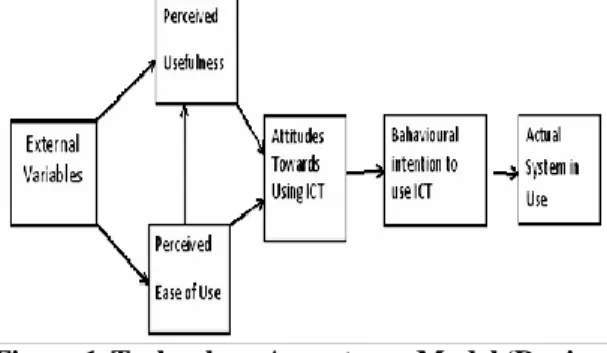
Davis (1989) used Technology Acceptance Model to test the ICT usage and attitudes among educators. The aim of the research was to establish the percetion of the participants with regard to ICT usage and adequate skill among the tutors. The model shows how user accept and apply the use of ICT. The evidence of the outcome is that when users are subjected to new systems there factors that determines perceived usefulness. He concluded that the level of ones perception in the usefulness of the program is most likely to influence the use of ICT the evidence shows that professional skills is a contributing factor to ICT usage .
Figure 1. This structure was used to Investigate the teachers acceptance level of using ICT
Figure 1 Technology Acceptance Model (Davis, 1989).
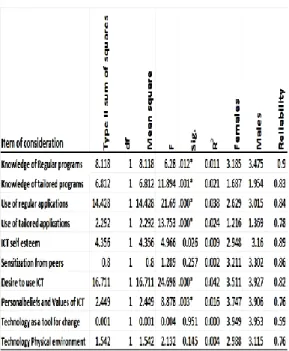
Kandasamy (2013) carried out experiments con-ducted to determine effects Gender relationships in all the items of study.
The study established that High numbers of male tutors have sufficient skill in running programs as opposed to their female counterparts rated (F=6.28, p=0.012), Male tutors appear to be to be more conversant with regular programs than the female (F=21.69, p<0.000) and tailored programs (F=13.75, p<0.000). While measuring the self-es-teem males were found to be more attracted to us-ing technology as a teachus-ing tool as opposed to their female counterparts. (F=24.69, p<=0.003).
12
Figure 2 Shows experiments comparing results of various items of this study (Kandasamy, 2013).Krishnan (2015) carried out an experiment by employing SEM algorithm the result was a good fit. Using path evaluation ten hypotheses were tested. The highest level of satisfaction was recorded in technology effectiveness. An average score was recorded on behavior in ICT usage.
Figure 3 Research Model (Kannan, 2015).
KEY:
H1 – Tutor will be positive on usefulness of ICT workshop.
H2 _The workshop will positvely improve technology effectiveness among tutors.
H3 and H4 _ Tutors motivation will have a positive impact in technology. H5_ Perceived usefulness to impact positively to change in attitude.
H6_ Change of attitude will positvely impat on use of ICT.
H7_Tutors effectiveness leads to positive ICT usage.
H8_ Technological reliability will lead to satisfaction in ICT Intergration.
H9 and H10 – Tutors motivation will positively influence ICT intergration.
This test conducted by Kannan (2015), H1, showed that with access to training teachers had positive attitude towards ICT intergration. H2 provides evidence that profficieny trainings contributes significantly to educators skills in ICT intergration. H3 and H4 shows that teachers attitudes were changed when the were motivated as a result a positive outcome was registered in utilizing ICT. H5 provides the evidence that teachers perceptions largerly contributes to change in attitude using ICT. While H6_ justified that a change in attitude positively lead top increased usage of ICT by the educators as shown in figure 3. Study shows that tutors with adequate skills oftenly use ICT more H7. The condition of ICT equipments was also cited to have an impact in ICT usage. In Institutions where high frequency of repairs is recorded teachers tend to be discouraged compared to similar Institutions where ICT equipments are in good condition and sufficient H8. H9 and H10.
The test carried was sampled from100 teachers data collected from teachers who were operating from different geographical locations. The study adopted the online survey method. The outcome of the findings is sufficient to prove that teachers perception influences ICT usage.
Volman (2005) conducted a study that showed that the female showed less effort in learning ICT at high school and after secondary compared to their male counter parts. Contrary to (Watson, 2006) conducted a study in Queensland state schools on use of ICT from 929 educators revealed that female teachers are least participating in ICT integration compared to their male counter parts. In comparison with US Mid-western schools (Breisser, 2006) findings showed that female teachers drastically improved in their perceptions as opposed to their male counter parts that
13
remained dormant, (Adam, 2002) accepted an outcome of a study that concluded that female teachers applied ICT more than their male counter parts. (Yukselturk, 2009) justifies that gender parity is not a determinant on use of ICT among teacher’s facts more female teachers were seen using internet technologies. (Kay, 2006) study concluded that although male teachers had high ability and attitude but variances existed between female and male teachers after implanting ICT his conclusion is that training played vital role in re-aligning the disparities.
3.0 Conclusions
Integration of ICT has continued to grow increasingly ambitious that it is almost becoming mandatory for every teacher and student to live with it. This process has equally been met by certain social barriers mainly from the educators like appropriate skills, physical ICT environment, attitudes and tutors motivation to use ICT in teaching of other areas as a modern class room tool (Shah, 2013).
Having analysed, compared and contrasted the psychometric factors affecting teachers in ICT integration that impede their energy to teach using ICT equipment’s, my findings revealed that majority of the researchers agreed that ICT integration is inexistence but its success will depend on the efforts that will be taken to turn around the underlined issues. Among the issues I established affecting the tutors are knowledge in using regular applications, tutors’ behaviour and value in ICT integration, use of tailored programs, tutors’ self-esteem, sensitization by the peers, and attraction in using ICT equipment’s, technology physical environment, ICT as tool of change in learning. My Investigations shows that various responses have a reliable outcome that highly depicts the actual situation. In my view from the various evidence gathered teachers have come out to play an important role in making ICT integration yet a reality. Therefore there is a need to create strategic plans in employing corrective measures to counter various challenges opposed to making ICT integrations a reality.
The need for sensitization of educators’, training and leadership that fosters positive attitudes to learners and tutors, team work and self-drive are among the key pointers that can be used to reverse these trend (Singhavi, 2017).
Having gone through various journals and conferences, I carried out various analysis with sufficient evidence and concluded that the presence of ICT equipment’s in learning centres does not necessary translate to their usage in enhancing learning activities. The reality is that by addressing the psychometric factors discussed in this paper and applying corrective pointers will certainly change learning using ICT.
4.0 Further Work
Since the report was conducted as a self-report it could be possible some of our respondent fully with regards to social responsibility. Therefore it is highly recommended that a cross validation may be essential to establish the tutors’ behaviour, skills and attitudes in ICT integration by conducting a further investigation to make the way ICT integration in our learning centres a reality
References
Abd. Rahim, B. S., 2008, ‘Teaching Using Information Communication Technology: Do trainee teachers have the confidence?’
International Journal of Education and
development Using ICT, 4(1).
Adam, N., 2002, ‘Educational computing concerns of postsecondary faculty’, Research on
Technology in Education, 285 - 303.
Alkahtani., 2016, ‘ICT in teaching in Saudi Secondary Schools.’ International Journal of education and Development using Information
and Communication Technology., pg 34.
Anderson, K., 2002, ‘Factors Affecting Teaching with Technology.’ Educational Technology &
Society., pg 69-86.
Bauaneng-Andoh, C., 2012, ‘Factors influencing teachers' adoption and intergration of information and communication technology into teaching’,
International Journal of Education and
Development using Information and
Communication Technology, 8(1), 136-155.
Breisser, S., 2006, ‘An examination of gender differences in elementary constructionist
14
classrooms using Lego/Logo instruction’,
Computers in the Schools, Vol 22 pp. 7-19.
Davis, 1989, ‘Technology Acceptance Model’
Information seeking Bahaviour and Technology
Adoption, pp. 319-340.
Gorder, L., 2008, ‘A study of teacher perceptions of instructional technology intergration in the classroom.’ Delta Pi Epsilon Journal, Vol 50, pp. 21-46.
Kandasamy, 2013, ‘Knowledge, Attitude and Use of ICT among ESL Teachers’, GSE Journal of
Education (p. 185). Malaysia: National University
of Malaysia.
Kannan, K., 2015, ‘A structural Equation Modelling Approach for Massive Blended Sychronous Teacher Training’,. Educational
Technology & Society, Vol 18.
Kay, R., 2006, ‘Addressing gender differences in computer ability, attitudes and use: The laptop effect’, Journal of Educational Computing
Research,, Vol 34, pp 187-211.
Keengwe, J., 2008, ‘Computer Technology intergration and student learning: Barriers and Promise.’, Journal of Science Educational and
Technology, 560 - 565.
Krishnan, K., 2015, ‘A Structural Equation Modelling Approach for Massive Blended Synchronous Teacher Training.’, Educational
Technology & Society., 1-15.
Lau, T., 2008, ‘Learning behaviour of university's business students in regards to gender and levels of study-An exploratory research.’, Proceedings of International Conference Sciences and.
Malaysia.
Mumtaz., 2018, ‘Factors Affecting teachers' use of information and communication Technology.’,
Journal of Information Technology for Teacher
Education., pg 319-342.
.
Papanastasiou., 2008, ‘Factors Affecting Teachers Teaching with Technology.’, Educational
Technology & Society, Pg 69-89.
Parr, W., 2010, ‘Prospective EFI Teachers' Perception of ICT Intergration’, Educational
Technology & Society, pg 185-196.
Patnoudes, 2014, ‘Asessment of Teachers Abilities to Support Blended Learning Implementation in Tanzania.’, Contemporary Educational Technology.
Pelgrum, 2001, ‘Factors affecting teachers teaching with technology.’, Educational
Technology & Society., Pg 69-86.
Rozell, E. G., 1999, ‘Computers in human Behavior.’, Computer-related success and failure, a longitudinal field study of factors influency
computer-related performance., Vol 15, 1-10.
Shah, K., 2013, ‘Knowledge, Attitudes and Use of ICT Among ESL teachers.’, GSE Journal of
education (worldconferences.net), pg.186.
Singhavi, B., 2017, ‘Factors Affecting teachers perceived in Using ICT in the classroom.’,
IAFOR Journal of Education,, pg 69.
Tinio., 2017, ‘Centralised Learning and assessment tool for Department of Education.’,
International Journal of computing sciences, vol
No1 Pg 21-35.
Volman, M., 2005, ‘New technologies, new differences. Gender and ethnic differences in pupils' use of ICT in primary and secondary education.’, Computers & Education, 45, 35- 55.
Watson., 2006, ‘Technology Professional development: Long-term effects on teacher self-efficacy.’, Journal of Technology and Teacher
education., vol. 14 151 -166.
Yukselturk. E., 2009, ‘Gender differences inself-regulated online learning environment.’, Journal
of Educational Technology & Society, 12-22.
Yunus. M. M., 2007, ‘Malaysian ESL teachers' use of ICT in their classrooms: expectations and realities.’, European Association for Computer
Assisted Language Learning., ReCALL,
15
A Critical Analysis of Current Measures for Preventing Use of
Fraudulent Resources in Cloud Computing
Grant Bulman
Abstract
Economic Denial of Sustainability (EDOS) attacks could have huge financial implications for an organisation, whether this EDOS attacks where renting server space within The Cloud on a Pay-As-You-Go basis, or DDOS attacks. This paper discusses current DDOS/EDOS prevention algorithms in place, as well as provide a critical evaluation of these algorithms. Furthermore, a comparison is made between each algorithm based on the experiments performed. Penultimately, methodologies will then be fully examined in order to propose the best solution from the algorithms evaluated. Finally, conclusions will be provided and recommendations made based on the critical evaluation of these current algorithms.
1
Introduction
Cloud Computing is revolutionising the way modern businesses store their data and the way in which their services are provided. Threats posed from DDOS and EDOS attacks are increasing dramatically. In 2016, we saw the highest amount of DDOS attacks in history. Saied, A et. al. (2015) state that “DDOS attacks are serious security issues that cost organisations and individuals a great deal of time, money and reputation, yet they do not usually result in the compromise of either credentials or data loss.”
Idziorek J et. al., (2012) state that use of fraudulent resources “is a considerably more subtle attack that instead seeks to disrupt the long-term financial viability of operating in the cloud by exploiting the utility pricing model over an extended time period”.
The Cloud offers businesses the flexibility of renting server space/bandwidth on a Pay-As-You-Go basis, meaning they only pay for the bandwidth used. Somani G et. al. (2016) state that “Economic aspects are affected because of the high resource and energy usage, and the resultant resource addition and plugging, thus generating heavy bills owing to the “pay-as-you-go” billing method”. Somani G et. al. (2016) go on to develop a system to better understand a DDOS attack and conclude that “this model has also detailed the resource
overload state of a virtual machine under attack and its possible spread using vertical scaling, horizontal scaling and migrations”. They also go on to differentiate and relate DDOS and its economic version EDOS.
An EDOS Attack is very subtle in the way in which it is performed and is very hard to identify, unlike a DDOS attack. The attacker would generally be motivated to perform this attack at a specific organisation. The attacker would ping the server, consume as much bandwidth data as possible without any dramatic traffic being identified by the client. Alosaimi W et. al. (2015) create and test a new algorithm to protect the cloud environment from both DDOS and EDOS attacks.
Over the course of this research paper we will analyse different methods of detection of Denial of Service (DDOS) and Economic Denial of Service (EDOS) attacks and compare these. The experiments used, as well as their claims will be critically evaluated in order to select the most practical method for detecting these types of attack.
2
Current Measures for Preventing
Fraudulent use in the Cloud
The following section provides an evaluation of current algorithms in place for preventing fraudulent use of cloud resources.
16
2.1 DDOS AttacksSomani G, et. al. (2016) state that DDOS attacks target the victim server by sending a high volume of service requests to the server by using a bot. Nowadays, Botnets can easily be obtained for free online and are amongst the most popular types of cybercrime.
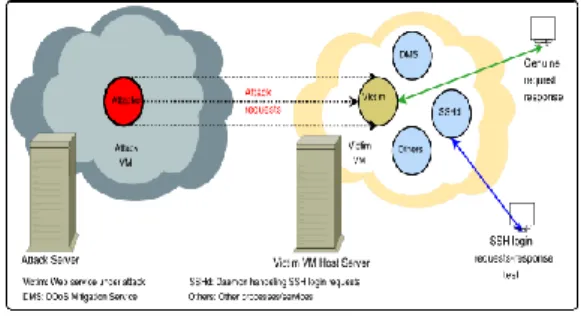
They propose an algorithm known as Victim Service Containment, which aims to minimise the effects a DDOS attack can have both physically and financially. They do this by using a system called DDOS Deflate which will identify if an attacker has made more than 150 connections to the client’s server (fig1).
Figure 1: Experimental setup (Somani G et. al. 2016)
They perform the experiment by hosting two VM’s (Virtual Machine), one is the victim VM and the other is the attacker. They then send 500 Secure Shell (SSH) requests, 100 genuine requests (each request logs out of the session before the next request is sent) and 500 concurrent attack requests all simultaneously. The results are as follows:
Figure 2: Experimental results (Somani G et. al. 2016)
From the results of this experiment they then create an algorithm which calculates resource in order to contain resource contention.
The authors conducted the experiment in a controlled environment which helps reduce the risk of bias. They also repeated the experiment to get accurate data before they published the results. Additionally, they compared this technique to other techniques in order to check if their algorithm is more effective. Therefore the experiment performed was of a high level as the work done involved 500 attack requests and it was made clear in their conclusions that more research is needed and further work is needed before the algorithm is to be applied in the real world.
In order to detect a DDOS attack sooner, Hoque N, et. al. (2017) propose a new method to actively detect a DDOS attack as it is happening, known as NaHIDverc. The experiment is performed by capturing raw data from the router as “TCP/IP network layer packets, which are subsequently sent to the pre-processor module.” Hoque N, et. al. (2017).
Figure 3: Implementation model (N et. al. 2017)
In order to evaluate the results, they use three network intrusion datasets: CAIDA, DARPA and TUIDS.
17
Figure 4: Simulation waveformsdemonstrating the operation of the DDOS Attack Detection Model (N et. al. 2017)
The results from this experiment showed a 99% detection rate on the CAIDA dataset, 100% accuracy on the DARPA dataset and 100% detection using the TUIDS dataset, therefore they conclude that they fully met the hypothesis of the research, which was to detect all DDOS and sooner.
The experiment was carried out by the authors was performed fairly and under a controlled lab environment to reduce the risk of bias. Additionally, they tested their algorithm under three different intrusion datasets which proved some very promising results when it comes to detecting this type of attack sooner, including detecting an EDOS and FRC attack which has financial impacts. Although the work demonstrates higher levels of testability than other work in this area, the validity of the results should be questioned because it could be argued that the authors could have manipulated the variables to better the results. Conclusively, the experiment should be repeated to get a mean average of the results in order to get a better understanding of its accuracy and this should be performed in a secure, controlled environment to ensure these results are valid.
Wang C et. al. (2017) also propose a new algorithm for detecting DDOS attacks effectively, based on RDF-SVM. Their algorithm is developed in Python and aims to detect unusual incoming traffic and validates the precision rate of this. They compare this to two other algorithms: SVM and RF and SVM to compare the results.
They compare all three algorithms and the results show that the RDF-SVM algorithm has an 82.5% detection precision rate and overall 80.09% recall rate – which is the highest of the three.
Figure 5: Precision rate three methods (Wang C et. al. 2017)
Figure 6: Recall rate three methods (Wang C et. al. 2017)
The authors conclude that the RDF-SVM algorithm detects DDOS attacks, both known and unknown effectively.
Overall, the experiment conducted by the authors was compared with other algorithms in place to detect better accuracy and give better results, therefore this gave a better understanding of the results. Additionally, the authors also made a comparison among three methods, to ensure the validity of the results given.
Wang B et. al. (2015) also propose a similar DDOS mitigation technique, called DaMask. This technique consists of three layers: the network switch, the network controller and the network application. The purpose of this mitigation technique is to detect DDOS attacks quickly and react instantly.
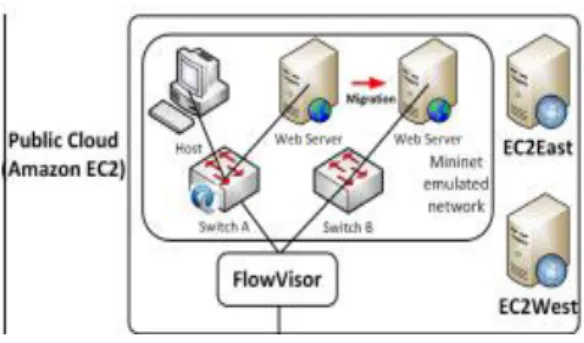
The test is performed in the hybrid Cloud, again using the Amazon EC2 service and the authors use Mininet to create a virtual network to emulate the SDN setting used during the experiment.
18
Figure 7: Experimental setup on Public Cloud Amazon EC2 (Wang B et. al. 2015)They then compare the results of this experiment with the Bayesian technique as well as the Snort mitigation technique, which is a free open-source detection system. The results from the experiment show that the new DaMask technique is similar to that of the Bayesian technique.
Figure 8: Experimental setup on Public Cloud Amazon EC2 (Wang B et. al. 2015)
The authors conclude that whilst the DaMask technique is similar to current techniques, it requires little effort from the cloud provider, meaning minimal changes required from the computing service architecture. Overall, the authors have conducted a fairly good experiment. They firstly checked the bandwidth speed and logged this to prevent bias, as well as conducted the experiment in a controlled environment. Additionally, they compared their technique with others and concluded that the results are similar.
Conclusively, the authors carried out extensive testing during the experiment, which eliminated bias from the results. It should be noted however
that they use Mininet to create a virtual network which is rather outdated. They could have improved the validity of the results by using a more recent version to get better results rather than ones similar to the Bayesian and Snort techniques.
2.2 EDOS Attacks
Wang H et. al. (2016) state that “Distributed Denial of Service (DDOS) attacks have evolved to a new type of attack called Economic Denial of Sustainability (EDOS) attack”. Unlike a DDOS attack, an EDOS attack aims to financially impact the victim through use of the Cloud’s Pay-As-You-Go model.
They perform their controlled experiment by building a website in the Amazon Cloud and “The website hosts various recourses including images with sizes from 38KB to 40MB, videos with sizes from 2MB to 171MB and documents with size from 10KB to 10MB” Wang H et. al. (2016). The attack laptop then calls each provider to bring the targeted resources 2000 times with a request interval of 10 seconds.
Figure 8: Average network out traffic during experiment (Wang H et. al. 2016)
The results show that the attacker incurred charges of $11.87 to the victim in this short test alone.
In order to keep costs to a minimum, Wang H et. al. (2016) propose a ‘Redirection-Based Defense Mechanism” which aims to redirect third-party services to the URLs with a valid cache and checking it has a cache hit. They go on to state that the victim then experiences much less traffic when this algorithm is tested.
19
The research conducted by Wang H et. al. (2016) is of a very high quality. They analyse current algorithms for preventing EDOS attacks and present their conclusions. However, their own experiment is only performed once and they jump to conclusions from this. They then state terms such as “We imagine…” which is not justified nor is it good science.
Baig Z et. al. (2016) propose a mitigation technique for detecting EDOS attacks sooner. To do this, they deployed two Cloud servers and the upper and lower limit of auto-scaling are set to 80% and 30%.
Figure 9: Parameters used in experiment (Baig Z et. al. 2016)
To perform the experiment they assumed a normal CPU usage rate of 40% is legitimate usage and the cost of a VM instance as $0.03. They then and send between 200 and 400 requests per second to the victim server, up to a maximum of 1200 requests (see Fig 6) before the CPU peaks its consumption.
The results show that without their mitigation technique in place the costs billed to the victim sever would increase dramatically. The mitigation technique in effect identifies suspicious requests targeting the victim sever through use of a Firewall which filters the incoming traffic and any unusual request are added to a blacklist.
Figure 10: EDOS attack effect against CPU usage (Baig Z et. al. 2016)
The results from the experiment show that with the mitigation technique in place, the cost stays at a steady rate (Fig 6) and therefore the victim will be billed less than without the technique. The author concludes that the technique is able to detect intelligent/smart attackers with a good degree of accuracy, preventing higher bills to the victim.
The experiment carried out by the author followed good science principles as it in a controlled environment and was repeated 10 times, then the results averaged. From the results, it is clear that the mitigation technique did reduce the cost to the victim, however there is still an increase and therefore we still need further work on this mitigation technique.
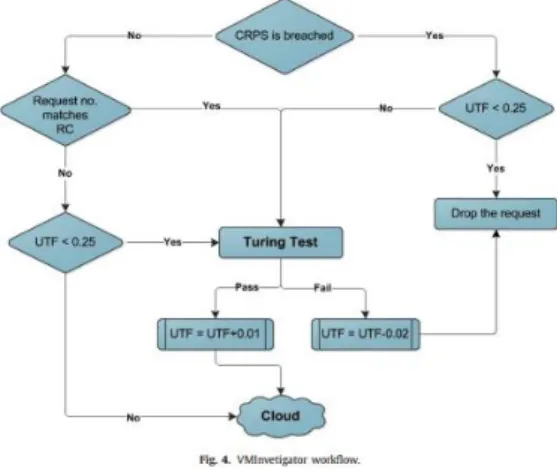
Additionally, VivinSandar, S et. al. (2012) propose an algorithm which works in a similar way to Wang H et. al. (2016), where a request is made by a user and is first intercepted by the firewall. This is sent to an on demand puzzle server; the user then must solve the puzzle and if the server verifies the result is correct they will be added to the firewall ‘white list’.
The authors do this by conducting their experiment in the EC2 Cloud. Four EC2 instances are grouped together and to simulate an attack they sent repeated HTTP requests to the victim server and all packets are monitored through a packet capturing application, in this case they use Wireshark. The results of the authors experiment is as follows:
20
Figure 11: Number of attacks vs Cost(VivinSandar, S et. al. 2012)
The results show that as more requests are sent to the server, the cost applied to the victim server again increases rapidly. Although the algorithm was in place, the results show that the cost factor still caused an issue and therefore they conclude that further search is needed to provide a better mechanism for detecting an EDOS attack sooner.
Overall, aside of the results from the test, the authors conducted this in a controlled environment to reduce bias. However, they only performed the experiment once, which should have been done more to check for any discrepancies. The conclusion however did match the experiments and the author made it clear that further research into EDOS prevention was needed.
Masood M et. al. (2013) have also proposed another similar EDOS mitigation technique called EDOS Armor. This technique has three components: challenge, admission, congestion control. The technique in effect only allows a certain number of users to access the server to avoid DDOS. Then, they check browsing behavioural patterns to allocate priority to users based on the user’s priority level.
The experiment works when a client’s access the server, they are passed to the challenge server which asks them to complete a puzzle, if they complete it correctly they can access the server. After this, the congestion control then filters out good clients from bad clients (bad clients being the ones sending tons of requests to the server) and allocates less resource to the bad client(s).
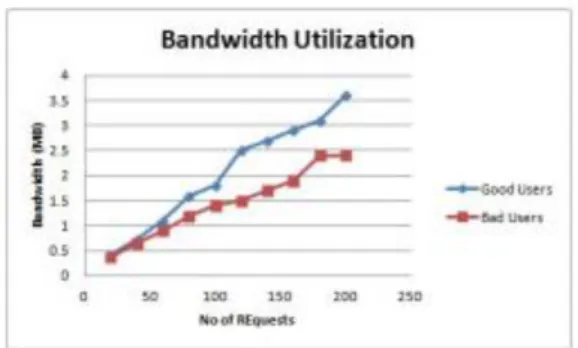
Figure 12: good client’s vs Bad clients (Masood M et. al. 2013)
The results show (Fig 11) that as the requests get higher, the mitigation technique reduces the resource allocated to what it deems as bad clients and therefore the bandwidth rate is less. They conclude that this is a good technique for filtering out good and bad clients, which will result in less impact of an EDOS attack.
Overall, the authors experiment is good as the results clearly show a difference in bandwidth allocation between good and potential bad clients. However, the experiment is not repeated and results averaged to get a better accuracy and they do not seem to have compared and tested this with similar mitigation techniques in place. The results could have been less biased had this been done.
3
Comparison of Current Measures
Upon evaluating each mitigation technique, the most favourable technique is proposed by Hoque N, et. al. (2017). The accuracy rate showed a 99% detection rate on the CAIDA dataset, 100% accuracy on the DARPA dataset and 100% detection using the TUIDS dataset. All of which are very promising results.
Wang C et. al. (2017)’s RDF-SVM algorithm has an 82.5% detection precision rate, which is lower than the experiment performed by N, et. al. (2017), and unlike Hoque N, et. al. (2017) they compared this with two datasets (KDD Train and KDD Test) which are very outdated and are irrelevant for modern intrusion detection systems.
A modern dataset would be that used by Hoque N, et. al. (2017), such as CAIDA. Therefore there is no surprise that their results were so much higher than other work evaluated in this paper.
21
4
Conclusions
This paper has critically evaluated 8 different mitigation techniques for detecting DDOS and EDOS attacks, which are both performed in very similar ways, quicker. It should be noted that this is a very large research area and these 8 techniques only represent a small portion of the techniques in place. Due to the importance of this field and the rise in DDOS and EDOS attacks it is anticipated that research will be constantly performed for the foreseeable future.
All mitigation techniques are similar in the way they have been created, however some have been performed in a way that has yielded better results for detecting such attacks.
Wang C et. al. (2017) concluded that their technique “can detect known and unknown attacks and distinguish random IP address attacks, real IP address attacks and Flash crowd more effectively” compared with other methods, whilst Hoque N, et. al. (2017) concluded that NahidVerc “is able to achieve an attack detection accuracy of 100% over benchmark datasets”.
Conclusively, it is evident that mitigation techniques for preventing DDOS and EDOS attacks are still not perfect, however they are becoming more and more accurate as these types of attack evolve. However, a lot of the experiments performed in this paper were performed with outdated software, datasets and not in a fully controlled lab environment. EDOS and DDOS attacks are constantly evolving and as a result we need to continuously build and use new datasets to test prevention of these – using outdated datasets will not prevent modern attacks. Therefore further research in this area is still needed and will be for some time.
References
Alosaimi, W. Zak, M. Al-Begain, K (2015), ‘Denial of Service Attacks Mitigation in the Cloud’. 9th International Conference on Next Generation Mobile Applications, Services and
Technologies. pp47-53.
Baig, Z. Sait, S. Binbeshr, F (2016), ‘Controlled access to Cloud Resources for mitigating
Economic Denial of Sustainability (EDOS) attacks’. Computer Networks 97 pp31-47.
Hoque, N. Kashyap, D and Bhattacharyya D.K. (2017), ‘Real-time DDOS Attack Detection using FPGA’, Austin, Texas, August. AAAI. pp 198-202 Idziorek J, Tannian M and Jacobson D, 2012, ‘Attribution of Fraudulent Resource Consumption in the Cloud’, IEEE Fifth International
Conference on Cloud Computing. Pages 99-100.
Masood, M. Anwar, Z, Raza S. A. and Hur M. A, "EDoS Armor: A cost effective economic denial of sustainability attack mitigation framework for e-commerce applications in cloud environments," INMIC, Lahore, 2013, pp. 37-42.
Saied, A. Overill, R. Radzik, T, (2015). ‘Neurocomputing’ 172. Computer Networks, 110, pp385-393.
Somani, G. Gaur, M. Sanghi, D and Conti, M. (2016). ‘DDOS Attacks in Cloud Computing: Collateral Damage to non-targets’. Computer
Networks, 110, pp48-58.
VivinSander, S. Shenai. (2012), ‘Economic Denial of Sustainability (EDOS) in Cloud Services using HTTP and XML based DDOS Attacks’.
International Journal of Computer Applications.
41 pp-11-16.
Wang, B. Zheng, Y. Lou, W. Hou T. (2015), ‘DDOS attack protection in the era of cloud computing and software-defined networking’.
Computer Networks. 81. Pp-308-319.
Wang, C. Zheng, J. Li, X. (2017), ‘Research on DDOS Attacks Detection Based on RDF-SVM’.
International Conference on Intelligent
Computation Technology and Automation.
Pp-161-165.
Wang, H. Xi, Z, Li, F and Chen, S. (2016), ‘Abusing Public Third-Party Services for EDOS Attacks’. Proceedings of the 10th USENIX
Conference of Offensive Technologies.
Pp-155-167.