UC Irvine
UC Irvine Previously Published Works
TitleThe Effect of Corporate Tax Avoidance on the Cost of Equity Permalink https://escholarship.org/uc/item/3vc8d186 Journal ACCOUNTING REVIEW, 91(6) ISSN 0001-4826 Authors Goh, Beng Wee Lee, Jimmy Lim, Chee Yeow et al. Publication Date 2016-11-01 DOI 10.2308/accr-51432 Peer reviewed
The Effect of Corporate Tax Avoidance on the Cost of
Equity
Beng Wee Goh [email protected] School of Accountancy Singapore Management University
Jimmy Lee [email protected] School of Accountancy Singapore Management University
Chee Yeow Lim [email protected]
School of Accountancy Singapore Management University
Terry Shevlin [email protected] Merage School of Business University of California at Irvine
February 10, 2016
Key words: Tax avoidance, tax planning, cost of equity JEL codes: G32, H26, M41
We thank the Editor, Harry Evans, and two anonymous reviewers for their constructive
comments. We also thank Qiang Cheng, Alex Edwards, Mort Pincus, Jake Thornock, Oliver Li, Gerry Lobo, Travis Chow, Yen-Hee Tong, Yan Li, and conference participants at the SMU-SOAR Accounting Symposium 2012, the European Accounting Association Annual Congress 2013 and the American Accounting Association Annual Meeting 2013 for helpful comments. Goh, Lee and Lim thank the School of Accountancy Research Center (SOAR) at Singapore Management University for financial support. Shevlin acknowledges financial support from the Paul Merage School of Business at the University of California-Irvine.
The Effect of Corporate Tax Avoidance on the Cost of
Equity
Abstract
Based on Lambert, Leuz, and Verrecchia (2007)’s derivation of the cost of equity capital in terms of expected cash flows, we generate a testable hypothesis that relates tax avoidance to a firm’s cost of equity capital. Using three broad measures of tax avoidance—book-tax differences, permanent book-tax differences, and long-run cash effective tax rates—to test our hypothesis, we find that the cost of equity is lower for tax-avoiding firms. This effect is stronger for firms with better outside monitoring, firms that likely realize higher marginal benefits from tax savings, and firms with higher information quality. Overall, our results suggest that equity investors generally require a lower expected rate of return due to the positive cash flow effects of corporate tax avoidance.
I. INTRODUCTION
Dyreng, Hanlon, and Maydew (2008) document that many U.S. corporations exhibit low long-run cash effective tax rates.1 Presumably, such persistent tax avoidance must have some beneficial effects for shareholders, which explains why firms provide incentives to executives to reduce tax burdens (Robinson, Sikes, and Weaver 2010; Armstrong, Blouin, and Larcker 2012). We analyze the effect of this tax avoidance on a firm’s cost of equity. Following Dyreng et al. (2008), we define tax avoidance broadly to include all tax planning activities that reduce the firm’s taxes relative to its pretax accounting income. Consequently, our empirical measures of tax avoidance in this study reflect both tax reductions that are in clear compliance with the law as well as those that result from grey-area interpretations; our measures do not specifically distinguish between the two.2
Our analysis adds to an emerging literature examining the consequences of tax avoidance in the equity capital markets. Hanlon and Slemrod (2009) and Wilson (2009) examine, respectively, short-term equity market reaction and long-term stock returns to the disclosure of tax shelter activities. However, they do not link their predictions or results to the cost of equity. More importantly, tax shelters represent an
1 Dyreng et al. (2008) find that approximately one-fourth of their sample firms are able to
maintain long-run cash effective tax rates below 20 percent, compared to a sample mean tax rate of approximately 30 percent and the statutory tax rate of 35 percent. This suggests that many U.S. firms engage in significant tax planning activities.
2 As highlighted by Hanlon and Heitzman (2010, footnote 39), it is difficult to distinguish
between technically legal avoidance and illegal evasion for two reasons. First, most of the tax planning activities in question involve transactions that are often technically legal. Second, the legality of a tax avoidance transaction is often determined after the fact in a court of law, and the permissibility of these transactions is almost always ambiguous. In our main tests, we specifically utilize broad tax avoidance measures that are less likely to just capture extreme forms of tax avoidance such as tax sheltering (see Section III).
extremely aggressive and risky form of tax avoidance at one end of the continuum of tax planning strategies (Hanlon and Heitzman 2010), and are not representative of the tax planning activities that most U.S. firms engage in. In contemporaneous working papers, Koester (2013) examines how investors value uncertain tax avoidance captured in firms’ tax reserves and Hutchens and Rego (2015) test the relation between a firm’s tax reserves and its cost of equity. However, Dyreng, Hanlon, and Maydew (2014) argue that uncertain tax avoidance strategies are only a subset of the overall tax avoidance firms engage in, and firms only turn to uncertain tax avoidance strategies when safe tax avoidance strategies are exhausted. By presenting large-sample evidence on the association between cost of equity and tax avoidance that generate large book-tax differences, large permanent book-tax differences and low cash effective tax rates, we are able to examine and draw inferences on whether equity investors require a higher or lower expected rate of return for tax avoiding firms.
Applying the Lambert, Leuz, and Verrecchia (2007) derivation of the cost of capital to our setting, we argue that tax avoidance can affect the cost of capital via its effect on the firm’s expected future cash flow and its effect on the variance of the firm’s own cash flows as well as the covariance of the firm’s cash flow with the sum of all cash flows in the market. On the one hand, tax avoidance can result in substantial cash tax-savings (Dyreng et al. 2008), which increases expected future cash flows and hence reduces the cost of equity capital. On the other hand, tax avoidance could substantially increase the variance and covariances of
the firm’s cash flows, thereby increasing the cost of equity capital. First, firm risk can increase from the transactions or business fundamentals underlying these tax strategies such as foreign operations, research and development activities and investments in intangibles. More aggressive tax strategies such as transfer pricing may involve complex structuring of transactions, which can increase the riskiness of the firm’s overall cash flows. Second, equity holders are exposed to the risk that some of the firm’s more aggressive tax avoidance activities may not be deemed by the IRS and the tax courts to be compliant, which could subject the firm to additional taxes, fines, interest and penalties (Mills 1998; Hanlon and Slemrod 2009). Finally, to the extent that there is a positive feedback effect between corporate tax avoidance and managerial actions (Desai and Dharmapala 2006), equity holders are exposed to the agency risk of managerial rent diversion. Because the possibility of wealth expropriation increases the riskiness of the firm’s cash flows to shareholders, tax avoidance activities can increase the variance and covariances of the firm’s cash flows.
Hasan, Hoi, Wu, and Zhang (2014) find that firms with greater tax avoidance incur higher bank loan spreads, while Shevlin, Urcan, and Vasvari (2013) find that firms with greater tax avoidance incur higher public bond yield spreads at issuance. These findings are consistent with debt holders being exposed to the risks of tax avoidance but not sharing in the corresponding rewards from tax savings. In our context, to the extent that equity holders enjoy the upside potential of increased expected cash flows from tax savings and this incremental benefit
outweighs the incremental risk exposure due to tax avoidance activities, we expect a negative association between tax avoidance and cost of equity.
Using a large sample of firms from 1993-2010, we find that higher levels of book-tax differences (BTD) and permanent book-tax differences (PBTD), and lower levels of long-run cash effective tax rates (CETR) are associated with a lower cost of equity capital. We measure the ex-ante cost of equity based on current stock prices and analysts’ forecast of future earnings (Easton 2004; Botosan and Plumlee 2005). This result is robust to using a change specification, using three alternative measures of cost of equity, using beta to proxy for equity risk, using earnings forecasts from a cross-sectional earnings model so as to avoid error in estimates of cost of equity arising from biased analyst forecasts, estimating the cost of equity based on expected returns from the Fama-French factor model, and using three alternative measures of tax avoidance (GAAP effective tax rate, Zimmerman (1983) current effective tax rate and the one-year measure of cash effective tax rate). The effect of tax avoidance on the cost of equity is also economically significant. A one standard deviation increase in our measures of tax avoidance is associated with a 13 to 26 basis points reduction in the cost of equity, even after controlling for an extensive list of risk factors that are documented in the prior literature to be associated with cost of equity as well as controlling for the business fundamentals underlying these tax saving transactions.3 Overall, our results suggest that equity investors
3 Following prior studies such as Hasan et al. (2014), we assess the economic significance
require a lower expected rate of return due to the positive cash flow effects of corporate tax avoidance.
To corroborate our findings, we further investigate whether the negative association between tax avoidance and cost of equity is moderated by outside monitoring, the marginal benefits of tax savings, and information quality. We expect the negative association between tax avoidance and cost of equity to be stronger for firms with better outside monitoring because effective monitoring can reduce managerial opportunism and mitigate agency risks associated with tax avoidance. In addition, we expect the negative association between tax avoidance and cost of equity to be stronger for firms with greater financial constraints and better growth opportunities because the marginal benefit of cash tax savings to firms in these circumstances are higher.4 Finally, to the extent that higher information quality enhances investors’ ability to assess firms’ expected values and the uncertainty of future cash flows and facilitates outside monitoring (Lambert et al. 2007), we expect the negative association between tax avoidance and cost of equity to be stronger for firms with higher information quality. The cross-sectional results are all consistent with our expectations.
Our final analysis examines the relation between cost of equity and a firm’s likelihood of engaging in tax shelter activities, proxied by the tax
avoidance on the cost of equity. We acknowledge that a one standard deviation increase in our measures of tax avoidance appears economically large, and that it seems implausible for a firm to increase tax avoidance by that economic magnitude in order to reduce the cost of equity. In other words, we are not able to observe the counter-factual.
4 Edwards, Schwab, and Shevlin (2015) find that firms facing financial constraints
undertake more tax avoidance in order to save tax cash outflows. Consequently, these cash flows could be employed to satisfy working capital needs and to fund profitable investment opportunities.
shelter prediction score in Lisowsky (2010), and the predicted unrecognized tax benefit (UTB) in Lisowsky, Robinson, and Schmidt (2013). We conjecture that when a firm engages in aggressive and risky forms of tax avoidance such as tax shelter activities, the increase in the variance and covariances of the firm’s cash flows could, on a net basis, outweigh the increase in the firm’s expected future cash flows from avoiding taxes.5 We find a significantly positive relation (no relation) between predicted UTB (tax shelter prediction score) and cost of equity.
Our finding that broad measures of tax avoidance are associated with lower cost of equity do not mean that tax avoidance is a “no lose” situation in which all firms should participate aggressively. Consistent with the Scholes-Wolfson framework, effective tax planning/avoidance does not equate to or imply a tax minimization strategy. Effective tax planning involves evaluating not only the benefits in tax savings, but also the non-tax costs, implicit non-taxes and effects on other parties to the extent these affect the terms of trade.6 Existing literature documents significant
cross-5 For instance, tax shelter activities can lead to greater complexity in the firm’s
transactions and operations, further increasing the variance and covariances of the firm’s overall cash flows. Tax shelter activities also have a greater likelihood of being disallowed by IRS (which can subject the firms to more taxes and fines) and diversion of corporate resources for managers’ private benefits, both of which can reduce the firm’s expected cash flows accruing to shareholders and increase the riskiness of the firm’s cash flows.
6 For instance, firms have to invest substantial resources in the form of fees paid to tax
accountants and attorneys, as well as the time that managers and their employees devote to tax planning and resolving audits with tax authorities. Costs can increase significantly if tax authorities are successful in challenging an aggressive tax position. Further, Graham, Hanlon, Shevlin, and Shroff (2014) highlight potential reputation costs associated with corporate tax avoidance. Their survey documents that the potential for an adverse effect on company reputation significantly constrains firms’ incentives to engage in tax planning strategies, with 69 percent of their survey respondents, including 72 percent of publicly traded respondents, indicating that reputation concerns are ‘important’ or ‘very important.’ Other studies document that tax avoidance increases the firm’s cost of debt (e.g., Hasan et al. 2014; Shevlin et al. 2013). Finally, there are also costs associated with corporate tax avoidance activities such as potential managerial rent diversion and agency problems (e.g., Desai and Dharmapala 2006).
sectional variation in corporate tax avoidance due to the cross-sectional variation in the costs and benefits of tax avoidance activities. Our cross-sectional results also suggest cross-firm variation in the costs and benefits.
Our study makes several contributions to the existing literature. First, it extends the literature on how investors value corporate tax avoidance behavior. While prior studies examine how investors value tax sheltering and uncertain tax avoidance, the results are inconclusive (Hanlon and Slemrod 2009; Wilson 2009; Koester 2013; Gallemore, Maydew, and Thornock 2014; Hutchens and Rego 2015) and there is little evidence on how investors view tax avoidance in general. Desai and Dharmapala (2009) and De Simone and Stomberg (2013) both examine the relation between broad measures of tax avoidance and firm value, but these studies do not directly investigate how tax avoidance is associated with a firm’s cost of equity.7 Our study complements these studies by using a large sample of firms to examine how broadly defined measures of tax avoidance, which include the less aggressive tax planning methods, are associated with a firm’s cost of equity.
Second, our study adds to the debate on the corporate governance view of tax avoidance. While Desai and Dharmapala (2006) and Desai, Dyck, and Zingales (2007) argue that aggressive tax avoidance increases financial opacity and facilitates managerial rent extraction, Blaylock
7 Desai and Dharmapala (2009) use book-tax differences adjusted for accruals as a proxy
for tax avoidance, and they find no significant relation between their proxy for tax avoidance and Tobin’s q, and only a positive relation between tax avoidance and Tobin’s q in firms with high levels of institutional ownership. De Simone and Stomberg (2013) document a positive association between low cash ETRs and Tobin’s q, and that this effect is stronger for firms whose mobile income and asset structures afford them greater opportunities to engage in long-term, sustainable tax avoidance.
(2015) fails to find evidence to support this contention. In fact, using a large panel of U.S. firms, he finds that tax avoidance is positively associated with future firm performance and with a more optimal investment policy, even among poorly governed firms. Our main findings of a negative association between broad measures of tax avoidance and the cost of equity also suggest that the agency risks associated with tax avoidance activities do not outweigh the benefits of increased expected cash flows from tax savings. However, our cross-sectional results suggest that relative to well governed firms, weakly governed firms do face increased cost of equity presumably due to such risks. Nonetheless, our results suggest that corporate tax avoidance is desirable from investors’ perspective, which potentially explains why many U.S. corporations provide incentives to maangers to reduce tax burdens (Robinson et al. 2010; Armstrong et al. 2012). If tax avoidance behavior is undesirable from the shareholders’ viewpoint, it is difficult to reconcile the prevalence of tax planning in U.S. corporations despite the relatively strong corporate governance and legal environment in the U.S.
Next, Section II discusses the findings in related literature and develops our hypotheses. Section III describes the data and our research methodology. We present and discuss the results in Section IV. Section V reports additional analyses and sensitivity tests and Section VI concludes.
II. RELATED LITERATURE AND HYPOTHESIS DEVELOPMENT The Association between Tax Avoidance and the Cost of Equity Capital
To develop testable hypotheses relating tax avoidance to the cost of equity, we rely on the cost of capital derivation by Lambert et al. (2007), who develop a model in a single-period multi-security CAPM setting that expresses the cost of equity, given the information available to market participantsΦ, as follows (their equation 4b):
E
(
~Rj|
Φ)
=RfH(Φ)+1H(Φ)−1 ,where H(Φ)=
E(~Vj∨Φ)
1
NτCov¿ ¿
From this expression, the cost of equity for a firm is affected by the: 1) risk-free rate Rf; 2) aggregate market risk tolerance Nτ; 3) expected future cash flow E(~Vj) and; 4) covariance of the firm’s cash flow with the
sum of all firms’ cash flows in the market Cov¿, which is increasing in the
riskiness of the firm’s cash flow. The expected future cash flow affecting the cost of equity capital in the Lambert et al. (2007) model is counterintuitive if one thinks of expected cash flows as the numerator in a discounted cash flow valuation model. Lambert et al. (2007, 392) clarify this relationship as follows: “Perhaps the most surprising result is that an increase in the expected value of cash flows decreases the expected rate of return. The intuition, however, is fairly straightforward. Consider a firm with two components of cash flow: a riskless component and a risky component. Clearly the cost of capital for the firm is somewhere in between the cost of capital for the riskless component and the cost of capital for the risky component. But if the firm’s expected cash flow increases without affecting the firm’s variances or covariances, this is
exactly analogous to adding a new riskless component of cash flow to the firm’s existing cash flow. The firm’s cost of capital therefore decreases.”8,9
While Lambert et al. (2007) apply the model to analyze the effect of information quality on a firm’s expected returns or risk, the derivation of the cost of capital in terms of expected cash flows can also be used to analyze any firm’s action that has cash flow effects. They state, “There is nothing in Proposition 1 that is specific to accounting information. Any shock – new regulations, taxes, inventions, et cetera – that affects the H term has a corresponding effect on the firm’s expected returns (Lambert et al. 2007, 394).” Applying the Lambert et al. (2007) derivation of the cost of capital to our setting, we argue that tax avoidance can affect the cost of capital via its effect on the firm’s expected future cash flow and its effect on the variance of the firm’s own cash flows as well as the covariance with other firms’ cash flows. The most obvious benefit of tax planning is cash tax-savings. Extending the logic of equation (1), this benefit of tax avoidance can be interpreted as cash flow appropriated by
8 As highlighted by Lambert et al. (2007, 390), because the CAPM formulation is
expressed solely in terms of covariances, this may imply that other factors (such as expected cash flow), do not directly affect the firm’s cost of capital. Lambert et al. (2007) stress that the covariance term in the CAPM is expressed in terms of returns, not in terms of cash flows. Returns and cash flows are related as follows:
Cov
(
~Rj,~Rm)
=Cov(
~V j Pj , ~V m Pm)
= 1 PjPmCov( ~V j, ~V m)where ~Vj and ~Vm refer to the cash flow at the end of the period for the firm and the market portfolio, and Pj and Pm refer to the price at the beginning of the period for the firm and the market portfolio. Clearly, the current stock price of the firm Pj is a function of the firm’s future cash flow, and this is demonstrated in Fama (1976, Eq.83) where the current stock price of the firm is expressed as the expected end-of-period cash flow minus a reduction for risk.
9 Lambert et al. (2007) provide this simple example based on ceteris paribus conditions
to illustrate that an additional riskless cash flow component can result in a lower cost of capital. Conceptually, it is not necessary that the additional cash flow component be riskless in order to result in a lower cost of capital. All it requires is for the additional cash flow component to result in a higher H(Φ) to lead to an overall decrease in the cost of capital as in Equation (1).
the firm from the tax authorities, and therefore this appropriation is predicted to increase expected cash flows and thus reduce the firm’s cost of equity. The cash savings from tax avoidance can be substantial. For instance, Mills, Erickson, and Maydew (1998) find that an additional $1 investment in tax planning results in a $4 reduction in tax liabilities. Dyreng et al. (2008) find that approximately one-fourth of their sample firms are able to maintain long run cash effective tax rates below 20 percent, compared to a sample mean tax rate of approximately 30 percent and the statutory tax rate of 35 percent.
However, it is important to note this prediction that tax savings reduce the firm’s cost of equity is based on ceteris paribus conditions. In Equation (1), an increase in expected cash flows from tax avoidance activities could also increase the variance and covariances of the firm’s cash flows and thus the firm’s cost of equity capital. First, firm risk can increase from the transactions or business fundamentals underlying these tax strategies such as foreign operations, research and development activities and investments in intangibles. While tax strategies such as municipal bond investments may increase after-tax cash flows with little or no increase in variance and covariances of cash flows, more aggressive strategies such as transfer pricing or using foreign tax havens involve complex structuring of transactions to minimize overall tax burdens. These strategies can increase the riskiness and hence the variance and covariances of the firm’s overall cash flows. For example, Balakrishnan, Blouin, and Guay (2013) discuss the case of Google and Forest Laboratories in which tax planning strategies can alter the capital flows
within a firm. The authors argue that these circuitous flows and separation of business activities make it more difficult for outsiders to interpret the source and persistence of the firm’s earnings and cash flows.
Second, as firms get progressively more aggressive in reducing their tax liabilities, they are more likely to stretch the limits of legal interpretations of tax laws (Hanlon and Heitzman 2010) and are more likely to be audited by the IRS (Mills 1998). To the extent that some of the firm’s aggressive tax avoidance activities are deemed by the IRS and the tax courts to be noncompliant, they may be disallowed and the firm could be subject to additional taxes, fines, interest and penalties (Mills 1998; Hanlon and Slemrod 2009). For example, GlaxoSmithKline P.L.C. settled with the IRS with a $3.4 billion payment for transfer pricing practices that seek to avoid taxes. This can lead equity holders to anticipate greater uncertainty in the firm’s future after-tax cash flow and thus the variance and covariances of cash flows increase.
Finally, Desai and Dharmapala (2006) argue that complementarities exist between tax sheltering and rent extraction activities. They discuss the example of Dynegy in which tax sheltering activities can facilitate managerial misrepresentation and destroy shareholder value. They find that better manager-shareholder incentive alignment via higher stock-based compensation is associated with lower tax avoidance, and the negative association between firm value and tax avoidance is driven primarily by firms with weaker governance. The authors interpret their evidence as consistent with agency costs diminishing the benefits of corporate tax avoidance to shareholders. Consistent with this agency view
of tax avoidance, Chen, Chen, Cheng, and Shevlin (2010) find that family firms have lower levels of tax avoidance, which is consistent with the notion that family owners are willing to forgo tax benefits to avoid the non-tax cost of a potential stock price discount. The discount could arise from minority shareholders’ concern with rent-seeking masked by tax avoidance activities. This possibility of wealth expropriation increases the riskiness of the firm’s cash flows to shareholders, and hence the variance and covariances of the firm’s cash flows.10
In sum, while tax avoidance increases expected after-tax cash flows, it can also affect the variance and covariances of the firm’s cash flows. Hasan et al. (2014) find that firms with greater tax avoidance incur higher bank loan spreads, while Shevlin et al. (2013) find that firms with greater tax avoidance incur higher public bond yield spreads at issuance. However, it is important to note that debt holders and equity holders have significantly different risk preferences and return expectations. Unlike equity holders, debt holders such as banks and bondholders have asymmetric payoffs. They generally receive a fixed future income and face substantial downside risk. Although tax savings might accrue to equity holders, they do not necessarily benefit debt holders who are fixed claimants. The results in Hasan et al. (2014) and Shevlin et al. (2013) are consistent with debt holders being exposed to the risks of tax avoidance but not sharing in the corresponding rewards from tax savings. In our context, to the extent that shareholders enjoy the benefits of the
10 Managerial rent diversion can also reduce the expected after-tax cash flow accruing to
shareholders, which the Lambert et al. (2007) model predicts should increase the cost of equity.
substantial tax savings from tax avoidance activities and this incremental benefit outweighs the incremental risk exposure due to tax avoidance activities, we expect a negative association between tax avoidance and cost of equity. Hence, we present our hypothesis in alternative form:
H1: Ceteris paribus, the cost of equity capital is negatively associated with firms’ tax avoidance.
Notwithstanding the above arguments, it is important to note that Sikes and Verrecchia (2014) show in their theoretical model that when a meaningful proportion of firms in an economy engage in tax avoidance strategies, the covariance between a firm’s cash flow and the market cash flows increases, thereby increasing a firm’s cost of capital. In our hypothesis development, we assume that the increase in the firm’s expected future cash flows from tax avoidance outweighs the increase in the variance and covariances of the firm’s cash flows and hence results in a lower cost of equity on a net basis. To the extent that this assumption is incorrect, we might observe no relation or even a positive association between tax avoidance and cost of equity capital. Therefore, whether we find results consistent with H1 is an empirical question.11
Cross-sectional Predictions
Effect of Outside Monitoring
Our earlier discussion predicts that tax avoidance can reduce the cost of equity via the effects of increased expected future cash flows from
11 Sikes and Verrecchia’s (2014) model assumes that firms’ pre-tax cash flows are
independent of their tax avoidance strategies; however, firms’ pre-tax cash flows are potentially dependent on how the dollars saved from paying tax can be redeployed to more productive uses. As acknowledged by the authors, relaxing the independence assumption leaves open the possibility that tax avoidance can be negatively associated with the cost of equity capital.
cash tax-savings. However, the agency problems embedded within tax avoidance activities (Desai and Dharmapala 2006) can increase managerial diversion of corporate resources, which can decrease the expected cash flows accruing to shareholders and increasing the variance and covariances of cash flows. We predict that outside monitoring can reduce the diversion of tax savings by managers for their private consumption or the likelihood that tax avoidance activities are being used to mask managerial rent extraction. Consistent with this reasoning, Chen et al. (2010) find that tax avoidance in family firms is increasing in effective outside monitoring, presumably because effective outside monitoring mitigates managerial rent extraction and reduces the concern with family firms extracting rents through tax avoidance activities. Desai et al. (2007) also find that increases in corporate tax rates are associated with increases in corporate tax revenue only in countries with strong governance, suggesting that managers are able to divert less with more effective outside monitoring. Therefore, we predict that outside monitoring can reduce the diversion of tax savings by managers for their private consumption or the risk that tax avoidance activities are being used to mask managerial rent extraction.12 Our first cross-sectional hypothesis is:
12 Armstrong, Blouin, Jagolinzer, and Larcker (2015) presents an alternative
agency-theoretic view that tax avoidance is one of many risky investment opportunities available to management. Similar to other investment decisions, unresolved agency problems can lead managers to select a level of tax avoidance that differs from what shareholders would prefer. The authors argue that tax avoidance does not necessarily result in opportunities for managerial diversion but as with other agency problems, various governance mechanisms in place can mitigate over- and under-investment problems with respect to tax avoidance. To the extent that outside monitoring mitigates under-investment in tax avoidance, we expect investors to view tax avoidance more positively for firms with better outside monitoring, consistent with the alternative agency-theoretic view proposed by Armstrong et al. (2015).
H2a: Ceteris paribus, the negative association between firms’ tax avoidance and the cost of equity capital, as hypothesized in H1, is stronger for firms that have better outside monitoring.
Effect of Marginal Benefits from Tax Savings
Earlier, we argue that tax avoidance can reduce the cost of equity through the increased expected future cash flows from tax savings. The strength of this “cash-flow effect” likely depends on the marginal benefit of tax avoidance to the firm and the use of the marginal dollar saved from paying taxes. Firms with financial constraints face difficulty in obtaining sufficient financing to fund investments when profitable opportunities arise. The cash savings from tax avoidance can be utilized to fund these investments that would otherwise be foregone. As such, the marginal benefit of a dollar of tax saved is likely to be higher for these firms. Consistent with this reasoning, Denis and Sibilkov (2010) find that the value of cash holdings is higher for financially constrained firms because it allows them to increase investment. Edwards et al. (2015) also find that an increase in financial constraints leads firms to increase internally-generated funds via tax planning, because the marginal benefits of tax avoidance is greater when firms are more financially constrained. In a similar vein, firms with higher sales growth are likely to benefit more from the marginal dollar saved from paying less tax as it allows them to fund their growth opportunities. Therefore, to the extent that the benefits of tax avoidance in the form of increased expected future cash flows from tax savings are greater for firms with greater financial constraints and growth opportunities, we expect the negative association between tax
avoidance and the cost of equity to be stronger for these firms. Our next cross-sectional hypothesis is:
H2b: Ceteris paribus, the negative association between firms’ tax avoidance and the cost of equity capital, as hypothesized in H1, is stronger for firms with higher marginal benefits from tax savings.
Effect of Information Quality
Prior studies suggest that information quality enhances investors’ ability to assess firms’ expected values and uncertainty of future cash flows (e.g., Lambert et al. 2007). Therefore, we expect investors to be better able to assess the benefits and uncertainty behind tax planning activities when information quality is high.13 Also, to the extent that higher information quality facilitates monitoring by outsiders (Lambert et al. 2007), agency problems can be mitigated and the likelihood of misappropriation by managers declines. Accordingly, we expect the negative association between tax avoidance and cost of equity to be stronger for firms with higher information quality. Our final cross-sectional hypothesis is:
H2c: Ceteris paribus, the negative association between firms’ tax avoidance and the cost of equity capital, as hypothesized in H1, is stronger for firms with higher information quality.
III. RESEARCH DESIGN
13 Our prediction does not rely on there being an association between tax avoidance and
information quality although such an association might exist but the sign is debatable. On one hand, Gallemore and Labro (2015) argue that tax avoidance and high quality internal information environment go hand in hand, and they document a positive association between tax avoidance and proxies for the firm’s internal information environment. On the other hand, Frank et al. (2009) find that tax avoidance is associated with financial reporting aggressiveness, which presumably increases opacity, and Balakrishnan et al. (2013) report that tax avoidance increases the opacity of a firm’s information environment.
Measures of Tax Avoidance
Because we want to capture a broad spectrum of tax avoidance, we focus on book-tax differences, permanent book-tax differences, and long-run cash effective tax rates, which Lisowsky et al. (2013) propose as measures that capture the less aggressive and risky form of tax avoidance activities. Our first measure, book-tax differences (BTD), is defined as the total difference between book and taxable income:
BTD = PI – (TXFED + TXFO)/STR
where PI refers to pretax income, TXFED refers to current federal tax expense, TXFO refers to current foreign tax expense and STR refers to the statutory tax rate. For cross-sectional aggregation purposes, BTD is scaled by lagged total assets.14
BTDs capture both permanent differences (e.g., book income that is non-taxable such as tax credits) as well as temporary differences, such as favorable tax treatment for depreciation that defers taxation until future periods. Prior literature is divided with respect to whether permanent or temporary differences better capture tax avoidance behavior (e.g., Hanlon and Heitzman 2010). Thus, we utilize permanent book-tax difference (PBTD) as our second measure for tax avoidance. PBTD is computed as total book-tax differences (BTD) less temporary book-tax-differences (TXDI/STR), where TXDI is total deferred tax expense. Our third measure is
14 Our treatment of missing variables for TXFO and TXFED follows Frank, Lynch, and Rego
(2009, footnote 9). In particular, if TXFO is missing, we set it to zero. If TXFED is missing, we set it equal to total tax expense (TXT) less the sum of current foreign tax expense (TXFO) plus current state tax expense (TXS) plus deferred tax expense (TXDI).
the long-run cash effective tax rate (CETR), which we define similarly to Dyreng et al. (2008):15
CETR = -1 × [Five-year sum of cash taxes paid (TXPD)/(five-year sum of pretax income (PI) less special items (SPI))]
Using an effective tax rate measure over a five-year horizon avoids annual volatility in effective tax rates, and mitigates concerns about earnings management through accruals because accruals are likely to reverse over the long run. Using a cash-based effective tax rate measure also avoids tax accrual effects present in the current tax expense. We multiply the five-year cash-based effective tax rate by negative one so that all three measures are increasing in tax avoidance.
Measure of Cost of Equity Capital
Following prior studies, our measure of ex-ante cost of equity capital is based on the discount rate that the market applies to a firm’s future cash flow to determine the current stock price (e.g., Easton 2004; Botosan and Plumlee 2005; Easton and Monahan 2005). Because we cannot directly observe the market’s expectation of a firm’s future cash flow, we rely on analysts’ expectations of future earnings as a proxy for market’s expectations. Botosan and Plumlee (2005) and Botosan, Plumlee, and Wen
15 In calculating CETR, we first require the denominator, five-year cumulative pre-tax
income less special items, to be positive following the extant literature (e.g., Dyreng et al. 2008). Our results are robust to including special items in our measurement of five-year cumulative pre-tax income. In our full sample of firm-five-year observations with non-missing control variables for our main analyses, we drop 1) 11.6 percent of the sample for incomplete five years of data due to missing cash tax paid; and 2) 5.1 percent of the sample for cumulative losses over five years. We truncate CETR to lie between zero and one resulting in a further reduction of 3.8 percent of the sample. In an additional robustness test, we use an alternative measure of tax avoidance proposed by Henry and Sansing (2014) that addresses the CETR data truncation bias. Our results are robust to this alternative measure (results available upon request). Note that our other measures of tax avoidance (e.g., BTD and PBTD) do not require firms to be profitable in order to be included in our sample.
(2011) review a number of valuation models to derive the implied cost of equity. The models differ in their assumption of short-term and long-term growth rates, the explicit forecasting horizon and whether and how inflation is incorporated into the steady-state terminal value. Our main measure is based on Easton (2004), where the cost of equity capital (labeled R_PEG by Easton) is defined as:
RPEG=
√
eps2−eps1P0
where eps2 (eps1) refers to analysts’ forecast of two-year (one-year) ahead earnings and P0 refers to current stock price.16
We choose this measure for two important reasons. First, using Value Line analysts forecast data, Botosan and Plumlee (2005) suggest that this measure performs well as a proxy of cost of equity relative to other measures used in prior literature.17 Second, this measure imposes minimal data restriction and does not require an estimate of analysts’ forecasts of long-term earnings and stock price. Therefore, it allows us to conduct a large-sample study using I/B/E/S consensus analyst forecasts data as compared to using a much smaller restricted sample using Value Line data. In sensitivity tests, we follow Botosan and Plumlee (2005) and test our main hypotheses using two alternative measures on a smaller sample based on Value Line data. We also use a number of alternative
16 This measure restricts our sample to firms where eps2 is greater than eps1. We conduct
additional robustness tests using alternative measures of cost of equity that do not require forecasted EPS and EPS growth to be positive, such as VL_DIV based on the dividend discount model, BETA and expected returns from the Fama-French factor model (see Section V).
17 In particular, Botosan and Plumlee (2005) find that R_PEG is associated with various
measures of cost of equity, and we find that our results are robust to using these alternative measures (see Section V).
Empirical Models
Main Analysis
To test H1, we estimate the following pooled cross-sectional regression:
R_PEGit+1 = α + βTAXit + ψFIRM_CONTROLSit + YEAR_FE + IND_FE + εit (2),
where R_PEG refers to the measure of cost of equity capital, TAX refers to the measure of tax avoidance (BTD, PBTD, or CETR), FIRM_CONTROLS refers to a vector of firm-level controls and YEAR_FE and IND_FE refer to time and industry fixed-effects, respectively. We measure R_PEG at time t+1 to ensure that investors have access to information relating to the firm’s tax avoidance activities before determining their expected returns.18 The control variables are measured contemporaneously with TAX. Because we conduct our hypothesis testing on a pooled sample, we cluster the standard errors by firm and include time and industry fixed-effects in our regressions (Petersen 2009). Table 1 includes the detailed definition of all variables.
We select our first set of FIRM_CONTROLS that are documented in prior literature to be associated with the cost of equity capital (e.g., Fama and French 1992, 1993; Botosan and Plumlee 2005; Armstrong, Core,
18 In particular, we utilize inputs from the first consensus analyst forecast from I/B/E/S
four months after fiscal year end at time t to estimate the cost of equity at time t+1 to ensure that investors have access to information relating to the firm’s tax avoidance activities at time t before determining their expected returns at time t+1. Our results are robust to using the average cost of equity computed from inputs of monthly consensus estimates in time t+1.
Taylor, and Verrecchia 2011). We include historical beta (BETA) because standard capital asset pricing models view beta as the sole determinant of the cost of equity capital. Firm size (SIZE) and book-to-market ratio (BM) are included to control for the empirical measurement error in BETA. We use the leverage ratio (LEV) to control for firm’s capital structure, and bid-ask spread (SPREAD) to control for information asymmetry that is associated with the cost of capital. We include stock returns (RET), stock returns volatility ((RETVOL)), accounting performance (EBITDA) and
accounting performance volatility ((EBITDA)) to control for momentum
effects and idiosyncratic risks that are known to affect the cost of equity.19 We include analyst forecast bias (FCBIAS) as a control because optimism in analyst forecast may affect our estimate of cost of capital. Finally, we include accruals quality (AQ), multiplied by negative one so that it is increasing in information quality, as an additional control because prior works document a relationship between accruals quality and the cost of capital (e.g., Francis, LaFond, Olsson, and Schipper 2005; Shevlin 2013). We expect negative associations between cost of equity and size and accruals quality (SIZE and AQ), and between cost of equity and stock and accounting performance (RET and EBITDA). We expect positive associations between cost of equity and other risk factors (BETA, BM, LEV, SPREAD, (RETVOL)), (EBITDA), and FCBIAS).
19 We use EBITDA instead of pre-tax income to proxy for accounting performance to avoid
any mechanical relationship between pre-tax income and our measures of tax avoidance that are based on book-tax difference. In general, book-tax difference is defined as pre-tax book income minus estimated pre-taxable income. Therefore, if we include pre-pre-tax income as a control variable, we are essentially partialling out the book income from the book-tax difference, and hence the coefficient on book-tax difference essentially captures the coefficient on the negative of taxable income, which is not our construct of interest (i.e., tax avoidance). Our results are also robust to using cash flow from operations as an alternative measure for accounting performance.
The tax savings can arise from the transactions or business fundamentals of the firm – foreign operations, intangibles, equity income from other firms, depreciation timing differences, etc. To the extent that firm fundamentals associated with tax planning also affect a firm’s cost of equity, then our finding of an association between tax avoidance and cost of equity may be spurious. Hence, for our second set of FIRM_CONTROLS, we include capital expenditures (CAPEX), research and development expenditures (R&D), selling and general administrative expenses (SGA), foreign operations (FOREIGN), tax losses carry-forwards (TLCF) and excess tax benefit of stock options (TXBCO) to control for the business fundamentals of the firm underlying these tax strategies. Therefore, any remaining relation between tax avoidance and the cost of equity that we document will be incremental to these firm fundamental variables.
Cross-sectional Analyses
To test H2, we modify equation (2) to include the moderating variable (Moderating_VAR) and the interaction between TAX and Moderating_VAR:
R_PEGit+1 = α + βTAXit + ψFIRM_CONTROLSit + γModerating_VARit
+ ηTAXit × Moderating_VARit + YEAR_FE + IND_FE + εit (3)
In H2a, we examine the moderating effect of outside monitoring on the relation between tax avoidance and cost of equity. We measure the extent of outside monitoring using two proxies. The first proxy is analyst following (ANALYST) because prior work suggests that analysts serve as external monitors to the firm and provide additional scrutiny over
managers’ actions (e.g. Jensen and Meckling 1976). Yu (2008) finds that firms followed by more analysts are associated with lower earnings management. Dyck, Morse, and Zingales (2010) also document that analysts play a role in detecting corporate fraud. Therefore, we expect firms with greater analysts following to have more effective outside monitoring. The second proxy is the percentage of shares held by dedicated institutional investors (DEDHELD), where dedicated institutional investors are defined according to Bushee (1998) and as used in Atkins, Ng, and Verdi (2012).20 Prior work suggests that dedicated institutional investors are long-term oriented, often hold large stakes in the firm and hence are likely to be more effective monitors (e.g. Bushee 1998; Chen, Hartford, and Li 2007). Therefore, we expect firms with a greater percentage of shares held by dedicated institutions to have more effective outside monitoring.21 Based on H2a, we expect η to be negative in equation (3).
In H2b, we examine the moderating effect of marginal benefits from tax savings on the relation between tax avoidance and cost of equity. We estimate the marginal benefits from tax savings using two proxies. The first proxy is sales growth (SG), and we expect firms with greater sales growth to enjoy greater marginal benefits from tax savings because the cash saved from taxes can be used to fund growth opportunities. The second proxy is a measure of financial constraints based on the
Whited-20 We thank the authors for sharing the data on institutional classification with us.
21 We select these two measures out of many other measures of corporate governance
because these two measures are widely used in the extant literature (e.g. Yu 2008; Chen et al. 2010), and these two measures result in the least sample restriction. Using other governance measures (e.g. board independence where data are available only for S&P 1500 firms, and board financial expertise is only available from 2007 onwards) would substantially reduce our sample size and limit the generalizability of our findings.
Wu index (DWW), which is based on a standard intertemporal investment model augmented to account for financial frictions (Whited and Wu 2006).22 We expect firms with greater financial constraints to enjoy greater marginal benefits from tax savings because the cash saved from taxes can be utilized to relieve financial constraints and to fund profitable investment opportunities. Based on H2b, we expect η to be negative in equation (3).
Finally, H2c examines the moderating effect of information quality on the relation between tax avoidance and cost of equity. We measure the quality of information environment using three measures. The first measure is accrual quality (AQ) based on Dechow and Dichev (2002).23 This measure captures the quality of the accruals estimation process, which could be affected by the firm’s underlying economic determinants, the measurement error in the accounting system and/or earnings management. This variable is multiplied by negative one so that it is increasing in information quality. We also utilize two other proxies for information quality following Gallemore and Labro (2015): 1) speed of earnings announcement (EASPEED) and; 2) management forecast accuracy (MFACC).24 Jennings, Seo, and Tanlu (2014) argue that a
high-22 Our inferences are unchanged when we use an alternative measure of financial
constraints following Lamont, Polk, and Saa-Requejo (2001), which is constructed based on the results in Kaplan and Zingales (1997). In particular, the coefficient of interest is statistically significant when we examine BTD and PBTD, while it retains the expected sign but loses significance when we examine CETR as a measure of tax avoidance.
23 Our results are robust to using the following alternative measures of accrual quality: 1)
natural log of the absolute value of performance adjusted discretionary accruals, as used in Ashbaugh, LaFond, and Mayhew (2003); 2) income tax accrual quality based on Choudhary, Koester, and Shevlin (2015).
24 Gallemore and Labro (2015) label these measures as proxies for internal information
environment. Following prior studies (Hemmer and Labro 2008; Dichev, Graham, Harvey, and Rajgopal 2013), they argue that the quality of the firm’s internal information environment is positively associated with the quality of the firm’s external information environment. Here, we examine whether the firm’s overall information
quality accounting system is capable of integrating information across different parts of an organization and thus increasing the speed with which the books are closed and earnings are announced. Prior work also suggests that because managers need good internal information environment to forecast accurately (Gong, Li, and Xie 2009; Jennings et al. 2014), the quality of information environment is higher in such environments. Based on H2c, we expect higher information quality to improve investors’ ability to estimate variance and covariances of future cash flows, and thus η to be negative in equation (3).
IV. RESULTS Sample
The sample period for the current study spans from 1993-2010.25 We collect our data primarily from I/B/E/S, Compustat, and CRSP in computing the cost of equity capital, tax avoidance, the hypothesized moderating variables and the control variables used in the regression analysis. We exclude firms in the financial industries (SIC codes 6000 to 6999). The sample size varies for each test because of the specific measure used in the test. For example, sample size is typically larger when tax avoidance is measured by total book-tax-difference (BTD) or permanent book-tax differences (PBTD), compared to long-run cash effective tax rates (CETR) because of the more stringent five-year requirement to compute the latter variable. Similarly, models using sales
quality/environment affects investors’ assessment of tax avoidance. Therefore, we do not make a strong distinction between internal and external information environment in our choice of empirical proxies.
25 Our sample begins in 1993 to coincide with the implementation of FAS 109 (now
codified in ASC 740) to ensure consistent financial reporting for income taxes over the sample period.
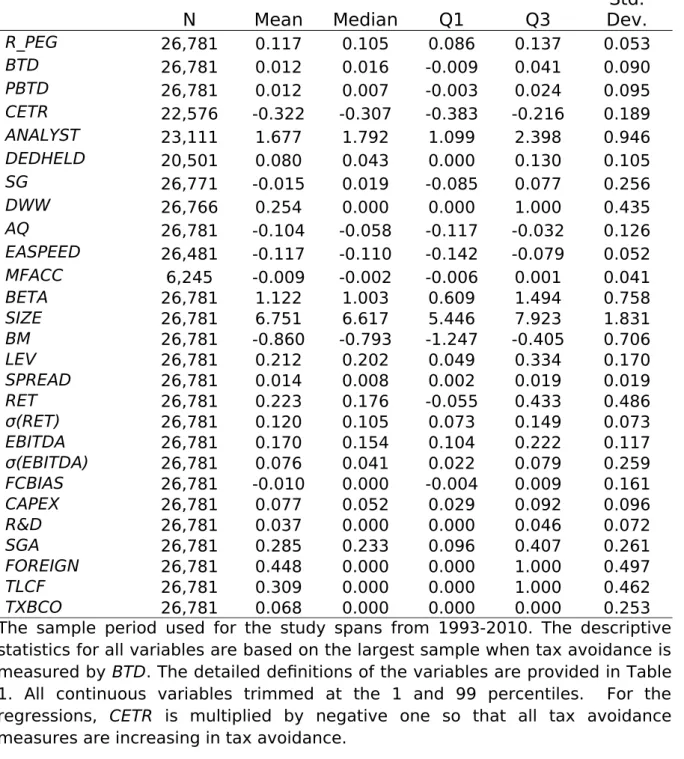
growth (SG) and financial constraints (DWW) as the moderating variables have relatively larger sample size compared to models using dedicated institutional ownership (DEDHELD) or management forecast accuracy (MFACC), because these latter variables are available only for larger firms and for firms that issue earnings forecasts, respectively. We also truncate each continuous variable at the 1 percent and 99 percent levels to mitigate the effect of outliers. The final sample size used in the regression analyses ranges from 5,610 to 26,781 firm-year observations for the 18-year sample period.
Descriptive Statistics
Table 2 reports descriptive statistics on the regression variables. The mean and median cost of equity (R_PEG) are 11.7 percent and 10.5 percent, respectively, which are comparable to those reported in prior studies (e.g., Botosan et al. 2011). The mean (median) BTD is 0.012 (0.016), which is comparable to that reported in another large sample study by Frank et al. (2009). The mean (median) PBTD is 0.012 (0.007), and the mean (median) five-year CETR is 32.2 percent (30.7 percent), where CETR is multiplied by negative one so that all three measures are increasing in tax avoidance.The mean and median five-year cash effective tax rate in our sample are higher than the 29.1 percent and 27.7 percent reported in Dyreng et al. (2008). The difference is likely due to Dyreng et al.’s (2008) sample containing larger firms, which exhibit lower cash effective tax rates.
Table 3 reports the Pearson correlation table of the variables in our analyses. The three measures of tax avoidance (BTD, PBTD, and CETR)
are positively correlated, consistent with each capturing tax planning activities. However, the correlations among the three measures, between 0.19 to 0.57, suggest that each measure likely captures different dimensions of tax avoidance.
The correlations between cost of equity (R_PEG) and the three measures of tax avoidance (BTD, PBTD, and CETR) are significantly negative, which suggests that tax avoidance is associated with a lower cost of equity. The correlation between cost of equity and other control variables is also largely consistent with prior literature and our expectations. Recall that all right hand explanatory variables are lagged one year relative to the R_PEG estimate. In particular, R_PEG is positively correlated with beta (BETA), book-to market (BM), leverage (LEV), bid-ask spreads (SPREAD), stock return volatility ((RET)), accounting
performance volatility ((EBITDA)), and analyst forecast bias (FCBIAS),
and is negatively correlated with firm size (SIZE), stock returns (RET), accounting performance (EBITDA) and accruals quality (AQ).
Main Analysis – Test of H1
This section reports the results for the test of H1 which examines the association between tax avoidance and cost of equity. As shown in Table 4, all three of our measures of tax avoidance are negatively and significantly associated with the cost of equity capital (tstatistic = 5.27, -3.82, and -4.71 for BTD, PBTD, and CETR, respectively). The effect of tax avoidance on cost of equity is also economically significant. Specifically, a one standard deviation increase in book-tax difference (BTD), permanent book-tax difference (PBTD), and cash-based effective tax rate (CETR) is
associated with a 26 basis points, 13 basis points, and 19 basis points decrease in the cost of equity, respectively.26 Because we explicitly control for the business fundamentals (CAPEX, R&D, SGA, FOREIGN, TLCF and TXBCO) that can give rise to the transactions underlying these tax strategies, our results suggest that tax avoidance leads to a lower cost of equity that is incremental to these business fundamentals.
The coefficients on the other control variables are significant and consistent with prior literature. In particular, we find that firms with higher beta (BETA), higher book-to-market (BM), higher leverage (LEV), higher bid-ask spread (SPREAD), higher idiosyncratic risks ( (RET)), higher
accounting performance volatility ((EBITDA)) and higher analyst forecast
bias (FCBIAS) are associated with a higher cost of equity while larger firms (SIZE) and firms with higher stock returns (RET), better accounting performance (EBITDA) and higher accruals quality (AQ) are associated with a lower cost of equity.
Overall, the above results suggest that equity investors generally require a lower expected rate of return due to the positive cash flow effects of corporate tax avoidance. The next section explores the cross-sectional variation in the relation between tax avoidance and cost of equity.
Cross-sectional Analyses – Test of H2
H2a examines the moderating role of outside monitoring. In
26 Following prior studies (e.g., Hasan et al. 2014), we assess the economic significance
of our results by estimating the effect of a one standard deviation change in tax avoidance on the cost of equity. For example, the impact of a one standard deviation increase in total book-tax difference (BTD) on the cost of equity (R_PEG) is computed as -0.029 (coefficient on BTD) × 0.090 (the sample standard deviation of BTD) = -0.26 percent.
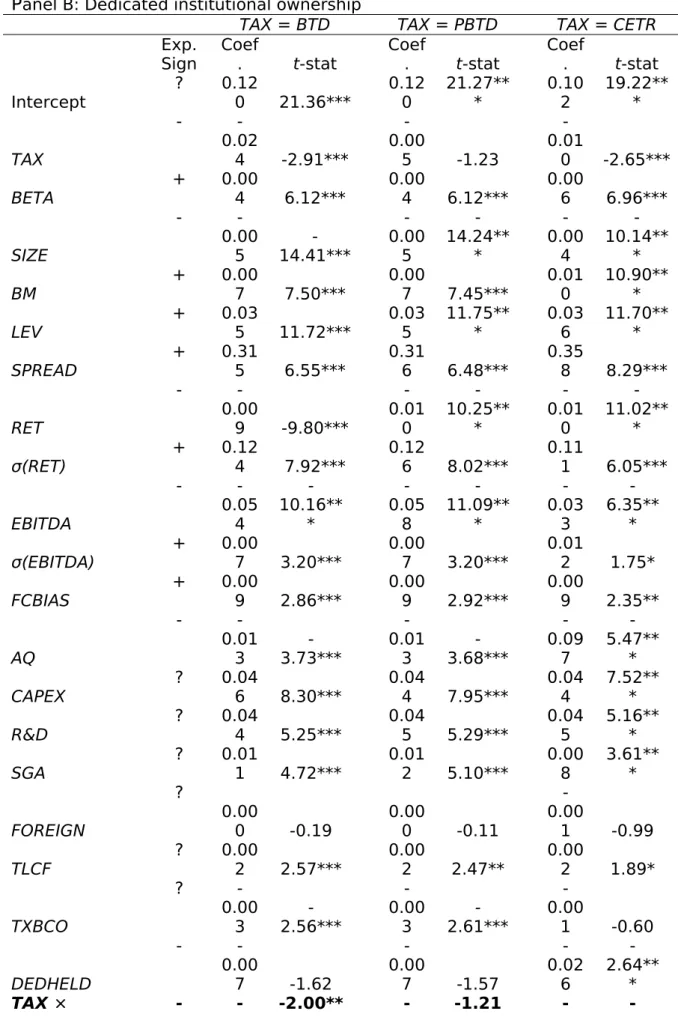
particular, we argue that stronger outside monitoring reduces managerial opportunism associated with or masked by tax avoidance and hence the negative association between firms’ tax avoidance and the cost of equity capital should be stronger for firms with better outside monitoring. Table 5, Panel A uses analyst coverage (ANALYST) as a proxy for the extent of outside monitoring and Panel B uses the percentage of dedicated institutional ownership (DEDHELD) as a proxy for the extent of outside monitoring. Consistent with our prediction in H2a, the negative association between tax avoidance and cost of equity is stronger for firms with greater analyst following and for firms with greater dedicated institutional ownership, except when we use PBTD as a proxy for tax avoidance. We also find that the coefficients on ANALYST and DEDHELD are negative and mostly significant, which suggests that better outside monitoring is associated with a lower cost of equity. The coefficient on PBTD becomes insignificant when we include the interaction with DEDHELD (Panel B). Taken together, the results in Table 5 suggest that investors require an even lower expected rate of return from tax avoiding firms when these firms have better outside monitoring because better outside monitoring likely mitigates managerial rent-diversion associated with tax avoidance.
H2b examines the moderating role of marginal benefits of tax savings and predicts the negative association between firms’ tax avoidance and the cost of equity capital to be stronger for firms that likely realize more benefits from a marginal dollar saved from taxes. Table 6, Panel A uses sales growth (SG) as a proxy for the marginal benefits for tax
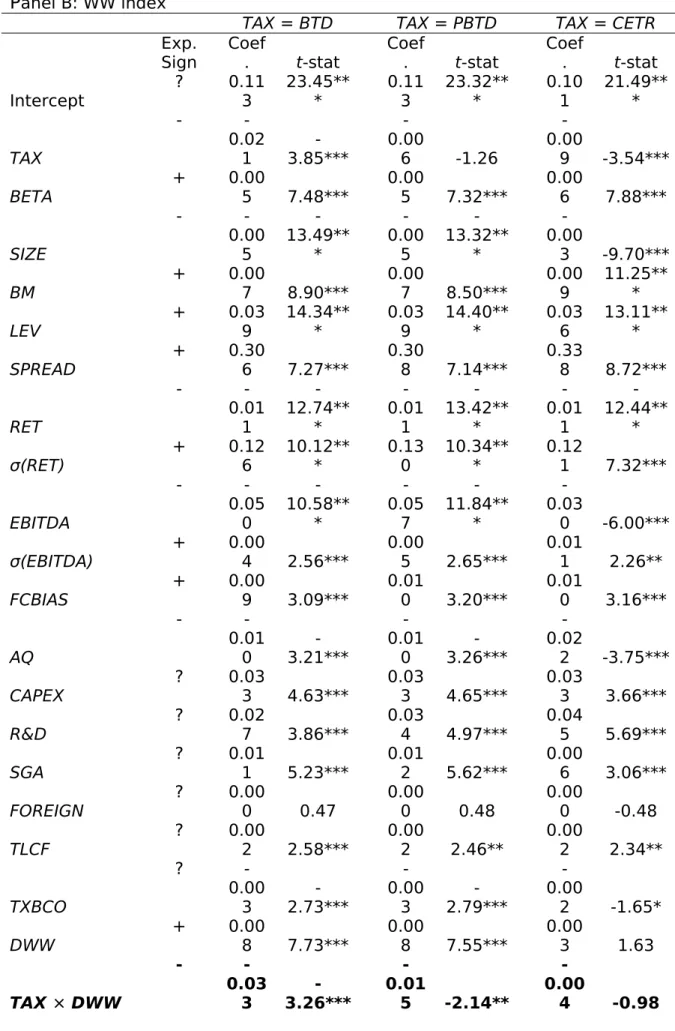
savings and we expect firms with higher sales growth to realize greater benefits from a marginal dollar saved because these tax savings can be used to fund firm growth. Consistent with H2b, the negative association between tax avoidance and cost of equity is stronger for firms with greater sales growth. Panel B uses the WW Index (DWW) as a proxy for the marginal benefits for tax savings, where firms with greater financial constraints should benefit more from incremental tax savings because these savings make it feasible to fund profitable investment opportunities. Consistent with H2b, we find some evidence that the negative association between tax avoidance and cost of equity is stronger for firms with greater financial constraints, except when we use CETR as a proxy for tax avoidance. The coefficient on PBTD becomes insignificant when we include the interaction with DWW (Panel B). The results in Table 6 suggest that investors recognize how tax savings can be redeployed to more productive uses and therefore reward tax-avoiding firms with higher marginal benefits from tax savings with a lower cost of equity.
Finally, H2c examines the moderating role of information quality. Higher information quality can reduce investors’ information uncertainty concerning the firm’s future cash flow in the form of the variance and covariances of expected future cash flows, and hence the negative association between firms’ tax avoidance and the cost of equity capital is expected to be stronger for firms with higher information quality. Test in Table 7, Panel A uses accrual quality (AQ) based on the Dechow and Dichev (2002) as a proxy for information quality, with higher values indicating higher information quality. Panel B uses the speed of earnings
announcement (EASPEED) as a proxy for information quality, and Panel C uses management forecast accuracy (MFACC) as a proxy for information quality. Consistent with H2c, all three panels show that the negative association between tax avoidance and cost of equity is stronger for firms with higher information quality. In addition, the coefficients on AQ, EASPEED and MFACC are all negative and mostly significant, suggesting that good information quality is associated with a lower cost of equity, consistent with the findings in prior studies (e.g., Francis et al. 2005). Note that the coefficient on BTD (PBTD) becomes insignificant when we include the interaction with EASPEED in Panel B (MFACC in Panel C). In sum, the results in Table 7 suggest that investors require an even lower expected rate of return from tax avoiding firms when these firms have higher information quality, consistent with investors being better able to estimate the variance and covariances of future cash flows relating to tax planning.
This section finds results generally consistent with our cross-sectional hypotheses that the negative association between tax avoidance and cost of equity is strengthened with stronger outside monitoring, higher marginal benefits of tax savings, and higher information quality.
V. ADDITIONAL ANALYSES AND SENSITIVITY CHECKS27
Change Analyses
In our earlier analyses, we control for various documented risk factors that could potentially correlate with both our measures of tax
27 All results discussed below and the related variable definitions are presented in detail
in an online appendix. The online appendix also contains a discussion and a comparison of our results to a contemporaneous working paper by Hutchens and Rego (2015).
avoidance and the cost of equity to mitigate endogeneity concerns, including market risk, and business/transaction fundamental risk. To further mitigate the concern that an omitted correlated variable is driving our results, we utilize a change regression specification for our main analyses in an additional sensitivity test. We find that an increase in tax avoidance is significantly associated with a decrease in the cost of equity. We also re-run our cross-sectional analyses (H2) using a change specification. Despite the reduction in variation for the test of our cross-sectional analyses based on a change specification, we still find some evidence consistent with our cross-sectional hypotheses.
Using Alternative Dependent Variables
Alternative Measures of Cost of Equity Capital
We examine the robustness of our results using three alternative measures of cost of equity capital. The first two alternative measures are proposed by Botosan and Plumlee (2005) and Botosan et al. (2011) as appropriate measures because they correlate consistently and predictably with various known proxies for risk.28 For the third alternative measure, we use an average ex-ante cost of equity measure based on the valuation models from Claus and Thomas (2001), Gebhardt, Lee, and Swaminathan (2001), Ohlson and Juettner-Nauroth (2005), and Easton (2004). This average measure has been used extensively in the literature (e.g., Dhaliwal, Krull, and Li 2007).29 Our main inferences from earlier analyses remain unchanged using these alternative measures of cost of equity.
28 These two alternative measures are based on the PEG ratio method and the target
price method (Botosan and Plumlee 2005).
29 The computation and model-specific assumptions of the four valuation models used to