Electronic copy available at: http://ssrn.com/abstract=2235236
1169 RULES, AND TAX
Andrew Blair-Stanek*
HE distinction between property rules and liability rules has revo-lutionized our understanding of many areas of law. But scholars have long assumed that this distinction has no relevance to tax law. This assumption is flatly wrong. Tax law currently uses both property rules and liability rules, and the choice between them has real conse-quences. When a taxpayer violates a requirement for a favorable tax status, tax law either imposes additional tax proportionate to the harm (a liability rule) or imposes the draconian penalty of taking away the tax status entirely (a property rule). This recognition has three key im-plications. First, Congress can and should draw on the rich property and liability rule literature to draft better tax legislation and to reform the tax code. Second, novel variations on property and liability rules can be used to rethink the remedies given to the IRS. Third, tax law will enrich the literature on property and liability rules across many other areas of law.
INTRODUCTION ... 1171
I. REMEDIES IN TAX LAW ... 1175
A. Property Rules and Liability Rules ... 1175
B. Tax Statuses ... 1178
C. Four Examples of Tax Statuses ... 1180
1. Public Charities ... 1181
2. Real Estate Investment Trusts (REITs) ... 1182
3. Tax-Exempt Municipal Bonds ... 1183
4. Qualified Retirement Plans ... 1184
D. Why Taxpayers Violate Requirements ... 1185
E. Tax Status-Loss Is a Property Rule ... 1187
*Assistant Professor of Law, University of Maryland Francis King Carey School of Law.
J.D., Yale Law School. I am very grateful for valuable feedback and comments from Anne Alstott, Ian Ayres, Victor Fleischer, David Gamage, David Singh Grewal, Henry Hansmann, Simone Sepe, Noel Brock, Daniel Epps, Nathaniel Gleicher, Megan Hall, Brittan Heller, Daniel Hemel, Connor Raso, Megan Woodford, the Yale Moot Camp participants, and the full law faculties of Tulane, Alabama, Maryland, Wake Forest, Texas, George Washington, San Diego, Illinois, and Virginia.
Electronic copy available at: http://ssrn.com/abstract=2235236
F. Other Property Rules in Tax Law ... 1191
G. Liability Rules in Tax Law ... 1192
II. CHOOSING BETWEEN PROPERTY AND LIABILITY RULES TO PROTECT TAX STATUSES ... 1195
A. Compliance Expenditures ... 1195
B. Encouraging Efficient Transactions ... 1198
1. Allowing Efficient Violations of Requirements by Setting a “Price” ... 1198
2. Preventing Ambiguity from Discouraging Efficient Transactions ... 1199
C. Deterrence ... 1200
1. Model of IRS Utility ... 1203
2. Contrasted with Nuisance Dispute ... 1209
3. Feedback from Enforcement or Non-Enforcement ... 1211
D. Improving Taxpayer-IRS Negotiation ... 1211
1. Encouraging Settlements to Happen ... 1212
2. More Consistent and Equitable Settlements ... 1212
E. Biased Liability Amounts ... 1213
F. Calculation Costs ... 1214
G. Non-Economic Concerns ... 1216
H. Definitional Requirements ... 1217
III. BEYOND PLAIN PROPERTY AND LIABILITY RULES:NEW APPROACHES ... 1217
A. Liability Rules Tailored to Probability of Detection ... 1218
B. Pliability Rules ... 1219
1. Information-Forcing Pliability Rules ... 1220
2. Pliability Rules Triggered by Financial Crises ... 1220
C. Why Not Other Property Rules? ... 1222
D. Rule 4 ... 1223
E. Less Than Zero: The IRS Put-Option ... 1226
IV.TAX LAW’S CONTRIBUTION TO THE PROPERTY AND LIABILITY RULE SCHOLARSHIP ... 1228
A. Relaxing Assumption of Constantly Increasing Utility ... 1228
B. Taker’s Information Costs ... 1230
C. Liability Rules as “Gentle Nudges”; Property Rules as “Hard Shoves” ... 1231
D. Empirical and Experimental Opportunities ... 1232
Electronic copy available at: http://ssrn.com/abstract=2235236
INTRODUCTION
In a pioneering 1972 article, Guido Calabresi and Douglas Melamed introduced the distinction between “property rules” and “liability rules.”1 Property-rule remedies like injunctions protect by deterrence, while lia-bility-rule remedies protect by requiring compensation. Property rules and liability rules are “workhorse concepts that permeate every corner of the economic analysis of law.”2 Scholars have used these concepts to draw insights into areas as diverse as torts, property, contracts, intellec-tual property, and constitutional law.3 But the common wisdom has been that tax law relies entirely on liability rules, and that the property and li-ability rule distinction has no use in tax law. As one leading scholar put it in the Yale Law Journal, tax law is the “quintessential liability rule re-gime.”4
This common wisdom is wrong. Tax law uses both property rules and liability rules. The extensive scholarship on property rules and liability rules can and should be used to improve tax law. And tax law can con-tribute to the broader property and liability rule debate across all areas of law.
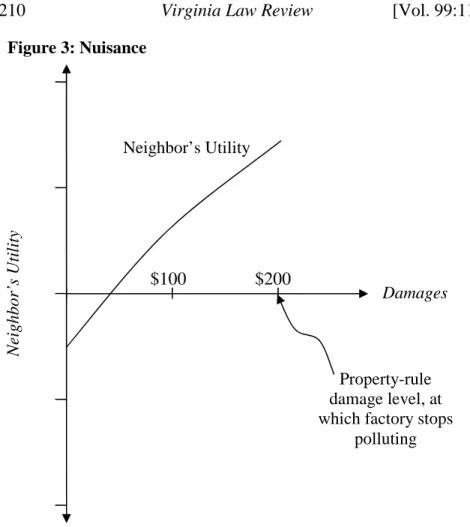
Consider briefly the quintessential scenario for property and liability rules: a factory’s pollution harms neighboring residents. Tort law has two basic approaches to protecting the residents’ entitlement to clean air.5 First, a liability rule requires the factory to pay compensatory
dam-1
Guido Calabresi & A. Douglas Melamed, Property Rules, Liability Rules, and Inaliena-bility: One View of the Cathedral, 85 Harv. L. Rev. 1089 (1972).
2
Lee Anne Fennell, Adjusting Alienability, 122 Harv. L. Rev. 1403, 1404–05 (2009). 3
E.g., Richard Craswell, Property Rules and Liability Rules in Unconscionability and Re-lated Doctrines, 60 U. Chi. L. Rev. 1 (1993); Louis Kaplow & Steven Shavell, Property Rules Versus Liability Rules: An Economic Analysis, 109 Harv. L. Rev. 713 (1996); Eugene Kontorovich, Liability Rules for Constitutional Rights: The Case of Mass Detentions, 56 Stan. L. Rev. 755 (2004); Mark A. Lemley & Philip J. Weiser, Should Property or Liability Rules Govern Information?, 85 Tex. L. Rev. 783 (2007).
4
Carol M. Rose, The Shadow of The Cathedral, 106 Yale L.J. 2175, 2197 (1997) (arguing that Louis Kaplow naturally brought pro-liability-rule tendencies to the property- and liabil-ity-rule scholarship because he has made major contributions to the study of “that quintes-sential liability rule regime, tax”).
5
Calabresi & Melamed, supranote 1, at 1092. Calabresi and Melamed discuss a third type of rule, inalienability rules, which forbid selling the entitlement. Id. at 1092–93. They recog-nize, “[i]nalienability rules are thus quite different from property and liability rules,” id. at 1093 (emphasis added), and therefore treat them separately. Id. at 1106. Although inaliena-bility has applications in tax law, these applications will be addressed in a subsequent article.
ages to the residents but allows the pollution to continue.6 Second, a property rule imposes a much harsher penalty on the factory. Examples of property-rule remedies include injunctions, prison terms, and dis-gorgement (that is, forcing the factory to disgorge all its profits).7 Liabil-ity rules set a price that compensates residents, so that the factory will pollute only when it is economically efficient; property rules set a penal-ty so high that the factory should never rationally pollute.
The same dichotomy appears in tax law, most notably in the require-ments to qualify for a favorable tax status, such as being a tax-exempt public charity. When a taxpayer violates a requirement for a favorable tax status, tax law has two basic approaches for protecting the govern-ment’s entitlement to compliance. First, it can increase the taxpayer’s taxes by an amount that compensates the government for the harm that violating the requirement caused, such as lost tax revenues, while the taxpayer retains the favorable tax status. This is a liability rule. Second, tax law can strip the taxpayer of the tax status entirely, resulting in a sharp, punitive rise in taxes. This is a high penalty that no taxpayer should rationally incur. Status-loss is a property-rule remedy. It is a form of disgorgement, requiring the taxpayer to disgorge all benefits from the tax status.
An example illustrates the distinction. Consider a university that qual-ifies as a public charity, which not only makes the university tax exempt, but also allows donors to deduct donations.8 To qualify for public chari-ty status, the universichari-ty must satisfy numerous requirements.
One requirement is that public charities must be “operated exclusive-ly” for exempt purposes, such as education.9 Suppose that the university owns land that it plans one day to use for a dormitory, but that it current-ly uses for a parking lot that is open to the public and that charges by the hour. The university is no longer “operated exclusively” for exempt pur-poses, because it is operating a commercial parking lot in addition to be-ing operated for educational purposes. But it does not lose its favorable status as a public charity.10 Rather, the university must pay a special
6
Calabresi & Melamed, supranote 1, at 1092, 1121; e.g., Boomer v. Atlantic Cement Co., 257 N.E.2d 870, 875 (N.Y. 1970) (awarding permanent damages to residents against a near-by cement factory).
7
See Ian Ayres, Optional Law: The Structure of Legal Entitlements 13 (2005). 8
I.R.C. §§ 501(a), 501(c)(3), 170(a)(1), 170(c)(2) (2006). 9
Id. § 501(c)(3) (listing exempt purposes). 10
At some point, if too much of the university’s operations are unrelated trade or business activities, then it might lose its 501(c)(3) status, but tax law is generally very forgiving on
tax11 that approximately equals the income tax that a for-profit corpora-tion operating the same parking lot would have paid. The “operated ex-clusively” requirement is thus protected by a liability rule that compen-sates the government for the lost tax revenue,12 thus setting a “price” so that the university can choose whether to violate the “operated exclu-sively” requirement by operating the parking lot.
But not all tax-status requirements are protected by liability rules. For example, another requirement that the university must meet to be a lic charity is that it “not participate in, or intervene in (including the pub-lishing or distributing of statements), any political campaign on behalf of (or in opposition to) any candidate for public office.”13 Suppose that the university circulated leaflets expressly advocating the defeat of a Member of Congress who opposed public funding for scientific re-search. In this case, the university has violated the requirement that it not participate or intervene in elections. The law provides that the university entirely loses its status as a public charity.14 This status-loss means not only that the university must pay tax on all of its income,15 but also that donors cannot deduct their contributions to it.16 This property-rule reme-dy sets the penalty so high that no university would rationally incur it.
this point. See Treas. Reg. § 1.501(c)(3)-1(e) (2006); Peter Molk, Reforming Nonprofit Ex-emption Requirements, 17 Fordham J. Corp. & Fin. L. 475, 515 & n.189 (2012) (arguing inter alia for moving to a pure liability rule for this requirement). See generally Frances R. Hill & Douglas M. Mancino, Taxation of Exempt Organizations ¶ 21.03[1] (2013) (discuss-ing the effect of unrelated business income).
11
I.R.C. § 511(a) (imposing the unrelated business income tax). 12
Requiring tax-exempt entities to compensate the government levels the playing field be-tween tax-exempt and for-profit businesses engaged in the same for-profit activity. SeeS. Rep. No. 81-2375, at 28–29 (1950). 13 I.R.C. § 501(c)(3). 14 Id. § 501(a), 501(c)(3). 15
Universities are an example of what Henry Hansmann called “commercial nonprofits,” in that much of their income comes from the provision of a good or service, specifically tui-tion paid for educatui-tion. See Henry Hansmann, The Ratui-tionale for Exempting Nonprofit Or-ganizations from Corporate Income Taxation, 91 Yale L.J. 54, 59 (1981) (internal quotations omitted). Hansmann notes that many non-profits have substantial net earnings that could be subject to corporate taxation. Id. at 56, 58–59. Donations, meanwhile, could be income to a tax-exempt organization just as amounts paid to Tiffany’s for a gift to a third party are in-come to Tiffany’s. Id. at 61–62; see also Boris I. Bittker & George K. Rahdert, The Exemp-tion of Nonprofit OrganizaExemp-tions from Federal Income TaxaExemp-tion, 85 Yale L.J. 299, 307–16 (1976) (noting that normal tax principles are inappropriate for taxing non-profits); cf. Hans-mann, supra, at 59 (arguing that “Bittker and Rahdert overstate the difficulties” in calculat-ing a non-profit’s net income).
16
Part I of this Article explains further how imposing status-loss is a rule remedy, just as injunctions and disgorgement are property-rule remedies in the common law. It also discusses the central im-portance of tax statuses throughout tax law, which uses statuses to de-termine tax rates, tax exemptions, exclusions, deductions, and credits. Tax statuses can apply not only to non-profit entities such as universi-ties, but also to individuals, business entiuniversi-ties, properuniversi-ties, transactions, and debts. Although status-loss is the most common property-rule reme-dy in tax law, Section I.F gives examples of several other property-rule remedies in tax. Section I.G then gives examples of liability rules in tax. In short, Part I conclusively disproves the conventional wisdom that tax law is the “quintessential liability rule regime.”17
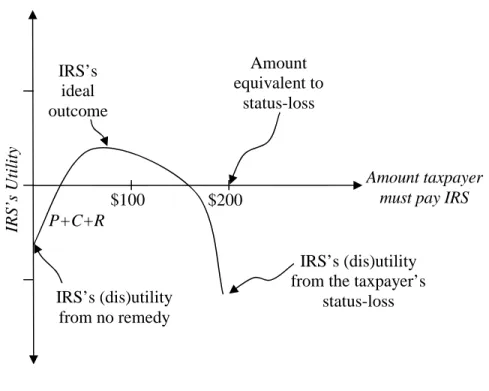
Scholars have produced a rich literature to guide lawmakers and judg-es in choosing between property and liability ruljudg-es in different situa-tions. Part II explores how lawmakers can draw on these scholarly in-sights to best protect tax-status requirements. For example, liability rules can substantially reduce taxpayers’ compliance costs for requirements that are ambiguous. Liability rules can also encourage economically ef-ficient transactions and improve settlement negotiations between tax-payers and the IRS. Surprisingly, a simple model of IRS utility demon-strates that, in many instances, liability rules do a better job of deterring taxpayers from violating tax-status requirements than draconian property rules. Meanwhile, other considerations identified by scholars, such as calculation costs and biases, may weigh in favor of using property rules in other situations. Congress can and should draft better tax legislation by understanding the property and liability rule distinction.
But tax law can expand beyond plain property and liability rules. Scholars have developed many novel variations, and Part III shows how these innovative remedies can be used to rethink how the IRS protects tax-status requirements. For example, “pliability rules”—where a trig-gering event switches from one rule (either property or liability) to a second rule (also either property or liability)18—can be used for purposes as varied as encouraging taxpayers to disclose information to the IRS or helping taxpayers to survive financial crises. Another example is the “Rule 4” remedy: In the pollution dispute, Rule 4 involves enjoining the polluting factory but requiring the neighboring residents to compensate
17
Rose, supra note 4. 18
the factory for shutting down.19 In tax law, Rule 4 can be used to protect students when their university violates a requirement for public charity status. Part III also explores several other new IRS remedies drawn from the broader property and liability rule literature.
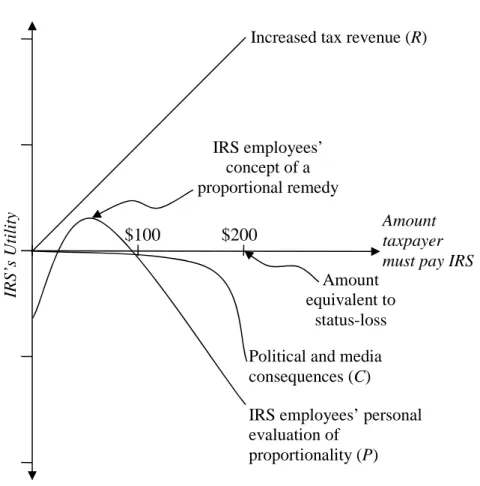
Recognizing the relevance of the property and liability rule distinction to tax law can inform the broader literature across numerous other areas of law, as Part IV shows. Over the years, applying the distinction to con-tract law, intellectual property, and constitutional law has enriched the broader debate.20 Each new area of law has brought new examples (and counterexamples) and unmasked implicit assumptions. Tax law is no different. For example, the IRS will often prefer not to get additional money from taxpayers who violate a requirement, because the IRS seeks proportional remedies and responds to political and media pressure.21 This reveals the assumption implicit throughout the existing literature that parties always prefer to receive more money from the other side. Another contribution tax law can make to the broader literature is as a testing ground for scholars’ predictions and novel remedies, as lawmak-ers constantly seek ways to increase tax revenues while keeping taxpay-ers happy.
Tax law has both property rules and liability rules. This recognition has concrete implications for tax law, as well as implications for the on-going scholarly debate about property rules and liability rules in all areas of law.
I.REMEDIES IN TAX LAW
This Part begins with a brief overview of the rich property and liabil-ity rule scholarship, and moves on to give examples of tax statuses used throughout the Article to illustrate remedies in tax law. The Part then demonstrates why taking away a tax status is a property rule. It con-cludes with examples of property rules and liability rules in tax.
A. Property Rules and Liability Rules
Calabresi and Melamed’s seminal 1972 article, Property Rules, Lia-bility Rules, and InalienaLia-bility: One View of the Cathedral,22 which
19
See infra Section III.D. 20
See infra notes 344–49. 21
See infra Subsection II.C.1. 22
scholars often simply call “The Cathedral,”23 introduced the distinction between property rules and liability rules. Since then, the distinction has resulted in a flowering of scholarship.24
Notably, scholars have generated numerous insights into the relative merits of property and liability rules in different situations.25 For exam-ple, many scholars argue that property rules encourage negotiated effi-cient resolutions (such as sales), and that liability rules are preferable when high transaction costs make such consensual resolutions difficult.26 Others have noted, for example, that property rules encourage overvestment in search costs, because accidentally taking an entitlement in-curs draconian punishments.27
Scholars have hardly limited themselves to debating the merits of property and liability rules—they have developed entirely new remedies. Calabresi and Melamed themselves started this process in their path-breaking article by recognizing the possibility of a new remedy called
23
E.g., Emily Sherwin, Introduction: Property Rules as Remedies, 106 Yale L.J. 2083, 2084 (1997).
24
See, e.g., Ayres, supra note 7; Ian Ayres & J.M. Balkin, Legal Entitlements as Auctions: Property Rules, Liability Rules, and Beyond, 106 Yale L.J. 703 (1996); Ian Ayres & Paul M. Goldbart, Optimal Delegation and Decoupling in the Design of Liability Rules, 100 Mich. L. Rev. 1 (2001); Ian Ayres & Eric Talley, Solomonic Bargaining: Dividing a Legal Entitle-ment to Facilitate Coasean Trade, 104 Yale L.J. 1027 (1995); Lee Anne Fennell, Revealing Options, 118 Harv. L. Rev. 1399 (2005); Kaplow & Shavell, supra note 3; A. Mitchell Polin-sky, Controlling Externalities and Protecting Entitlements: Property Right, Liability Rule, and Tax-Subsidy Approaches, 8 J. Legal Stud. 1 (1979); A. Mitchell Polinsky, Resolving Nuisance Disputes: The Simple Economics of Injunctive and Damage Remedies, 32 Stan. L. Rev. 1075 (1980); Henry E. Smith, Exclusion and Property Rules in the Law of Nuisance, 90 Va. L. Rev. 965 (2004) [hereinafter Smith, Exclusion]; Henry E. Smith, Property and Prop-erty Rules, 79 N.Y.U. L. Rev. 1719 (2004) [hereinafter Smith, PropProp-erty].
25
Ayres, supra note 7, at 183–200 (discussing the property rule vs. liability rule debate); Ian Ayres & Paul M. Goldbart, Correlated Values in the Theory of Property and Liability Rules, 32 J. Legal Stud. 121, 129–48 (2003) (refuting the argument for property rules when different parties’ values are correlated); Lucian Arye Bebchuk, Property Rights and Liability Rules: The Ex Ante View of the Cathedral, 100 Mich. L. Rev. 601, 619–32 (2001) (consider-ing ex ante incentives created by different rules); Richard A. Epstein, A Clear View of The Cathedral: The Dominance of Property Rules, 106 Yale L.J. 2091, 2096 (1997) (arguing that liability rules are rightfully the exception).
26
Ayres & Balkin, supra note 24, at 705–06 & n.9; James E. Krier & Stewart J. Schwab, Property Rules and Liability Rules: The Cathedral in Another Light, 70 N.Y.U. L. Rev. 440, 450–51 (1995) (deeming it a “virtual doctrine” that “[w]hen transaction costs are low, use property rules; when transaction costs are high, use liability rules”).
27
Stewart E. Sterk, Property Rules, Liability Rules, and Uncertainty About Property Rights, 106 Mich. L. Rev. 1285, 1297 (2008) (building on the work of Thomas W. Merrill, Trespass, Nuisance, and the Costs of Determining Property Rights, 14 J. Legal Stud. 13 (1985)).
“Rule 4” that awards an entitlement to a defendant but protects it with only a liability rule.28 Subsequent scholars have developed an array of creative new remedies,29 drawing on seemingly unrelated areas such as option theory.30
Professors Louis Kaplow and Steven Shavell made the important ob-servation that property rule and liability rule remedies lie along a con-tinuum from zero damages to infinitely high damages.31 Liability rules set the remedy to compensatory damages, while property rules simply set the remedy much higher up the continuum.32 In other words, proper-ty-rule remedies can be put into dollar terms, and property and liability rules can be viewed as differing only in degree of severity. This observa-tion opened up the entire continuum of possible remedies for discussion. As they observed, “the fully optimal rule may be neither one with ex-treme damages (that is, a property rule) nor one with damages equal to harm (that is, the conventional liability rule).”33
Kaplow and Shavell followed Calabresi and Melamed in drawing their examples from torts and property.34 Other scholars have fruitfully applied the property and liability rule distinction to numerous other are-as, including contract law,35 constitutional law,36 and intellectual proper-ty.37 But no one has yet applied the distinction in tax law, with the ex-ception of one fleeting reference by Professor Henry Smith.38
Smith proposed an innovative intermediate tax filing status for married couples. A detail of implementing this proposal would be how to recap-ture benefits that later turned out to be inappropriate. In passing, Smith
28
Calabresi & Melamed, supra note 1, at 1116 (calling this a “fourth rule”); Rose, supra note 4, at 2178 (their fourth rule is now uniformly called “Rule 4”). Rule 4 is discussed in greater depth infra Section III.D.
29
E.g., Saul Levmore, Unifying Remedies: Property Rules, Liability Rules and Startling Rules, 106 Yale L.J. 2149, 2156 tbl.2, 2157 tbl.3, 2159 tbl.4, 2163 tbl.5, app. at 2173 (1997) (listing various remedies developed, including origins); Madeline Morris, The Structure of Entitlements, 78 Cornell L. Rev. 822 (1993).
30
E.g., Ayres, supra note 7, at 5; Morris, supra note 29, at 852, 854. 31
Kaplow & Shavell, supra note 24, at 756–57. 32
Id. at 756. Of course, property rules in favor of defendants are the same as zero damages (that is, the bottom of the continuum).
33 Id. 34
Id. at 748–55, 760–62. 35
E.g., Craswell, supra note 3. 36
E.g., Kontorovich, supra note 3. 37
E.g., Lemley & Weiser, supra note 3. 38
Henry E. Smith, Intermediate Filing in Household Taxation, 72 S. Cal. L. Rev. 145, 192 (1998).
noted that “the recapture rule could fall anywhere on the continuum from liability rule to property rule.”39 Unfortunately, Smith did not further in-vestigate the relative merits of using property rules or liability rules for his innovative proposal, let alone for tax law in general. But Smith’s passing reference does reinforce this Article’s basic insight that tax law has not only liability rules, but also property rules and rules falling in between.
B. Tax Statuses
This Article uses the term “tax status” to refer to the qualification of a taxpayer, a property, or a transaction for particular treatment under the tax laws. Sometimes the tax code actually uses the word “status” to de-scribe what this Article calls a tax status, as with “tax-exempt status.”40 Sometimes the tax code instead uses the word “qualification,” as, for ex-ample, with “qualified retirement plan,”41 which is a tax status. Other times the tax code simply uses the status’s specific name (for example, “S corporation”42) to describe the tax status.
Tax statuses are essential to the working of the tax laws. They determine basic matters such as whether a taxpayer must pay tax, what rates apply, whether a deduction is allowed, whether the taxpayer can take a credit, and how taxable income is calculated. Congress loves adding new tax statuses.43
Entities can potentially qualify for a dizzying array of tax statuses, in-cluding C corporation,44 S corporation,45 partnership,46 numerous varie-ties of tax exemption,47 consolidated group,48 bank,49 regulated
invest-39 Id. 40
E.g., I.R.C. § 501(p) (2006) (“tax-exempt status”); id. § 142(d)(7) (“tax-exempt status”); id. § 62(b)(3)(C) (“marital status”); id.§ 150(d)(3) (“status as qualified scholarship funding corporation”); id. § 507 (“private foundation status”).
41
Seeid. § 4974(c) (defining “qualified retirement plan” as including various plans under §§ 401, 403, and 408); see also id. §§ 401, 403(a) & (b), 408(a) & (b). For other examples of “qualification” for a status, see, e.g., id. § 953(e)(4) (defining “[q]ualifying insurance com-pany branch”); id. § 48(c)(4)(B) (defining “[q]ualifying small wind turbine”).
42
SeeRev. Proc. 96-30 § 4.04(3), 1996-1 C.B. 696, 704 (“An alternative transaction that will cause the loss of a favorable special tax status, such as an existing S corporation elec-tion, will ordinarily be viewed as unduly expensive.” (emphasis added)).
43
See, e.g., infra notes 44–74. 44
I.R.C. §§ 11 & 1361(a)(2). 45 Id. § 1361(a)(1). 46 Id. § 761(a) (2006). 47 E.g., id. § 501(c)(1)–(29). 48 Id. § 1501. 49 Id. § 581.
ment company,50 real estate investment trust,51 controlled foreign corpo-ration,52 publicly traded partnership,53 U.S. real property holding corpo-ration,54 passive foreign investment company,55 public utility,56 and po-litical subdivision of a State.57 These statuses span business, civil so-society, and state and local government.
Individuals also may qualify for various tax statuses. Examples in-clude resident alien,58 head of household,59 qualifying child,60 independ-ent contractor,61 religious minister,62 and dependent.63
Transactions may qualify for tax statuses, with some examples includ-ing tax-free corporate reorganizations,64 various types of prohibited transactions,65 complete redemptions,66 and like-kind exchanges.67 Debts may qualify for statuses, with examples such as qualified education loan,68 qualified residence acquisition indebtedness,69 or applicable high yield discount obligation.70 Property may likewise qualify for statuses, including, for example, tax-exempt municipal bond,71 qualified low-income housing,72 regular interest in a real estate mortgage investment conduit,73 and Section 1256 contract.74
50 Id. § 851. 51 Id. § 856. 52 Id. § 957. 53 Id. § 7704. 54 Id. § 897(c)(2). 55 Id. § 1297(a). 56 Id. § 115(1). 57 Id. 58 Treas. Reg. §§ 1.871-2, 301.7701(b)-1 (2012). 59 I.R.C. §§ 2(b), 7703(b). 60 Id. § 24(c). 61 Treas. Reg. § 31.3401(c)-1(b). 62 I.R.C. § 107. 63 Id. § 152. 64
Id. § 368(a); see also id. §§ 336(c), 354(a)(1), 361(a), 1032(a) (making reorganizations tax-free to various taxpayers involved in the reorganization.
65
Id. § 503(b) (prohibited transactions for certain tax-exempt organizations); id. § 857(b)(6)(B)(iii) (prohibited transactions for REITs).
66 Id. § 302(b)(3). 67 Id. § 1031. 68 Id. § 221(d)(1). 69 Id. § 163(h)(3)(B). 70 Id. § 163(e)(5). 71 Id. § 103. 72 Id. § 42(g)(1). 73 Id. § 860G(a)(1)–(2). 74 Id. § 1256(b).
Each tax status involves meeting multiple requirements. In U.S. fed-eral tax law, each requirement is spelled out in the tax code, Treasury regulations, case law, or some combination thereof.
Every status has an equal and opposite status consisting of not quali-fying. As a matter of nomenclature, this Article uses the term “tax sta-tus” to refer to whichever one is favorable (tax-minimizing) for the rele-vant taxpayer.75 Therefore, whenever this Article refers to losing a tax status, the loss is always unfavorable for the taxpayer.
U.S. federal tax law’s reliance on statuses is hardly unique. The tax laws of other countries,76 as well as of many U.S. states and local gov-ernments,77 use tax statuses to organize their tax systems and achieve various policy goals. Tax treaties between countries also rely on tax sta-tuses.78 Although this Article focuses on U.S. federal tax law, its analy-sis applies fully to foreign, state, and local tax laws, as well as to tax treaties.
C. Four Examples of Tax Statuses
To illustrate the discussion, this Article focuses on the following four examples of tax statuses in the U.S. tax code.
75
A status that is favorable for a taxpayer at a given time may be unfavorable at a different time or for a different taxpayer. For example, taxpayers sometimes seek to be taxed as cor-porations, see, e.g., United States v. Kintner, 216 F.2d 418, 421 (9th Cir. 1954), while some seek to avoid being taxed as corporations, see, for example, Morrissey v. Commissioner, 296 U.S. 344, 348–49 (1935).
76
E.g., Income Tax Act, R.S.C., 1985, c. 1 (5th Supp.), § 149(1)(e) (Can.) (tax-exempt statuses). Numerous other countries have followed the U.S. in creating a special tax status for real estate investment trusts (“REITs”). Nat’l Ass’n of Real Estate Inv. Trusts, Frequently Asked Questions About REITs 28 (2011), available at http://www.reit.com/portals/0/ PDF/2011FAQ.pdf (listing countries); see 445 Parl. Deb., H.C. (6th ser.) (2006) 369 (U.K.), available at http://www.publications.parliament.uk/pa/cm200506/cmhansrd/vo060424/debtext/ 60424-08.htm#60424-08_spnew9 (statement of Des Browne, Chief Secretary to the Treasury) (explaining the United Kingdom’s adoption of REITs); cf. infra Subsection I.C.2 (discussing REITs in U.S. tax law).
77
See, e.g., Md. Code Ann., Tax-Gen. § 10-724 (LexisNexis 2010) (providing a tax status for property qualifying as an “aquaculture oyster float”).
78
See, e.g., Convention for the Avoidance of Double Taxation and the Prevention of Fis-cal Evasion with Respect to Taxes on Income, U.S.-Japan, art. 5, Nov. 6, 2003, T.I.A.S. No. 04,330 (defining “permanent establishment”).
1. Public Charities
Examples of public charities include churches, homeless shelters, and private universities.79 Public charity status comes with two main bene-fits: The entity itself is generally exempt from taxation,80 and donors to these organizations can reduce their own taxes by deducting their contri-butions.81
An organization must meet numerous requirements to qualify as a public charity. Many of these requirements generate ambiguity. Most importantly, the organization must be “organized and operated exclu-sively for religious, charitable, scientific,” or other enumerated purpos-es.82 These purposes have generated controversy, such as over the mean-ing of “charitable.”83
Another requirement is that “no part of the net earnings” of the organ-ization may “inure[] to the benefit of any private shareholder or individ-ual.”84 This requirement raises numerous questions. For example, how much can a charity reward its professional fundraisers?85 How well can it pay its president?86
There are two separate restrictions on public charities’ political in-volvement. First, no “substantial part” of the organization’s activities can consist of “carrying on propaganda, or otherwise attempting, to
in-79
Richard A. Westin, WG&L Tax Dictionary 568–69 (2002–2003) (defining “public char-ity” as “a nontechnical term for exempt organizations that are described in [I.R.C.] § 501(c)(3), but which are not private foundations”) (emphasis omitted). Not all organiza-tions qualifying under 501(c)(3) are public charities; some are private foundaorganiza-tions. See I.R.C. § 509 (2006) (defining “private foundation”); 5 Boris I.Bittker & Lawrence Lokken, Federal Taxation of Income, Estates, and Gifts ¶ 100.1.2 (3d ed. 2012).
80
I.R.C. § 501(a) (2006). In the case of a university that lost its 501(c)(3) status, taxable income would generally consist of gross income such as tuition minus deductions such as professors’ salaries. See id. §§ 61, 63.
81
Id. § 170(a), (c)(2). 82
Id. § 501(c)(3). This creates both an organizational test and an operational test. See Bittker & Lokken, supra note 79, ¶ 100.2.
83
Bob Jones Univ. v. United States, 461 U.S. 574, 595–96, 605 (1983) (holding that a uni-versity’s racial policies made it not qualify as “charitable”); Bittker & Rahdert, supra note 15, at 330 (noting that neither Congress nor Treasury nor the IRS have ventured to define “charitable”). See generally Bittker & Lokken, supra note 79, ¶ 100.3.2.
84
I.R.C. § 501(c)(3). See generally Bittker & Lokken, supranote 79, ¶ 100.4 (discussing inurement test).
85
See, e.g., United Cancer Council, Inc. v. Comm’r, 165 F.3d 1173, 1175–76 (7th Cir. 1999).
86
fluence legislation . . . .”87 But what is “substantial,” what is “propagan-da,” and what is “legislation”? For instance, does this requirement cover attempts to influence executive-branch decisions?88 Second, public char-ities must “not participate in, or intervene in (including the publishing or distributing of statements), any political campaign on behalf of (or in opposition to) any candidate for public office.”89 But, aside from “the publishing or distributing of statements,” it is unclear what “participate” or “intervene” means.90
2. Real Estate Investment Trusts (REITs)
A real estate investment trust, or REIT (pronounced “reet”), is effec-tively a mutual fund91 for real estate.92 The basic concept of mutual funds and REITs is the same: enabling small investors to buy into a pro-fessionally managed, diversified portfolio.93 While traditional mutual funds invest in a portfolio of stocks and other securities, REITs invest in a portfolio of real estate assets. The 141 REITs traded on the New York Stock Exchange have a total market capitalization of $461 billion.94 REITs own a wide variety of real estate assets ranging from warehouses and skyscrapers to mortgage-backed bonds and apartment buildings95— including my apartment building.
The key benefit of this status is that REITs are generally exempt from income tax, although the dividends a REIT pays out are fully taxable to its shareholders.96 Thus, if a REIT owns a building and earns rent, which it pays out to its shareholders, the rent is taxed only once. This treatment
87
I.R.C. § 501(c)(3). 88
Hill & Mancino, supranote 10, ¶ 5.04[4] (discussing the instances when lobbying exec-utive branch officials qualifies as attempting to influence legislation).
89
I.R.C. § 501(c)(3). 90
Hill & Mancino, supranote 10, ¶ 6.04[1] (“Section 501(c)(3) provides no guidance with respect to the political prohibition.”).
91
Designation as a mutual fund or “regulated investment company” is another example of a tax status. See I.R.C. § 851.
92
Michael K. Carnevale et al., Real Estate Investment Trusts, in 742 Tax Management A-1 (3d ed. 2012).
93
H.R. Rep. No. 86-2020, at 3–4 (1960). 94
Nat’l Ass’n of Real Estate Inv. Trusts, REITWatch, June 2011, at 1, available at http://returns.reit.com/reitwatch/rw1106.pdf.
95
Nat’l Ass’n of Real Estate Inv. Trusts, Frequently Asked Questions About REITs 2 (2011), available athttp://www.reit.com/portals/0/PDF/2011FAQ.pdf.
96
4 Boris I. Bittker & Lawrence Lokken, Federal Taxation of Income, Estates and Gifts ¶ 99.5.1 (3d ed. 2003).
puts the REIT’s shareholders on equal footing with wealthy individuals who can own buildings directly and who are also taxed only once on rent. But losing REIT status is disastrous, causing the REIT to pay the full corporate tax rate,97 generally for the next five years,98 with its divi-dends being taxable a second time to shareholders.
Qualifying for REIT status requires meeting a detailed array of statu-tory and regulastatu-tory requirements. Most of these requirements ensure that REIT status is available only to entities that allow small investors to in-vest in diversified real estate portfolios. To give a taste of the complexi-ty, the requirements include that the REIT’s shares be transferable,99 that there be at least 100 shareholders,100 that no five individuals own 50% or more of the stock,101 that at least 95% of the REIT’s gross income come from passive sources like interest,102 that at least 75% of its gross income be real-estate related, such as rent, mortgage interest, or gain on real es-tate sales,103 and that at least 75% of its assets be passive investments.104
3. Tax-Exempt Municipal Bonds
Interest on bonds issued by state and local governments (generally called “municipal” bonds) is received tax-free.105 This is an exception to the general rule that interest is income to the recipient.106 This exemption allows state and local governments to borrow at lower interest rates.107 Tax-exempt status for a municipal bond is an example of a tax status that applies to property, not an entity.
Bonds must meet numerous, detailed requirements to qualify for this highly favorable status. Most obviously, they must be issued by a state or local government. But even this seemingly simple requirement has
97
I.R.C. § 856(a)(3) (2006) (requiring that a REIT “(but for the provisions of this part) would be taxable as a domestic corporation”).
98 Id. § 856(g)(3). 99 Id. § 856(a)(2). 100 Id. § 856(a)(5). 101
Id. §§ 856(a)(6), 856(h)(1)(A), 542(a)(2). 102 Id. § 856(c)(2). 103 Id. § 856(c)(3). 104 Id. § 856(c)(4). 105
Id. § 103; cf.South Carolina v. Baker, 485 U.S. 505, 525(1988) (holding that the U.S. Constitution does not require this tax exemption).
106
I.R.C. § 61(a)(4). 107
See 1 Boris I. Bittker & Lawrence Lokken, Federal Taxation of Income, Estates and Gifts ¶ 15.1.1 (3d ed. 1999).
caused controversy over issuers such as volunteer fire departments108 and agencies created by multistate compact.109 A host of requirements prevent governments from using their lower borrowing costs for non-governmental purposes.110 These and the many other requirements in-volve substantial complexity and uncertainty.111
4. Qualified Retirement Plans
Qualified retirement plans, such as pension plans or Section 401(k) plans, bring substantial tax benefits to both employer and employees.112 The employer gets an immediate (and thus more valuable113) deduction for amounts contributed to the plan.114 The employee defers taxes on contributions, typically until retirement years later.115 Additionally, in-vestment income on the retirement assets is exempt from tax, and these tax savings compound exponentially, allowing the retirement assets to grow more rapidly.116
These significant tax benefits come at the cost of compliance with an extraordinary number of requirements, which commentators have called “an ever-increasing maze of laws, rules, and regulations.”117 Some re-quirements are procedural, such as rere-quirements that the trust instrument be written, established in the United States, communicated to
employ-108
SeeSeagrave Corp. v. Comm’r, 38 T.C. 247, 250–51 (1962), superseded by statute, Tax Reform Act of 1986, Pub. L. No. 99-514, § 1301(b), 100 Stat. 2085, 2654 (1986) (codi-fied at I.R.C. § 150(e)).
109
SeeComm’r v. Shamberg’s Estate, 144 F.2d 998, 999–1000 (2d Cir. 1944) (divided panel).
110
E.g., I.R.C. § 103(b)(1) (2006);Bittker & Lokken, supranote 107, ¶ 15.2 (discussing history and requirements relating to private activity bonds).
111
See, e.g., Letter from Kathleen C. McKinney, National Association of Bond Lawyers, to Internal Revenue Serv., Tax Notes Today, June 14, 2010, LEXIS, 2010 TNT 113-93 (sug-gesting eleven areas relating to tax-exempt bonds where the IRS should make issuing guid-ance a priority).
112
See generallyPamela D. Perdue, Qualified Pension and Profit-Sharing Plans ¶ 1.02 (2011) (discussing the advantages of maintaining a tax-qualified plan).
113
SeeStephen F. Gertzman, Federal Tax Accounting ¶ 1.01[2] (2d ed. 1993 & Supp. 2012).
114
I.R.C. § 404(a)(1), (5), (6) (2006). See generally Perdue, supranote 112, ¶ 1.02[1][a]. 115
See, e.g., I.R.C. §§ 401(k), 501(a). There are still other benefits to the employee, such as tax-free rollovers. Id. § 402(c); Perdue, supra note 112, ¶ 1.02[2][b].
116
I.R.C. § 501(a). See generallyPerdue, supranote 112, ¶ 1.02[1][b], [2][a]. 117
Perdue, supranote 112, ¶ 1.01. The primary statute governing plan qualification is the Employee Retirement Income Security Act of 1974 (ERISA), Pub. L. No. 93-406, 88 Stat. 829 (codified as amended at 29 U.S.C. §§ 1001–1461 (2006)). The IRS and Department of Labor dually administer ERISA. Perdue, supra note 112, ¶ 2.02.
ees, and permanent.118 Other requirements relate to substance, including requirements for minimum coverage,119 not discriminating in favor of highly compensated employees,120 minimum vesting and benefit accru-al,121 minimum distributions,122 and diversification.123 Complying with this thicket of requirements has generated plenty of work for law firms.124
D. Why Taxpayers Violate Requirements
The reasons why taxpayers violate requirements can be grouped into four categories: tax law ambiguities, factual changes, ignorance of the tax law, and playing the “audit lottery.”
First, legal ambiguity exists in tax as in all other areas of law. Some-times no statute, IRS guidance, or case law is on point. Other Some-times, ex-isting law is subject to different reasonable interpretations.125 For in-stance, REITs must have at least 75% of their assets invested in specified categories of property,126 but tax law is unclear as to whether assets used as collateral in common financing transactions count towards the required 75%.127 Although most practitioners believe they do count,
118
Perdue, supranote 112, ¶ 2.04[1]. 119 I.R.C. § 410. 120 Id. § 414(q). 121 Id. § 411. 122 Id. § 401(a)(9). 123 Id. § 401(a)(35). 124
See, e.g., Employee Benefits, McDermott Will & Emery, http://www.mwe.com/ Employee-Benefits--Pensions (last visited July 16, 2012).
125
David Weisbach has discussed line-drawing in otherwise gray areas of tax. David A. Weisbach, An Efficiency Analysis of Line Drawing in the Tax Law, 29 J. Legal Stud. 71, 71 (2000); David A. Weisbach, Line Drawing, Doctrine, and Efficiency In The Tax Law, 84 Cornell L. Rev. 1627, 1627 (1999). Weisbach’s articles focus on whether a line is crossed, while this Article looks at the result if a line is crossed.
126
I.R.C. § 856(c)(4). 127
The common financing transaction at issue is a sale-repurchase agreement (“repo”) of a mortgage-backed security. In entering a repo, a REIT would sell a mortgage-backed security to a counterparty for cash, but also contract to repurchase the security later at a higher price constituting interest on the sales proceeds. Although repos are generally understood by prac-titioners to be secured loans for tax purposes, the question is ambiguous. See William W. Chip, Are Repos Really Loans?, 95 Tax Notes 1057 (May 13, 2002). If repos are indeed se-cured loans, the securities used as collateral remain assets of the REIT for the 75% asset test. But if repos are sales, the securities are not assets of the REIT for the duration of the repo, meaning they no longer count towards the 75% test.
many REITs would unexpectedly find themselves in violation of the 75% asset test if the IRS or a court were to decide otherwise.128
Second, factual changes—ranging from business exigencies, to com-pliance with non-tax law,129 to accidental paperwork failures—can also cause taxpayers to violate requirements. For example, a REIT may gen-erate most of its income from rents, thereby meeting the requirement that at least 75% of a REIT’s gross income must come from real-estate sources.130 But in a recession, some tenants may stop paying rent, caus-ing the percentage of gross income from real-estate sources to fall below the 75% threshold. Similarly, a church’s tax-exempt status might be im-periled by a guest preacher’s unexpected advocacy of a political candi-date. Or, a qualified retirement plan might accidentally misfile paper-work, leading the entire plan to lose its qualification.131
Third, ignorance of tax law’s requirements is common, which is un-derstandable due to the tax code’s extraordinary length and complexi-ty.132 For example, church leaders may not be aware of the no-campaigning requirement for public charities. A small business owner may not understand the requirements for retirement plan qualification. And a REIT’s lawyers and accountants may miss a potential legal issue.
Finally, some taxpayers simply play the “audit lottery,” which is tak-ing an incorrect tax position on one’s return and hoptak-ing the IRS does not audit the return and discover the problem.133 Like the traditional lottery, the “audit lottery” is a game of chance.134 A taxpayer playing the “audit
128
See AG Mortgage Investment Trust, Inc., Prospectus, SEC Registration No. 333-172656, at 69 (June 29, 2011), available at http://www.sec.gov/Archives/edgar/data/ 1514281/000119312511179374/d424b1.htm. (“The failure of RMBS subject to repurchase agreements to qualify as real estate assets could adversely affect our ability to qualify as a REIT.”).
129
See, e.g., Cherry-Burrell Corp. v. United States, 367 F.2d 669, 677–78 (8th Cir. 1966) (noting that corporate law considerations prevented a taxpayer from meeting status require-ments and forgiving the violation based on the statute’s purpose).
130
I.R.C. § 856(c)(3). 131
See, e.g.,Fazi v. Comm’r, 102 T.C. 695, 700 (1994). 132
SeeMichael J. Graetz, The U.S. Income Tax 293 (1999) (“[The Internal Revenue Code is] now more than six times longer than Tolstoy’s War and Peace and considerably harder to parse.”).
133
Richard A. Westin, WG&L Tax Dictionary 59 (2002–2003) (defining “audit lottery” as “a slang term for the fact that one can take an incorrect tax position on one’s return and pre-vail in the sense of not being discovered. The notion is that by doing so, one plays a game of chance, i.e., the audit lottery.”).
134 Id.
lottery” may violate a requirement but hope that the IRS will not discov-er the violation.135
None of these four considerations are unique to tax law. For example, an author may potentially infringe another’s copyright due to legal am-biguity about the fair use doctrine. Authors revising their manuscript may accidentally quote another’s work. Authors may be ignorant of copyright law’s requirements, or may simply hope that their infringe-ment goes undiscovered. In copyright and other areas of law, such viola-tions can be remedied by either property rules or liability rules, and the same is true in tax law.
E. Tax Status-Loss Is a Property Rule
Although injunctions are perhaps the quintessential property-rule remedy, disgorgement is also a traditional property-rule remedy.136 In-deed, the economic consequences of an injunction are nearly identical to those of disgorgement.
Consider a nuisance dispute where a factory increases its profits $20 million annually by emitting pollution that inflicts $1 million in annual harm on neighboring residents. A liability rule would require
135
There are various procedural measures to deter such behavior, including penalties and sanctions. E.g., I.R.C. § 6662; 31 C.F.R. §§ 10.50–53 (Circular No. 230) (2007).
136
Ayres, supra note 7, at 13 (“[D]isgorgement and prison terms are traditional property-rule remedies . . . .”); seeIan Ayres & Kristin Madison, Threatening Inefficient Performance of Injunctions and Contracts, 148 U. Pa. L. Rev. 45, 62 (1999); accordEmily Sherwin, Prop-erty, Rules, and Property Rules 22 (Cornell Law Faculty Working Papers No. 26, 2007), available athttp://scholarship.law.cornell.edu/clsops_papers/26 (“A more promising form of property rule is restitution of profits.”). Restitution of profits is disgorgement by definition. Black’s Law Dictionary 536 (9th ed. 2009) (defining “disgorgement” as “[t]he act of giving up something (such as profits illegally obtained) on demand or by legal compulsion”). Disgorgement is just one type of supracompensatory damages, which scholars recognize as property-rule remedies. See, e.g., Ayres, supra note 7, at 83 tbl.5.1 (showing high damag-es of $100 as a property rule); id. at 147 (“[I]f the damagdamag-es are greater than $100 (the highdamag-est valuation of any potential defendant), then the plaintiff’s entitlement is property-like in na-ture.”); Ayres & Talley, supranote 24, at 1041 (stating that an entitlement protected by dam-ages higher than any potential taker’s valuation is “property-like” in nature); see also id. at 1045 (referring again to “property-like” damages as damages exceeding valuation); Cras-well, supranote 3, at 4 (noting that “damage measures designed to deter breach rather than merely to compensate the promisee—for example, in terrorem penalty clauses or punitive damages” are property rules); Epstein, supranote 25, at 2096 (arguing that Roman law’s remedy of giving a plaintiff the right to set liability very high was “an early preference for the property rules”); David D. Haddock et al., An Ordinary Economic Rationale for Extraor-dinary Legal Sanctions, 78 Calif. L. Rev. 1, 2 (1990); Smith, Property, supranote 24, at 1742 (noting that property rules are associated with very high levels of liability and injunctions).
the factory to pay $1 million in damages each year to the residents, but allow the factory to continue polluting.137 This $1 million compensates the residents for taking their entitlement to clean air. But if a court in-stead issues an injunction against the pollution, the factory will ration-ally pay the residents any amount up to $20 million (its profits from polluting) to dissolve the injunction.138 With an injunction, the resi-dents can force the factory to “disgorge” an amount up to its full prof-its from the pollution.
Court-ordered disgorgement has the same effect as an injunction. If the factory must disgorge all its profits earned from polluting, it will simply stop polluting, unless it can settle with the residents to pay some-thing less than its full profits.
Tax status-loss is a form of disgorgement, specifically disgorgement of all the tax benefits from the status. For example, suppose that a REIT’s tax status will allow it to save $20 million in taxes over the next five years, which is the period during which status-loss lasts for a REIT.139 Moreover, suppose that this REIT violates a requirement that harms the Treasury by $1 million. A liability-rule remedy might impose $1 million in additional taxes, and, indeed, several REIT requirements are protected by liability rules.140 But, by contrast, status-loss forces the REIT to disgorge the full $20 million in tax benefits, which is a proper-ty-rule remedy.141 Compliance with a requirement protected by status-loss is, as a practical matter, mandated.142
137
SeeBoomer v. Atlantic Cement Co., 257 N.E.2d 870, 873 (1970) (awarding permanent damages to residents against a nearby cement factory).
138
SeePolinsky, supranote 24, at 1077 (using this example and referring to this as the “extortion” argument against property-rule protection).
139
I.R.C. § 856(g)(3). 140
E.g., id. § 857(b)(5) (subjecting REIT to a 100% tax on an amount based on the magni-tude of the failure to meet the gross income tests); id. § 857(b)(6)(A) (subjecting REIT to 100% tax on prohibited transaction income).
141
Taking away a tax status may be permanent, as with id. § 7704(c)(1)–(2) (publicly trad-ed partnerships), or it may be for a period of years, as with REITs, id. § 856(g)(3). The length or permanency of status-loss is irrelevant; the relevant issue for status-loss is the value of all tax benefits lost.
142
See Henry E. Smith, Ambiguous Quality Changes from Taxes and Legal Rules, 67 U. Chi. L. Rev. 647, 661 (2000) (“What we commonly call ‘tax’ laws can often have the effect of mandating features of a transaction or activity. For example, the Internal Revenue Code’s provisions on the qualifications for tax-exempt status and for eligibility for deductible chari-table contributions have the effect of regulating the form in which charities and some other organizations do business.” (emphasis added)).
A straightforward example demonstrates how tax status-loss has re-sults identical to an injunction. Suppose the IRS got an injunction bar-ring the REIT from calculating its taxes using the favorable REIT rules that save $20 million in taxes over five years. This injunction would cost the REIT the same $20 million as status-loss.
The IRS is the entitlement holder under both status-loss and the liabil-ity rules currently in the tax code. Specifically, the IRS holds the enti-tlement to compliance with tax-status requirements.143 Similarly, in the nuisance example, both an injunction against the factory and damages paid to the residents give the entitlement to the residents, specifically the entitlement to clean air.
When an injunction is a court’s only possible remedy for a nuisance like the polluting factory, there are three possible outcomes. Assume, as above, that the factory increases its profits $20 million by polluting, while the neighbors suffer $1 million in harm. First, the judge may issue an injunction, and the residents and factory may then negotiate a settle-ment whereby the factory pays something between $1 million and $20 million to the residents to dissolve the injunction. This is the social-ly optimal outcome because the $20 million in benefits of the pollution exceed the $1 million costs to the residents by $19 million. Second, the judge may issue an injunction, but negotiations between residents and the factory may fail, causing the factory to cease pollution. This failure results in a net loss to society of $19 million, and much of the property- and liability-rule scholarship considers how to avoid such inefficient outcomes.144 Third, the judge may decline to issue an injunction alto-gether, because the costs imposed on the factory vastly exceed the bene-fits to the residents.145 This no-remedy outcome often results when only
143
In the two-by-two matrix resulting from Calabresi and Melamed’s work, the rows cor-respond to who gets the entitlement, while the columns corcor-respond to whether the entitle-ment is protected by a property rule or liability rule. SeeAyres, supra note 7, at 14 tbl.2.1 (reproducing the matrix). The possibility of giving the entitlement, instead, to the taxpayer, and protecting it with a liability rule (that is, Rule 4) is discussed infraSection III.D.
144
See, e.g., Ayres, supra note 7, at 24; Ayres & Talley, supranote 24, at 1029–33 (using liability rules to improve bargaining); cf. Calabresi & Melamed, supranote 1, at 1107 (not-ing freeloader issues). Carol Rose notes that such a failure might result either from the costs of bringing together “numerous or indistinctly defined interested parties” or from “the im-pediments that come after bargaining begins, from parties who are close-mouthed, poker-faced, strategically bargaining misanthropes.” Rose, supranote 4, at 2184.
145
This result is what the property- and liability-rule literature calls a “Rule 3,” whereby the factory’s right to pollute is protected by a property rule.
property rules are available to decision makers (typically judges), and such remedies are too draconian under the relevant circumstances.146
Similarly, there are three possible outcomes when a taxpayer violates a tax-status requirement protected solely by status-loss. First, the IRS and the taxpayer may reach a settlement allowing the taxpayer to keep the status but pay some portion of the status’ tax benefit. The vast major-ity of tax disputes are settled.147 This outcome is analogous to a court en-joining the factory’s pollution, but the factory paying the residents some portion of its profits to dissolve the injunction. Second, negotiations be-tween the IRS and the taxpayer may break down, with the taxpayer los-ing the tax status entirely. This outcome is analogous to a breakdown in negotiations between the factory and residents to dissolve the injunction. Third, the IRS or a court148 may see status-loss as too draconian and de-cline to impose it entirely. This outcome is analogous to a judge refusing to enjoin the factory’s pollution.
In sum, when a taxpayer violates a tax-status requirement protected in the tax code or Treasury regulations only by status-loss, there are actual-ly three possible outcomes: a negotiated settlement that allows the tax-payer to keep its status but pay the IRS; the taxtax-payer’s loss of the status; or no remedy at all.
Unless the relevant tax code or Treasury regulation section provides that violating a requirement results in some compensatory additional tax (a liability rule), then the remedy for violation is status-loss (a property rule).149 In other words, status-loss is the default remedy for violating a requirement, with liability rules applying only when specifically provid-ed.
146
See discussion infranote 243 (citing examples of judges avoiding finding violations when that necessitates a draconian property-rule remedy).
147
Michael I. Saltzman, IRS Practice and Procedure¶ 9.01 (“In tens of thousands of cases each year, Appeals officers negotiate and in about 85 to 90 percent of the cases settle with taxpayers.”). These statistics reflect all types of tax disputes, not just violations of tax-status requirements, but one would expect that similar majorities of violations are settled.
148
Many tax-status requirements provide sufficient ambiguity for a court to decline to im-pose status-loss when that is too draconian. See, e.g., Cherry-Burrell Corp. v. United States, 367 F.2d 669, 676–77 (8th Cir. 1966) (straining interpretation of tax-free liquidation status to avoid unduly harsh result, at one point commenting the “intendment of the statute should not be thwarted by technical niceties”).
149
See, e.g., Christy & Swan Profit Sharing Plan v. Comm’r, T.C.M. (RIA), No. 2011-62, at 18 (2011) (noting that the “requirements that a plan must satisfy for qualification under section 401(a) must be strictly met,” and if not, status is lost).
F. Other Property Rules in Tax Law
Status-loss is the most widespread property-rule remedy in federal tax law, but it is not the only one. Jail time is a property-rule remedy,150 and it is used in tax for serious procedural violations, such as willfully not filing tax returns151 or threatening physical harm to an IRS agent.152 Su-pracompensatory damages such as punitive damages are also property-rule remedies,153 and the civil tax fraud penalty fits in this mold.154
Congress has occasionally sought to impose taxes modeled on com-mon-law property-rule remedies such as disgorgement.155 For example, in 1919, Congress passed the Child Labor Tax Law,156 which required a business employing child labor to pay a tax of one-tenth of its profits. In other words, the government’s remedy against employing children was disgorgement of one-tenth of profits. This tax was a property rule, set-ting a penalty intended to be so high that no taxpayer would employ children. But the Supreme Court struck down this tax in Bailey v. Drexel Furniture Co.157 as exceeding Congress’ constitutional taxing power.
The Supreme Court recently distinguished Drexel Furniture in Na-tional Federation of Independent Business v. Sebelius,158 upholding the individual mandate to purchase health insurance159 as a “tax on going without health insurance.”160 The Court’s rationale was essentially that
Drexel Furniture involved a property rule, while the individual mandate is a liability rule that compensates for the harm caused by going without health insurance. The Court emphasized that the tax in Drexel Furniture
“imposed an exceedingly heavy burden,”161 while the individual
man-150
Ayres, supra note 7, at 13. 151
I.R.C. § 7203 (2006). 152
Id. § 7212(a). Other examples of tax crimes include id. § 7201 (willfully attempting to evade or defeat taxes), § 7202 (willful failure to collect or pay over tax), § 7206 (false re-turns), § 7207 (false documents). See generally6 Boris I.Bittker & Lawrence Lokken, Fed-eral Taxation of Income, Estates, and Gifts ¶ 114.9 (2d ed. 2012) (tax-crimes overview).
153
Smith, Property, supranote 24, at 1720 (“Such ‘property rules’ would include injunc-tions and supracompensatory damages . . . .”); seeauthorities cited supranote 136.
154
I.R.C. § 6663(a) (penalty of 75% of underpayment). 155
Ayres, supra note 7, at 13 (“[D]isgorgement and prison terms are traditional property-rule remedies . . . .”).
156
Pub. L. No. 65-254, 40 Stat. 1057, 1138 (1919). 157 259 U.S. 20, 44 (1922). 158 132 S. Ct. 2566, 2595–96 (2012). 159 Id. § 5000A(a). 160 132 S. Ct. at 2599. 161 Id. at 2595.
date payment will never be more than the cost of insurance.162 The Court stated, “It may often be a reasonable financial decision to make the [in-dividual mandate] payment rather than purchase insurance, unlike the ‘prohibitory’ financial punishment in Drexel Furniture.”163 In other words, the individual mandate sets a price that allows efficient breach (as do all liability rules), while the child labor tax set a prohibitively high penalty (as do all property rules).164
An interesting area for future research is the relationship between Congress’ constitutional taxing power and the property- and liability-rule distinction. This Article does not, however, further consider any constitutional questions.
G. Liability Rules in Tax Law
Liability rules in tax compensate for harm caused by violating a re-quirement. There are three types of harm: direct fiscal harm in the form of lost tax revenues; indirect fiscal harm, such as when one taxpayer’s non-compliance encourages others to avoid tax; and non-fiscal harm to third parties or to non-tax policies.165
Some liability rules in the tax code are imposed at normal income tax rates, which currently reach a maximum of 39.6% for individuals166 and 35% for corporations.167 For example, if a public charity violates the re-quirement that it be “operated exclusively for religious, charitable, sci-entific,” or other enumerated purposes,168 it must pay unrelated business income tax169 (“UBIT”) at normal corporate income tax rates of up to
162 Id. 163
Id. at 2595–96. 164
The Court also relied on the absence of criminal sanctions for failing to pay the indi-vidual mandate payment. Id. at 2596. Criminal sanctions are property-rule remedies, so this absence underlines the liability-rule character of the individual mandate.
165
Pigovian taxes aim to correct market failures such as negative externalities by taxing them. Britt Groosman, Pollution Tax, in 2 Encyclopedia of Law and Economics 2500 (Boudewijn Bouckaert & Gerrit De Gees eds., 2000). Some liability rules for violating tax-status requirements are Pigovian taxes.
166
American Taxpayer Relief Act of 2012, Pub. L. 112-240, § 101(b)(1), 126 Stat. 2316 (2013). 167 SeeI.R.C. § 11 (2006). 168 Id. § 501(c)(3). 169
Id. § 511(a)(1), (a)(2)(A). The UBIT is also applied on qualified retirement plans in certain circumstances. Perdue, supranote 112, at ¶ 20.02.
35% on all income unrelated to its exempt purpose.170 If a university opens a parking lot open to the public or invests part of its endowment in a private equity fund,171 it generally must pay UBIT on the resulting in-come. Or, if an art museum’s gift shop sells souvenirs unrelated to its art collection,172 it pays UBIT on the sales income. The UBIT compensates the government for the revenue that would be collected if the activity were carried on by a taxable corporation.173 Similarly, various REIT re-quirements are protected by 35% liability rules.174
An important category of liability rules imposed at normal tax rates applies to tax-free exchanges, such as corporate reorganizations,175 cor-porate separations,176 and like-kind property exchanges.177 Tax-free changes are examples of tax statuses for transactions. All tax-free ex-changes have a requirement that “solely” qualified property can be exchanged.178 But when taxpayers violate this requirement by also ex-changing nonqualified property (colorfully called “boot”179), the transac-tion does not lose its tax-free status. Instead, the taxpayer pays tax at normal tax rates on the value of the boot,180 which is a liability rule.
170
SeeBittker & Rahdert, supranote 15, at 316–17 (discussing UBIT’s relation to the “operated exclusively for” exempt purposes requirement).
171
Private equity funds tend to invest using pass-through entities that result in UBIT. See I.R.C. § 512(c)(1); Andrew W. Needham, Portfolio 735: Private Equity Funds ¶ VII.A.2 (2d ed. 2010).
172
SeeRev. Rul. 73-105, 1973-1 C.B. 264. 173
Cf. supranote 10 (at some point too much unrelated business income leads to status-loss).
174
SeeI.R.C. § 856(c)(7)(C), (g)(5) (violations of asset-composition requirements); id. § 857(b)(4) (dealing in foreclosure property); id. § 860E(e)(6)(A), (B)(i) (certain income from mortgage securitization structures).
175
Id. §§ 354(a)(1), 368(a)(1). 176
Id. § 355(a)(1). 177
Id. § 1031(a). 178
Id. § 354(a)(1) (“exchanged solely for stock or securities” (emphasis added)); id. § 355(a)(1)(A) (requiring that distributing corporation distribute “solely stock or securities of a corporation . . . which it controls immediately before the distribution” (emphasis added)); id. § 1031(a)(1) (“if such property is exchanged solely for property of like kind” (emphasis added)).
179
Richard A. Westin, WG&L Tax Dictionary 75–76 (2002–2003) (defining “boot” as “a colloquial name for property that is precluded from being transferred by one taxpayer to an-other tax-free, yet is transferred as part of an an-otherwise tax-free exchange” (emphasis omit-ted)).
180
I.R.C. § 355(c) (for separations that are not reorganizations); id. § 356(a)(1) (for both reorganizations and separations); id. § 1031(b) (for like-kind exchanges).
Other liability rules are imposed at 100% rates,181 which make sense when violating the requirement is fundamentally inconsistent with the tax status. For example, to ensure that REITs invest primarily in real es-tate, one requirement is that they receive 75% of their gross income from real-estate investments like rent or mortgage interest.182 But a REIT that falls below 75% does not lose its status; rather, it generally pays 100% of all taxable income attributable to gross income that falls below the threshold.183 This compensates the government for a REIT’s failure to focus primarily on investing in real estate.
Similarly, tax-exempt municipal bonds have the requirement that the borrowing government must not invest the borrowed money in higher-yielding taxable investments like corporate bonds.184 Such “arbitrage”— using the tax exemption to borrow low, then investing high, and pocket-ing the difference—would be a way for the borrowpocket-ing government to grab tax dollars properly headed to the federal Treasury.185 When the borrowing government violates this no-arbitrage requirement, the bonds do not lose their status. Rather, the borrowing government simply pays to the federal government 100% of the arbitrage income, thus returning the money.186
There are a variety of liability rules in the tax code with other rates, such as various taxes set at 10%,187 25%,188 and 30%189 for requirement-violations by certain tax-exempt organizations. Still other liability rules impose a flat $50,000.190 A promising area for future scholarship is
im-181
Variations in calculating damages to the payee are entirely consistent with a liability rule. For example, some of the nineteenth-century Mill Acts provided for a liability rule with damages for flooding property of 150% of fair-market value. SeeAn Act for the Encour-agement of Manufactures, ch. 20, § 3, 1868 N.H. Laws 152, 153, cited in Head v. Amoskeag Mfg. Co., 113 U.S. 9, 9 n.1 (1885).
182
I.R.C. § 856(c)(3). 183
Id. § 857(b)(5). Relief is possible if the violation is “due to reasonable cause and not due to willful neglect” and is properly disclosed. Id. § 856(c)(6). As discussed infra Section III.A, this is an example of a pliability rule.
184
Id. §§ 103(b)(2), 148. 185
See1 Bittker & Lokken, supranote 107, at ¶ 15.4.1. 186
I.R.C. § 148(f)(2); Treas. Reg. § 1.148-3 (2011). 187
I.R.C. § 4941(a) (tax on self-dealing); see alsoid. § 4944 (tax on foundation invest-ments that jeopardize carrying out of exempt purposes).
188
Id. § 4911(a) (tax on excess expenditures to influence legislation). 189
Id. § 4942(a) (tax on failure to distribute income). 190
E.g., id. § 856(g)(5) (certain REIT violations); id. § 4959 (501(c)(3) hospital viola-tions).