FRACTAL AND FINGERPRINT
ANALYSIS THROUGH PHASE
EMBEDDED DIFFRACTION PATTERN
M. S. Swapna, S. S. Shinker, Aarcha S.Lekshmi, and S. Sankararaman*
Department of Optoelectronics, University of Kerala, Trivandrum, Kerala 695581. * e- mail: [email protected]
Abstract Fingerprint recognition is the most popular biometric identification method currently employed in security applications. Though there are several optical methods for fingerprint analysis based on intensity recording, phase recording alone can give the precise result. Interference and diffraction phenomenon are capable of recording phase variations. In the present method diffraction patterns corresponding to the fingerprints are generated and the spacing between the ridges is calculated. The spacing between ridges is found to be in agreement with the value measured using the software ImageJ. The fingerprint impressions of more than thirty-five persons are recorded and analyzed using the statistical tools in Matlab.The fingerprints are also subjected to fractal analysis. The program could successfully identify a fingerprint from the database. The present work is the first report of fingerprint analysis from diffraction pattern.
Keywords: Diffraction; Skew; Kurtosis; Fractals
1. INTRODUCTION
Fingerprint recognition is the most popular biometric identification method currently employed in areas such as law enforcement, financial transactions, access control, and information security. Because of their uniqueness and consistency over time, fingerprints have been used for several centuries as a means of identifying individuals. Fingerprints consist of ridges and furrows on the surface of a fingertip. The present fingerprint recognition technique has limitations such as difficult to calculate ridge spacing and furrow depth. At present, there are several methods for fingerprint analysis such as optical scanning methods, capacitive scanning methods, image processing methods, frustrated total internal reflection, fingerprint sensing using optical fibers etc. The exact identification depends on the analysis of finer details of the fingerprint pattern such as curvature of the ridges, spacing, depth, branching etc. Intensity based optical sensing has the limitations of phase detection. Hence more reliable results can be obtained if we could record the phase variation of the signals from the fingerprint. Recording of interference or diffraction pattern can be used as a good method for fingerprint identification as it depends on phase recording. This paper is a case study on fingerprint recognition using diffraction pattern. For the study, the fingerprints of thirty-five persons are collected and the diffraction pattern of the corresponding fingerprint is photographed. The spacing between the ridges was calculated from the diffraction pattern recorded, and was compared with the actual values measured from the fingerprint impression using the software ‘ImageJ’. The results were in good agreement with the measured values. Then the image patterns were analyzed using signal processing program - Matlab. With the help of statistical parameters such as skew, kurtosis, nth order moment etc., we could successfully distinguish the fingerprints. To confirm the accuracy of the method, fingerprints of two persons were recorded once again and the corresponding images were processed and compared with our database. Hence we propose the method to be far better than the traditional approaches.
Fig.1. Fingerprint showing (a) whorl (b) loop (c) arch.
(2003); Ratha and Bolle (2004); James Wayman(2005)]. The types of information that can be collected from a fingerprint impression are a flow of friction ridges, presence or absence of features along the ridges and the detail of a single ridge [Maltoni (2005); Kumar and Waha (2011)]. The fingerprint patterns can be classified into three – (a) whorl (b) loop (c) arch [Singh et al. (2016); Nanakorn et al.(2013)].
2 EXPERIMENTAL METHODS
2.1 Diffraction Study
In the present work fingerprint analysis is carried out by analyzing the diffraction pattern produced by the laser beam. The fingerprint impressions of thirty-five people are recorded on cleaned glass slides. Typical fingerprint image recorded are shown in Fig.1. The experimental set up for the study is shown in Fig.2. Optical methods based on interference and diffraction is more sensitive and accurate as they involve phase recording. When a beam of light passes through the glass plate containing fingerprint impression acting as a grating, it undergoes diffraction. The diffraction pattern produced by the fingerprint impression is shown in Fig.2. A slight change in the separation between the ridges, or bifurcation of the ridge is recorded and the ridge spacing is calculated using the software ImageJ. Variations in curvature are capable of changing the diffraction pattern on the screen. Hence, a proper analysis of the diffraction pattern can give information about the fingerprint. The separations between the ridges are calculated from the diffraction pattern using Eq. (1).
= . (1)
where‘a’ is the ridge spacing, ‘λ’ wavelength of laser light, ‘m’ order of diffraction, ‘D’ distance between the glass plate and the screen and ‘r’ is the radius of the diffraction ring.The experiment is repeated for different values of D and the average value for ridge spacing is calculated.
Fig. 2. Experimental setup.
2.2 Image processing using Matlab
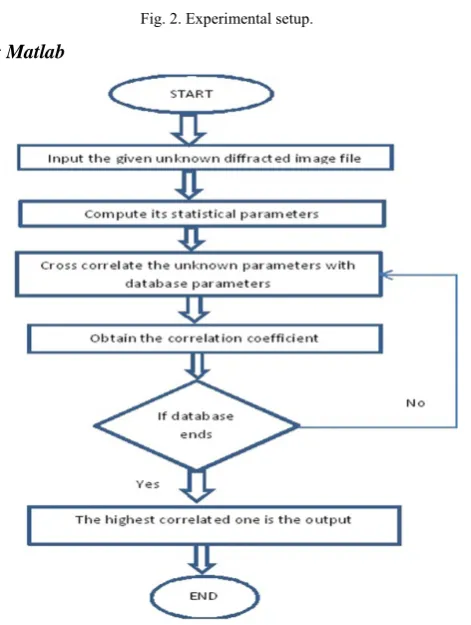
The diffraction patterns are analyzed using Matlab software by first creating a database of images. The diffraction images are then converted into a three-dimensional matrix with components red, blue and green. Then the data are processed by studying the skewness and kurtosis. Skewness is a measure of symmetry whereas kurtosis is a measure of the deviation of the data from the normal distribution. These parameters help in identifying the fingerprint from the database. The correlation coefficient is also calculated for the exact identification of the fingerprint. The flowchart for the Matlab analysis is shown in Fig. 3. The Matlab source code used is given below.
clc; close all; clear all;
% ntheta = zeros (510,510); I1 = imread ('1.jpg'); I2 = imread ('2.jpg'); ……….. ……….. I34 = imread ('34.jpg'); I35 = imread ('34a_new1.jpg'); I = zeros (3200,2400,3,35); I (: , : , : ,1) = I1;
I (: , : , : ,2) = I2; I (: , : , : ,3) = I3; ……….. ……….. I (: , : , : ,34) = I34; I (: , : , : ,35) = I35; for i = 1:35
ID = im2double ( I (: , : , : , i ) ); variance ( i , : , : ) = var ( ID ); skew ( i , : , : ) = skewness ( ID ); kurt ( i , : , : ) = kurtosis ( ID );
mom ( i , : , : ) = moment ( ID , 2 ); % nth order moment % end
RS = zeros (34,1) ; for j = 1:34
R = corr2 ( skew ( j , : , : ) , skew (35 , : , : ) ); RS ( j ) = R ;
end
RK = zeros ( 34 , 1 ) ; for j = 1 : 34
R = corr2 ( kurt ( j , : , : ) ,kurt (35 , : , : ) ) ; RK (j) = R ;
end
2.3 Fractal Analysis
= + (1)
From the slope of the plot of Vs , we get the fractal dimension.
3. Results and Discussion
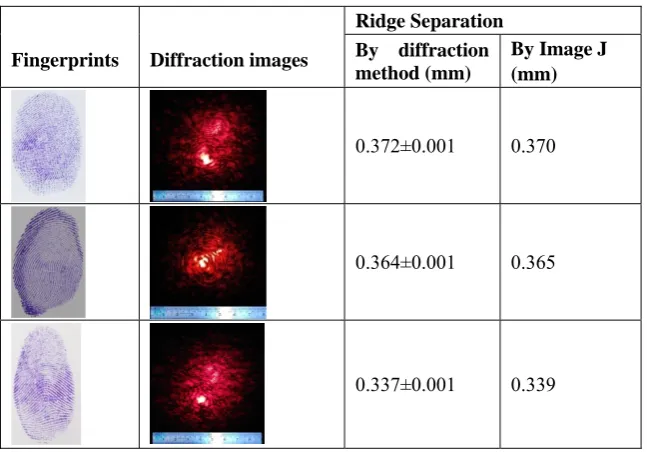
The fingerprint impressions photographed are analyzed using the software Image J and the separations between the ridges are measured. When the laser beam is passed through the glass plate with the fingerprint impression it produces a diffraction pattern. The ridge separations is calculated from the diffraction pattern using equation 1 and are compared with the values obtained from Image J. The data obtained in three cases with fingerprint images are given in Table 1. From the Table, it is clear that the values of separation between the ridges obtained from diffraction pattern are in good agreement with the values obtained directly from fingerprint images. Hence the images on proper analysis can help in identifying the fingerprint. The Matlab source code helps in identifying the fingerprint from skewness and Kurtosis. Inorder to check the reliability of Matlab analysis, the fingerprint image of one person who is already in the database, is recorded once again and compared with the database. For cross checking, the correlation coefficient of the skew and kurtosis of the newly recorded image is calculated with the database matrices. The correlation coefficient turns out to be higher for the exact match of fingerprints. Thus the person can be identified.
Table 1. Calculation of ridge separation.
Fingerprints Diffraction images
Ridge Separation By diffraction method (mm)
By Image J (mm)
0.372±0.001 0.370
0.364±0.001 0.365
0.337±0.001 0.339
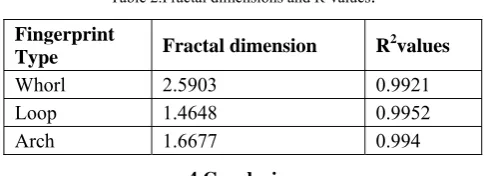
Fractal analysis has emerged as a potential tool in image analysis and identification. Since no two fingerprints cannot be identical, the fractal dimensions also cannot be the same. By varying the size of the box more accurate and exact identification is possible. In the present work, an attempt has been made to analyze the fingerprints based on fractal geometry. The fractal dimensions are calculated from Vs plot (Fig. 4) for the three representative patterns (Fig. 1). The high R2 value of the fitted equation gives the accuracy of the fractal dimension calculated. The values obtained for the three types of samples are given in Table 2.
Table 2.Fractal dimensions and R2values.
Fingerprint
Type Fractal dimension R
2
values
Whorl 2.5903 0.9921
Loop 1.4648 0.9952
Arch 1.6677 0.994
4 Conclusion
Fingerprint identification has become an unavoidable part of forensic science. The present work describes and suggests a possible method of fingerprint identification based on laser beam diffraction technique and fractal analysis. A Matlab sourcecode is also prepared to identify a fingerprint from the database. The study could identify the person from the diffraction pattern produced by the fingerprint. The results and the source code can be modified by increasing the number of samples. The possible potential application of fractal studies is also described. The fractal analysis can give better results if a large number of samples are analyzed to form a large database.
References
[1] Barnsley, M. F. (1993): Fractals Everywhere. Academic Press Professional, 2nd edn., New York.
[2] Farhan, M. H., George, L. E, Hussein, A. T. (2014): Fingerprint Identification Using Fractal Geometry. Int. j. adv. res. comput. sci. softw. eng., 4 (1), pp. 52-61.
[3] Feder, J. (1988): Fractals. Plenum Press, New York.
[4] James Wayman; Jain, A.; Maltoni, D.; Maio, D. (2005): Biometric Systems Technology, Design and Performance Evaluation, Springer, ist edn., p. XIV, 370, London.
[5] Kumar ; Waha, E. (2011): Analysis of various biometric techniques. International journal of computer science and Information technologies 2 (4), 1595-1597.
[6] Maltoni, D.; Maio, D.; Jain, A.; Prabhakar, S. (2005): Handbook of Fingerprint Recognition. Springer, 2nd edn., p. XVI, 494, New
York.
[7] Mandelbrot, B. B. (1983): The fractal geometry of nature. W. H. Freeman and Company, New York. [8] Menzel, E. R. (1999): Fingerprint detection with Lasers. Marcel Dekker, 2nd edn., New York.
[9] Nanakorn, S.; Kutanan, W.; Chusilp, K.; Chiang Mai. (2013): An exploration of fingerprint patterns and their concordance among thai adolescents. J. Sci., 40 (3), pp. 332-343.
[10] Ratha, N.; Bolle, R. (2004): Automatic Fingerprint Recognition Systems. Springer, 1st edn., p. XVII, 458, New York.
[11] Ribalda, R.; de Rivera, G. G.; de Castro, Á.; Garrido, J. (2010): A mobile biometric system on-token system for signing digital transactions. IEEE, 8.
[12] Singh, S.; Khurana, A. K.; Harode, H. A.; Tripathi, A.; Pakhare, A.; Chaware, P. (2016): Study of fingerprint patterns to evaluate the role of dermatoglyphics in early detection of bronchial asthma. J Nat SciBiol Med., 7(1): pp.43–46.
[13] Sonia, P. S.; Fairgrieve, S. I. (2012): Exsanguinated blood volume estimation using fractal analysis of digital images. J Forensic Sci., 57(3), p. 610-7.