Indian J. Plant Physiol., Vol. XXVI, No.4. pp. 385-390 (December 1983)
NUTRITIONAL STATUS OF MUNG BEAN (Vigna radiata (L.) Wilczek)
B. GOPAL SINGH· AND J. N. SINGH Department of Plant Physiology
Institute of Agricultural Science, Banaras Hindu University, Varanasi, (Revised: September 19, 1983)
SUMMARY
During the seasons under investigations (Kharif and summer), the amount of nutrients increased upto 45 days after sowing and therearter declined as the crop advanced in age. The amount of calcium, however, appeared to increase upto 60 days of crop growth and thereafter declined at harvesting stage. The leaf was the richest in the total amount of nutri ents upto the pod development stage, whereafter, the nutrients, especially. nitrogen accumulated more in the developing pods. The amount of nitrogen in the pedicel was more than stem, root and flower during both the seasons. Accumulation of phosphorus, during both the seasons; followed a sigmoid pattern in the leaf, stem and root, whereas in the pedicel and pod, the trend was found to be linear. Potassium accumulated more in the stem as compared to the other plant parts during both the seasons. Nutrient accumulation was inftuenced by higher dry matter production and better root growth in kharifcrop. whereas in summer it was at the expense of energy.
INTRODUCTION
Absorption of macro-and micro-nutrients differs in quantity and pattern in different species depending upon the growth habits of the plants. By determi ning the actual demand of these plant nutrients at different stages of the crop growth, their supply may be regulated and maintained to derive maximum benefit. It is not sufficient to know the quantities of various nutrients removed by a particular crop, but it is of vital importance to know the relative quantities of individual nutrients absorbed by a crop at different stages of its growth. However, the nutrient uptake and distribution differ greatly with location and is a function of climate. So, it is desirable to reveal the influence of season on nutritional status of the plant at different growth stages.
386 B. GOPAL SINGH AND J.N. SINGH
~~
a..
,so
90 6.0
30
5
eo
60
30
s
4-00
.00
15 30
I<.HARIF
---
'- ----.
SUMMER
~---;:---::;;:e:---~ _u: •.~::
.,---.
~~.:::~
~
'0
~g IG 30 45DAYS AFTER SOWING
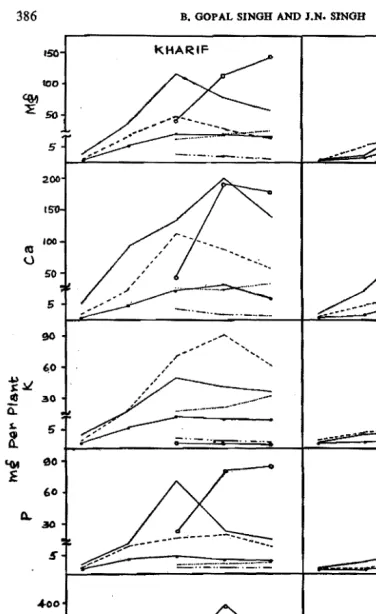
Fig. 1. Effect of sowing in total amount of nutrients in leaf (-), Stem (---). Root
<e-.).
Pedicel t ..), Flower (_. --), and Pod (0-0). cO0::
:.
So. 'eMNUTRITIONAL STATUS OF GREEN GRAM 387
MATERIALS AND METHODS
Plant material for this study was drawn from mungbean (cv Pusa Baisa khO plants grown in randomised block design during kharif(July to October) and summer (March to June) seasons (1978 and 1979). Ptants were harvested at different growth stages and the constituent organs, viz., leaf. stem, root, pedicel - flower and pod were used for determination of nitrogen (Humphries, 1956), phosphorus (Betramson, 1942), potash (Jackson, 1967) and calcium and magne sium (Johnson and Ulrich, 1959).
RESULTS AND DISCUSSION
The results clearly indicated that the amount of nutrients in component parts, irrespective of season, was in the order Ca
>
N>
Mg>
K>
P in the leaf, stem and roat, whereas in pedicel, flower and pod the nutrient accumulation was in the order N>
Ca>
Mg>
K>
P (Fig.O.
During the seasons under investigation, the amount of. nutrients in leaf, stem and root on an average, continued to increase upto 45 days after sowing (DAS),suggesting that most of the nutritional requirements were completed during this active growth period. These results further suggested that 30-45 DAS was the critical period for nutrient absorption. However, the per cent of nutritional requirement in summer grown mung was more at 45-60 DAS as compared to
kharifgrown one (Fig. 1). The higher amount of nutrients in kharij indicated favourable conditions during the early crop growth period, where RGR (0.17 g.g-1 day-I) was more (Table I), thereby favouring nutrients to accumulate. Besides this, the extensive lateral root growth might have increased the regions of root absorption. This proportion of root in nutrient uptake was greater (higher day matter) during kharif The total amount of nutrients, during both the seasons; was strongly associated (r=0.8963 to r=0.9386) with the total dry matter content. A relatively better correlation during summer suggested that the accumulation of nutrients per unit dry weight was more as compared to
kharifgrown mung.
A steep decline in the amount of nitrogen in leaf, stem and root from 45 DAS (Fig. I) can be attributed to continuous assimilation of nitrogen by the developing pods and its translocrtion from vegetative parts. Such decrease in the total N concentration of vegetative plant parts as a consequene of its translo cation to the reproductive tissue in soybean has also been reported (Pal and Saxena, 1976). The increase in the amount of nitrogen in the pods from 45 days onwards during both the seasons coincided with the pod development and filling stages and during this period the supply of nitrogen was heavy. So, nitrogen
"--" - .
. .
388 B. GOPAL SINGH AND J.N. SINGH
Table I : Seasonal changes'
in
growth and yi<Hd' attributes of mungbean'RGR Total dry POd length 1000-seed wt. Protein%
(g g-1 day-1) matter (cm) (g). in seeds
DAS (g/plant)
- - - -
---..------
- - - -
----
K S K S K S K S. K S
15 0.170 0.132 0.570 0.200 30 0.123 0.092 '1.360 1.510 45 0.016 0.060 44.640 5.990
60 0.001 0.005 58.050 13.940
.,
75 57.680 18.370 ' 9.020 ·6.640 32.650 35.570 22.50 24.43 DAS=Days After Sowing, K,bKkari/. S=Summer.
fixation per unit of mungbean plants decreases sharply following the early pod development which may be, due to tJte limited supply of nitrogen when it is required most at the time of development of fruits which are rich in proteins (Sinha, 1978).
Even though, the pattern of accumulation of nitrogen in the pods. during both the seasons. was same, its a!D0unt was more in kharif grown mung indica ting that more quantity of nit~ogen might have been stored in the pod wall. On the o.ther hand, the increased pod length (9.02 cm) and decreased seed size (3.2.65 g/1000 seed weight) (Table I) probably led to a lower conte~t of nitrogen (3.6%) in the seeds of kharif grown crop. Furthermore, the decreased content of nitrogen in the seeds
of
khari/ grown mung m,ight be. due to translocation of vegetative nitrogen to the developing pods. Besides this, the percent absorption of nitrogen in the reproductive parts (flower and pod) ,was less as compared to summer grown crop (Table II). However, the higher amount of nitrogen in the pediceLthan flowers and roots, during both the seaSQns, indicated an increased translocation aspedice,llength is, more in greengram crop.The lower concetitration of phosphorus during the present study signifies its remobilization from vegetative structures to the reproductive parts and being stored in the seed. Its content, however, was more (0.35%) in the seeds as compared to the other plant parts of summer grown crop, due to which the seed size (35.57 g/lOOO-seed weight) and protein content (24.43%) were increased. Its deficiency has been reported to affect adversely the yield and the size of the seeds of legumes (Harper. 1971; Agarwa1a and Sharma, 1976). Thoughthe potassium content in the seed (0.12-0.15%) was less as compared to phosphorus,
if may be sufficient for increasing the protein content (Table II). Hsiao et al.
NUTRITIONAL STATUS OF GREEN GRAM 389
TABLE II: Amount of nitrogen in component parts of mungbean during different seasons (expressed as percentage of total amount in the whole plant)
Leaf Stem Root Pedicel Flower Pod
DAS
---~--K S K S K S K S K S K S
15 57.0 45.7 34.5 42.1 8.8 12.2
30 62.7 69.2 24.5 24.9 9.5 6.0
45 37'6 28.7 13.0 3.4 7.5 2.0 5.9 2.6 1.1 1.9 34.9 61.3
60 23.8 15.8 7.9 0.9 5.2 1.6 6.4 5.7 0.5 1.2 56.2 74.3 75 20.4 7.1 7.3 0.5 6.5 0.6 6.7 4.9 0.5 0.6 58.7 86.3 DAS=Days After Sowing, K=Kharif. S=Summer.
The higher values of potassium in the stem (Fig. I) during both the' seasons indicated the possibility of its regl!latory mechanism in translocation of sugars. Potassium deficient sugarcane was demonstrated to have a slower sugar translocation, eventhough the photosynthetic activity was not altered (Hartt, 1970). The weaker association of dry weight (r=0.4381-r=0.5801) with potas sium accumulation in the pods indicated that potassium requirement in the vegetative parts of greengram in more than the reproductive unit.
The increase in the amount of calcium and magnesium indicated their utilisation for structural and developmental processes. The higher accumula tion of calcium during both the seasons suggested its higher requirement in mungbean. So, legumes generally require more calcium than cereals and other grasses (Kanwar, 1976).
There was a significant correlation between nitrogen and calcium (r= 0.9755) as compared' to magnesium with nitrogen (r=0.8776). This clearly indicated that calcium might have acted as a major exchangeable cation in nutri tional absorption. However, the association of calcium (r=0.4142-r=0.5700) and magnesium (r=0.5052-r=0.5925) with potassium was smaller during both the seasons. Rama moorthy and Velayuthum (1976) also opined an inadequate intake of potassium as a consequence of higher amounts of calcium and magne sium.
390
B. GOPAL SINGH AND J.N.SINGHTABLE Ill. Actual amount of nutrients absorbed at different crop growth periods in different seasons (mg/plant)
N P K Ca Mg
DAS
K S K S K S K S K S
15-29 106.9 17.7 23.4 8.0 41.6 6.3 110.2 23.9 59.8 7.4 30-44 532.9 172.1 78.2 17.8 104.9 5.0 219.1 89.4 181.5 53.9 45-59 45.6 115.0 38·8 5.8 23.7 3.0 212.9 146.1 15.8 21.7 60-75 -240.3 -34.8 -19.9 -7.8 -30.1 -3.9 -139.6 -53.2 -10.4 51.5 DAS=Days After Sowing, K=KharifS=Summer.
(0.222-0.594 1£1 O2 uptake/mg dry wt./h). So, the season exerts a greater
influence on the nutrient absorption and their utilisation in different growth processes of mungbean.
REFERENCES
Agarwala, S.C. and Sharma, C.P. (1976). Plant nutrients-their functions and uptake c.f. Soil Fertility, (Theory and Practice). (ed Kanwar, J.S.) ICAR, New Delhi. pp.7-63,
Betramson, B.R. (1942). Phosphorus analysis of plant material. Plant Physiol., 17 : 457-54. Harper, J.E. (1971). Seasonal nutrient uptake and accumulation pattern in soybean. Crop
ScL, 11 : 347-50.
Hartt, C.E. (1970). Effect of potassium deficiency upon tranillocation of1&C in detached blades of sugarcane. Plant Physiol •• 45: 183.
Hsiao, T.C., Hageman, R.H. and Tyner, E.H. (1968). Effect of potassium nutrition on RNA .and ribunuclease in Zea mays L. Plant Physiol., 43 : 1941.
Humphries, E.C. (1956). Mineral component and ash analysis. In. 'Modern Methods of Plant Analysis', (cd. Peach,X. and Tracey, M.V.) Springer-Verlag Berlin, Gotti nCen. Heidelberg. pp. 468.
Jackson, M.L. (1967). Soil Chemical Analysis. Constable, London.
Johnson, C.M~ and Ulrich, A. (1959). Analytical methods for use in plant analysis. Calif
Agric. Exp. Sta. Bull., 766 : 25-28.
IGmwar, J.S. (1976). Calcium, Magnesium and Sulphur. In. 'Soil Fertility (Theory and Practice), ICAR, New Delhi. pp. 202-28.
Pal, U.R. and Saxena, M.e. (1976). Relationship between nitrogen analysis of soybean tissues and soybean yield. Agron. J., 68 : 927-32.
Rama moorthy, B. and Velayuthum, M. (1976). Nitrogen, Phosphorus and Potassium in Soil Chemistry-Forms and Availability. c.f. Soil Fertility (Theory and Practice). (ed. Xanwar, J.S.) ICAR, New Delhi. pp. 156-200.
Sinha, S.X. (1978). Nodulation, growth and yield in pulse crops. Nitrogen Assimilation and . Crop Productivity (cds. Sen, S.P., Arbol, Y.P. and Sinha, S.K.,. Associated