Empirical analysis of the Concurrent Edge
Prevision and Rear Edge Pruning
(CEG&REP) Performance
Anurag Choubey
Dean Academic, Technocrats Institute of Technology, Bhopal Rajiv Gandhi Technological University, Bhopal, India.
Email: [email protected]
Ravindra Patel
Associate Professor and Head, Department of Computer Applications Rajiv Gandhi Technological University, Bhopal, India
Email: [email protected]
J.L. Rana
Former Professor and Head,
Department of Computer Science and Engineering & Information Technology, MANIT, Bhopal, India Email: [email protected]
Abstract:
Frequent item sets play an essential role in association rule mining, The congested frequent set of items mining is a progression to frequent set of items mining of association rules, which turn into an interesting topic for researchers. In this paper, we present an experiential study to evaluate the performance compatibility of the Frequent closed set of items mining algorithms that are in the current state of the art for mining association rules.
Keywords: CEG&REP, frequent sets of items, data mining, association rules, comparative study
1. Introduction:
In the operation of association rule mining, frequent set of items mining is an important stage that has been aimed at and in which remarkable improvements have been made. The study varies from efficient and scalable algorithms to most research frontiers; with sequential, structured, correlative mining, associative classification and frequent set of items based clustering. Let us discuss the present status of this step including the analyzed challenges.
Frequent item sets are item sets or substructures which occur in a data set more than specified least number of times. A substructure can be a sub-graph or sub-tree. If such substructure occurs more than specified threshold, it is called a frequent structural set of items. Identifying frequent sets of items are important in mining associations and correlations. It gives in data indexing, classification and clustering. It is proposed by Agarwal et al. [1] for market basket analysis which explores customer characteristics from the associations between objects in the basket. There are several proposed algorithms for generating frequent item sets which vary in the way of traversing item set lattice, use of anti-monotone property and the way the database is handled. Based on these variations, representative set of algorithms is explained.
Problem Definition: The task of discovering all frequent sets of items are fairly challenging. The search space is exponential in the number of items occurring in the database. The support threshold confines the output to a hopefully reasonable subspace. Also, such databases could be massive, have millions of transactions, making counting process a tough problem. The search space of all sets of items
2
icontains different sets of items. If ‘i
’ is large enough, then the naive approach to generate and count the supports of all sets of items over the database can’t be achieved within a reasonable period of time. To compute the supports of a collection of sets of items, we require to access the database. Since such databases tend to be extremely big, it is not always possible to store them into main memory. Hence the frequent set of items mining algorithm performance will be analyzed based on its ability to search and memory usage.2. Exploration of the Algorithms opted for performance evaluation:
2.1 CHARM [5]:
CHARM simultaneously explores the set of items space and tidset space using the IT-tree, unlike the previous technique which typically exploit only the set of items space. CHARM uses a novel search technique, based on the IT-pair properties, that skips several levels in the IT-tree to quickly converge on the set of items closures, rather than having to detail several possible subsets. The pseudo-code for CHARM show in Figure 5. The algorithm starts by initializing the prefix class [P], of nodes to be examined, to the frequent single items and their tidsets. We assume that the elements in [P] are ordered according to a suitable total order f. The major computation is performed in the CHARM-Extend which returns the set of closed recurrent sets of itemsC. CHARM-Extend is responsible for considering each combination of IT-pairs appearing in the prefix class [P]. For each IT-pair Xi × t (Xi) it combines with the IT-pairs Xj t Xj
. Each Xigenerates a new prefix class
Pi which is initially empty. The two IT-pairs are combined to produce a new pairX Y, where X Xi U Xj and
Y t Xi t Xj . Then tests which of the four IT-pair properties can be applied by calling ChARM-Property. Note that this routine may alter the present class
P by deleting IT-pairs that are already subsumed by the other pairs. It also inserts the recently generated IT-pairs in the new class
Pi . Once all Xj have been processed, thenrecursively explore the new class
Pi in a depth-first manner. Then insert the set of items X, an extension ofXi, in the set of closed sets of items C, provided that Xis not subsumed by a previously found closed set. At this stage any closed set of items containing Xihas already been generated. And then continues to process the next IT-pair in
P .Charm Algorithm pseudo representation
CHARM D, min sup :
P {Xi t Xi : Xi I Xi min sup}
CHARM Extend ( P , C )
for each Xi t Xi in P
Pi and X Xi
for each Xj t Xj in P , with Xj f Xi
X X Xj and Y t Xi t Xj
CHARM Property P , Pi
if ( P
i ) then CHARM Extend Pi , C
delete Pi
C C X / /if X is not subsumed CHARM Property P , Pi
if X minsup then
if t Xi t Xj then / /Property 1
Remove Xj from P
Replace all Xi with X
else if t Xi t Xj then / / Property 2
Replace all Xi with X
else if t Xi t Xj then / /Property 3
Remove Xj from P
Add X Y to Pi / /use ordering f
else if t Xi t Xj then / /Property 4
Add X Y to Pi / /use orderin
2.2 CLOSET+ [6]:
prefix sets of items as rapidly as possible. Besides adopting the above mentioned item integration and sub-set of items pruning methods, CLOSET+ also having the item skipping technique to further prune search space and speed up mining.
Bottom up physical tree projection: For dense datasets, their FP-trees can be hundreds (or even thousands) times smaller than their corresponding original datasets due to compression. Its conditional projected FP-trees are generally very compact as well. Every projected FP-tree is much smaller than the unique FP-tree, and mining on such a compact structure will also be efficient. As a result, for dense datasets CLOSET+ still physically builds projected FP-trees and it is done recursively in a bottom-up manner.
Top down pseudo tree projection: Physically projecting FP-trees will introduce some over- head both in space usage and runtime (due to allocating and freeing memory for projects FP-trees), particularly if the dataset is sparse, the projected FP-tree will not be extremely compact and does not shrink rapidly. Instead of physically building projected FP-trees, a new technique is developed for sparse datasets: top-down pseudo projection of FP-tree. Unlike bottom-up objective projection of FP-trees, the fake projection is done in the f list order (i.e., in support downward order). Similar to bottom-up physical projection, a header table is also used to record sufficient information such as local common items, their counts and side-link pointers to FP-tree nodes in order to locate the sub trees for a certain prefix item- set.
2.3 BIDE[7]:
BIDE, an algorithm for discovering the complete set of frequent closed sequences. The contributions of this algorithm include: (1) A new paradigm for mining closed sequences without candidate preservation, called Bidirectional Extension. The forward directional extension is used to develop the prefix patterns and also check the closure of prefix patterns, while the back directional extension can be used to both check closure of a prefix pattern and prune the look for space. (2) Under the BI-Directional Extension paradigm, opted to frequent closed sequence mining algorithm, BIDE. The BI-Directional Extension pattern closure checking scheme, the BackScan pruning technique, and the ScanSkip optimization technique are proposed to speed up the mining and also assure the correctness of the algorithm.
2.4 CEG&REP [8]:
The model CEG&REP [8] anticipates an unusual algorithm for withdrawing recurring closed series with the help of Sequence Graph. It executes the following tasks: It shuns the blight of contender’s maintenance and test the pattern, administers memory space proficiently and guarantees recurrent closure of clogging in a well-organized manner and at the same instant guzzling less amount of memory plot in comparison with the earlier developed mining algorithms. There is no need of safeguarding the already defined recurrent sets that are blocked, thus it very well poises the range of the count of recurrent closed models. A Sequence graph is embraced by CEG&REP and has the capability of harvesting the recurrent clogged pattern in an online procedure. The effectiveness of dataset outlines can be showcased by a widespread range of experimentation on a number of authentic data sets amassing varied allocation attributes.
CEG&REP [8] opt to Sequence Graph protruding that based on edge projection and pruning, an asymmetric equivalent algorithm for finding the set of frequent closed sequences. The giving of this CEG&REP [7] is: (A) an improved sequence graph based idea is generated from mining closed sequences without candidate preservation, termed as Parallel Edge Projection and pruning (CEG&REP) based Sequence Graph Protruding for closed set of items mining. The Edge protuberance is a forwarding methodology raise till edges with required support is possible during that time the edges will be pruned. During this pruning procedure vertex of the edge that differs in support with next edge projected will be considered as closed set of items, also the sequence of vertices that associated by edges with similar support and no projection possible also be considered as closed set of items (B) in the Edge Projection and pruning based Sequence Graph Protruding for closed set of items mining, CEG&REP contains Forward edge projection and back edge pruning algorithms.
As a first stage CEG&REP performs dataset preprocessing and sets of items Database initialization, which finds sets of items with a single element, in parallel prunes sets of items with single element those contains total support less than required support.
2.4.1 Concurrent Edge Prevision:
3. Comparative Study
This section explores the performance compatibility of CHARM [5], CLOSET+ [6], BIDE [7] and CEG&REP [8]. All the experiments were performed on CPU: Intel E6850 with MOTHERBOARD: nvidia 680i chipset based with SLi, RAM: 4GB(2 x 2GB running in dual channel mode ) 800Mhz DDR2 and HARDDRIVE: Maxtor Raptor 74GB 10,000RPM + 500GB western digital. We ran the four algorithms on the same environment. Because our performance study showed that other reputed algorithms such as OP [9] and CLOSET [10] cannot compete in high memory usage with algorithms [5, 6, 7, 8] those we opted, hence we compared only CHARM [5], CLOSET+ [6], BIDE [7] and CEG&REP [8] on peak memory usage.
3.1 Experimental Setup
Our performance study includes both synthetic and real datasets. We used a couple of synthetic datasets that are generated using IBM-DG[11] and a real dataset Gazelle contains a click stream. In Gazelle, we consider different products as different items and the page views as events. The characteristics of these datasets are shown in table 1.
Dataset Name
No. Seq
No. Items
avg. Seq. Len
Max. Seq. Len
Mock dataset1
150000
6532
42
61
Mock Dataset 2
150000
5092
71
114
GAZELLE
2, 937
1, 423
29
1, 443
Table1: Structure of datasets opted for performance check
3.2 Results Analysis
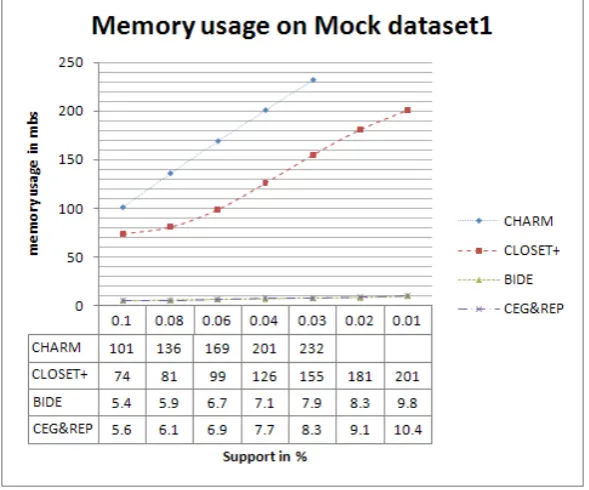
To verify the performance on dense dataset we opt to synthetic dataset MOCK-DATASET-1 Figure1 and Figure 2 explores the performance of the mining algorithms[5,6,7,8] opted. Fig. 2 shows CEG&REP can be orders of magnitude faster than BIDE and other two algorithms CHARM and CLOSET+. When the support is not too low , CHARM, CLOSET+, BIDE and CEG&REP performed in a similar way. When the support threshold 10% and lower CHARM cannot run by reporting memory issues. The rest three algorithms CLOSET+, BIDE and CEG&REP performance is scalable up to the support value 4% , At the support lesser than 4% CEG&REP and BIDE maintains their scalability, but the CLOSET+ took huge execution time for support value 4% and lower. The CEG&REP elevated as best in time taken for execution. In terms of memory usage CHARM is very poor. From Fig. 1 we can observe that BIDE and CEG&REP uses less memory than CLOSET+ For example, at support 85%, CLOSET+ consumes about 190MB while BIDE and CEG&REP consumes about 18MB.
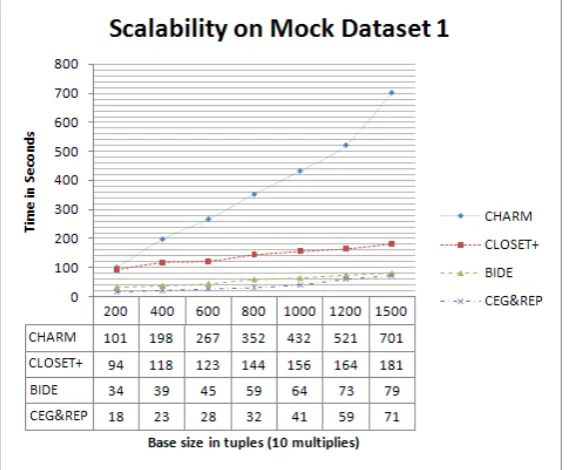
Figure 2: Graph representation of Time in seconds taken by algorithms to execute on MOCK-DATASET-1
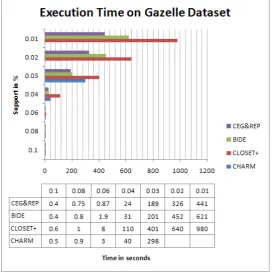
To verify the performance on the sparse dataset we opt to real time dataset GAZELLE. Figure3 and Figure 4 explores the performance in execution time and memory usage of the mining algorithms[5,6,7,8] opted. Fig. 3 shows CEG&REP can be orders of magnitude faster than BIDE and other two algorithms CHARM and CLOSET+. When the support is not too low, CHARM, CLOSET+, BIDE and CEG&REP performed in a similar way. When the support threshold 10% and lower CHARM cannot run by reporting memory issues. The rest three algorithms CLOSET+, BIDE and CEG&REP performance is scalable up to the support value 4% , At the support lower than 4% CEG&REP and BIDE maintains their scalability, but the CLOSET+ took huge execution time for support value 4% and lower. The CEG&REP elevated as best in time taken for execution. In terms of memory usage CHARM is very poor. From Fig. 4 we can observe that BIDE and CEG&REP uses less memory than CLOSET+.
Figure 4: Graph representation of Memory used by algorithms on GAZELLE for various support values in %
We used the synthetic datasets MOCK-DATASET-1 and SD2 those generated by IBM-DG to test the scalability of CLOSET+ and compared it with both CHARM and CLOSET. We first tested the scalability in terms of database size using the dataset series MOCK-DATASET-1 with base size from 2000 tuple to 15000 tuple and the support threshold set at 0.008%. From Figure 5, we can see that, CHARM has the poorest scalability, and it even becomes worse when the dataset contains more than 600K tuple. In comparison between CLOSET+, BIDE and CEG&REP, CEG&REP runs much faster and it also has much better scalability in terms of base size: the slope ratio for CHARM is much higher than other three and CEG&REP and BIDE are much more scalable that compared to CLOSET+.
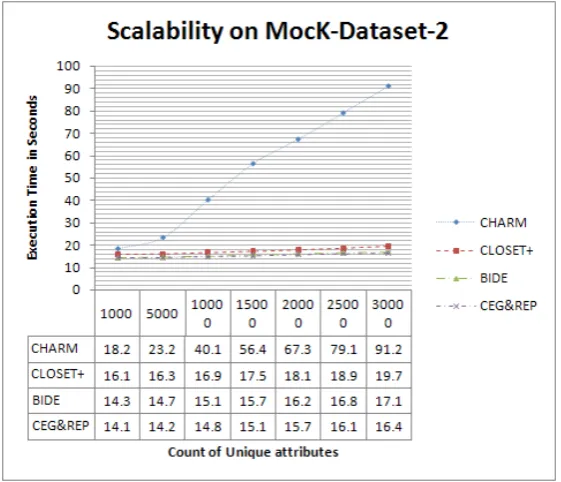
Figure 6: Graph representation of time taken by algorithms on SD2 for various count of distinct elements
The scalability in terms of the number of distinct items using SD2 series with a number of distinct items set at 5092, 15845, 27550 and 31169, respectively, and minimum support set at 0.005%. From Figure 6, we can see that initially all algorithms have very similar performance when the number of distinct items is small, but once the number of distinct items increases, the runtime of CHARM has much bigger jump than CLOSET+, BIDE and CEG&REP. Out of CLOSET+, BIDE and CEG&REP, the CEG&REP run time is much scalable, which means CEG&REP also has better scalability than CHARM, CLOSET+ and BIDE in terms of the number of distinct items.
4. Conclusion:
Frequent pattern mining has been studied extensively in data mining research. In this study, we have reexamined some previously proposed methodologies, and mainly focused on the new technique CEG&REP [8] developed for frequent closed set of items mining, a highly scalable and both runtime and space efficient algorithm for dense and sparse datasets, on unlike data distributions and support thresholds. In this paper we conducted an empirical analysis of the performance differences between CHARM[5], CLOSET+ [6], BIDE [7] and CEG&REP [8]. The aim of this comparative is to prove the performance in speed, memory usage and scalability of CEG&REP over CHARM, CLOSET+ and BIDE.
References:
[1] Agrawal, R., T, Imielinski and A, Swami, 1993, Mining association rules between sets of items in large databases, Proceedings of the 1993 ACM SIGMOD International Conference on Management of Data, May 25-28, ACM, New York, USA., pp: 207-216
[2] Agrawal, R, and R, Srikant, 1994, Fast algorithms for mining association rules, Proceedings of the 20th International Conference on Very Large Data Bases, Sept, 12-15, San Francisco, CA., USA., pp: 487-499
[3] Mannila, H., H, Toivonen and A, Inkeri Verkamo, 1994 Efficient algorithms for discovering association rules Proceedings of the AAAI Workshop on Knowledge Discovery in Databases, (KDD-94), IEEE, pp: 181-192
[4] Han, J., J, Pei, Y, Yin and R, Mao, 2004, Mining frequent patterns without candidate generation: A frequent-pattern tree approach, Data Mining Knowledge Discovery, pp: 53-87
[5] M. Zaki, and C. Hsiao, CHARM: An efficient algorithm for closed set of items mining. In SDM’02, Arlington, VA, April 2002. [6] J. Wang, J. Han, and J. Pei, CLOSET+: Searching for the Best Strategies for Mining Frequent Closed Sets of items. In KDD’03,
Washington, DC, Aug. 2003, pp: 1-20
[7] J. Wang and J. Han. BIDE: Efficient mining of frequent closed sequences. In Proc. 20th International Conference on Data Engineering, 2004, pp 79–90,
[8] Anurag Choubey, Dr. Ravindra Patel, Dr. J.L. Rana; Concurrent Edge Prevision and Rear Edge Pruning Approach for Frequent Closed Set of items Mining; (IJACSA) International Journal of Advanced Computer Science and Applications, Vol. 2, No. 11, 2011 pp: 25-31 [9] J. Liu, Y. Pan, K. Wang, and J. Han. Mining frequent item sets by opportunistic projection. In SIGKDD'02, July 2002.
[10] J. Pei, J. Han, and R. Mao. CLOSET: An efficient algorithm for mining frequent closed sets of items. In DMKD'00, May 2000, a. pp: 1-10