Development of Software to Improve the
Effectiveness of Delivery and
Understanding of Content by the End User
in Distance Education
Daulat Singh1
Department of Computer Science, ITM University, Gwalior, India. [email protected]
Rakesh Shrivastava2
Department of Higher Education, Govt. of Madhya Pradesh, Bhopal, India. [email protected]
Dinesh Varshney3
Multimedia Regional Center, MP, Bhoj (Open) University, Indore [email protected]
ABSTRACT
Teaching in recent days class room environment is more difficult than ever in the history of academia. In recent times world there are big number of distractions invade the concentration of a student in the classroom. With the advancement in technological gadgets for example laptops, notebooks, smart phones etc. major addition is of distraction. It is more difficult and challenging to maintain the interest and concentration of students in virtual environment where instructor/teacher is not physically present in the classroom which is typically a model of distance education. The lack of concentration level directly influences the quality of education. In the present studies, we have proposed a model and develop a software to use information and communication technology to increase the concentration level of the students studying in distance mode which will directly improve the quality of education imparted in distance mode.
Keywords
Distance education, Distance mode, Distractions, Information and Communication technology (ICT). 1. INTRODUCTION
Since ages higher education system has played an important and integral role in the development and building of country. From last two decades technology has become an important tool for higher education for not only conducting research but also for development of content and its delivery to learners. The use of technology has changed the overall learning experience. In last decade lot of investment is made into the use of information and communication technology (ICT) in education throughout the world. The dissemination of knowledge with the help of ICT has changed the way various curriculum programs used to be designed in past globally. The current technology for example, allows learner interaction with the computer screen rather than the teacher. Through the computer network, learners are able to communicate with the instructor on the material and can discuss assignments.
The institutes for higher education are the spearhead of research and of scientific endeavor to train and educate the youth of the country. It is the responsibility of the higher education institute to educate the learners on self learning and methods of searching for information, as well as ways to find solutions of the emerging and present problems which may arise in their operation. For fulfilling above objective higher education system is a) influenced by the continuous progress in ICT, which b) increases the communication among all industrial enterprises and service, c) encourages finding sources of information which will be used by students and researchers who are able to understand and use many terms to describe this change [1].
education imparted in distance education. The software is mainly developed for EDUSAT Network used by MPBOU to conduct courses in distance mode. The question will be asked through a server and students can reply with the help of a computer, ipad or even with mobile phone. One of the secondary objective of the software is also to use the devices which cause distraction for academic purpose in order to maintain the concentration and interest of students in the lecture being delivered.
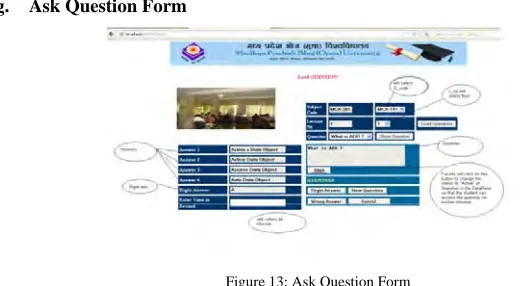
The online software is a web application to take online test in an efficient manner to check the effectiveness of delivery of content and to maintain the concentration and interest level of students studying in distance mode. The software has provision to input n number of questions which can be allocated to a particular topic to be delivered. Further it have a provision of containing questions of all the subjects allocated to a course. The questions are objective type with four options. The teacher will be having an option to flash a question in between the lecture, the question will be related to the topic being taught in that lecture. As soon as the question is flashed the student has to respond with one option in stipulated time. The teacher will get the names of students who have answered correctly and also names of the students who have given wrong answer. On the basis of response of the students a teacher can evaluate the effectiveness of the delivery of content and concentration and understanding of the content by students attending the class. The results of the test may be used for assessment of students in case university adopt continues assessment systems (CAS) which is widely being used by majority of good universities and institutes across the world. The software will also help to automise the process of attendance as the teacher and student both have to login at the start of the class.
The hardware and software requirements were analysed before doing the feasibly study of the project. It was kept in mind that the platform to non the application software should be commonly available and user don’t have to invest extra cost of purchasing operating system and other system software’s. The following system software were finalized by developing the application. (a) Operating system: windows (XP) (b) Java web server (Apache Tomcat 5.5.27) (c) Oracle 10g (d) JDK 1.5 or higher (e) web browser. The hardware configuration required to run the application software is (a) Pentium 3 processor or above (b) 256 MB minimum RAM (Primary memory) (c) 20 GB HDD (Secondary memory) (d) Internet connection (broadband recommended). 2. THE MODEL
The pure waterfall performs well for products with clear understanding of requirements or when working with well understood technical tools, architectures and infrastructures. Its weaknesses frequently make it inadvisable when rapid development is needed. In those cases, modified models may be more effective [3].
Figure 1: Modified Waterfall Model
There are number of strengths identified to justify the use of modified waterfall model such as modified waterfall model provide more flexibility than the pure waterfall model. If there is any personnel continually between the phases, documentation can be substantially reduced and implementation can be done in parts hence don’t have to wait for coding of all modules of the software.
The modified waterfall uses the same phases as the pure waterfall, but is not done on a discontinuous basis. This enables the phases to overlap when needed. The pure waterfall can also split into subprojects at an appropriate phase (such as after the architectural design or detailed design). The hardware and software requirements were analysed before doing the feasibly study of the project. It was kept in mind that the platform to non the application software should be commonly available and user don’t have to invest extra cost of purchasing operating system and other system software’s. The following system software were finalized by developing the application. (a) Operating system: windows (XP) (b) Java web server (Apache Tomcat 5.5.27) (c) Oracle 10g (d) JDK 1.5 or higher (e) All web browser compliable. The hardware configuration required to run the application software is (a) Pentium 3 processor or above (b) 256 MB minimum RAM (Primary memory) (c) 20 GB HDD (Secondary memory) (d) Internet connection (broadband recommended).
Due to above strengths and working of “Modified Waterfall Model”, we have selected it for this application. Feasibility study [4] serve as a decision document, it must answer three key questions i.e. is there a new and better way to do the job that will benefit the user? What are the cost and savings of the alternative? And lastly what is better recommendation?
To answer these questions feasibility study is divided into six sub parts. We will discuss these sub parts one by one is reference to our project economical feasibility: We have done economical feasibility study of project and found the project economically feasible because the objective is to reduce wastage of time and to ensure proper attention to make proper use of sessions undusted. The software and hardware required to run the application is Communication
project initiation requirements gathering
Planning
estimating scheduling tracking
Deployment
Delivery support feedback
Modeling
analysis design
Construction
easily avai low to the configurati is used and to the mem bare minim Time feasi estimated t industryhen manageme It is very e non techni without an aninformat kinds of in where the whether pr the system Level 0:-It agents whi modeled pu as a single
Level 1:Th with one o functionali
ilable and is no user. The tech ion of hardwar d is available e mory available mum processin
ibly is calcula time of six mo nce it is legal ent is required. easily to use be cal and anybod ny difficulty. A
tion system [5 nformation will
data will be st rocesses will op m, showed how
t is known as ich act as data urely in terms process.(Figur
he Level 1 DF or more of th ity of the system
ot expensive an hnical feasibilit
re and software everywhere. M
in any PC in p g speed. The p ated and proje nths.As the pro ly feasible. Be
ecause anybod dy who is well A data flow dia ]. DFDs can a l be input to an tored. It does n
perate in seque the data move Context Free a sources. On t of data flows a re 1)
Figure 2:
D shows how he data flows m as a whole.
nd finally the ty of the projec e required is v emory space re present times h project is socia ect was found oject is followi ehavioral feasi
dy who can use l versed with t agram (DFD) i also be used fo nd output from not show inform
ence or in para d from one pro Diagram, whic the context dia across the syste
Level 0, content fr
the system is to or from an
Figure 3:
estimated cost ct is done and ery general an equired (both p hence no extra ally feasible be time feasible ing all the lega ible because it
e internet can o terminology us is a graphical r or the visualiza m the system, w
mation about t llel. DFDs sho ocess to anothe ch shows the i agram the syst em boundary. T
free diagram for the
divided into s n external age
: Level – 1 DFD
t of implement project is foun nd can be obtain
primary and se a memory of an ecause it has no because it ca al rules as per I t is very user
operate it and f sed in manual
representation ation of data pr where the data the timing of p ow the flow of er, as well as its
interaction bet tem's interactio The context di
e online software
ub-systems (pr ent, and whic
tation and deve nd technically
ned easily, for econdary is ver ny kind is requ o wrong impac an be easily c IT act and idea friendly and n
finally the term system can use of the "flow" rocessing. A D will come from processes, or in
data from exte s logical storag tween the syst ons with the ou
agram shows t
rocesses), each h together pro
elopment is ve feasible becau r example JAV ry less compare uired along wi ct on the societ ompleted in th al practices of I no much chang
minology used e the applicatio
of data throug DFD shows wh
m and go to, an nformation abo ernal entities in ge.
em and extern utside world a the entire syste
h of which dea ovide all of th
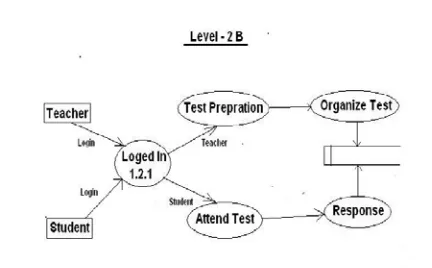
Figure 4: Level 2 DFD
Level 2: In this level we describe the function of the External agent with their operation and their internal data storage. This must be present in order for the system to do its job, and shows the flow of data between the various parts of the system.
3. ER-DI
4. RESUL The detail preparing o software h front end ( requiremen is done in requiremen 4.1 Databa
IAGRAM
LT AND DISC led requiremen of various DFD as three impor (look and feel) nt of the softw n order to min
nt, the database ase Table
Figure
CUSSION nt analysis, fe D’s and ER dia rtant parts a) de
and c) develop ware and also co nimize redund e is designed w
S.No. 1. F_ Ke 2. F_ 3. Pa 4. De S.No. 1. Us key 2. Pa
6: Detailed ER dia
easibility study agrams resulted evelopment of pment of logic onsidering sco dancy and dep which comprise Table 1 Field _Id(primary ey) _Name ssword epartment Table 2 Field ser_Id(primary y) ssword
agram of the onlin
y, analysis of d in final devel f back end sche c (code). The d
pe of handling pendency in t es of six tables
1.Faculty_Info Type Varchar2 Varchar2 Varchar2 Varchar2 2. Login_Info Type Varchar2 Varchar2
ne software [6].
f software and lopment of the ema (database atabase is desi g any future req
the database. .
Description
To store Facult ID
To store Facult Name To store Facult Password To store Facult Department
Description
To store User ID
To Store Password of user
d hardware re software. The design) b) dev gned after ana quirements. Th After criticall ty ty ty ty n equirements an e development
velopment of th lysing the actu he normalizatio
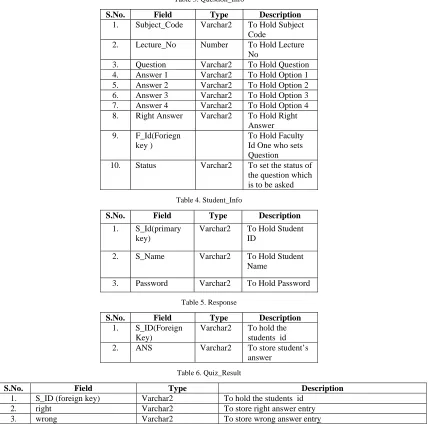
Table 3. Question_Info
S.No. Field Type Description
1. Subject_Code Varchar2 To Hold Subject Code
2. Lecture_No Number To Hold Lecture No
3. Question Varchar2 To Hold Question 4. Answer 1 Varchar2 To Hold Option 1 5. Answer 2 Varchar2 To Hold Option 2 6. Answer 3 Varchar2 To Hold Option 3 7. Answer 4 Varchar2 To Hold Option 4 8. Right Answer Varchar2 To Hold Right
Answer 9. F_Id(Foriegn
key )
To Hold Faculty Id One who sets Question 10. Status Varchar2 To set the status of
the question which is to be asked
Table 4. Student_Info
S.No. Field Type Description
1. S_Id(primary key)
Varchar2 To Hold Student ID
2. S_Name Varchar2 To Hold Student Name
3. Password Varchar2 To Hold Password
Table 5. Response
S.No. Field Type Description
1. S_ID(Foreign Key)
Varchar2 To hold the students id 2. ANS Varchar2 To store student’s
answer
Table 6. Quiz_Result
S.No. Field Type Description
1. S_ID (foreign key) Varchar2 To hold the students id 2. right Varchar2 To store right answer entry 3. wrong Varchar2 To store wrong answer entry
4.2 Normalization of Database
1st Normal Form: According to first normal form every table has no multivalued attributes. Since all the tables has coated in Oracle Database successfully hence the database exist in First Normal form.
2nd Normal Form: We remove Functional dependency and break the single valued attribute into multivalued attribute. For that we break our primary single table into 2 or more tables.
5. SCREEN SHOTS OF THE PROJECT a. Home page
Figure 7: Home Page
The home page is the gateway to the software student, Administrator and teacher. The home page enables all the users to login into the software by entering username and password. The home screen contains the help button for making software more user friendly and easy to use.
b. Admin Form
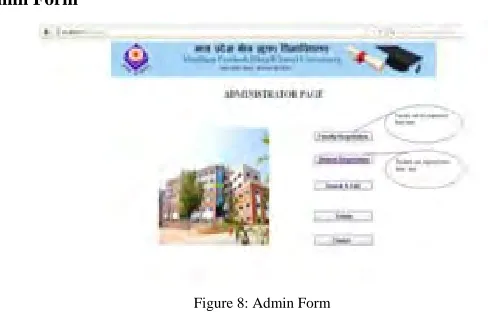
Figure 8: Admin Form
c. Faculty Form
Figure 9: Faculty form
The faculty has the option of setting questions with the multiple options of answer and correct answer. The faculty can do the above task from this page.
d. Faculty Registration Form
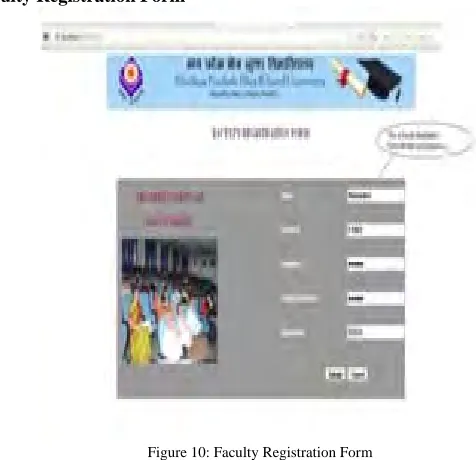
Figure 10: Faculty Registration Form
e. Student Registration Form
Figure 11: Student Registration From
The above page enable registration of students. All the fields are mandatory. f. Set Question Form
Figure 12: Set Question Form
The above page enable a form to the faculty on which the faculty can input question corresponding to a subject. The faculty has to input the multiple options for answer and have to indicate the right answer.
g. Ask Question Form
Figure 13: Ask Question Form
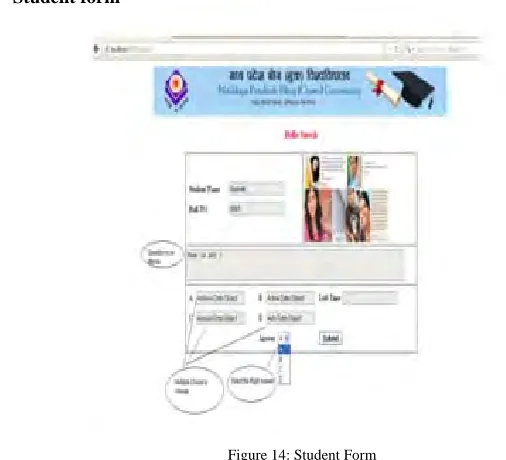
h. Student form
Figure 14: Student Form
The student lands to the above page after login. He/she should submit right answer on this page. The page shows the question and possible answers.
6. CONCLUSION
The software is used for testing in the classroom of ITM University and is found very useful. The faculty used the beta (β) version in online classroom and found that students have shown lot of enthusiasm on implementation of the application. It resulted in maintaining of better concentration, interest and understanding of content by students. The faculty found it useful also to plan the lecture better as when he/she inputs the question regarding a particular topic. Most of the faculty found it complimenting if the faculty is using audio/visual tools or PPT. The new version of the software will have capability to run on smart phones and the student can even send reply through SMS in case the student don’t have laptop, ipad or Smart phone. This will help student of weak financial background also to participate in the test through cheap mobile phones. The overall result and outcome of the software is quite enthusiastic and successful and contributes to the overall improvement in quality of education.
For future use there are so many provision specified, with the help of that capability and working of the software can be enhanced with minor changes and it can survive in the future with its excellent capacity. With minor modification in software it can be used for test where a set of questions are asked sequentially one after another in given period of time. There is always room for further enhancement of this system in the following areas: a) To keep Result, Date and Time of the test one data base is only required; b) With very little modification, it can be deployed for use in other Institutions, c) In Case Management wants to maintain Attendance Record of the student and Teacher, can be made possible.
7. REFERENCES
[1] Adebayo, F.A., (2007). “Management information system for managers”,Ikeja, Lagos. Atlantic Associated Publishers.
[2] Fred, Donna, Renold (2001) “The relative potency of classroom Distracters on student concentration” Proceedings of ASBBS Volume
18, Number 1.
[3] Roger S. Pressman (2005) “Software Engineering, A practitioner approach”, pp. 77-85
[4] Rajib Mall (2009). “Fundamentals of Software Engineering”, pp 57-74.
[5] Ibraham, Yen (2010) “Formalisation of the Data Flow diagram Rules for Consistency check” IJSEA, Vol. 1, PP 4.