
Article
1
A methodologic approach for the selection of
2
bio-resorbable polymers in the development of
3
medical devices: the case of
4
poly(L-lactide-co-
ε
-caprolactone)
5
Alberto Cingolani 1,2, Tommaso Casalini 1,3, Stefano Caimi 1, Antoine Klaue 1, Mattia Sponchioni 4,
6
Filippo Rossi 4,* and Giuseppe Perale 1,3,*
7
1 Institute for Chemical and Bioengineering, Department of Chemistry and Applied Bioscience ETH
8
Zurich, Vladimir-Prelog-Weg 1-5/10, 8093 Zürich, Switzerland; A.C. [email protected]; T.C.
9
[email protected]; S.C. [email protected]; A.K. [email protected].
10
2 Industrie Biomediche Insubri SA (IBI), Via Cantonale 67, 6805 Mezzovico-Vira, Switzerland
11
3 Biomaterials Laboratory, Institute for Mechanical Engineering and Materials Technology, SUPSI –
12
University of Applied Sciences and Arts of Southern Switzerland. Via Cantonale 2C, Galleria 2, 6928
13
Manno, Switzerland; G.P. [email protected];
14
4 Department of Chemistry, Materials and Chemical Engineering “G. Natta”, Politecnico di Milano, 20100
15
Milan, Italy; M.S. [email protected]; F.R. [email protected].
16
• Correspondence: [email protected]; Tel: +39 02-2399-3145
17
[email protected]; Tel.: +41-58-666-66-41
18
19
20
Abstract: In the last decades bioresorbable and biodegradable polymers have gained a very good
21
reputation both in research and in industry thanks to their unique characteristics. They are, indeed,
22
able to ensure high performances and biocompatibility, at the same time avoiding post-healing
23
surgical interventions for devices removal. In the medical device industrial use of such
24
biopolymers, it is widely known that product formulation and manufacturing need to follow
25
specific procedures in order to ensure both proper mechanical properties and desired degradation
26
profile. Moreover, also the sterilization method is crucial and its impact on physical properties is
27
generally underestimated. In this work we focused our attention on the effect of different terminal
28
sterilization methods on two commercially available poly(L-lactide-co-ε-caprolactone) with
29
equivalent chemical composition (70% PLA and 30% PCL) and relatively similar initial molecular
30
weight, but different chains arrangement and crystallinity. Results obtained show that crystallinity
31
plays a key role, helping in preserving the narrow distribution of chains and, as a consequence,
32
defined physical properties. These statements can be used as guidelines for a better choice of the
33
most adequate biodegradable polymers in the production of resorbable medical devices.
34
Keywords: electron beam; ethylene oxide; medical devices; polymers; sterilization.
35
36
1. Introduction
37
Biodegradable polymers have become, in the last decade, a major base material for the
38
development of many different bioresorbable medical devices[1–3]. Thanks to their intrinsic
39
characteristics and chemical and physical nature, they perfectly match with this kind of specific
40
application, as they ensure high performance, complete biocompatibility and tunable resorbability at
41
the same time[4–6].
42
43
Indeed, playing with initial composition of polymers and their molecular weights, mostly
44
derivatives of polylactic acid (PLA), of polyglycolic acid (PGA) and of polycaprolactone (PCL),
45
and/or their copolymers and blends, enables to perfectly combine desired mechanical characteristics,
46
with a fully bioresorbable product[7,8]. Specifically, they properly address the big disadvantage of
47
the post-healing surgical intervention for devices that needs to be implanted into the patient’s
48
body[9], because, upon degradation, they will be naturally eliminated by the organism, without
49
necessity of direct removal[10–12].
50
These considerations, coupled with the intrinsic ease of processing and production of
51
polymer-based building blocks, both in the form of individual polymer chains[13] or in the micro
52
and nanoparticles fashion[14–16], make them a very robust path towards the development of
53
advanced medical devices and eventually also controlled drug delivery systems. Indeed, many
54
different applications have been properly exploited and developed, from biodegradable sutures
55
system[17], to polymer capsules for drug delivery application[14], hydrogels[18] for controlled drug
56
release and scaffold for cells in tissue engineering[19]. As mentioned before, the great advantage that
57
all of the aforementioned products have in common is that they will naturally disappear from the
58
patient’s body in reasonable and controllable time after the implantation, leaving minimal traces and
59
small impact[1].
60
When dealing with implantable medical devices, it is very important to point out that, in the
61
industrial practice, product formulation and manufacturing need to follow specific procedures.
62
Indeed, once the desired inputs are defined (i.e. mechanical properties and degradation profile)
63
accurate selection of the base material needs to be done. This has to take into consideration not only
64
the characteristics of the pristine base polymer but also the way they will be affected by all the
65
manufacturing and post-processing steps.
66
As a matter of fact, processes such as thermoforming, injection molding, extrusion and in
67
general all of those that are performed at medium to high temperature and/or applying mechanical
68
stress can significantly alter the polymers features[20]. Moreover, though some steps might be
69
product dependent, certainly terminal sterilization represents in this sense not only a major point,
70
but also a crucial, necessary and compulsory passage in the production of every implantable medical
71
device[21,22]. Specifically, it aims at the inactivation of any microbiological contaminants that might
72
be present on the final products itself. Moreover, although preparation conditions might be perfectly
73
in accordance with quality management system guidelines (i.e. ISO 13485-2016), the finite outputs
74
can be considered sterile only if they are free from any viable microorganisms[23,24]. The necessity
75
on relying on a fully validated and fixed protocol, ensuring reliable and reproducible performances,
76
therefrom derives.
77
The most widely used industrial terminal sterilization techniques imply either steam, ethylene
78
oxide (EtO), γ or electron beam irradiation[25]. Regarding polymer-based devices, not all of the
79
aforementioned possibilities are available as, for example, steam and γ irradiation frequently cause
80
excessive degradation and changes in physical or mechanical properties, which can be detrimental
81
for intended performance, especially in terms of degradation rates and times and also device shapes
82
and dimensions[24,25]. Thus, the most conventional solutions in this sense, involve electron beam
83
radiations and exposition to alkylation agents (ethylene oxide)[23].
84
Apart from the composition and the molecular weights (Mw, Mn,, PDI), that clearly have a role
85
in polymer response to all manufacturing and post-processing operations[20,26], and are generally
86
taken into consideration in product formulation, often also other crucial physical parameters (Tg, Tm,
87
crystallinity)[27,28], might be of great interest, though many times neglected. A superficial
88
characterization generally leads to major issues when different raw materials suppliers or
89
formulations are required, especially because the final response to the whole production processing,
90
including sterilization, might not be identical[29].
In this work we decided to study the effect of the two most common different terminal
95
sterilization methods for resorbable biopolymers (EtO and electron beam) on two commercially
96
available poly(L-lactide-co-ε-caprolactone) with equivalent chemical composition (70% PLA and
97
30% PCL) and relatively similar initial molecular weight, but different chains arrangement and
98
crystallinity.
99
These polymers find application e.g. in the production of devices for hard tissues fixation and
100
regeneration[30–32]. As a matter of fact, it resulted that crystallinity, indeed, plays a role in the
101
response of these apparently equivalent polymers to different sterilization techniques, helping in
102
preserving the narrow distribution of chains and, as a consequence, defined physical properties.
103
Furthermore, we employed independent experimental data from literature in order to quantify the
104
impact of the sterilization on the actual degradation rate through mathematical modeling.
105
As an outcome, we identified two major points to be taken into consideration in the formulation
106
of polymer-based medical devices: first, the importance of establishing the impact of the selected
107
terminal sterilization methodology on the polymeric material itself; second, the characterization of
108
the base polymer cannot simply focus on the molecular weight and chemical composition but needs
109
to be extended to other physical parameters. These statements can be used as guidelines for the
110
usage of biodegradable polymers in the production of bioresorbable medical devices.
111
112
2. Materials and Methods
113
2.1. Materials
114
The following chemicals have been used as supplied, without further treatment:
115
poly(L-lactide-co-ε-caprolactone) purchased as PLC 70 from Purac-Corbion (The Netherlands),
116
named from now on polymer P; poly(L-lactide-co-ε-caprolactone) purchased as RESOMER® LC 703
117
S from Evonik (Germany), named from now on polymer E; tetrahydrofuran (THF) and
118
deuterochloroform (CDCl3) purchased from Sigma Aldrich (Germany).
119
2.2. Terminal sterilization procedures
120
Sterilization of a product is properly intended to remove all the living microorganisms
121
contained in or adhering to it, including their resistant dormant bodies, such as e.g. spores[23]. When
122
dealing with medical devices this passage is often referred as terminal, because it occurs on the fully
123
finished product, already packed and ready to be sold. A major consequence of this, is the
124
impossibility of analytically testing again each individual device as it would mean removing the
125
packaging and indirectly invalidate the previous sterilization, making all the previous operations
126
useless. Therefore, it is necessary to imply a consolidated, reliable and validated protocol, based on
127
routinely monitored procedures and equipment, which must ensure full sterilization and limited
128
damage on the product. Thus, the selected sterilization conditions must take into consideration, on
129
one hand the number and resistance of microorganisms in the environment in which the treatment is
130
performed and on the other hand the necessity of limited interference with the initial desired
131
characteristics of the final product. All sterilization protocols involved in this work have been
132
conducted in accordance to the aforementioned requirements and are the actual ones currently in
133
use for conventional protocols in the production of biodegradable polymer-based medical devices.
134
2.2.1. Ethylene oxide processing
135
Sterilization via EtO has been performed on both P and E polymers, following a validated
136
protocol, in accordance with the guidelines described in detail in ISO 11135. These procedures take
137
into consideration manufacturing conditions, construction materials and product design, including
138
geometric variability and packaging characteristics (i.e. the container must have good EtO
139
permeability).
140
The physical performance qualification allows the verification of the cycle reproducibility as
141
well as the evaluation of the cycle impact on the product, packaging functionality and safety.
Specifically, the samples, packed into a sealed, sterile plastic bag and aligned in a rack within a
143
carton box are firstly pre-conditioned for a time range of 105 – 170 min at temperature in range 48 –
144
52°C. Afterwards the cycle starts, first reaching vacuum within a time range of 60 – 120 min at
145
temperature in range 48 – 52°C, and second exposing the product to EtO in gas form for a time of 345
146
– 375 min always at the previous temperature and humidity higher than 60%. The concentration of
147
the gas in this phase is range 320 – 322 g/mc. This last passage is performed at least three times.
148
Finally, a degassing step of 1425 – 1455 min at temperature of 41 – 51°C is performed.
149
2.2.2. Electron beam processing
150
Electron beam sterilization has been applied following a procedure approved and described in
151
the standard ISO 11137. Samples, sealed in glass vials, closed with plastic stopper and aluminum cap
152
and housed in a carton box, were passed through the chamber for few minutes at 47.4 C and
153
invested by a radiation dose in range 25 – 30 kGy. As the beam hits the samples, electrons penetrate
154
the cardboard box and all the samples in their individual packages inside the carton[23]. This
155
ensures that harmful microorganisms are completely inactivated. More specifically, as the electrons
156
penetrate the products, the radiation dose diminishes, therefore, in reality, less radiation leaves the
157
box then entered. Thus, the whole containing boxes are usually turned over and irradiated again
158
from the opposite side in order to get a relatively uniform dose.
159
2.3. Analytical methods
160
Polymer samples have been characterized both before and after each sterilization procedures
161
using the analytical techniques presented in hereby following.
162
2.3.1. Gel permeation chromatography
163
Weight-average (Mw) and number-average molecular weight (Mn) values and molecular
164
weight distributions (Mw/Mn) values of the polymers were evaluated using a Jasco LC-2000Plus
165
gel permeation chromatograph (GPC) equipped with a refractive index detector (RI-2031Plus,
166
Jasco) using 3 Agilent PLgel columns, 5 × 10⁻⁶ M particle size, 300 × 7.5 mm (MW range: 5 × 10² to 17
167
× 105 g mol−1). THF was chosen as eluent at a flow rate of 0.5 mL min−1 at 35 °C. The GPC samples
168
were injected using a Jasco AS-2055Plus autosampler. The instrument was calibrated using
169
polystyrene standards from 580 to 3250000 Da (Polymer Laboratories).
170
2.3.2. Differential scanning calorimetry
171
Differential scanning calorimetry (DSC) measurements were conducted using Q1000
172
Differential Scanning Calorimeter (TA Instruments) using 40 μL crucibles in aluminum and a
173
heating and cooling rate of 5°C/min in a nitrogen atmosphere (T ranges: 0 – 200 °C and 0 – 300 °C).
174
2.3.3. X-ray diffraction
175
The crystal structure was investigated by the grazing incident X-ray diffraction (XRD)
176
technique with Cu K-α radiation in Bragg-Brentano configuration with the scanning angle of 3°.
177
2.3.4. Nuclear magnetic resonance (1H-NMR)
178
Nuclear Magnetic Resonance (1H-NMR) was run on samples prepared by dissolving 50 mg of
179
species of interest in 3 mL in CDCl3 and analyzed with H-NMR 300 MHz from Bruker.
3. Results and discussion
187
3.1. Prystine polymer characterization
188
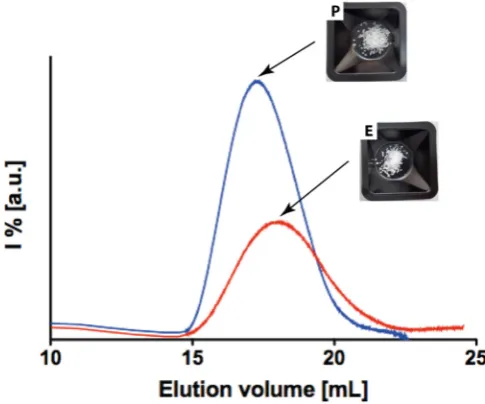
In this section, the characterization of the two pristine polymers is reported. In Figure 1 the GPC
189
chromatograms for both polymer P and E are visible and the characterization results, including also
190
the other analytical techniques, are presented in Table 1. As evident, their initial molecular weight is
191
relatively high in both cases, and the NMR spectra (in S.I.) shows full consistency in their
192
composition, which is confirmed equal to the one declared by suppliers of 70% PLA and 30% PCL
193
(full data in Table 1).
194
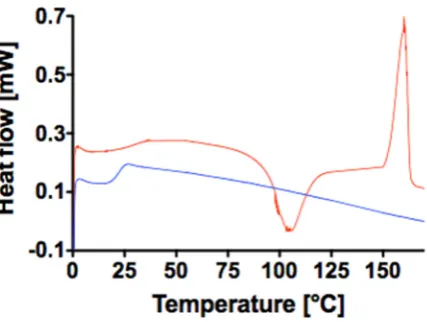
On the other hand, still NMR, DSC (Figure 2) data and XRD enable to identify considerable
195
differences between the two polymers (data in Table 1). As a matter of fact, E polymer has a
196
crystallinity degree of 65% whereas P is around 35%. This statement is well supported by the NMR
197
and DSC curve of Figure 2. Indeed, polymer E presents a well for the crystallization temperature, at
198
106°C, and a defined melting point at 160°C, whereas polymer P does not show any of the
199
aforementioned detectable points and the shape of the curve clearly resemble the one of amorphous
200
polymers. Similar conclusion can be drawn when looking at the XRD measurement (in S.I.) that also
201
confirms the partial crystalline nature of E and the amorphous one of P. Indeed, from Scherrer
202
equation we calculated full width at half maximum (FWHM) and average garin size (Lhkl) [33]and
203
the more crystalline nature of E sample is evident. Therefore, though the two polymers might look
204
similar from the composition and up to certain extent also from the molecular weight perspective, it
205
is however reasonable to expect different physical behavior and response to the sterilization
206
protocols in dependence on their crystallinity.
207
208
Figure 1. GPC chromatograms of P (blue line) and E (red line). Picture of the two pristine polymers as
209
removed from the supplier’s packaging.
210
Table 1. Data obtained by GPC, 1H-NMR, DSC and XRD of the polymeric samples.
219
GPC 1H-NMR DSC XRD
# Sample
Mw
[Da]
Mn
[Da]
PD
[-]
CL [%
g/gtot]
cristallin
ity [%]
cristallin
ity [%]
FWHM
[°]
Lhkl
[A]
E 119600 85660 1.12 25.4 61.1 65 4.5 0.308
P 172750 123800 1.6 25.5 36.1 35.2 7.5 0.185
E EtO 96000 78700 1.2 25 59.6 60 4.5 0.308
P EtO 159400 97300 1.64 25.7 34.3 35 7.5 0.185
E e-beam 51800 43660 1.3 25.6 60.6 59.2 4.5 0.317
P e-beam 133300 64100 2.08 25.4 35.5 32.1 7.5 0.185
220
221
Figure 2. DSC curve of P (blue line) and E (red line).
222
3.2. Ethylene oxide processing
223
Though relatively expensive, ethylene oxide (EtO) processing is widely used for the
224
sterilization of medical devices and surgical instruments and it basically consists in a controlled
225
exposure of the products to ethylene oxide in gaseous form, in a sealed chamber. The high
226
diffusivity of EtO, coupled with its high reactivity, is of major importance for the inactivation of
227
microorganisms. In fact, EtO can penetrate selected packaging and access all the exposed surfaces of
228
the product. Moreover, it works as an alkylating agent for protein essential for cell reproduction,
229
DNA and RNA. This way, it prevents normal cellular metabolism and the ability to reproduce of the
230
affected microbes, which becomes nonviable[24]. In general, the chemical species targeted by EtO
231
are not included in most of the medical devices composition, therefore, their exposure to EtO should
232
have very little or no impact on them, independently on their physical characteristics. On the other
233
hand, the whole process is performed at mid-high temperature and relatively high humidity, both
234
parameters that might affect the polymer initial fashions. Indeed, though not great changes are
235
recorded in the physical characteristics of the polymers (DSC in Figure 3 and XRD in S.I.), still a
236
statistically relevant albeit small reduction of the molecular weights is recorded for both of them
237
(Table 1). As a matter of fact, the Mw of polymer E moves from 119609 Da to 96000 Da, with a change
238
in PD of 0.013, whereas the one of polymer P shifts from 172746 Da to 159413 Da with a PD variation
239
of 0.04 (Figure 4). Though these changes might not be an effect of the EtO directly, it is anyhow
240
rather important to record the inevitable degradation effect given by the whole sterilization protocol.
241
3.3. Electron beam processing
243
Electron beam irradiation processing (e-beam) is commonly used in the sterilization of medical
244
devices and in general represent a much faster and cheaper solution in respect to EtO processing.
245
The procedure involves irradiation of the products with a high-energy electron beam which ionize in
246
a controlled way the hit samples. The bombardment results in a cascade of free electrons through the
247
material domain, which, when interact with surrounding molecules, generate free radicals. These
248
last species induce breaks in the DNA double helix, preventing replication and expression, therefore
249
enabling sterilization effects[23]. Due to its mechanism of action, it is important to limit the duration
250
of the whole irradiation to the minimum (generally just few minutes), otherwise great damage on
251
the final products, such as polymers embrittlement, oxidative damage and color change might
252
occur[34,35]. Indeed, especially for polymer based devices, ionizing radiations exhibit an important
253
side effect that affects their performances, such as decrease in both number and weight average
254
molecular weight and modification of the chains distribution and conformation.
255
Such effect is evident already at the minimal radiation dose (the "overkill dose") that ensures
256
sterilization, equal to 25 kGy[36]. Indeed, the free radicals and ions can also lead to recombination
257
reactions, hydrogen abstraction or cross-linking reactions[37]. Moreover, if radiation energy is
258
higher than intramolecular forces, unzipping reactions (i.e. depolymerization reactions) can occur.
259
Generally speaking, the molecular weight decrease is proportional to the radiation dose[37–39].
260
Moreover, the specific trend depends on material composition (which determines the reactions
261
pathways), degree of crystallinity, and sterilization environment (i.e. temperature and the presence
262
of air, since oxygen molecules enhance the molecular weight decrease). This phenomenon has an
263
important impact on the final behavior of devices made of aliphatic polyesters which in general
264
reflects on the mechanical properties of the finite device. Indeed, though the Young modulus
265
decreases very slightly, the elongation at break diminishes dramatically, following a
266
dose-dependent trend. In addition, radiations also influence the glass transition temperature,
267
melting temperature and the degree of crystallinity[38,40–42].
268
In general, the two main reactions that take place during irradiation are chain scission and
269
cross-linking[26,28,38,43]. The ratio between methylene and ester groups CH2/COO is a very
270
important parameter, because it discriminates the structure of the material after irradiation dose[38].
271
In particular, for high values of CH2/COO ratio cross-linking is the dominant kinetic mechanism,
272
while at low values polymer degradation mainly occurs.
273
In particular, polyglycolic acid exhibits the lowest CH2/COO ratio and experiences degradation
274
while irradiated; cross-linking reactions appear only after very high radiation doses. Regarding the
275
considered example of poly(L-lactide-co-ε-caprolactone), as one can see from Table 1, a clear
276
decrease after irradiation in molecular weight Mw for both polymers E and P is observable. Indeed,
277
the final values are 51814 Da for E and 133265 Da for P. In this sense, this is a huge difference in
278
respect to the previously discussed EtO sterilization treatment. Moreover, though the variation of
279
polymer P might appear to be smaller than the case of E, this result has to be taken into consideration
280
in light also of the PD values of both distributions. As evident from Table 1 it varies considerably
281
between the two polymers: E shows a variation of 0.113 whereas P one of 0.48. This means, that in
282
the case of P much more oligomers are produced upon irradiation so that the distribution
283
considerably enlarges. Therefore, clearly it would be more difficult, from a process perspective, to
284
rely on the selected initial properties of the pristine material. On the other hand, polymer E almost
285
preserves its intrinsic polydispersity making the effect of the treatment on the final properties of the
286
finished device more easily predictable. The difference that is observed within the two ionized
287
polymers can be explained by the mechanism of action of the radical species. Indeed, if they find
288
themselves confined in close proximity within the highly-ordered arrangement of chains (“cage”) in
289
the crystalline domain it is easier for them to recombine rather than diffuse out and propagate,
290
reducing the effective chain scissions and making it occur in a rather more controlled way within the
291
crystalline domain. On the other hand, such a “cage effect” is certainly less expected for amorphous
292
arrangements, where much more free space is left to the radicals to diffuse and propagate randomly
293
through the overall polymer network[28,43].
Moreover, though the actual composition is left untouched (NMR in S.I.) detectable
295
modifications are recorded also in the crystallinity of the two polymers upon irradiation. Indeed, the
296
crystallinity degree of E is reduced and the actual well for the point of crystallization is shifted from
297
100°C for the pristine polymer to 87°C for the ionized one. Such changes are not easy to detect for the
298
case of P, as already in its pristine appearance, it presents and amorphous nature, whose DSC curve
299
does not present any noticeable wells or peaks (Figure 3).
300
301
302
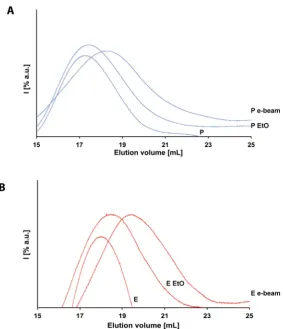
Figure 3. DSC curves of: A) P, P EtO and P e-beam (blue lines); B) E, E EtO and E e-beam (blue lines).
303
305
Figure 4. GPC chromatograms of: A) P, P EtO and P e-beam (blue lines); B) E, E EtO and E e-beam
306
(blue lines).
307
308
3.4. Mathematical modelling
309
Electron beam sterilization not only alters the initial polymer properties, but also accelerates the
310
degradation rate. This cannot be disregarded, because a faster decay of the molecular weight reduces
311
the time span where, e.g., a device can assure the desired mechanical properties. Therefore, a
312
comprehensive overview of the consequences of electron beam sterilization should couple the
313
analysis of the detrimental effects on raw material as well as its accelerated degradation.
314
For this purpose, mathematical modeling emerges as a useful tool that can provide a
315
quantitative estimation of the molecular weight decay. In this framework, the model proposed by
316
Perale et al.[44] and Casalini et al.[45] has been chosen for the comprehensive description of the
317
involved phenomena (hydrolysis, autocatalysis and transport phenomena) and its validated results.
318
Details are extensively discussed in previous papers[44,45], but model formulation is here
319
summarized for the sake of completeness.
320
The model is based on population balances, where a mass balance for a polymer chain with n
321
repeating units is written. Since it is necessary to write an equation for each considered chain length
322
value, this approach would imply a large number of differential equation to be solved (about 105). In
323
order to reduce the computational effort, the method of the statistical moment is employed[46],
324
allowing to reduce the large number of population balance equations to three equations, which
325
accounts for the time and spatial evolution of the statistical moments of the first three orders.
The generic j-th order moment μj is defined as follows:
331
332
= ∑ (1)
333
334
where n is chain length and Cn is the concentration of a polymer chain with n repeating units.
335
336
Under the assumption that only oligomers up to nonamers can diffuse through polymer matrix,
337
model is composed by a system of partial differential equations that account for time and spatial
338
evolution of monomer (eq. 2), water (eq. 3), oligomers (eq. 4) and statistical moments of zero-th, first
339
and second order (eqs. 5 – 7):
340
341
= ∇( ∇ ) + 2 ( − ) (2)
342
= ∇( ∇ ) − ( − ) (3)
343
= ∇( ∇ ) + 2 ( − ∑ ) − ( − 1) 2 ≤ n ≤ 9 (4)
344
= ∑ ∇ ∇ + ( − ) (5)
345
= ∑ j ∙ ∇ ∇ (6)
346
= ∑ ∙ ∇ ∇ + − 2 + (7)
347
348
Where CM is monomer concentration, DM is monomer diffusion coefficient, kd is degradation
349
kinetic constant, CW is water concentration, DW is water diffusion coefficient, Cn is the concentration
350
of an oligomer with n repeating units and Dolig is oligomer diffusion coefficient.
351
The model takes into account the increase of diffusivity due to degradation (chain scissions
352
open new and wider diffusive path) through the following expression:
353
354
= 2.5 1 − (( , )) . i = monomer, oligomer, water (8)
355
356
Where Di0 is the diffusion coefficient of the i-th species before degradation onset, and x is a
357
generic spatial coordinate.
358
The average properties of interest, such as number average molecular weight Mn, weight
359
average molecular weight Mw and polydispersity PD can be easily calculated starting from the
360
statistical moments:
361
362
= (9)
363
= (10)
364
= (11)
365
366
where Mmon is the molecular weight of the repeating unit.
367
Model equations are here written in their general form, but only one spatial coordinate (the
368
characteristic diffusion length) is usually considered in the Laplacian term. The system of partial
369
differential equations constituted by eqs. 2 – 7 is solved through the method of lines: spatial
370
derivatives are approximated through a finite difference scheme (centered formulation) and the
371
resulting system of ordinary differential equations is numerically integrated by means of ode15s
372
algorithm implemented in MATLAB.
373
The analysis has been performed starting from experimental data taken from Loo et al.[26],
374
chosen as a reference case for their exhaustiveness; in particular, Loo and coworkers studied the
375
influence of irradiation dose on the initial properties and hydrolytic degradation of electron beam –
376
irradiated films of polylactic acid.
The mathematical model has been used in order to compute a degradation kinetic constant,
379
which offers a quantitative estimation of the degradation enhancement provided by electron beam
380
sterilization; film thickness has been considered as characteristic diffusion length. Kinetic constants
381
have been obtained through fitting of experimental data, in order to best reproduce the decay of the
382
number average molecular weight over time; data fitting has been carried out by means of lsqnonlin
383
algorithm implemented in MATLAB. Model input parameters are summarized in Table 2.
384
385
Table 2. Model input parameters
386
Film thickness [μm] 55
Mmon [g mol-1] 90.08
ρpol 1.2
DM0 [cm2 s-1] 10-10
Dolig0 [cm2 s-1] 10-10
DW0 [cm2 s-1] 10-8
387
Initial conditions and kinetic constants are summarized in Table 3, while a comparison between
388
model results and experimental data is shown in Figure 5A.
389
390
Table 3. Initial properties of the polymer analyzed through mathematical modeling and degradation
391
kinetic constants obtained through experimental data fitting.
392
Radiation dose [Mrad]
Number average molecular weight [g mol-1]
Polydispersity [-]
Degradation constant [cm6 mol-2 s-1]
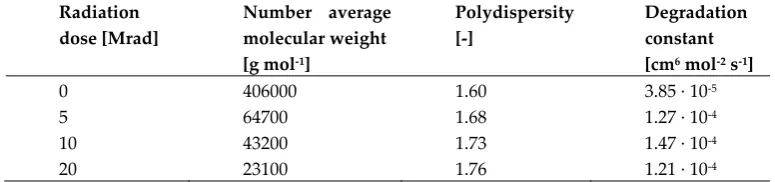
0 406000 1.60 3.85 ∙ 10-5
5 64700 1.68 1.27 ∙ 10-4
10 43200 1.73 1.47 ∙ 10-4
20 23100 1.76 1.21 ∙ 10-4
397
Figure 5.Comparison between model predictions (continuous line) and experimental data (filled circles)
398
taken from Loo et al.[26] for different radiation doses (a). Normalized degradation kinetic constants as a
399
function of radiation dose. Values have been normalized with respect to the kinetic constant of the non -
400
irradiated polymer (b).
401
402
Model best fitting is in good agreement with experimental data, thus confirming the reliability
403
of the chosen approach. The obtained kinetic constants are listed in Table 3, while the normalized
404
values are shown in Figure 5B. In particular, values have been normalized choosing the non –
405
irradiated polymer as reference value. In primis, data confirm that electron beam sterilization
406
accelerates polymer degradation, since it reduces the initial molecular weight through chain
407
scission. According to model results, hydrolysis is about 3.5 times faster for the irradiated polymer;
408
in addition, degradation enhancement does not depend on radiation dose, since the values of the
409
kinetic constants are close to each other.
410
This analysis highlights that, for an optimal device design, the initial molecular weight drop
411
due to irradiation must be coupled with the enhanced degradation in order to identify the most
412
suitable polymer. In other words, the choice of the raw material (i.e., before sterilization and
413
processing) should take into account that the initial molecular weight will be not only reduced by
414
processing and sterilization but will also decay faster. This is essential for those applications where
415
the device must assure, e.g., mechanical stability in a determined time span.
4. Conclusions
425
In this work we presented a case study for showing a possible methodologic approach for the
426
selection of appropriate biodegradable polymers in product formulation for medical devices
427
manufacturing. In particular, the major effect of the finished product terminal sterilization is
428
discussed and a comparison between the EtO and e-beam treatments is presented for two apparently
429
similar poly(L-lactide-co-ε-caprolactone) base materials with identical composition (70% PLA and
430
30% PCL). Specifically, the major difference resembles in the degree of crystallinity of the
431
aforementioned polymer: E has a relatively high degree of 65% whereas P a rather amorphous
432
structure. Once sterilized, independently on the implied sterilization protocol, both polymers
433
exhibited degradation. Actually, the EtO exposition minimally affected the initial characteristics (in
434
terms of Mw, PD and crystallinity), whereas major differences before and after the treatment was
435
observed for e-beam irradiation. Indeed, a major reduction in molecular weight was observed for
436
both polymers. Additionally, the different chains arrangement led to different response to the
437
treatment. Indeed, even if polymer P degraded apparently less than polymer E, the chain length
438
distribution considerably broadened. This would reflect in a more uncontrolled change in the
439
desired initial properties selected during product formulation and design. Moreover, irradiation has
440
also a major effect on the degradation kinetic of polymers. This effect has been studied through a
441
mathematical model, which allowed to identify that hydrolysis is about 3.5 times faster for the
442
irradiated polymer than to pristine one, remarkably not being dependent on the radiation dose.
443
As a conclusion, we believe that the presented example might be very useful in the
444
development of bioresorbable devices. As a matter of fact, intrinsic response of the material upon the
445
overall post-processing steps might be understood only upon a deep and appropriate
446
characterization of the starting polymers, even when they are nominally similar.
447
448
449
450
451
Supplementary Materials: The following are available online, Figure S1: NMR spectra of P and E samples,
452
Figure S2: XRD spectra of P (blue line) and E (red line), Figure S3: NMR spectra of P and E after EtO, Figure S4:
453
XRD spectra of P (blue line) and E (red line) after EtO, Figure S5: NMR spectra of P and E after electron beam
454
irradiation, Figure S6: XRD spectra of P and E after electron beam irradiation.
455
Author Contributions: Conceptualization, A.C., F.R. and G.P.; Experiments, A.C., S.C., A.K. M.S. and F. R.;
456
Mathematical modeling T.C.; Writing-Original Draft Preparation, A.C. and T.C.; Writing-Review & Editing, ,
457
A.C., T.C., A.C., A.K., M.S., F.R. and G.P.; Supervision A.C., T.C., F.R. and G.P.
458
Funding: This research received no external funding.
459
Conflicts of Interest: The authors declare no conflict of interest.
460
References
462
1. Perale, G.; Hilborn, J. Bioresorbable Polymers for Biomedical Applications - From Fundamentals to
463
Translational Medicine; 1st ed.; Woodhead Publishing Series in Biomaterials, 2016;
464
2. Cameron, R. E.; Kamvari-Moghaddam, A. Synthetic bioresorbable polymers; Woodhead
465
Publishing Limited, 2012; ISBN 9781845699291.
466
3. Planell, J. A. Bone Repair Biomaterials; Woodhead Publishing Limited, 2009; ISBN
467
9781845693763.
468
4. Armentano, I.; Bitinis, N.; Fortunati, E.; Mattioli, S.; Rescignano, N.; Verdejo, R.;
469
Lopez-Manchado, M. A.; Kenny, J. M. Multifunctional nanostructured PLA materials for
470
packaging and tissue engineering. Prog. Polym. Sci. 2013, 38, 1720–1747,
471
doi:10.1016/j.progpolymsci.2013.05.010.
472
5. Ceccarelli, G.; Presta, R.; Benedetti, L.; Cusella De Angelis, M. G.; Lupi, S. M.; Rodriguez Y
473
Baena, R. Emerging Perspectives in Scaffold for Tissue Engineering in Oral Surgery. Stem
474
Cells Int.2017, 2017, doi:10.1155/2017/4585401.
475
6. Athanasiou, K. A.; Niederauer, G. G.; Agrawal, C. M. Sterilization, toxicity, biocompatibility
476
and clinical applications of polylactic acid/polyglycolic acid copolymers. Biomaterials1996, 17,
477
93–102, doi:10.1016/0142-9612(96)85754-1.
478
7. Casalini, T.; Perale, G. Types of bioresorbable polymers for medical applications. Durab.
479
Reliab. Med. Polym.2012, 3–29, doi:10.1016/B978-1-84569-929-1.50001-5.
480
8. Farah, S.; Anderson, D. G.; Langer, R. Physical and mechanical properties of PLA, and their
481
functions in widespread applications — A comprehensive review. Adv. Drug Deliv. Rev.2016,
482
107, 367–392, doi:10.1016/j.addr.2016.06.012.
483
9. Sheikh, Z.; Najeeb, S.; Khurshid, Z.; Verma, V.; Rashid, H.; Glogauer, M. Biodegradable
484
materials for bone repair and tissue engineering applications. Materials (Basel).2015, 8, 5744–
485
5794, doi:10.3390/ma8095273.
486
10. Miller, N. D.; Williams, D. F. The in vivo and in vitro degradation of poly(glycolic acid)
487
suture material as a function of applied strain. Biomaterials 1984, 5, 365–368,
488
doi:10.1016/0142-9612(84)90037-1.
489
11. Prakasam, M.; Locs, J.; Salma-Ancane, K.; Loca, D.; Largeteau, A.; Berzina-Cimdina, L.
490
Biodegradable Materials and Metallic Implants—A Review. J. Funct. Biomater. 2017, 8, 44,
491
doi:10.3390/jfb8040044.
492
12. Santoro, M.; Perale, G. Using synthetic bioresorbable polymers for orthopedic tissue
493
regeneration. Durab. Reliab. Med. Polym. 2012, 119–139,
494
doi:10.1016/B978-1-84569-929-1.50006-4.
495
13. Colombo, C.; Gatti, S.; Ferrari, R.; Casalini, T.; Cuccato, D.; Morosi, L.; Zucchetti, M.;
496
Moscatelli, D. Self-assembling amphiphilic PEGylated block copolymers obtained through
497
RAFT polymerization for drug-delivery applications. J. Appl. Polym. Sci. 2016, 133, 1–8,
498
doi:10.1002/app.43084.
14. Kumari, A.; Yadav, S. K.; Yadav, S. C. Biodegradable polymeric nanoparticles based drug
500
delivery systems. Colloids Surfaces B Biointerfaces 2010, 75, 1–18,
501
doi:10.1016/j.colsurfb.2009.09.001.
502
15. Ferrari, R.; Cingolani, A.; Moscatelli, D. Solvent effect in PLA-PEG based nanoparticles
503
synthesis through surfactant free polymerization. Macromol. Symp. 2013, 324,
504
doi:10.1002/masy.201200073.
505
16. Ferrari, R.; Yu, Y.; Morbidelli, M.; Hutchinson, R. A.; Moscatelli, D. ε-Caprolactone-Based
506
Macromonomers Suitable for Biodegradable Nanoparticles Synthesis Through Free Radical
507
Polymerization. Macromolecules2011, 44, 9205–9212, doi:10.1021/ma201955p.
508
17. Pillai, C. K. S.; Sharma, C. P. Review paper: Absorbable polymeric surgical sutures:
509
Chemistry, production, properties, biodegradability, and performance. J. Biomater. Appl.2010,
510
25, 291–366, doi:10.1177/0885328210384890.
511
18. Peppas, N. A.; Bures, P.; Leobandung, W.; Ichikawa, H. Hydrogels in pharmaceutical
512
formulations. Eur. J. Pharm. Biopharm.2000, 50, 27–46, doi:10.1016/S0939-6411(00)00090-4.
513
19. Freed, L. E.; Vunjak-Novakovic, G.; Biron, R. J.; Eagles, D. B.; Lesnoy, D. C.; Barlow, S. K.;
514
Langer, R. Biodegradable Polymer Scaffolds for Tissue Engineering. Nat. Biotechnol.1994, 12,
515
1119–1124, doi:10.1038/ng1294-340.
516
20. Kutz, M. Applied Plastics Engineering Handbook; Elsevier Inc., 2011;
517
21. Lambert, B. J.; Mendelson, T. A.; Craven, M. D. Radiation and Ethylene Oxide Terminal
518
Sterilization Experiences with Drug Eluting Stent Products. AAPS PharmSciTech 2011, 12,
519
1116–1126, doi:10.1208/s12249-011-9644-8.
520
22. Dearth, C. L.; Keane, T. J.; Carruthers, C. A.; Reing, J. E.; Huleihel, L.; Ranallo, C. A.; Kollar, E.
521
W.; Badylak, S. F. The effect of terminal sterilization on the material properties and in vivo
522
remodeling of a porcine dermal biologic scaffold. Acta Biomater. 2016, 33, 78–87,
523
doi:10.1016/j.actbio.2016.01.038.
524
23. Tipnis, N. P.; Burgess, D. J. Sterilization of implantable polymer-based medical devices: A
525
review. Int. J. Pharm.2018, 544, 455–460, doi:10.1016/j.ijpharm.2017.12.003.
526
24. C Mendes, G. C.; S Brandão, T. R.; M Silva, C. L. Ethylene oxide sterilization of medical
527
devices: A review. Am J Infect Control2007, 35, 574–581, doi:10.1016/j.ajic.2006.10.014.
528
25. McKeen, L. Effect of Sterlization Method on Plastics and Elastomers; 3rd ed.; Elsevier Inc., 2012;
529
26. Loo, S. C. J.; Tan, H. T.; Ooi, C. P.; Boey, Y. C. F. Hydrolytic degradation of electron beam
530
irradiated high molecular weight and non-irradiated moderate molecular weight PLLA. Acta
531
Biomater.2006, 2, 287–296, doi:10.1016/j.actbio.2005.10.003.
532
27. Loo, S. C. J.; Ooi, C. P.; Boey, Y. C. F. Radiation effects on poly(lactide-co-glycolide) (PLGA)
533
and poly(L-lactide) (PLLA). Polym. Degrad. Stab. 2004, 83, 259–265,
534
doi:10.1016/S0141-3910(03)00271-4.
535
536
28. Loo, J. S. C.; Ooi, C. P.; Boey, F. Y. C. Degradation of poly(lactide-co-glycolide) (PLGA) and
538
poly(L-lactide) (PLLA) by electron beam radiation. Biomaterials 2005, 26, 1359–1367,
539
doi:10.1016/j.biomaterials.2004.05.001.
540
29. Pertici, G. The effect of molecular structure on the properties of biomedical polymers. Durab.
541
Reliab. Med. Polym.2012, 30–48, doi:10.1016/B978-1-84569-929-1.50002-7.
542
30. Roato, I.; Belisario, D. C.; Compagno, M.; Verderio, L.; Sighinolfi, A.; Mussano, F.; Genova, T.;
543
Veneziano, F.; Pertici, G.; Perale, G.; Ferracini, R. Adipose-Derived Stromal Vascular
544
Fraction/Xenohybrid Bone Scaffold: An Alternative Source for Bone Regeneration. Stem Cells
545
Int.2018, 2018, 1–11, doi:10.1155/2018/4126379.
546
31. D’Alessandro, D.; Perale, G.; Milazzo, M.; Moscato, S.; Stefanini, C.; Pertici, G.; Danti, S.
547
Bovine bone matrix/poly(L-lactic-co-ε-caprolactone)/gelatin hybrid scaffold (SmartBone®)
548
for maxillary sinus augmentation: A histologic study on bone regeneration. Int. J. Pharm.
549
2017, 523, 534–544, doi:10.1016/j.ijpharm.2016.10.036.
550
32. Pertici, G.; Carinci, F.; Carusi, G.; Epistatus, D.; Villa, T.; Crivelli, F.; Rossi, F.; Perale, G.
551
Composite Polymer-Coated Mineral Scaffolds for Bone Regeneration: From Material
552
Characterization To Human Studies. J. Biol. Regul. Homeost. Agents2015, 29, 136–148.
553
33. Scardi, P.; Leoni, M.; Delhez, R. Line broadening analysis using integral breadth methods: A
554
critical review. J. Appl. Crystallogr.2004, 37, 381–390, doi:10.1107/S0021889804004583.
555
34. Xiao, L.; Wang, B.; Yang, G.; Gauthier, M. Poly (Lactic Acid) -Based Biomaterials : Synthesis ,
556
Modification and Applications. 2006, doi:10.5772/23927.
557
35. Cairns, M. L.; Sykes, A.; Dickson, G. R.; Orr, J. F.; Farrar, D.; Dumba, A.; Buchanan, F. J.
558
Through-thickness control of polymer bioresorption via electron beam irradiation. Acta
559
Biomater.2011, 7, 548–557, doi:10.1016/j.actbio.2010.09.012.
560
36. Nguyen, H.; Morgan, D. A. F.; Forwood, M. R. Sterilization of allograft bone: Is 25 kGy the
561
gold standard for gamma irradiation? Cell Tissue Bank. 2007, 8, 81–91,
562
doi:10.1007/s10561-006-9019-7.
563
37. Guo, C.; Zhou, L.; Lv, J. Effects of expandable graphite and modified ammonium
564
polyphosphate on the flame-retardant and mechanical properties of wood
565
flour-polypropylene composites. Polym. Polym. Compos.2013, 21, 449–456, doi:10.1002/app.
566
38. Narkis, M.; Sibony-Chaouat, S.; Siegmann, A.; Shkolnik, S.; Bell, J. P. Irradiation effects on
567
polycaprolactone. Polymer (Guildf).1985, 26, 50–54, doi:10.1016/0032-3861(85)90056-4.
568
39. Gupta, M. C.; Deshmukh, V. G. Radiation effects on poly(lactic acid). Polymer (Guildf).1983,
569
24, 827–830, doi:10.1016/0032-3861(83)90198-2.
570
40. Filipczak, K.; Wozniak, M.; Ulanski, P.; Olah, L.; Przybytniak, G.; Olkowski, R. M.;
571
Lewandowska-Szumiel, M.; Rosiak, J. M. Poly(ε-caprolactone) biomaterial sterilized by
572
E-beam irradiation. Macromol. Biosci.2006, 6, 261–273, doi:10.1002/mabi.200500215.
573
41. Gandhi, K.; Kriz, D.; Salovey, R.; Narkis, M.; Wallerstein, R. Crosslinking of polycaprolactone
574
in the pre-gelation region. Polym. Eng. Sci.1988, 28, 1484–1490, doi:10.1002/pen.760282209.
42. Oláh, L.; Filipczak, K.; Czvikovszky, T.; Czigány, T.; Borbás, L. Changes of porous
576
poly(ε-caprolactone) bone grafts resulted from e-beam sterilization process. Radiat. Phys.
577
Chem.2007, 76, 1430–1434, doi:10.1016/j.radphyschem.2007.02.046.
578
43. Loo, S. C. J.; Ooi, C. P.; Boey, Y. C. F. Influence of electron-beam radiation on the hydrolytic
579
degradation behaviour of poly(lactide-co-glycolide) (PLGA). Biomaterials2005, 26, 3809–3817,
580
doi:10.1016/j.biomaterials.2004.10.014.
581
44. Perale, G.; Arosio, P.; Moscatelli, D.; Barri, V.; Müller, M.; Maccagnan, S.; Masi, M. A new
582
model of resorbable device degradation and drug release: Transient 1-dimension diffusional
583
model. J. Control. Release2009, 136, 196–205, doi:10.1016/j.jconrel.2009.02.014.
584
45. Casalini, T.; Rossi, F.; Lazzari, S.; Perale, G.; Masi, M. Mathematical modeling of PLGA
585
microparticles: From polymer degradation to drug release. Mol. Pharm.2014, 11, 4036–4048,
586
doi:10.1021/mp500078u.
587
46. Ramkrishna, D. Population Balances - Theory and Applications to Particulate Systems in
588
Engineering; Elsevier Inc., 2000

![Figure 5. Comparison between model predictions (continuous line) and experimental data (filled circles) taken from Loo et al.[26] for different radiation doses (a)](https://thumb-us.123doks.com/thumbv2/123dok_us/1067473.1607316/12.595.175.422.84.406/figure-comparison-predictions-continuous-experimental-circles-different-radiation.webp)
