Article
Efficient Self-Rotation Perception
Andrew Duggins 1, 2 *
1 Western Clinical School, Faculty of Medicine and Health, University of Sydney; [email protected]
2 Department of Neurology, Westmead Hospital; [email protected] * Correspondence: [email protected]; Tel.: +61-413-475-681
Abstract: An event occurring within a stationary environment, in the direction toward which an observer self-rotates, is perceived to precede a simultaneous event, in the direction away from which she moves. When self-rotation results from angular acceleration in the dark, perception of space is also distorted, such that the subjective straight-ahead shifts in the opposite direction to motion and temporal event promotion. A reference frameshift theory, based on the special theory of relativity, is proposed to explain these findings. Here, a hyperbolic tangent transformation of objective angular velocity constrains subjective self-rotation velocity within finite bounds, consistent with it being a limited perceptual resource. Identifying this subjective variable with vestibular nystagmus slow-phase angular velocity, the asymptotic perceived self-rotation velocity is estimated at ~200 ° 𝑠⁄ . When included in the Lorentz transformations of the new formalism, this value predicts experimental simultaneity distortion. Hypothetically, the hyperbolic tangent objective-to-subjective transfer function would maximize the differential entropy of the percept, and thereby also the stimulus/percept mutual information, if angular velocities of body rotation encountered in naturalistic environmental interaction have a logistic probability density distribution of scale 100 ° 𝑠⁄ , a proposed experimental test of the scheme.
Keywords: special relativity; efficient coding hypothesis; temporal order judgement; circular vection; vestibulo-ocular reflex; time perception; Lorentz transformation; accelerated reference frame; equivalence principle; optimization of perception
1. Introduction
1.1. Focus on consciousness
The superficial aim of what follows is to describe mathematically the transformation into experience of objective angular velocities of rotation, of the body relative to the environment. I will go further to suggest that this formulation is a specific application of a more general mathematical principle underlying the structure of sensory perception, notably the same principle of relativity that unites space and time in the physical domain[1]. Importantly, this specific application is also a model of consciousness, in the sense that it implies a simple mathematical relation between an aspect of sensory experience and its neural correlate: the efficient coding principle [2,3], describing in information theoretic terms the optimal transformation into neural code of an environmental stimulus variable, is also proposed to constrain perceptual experience. If the statistics of body rotation during prolonged environmental immersion were to fit the specific predictions of the model of self-rotation perception that will be presented, then this hypothesis would be confirmed.
1.2. Self-rotation perception
The experience of one’s body rotating (perceived self-rotation) can be evoked either by vestibular or visual stimulation. In either case the percept is an indirect interpretation of sensory input that captures the motion of the head relative to the environment. Only when this record of motion is unmatched by stretch afferent evidence of passive, or efference copy evidence of active neck turning will self-rotation be inferred [4]. The semicircular canals of the vestibular organs detect the angular velocity of the head, when it is rapidly changing, or alternatively its slow angular acceleration [5]. In either context, the experience of rotation is relative to an assumed rest condition. A constant angular velocity of en bloc rotation, without visual input, will be interpreted as rest, until an abrupt deceleration evokes an illusory self-rotation percept known as vertigo. An assumed rest condition is also a feature of ‘circular vection’ that results from coherent full field visual motion (‘optic flow’). Here the percept of self-rotation is a parsimonious interpretation that it is more likely to be
the environment that is stationary.
The interaction of a moving subject with a natural environment will usually generate simultaneous visual and vestibular inputs contributing to the self-rotation percept. However, it is possible to isolate vestibular inputs by angularly accelerating a subject from rest in the dark, or selectively to stimulate the visual system by placing a stationary subject within a rotating optokinetic drum (real or virtual). In both experimental scenarios, self-rotation is accompanied by an eye movement in the opposite direction that becomes the slow phase of nystagmus if rotation persists, vestibular nystagmus in the case of angular acceleration, optokinetic nystagmus with full-field visual motion. These observable manifestations are neither sensitive nor specific for the experience of self-rotation. Optokinetic nystagmus typically occurs without circular vection, for the first few seconds of drum rotation [6]. The vestibulo-ocular reflex (VOR) can be suppressed by fixation on a target that moves with the head and body, even as perceived self-rotation persists. I will assume, however, that in the absence of visual input, the slow phase angular velocity of vestibular nystagmus is equal in magnitude but opposite in sign to the angular velocity of perceived self-rotation.
A conventional explanation of these rotation-induced illusions invokes covert orienting of attention to the upcoming region of space, shortening the latency to neural (and mental) representation of stimuli presented in this region [7,8,9]. The explanation is problematic particularly where the accumulation of angular velocity is inferred from vestibular input, in that rotatory vestibular stimulation displaces the subjective ‘‘straight ahead” [10,11] and caloric vestibular stimulation displaces spontaneous head orientation [12], in the direction opposite to that in which self-rotation would be perceived, i.e. away from the purported direction of covert attentional orientation. Teramoto et al [8] put forward an alternative hypothesis that the “reference frame for determining the order in which objects come into awareness…might be shifted to the direction of
perceived motion and the shift amount could be in proportion to the strength of perceived self-motion”. In what follows I will propose a specific mathematical model for this reference frameshift
theory of self-rotation perception.
2. Materials and Methods
The model to be developed is inspired by the relativity of experience under rotation: the identity of experience between a stationary subject in an environment that rotates uniformly to the right and a subject rotating uniformly to the left in a stationary environment (opposite centrifugal forces acting on the utricles of the two inner ears presumably result in vestibular inputs that exactly cancel). This contrasts to the relativity under uniform translational motion that characterizes objective physics. I will adapt the Lorentz transformations of Einstein’s special relativity [1], that apply to reference frames in relative linear motion, to the rotating reference frames of subjects and their environments, in order to reconcile this subjective relativity with reciprocal distortions in perceived simultaneity.
I predict that a stationary subject will overestimate the duration of, and underestimate the angle subtended by, a stimulus co-rotating with an optokinetic field, mirroring effects on time and length respectively in special relativity [1]. I will show how the theory explains the ‘gain’ function of the VOR under constant angular acceleration of head and body, and derive the experimental magnitude of simultaneity distortion (above) from the measured asymptotic VOR nystagmus slow-phase velocity of 200 ° 𝑠 ⁄ [13]. I will show how a shift of the subjective ‘straight ahead’, that would explain the direction of tonic head and eye deviation in vestibular stimulation [12], follows directly from application of the theory to an accelerating reference frame.
The profound philosophical implication of these results is that there is a shared virtual environment, within which every sentient protagonist interacts with the avatars of others, that is a relativistic spacetime. I will argue that what underlies the human ability to share representations of the world is a common ‘yardstick’ of spacetime separation that is also the actual time difference between events.
3. Results
3.1. Alice and Bob
will just use ‘angle’ or ‘yaw’, rather than ‘longitude’ or ‘angle of yaw’) to the perceptual ‘straight
ahead’ that I will call her prime orientation, and ±𝜋
2 radians to the position of her shoulders. I will call the region between these angles the ‘anterior hemisphere’ of her ‘subjective space’. Alice describes her subjective experience of time in seconds elapsed, relative to an index event. I assume that Alice associates this output of her internal ‘clock’ with her prime orientation, rather than it being
omnipresent across her subjective space. She fills out her spatiotemporal coordinate system by extrapolating times at peripheral angles along ‘lines’ of perceived simultaneity.
Alice sits immobile at the center of an optokinetic drum (Figure 1). At various objective angles around the patterned inner surface of the drum are embedded point sources of light that occasionally flash. If the drum were stationary, then I assume that the subjective angles 𝑌 (for ‘yaw’) and times 𝑡 that Alice would assign to flashes would correspond without systematic bias to objective light angles and flash latencies relative to a common origina. Actually though, the drum rotates clockwise at angular velocity 𝜌 such that Alice experiences an illusory sense of anticlockwise yaw rotation, known as ‘vection’.
a I will explore below how systematic bias in the allocation of perceived angles may occur in dynamic situations.
Note from the definition of prime orientation and the common origin that if such bias were to distort Alice’s perception of ‘straight ahead’, then the origin of objective space would shift similarly.
Alice
𝜌𝜏
𝜌
Figure 1. Alice and Bob each sit at the center of an identical patterned optokinetic drum, rotating clockwise at angular velocity 𝜌. Although their starting orientations are identical, Bob co-rotates with his drum, whereas Alice remains stationary. A red light on the inner aspect of each drum flashes at time 𝜏, at an angle 𝜓to Bob’s right. By this stage, Bob has rotated clockwise an angle 𝜌𝜏relative to Alice.
Bob sits within an identical optokinetic drum to Alice, within which identically positioned lights flash at corresponding times. This drum also rotates clockwise at angular velocity 𝜌. Bob, however, is not still, but rather his seat rotates clockwise at the same angular velocity 𝜌, such that he experiences an illusory sense of immobility. Bob has previously practiced with Alice describing spatiotemporal experience using her coordinate system, so that there is no systematic error between the two perceivers when reporting events within an environment that does not move. Moreover,
Bob’s subjective angles 𝜓 and times 𝜏 correspond without bias to actual light angles and flash
latencies on the rotating drum. We conclude that a transformation that embeds these objective coordinates in Alice’s subjective coordinate system will also formally relate Bob’s experience to that
of Alice.
3.2. Galilean relativity of self-rotation perception
We might imagine that the angular velocity of Alice’s vection would be −𝜌, and that relative to
an index event at the common origin of drum and subjective coordinates, she would experience a subsequent flash at an angle that exceeds its objective drum angle by the objective number of seconds elapsedtimes 𝜌. The spatiotemporal correspondence between Bob’s experience and the co-moving drum implies the following transformation from Bob’s subjective coordinates to those of Alice,
illustrated in Figure 2:
𝑌 = 𝜓 + 𝜌𝜏 𝑡 = 𝜏
The common time experienced by both perceivers, according to this classical hypothesis of perception, implies agreement between them about events that are simultaneous. It also allows us also to express Bob’s coordinates in terms of Alice’s:
𝜓 = 𝑌 − 𝜌𝜏
3.3. Special relativity of self-rotation perception
Remarkably, the experimental evidence mentioned above [8] is inconsistent with this classical hypothesis. When, as above, the drum co-rotates clockwise with Bob, a light further to the left on the drum, which he correctly perceives to flash simultaneously with one further to the right, will be perceived by Alice to occur first. Yet the relativity of experience under rotation implies that if the drum were stationary, Bob would prioritize the rightward flash to the same extent. A revised coordinate transformation that relates our protagonists’ experiences must capture these same distortions, when expressed in either direction. Under a Lorentz transformation that meets these stringent criteria, the relativity of Alice and Bob’s experience under rotation mirrors Einstein’s special relativity of linear motion in objective physics. Here we no longer assume an identical perceived angular velocity 𝜔 to actual relative angular velocity 𝜌. A feature of the Lorentz transformation is a limiting but finite perceived angular velocity 𝛾, upon which both Alice and Bob agree, analogous to the speed of light 𝑐 in special relativity [1]:
𝜓 = 𝛽(𝑌 − 𝜔𝑡) (1)
𝜏 = 𝛽 (𝑡 −𝜔𝑌 𝛾2)
(2)
𝑌 = 𝛽(𝜓 + 𝜔𝜏) (3)
𝑡 = 𝛽 (𝜏 +𝜔𝜓 𝛾2)
(4)
𝛽 = 1
√1 −𝜔𝛾22
(5)
One combination of squared time and yaw coordinates does not involve 𝜔 and is the same for both protagonists (from equations (1), (2) and (5)):
𝜏2−𝜓 2
𝛾2 = 𝑡 2−𝑌
2
𝛾2
(6)
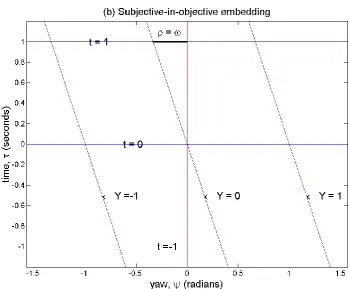
Figure 3. Embedding diagrams illustrating the reference frameshift model of self-rotation perception,
in which radians are adopted as units of time so that the limiting angular velocity of perceived self-rotation 𝛾 = ±1. Reflected green – 𝛾 trajectories in (a) illustrate a mapping of angular coordinates
by time, useful when this constant rotation model is extended to angular acceleration (see text). The relative actual angular velocity of environmental rotation in this example 𝜌 =1
3, reflecting anticlockwise self-rotation, is the hyperbolic angle of embedded objective yaw and time coordinates to their subjective counterparts in (a), the gradient of embedded coordinates being the perceived
relative angular velocity 𝜔. The degree of subjective time contraction is the factor 𝛽 that unit
objective time is dilated, subjective angle dilation the factor 𝛽1 that unit objective angle is contracted
in experience. Subjective coordinates can also be situated within an objective spatiotemporal
reference frame (b). The hyperbola 𝑡2− 𝑌2= 1 in (a), connecting events 1 radian of proper time from the origin, Lorentz transforms to the hyperbola 𝜏2− 𝜓2= 1 in (b).
The implications of this new scheme are best appreciated in an embedding diagram. As above, Bob rotates with the optokinetic drum, so he shares objective yaw and time coordinates that are embedded in Alice’s subjective spatiotemporal reference frame in Figure 3a. In contrast to the classical hypothesis of Figure 2, not only do Bob’s 𝜓 coordinates have a slope 𝜔 with respect to
Alice’s 𝑡 axis, but so do his 𝜏 coordinates, which link objectively simultaneous events, have a slope
proportional to 𝜔 with respect to Alice’s 𝑌 axis. In Figure 3, a new unit of time is created: the period over which an angular velocity of 𝛾 traverses 1 radian of yaw. With time expressed in these
‘radians’, 𝛾 takes a value of 1, so that the slope of Bob’s simultaneity lines equals 𝜔. The scale of
both 𝜓 and 𝜏 is dilated by a common factor 𝛽 relative to Alice’s corresponding coordinates, a symmetric reciprocal dilation being suggested by the 𝑌 and 𝑡 intercepts of Bob’s constant angle and simultaneity lines respectively in Figure 3a.
The set of points of constant proper time (equation (6)) form a hyperbola. A point on the hyperbola in Alice’s coordinate system (Figure 3a) Lorentz transforms to a different point on the same hyperbola in Bob’s coordinate system (Figure 3b). The hyperbolic angle, ‘hangle’, and hyperbolic
tangent of this transformation, shown in Figure 3a, are the actual and perceived angular velocities, 𝜌 and 𝜔 respectively, that characterize Bob’s motion relative to Alice. The angular velocity of Alice’s vection is −𝜔. If the optokinetic drum were to remain stationary with Alice instead of co-rotating with Bob, the relativity of experience under rotation demands that Bob would experience vection 𝜔. The form of the embedding diagram of protagonists’ coordinate systems (Figure 3) would not change, but rather the identification of 𝑡 not 𝜏 with actual time.
[15], here I will term the effect on Alice’s perception time contraction, in that relative to the ticks of an actual clock, seconds pass more rapidly for her inside the rotating drum.
A horizontal strip of light on the drum, which Bob correctly perceives to subtend 1 radian, Alice
will perceive to be shorter (perceived angle =1
𝛽 , taking 𝑡 = 0 in equation (1)). Here I will call this
perceived shortening angle dilation, referring to the expansion of Alice’s subjective angular
coordinates relative to the actual extent of the moving stimulus, when subjective spacetime is sectioned along her lines of simultaneity (Figure 3a). Estimation of 𝛽, to allow prediction of the magnitude of these effects in experiments with optokinetic stimuli, will require quantification of perceived angular velocities 𝛾 and 𝜔.
3.4. Objective manifestations
During the slow phase of vestibular nystagmus, the eyes follow a trajectory predicted to compensate for perceived rotation of the body. In the light, that trajectory might be modified by visual input in order to stabilize the retinal image. However, when a subject is angularly accelerated en bloc around the yaw axis in the dark, vestibular nystagmus slow phase angular velocity, relative to head and body position, becomes a pure reflection of perceived angular velocity 𝜔, both being integrated from the same vestibular input. Initially, one might question this identification of 𝜔, a gradient on a perceptual spacetime diagram like Figure 3a, with an objective angular velocity. However, the symmetry of the Lorentz transformations means that it is just as valid to embed Alice’s perceived gridlines in Bob’s static spacetime, where objective coordinates become orthogonal (Figure 3b). Now
the gradient of Alice’s yaw gridlines are −𝜔 relative to the vertical. 𝜔 does indeed represent the
objective angular velocity of her perceived rotation.
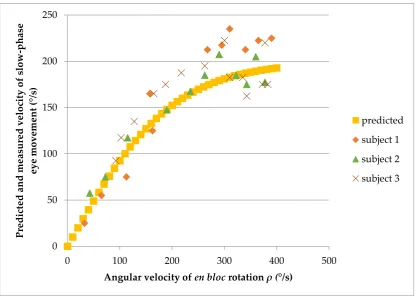
Figure 4 illustrates a historical experimental VOR dataset, from three subjects undergoing constant en bloc angular acceleration in darkness at 100 ° 𝑠⁄ 2[13]. Early in this accumulation of angular velocity 𝜌, the ‘gain’ of the VOR, 𝜔
𝜌, approximates 1. As 𝜌 increases, 𝜔 increases to a lesser
extent, approaching an asymptote of around 200 ° 𝑠⁄ , which I take to be the limiting perceived angular velocity 𝛾. The relationship between perceived and actual angular velocity mirrors that between speed and the additive quantity rapidity in special relativity [14] (p. 426), a relationship that is inherent in the Lorentz transformations above. Here I express 𝜔 as an objective-to-subjective
‘transfer function’ of 𝜌, 𝑓(𝜌). With 𝛾 no longer set to 1:
𝜔 = 𝑓(𝜌) = 𝛾 tanh𝜌 𝛾
(7)
The excellent fit of this model to the experimental data is shown in Figure 4.
Taking 𝛾 = 200°/𝑠, and 𝜌 = 30 ° 𝑠⁄ from the experiment of Teramoto [8], I estimate a perceived angular velocity of the optokinetic stimulus that is only marginally different from 𝜌:
𝜔 = 200 tanh 30
Insertion of this value of 𝜔 into the Lorentz equation for 𝛽 gives an estimated time contraction/angle dilation of about 1% for these stimulus parameters.
Figure 4. A hyperbolic tangent transfer function with limiting perceived angular velocity 𝛾 = 200 ° 𝑠⁄ , relating perceived angular velocity 𝜔 to actual velocity 𝜌 of self-rotation in the reference frameshift theory, here predicts slow phase velocity of vestibular nystagmus in three subjects undergoing en bloc
angular acceleration in darkness at 100 ° 𝑠⁄ 2 in the experiment of Pulaski [13].
The predicted actual temporal disparity between light flashes 16° to the left and right of a stationary observer (𝜓 = 32°) experienced to be simultaneous by the moving observer (𝑡 = 0), will
be, from Lorentz equation (4):
𝜏 = −𝜔𝛾
𝛾2 = −0.024𝑠
consistent with experimental results [8].
3.5. Uniform acceleration
Application of this model to vestibular stimulation, to predict distortions of subjective space even in the absence of rotation, will parallel Gleeson’s application of special relativity to a linearly accelerating reference frame [16]. Constant actual angular acceleration of a subject results in constant vestibular stimulation. Let’s now imagine that Alice undergoes constant anticlockwise acceleration, and define 𝑎 as the relative clockwise angular acceleration of her environment (not necessarily an optokinetic drum). What Alice perceives as the relative angular velocity of her environment, 𝜔,starts at 0 if she accelerates from rest (−𝜔 once again quantifies her vection). For the first few moments of acceleration, actual environmental relative rotation 𝜌 = 𝜔, so I will take 𝑎 also to be perceived
environmental angular acceleration (Alice ‘feels’ an angular acceleration of −𝑎 as a result of her
0 50 100 150 200 250
0 100 200 300 400 500
P re d ict ed a n d me asu re d ve loci ty of sl ow -p h ase eye move me n t (° /s)
Angular velocity of en bloc rotation ρ (°/s)
predicted
subject 1
subject 2
vestibular input). Note, however, that over time, 𝜔 willasymptote at 𝛾, even as acceleration feels to be unchanging. The next task will be to describe the distortions of Alice’s perceptions, as she angularly accelerates, as an embedding of objective coordinates in her spacetime.
I will argue that the embedding diagram should be as illustrated in Figure 5, where once again
we use radians as units of time, such that 𝛾 = 1, and Alice accelerates anticlockwise at −1 4𝑟𝑎𝑑
−1
(relative environmental acceleration 𝑎 = +1 4𝑟𝑎𝑑
−1 ). The diagram includes not only Alice’s
accumulation of anticlockwise rotation from rest (at 𝑡 = 𝜏 = 0), mentioned above, but also before that her decelerating clockwise rotation.
Firstly, consider objectively simultaneous events. Alice is subject to constant angular
acceleration, so increments of her environment’s relative actual angular velocity 𝜌 must be achieved
in increments of actual time. Events simultaneous with objective time 𝜏 must form a line at hangle
𝜌 = 𝑎𝜏 relative to the horizontal 𝑌 axis. Red lines radiating to the right from a ‘magic point’ at −1 𝑎
in Figure 5a all intersect a hyperbola through the origin, of radius 1𝑎 , in the same way that time and
angular coordinates intersect in the constant angular velocity case illustrated in Figure 3: a tangent to the hyperbola, at the point of its intersection with the line of hangle 𝜌 to the horizontal 𝑌 axis, is at hangle 𝜌 to the vertical 𝑡 axis; the intersection is symmetric across the diagonal. At this point, then, the hyperbola represents rotation at objective and subjective angular velocity of 𝜌 and 𝜔 respectively. I conclude that the hangle 𝜌 line from the magic point and the origin hyperbola are the objective 𝜏 simultaneity line and 𝜓 = 0 objective yaw coordinate respectively, of an environment with respect to which Alice angularly accelerates.
A family of other hyperbole, each separated from the magic point by its hyperbolic radius, also intersect the 𝜏 simultaneity line at 𝜌 objective and 𝜔 subjective angular velocity, so are candidates to be 𝜓 coordinates. The question is, what defines the hyperbole that correspond to increments of 𝜓? Intriguingly, the answer depends on 𝛾. Figure 3a reveals how, in the setting of constant rotation,
a 𝛾 trajectory (in green) emanating from the origin, reflecting off Bob’s coordinate 𝛿𝜓, a fraction of
a radian away (in the diagram 14𝑟𝑎𝑑), returns (along a −𝛾 trajectory) to his prime meridian at 𝜏
Figure 5. Embedding of objective spatiotemporal coordinates in the subjective spacetime of a subject undergoing and experiencing constant anticlockwise angular acceleration −𝑎 = −14𝑟𝑎𝑑−1. (a) In
increments of objective time 𝜏, red objective simultaneity lines, emanating from a magic point at 𝑌 = −1
𝑎 , increment in hyperbolic angle 𝜌, reflecting constantly increasing actual angular velocity. Perceived angular velocities 𝜔, the gradients of these simultaneity lines, range between finite limits
of 𝛾 = ±1. Approaching the magic point, hyperbolic coordinates at increments of objective angle 𝜓, mapped by reflections of 𝛾 (in green, see text), correspond to exponentially decreasing changes in subjective angle 𝑌, so that all of objective time is compacted into the ‘forward elsewhere’ of subjective
spacetime. (b) The compaction of objective space is evident even in the anterior hemisphere of subjective space, within which there is more objective angle to the left than to the right of the prime
meridian at 𝑌 = 0. This corresponds to the objective rightwards displacement of the subjective
‘straight ahead’ with left vestibular stimulation.
In Figure 5, the same procedure has been used to define 𝜋
4 increments of 𝜓 from − 𝜋
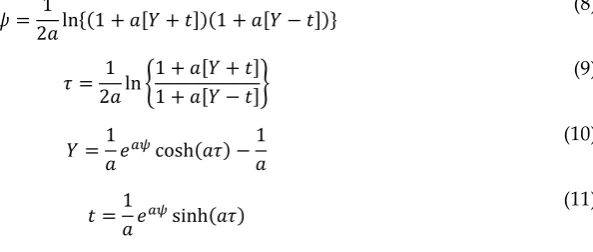
2. I assume that the scale of 𝜓 and 𝑌 is the same at the origin. The procedure ensures that at decreasing 𝜓, objective even increments of angle correspond to exponentially decreasing subjective increments (exponentially increasing subjective increments as 𝜓 exceeds 1). These angular and temporal relations are expressed mathematically in a new system of transformations, analogous to the Lorentz transformations of constant motion:
𝜓 = 1
2𝑎ln{(1 + 𝑎[𝑌 + 𝑡])(1 + 𝑎[𝑌 − 𝑡])}
(8)
𝜏 = 1 2𝑎ln {
1 + 𝑎[𝑌 + 𝑡] 1 + 𝑎[𝑌 − 𝑡]}
(9)
𝑌 =1 𝑎𝑒
𝑎𝜓cosh(𝑎𝜏) −1 𝑎
(10)
𝑡 =1 𝑎𝑒
𝑎𝜓sinh(𝑎𝜏) (11)
Note that the range of objective times depicted in Figure 5 is an eternity, extending from 𝜏 = −∞, when Alice has infinite clockwise angular velocity, to 𝜏 = ∞, by which time she has acquired
infinite anticlockwise rotation. Even so, this objective eternity occupies only a limited region of Alice’s subjective spacetime. She might imagine events in the future of the magic point (i.e. that would be separated from it by a positive proper time) that will never objectively be realized!
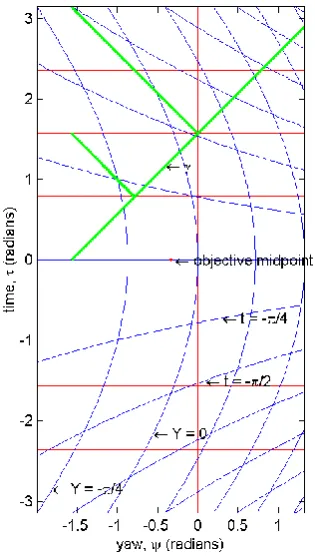
origin). Here I limit the field of view to that part of objective space that corresponds to Alice’s anterior hemisphere when she is momentarily at rest. When Alice accelerates anticlockwise, the default direction of head and eyes, which corresponds to her prime meridian, is displaced to the right of the objective midpoint of her anterior hemisphere [12].
Figure 6. Subjective angle (𝑌) and time (𝑡) coordinates from Figure 5 are embedded in a Cartesian grid of objective (𝜓, 𝜏) coordinates, that part of objective space being displayed that corresponds to the anterior hemisphere of the anticlockwise accelerating subject’s subjective space when (at 𝑡 = 𝜏 = 0) they are momentarily at rest. The prime meridian (at 𝑌 = 𝜓 = 0), the subjective ‘straight ahead’
that is chosen as the default orientation of head and eyes, does not bisect this objective space, but is displaced to the right of the objective midpoint. In this objective reference frame, ±𝛾 trajectories (in green) are once again diagonal, and the method (see text) of mapping angular coordinates by reflections of 𝛾 remains valid.
3.3. Efficient perception
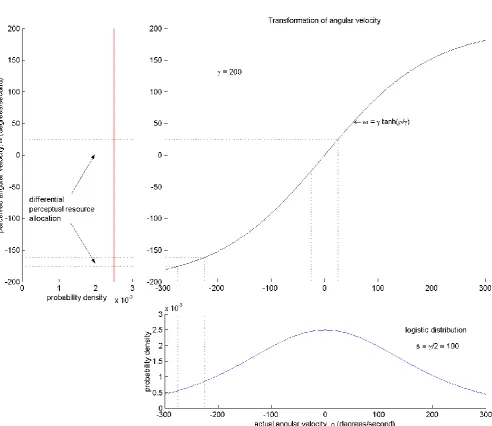
Figure 7. The differential entropy of perception is maximized when the probability density of subjective angular velocity𝜔 is uniform between experiential horizons (top left). Entropy maximization will also maximize the mutual information between 𝜔 and objective angular velocity of self-rotation𝜌, assuming that there is little perceptual noise. The objective-to-subjective transformation that will maximize subjective entropy is the cumulative of the probability density function of𝜌. The transfer function derived from the reference frameshift model, = 𝛾 tanh𝜌
Angular velocity of objective self-motion is also infinite in principle, although the distribution of velocities encountered by our ancestors, shaping the evolution of our brains, is likely to have been much narrower, peaking at rest. The model presented above proposes that perceived angular velocity of self-motion is finite, bounded at experiential horizons of ±𝛾. I hypothesize that the principle guiding subjective representation within finite limits, that is responsible for the hyperbolic tangent relationship of objective to subjective angular velocity (equation (7)), is the maximization of mutual information between stimulus and percept.
The mutual information between subjective and objective angular velocity, 𝜔 and 𝜌 respectively, can be decomposed as follows:
𝐼(𝜔; 𝜌) = ℎ(𝜔) − ℎ(𝜔|𝜌)
Here, ℎ(𝜔) is the differential entropy of the subjective variable, perhaps over a long period of environmental immersion. Conceptually, this is the total information content of this aspect of experience. Only a component of this, 𝐼(𝜔; 𝜌), is information about the objective variable 𝜌. The residual information is the conditional differential entropy ℎ(𝜔|𝜌). Previously, I had implied, when in equation (7) I expressed 𝜔 as an objective-to-subjective transfer function 𝑓(𝜌), a one-to-one relationship between these variables. More likely, 𝜔 varies narrowly around 𝑓(𝜌), and it is this small residual variance that is the source of ℎ(𝜔|𝜌). In these circumstances, ℎ(𝜔) largely depends on 𝑓(𝜌). If, as predicted above, the probability density distribution of 𝜌 is sharply peaked at 𝜌 = 0, a linear 𝑓(𝜌) would result in a peaked distribution of 𝜔 (between limits of ±𝛾), such that ℎ(𝜔) would be relatively low. A transfer function that flattened the distribution of 𝜔, to maximize ℎ(𝜔), would also maximize 𝐼(𝜔; 𝜌), as long as it did not result in a commensurate increase in ℎ(𝜔|𝜌). The transfer function to achieve such optimized subjective representation would be identical in shape to the cumulative distribution function of 𝜌.
A hyperbolic tangent cumulative distribution function is the integral of a logistic (or sech2 ) probability density distribution. Specifically, the transfer function used to model eye movement data in Figure 4, with 𝛾 set at 200 ° 𝑠⁄ , would optimise subjective/objective mutual information if 𝜌 had a logistic distribution of scale 𝑠 =𝛾
2= 100 ° 𝑠⁄ (Figure 7).
4. Discussion
Different characterizations of optimal perception reflect very different presuppositions about consciousness. At the physicalist extreme of a spectrum of views, Koch insists: “There must be an explicit correspondence between any mental event and its neuronal correlates” and “any change in a subjective state must be associated with a change in a neuronal state” [21] (p. 17). This accords with a functionalist perspective on optimality: “the biological usefulness of visual awareness (or strictly of its neural correlate)…is to produce the best current interpretation of the visual scene…and to make it available, for a sufficient time, to the parts of the brain that contemplate, plan and execute voluntary motor outputs” [22]. On the other hand, the Bayesian account verges on dualism in its refusal to consider any neural basis for the meta-perceiver. If there were no neuronal correlate of an optimal Bayesian percept, it is hard to understand how it would influence motor output. Of course, prior distributions and likelihood functions may well be stored in patterns of neural connectivity established generatively by some Hebbian process (e.g. [23]), and estimation may well occur further up the sensory cortical hierarchy than where the stimulus is originally encoded [22]. However, if there is explicit correspondence between a percept and its neural representation in a higher-order sensory or associative cortex, surely that higher-order sensory representation should also be constrained by the efficient coding principle. If there is no residual information in subjective states, conditional on the information in the neuronal states to which they correspond, then the mutual information between stimulus and percept should also be maximizedb.
If the actual angular velocity of the body over a long period of naturalistic interaction with the environment were to conform to the logistic distribution of Figure 7, then the efficient self-rotation perception hypothesis would be confirmed. Indirectly, Koch’s explicit correspondence axioms of consciousness [21] would also be supported. This is an approach now well established in computational and experimental neuroscience. Typically, one attempts to demonstrate or infer that an observer’s internal model matches natural stimulus statistics, in order to test a perceptual hypothesis [28]. Usually this is a Bayesian statistical estimation framework (like that outlined above), but even the efficient coding hypothesis depends on such matching. For example, a prior probability distribution of human visual speed, reverse-engineered from trial-by-trial responses and heavier-tailed than a Gaussian prior, was better predictive of perceptual behavior [29], perhaps because of a closer correspondence to the actual distribution of retinal image velocities. Visual orientation priors, inferred by the same technique, not only improved the accuracy of judgements, but were weighted towards cardinal orientations just like the image statistics of photographs of natural scenes [30]. Of more direct relevance to the current model, the statistical structure of yaw rotation signals at the head encountered with natural environmental immersion has been recently studied [31]. The recorded distribution is centered at rest, but is much more profoundly leptokurtic than Figure 7 (although the predicted distribution here still has heavier tails than a Gaussian). However, much of the high angular velocity recorded at the head probably reflects active or passive neck turning, so the kurtosis of the distribution of body rotation is presumably much less.
The logistic or sech2 probability distribution of Figure 7 is hypothetically also a perceptual resource allocation function on the domain of objective rotation velocities 𝜌. Greater resource allocation should improve accuracy, and reduce the minimal threshold above which similar stimuli can be discriminated. This discrimination threshold for 𝜌 should then vary inversely with the probability density [19]. To the extent that the cosh2 function deviates from linearity, self-rotation
b If the author’s quantum model of neural signalling [24,25,26] holds true, then this statement, and Koch’s
explicit correspondence axioms, would only strictly be true in the classical limit. The Mind/Brain Inequality,
derived from that model’s quantum information theoretic extension, implies that the information content of
the conscious percept should indeed exceed that of its neural correlate [27]. Still, the argument that the stimulus-percept function should mirror the stimulus-response function, both being constrained by the
perception is predicted to break Weber’s Law of linearly increasing discrimination threshold for magnitude variables [32]. Wei and Stocker deduce from their Bayesian observer theory of perception (outlined above) and Weber’s Law that the average deviation of the percept from the stimulus should also vary linearly with stimulus magnitude [18,19]. Applying this theory to visual speed perception data they find perceived speeds progressively underestimate objective speeds of increasing magnitude, a negative proportionality constant between stimulus and percept, but have to invoke a different loss function to other variables (the mode rather than the mean of the posterior distribution, see above) to explain the finding [19]. The current model predicts a similar negative perceptual bias in self-rotation: 𝜔 − 𝜌, the vertical deviation of the objective-to-subjective transfer function from the diagonal in Figure 7. Fundamentally this is because in the current theory 𝜔 approximates 𝜌 when small, but only extends between finite limits of ±𝛾. Indeed the Bayesian characterization of the optimal percept, as one that minimizes a loss function in stimulus space, seems flawed when a finite perceptual variable represents an infinite stimulus.
As suggested above, subjective space itself seems to be limited at an experiential horizon. It would be natural, when seeking to extend a theory that is based on special relativity, to look to General Relativity for answers. I speculate that the experiential horizon of subjective space is an asymptote where apparent depth, which undergoes progressive perspective foreshortening at increasing objective distance, eventually vanishes completely. This phenomenon of subjective length dilation (as defined above) seems amenable to mathematical description with differential geometry. Considering also the lack of evidence that perceptual space should be Euclidean, and the impression that the dilation phenomenon is symmetric under rotation through three dimensions, one might hypothesize that subjective space is positively curved. If so, this might explain why angular rather than linear velocities have been found to be fundamental in the model of subjective spacetime presented above. Length dilation of perception in the direction of accelerated linear motion has been found experimentally using auditory stimuli [33]. It is likely that mathematical description of linear self-motion perception will require reconciliation of the current model of self-rotation with the proposed curvature of space to create a map of differential rotations.
Finally, it is intriguing that distortions of space, very similar to those described and modeled above in the context of perceived angular acceleration, are also a feature of the neurologic disorder of left hemispatial neglect [34]. Here a non-dominant right inferior parietal lesion causes an event prediction bias to the subject’s right, toward which direction there is also bias of default head and eye orientation. Perhaps just as occurred in 20th century physics[35,36], what is now a mere neurologic equivalence principle might eventually lead to field equations that formalize attention as the distortion of curvature of subjective spacetime by information .
Supplementary Materials: There are no supplementary materials
Funding: This research received no external funding.
Conflicts of Interest: The author declares no conflict of interest.
References
1. Einstein, A. Zur Elektrodynamik Bewegter Körper. Ann. Phys. 1905, 322 (10), 891–921. https://doi.org/10.1002/andp.19053221004.
2. Attneave, F. Some Informational Aspects of Visual Perception. Psychol. Rev. 1954, 61 (3), 183–193. https://doi.org/10.1037/h0054663.
3. Barlow, H. Possible Principles Underlying the Transformation of Sensory Messages. In Sensory communications; Rosenblith, W., Ed.; MIT Press: Cambridge, MA, 1961; pp. 217–234.
4. Cullen, K. E. Vestibular Processing during Natural Self-Motion: Implications for Perception and Action.
5. Iversen, M. M.; Rabbitt, R. D. Wave Mechanics of the Vestibular Semicircular Canals. Biophys. J. 2017, 113
(5), 1133–1149. https://doi.org/10.1016/j.bpj.2017.08.001.
6. Wertheim, A. H. Motion Perception during Selfmotion: The Direct versus Inferential Controversy
Revisited. Behav. Brain Sci. 1994, 17 (2), 293–311. https://doi.org/10.1017/S0140525X00034646.
7. Teramoto, W.; Watanabe, H.; Umemura, H.; Kita, S. Change of Temporal-Order Judgment of Sounds
during Long-Lasting Exposure to Large-Field Visual Motion. Perception 2008, 37 (11), 1649–1666. https://doi.org/10.1068/p5692.
8. Teramoto, W.; Watanabe, H.; Umemura, H.; Matsuoka, K.; Kita, S. Judgment Biases of Temporal Order
during Apparent Self-Motion. IEICE Trans. Inf. Syst. 2004, E87-D (6), 1466–1476.
9. Figliozzi, F.; Guariglia, P.; Silvetti, M.; Siegler, I.; Doricchi, F. Effects of Vestibular Rotatory Accelerations
on Covert Attentional Orienting in Vision and Touch. J. Cogn. Neurosci. 2005, 17 (10), 1638–1651. https://doi.org/10.1162/089892905774597272.
10. Lewald, J.; Karnath, H.-O. Vestibular Influence on Human Auditory Space Perception. J. Neurophysiol.
2000, 84 (2), 1107–1111. https://doi.org/10.1152/jn.2000.84.2.1107.
11. Lewald, J.; Karnath, H.-O. Sound Lateralization during Passive Whole‐body Rotation. Eur. J. Neurosci. 2001,
13, 2268–2272.
12. Karnath, H.-O.; Himmelbach, M.; Perenin, M.-T. Neglect-like Behavior in Healthy Subjects. Exp. Brain Res.
2003, 153 (2), 231–238. https://doi.org/10.1007/s00221-003-1596-0.
13. Pulaski, P. D.; Zee, D. S.; Robinson, D. A. The Behavior of the Vestibulo-Ocular Reflex at High Velocities
of Head Rotation. Brain Res. 1981, 222 (1), 159–165. https://doi.org/10.1016/0006-8993(81)90952-5.
14. Penrose, Roger. The Road to Reality. A Complete Guide to the Laws of the Universe; Jonathan Cape: London, UK, 2004.
15. Kanai, R.; Paffen, C. L. E.; Hogendoorn, H.; Verstraten, F. A. J. Time Dilation in Dynamic Visual Display.
J. Vis. 2006, 6 (12), 8–8. https://doi.org/10.1167/6.12.8.
16. Phy 375R course notes on Introduction to Relativity, Chapter 6, Uniform Acceleration. Available online:
https://web2.ph.utexas.edu/~gleeson/RelativityNotesChapter6.pdf (accessed on 5th February 2020).
17. Laughlin, S. A Simple Coding Procedure Enhances a Neuron’s Information Capacity. Z. Für Naturforschung C 1981, 36, 910–912. https://doi.org/10.1515/znc-1981-9-1040.
18. Wei, X.-X.; Stocker, A. A. A Bayesian Observer Model Constrained by Efficient Coding Can Explain “anti
-Bayesian” Percepts. Nat. Neurosci. 2015, 18 (10), 1509–1517. https://doi.org/10.1038/nn.4105.
19. Wei, X.-X.; Stocker, A. A. Lawful Relation between Perceptual Bias and Discriminability. Proc. Natl. Acad. Sci. 2017, 114 (38), 10244–10249. https://doi.org/10.1073/pnas.1619153114.
20. Ma, W. J. Organizing Probabilistic Models of Perception. Trends Cogn. Sci. 2012, 16 (10), 511–518. https://doi.org/10.1016/j.tics.2012.08.010.
21. Koch, Christof. The Quest for Consciousness. A Neurobiologic Approach; Roberts: Englewood, CO, 2004. 22. Crick, F.; Koch, C. Are We Aware of Neural Activity in Primary Visual Cortex? Nature 1995, 375 (6527),
121–123. https://doi.org/10.1038/375121a0.
23. Berkes, P.; Orbán, G.; Lengyel, M.; Fiser, J. Spontaneous Cortical Activity Reveals Hallmarks of an Optimal
Internal Model of the Environment. Science 2011, 331 (6013), 83–87. https://doi.org/10.1126/science.1195870. 24. Duggins, A. J. A Complex Vector Space Model of Single Neuronal Coding and Experience. Biosystems 2010,
102 (2), 124–133. https://doi.org/10.1016/j.biosystems.2010.08.005.
25. Duggins, A. J. Pure State Consciousness and Its Local Reduction to Neuronal Space. AIP Conf. Proc. 2013,
26. Duggins, A. Generation of the Stream of Consciousness by Neuronal Synaptic Interaction. 2020.
https://doi.org/10.20944/preprints202001.0345.v1.
27. Duggins, A. J. The Form of Consciousness. Doctoral, UCL, London, UK, 2009.
28. Geisler, W. S. Visual Perception and the Statistical Properties of Natural Scenes. Annu. Rev. Psychol. 2008,
59 (1), 167–192. https://doi.org/10.1146/annurev.psych.58.110405.085632.
29. Stocker, A. A.; Simoncelli, E. P. Noise Characteristics and Prior Expectations in Human Visual Speed Perception. Nat. Neurosci. 2006, 9 (4), 578–585. https://doi.org/10.1038/nn1669.
30. Girshick, A. R.; Landy, M. S.; Simoncelli, E. P. Cardinal Rules: Visual Orientation Perception Reflects
Knowledge of Environmental Statistics. Nat. Neurosci. 2011, 14 (7), 926–932. https://doi.org/10.1038/nn.2831.
31. Carriot, J.; Jamali, M.; Chacron, M. J.; Cullen, K. Statistics of the Vestibular Input Experienced during Natural Self-Motion: Implications for Neural Processing. J. Neurosci. 2014, 34 (24), 8347–8357. https://doi.org/10.1523/JNEUROSCI.0692-14.2014.
32. Weber, E. H. The Sense of Touch; Ross, H., Murray, D., Trans.; Academic: San Diego, CA, 1978.
33. Teramoto, W.; Sakamoto, S.; Furune, F.; Gyoba, J.; Suzuki, Y. Compression of Auditory Space during Forward Self-Motion. PLoS ONE 2012, 7 (6). https://doi.org/10.1371/journal.pone.0039402.
34. Karnath, H.-O.; Dieterich, M. Spatial Neglect—a Vestibular Disorder? Brain 2006, 129 (2), 293–305. https://doi.org/10.1093/brain/awh698.
35. Einstein, A. Relativitätsprinzip und die aus demselben gezogenen Folgerungen. Jahrb. Radioakt. 1907, 4, 411–462.