A liability claim – what to expect;
from initiation to resolution
PF Carey,
DC*
GM Townsend,
DC* President, Canadian Chiropractic Protective Association, 1396 Eglinton Avenue West, Toronto, Ontario, Tel: 416-781-5656.
Chiropractors expect that their patients will be healthy, happy and advocate the health care they are receiving. More often than not, this remains the case. However, on occasion, a liability claim can disrupt this conception.
Using the recent Elliott v. Richmond case as a template, the authors will illustrate stepwise the intricacies of a liability claim.
Step 1 – The chiropractor is served a Writ of Summons, or predicts such an action.
Step 2 – The chiropractor advises the Canadian Chiropractic Protective Association (CCPA) of the potential or actual claim as soon as possible.
The Writ of Summons is a vaguely worded document outlining the basis of the action. Briefly, some of the allegations for the Writ include a breach of duty of care (i.e., negligent treatment, failure to warn of risks), a breach of con-tract (i.e., to provide services reasonably expected of a chiropractor) and assault and battery, as demonstrated in the Elliott v. Richmond example.
Step 3 – A detailed written account of the incident is submitted to the CCPA office by the chiropractor. (Appendix 1 - The Defendant Chiropractor’s Evidence)
This includes a narrative in addition to a complete copy of the patient’s records. Additional accounts of the events may be included by other involved chiropractors, receptionists, chiropractic assistants, or patients (if they are willing to do so), that are relevant.
The defendant chiropractor’s narrative must be comprehensive and truthful, even if something is felt to fall below an acceptable standard. The truth will eventually surface; if not at the Examination for Discovery, it does at the trial. The plaintiff’s lawyers will use unreliable records and narratives to convincingly discredit a chiropractor. Poor credibility ruins the case, regardless of the issue(s).
The Elliott v. Richmond case demonstrates that a decision at trial is very likely to hinge on a factor such as credibility.
Steps 1, 2, and 3 primarily involve the chiropractor. After these steps are complete, the CCPA and the legal repre-sentatives for the chiropractor manage the majority of the prospective events.
The chiropractor’s involvement throughout the claim is outlined in Appendix 8.
Step 4 – A response to the Writ of Summons is made on behalf of the chiropractor.
Step 5 – The plaintiff’s counsel provides a Statement of Claim. (Appendix 2 – Statement of Claim)
Typically, a request is made for the defendant to retain counsel and provide a statement of defence in order to advance the claim and arrange discoveries. The Statement of Claim roughly defines why they are seeking retribution, but is a more detailed version of the Writ of Summons.
Step 6 – Medical reports are amassed and distributed to the involved parties. They attempt to define the nature of the injury and the degree of permanent problems (or compensable damages). Any previous statements and reports provided by the chiropractor in question will also be included. (Appendix 3 – “Medical Evidence”)
Step 7 – The plaintiff defines the damages.
The plaintiff may declare how the injury reduces the chance of re-employment or somehow affects their ability to earn a living (future income loss). They may show a decreased earning potential compared to their pre-injury state. However, they must also demonstrate a reasonable attempt at mitigating the damages. This can be done by attempting to return to some form of employment or by following a treatment regime designed to rehabilitate to a state similar to their pre-injury status. In Elliott v. Richmond, this included a letter from the plaintiff’s employer that updated her employment status.
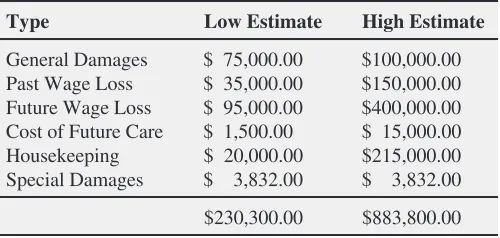
The quantum of damages is also discussed to predict the magnitude of the claim. Some factors are wage loss (past and future), future health care, costs to cover daily living tasks that the plaintiff can no longer perform adequately, and legal costs and disbursements. This information can apply to a judgment at trial or in deriving a fair settlement offer.
At this point, the lawyers for the plaintiff attempt to ascertain the facts from the aforementioned reports and statements in order to display the nature of their case. The lawyers for the defendant are also collecting facts to substantiate their arguments against the claims that they do not believe to be justifiable. Since conjecture may be the inevitable solution to the claim, the lawyers will;
a) solidify their arguments with the available facts,
b) use expert reports to further reinforce their stance or to present admissible hypotheses,
c) and prepare the witnesses and experts to relay their position at the trial while maintaining credibility and plausibility.
If the defendant lawyer feels that their case is fallible due to a perceived weakness in one of the areas mentioned above, they will do one of two things. If necessary, they can try to minimize the weaknesses and emphasize the stronger arguments
Table 1
Damages Assessed by plaintiff
Type Low Estimate High Estimate
Step 8 – Employment of ‘experts’ and treating health care practitioners.
They update information if it is appropriate and/or required, or simply review the material given to them by the lawyer and offer their opinions. Their assessment and/or opinions on specific questions either clarify an argument or bolster its significance. The experts may also offer an hypothesis that provides a counter-argument to the other party’s claim.
In Elliott v. Richmond, eight doctors provided reports for the purpose of explaining the case as it applied to their area of expertise.
Step 9 – Examinations for Discovery – This process involves the lawyers questioning those directly involved in the claim (and named in the statement of claim as either ‘plaintiff’ or ‘defendant’ under oath). This is a very important step in the progression or regression of a claim. The chiropractor explains the reason(s) for their action(s) in question, in addition to describing their usual practices and beliefs. (Appendix 4 - Examination of Plaintiff)
The goal of the lawyers’ questioning is to clarify the details of the events and proposed arguments. For the defendant this can include questions about the nature of the treatment in question, the chiropractor’s normal practices and routines, and professional standards and practices. The plaintiff may be asked questions about the events and treatment in question, and the nature and present status of the injury.
Step 10 – Offer to Settle
The offer to settle is made when considering all of the facts available. The defendant’s lawyer determines if a settlement is suitable or a more reasonable course of action is desired. This can be offered anytime prior to the trial. Most claims are settled in order to reduce the potential personal anxiety and excessive expenses. Of course, settlements are offered with an understanding by the plaintiff that the defendant offers no guilt.
An offer to settle in Elliott v. Richmond was delivered to the plaintiff with an understanding that there was “no basis for allegations that injuries (were) due to malpractice on the defendant’s part.” A ‘Consent to Dismissal’ was required in addition to a ‘Release of All Claims’ in favour of the defendant.
A second ‘Offer to Settle’ was made, increasing the amount from the previous offer. All offers to settle were declined.
Step 11 – Trial – The trial of Elliott v. Richmond lasted a total of 6 ½ days.
The plaintiff and her husband, a coworker and her supervisor, the defendant’s receptionist, four experts, and the defendant were cross-examined and/or examined at the trial.
No experts were called to give evidence on behalf of the defendant, as the defendant’s counsel did not feel that this would be necessary. They felt that they were already in a good position for the decision based on the evidence of the aforemen-tioned witnesses and the points outlined below.
•
the plaintiff’s recollection of events and the onset of pain was vague and inconsistent•
the plaintiff’s neurologist implied that the plaintiff’s pain was spurious•
the orthopedic surgeon said that there was, “no objective reason for her pain,” and, “no organic reason for her ongoing pain.”Step 12 – Judgment
The defendant was not found responsible for the damages, and costs were awarded to the defendant as well. Reasons for the Judgment are given in Appendix 7.
Step 13 – Argument as to Costs
Most claims will end without an Argument as to Costs. In Elliott v. Richmond, it was involved.
Step 14 – Appeal
An appeal is filed on behalf of the plaintiff or the defendant in order to be heard by another judge, if desired. The party filing the appeal must consider various factors when deciding if a judgment should be appealed. Obviously, the judgment will have gone against the party appealing, and an emotional disbelief may fuel the appeal.
In the example of Elliott v. Richmond, an appeal was filed on behalf of the plaintiff. The defendant gave the required “Appearance for Appeal” three days later.
An appeal may overturn a decision, although successful appeals usually require a strong reason for a judge’s decision to do so.
Conclusion
This article is written for the purpose of reducing the anxiety created by the anticipation of impending events in a liability claim. Although reactions of panic and extreme distress are purposeless, a claim should not be taken lightly. The issues that can be debated in the courts may have a serious effect on the chiropractic profession. The role of informed consent changed from voluntary practice to a standard of practice via litigation. The authors encourage the readers to become introspective and examine such things as record keeping and informed consent in an attempt to further diminish the anxiety of a potential claim.
Appendix 1
The Defendant Chiropractor’s Evidence
June 1980 – December 1991: Periodic care (63 treatments) for various spinal and extremity complaints. The defendant is a Grostic upper cervical practitioner.
January 23, 1992 – Presenting complaint: low back pain. Examined, adjusted, as in past visits. She had a “fundamental
alignment problem that was consistent with past examinations”. He explained that her neck needed to be adjusted in order to stabilize her back. He treated the cervical, dorsal and lumbar spine (in that order), with a “major adjustment” taking place at the upper cervical region. The patient declined to have follow-up X-rays at this time. Some improvement was noted after treatments during the next five weeks. Nine treatments were conducted after the alleged date of injury.
She agreed to x-rays on April 20, 1992. The x-rays were found to be “significantly different” from a 1984 series. No subjective, symptomatic improvement occurred with treatments during the following week. The plaintiff then put a stop payment on her cheque for the X-rays. The plaintiff later replaced the cheque, including a note explaining her dissatisfaction. The defendant believed that the inspiration for the claim came from the billing dispute.
Appendix 2 Statement of Claim
The defendant wrongfully and intentionally committed a battery on the plaintiff by performing a chiropractic manipulation against her will and without first obtaining her consent …
The treatment of the plaintiff … created a duty of care …, and a contractual relationship … whereby the defendant undertook to practice treatment commensurate with the standard provided by other professional chiropractors.
“Severe personal injuries” include;
•
injury to neck, back, right arm, elbow, wrist, hand and fingers•
vinjury to jaw, including malocclusion•
depression, sleeplessness, headaches, irritability, anxietyThe injuries have caused and continue to cause the plaintiff pain and suffering, loss of earnings both past and prospective, and loss of enjoyment of life, all of which said injuries, loss and damage were caused by the defendant.
Appendix 3 “Medical Evidence”
A) Consultations preceding the claim
The reports contained some noteworthy points
•
the patient was ‘forced’ into treatment, but she continued treatment after the onset of the neck pain•
the patient reported that her neck was asymptomatic previously (although X-rays taken by the chiropractor demonstrated evidence of degeneration) and pain increased after the last treatment•
(intermittent) arm pain (with some weakness and numbness) occurred after a treatment sometime in April•
the arm pain increased; the neck pain decreased over time (no further treatment by the defendant chiropractor)B) Procedures delivered to plaintiff after ‘date of injury’
Physiotherapy, received during 1992, was not beneficial. x-rays, taken in May of 1992, showed degeneration and IVF encroachment at C5–7. The CT scan, taken June 1, 1992, showed a large C5–6 and small C6–7 disc herniation. The nerve conduction test, performed on September 10, 1992, was uninformative.
C) Consultations for surgery (post-injury status)
One neurosurgeon commented that surgery would be performed on account of the pain, not because of any motor or sensory deficit. A second surgeon said that surgery at C6–7 was unnecessary (marginal, currently asymptomatic, could accelerate degenerative changes). However, he and a third surgeon believed that she was a “candidate for C5-6 discectomy and fusion.”
D) Surgery – November 9, 1992
E) Consultations post-surgery
The reporting physicians offered the following information and comments in their reports and consultation notes.
•
discomfort in the right forearm and hand returned (similar to that prior to surgery)•
“Her sensory, motor and vascular exam is perfectly normal. She has no nerve root tension signs and her neck, … is asymptomatic.” This report was written 6 months after the surgery. X-rays showed satisfactory healing of fusion.•
“Mild discomfort right lateral forearm”; “No other symptoms”; physiotherapy recommended for a right lateral epi-condylitis.•
“Marked voluntary giving-way in all muscle groups in right and occasionally the left hand; sensory examination is not consistent either. … I do not think that there is any ongoing nerve root compression.”•
CT repeated – very small bony spur at right C5-6 intervertebral foramenF) Consultations and reports – present status of the patient
Medical report - September 1995. paraphrased
History – During one of the visits in January 1992, two manipulations were carried out, despite her being asymptomatic and
reportedly against her wishes. She developed persistent neck pain in spite of further chiropractic treatments. Constant right arm pain persisted. Laritine produced considerable pain reduction.
Account of subsequent events – In early March she consulted the chiropractor for pain down her right arm. X-rays were
taken. Her doctor sent her to physiotherapy, although she claimed the physiotherapy ‘wouldn’t do anything’. A neurologi-cal consultation was suggested. A CT scan in June showed C5–6, C6–7 disc protrusions.
A neurosurgeon examined her, finding her neck restricted, her arm feeling weak, and decreased sensation in arm. He advised a discectomy and possibly additional operations. A second opinion concluded that surgery was required. A pre-operative work-up included (“extremely painful”) electro-diagnostic studies and a nerve block injection.
The discectomy and fusion of the cervical spine; “helped considerably with pain and movement in the neck”. Post-operative care was received for approximately one year. She took various anti-inflammatory and tricyclic medications. Referrals to a pain clinic and the Canadian Back Institute were ignored due to waiting periods and expense respectively. Approximately one year of physiotherapy included rehabilitative exercises and manipulation for her neck and jaw, and concluded one year prior to this consultation. A CT scan was repeated 2 years after the operation. She was advised that there was still nerve compression but there was no more need for surgery.
Present History (i.e., Sept. 12/ 95) – She was experiencing constant pain in the front of her right arm to the elbow, over the
radial aspect of the forearm to the wrist, including all fingers except the long finger. The complaint was aggravated by any upper limb movement and cold, but was not aggravated by coughing or straining. She is not currently on medication.
Testing for Present Status — The patient held her hand at the side of the body with her elbow flexed and the wrist and
fingers clenched. Range of motion testing revealed generally decreased ranges in the neck. She had full right shoulder ranges, but performed them slowly and with discomfort. Neurological testing demonstrated globally decreased sensation in the right hand and forearm. She had symmetrical and normal reflexes.
Appendix 4
Examination for Discovery of plaintiff
She began seeing the defendant in the early 1980’s. Although unclear, she likely sought care originally for low back pain brought on by jogging. In the late 1980’s she was receiving less benefit from the treatments.
January 23, 1992 – The plaintiff claimed that the chiropractor took her husband to a pharmacy where he gave the husband Valium to prepare him for an adjustment. The husband became tired from the drug and went to the car after his treatment. When the plaintiff came out of the washroom, the defendant insisted that she have a “tune-up”, and physically forced her into a treatment room. She called out for help to the receptionist, who was confused by the actions. Finally, after resisting the chiropractor several times, she decided that it was better to have the treatment and “get things over with”. He then quickly carried out a cervical manipulation. An intense stabbing neck pain was the consequence of his alleged actions. She saw the defendant again on February 3, 10, 13, 25 and 28, 1992. She went with her husband to England for a vacation for 2-3 weeks in March 1992, and did not consult any health care practitioner while in England. She consulted the defendant again on April 16, 1992, upon her return.
She was vague on when the right arm pain started, although she believed that the arm pain overtook the neck pain after the April 16, 1992 visit.
Several inconsistencies in the medical reports were noted. She denied most of the statements being made.
Appendix 5
Submissions of the plaintiff
Regarding Credibility – Due to the difference in the plaintiff’s and defendant’s versions of the events that took place on
January 23, 1992, the plaintiff believed that it “required an assessment of the credibility of witnesses”.
Regarding Consent to Treatment – The chiropractor’s receptionist during 1992 testified that she “observed the defendant
attempt to persuade clients and their spouses to have … maintenance manipulations after they had refused his previous request.”
Regarding Causation – One expert testified that the stresses of a passive manipulation are much greater than the forces
experienced in normal daily routines due to the absence of muscular support of the neck. He believed it was unlikely that the activities of daily life caused the injury. He added that the “only identifiable and probable source has been the defendant’s actions.”
A second expert for the plaintiff contradicted the first expert by testifying that the forces involved in a Grostic manipu-lation was not enough to cause the injury.
The plaintiff believed that the arm pain was a consequence of subsequent treatment given in April of 1992.
The plaintiff dismissed her inaccuracy and inconsistency in reporting the timing of her neck and arm problems and added that she consistently reported and experienced arm pain after the treatments in April of 1992.
The plaintiff concluded, “The most probable event causing the herniation as confirmed by all the plaintiff’s experts was manipulation by the defendant.”
Regarding Standards of Care – The plaintiff questioned the low back pain complaint (of January 1992) recorded by the
The plaintiff mentioned that no referrals were made “even though she was not showing satisfactory improvement with treatment.”
Regarding Negligence – The plaintiff’s lawyer cited a case (Penner v. Theobald, 1962) that explained the law regarding the
issue of professional negligence as it applies to health care practitioners. It says that the general principles of the law are essentially the same for chiropractors, osteopaths and medical doctors. It includes the statement that the practitioner must exercise the requisite degree of skill and care tested under the general rules and practices of the particular school of medicines to which they belong (i.e., chiropractic in this case). They claimed that the failure to meet the requisite standard of care caused damage to the plaintiff.
Appendix 6
Closing Arguments for the defendant
The lawyers for the defendant argued the claim by the plaintiff saying that there was no basis for the claim in either battery or negligence. It was also said that even if the plaintiff succeeded in establishing a breach of duty on the part of the defendant, that the breach in no way caused the injuries complained of. There was no reason to believe that the disc herniation(s) were caused by the treatment given to the plaintiff. Even if battery or negligence were proven, the cause of a herniation would not be the treatment.
The alleged battery was called into question due to the fact that the plaintiff consulted the defendant after the date that the injury took place. The inconsistencies in the plaintiff’s testimony and the medical records and reports were pointed out regarding the onset of symptoms. She also states that her ‘realization’ of the injury became apparent some time after the date that she claims the sudden injury took place.
The negligence concerning the manipulation and the manner in which it was carried out was dismissed by the defend-ant’s representatives, as was the informed consent issue. They declared that the manipulation did not cause the injury. The risk of a cervical rotary manipulation causing disc herniation is not considered a material risk and, therefore is unnecessary to disclose. A stroke (which is a material risk) would have had to occur for this to be an issue.
The use of the Grostic procedure by the defendant is considered an accepted method of adjusting the upper cervical spine. As well, the treatments are extremely unlikely to have herniated discs. No further investigations were necessary to identify contraindications to manipulation. The cervical spine degeneration found on x-rays is not a contraindication to manipulation.
Appendix 7
Judgment. – By Justice Meredith (Vancouver, BC)
Overview
The one defence that the judge decided should succeed is, “that nothing done by the defendant has been reliably shown to have caused or contributed to whatever injury may have been suffered by the plaintiff.”
“… On the evidence I am wholly unconvinced that the defendant inflicted any injury on the plaintiff whatsoever. … the plaintiff’s case against the defendant must be dismissed.”
added). I do not think that she has accurately related the facts. …” The judge outlined several specific examples of the inconsistencies in the plaintiff’s testimony.
2. “It is … unlikely that … (she and her husband) would have gone back had the plaintiff suffered the pain she said she did.” 3. The judge concluded that there was no falsification of the patient records by the defendant.
Regarding the defendant’s Treatment
1. “It seems… unlikely that any chiropractic manipulation… would result in a disc protrusion. …”
2. He concluded that, “it is unlikely that the cervical rotary manipulation performed by the defendant caused any injury to the plaintiff whatever.” He based this opinion on the expert testimony regarding disc herniation and disc degeneration. (“The true probability of causing a disc herniation by properly or improperly performing rotary cervical spine manipu-lation is unknown.” “Cervical disc degeneration is not a contraindication for cervical rotary manipumanipu-lation. … The people, for the most part, can safely receive cervical rotary manipulation without complication.”)
Regarding the defendant’s Practices – The defendant’s lawyer pointed out that Judge Meredith made “no adverse
comments as to (the defendant’s) practice standards.” He commented, “I believe that in Judge Meredith’s eyes, (the defendant) had unnecessarily been put to grief by this litigation, and he considers that it would be improper therefore to subject (the defendant), as a professional, to gratuitous criticism...”
Appendix 8
Chiropractor’s Involvement
•
submitted two letters, the patient files/records, a report of the incident, provided further required documentation•
35+ telephone calls•
9 conferences with the lawyer, 2 interviews and a meeting, each lasting from 1 to 6 ½ hours long•
examination for discovery; 2 days and approximately 10 hours in length (total)•
trial attendance for 6 ½ days•
examination and cross-examination at trial Elliott v. RichmondIncident Date ... January 23, 1992 Date when Writ of Summons served ... December 23, 1993 Date when Judgment handed down ... December 3, 1996 Date when Appeal filed ... December 20, 1996 Appeal abandoned ... March 10,1998
Patient subsequently paid CCPA a negotiated reimbursement for “costs”. File closed April 1998.