Evaluation of clinical practice
guidelines in chiropractic care:
a comparison of North American guideline reports
Melissa Brouwers,
PhD*†
Manya Charette,
BSc*†
Clinical practice guidelines developed by the Canadian Chiropractic Association (CCA) and the Council on Chiropractic Practice (CCP) were evaluated by three independent appraisers using the most current version of the Appraisal of Guidelines for Research and Evaluation in Europe (AGREE) Instrument. Eighteen eligible chapters within the two documents (nine from each organization) were evaluated. In general, the CCA document was rated more favourably than the CCP document. The strengths of both documents include clarity of objectives and target users and complete descriptions of methods used to formulate recommendations. Areas of improvement for both documents include the need for more detail regarding the bodies of evidence under consideration for each section of the guideline. This paper presents the complete results of the evaluation, discusses the strengths of each guideline document, and makes suggestions for areas of improvement.
(JCCA 2001; 45(3):141–153)
K E YW O R D S: guidelines, practice.
Les guides de pratique clinique élaborés par
l’Association chiropratique canadienne (ACC) et par le Council on Chiropractic Practice (CCP) ont été évalués par trois experts indépendants au moyen de la version la plus récente de l’instrument Appraisal of Guidelines for Research and Evaluation in Europe (AGREE). Dix-huit chapitres admissibles dans les deux documents (neuf de chaque organisme) ont fait l’objet d’une évaluation. En général, le document de l’ACC a été mieux coté que celui du CCP. Parmi les forces des deux documents, on note la clarté de l’énoncé des objectifs et des utilisateurs cibles ainsi que le caractère exhaustif des descriptions de méthodes employées pour la formulation de
recommandations. Les points à améliorer, dans les deux cas, comprennent le besoin de détailler l’accumulation des preuves à l’étude pour chaque section des guides. Cet article présente les résultats complets de
l’évaluation, examine les points forts de chaque guide et offre des suggestions concernant les points à améliorer. (JACC 2001; 45(3):141–153)
M O T S C L É S : guides, pratique.
* Department of Clinical Epidemiology and Biostatistics, McMaster University, Hamilton, Ontario, Canada. † Program in Evidence-based Care, Cancer Care Ontario, Hamilton, Ontario, Canada.
Corresponding author: Melissa Brouwers, PhD, McMaster University Health Sciences Centre, Room 3H7A, 1200 Main Street West, Hamilton, Ontario, Canada L8N 3Z5. Tel.: 905-525-9140, ext. 22055. [email protected]
Clinical practice guidelines
INTRODUCTION
Clinical practice guidelines are systematically developed statements designed to assist practitioner and patient deci-sions about appropriate health care for specific clinical circumstances.1 In the area of chiropractic practice, two key clinical practice guideline documents have been pro-duced in North America: Clinical Practice Guidelines for Chiropractic Practice in Canada commissioned by the Ca-nadian Chiropractic Association (CCA),2 and the Ameri-can counterpart, Vertebral Subluxation in Chiropractic Practice, Clinical Practice Guideline by the Council on Chiropractic Practice (CCP).3 The aim of both guideline documents is to facilitate an evidence-based approach to chiropractic care that enables conscientious, explicit and judicious use of the current best evidence in making deci-sions about the care of the individual patient.4
In 2000, a proposal was submitted and accepted by the CCA to evaluate the CCA and CCP clinical practice guidelines. The relative strengths and weaknesses be-tween the guideline documents and within each docu-ment were considered, as well as their adherence to evidence-based principles.
The documents were evaluated using the most current version of the Appraisal of Guidelines for Research and Evaluation in Europe (AGREE) Instrument.5 Although there is no universally accepted, validated tool for measur-ing the quality of practice guidelines, the AGREE instru-ment has been widely studied and is currently undergoing international validation as part of the BIOMED-PL96-3669 project. One of the appraisers (MB) is a member of this collaboration and special permission was granted by Francoise Cluzeau, project coordinator of BIOMED-PL96-3669, to use the most current version of the instru-ment (May 1999). The AGREE instruinstru-ment is generic and can be applied to practice guidelines that cover topics such as prevention, diagnosis, treatment or intervention in any disease area.
The appraisers are methodology specialists who have no experience or training with chiropractic practice or the specific clinical and policy literature in this area. The scope of this evaluation focused exclusively on the chap-ters in each of the guideline documents that met the criteria for appraisal set out by the instrument, with the emphasis directed towards the methodological quality of the docu-ments. The evaluation did not include the appraisal of clinical care and policy considerations.
METHODS Appraisers
The research team mandated to review the clinical practice guideline documents developed by the CCA and CCP was composed of three independent appraisers. The appraisers have expertise in the development of clinical practice guidelines for cancer care and in the implementation of the evaluation tool used in this study. The appraisers are meth-odological experts with training and experience in system-atic review, critical appraisal, and study design. One of the appraisers (MB), a doctorate-level behavioural scientist, coordinated the overall project.
This initiative was funded by the CCA. None of the appraisers have had any previous professional relation-ships with the CCA or the CCP. The CCA and the project coordinator agreed upon the scope of the evaluation before the initiative began. The research team had complete edi-torial independence from the CCA in the execution of the evaluation process, the final report submitted to the CCA, and the writing of this paper.
Evaluation instrument
It was agreed by the CCA and the project coordinator that the documents would be evaluated using the most current version of the AGREE Instrument.5 The AGREE Instru-ment capitalizes on the large literature identifying at-tributes that define high quality clinical practice guidelines (CPGs).6,7,8,9,10 Its purpose is to provide a framework to assess the confidence that the potential biases (e.g., meth-odological biases11,12,13) in guideline development have been adequately addressed, that the recommendations that emerge from the CPG are reliable and valid, and that prac-tical issues have been addressed.
The formulating recommendations dimension is measured by four items and is concerned with the formulation of recommendations, links between the evidence and recom-mendations, consideration of possible benefits and risks, and the impact on resources. The clarity dimension con-sists of four items and addresses the guideline structure, recommendations, and options for care. The application dimension is focused on organizational barriers, attitude/ behaviour change issues and tools for application, and consists of three items. Monitoring, consisting of two items, focuses on the criteria for adherence to the recom-mendations and the updating process. The editorial inde-pendence dimension consists of one item. The items are answered using a combined ordinal-dichotomous scale composed of six response options that includes a 4-point likert scale (points strongly agree, agree, disagree, strongly disagree) and two additional options no informa-tion to answer and not applicable.a
Scope of the evaluation
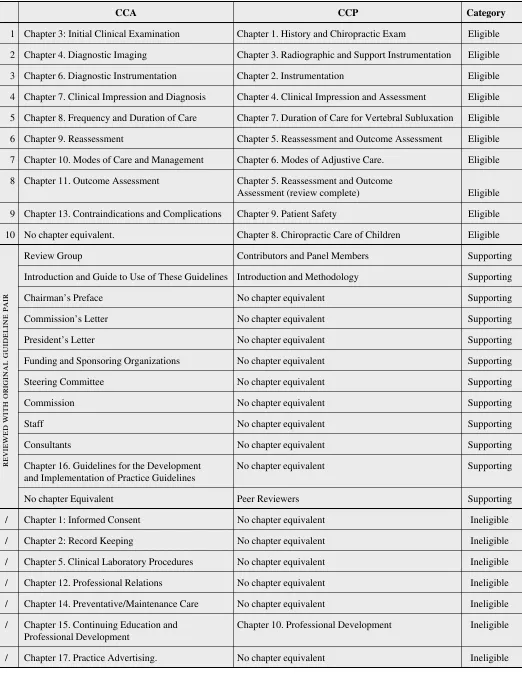
The project coordinator reviewed each of the guideline documents prior to beginning the evaluation. Each chapter was categorized as either eligible for evaluation according to the AGREE criteria, ineligible for evaluation according to the AGREE criteria, or as supporting (see Table 1). Eligible chapters were those that focused on specific clini-cal care issues (e.g., diagnosis, treatment). Where possi-ble, each of the eligible chapters from one document was paired with an equivalent chapter from the second docu-ment (e.g., CCA Frequency and Duration of Care was paired with CCP Duration of Care for Vertebral Subluxa-tion). The AGREE instrument was completed for each eligible chapter. Chapters that focused on non-clinical is-sues or isis-sues outside the scope of the AGREE instrument were categorized as ineligible, and were not considered in the evaluation. Methodological issues such as the quality of the systematic review and adherence to evidence-based principles are essential components to high quality CPGs and are reflected in the AGREE instrument.6,7,9,14 These issue were often represented in what we have termed sup-porting chapters in the CCA and CCP guideline docu-ments. Thus, for some items in the AGREE instrument, a general score was derived using the supporting chapters as a foundation on which the appraisers’ response options were based. In the absence of additional information within the eligible chapters in each guideline document,
the general scores for these items were applied. The evalu-ation focused on the written documents supplied by the CCA and CCP. No efforts were made by the evaluators to verify the processes, participation and methods outlined in the guideline documents.
Procedures
The research team initially met to review each of the items in the AGREE instrument, to clarify any ambiguities with item content, and to further operationally define items where, at face value, potential misunderstandings or in-consistencies in interpretation were possible. At the con-clusion of that meeting, each appraiser was provided with copies of the CCA and CCP guideline documents, a list outlining the categories in which the chapters were placed (Table 1), and 18 copies of the AGREE instrument. The AGREE instrument was completed for the nine eligible chapters from each organization. For both the CCA and CCP documents, the appraisers first read the supporting chapters, followed by the first eligible chapter, and then completed the AGREE assessment tool. A consultation meeting followed this process to review the results of the first pair of assessments, to address inconsistencies in the application of questionnaire items, to further refine the operational definitions of problematic items, and to deter-mine which of the instrument items could be classified as general.
Appraisers then completed a review and assessment of each eligible chapter pair as outlined in Table 1. The order of evaluation within each pair was counterbalanced to avoid bias based on chapter order. Consultation meetings were held after the first, second and third chapter pairs.b
Treatment of the data
Scoring
To evaluate the strengths and weaknesses of the CCA and CCP documents, responses provided by each of the asses-sors for each of the guidelines were obtained. Strongly agree, agree, disagree and strongly disagree responses were scored 4, 3, 2, and 1, respectively. No information to
aFor four items, only the 4-point likert scale was available. bOne appraiser was not available for the second consultation
Clinical practice guidelines
Table 1
Categorization of Canadian Chiropractic Association (CCA)
and Council on Chiropractic Practice (CCP) guidelines and order (O) of evaluation
CCA CCP Category
1 Chapter 3: Initial Clinical Examination Chapter 1. History and Chiropractic Exam Eligible
2 Chapter 4. Diagnostic Imaging Chapter 3. Radiographic and Support Instrumentation Eligible
3 Chapter 6. Diagnostic Instrumentation Chapter 2. Instrumentation Eligible
4 Chapter 7. Clinical Impression and Diagnosis Chapter 4. Clinical Impression and Assessment Eligible
5 Chapter 8. Frequency and Duration of Care Chapter 7. Duration of Care for Vertebral Subluxation Eligible
6 Chapter 9. Reassessment Chapter 5. Reassessment and Outcome Assessment Eligible
7 Chapter 10. Modes of Care and Management Chapter 6. Modes of Adjustive Care. Eligible
8 Chapter 11. Outcome Assessment Chapter 5. Reassessment and Outcome
Assessment (review complete) Eligible
9 Chapter 13. Contraindications and Complications Chapter 9. Patient Safety Eligible
10 No chapter equivalent. Chapter 8. Chiropractic Care of Children Eligible
Review Group Contributors and Panel Members Supporting
Introduction and Guide to Use of These Guidelines Introduction and Methodology Supporting
Chairman’s Preface No chapter equivalent Supporting
Commission’s Letter No chapter equivalent Supporting
President’s Letter No chapter equivalent Supporting
Funding and Sponsoring Organizations No chapter equivalent Supporting
Steering Committee No chapter equivalent Supporting
Commission No chapter equivalent Supporting
Staff No chapter equivalent Supporting
Consultants No chapter equivalent Supporting
Chapter 16. Guidelines for the Development No chapter equivalent Supporting and Implementation of Practice Guidelines
No chapter Equivalent Peer Reviewers Supporting
/ Chapter 1: Informed Consent No chapter equivalent Ineligible
/ Chapter 2: Record Keeping No chapter equivalent Ineligible
/ Chapter 5. Clinical Laboratory Procedures No chapter equivalent Ineligible
/ Chapter 12. Professional Relations No chapter equivalent Ineligible
/ Chapter 14. Preventative/Maintenance Care No chapter equivalent Ineligible
/ Chapter 15. Continuing Education and Chapter 10. Professional Development Ineligible Professional Development
/ Chapter 17. Practice Advertising. No chapter equivalent Ineligible
answer responses were given a score of 0, with the as-sumption that each of the characteristics featured in the instrument contributes to the overall quality of the docu-ment. Thus, if there were no indication that the characteris-tic was featured in the process, this would reflect poorer quality. Further, a not applicable response was also given a score of 0. However there was only one occasion in which the appraisers used this latter option.
Analyses
Data were analyzed using SPSS Version 10.0.5 for Win-dows.
Interrater reliability
The Kappa coefficient is a reasonable method for calculat-ing the interrater reliability of categorical data, whereas the intraclass correlation coefficient (ICC) is an appropri-ate measure when continuous data are used.15 One of the challenges of a combined ordinal/categorical scale is de-termining the most appropriate method for calculating interrater reliability. However, given the scoring rationale described above, the fact that four of the items included only the ordinal scale component, and that the not applica-ble option was chosen only once by the assessors, it was decided that an ICC would be the most appropriate and best estimate measure of interrater reliability.
Evaluation
Various evaluation scores were calculated. First, item scores across the appraisers were summed to give a total score for each dimension and the entire questionnaire. Sec-ond, these scores were compared to the maximum total score (mts). The mts was calculated by multiplying the number of appraisers by the number of items in the instru-ment component under consideration (e.g., dimension or complete questionnaire) by the highest possible score (i.e., strongly agree response with a score of 4). For example, the mts for the scope and purpose dimension is 48 (3 ap-praisers´4 items in scope and purpose dimension´4 highest possible score). Third, score means and standard deviations were calculated for each of the eight dimen-sions and the entire questionnaire for the eligible chapters across each of the appraisers. These values were calcu-lated for the whole CCA and CCP guideline documents as well as each eligible chapter within these two documents. Finally, rank order of the total scores of the guideline chapters is presented.
RESULTS
Interrater reliability and differences between raters’ scores
Measures of interrater reliability across all items and chap-ters revealed an ICC of r= 0.76 (95% confidence intervals [CI] = 0.73–0.79) for the CCA guidelines and r= 0.77 (95% CI = 0.74–0.80) for the CCP guidelines. Thus, ad-equate reliability was achieved.15
A one-way analysis of variance was conducted to deter-mine if there were statistically significant differences among the appraisers on mean evaluation scores across all items and all chapters in each practice guideline docu-ment. For the CCA document, a statistically significant main effect for appraisers was found, F(2,645) = 8.23, p< 0.001. The mean evaluation score was more positive for one of the appraisers (reviewer B: m =2.78, sd = 1.09), than either of the others (Reviewer A: m =2.31, sd =1.34 and Reviewer C: m =2.52, sd =1.24). Al-though the means fell in a similar pattern, no statistically significant difference among appraisers on mean evalua-tion scores for the CCP guidelines was found, F(2,645), p= 0.12 (Reviewer A: m =1.76, sd= 1.39; Reviewer B: m =2.00, sd =1.45; Reviewer C: m =1.84, sd =1.49). To increase reliability and address the biases in scoring, score means were used for the inferential statistics.
Evaluation scores
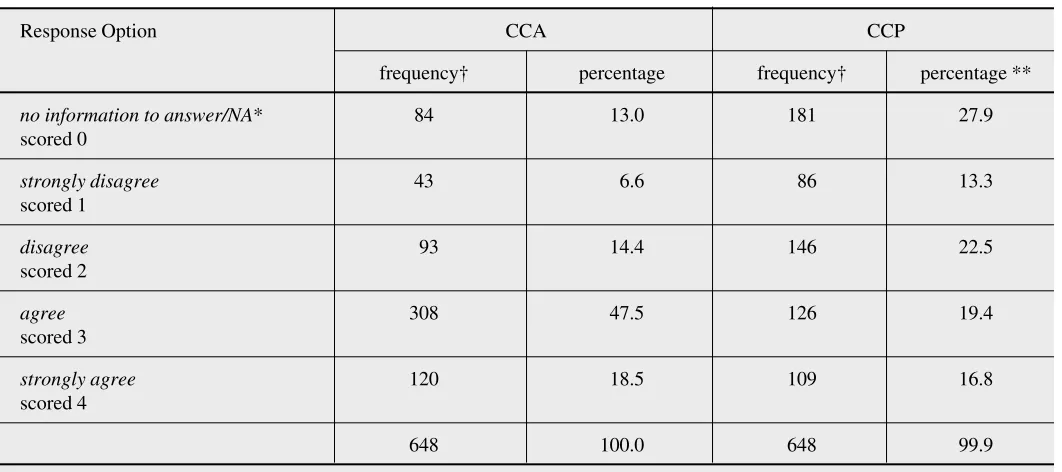
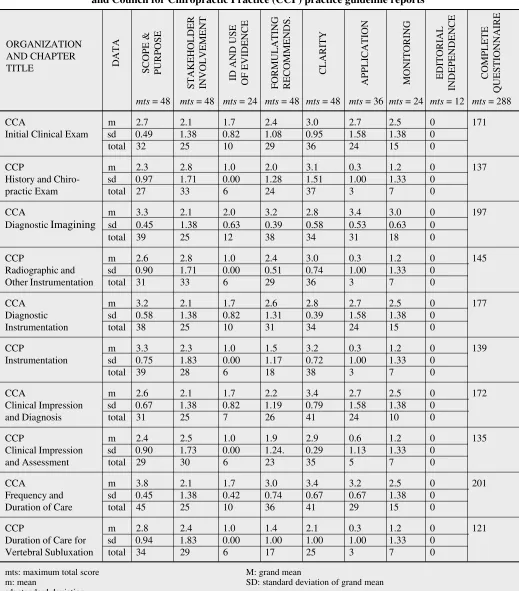
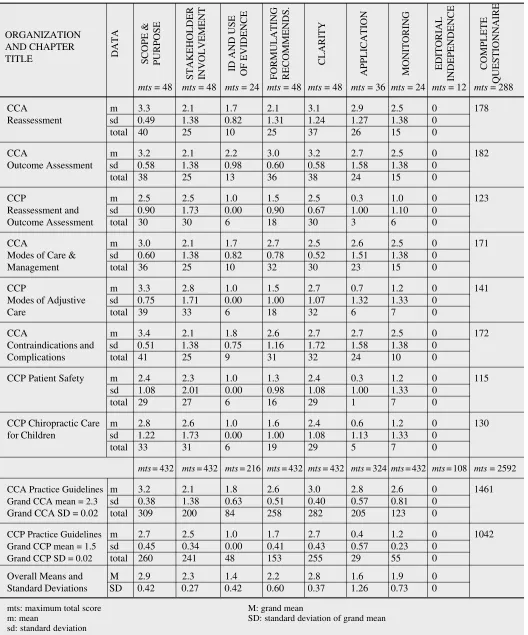
Tables 2 and 3 provide quantitative summaries of the evaluation results. Table 2 summarizes the distribution of responses for the CCA and CCP documents. Table 3 in-cludes the mean, standard deviation, and total scores as a function of instrument component (i.e., eight dimensions and the complete instrument) for each of the eligible chap-ters and the guideline documents as a whole. Also included in Table 3 are the maximum total score (mts) as a function of instrument component.
Distribution of scores
re-Clinical practice guidelines
sulted in two and a half times as many agree responses for the CCA document relative to the CCP document (47.5% v. 19.4%), over 40% fewer disagree responses (14.4% v. 22.5%) and half as many strongly disagree and no infor-mation to answer responses (CCA 6.6% and 13.0% v. CCP 13.3% and 27.9%, respectively). Interestingly, the most common response option in the CCA evaluation was agree (47.5%) in contrast to the no information to answer response with the CCP evaluation (27.5%). For both groups, the strongly disagree response was the least com-mon response option.
Chapter score evaluation
Based on these findings, it is not surprising that the mean scores and total scores suggest a tendency for the eligible chapters in the CCA document to be rated more highly than the corresponding chapters in the CCP document. Although the ranges were the same, the minimum to maxi-mum of total scores for eligible chapters in the CCA docu-ment were higher (171 to 201) and did not overlap with the
CCP document scores (115 to 145). Table 4 summarizes the rankings of all eligible chapters based on the total scores of the instrument (including those with no chapter equivalent). There are two noteworthy features of these rankings. First, the total scores of the CCA chapters were consistently higher (Tables 3, 4). Second, there appears to be no correspondence in the rankings of the CCA and CCP chapter pairs. For example, the strongest eligible CCA chapter was Frequency and Duration of Care. Its CCP counterpart, Duration of Care for Vertebral Subluxation was one of the organization’s weakest chapters (Table 4). In fact, the biggest difference in total scores and mean scores was found with this chapter pair. Similarly, the CCP counterpart of one of the weakest CCA chapters, Modes of Care and Management, was one of its strongest chapters, Modes of Adjustive Care. Although the total score of the CCA version of this chapter was still higher than the CCP version, the relative ranked positions of these chapters were very different.
Table 2
Distribution of response options of the Canadian Chiropractic Association (CCA) and Council for Chiropractic Practice (CCP) guideline documents
Response Option CCA CCP
frequency† percentage frequency† percentage **
no information to answer/NA* 84 13.0 181 27.9
scored 0
strongly disagree 43 6.6 86 13.3
scored 1
disagree 93 14.4 146 22.5
scored 2
agree 308 47.5 126 19.4
scored 3
strongly agree 120 18.5 109 16.8
scored 4
648 100.0 648 99.9
* NA: Not Applicable. This option was used by 3 appraisers for the CCA Contraindications and Complications chapter for the item addressing health benefits, risks and side effects.
** Please note that this column does not add to 100 % because of rounding.
mts= 48 mts= 48 mts= 24 mts= 48 mts= 48 mts= 36 mts= 24 mts= 12 mts= 288
CCA m 2.7 2.1 1.7 2.4 3.0 2.7 2.5 0 171
Initial Clinical Exam sd 0.49 1.38 0.82 1.08 0.95 1.58 1.38 0
total 32 25 10 29 36 24 15 0
CCP m 2.3 2.8 1.0 2.0 3.1 0.3 1.2 0 137
History and Chiro- sd 0.97 1.71 0.00 1.28 1.51 1.00 1.33 0
practic Exam total 27 33 6 24 37 3 7 0
CCA m 3.3 2.1 2.0 3.2 2.8 3.4 3.0 0 197
Diagnostic Imagining sd 0.45 1.38 0.63 0.39 0.58 0.53 0.63 0
total 39 25 12 38 34 31 18 0
CCP m 2.6 2.8 1.0 2.4 3.0 0.3 1.2 0 145
Radiographic and sd 0.90 1.71 0.00 0.51 0.74 1.00 1.33 0
Other Instrumentation total 31 33 6 29 36 3 7 0
CCA m 3.2 2.1 1.7 2.6 2.8 2.7 2.5 0 177
Diagnostic sd 0.58 1.38 0.82 1.31 0.39 1.58 1.38 0
Instrumentation total 38 25 10 31 34 24 15 0
CCP m 3.3 2.3 1.0 1.5 3.2 0.3 1.2 0 139
Instrumentation sd 0.75 1.83 0.00 1.17 0.72 1.00 1.33 0
total 39 28 6 18 38 3 7 0
CCA m 2.6 2.1 1.7 2.2 3.4 2.7 2.5 0 172
Clinical Impression sd 0.67 1.38 0.82 1.19 0.79 1.58 1.38 0
and Diagnosis total 31 25 7 26 41 24 10 0
CCP m 2.4 2.5 1.0 1.9 2.9 0.6 1.2 0 135
Clinical Impression sd 0.90 1.73 0.00 1.24. 0.29 1.13 1.33 0
and Assessment total 29 30 6 23 35 5 7 0
CCA m 3.8 2.1 1.7 3.0 3.4 3.2 2.5 0 201
Frequency and sd 0.45 1.38 0.42 0.74 0.67 0.67 1.38 0
Duration of Care total 45 25 10 36 41 29 15 0
CCP m 2.8 2.4 1.0 1.4 2.1 0.3 1.2 0 121
Duration of Care for sd 0.94 1.83 0.00 1.00 1.00 1.00 1.33 0
Vertebral Subluxation total 34 29 6 17 25 3 7 0
mts: maximum total score M: grand mean
m: mean SD: standard deviation of grand mean
sd: standard deviation
Table 3
Dimension and complete questionnaire mean, standard deviation and total scores for each applicable chapter from the Canadian Chiropractic Association (CCA)
and Council for Chiropractic Practice (CCP) practice guideline reports
ORGANIZATION AND CHAPTER
TITLE DATA SCOPE & PURPOSE
STAKEHOLDER INVOLVEMENT ID AND USE OF EVIDENCE FORMULATING RECOMMENDS.
CLARITY
APPLICATION MONITORING EDITORIAL
INDEPENDENCE
COMPLETE
Clinical practice guidelines
mts= 48 mts= 48 mts= 24 mts= 48 mts= 48 mts= 36 mts= 24 mts= 12 mts= 288
CCA m 3.3 2.1 1.7 2.1 3.1 2.9 2.5 0 178
Reassessment sd 0.49 1.38 0.82 1.31 1.24 1.27 1.38 0
total 40 25 10 25 37 26 15 0
CCA m 3.2 2.1 2.2 3.0 3.2 2.7 2.5 0 182
Outcome Assessment sd 0.58 1.38 0.98 0.60 0.58 1.58 1.38 0
total 38 25 13 36 38 24 15 0
CCP m 2.5 2.5 1.0 1.5 2.5 0.3 1.0 0 123
Reassessment and sd 0.90 1.73 0.00 0.90 0.67 1.00 1.10 0
Outcome Assessment total 30 30 6 18 30 3 6 0
CCA m 3.0 2.1 1.7 2.7 2.5 2.6 2.5 0 171
Modes of Care & sd 0.60 1.38 0.82 0.78 0.52 1.51 1.38 0
Management total 36 25 10 32 30 23 15 0
CCP m 3.3 2.8 1.0 1.5 2.7 0.7 1.2 0 141
Modes of Adjustive sd 0.75 1.71 0.00 1.00 1.07 1.32 1.33 0
Care total 39 33 6 18 32 6 7 0
CCA m 3.4 2.1 1.8 2.6 2.7 2.7 2.5 0 172
Contraindications and sd 0.51 1.38 0.75 1.16 1.72 1.58 1.38 0
Complications total 41 25 9 31 32 24 10 0
CCP Patient Safety m 2.4 2.3 1.0 1.3 2.4 0.3 1.2 0 115
sd 1.08 2.01 0.00 0.98 1.08 1.00 1.33 0
total 29 27 6 16 29 1 7 0
CCP Chiropractic Care m 2.8 2.6 1.0 1.6 2.4 0.6 1.2 0 130
for Children sd 1.22 1.73 0.00 1.00 1.08 1.13 1.33 0
total 33 31 6 19 29 5 7 0
mts= 432 mts= 432 mts= 216 mts= 432 mts= 432 mts= 324mts= 432 mts= 108 mts = 2592 CCA Practice Guidelines m 3.2 2.1 1.8 2.6 3.0 2.8 2.6 0 1461 Grand CCA mean = 2.3 sd 0.38 1.38 0.63 0.51 0.40 0.57 0.81 0
Grand CCA SD = 0.02 total 309 200 84 258 282 205 123 0
CCP Practice Guidelines m 2.7 2.5 1.0 1.7 2.7 0.4 1.2 0 1042 Grand CCP mean = 1.5 sd 0.45 0.34 0.00 0.41 0.43 0.57 0.23 0
Grand CCP SD = 0.02 total 260 241 48 153 255 29 55 0
Overall Means and M 2.9 2.3 1.4 2.2 2.8 1.6 1.9 0
Standard Deviations SD 0.42 0.27 0.42 0.60 0.37 1.26 0.73 0
mts: maximum total score M: grand mean
m: mean SD: standard deviation of grand mean
sd: standard deviation
Table 3 Continued
ORGANIZATION AND CHAPTER
TITLE DATA SCOPE & PURPOSE
STAKEHOLDER INVOLVEMENT ID AND USE OF EVIDENCE FORMULATING RECOMMENDS.
CLARITY
APPLICATION MONITORING EDITORIAL
INDEPENDENCE
COMPLETE
Instrument dimension evaluation
General findings
For the overall CCA document, mean scores on the dimen-sions from strongest to weakest are scope and purpose (3.2), clarity (3.0), application (2.8), formulating recom-mendations (2.6), monitoring (2.6), stakeholder involve-ment (2.1), identification and use of evidence (1.8) and editorial independence (0). For the overall CCP docu-ment, the mean scores are scope and purpose (2.7) and clarity (2.7), stakeholder involvement (2.5), formulating recommendations (1.7), monitoring (1.2), identification and use of evidence (1.0), application (0.4), and editorial independence (0). It is interesting to note that the scope and purpose and clarity dimensions were the strongest dimensions for both the CCA and CCP. Similarly, identifi-cation and use of evidence and editorial independence were two of the weakest areas for both groups.
DISCUSSION
The purpose of this project was to evaluate the CCA and CCP clinical practice guideline documents using the AGREE instrument.5 The findings from the evaluation process indicate that the CCA guideline document was rated more favourably than the CCP guideline document. For both the CCA and CCP document, the least frequent response option was strongly disagree. However, for the CCA document the agree option was most frequent in contrast to the no information to answer option for the CCP document. Indeed, recall that we were unable to find information to answer over one quarter of the quality items related to the CCP document. The interval of total scores for eligible chapters in the CCA document was higher (171 to 201) and did not overlap with the interval of total scores in the CCP document (115 to 145). Table 4 presents the rank ordering of the eligible chapters in the CCA and CCP guideline documents. There appears to be little
Table 4
The rank ordering of eligible chapters from the Canadian Chiropractic Association (CCA) with the corresponding eligible chapters from the Council for Chiropractic Practice (CCP)
practice guideline reports according to total score
CCA CCP
Total Total
Score Rank Chapter Score Rank Corresponding Chapter
201 1 Frequency and Duration of Care 121 8 Duration of Care for Vertebral Subluxation
197 2 Diagnostic Imaging 145 1 Radiographic and Other Instrumentation
182 3 Outcome Assessment 123 7 Reassessment and Outcome Assessment
178 4 Reassessment
177 5 Diagnostic Instrumentation 139 3 Instrumentation
172 6.5 Contraindications and Complications 115 9 Patient Safety
172 6.5 Clinical Impression and Diagnosis 135 5 Clinical Impression and Assessment
171 8.5 Modes of Care and Management 141 2 Modes of Adjustive Care
171 8.5 Initial Clinical Examination 137 4 History and Chiropractic Exam
Clinical practice guidelines
spondence in the rank order of common-theme chapters between the two groups, suggesting that the subject matter of the guideline chapters did not consistently predict qual-ity scores.
The CCA chapter scores were typically higher on the scope and purpose dimension than the CCP chapters, with the exception being the chapters that addressed mo-dality of care and instrumentation (Table 3). Typically, the differences between the organizations were modest, with the exception of the chapters that addressed safety and complications (i.e., CCA Contradictions and Com-plications and CCP Patient Safety), where there was a full point difference between the mean scores. The dif-ferences between the two groups were attributed prima-rily to the inclusion of additional information regarding clinical questions of interest and patient characteristics in the CCA chapter.
The CCP document scores were consistently higher than the CCA scores on the stakeholder involvement di-mension due primarily to the greater involvement of pa-tients and methods experts in the guideline development process (Table 3). The variation within the CCP document can be attributed primarily to the extent to which patient preferences were considered in each chapter. The CCA score was the same across all chapters because informa-tion used to answer the items in this secinforma-tion was found in the supporting literature.
The primary area for improvement for both the CCA and CCP guidelines falls within the identification and use of evidence dimension. Both the CCA and the CCP scored quite low on this dimension. Neither group provided com-prehensive descriptions of the methods used to search, se-lect, and synthesize the evidence (Table 3).
The mean scores for formulating recommendations were higher for the CCA document compared to the CCP document, with the former providing more explicit and complete descriptions. At no time was the mean score of the CCP chapter higher than its CCA counterpart on this dimension.
The clarity dimension is one of the highest ranked di-mensions for both the CCA and CCP documents. With the exception of chapters dealing with the duration of care, where the difference in means is greater than one point (CCA = 3.4 v. CCP = 2.1), the scores are very close be-tween the groups (Table 3).
The application dimension yields the greatest and most
dramatic difference in scores between the CCA and CCP documents (Table 3). This can be attributed to the CCA document addressing some theoretical aspects of applica-tion and the inclusion of flow charts and algorithms for the user. There was no overlap between the groups on mean score ranges.
As with the application subdimension, substantial dif-ferences on scores between the two groups are found with the monitoring dimension (Table 3). The CCA document out performed the CCP document and there was no over-lap between the mean ranges.
Finally, there was considerable debate among the ap-praisers regarding editorial independence. Financial sup-port to develop the guidelines for the CCA document comes from professional associations and groups that would have an interest in the results of the project. Mem-bers of these organizations were involved in each step of the development process. The financial supporters of the CCP activities are unknown. In the absence of an explicit statement indicating editorial independence from the fund-ing body, it was felt there was insufficient information to answer this question positively for either development group. The means and total scores for both the CCA and CCP document are zero for all of the chapters.
An important consideration is whether the differences in quality favouring the CCA document are meaningful and important. Three points bear on this issue. First, the great-est differences in total scores between the CCA and CCP documents are with the dimensions application (205 v. 29), formulating recommendations (258 v. 153), and monitoring (123 v. 55). Within these dimensions, the dif-ferences can be attributed, in large part, to the absence of information in the CCP guideline document rather than a description indicating that the guideline developers under-took a faulty or weak methodology. The distinction be-tween poor guideline process and poor reporting standards is important. Based on the argument above, there is at least evidence to support the notion that the CCA reporting style is more complete than the CCP reporting style.
have inadvertently neglected the inclusion of very impor-tant information that would enable the reader to make in-formed assessments about the recommendations. The “user friendly” compendium perhaps could have served as a supporting document to one in which all the issues were addressed.
The second aspect that bears on this issue is related to perceptions about the relevance of the individual dimen-sions. There may be some debate among the guideline development groups regarding the relevance of each di-mension of the AGREE instrument within the clinical, policy, and health services contexts in the chiropractic community. For example, the greatest discrepancies be-tween the CCA and CCP documents were with the appli-cation dimension and the monitoring dimension. If these dimensions are considered less relevant by the chiroprac-tic community than other dimensions in which there is greater correspondence, it could be concluded that the dif-ferences in scores between the two reports might be less meaningful than believed at first glance. Many factors can influence this debate: the guideline model of the ment groups, the mandate and responsibilities of develop-ment groups in contrast to the mandate and responsibilities of the professional organizations, the expertise of the members of the groups (e.g., clinical experts vs. methodol-ogy experts vs. implementation experts, etc.).
Finally, examining response patterns is the third consid-eration when trying to understand the evaluation outcome differences between the two groups. The CCA document received twice as many positive responses (combining strongly agree and agree options) and half as many nega-tive responses (combining strongly disagree and disagree) during the evaluation than did the CCP document. The larger proportion of no information to answer response options in the CCP evaluation results can not completely account for this difference. Further, higher scores were found across most of the dimensions for the CCA docu-ment, not only those judged as less relevant by the apprais-ers. Thus, there is evidence that absolute qualitative differences also played a role. In summary, higher ratings of the CCA document relative to the CCP document can likely be explained by a combination of reporting style and guideline quality factors.
The current evaluation shows that there is correspond-ence between the two documents regarding common areas of strength and common areas of weakness. Considering
areas of strength, Grilli and his colleagues suggest high quality CPGs from specialty societies should report rel-evant stakeholder groups, a strategy to identify primary evidence, and a process to grade recommendations based on the strength of studies incorporated into the report.14 The CCP and CCA documents meet two of these criteria; in both cases, a very elaborate and well thought out system of clas-sifying the recommendations and the type and quality of research used to inform them is outlined. Further, compre-hensive memberships of the guideline development groups, particularly in the case of the CCP, and clearly identified target audiences, added credibility to the processes.
In both documents, the reader could typically follow the rationale of why topics were chosen and understand the objectives. The documents were well organized and framed and the recommendations were easily located. Thus scope and purpose and clarity dimensions were the stronger features of both guideline groups that were well represented.
The third quality component advocated by Grilli was not successfully incorporated into either of the guideline documents.14 The appraisers agreed that both guideline documents could be improved by being more explicit, par-ticularly in the identification and use of evidence and the linkages between evidence and recommendations. Indeed, the feature that most clearly deviated from an evidence-based perspective of guideline development, was the lack of information describing the processes used to identify and choose the reviewed literature. Indeed, both develop-ers did not explicitly detail the strategy used to search for the evidence, and neither outlined the specific inclusion and exclusion criteria used to select the literature. Thus, for each applicable chapter, the specific body of literature considered, how this literature was chosen, and why other literature was ignored was unclear. Further, there was con-siderable inconsistency across the chapters, for both groups, with the link between evidence and the recommen-dations.
coun-Clinical practice guidelines
terpart, Duration of Care for Vertebral Subluxation. Whereas the former provides very detailed timelines, the latter explicitly indicates that there are no data to substan-tiate specific time periods for care. Review of the refer-ence lists indicates very little correspondrefer-ence between the two groups. This difference can not be explained by the different guideline dates (i.e., the more recent CCP docu-ment, does not have a reference list that only incorporates literature published after the release of the CCA docu-ment). The absence of information describing the litera-ture search and selection process makes it difficult to comment on which one of the two sets of guideline recom-mendations is more valid. Further, the factors that could explain why such very different recommendations emerged are unknown (e.g., regional differences in care, differences in patient values or clinical culture, etc.).
Finally, there were times when the reports did not estab-lish a link between the evidence and the recommendations, did not indicate the range of clinical options available, and offered ambiguous recommendations that provided little direction for the management of care, features linked to recommendation and uptake. For example, in an observa-tional study exploring factors that facilitate and hinder CPG practice, Grol and his colleagues found almost a two-fold difference in uptake between CPGs with ambiguous recommendations versus clearly worded recommenda-tions (36% vs. 67%, respectively).7
The level of editorial independence of the guideline de-velopment group from the funders was also unclear in both documents. Lack of editorial independence has the poten-tial to significantly jeopardise the quality of the document. Consider the findings by Barnes and Bero who found a statistically and scientifically meaningful relationship be-tween conclusions of review articles on the effects of pas-sive (“second-hand”) smoking and affiliations with authors.13 Here, the investigators found that of the 37% of reviews that concluded no harmful effects of passive smoking, over 70% of these authors had affiliations with the tobacco industry. If the CCA and CCP groups were in fact independent from the funders, an explicit statement to this effect would alleviate the liability inherent in the am-biguity. If there is dependency with funds, this has the capacity to undermine the credibility of the documents.
In summary, the strongest areas for both documents in-clude an identification of guideline objectives and clinical questions/themes, description of target users and patient
populations, a clear guideline structure, credible members on the guideline development groups, and a complete de-scription of the methods used to formulate the recommen-dations. Areas recommended for improvement in both documents include a more explicit and complete descrip-tion of the specific bodies of literature under considera-tion, more detail regarding the systematic methods used to search the evidence, incorporating inclusion and exclusion criteria, statements describing the links between the evi-dence and recommendations, and greater consistency in creating specific unambiguous recommendations.
Finally, the membership of the research team charged with conducting the evaluation precluded the considera-tion of clinical content or context. As such, it may be use-ful to engage in the evaluation process again bringing this perspective to the table. Further, it might be useful to re-peat this exercise when updated guideline documents de-veloped by the CCA and CCP are released and when the final version of the AGREE evaluation instrument is avail-able in the public domain.
References
1 Woolf SH. Practice guidelines: A new reality in medicine. I. Recent developments. Arch Intern Med 1990;
150:1811–1818.
2 Henderson D, Chapman-Smith D, Mior S, Vernon H (Eds). Clinical Practice Guidelines for Chiropractic Practice. Proceedings of a Consensus Conference Commissioned by the Canadian Chiropractic Association. Supplement to Journal of the Canadian Chiropractic Association 1994; 38(1).
3 Council on Chiropractic Practice. Clinical practice guideline: vertebral subluxation in chiropractic practice. Arizona: Council on Chiropractic Practice, 1998.
4 Hayward RSA, Wilson MC, Tunis SR, Bass EB, Guyatt G, for the Evidence-based Medicine Working Group. Users’ guides to the medical literature. Viii. How to use clinical practice guidelines. A. Are the recommendations valid? JAMA 1995; 274:570–574.
5 The AGREE Collaboration. Appraisal of Guidelines for Research and Evaluation in Europe (AGREE) Instrument. May 1999.
7 Grol R, Dalhuijzen J, Mokkink H, Thomas S, Veld C, Rutten G. Attributes of clinical guidelines that influence use of guidelines in general practice: observational study. BMJ 1998; 311:237–242.
8 Lohr KN. The quality of practice guidelines and the quality of healthcare. In: Guidelines in health care. Report of a WHO conference. January 1997, Baden-Baden: Nomos Verlagsgesellschaft, 1998.
9 Browman GP. Evidence-Based Cancer Care and Clinical Practice Guidelines. Am Soc Clin Oncol 1998; 451–457. 10 Brouwers M, Johnston M, Browman G (in press). Results
of a prospective study to keep guidelines current. Proceedings of the ISTAHC 2001 Conference.
11 Moher D, Pham B, Jones A, Cook D, Jadad A, Moher M, Tugwell P, Klass T. Does quality of reports of randomised
trials affect estimates of intervention efficacy reported in meta-analyses? Lancet 1998; 352:609–613.
12 Colditz GA, Miller JN, Mosteller F. How study design effects outcomes in comparisons of therapy. I: Medical. Statistics in Medicine 1989; 8:441–454.
13 Barnes DE, Bero LA. Why review articles on health effects of passive smoking reach different conclusions. JAMA 1998; 279:1566–1570.
14 Grilli R, Magrini N, Penna A, Mura G, Liberati A. Practice guidelines developed by speciality societies: the need for critical appraisal. Lancet 2000; 355:103–106.
15 Streiner DL, Norman GR. Health measurement scales. A practical guide to their development and use. Second edition. Oxford: Oxford University Press, 1995.
CANADIAN CHIROPRACTIC RESEARCH FOUNDATION
The C.C.R.F. is a registered Charitable foundation dedicated to quality Chiropractic research. We appreciate your continued support.
Please send your
Tax Deductible Donation
TODAY:
Donations
and/or
Requests for Grant Applications
may be forwarded to:
Canadian Chiropractic Research Foundation 1396 Eglinton Avenue West Toronto, Ontario M6C 2E4
Dr. Rob Allaby
Treasurer
Canadian Chiropractic Research Foundation