Article
Holistic Context-Sensitivity for Run-time
Optimization of Flexible Manufacturing Systems
Sebastian Scholze 1,*, Jose Barata 2 and Dragan Stokic 1
1 Institut für angewandte Systemtechnik Bremen GmbH, 28359 Bremen, Germany; [email protected] 2 Dep. De Eng. Electrotecnica, Faculdade de Ciencias e Tecnologica, Universidade Nova de Lisboa, 2829-516
Caparica, Portugal; [email protected]
* Correspondence: [email protected]; Tel.: +49-421-220-9263
Abstract: Highly flexible manufacturing systems require continuous run-time (self-) optimization of processes with respect to various parameters, e.g. efficiency, availability, energy consumption etc. A promising approach for achieving (self-) optimization in manufacturing systems is the usage of the context sensitivity approach. Thereby the Cyber-Physical Systems play an important role as sources of information to achieve context sensitivity. In this paper, it is demonstrated how context sensitivity can be used to realize a holistic solution for (self-) optimization of discrete flexible manufacturing systems, by making use of Cyber-Physical System integrated in manufacturing systems/processes. A generic approach for context sensitivity, based on self-learning algorithms, is proposed aiming at a various manufacturing systems. The new solution is propos encompassing run-time context extractor and optimizer. Based on the self-learning module both context extraction and optimizer are continuously learning and improving their performance. The solution is following Service Oriented Architecture principles. The generic solution is developed and then applied to two very different manufacturing processes. This paper proposes a holistic solution to achieve context sensitivity for Flexible Manufacturing Systems, whereby the knowledge created by applying the context sensitivity approach can be used for (self-) optimization of manufacturing processes.
Keywords: context sensitivity; cyber physical systems; flexible manufacturing system; process optimization; self-learning systems; SOA
1. Introduction
The modern Flexible Manufacturing Systems (FMS) exist in uncertainty; a change is expected, but the future is unknown [1]. The desire for ‘robustness’ stems from the fact that change is inevitable, both in reality and perception [2], and systems have to be continuously optimized to adapt to such changes. Both research and industrial communities have developed various approaches to cope with such changes. For example, the so-called changeable system method attempts to design the systems robust to various unknown changes [1]. Such systems need continuous run time optimization of various parameters, such as efficiency, energy consumption, availability, etc., and adapting to dynamically changing conditions under which they are operating. The classical approach to process optimization is to build specific off-line optimizations for different parameters and processes, each basing on different adaptive control laws. Building and, especially maintenance, of such solutions for highly dynamic FMS are time and costs consuming, and such solutions often cannot cope with many non-planned changes.
the Cyber-Physical Systems play an important role as they offer new/additional sources of information, which can be used to achieve context sensitivity. Especially CPS directly integrated in manufacturing processes can be used for an effective identification of dynamically changing context under which the manufacturing system is operating. Self-learning capabilities are introduced enabling applicability of the solution to wide scope of manufacturing processes. The assumption is that building and adjustments of such generic context sensitive solution for various specific optimizations and processes is much more time/costs effective than building of classical optimizations solutions. In this paper the applicability of the proposed context sensitivity solution is demonstrated in two different application scenarios. The experiment in the first scenario investigates the potential optimization of energy consumption within a manufacturing process (secondary manufacturing process) by applying context sensitivity. The second experiment investigates the potential optimization of process control to gain a higher efficiency of the manufacturing process (prime manufacturing process) by also applying context sensitivity.
The paper is organized in the following way. Section II provides the key research question and assumption, Section III includes a brief analysis of the state of the art in the key research areas relevant for the proposed solution. Sections IV and V describe the concept and implementation of the proposed solution. Section VI provides the results of the experimental investigations of the solution, while Section VII includes a brief analysis of the key benefits of the proposed solution, as well as the further research plans.
2. Research Question
The need for run-time optimizations of FMS is nowadays indispensable as described in the introduction of the paper. To achieve this there is a need for a solution that is capable of managing a high amount of data, complex models and algorithms. Furthermore, there is a need for a holistic solution that can be applied to different parameters, machines, systems and sectors. Thereby the effort for adjustments should be minimal. Such a holistic solution would prevent the building of scattered solutions and at the same time support the discovery of extensive problem solutions. However, in order to find such a generic solution, a common approach for the following two problems need to be elaborated:
Monitoring of changes during run-time within a FMS (e.g. changing process parameters, environment in which the system is operating etc.), which can be used for further processing.
Extraction of current context based on monitored data to be used for knowledge creation, which can be used for (self-) optimization of manufacturing processes.
2.1. Hypothesis
The generic context sensitive solution based on CPS, proposed in this paper, is easily adjustable to allow for optimization/adaptation of wide scopes of manufacturing systems. The context sensitivity allows for observation of changes in circumstances in which a manufacturing system is operating, which in turn allows for a dynamic adaptation of the system to these varying conditions [4].
2.2. Approach
The approach, therefore, assumes that more efficient and re-usable embedded optimization services can be developed by using context sensitivity than by using classical optimization services. Such context aware services use information acquired from various sources (e.g. CPS, inputs of the human operator, etc.). The run-time context extraction uses a context model for device spaces.
Aiming to allow application of the context model and context extraction services in different applications domains, the model consists of a generic model and a specific model, which instantiate generic concepts to allow for adjustments to the specific domain and application. The extracted context is used by embedded optimization services to adapt the process behavior to e.g. update process parameters.
This work will investigate how such approach can be used as a generic solution to realize (self-) optimization of manufacturing systems.
3. State of the Art
3.1. Context Sensitivity and Context modelling
Context Sensitivity is a concept propagated in the domains of Ambient Intelligence (AmI) and ubiquitous computing [7]. Existing research on context can be classified in two categories: context-based, proactive delivery of knowledge, and the capture & utilization of contextual knowledge. In the case of embedded services, the notion of context refers to process preferences of products and process skills of devices, physical capabilities of the equipment, environment conditions. As context integrates different knowledge sources and binds knowledge to the user to guarantee that the understanding is consistent, context modeling is extensively investigated within Knowledge Management research [8]. According to [9], context-sensitive computing uses contexts to provide relevant information and/or services to the users or applications. The relevancy depends mainly on the tasks or on the application domain [10].
Key research task for the manufacturing domain for achieving context sensitivity is the definition of a generic and dynamic context model. Furthermore, the model need to be easy extendable for various manufacturing domains as well as for specific applications. The model must include the context of processes, equipment, products, humans and the use of knowledge for planning/executing various activities.
[11] and [12] are describing such solutions that are ontology-based, concerned with the semantic representation of context and personalized service search and retrieval techniques. There are also approaches to extend existing standards by adding/using context, such as KNX ISO [13]. The need to go beyond context representation to context reasoning, classification and dependency is also recognized [14]. Defining the context (model), that is required for achieving context sensitivity can be difficult as indicated in [5], [3]. Informal context models are often based on proprietary representation schemes without facilities for sharing the understanding about context between different systems [15]. Existing formal context models support formality and address a certain level of context reasoning [16]. Most common approaches to context-modelling are key-value models, Markup Scheme Models, Graphical Models such as Unified Modelling Language (UML), OOM, Logic- Based Models and Ontology-Based Models [17]. Some researchers [18] report about the comparison of different context modelling techniques. The present research on context modelling is often focused on ontologies [19]. This approach due to its easy extendibility and applicability for various processes seems to be the most appropriate for manufacturing industry. The modeling of context in the case of processes optimization in manufacturing industry is a challenging research task, as services in this domain are highly dynamic and reside in distributed environments [18].
as well as selection of appropriate information sources are described that could foster the “easy” creation of context models.
3.2. Cyber-Physical Systems
According to [24] a Cyber-Physical Systems (CPS) is defined as an ‘integration of computation and physical processes’. The key idea is to combine the physical word (e.g. manufacturing process) with the virtual world (e.g. information processing). Thereby, CPS have a strong focus on a network of interacting CPS in order to achieve the desired functionality in contrast to traditional isolated systems. One example of a typical CPS is an intelligent manufacturing line, where the work of a machine is supported by the communication with its depending components.
The usage of CPS promises huge advantages against traditional systems. Hardware systems and software system can be interconnected arbitrarily. In addition, the connections of each other’s systems can be changed, deleted or newly built up on the fly. Furthermore, all accessible data, information and services can be deployed and utilized at any time anywhere in the system. Thus, cyber-physical systems’ services are independent from location, adapted to current systems requirements, partly autonomously, multifunctional and multimodal, networked and distributed along their application area [25], [26].
It is expected that CPS will play an important role in future systems, especially also in manufacturing systems [27], [28]. Recently there are several recommender models proposed to facilitate the sharing / extraction of knowledge [29].
Although more and more CPS are applied in industrial environments and CPS are used in consumer environments as information sources for context sensitivity, this is still not investigated in current manufacturing systems.
3.3. Service Oriented Architectures
Service oriented architecture (SOA) is an approach that has been around since 90s, when it was used in Tuxedo to describe ‘services’ and ‘service processes’ [30]. Service-orientation is still one of the most promising architectural designs for rapid integration of data and business processes. There are several standards available and accepted in industry that build on SOA principles, such as e.g. HTTP, JSON, XML, WS-*, etc. [22]. SOA is already heavily used in corporate and consumer environments but in embedded real-world environment SOA is emerging slower. The introduction of the OPC-UA architecture was a big step towards service-oriented architectures in industrial machine-2-machine sector. The upcoming trend to use CPS in industrial environments also fosters the usage of SOA-like principles in such environments. However, current research tries to apply SOA principles in domains, where such principles are not yet widely spread, such as industrial automation [31] or building automation [32] making it a promising approach for context aware solutions.
3.4. Self-Learning
4. Concept for Context Sensitivity
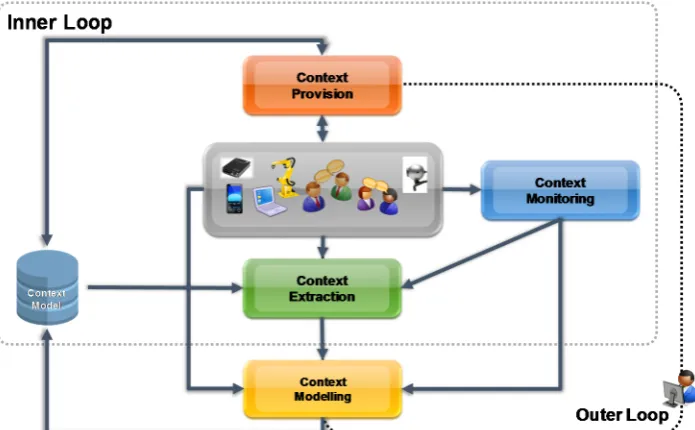
The concept to achieve context sensitivity in FMS is shown in Figure 1. Context Monitoring is used to collect “raw data” from the FMS. The collected data is subsequently used by the Context Extraction to derive the current context of the FMS. In a next the current identified context is provided to upstream services (Context Provision). The provided context can for example used for generating knowledge about a manufacturing process. This knowledge will be used as a basis for operational decisions. This generated knowledge in turn forms the basis for decisions about optimizations of specific manufacturing processes. Decisions regarding the optimization of manufacturing process can be a) short-term (specific tasks of a manufacturing process) and b) long-term (overall manufacturing process).
Figure 1. Context Sensitivity Concept
For achieving context sensitivity in production systems, CPS as well as other information sources are used to collect data about manufacturing process (as a sub-set of a whole production system). The collected data is used in the next step for identifying the current context of the monitored manufacturing processes. The identification starts through context monitoring services, which are, e.g. services for monitoring of processes or of a user interacting with a system for changing conditions [4]. The monitored “raw data” is transformed into an “standardized” data format by the monitoring services in order to allow further processing by the context extraction services. The context extraction service identifies current context by instantiating monitored data into the context model. Furthermore, reasoning techniques are used to support context identification. For reasoning previously identified context and the context model is used, which is stored in the context repository. In contrast to many current approaches, where often only data about location/user is used for identifying context, the presented approach uses any monitored information that can be instantiated in the context model for identifying context. After the current context is identified, it is send to the system adapter services, which are responsible for the system adaptation. In addition, the outer loop supports updating the context, based on the used concepts and relations of the identified context.
5. Implementation
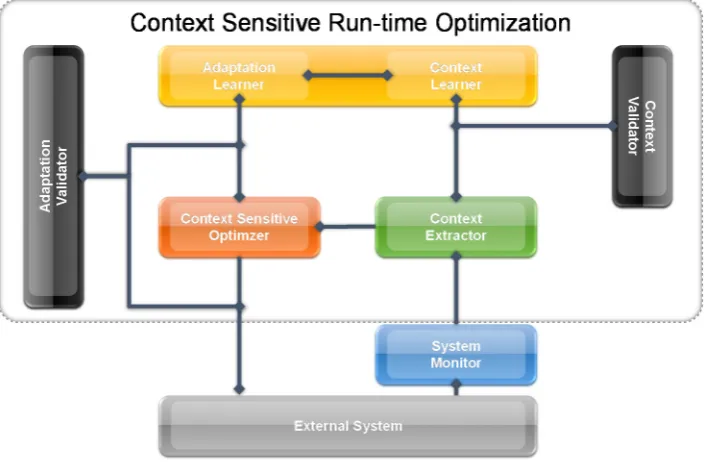
components in this architecture are: monitor for contextual changes, identification of context, adaptation of system behavior and learning based on executed adaptations. The resulting architecture is depicted in Figure 2.
Figure 2. “Reference” Architecture to achieve context sensitivity for manufacturing systems
The components of the proposed system include:
• System Monitor, Context Extractor (including the Context Model) and Context Sensitive Optimizer – see sections 5.1-5.4 for detailed explanation of these services.
• Adaptation Learner and Context Learner: These services allow the system to learn. Key factor for the learning are the results of the Validator Services (operator’s feedback). These results are analyzed using data mining techniques and are used to improve the operation of the Context Extractor and the Context Sensitive Optimizer during run time (see also section 5.4).
• Adaptation Validator and Context Validator: These services are measuring the performance of optimization and context extraction. The measurement is either based on the manual feedback of the operator (e.g. acceptance of optimization proposals) or on statistical analysis in case the system operates in automatic mode. The results of the validator services are the key input for the learning services.
For simplicity, the Data Access Layer, Data Processing and the Service Infrastructure as well as supporting services / modules are not shown in Figure 2. However, the overall architecture is following a strict SOA approach.
5.1. Context Model
For the extraction of current context, an underlying model is required that supports the identification of context. In that sense the context model forms the basic data model, that is used for the context identification /extraction. The proposed approach uses ontologies as technology for modelling the context model. Contrary to many ontologies, the context model proposed in this work is not foreseen, to define a full description of all possible context, but to model the concepts that are required for supporting the context identification [10].
The application of the proposed solution to a specific application domain normally requires adjustment of the context model. Therefore, a general and extensible context model is proposed. It is in a format that meets several requirements: help to describe and capture context easily; help to manipulate context; facilitate context consumption by services. Therefore, the context model consists of a layered ontology approach. The model includes:
• the domain specific and /or
• application specific context model(s).
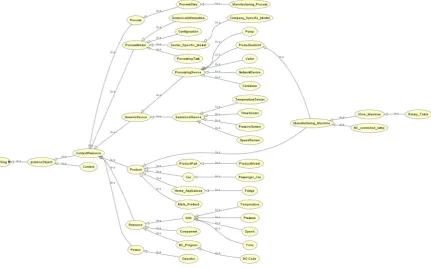
The generic device context model defines the high-level context. The other layer(s) define the domain and / or application specific context model(s). The context model to be used in the proposed approach consists of all three layers. Thus, the context model is a semantic model for an integrated representation of machine, device and processing knowledge (including information of goal, activity, resource, etc.) as well as its generation. The model developed is defined as high-level structured representations of the product, processes and resources involved in process and their relationships. The generic context model defines concepts such as: Generic Device, Production Unit, Process Step, Operator, Resource, etc. Subsequent, the sector specific context model defines concepts such as: Manufacturing Process, NC controlled Lathe, Shoe Machine, etc. Finally, the Application Specific part contains specific products and processes (see Figure 3 for an excerpt of the above-mentioned context models).
Figure 3. Context Model for device spaces
5.2. Context System Monitor
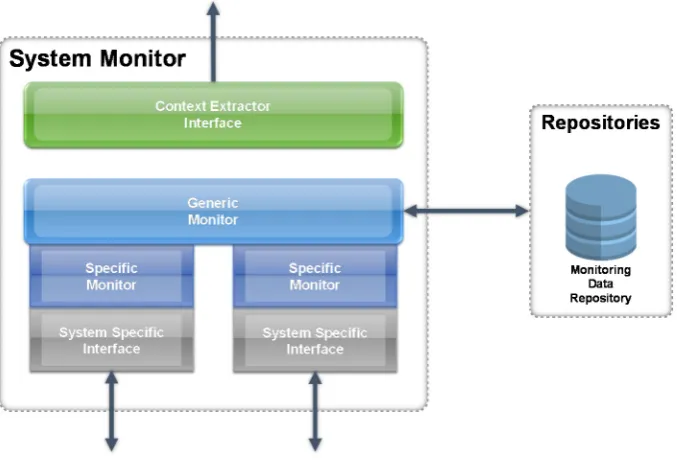
The objective of the System Monitor is to receive raw sensor data and provide aggregated data. In order to monitor “raw sensory data”, the System Monitor need to be connected to diverse legacy systems, such as CPS, Web Services, file systems etc. To achieve this the System Monitor implements a Service-oriented configurable monitoring architecture (SOMA). Each system to be integrated into the System Monitor will be monitored by a specific monitor, that delivers its data to the superior Generic Monitor for further processing. The Generic Monitor is able to standardize and correlate data from specific systems for further processing in the Context Extractor module.
The main component of the System Monitor is the modular monitoring process, used for all monitoring services with an extendable and configurable standardized process (see Figure 4).
Figure 4. Context System Monitor
The process is three-parted and contains the:
• Monitoring system/sensor module, which contains all services to monitor legacy systems and devices in enterprises vie the Data Access Layer. The distributed monitoring services also call back to this module with their gathered information. The monitoring services can be extended and configured for different data sources.
• Parser module, which contains content parser for the different possible data captured by the monitoring services. The parser offers access to the diverse data possible interacted and therefore monitored with.
• Analyzer builder module, which correlates the monitored content and constructs the “Monitoring Data” to be stored and handed over to the Context Extractor or any other service that needs this information.
5.3. Context Extractor
Figure 5. Context Extractor
Figure 5 shows the Context Extractor Architecture. The Context Extractor tries to extract current context based on the monitored data provided by the System Monitor. The following process involves Context Identification and Context Reasoning. Finally, the extracted context published via the System Optimizer Interface. The corresponding modules comprise the following functionality:
• Context Model – see Section 5.1 above. All features in the Context Extractor are based on this model.
• Context Monitoring - see Section 5.2 above. The Context Monitoring acts as a proxy between System Monitor and Context Identification.
• Context Identification module, which analyses the Monitoring Data handed over by the Context System Monitor and extracts knowledge context such as what products or components are involved, what resources are used, and what items, parts or units are referenced or manipulated in the current on-going context.
• Context reasoning module, a rule based system which reasons on the context provided by the Context Identification module, and generates more accurate contexts, which cannot be directly identified from the Context Identification module. This module also compares the similarity between the current on-going contexts and historical contexts in the model repository.
• System optimizer interface, which provides the results of the context extraction modules to other up-stream modules / services.
5.4. Optimizer and Self-Learning
The Optimizer module includes services which update/optimise the system behaviour based on the identified change of context. The Context Extractor identifies in run time the change in context and provides the information on the Optimizer. The optimizer then adapts the system behaviour to the changed ‘conditions’. In the currently developed version of the Optimizer, it includes sets of rules to adapt the system behaviour to the change of context. The rules are continuously updated by the Self-learning services which ‘learn’ how to improve the system behaviour based on the user validation of the proposals made by the Optimizer. However, besides such self-learning rule based solution, the Optimizer may include different other solutions such as classical optimization algorithms etc.
current optimization process as presented in [39]. Based on the input structure the learning module is able to instantiate the necessary number of algorithms to face the current application scenario.
Two core operations learn and reason, allow the training of the algorithm using a particular model and elaborating a result. The instantiated learning algorithms need a number of models to be trained, depending on the specific application. In the same application, several models can be used depending on the current application scenario. The number of instantiated algorithms determines the number of necessary models to use (see also [39]). An update of the existing learning models is carried out using the last optimization process result. The updated learning models serve to update the context model accordingly. The future self-learning uses then these new updated learning models, while the Context Extractor uses the updated context model.
The Learning Services have been implemented using RapidMiner1. This framework allows the easy integration and usage of several learning algorithms and is furthermore extensible. The following learning algorithms are possible to be executed through the Learning Services and are automatically selected based on the application requirements: ID3 Learner, Naïve-Bayes Learner, Support Vector Machine, Neural Networks, Rule Induction and Least Mean Square. The architecture of the Learning Services allows for an easy extension of existing learning algorithms as well as for integration of additional learning algorithms.
6. Experimental Results
As indicated above, the proposed solution is applicable to wide scope of systems. Two specific applications were investigated in practice, i.e. the above described solution is applied in two very different run-time optimizations. The adjustment of the generic solution to the specific applications includes: (a) definition/update of the context model relevant for the specific optimization and process, (b) definition of CPS and other sources of information as well updates of the rules to process these information needed for context extraction, (c) adjustment of the Optimizer initial rules to specific optimization.
6.1. Energy consumption optimization
The first scenario is the application of the proposed solution for the optimization of so-called secondary processes, in this case optimization of energy consumption of CNC machines. The above proposed solution is integrated to the existing service platform. The goal in this experiment is to improve machine tool energy consumption by using context aware and self-adapting solution, as an alternative to the common time-out strategy for reducing energy consumption. The majority of the current procedures for optimization of energy consumptions of CNC machines require setting of time out in advance which leads to suboptimal energy consumption. The proposed solution aims to avoid this shortcoming of the current procedures,
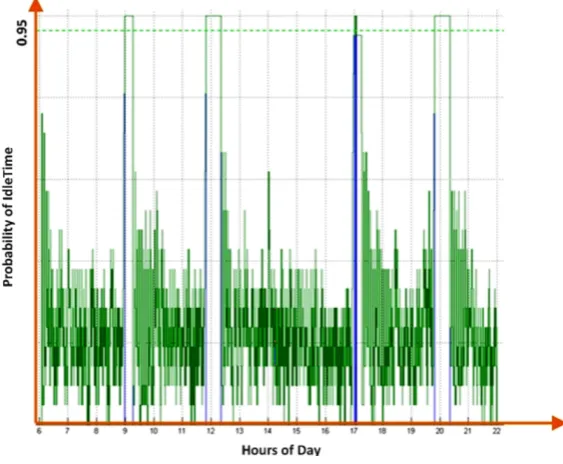
The Context Extractor monitors several machine control states in run-time of the manufacturing process and identifies the idle time patterns in different time domains. The Context Extractor receives raw-data via the Data Access Layer and identifies the idle times, i.e. deduces high-level information from the received low-level raw data and checks the context consistency and reliability as well. Context Extractor encapsulates all identified machine idle times in a standardized meta-data model and notifies the Optimizer that the context has changed. The machine tool data are classified in time domain (see Fig. 6). The identified idle times are sent to the Optimizer which proposes possible scheduling for energy saving tasks to be executed during the identified idle-times taking into account both their duration and the entire lifecycle of the machines and processes, i.e. taking into account the tasks executed in the past and various information describing the conditions under which the process is operating. The observation of the context, based on the data from CPS in processes, under which the machines/process are executed allows for modelling of machine tool behavior. This in turn allows to predict how the machine will be used in future and by this avoid setting of time-out, i.e. the machine can be shut-off once an idle time identified. Assuming that the characteristic wake up delay
is known, the machine can be turned on in advance, and by this avoid delays and potential losses in productivity of the processes. In addition, the model of the machine behavior gained allows identification of the most appropriate energetic states for the context under which the machine is operating.
Figure 6. Example of detected machine idle times
The proposed solution has been tested on data gathered from real machine installations. The context sensitive solution was fed with the provided data and by this the capability of the solution to recognize the idle times patterns and schedule machine energy saving tasks has been explored. The selected energy saving tasks were then communicated to the shop floor machines using an OPC-UA connection. The solution has been tested over a period of time showing good levels of reliability, feasibility and robustness. The results concerning the energy savings achieved as well as the loss of machine availability occurring by using the proposed solution are shown in Figure 7.
Figure 7. Energy saving result and machine availability
predict machine behavior. After this transient phase, the system stabilizes, i.e. the Optimizer learns based on the expert decisions along time and populates the learning model of the machine with new entries enhancing its capability to generalize.
As a result, the machine availability loss reduces along time approaching zero. Furthermore, the loss of availability along time goes to zero.
6.2. Availability and efficiency optimization at CPS based FMS
This experiment involved CPS based FMS in shoe industry. The production and manufacturing of shoes involves a wide variety of materials and a large number of operations. Such FMS comprise a set of complex operations that are labour intensive and are very dependent on the operator’s skill. The need for automatic recognition of current situations and continuous optimisation of processes has been identified by the producers of FMS for shoe industry.
The proposed solution has been integrated into real industrial equipment. The Context Extractor identifies current context of production process and reacts to changing of context caused by variations in different parameter sets in order to improve error-prone processes (caused by humans) and reduce maintenance problems.
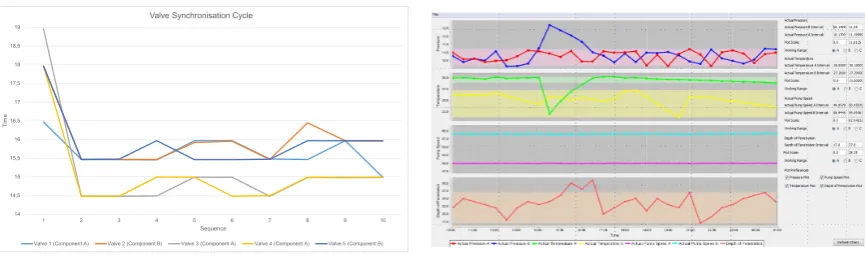
The selected experiment deals with a scenario in which the valves of a so called “mixing head” system shall be automatically adjusted based on the identified changing context. During the production process of shoe sole, different components are mixed by synchronously acting on different non-mechanical connected valves. The problem that arises after a vaguely defined time of shoe sole production, the valves get asynchronous. The influences that are causing the asynchronous operation of the valves are very different. Some of the cause are: different force requirements (due to changing products), different air supply, valve abrasion or operators skills. All of these skill are influence the quality of the final product. In the experiment the tested solution is continuously fed with manufacturing process parameters, which are collected from various CPS in the manufacturing process. These sets of parameters are used by the Optimizer to build a representative model of process relying on empirical data using data mining techniques. The parameters considered to build the model are the pressure and the temperature, speed frequencies of drives and pumps, proper material mix ratio and filling of materials into shoe forms etc.
The Context Extractor continuously tries to identify changing contexts. In case a changed context is identified, this context is sent to the Optimizer. The Optimizer starts an adaptation process, which results in a proposal for a set of production parameters to be changed. These Adaption proposal is evaluated by a human operator. Based on the results of adaptation and operator’s feedback, the learning services learn how changing cycle times and ambient conditions are influencing the production process (e.g. above explained valve synchronization) and update the rules for context identification, adaptation and extension.
Figure 8. Results of a Valve Sync. test run (initial experiment) [4]
Figure 9. Results of advanced Valve Synchronisation test run
The experiments have proven that the proposed solution when applied in control of FMS in shoe industry may assure keeping of the process parameters inside the optimum working range under wide spectrum of changes in conditions under which FMS operate. Applying the proposed solution for self-adaptation of machine parameters, leads to an increased efficiency and availability, i.e. it may assure high utilisation of machines and the product quality. Thereby changing ambient conditions are taken into account (identified changes in context).
7. Conclusion
The research presented in the paper resulted in an innovative context sensitivity solution to support run-time optimization of a wide scope of FMSs using run time information from CPS. The main benefit of the proposed generic solution is that it is easily adaptable to specific conditions of each system. The applicability of the solution for optimization of various parameters in two different manufacturing systems is demonstrated. The generic innovative context model has been proposed. The building and maintenance of the optimization solutions in both applications using the proposed approach is considerably more effective than building classical scattered solutions. Contrary to e.g. classical adaptive control solutions, the generic solution bringing intelligence into the manufacturing processes, are easily applicable to various machines/processes, gaining a higher benefit for the manufacturer:
• The time/efforts spent for building the both above described applications is estimated to be more than 60% less than time/efforts needed to build individual solution for each optimization. • The biggest advantages are seen in maintenance and extensibility of the solution: if the processes
and conditions change (which is often in FMS processes) the solution can be easily maintained/updated by extending the context model and perhaps adding/modifying certain monitoring services and rules for better context extraction and adaptation, but the overall structure of the optimization solution needs not to be changed. It is estimated that the costs for maintenance of such solution is more than 80% lower than for maintenance of classical solutions. • The benefit is that the proposed solution can be applied for a number (all) of optimization
processes within a factory, i.e. the company does not need to apply a high number of various solutions, which in turn may radically reduce development and maintenance costs of such solutions.
New applications of such approach for run-time optimization in FMS are elaborated.
Many research problems, however, are still under considerations. The decisions which raw data are worthy to on-line collect/provide by monitoring services (which means efforts/costs to integrate services with various systems that hold these data) in order to better extract the context and support optimization, have to be made on case basis and are specific for each applications. The methodology on how to analyze cost/benefit ratio for various applications is developed. The key research issues to be solved are how to refine the context models. Automatic update of the context model based on the observed changes in environment is a subject of the further research. Another problem under study
14 14,5 15 15,5 16 16,5 17 17,5 18 18,5 19
1 2 3 4 5 6 7 8 9 10
Ti
me
Sequence Valve Synchronisation Cycle
is how to assure better automatic evaluation and validation of the results to make learning process more autonomous.
Acknowledgement
This work is partly supported by the Self-Learning project of EU’s 7th FP, under the grant agreement no. NMP-2008-228857 and the PROSECO project of EU’s 7th FP, under the grant agreement no. NMP2-LA-2013-609143.This document does not represent the opinion of the European Community, and the Community is not responsible for any use that might be made of its content.
Author Contributions: S. Scholze and J. Barata conceived and designed the experiments; S. Scholze performed the experiments; S. Scholze and J. Barata analyzed the data; D. Stokic contributed in conceptual design; S. Scholze wrote the paper.
Conflicts of Interest: “The authors declare no conflict of interest". “The founding sponsors had no role in the design of the study; in the collection, analyses, or interpretation of data; in the writing of the manuscript, and in the decision to publish the results”.
References
[1] B. Shah, W. J., L. Viscito, Ross, M.A. and H. E.D., "Quantifying Flexibility for Architecting Changeble Systems," in 6th Conference on Systems Engineering Research, Los Angeles, 2008.
[2] A. Ross, D. Rhodes and D. Hastings, "Defining changeability: reconciling flexibility, adaptability, scalability, modifiability, and robustness for maintaining system lifecycle value.," Syst Eng, vol. 11, no. 3, p. 246–262, 2008.
[3] D. Stokic, S. Scholze and O. Kotte, "Generic Self-Learning Context Sensitive Solution for Adaptive Manufacturing and Decision Making Systems," in ICONS14 - The Ninth International Conference on Systems, Nice, France, 2014.
[4] S. Scholze and J. Barata, "Context Awareness for Flexible Manufacturing Systems using Cyber Physical Approaches," in Technological Innovation for Cyber-Physical Systems, 7th IFIP WG 5.5/SOCOLNET Advanced Doctoral Conference on Computing, Electrical and Industrial Systems, DoCEIS 2016, Costa de Caparica, Portugal, 2016.
[5] A. K. Dey, "Understanding and Using Context," Personal and Ubiquitous Computing Journal, vol. 1, no. 5, pp. 4-7, 2001.
[6] S. Scholze, D. Stokic and O. Kotte, "Cross-domain methods and tools for decision support services based on context sensitivity approach.," in 12th IEEE International Conference on Industrial Informatics - INDIN, Porto Alegre, 2014.
[7] L. Feng, P. Apers and W. Jonker, "Towards context-aware data management for ambient intelligence,"
Database and Expert Systems Applications, Proceedings, vol. 3180, pp. 422-431, 2004.
[8] P. Brézillon and A. J. Gonzalez, Context in Computing - A Cross-Disciplinary Approach for Modeling the Real World, New York: Springer Science+Business Media, 2014.
[9] M. K. Uddin, J. Puttonen, S. Scholze, A. Dvoryanchikova and J. L. M. Lastra, "Ontology-based context-sensitive computing for FMS optimization," Assembly Automation , vol. 32, no. 2, pp. 163-174, 6 4 2012.
[10] J. L. Bittencourt, R. Bonefeld, S. Scholze, D. Stokic, M. K. Uddin and J. Lastra, "Energy efficiency improvement through context sensitive self-learning of machine availability," in 9th IEEE International Conference on Industrial Informatics, Lisbon, Portugal, 2011.
[11] N. Chungooraa, R. I. Younga, G. Gunendranb, C. Palmera, Z. Usmana, N. A. Anjuma, A.-F. Cutting-Decellec, J. A. Hardinga and K. Casea, "A model-driven ontology approach for manufacturing system interoperability and knowledge sharing," in Computers in Industry, 2013.
[13] M. Ruta, E. Di Sciascio and G. Loseto, "Semantic-Based Enhancement of ISO/IEC 14543-3 EIB/KNX Standard for Building Automation," IEEE Transactions on Industrial Informatics, vol. 7, no. 4, pp. 731 - 739, 07 Nov. 2011.
[14] T. Gu, H. Pung and D. Zhang, "A service-oriented middleware for building context-aware services," in
Journal of Network and Computer Applications, 2005.
[15] T. Kindberg, . J. Barton, . J. Morgan, G. Becker, D. Caswell, P. Debaty, G. Gopal, M. Frid, V. Krishnan, H. Morris, J. Schettino, B. Serra and M. Spasojevi, "People, places, things: Web presence for the real world,"
Third IEEE Workshop on Mobile Computing Systems and Applications, 2000.
[16] K. Henricksen, J. Indulska and R. A., "Modeling Context Information in Pervasive Computing Systems,"
Proceedings of the First International Conference on Pervasive Computing, pp. 167-180, 2002.
[17] P. Moore, B. Hu, X. Zhu, W. Campbell and M. Ratcliffe, "A Survey of Context Modeling for Pervasive Cooperative Learning," in First IEEE International Symposium on Information Technologies and Applications in Education, ISITAE '07, 2007.
[18] C. Bettini, O. Brdiczka, K. Henricksen, J. Indulska, D. Nicklas, A. Ranganathan and D. Rib, "A survey of context modelling and reasoning.," Pervasive and Mobile Computing, vol. 6, pp. 161-180, 4 2010.
[19] S. Sattanathan, N. C. Narendra and Z. Maamar, "Ontologies for Specifying and reconciling Contexts of Web Services," Electronic Notes in Theoretical Computer Science, vol. 146, no. 1, pp. 43-57, 2006.
[20] M. Luther, B. Mrohs, M. Wagner, S. Steglich and W. Kellerer, Situational reasoning – a practical OWL use case, Chengdu, Jiuzhaigou: IEEE, 2005.
[21] S. Scholze, D. Stokic, J. Barata and C. Decker, "Context Extraction for Self-Learning Production Systems," in INDIN 2012, Beijing, 2012.
[22] S. Scholze, A. Correia and D. Stokic, "Novel Tools for Product-Service System Engineering," in 8th CIRP IPSS CONFERENCE, Bergamo, Italy, 2016.
[23] S. Scholze, A. Correia, D. Stokic, N. Nagorny and P. Spindler, "Tools for Human-Product Collaborative Development of Intelligent Product Service Systems," in PRO-VE 2016 - 17th Working Conference on Virtual Enterprises, Porto, Portugal, 2016.
[24] E. A. Lee, Cyber Physical Systems: Design Challenges, Berkeley: University of California, 2008.
[25] E. Geisberger and M. Broy, “agendaCPS: Integrierte Forschungsagenda Cyber Physical Systems, National Academy of Science and Engineering,” 2012.
[26] K. D. Bettenhausen and S. Kowalewski, Cyber Physical Systems: Chancen und Nutzen aus Sicht der Automation in: Thesen und Handlungsfelder, 2013.
[27] S. Khaitan and J. McCalley, "Design Techniques and Applications of Cyberphysical Systems: A Survey,"
Systems Journal, vol. 9, no. 2, pp. 350 - 365, 22 May 2015.
[28] K.-J. Park, R. Zheng and X. Liu, "Cyber-physical systems: Milestones and research challenges," Journal of Computer Communications, vol. 36, no. 1, pp. 1-7, December 2012.
[29] S. Gao, H. Luo, D. Chen, S. Li, P. Gallinari, Z. Ma and J. Guo, "A Cross-Domain Recommendation Model for Cyber-Physical Systems," Transactions on Emerging Topics in Computing, vol. 1, no. 2, pp. 384 - 393, 21 Jan 2014.
[30] P. Herzum, "Web Services and Service-Oriented Architectures," Cutter Distributed Enterprise Architecture Advisory Service, Executive Re-port, vol. 4, no. 10, 2002.
[31] A. Girbea, C. Suciu, S. Nechifor and F. Sisak, "Design and Implementation of a Service-Oriented Architecture for the Optimization of Industrial Applications," IEEE Transactions on Industrial Informatics,
vol. 1, pp. 185-196, Feb. 2014.
[32] S. Han, L. Gyu Myoung and N. Crespi, "Semantic Context-Aware Service Composition for Building Automation System," IEEE Transactions on Industrial Informatics, vol. 10, no. 1, pp. 752 - 761, 12 March 2013.
[33] L. Ribeiro, J. Barata and J. Ferreira, The Meaningfulness of Consensus and Context in Diagnosing Evolvable Production Systems, vol. 314, Springer Berlin Heidelberg, 2010, pp. 143-150.
[35] A. Lee and J. Martinez Lastra, "Enhancement of industrial monitoring systems by utilizing context awareness," in IEEE Conference on Cognitive Methods in Situation Awareness and Decision Support, San Diego, 2013.
[36] D. Stokic, S. Scholze and J. Barata, "Self-learning embedded services for integration of complex, flexible production systems," in IECON 2011 - 37th Annual Conference on IEEE Industrial Electronics Society, Melbourne, 2011.
[37] G. Di Orio, G. Cândido, J. Barata, S. Scholze, O. Kotte and D. Stokic, "Self-Learning approach to support lifecycle optimization of Manufacturing processes.," in IECON 2013-39th Annual Conference of the Industrial Electronics Society, 2013.
[38] G. Candido, A. Colombo, J. Barata and F. Jammes, "Service-Oriented Infrastructure to Support the Deployment of Evolvable Production Systems," IEEE Transactions on Industrial Informatics, vol. 7, no. 4, pp. 759 - 767, 05 Sept. 2011.
[39] S. Scholze, D. Stokic, O. Kotte, J. Barata, G. Di Orio and G. Candido, "Reliable Self-Learning Production Systems Based on Context Aware Services," in 2013 IEEE International Conference on Systems, Man, and Cybernetics, 2013.
© 2016 by the authors; licensee Preprints, Basel, Switzerland. This article is an open access article distributed under the terms and conditions of the Creative Commons by