Type of the Paper (Article.)
1
Does glutamine concentration depends on the type of
2
the operation?
3
Aleksandra Rozowicz1, Krzysztof Kusza2 , Marlena Jakubczyk1, Piotr Kośliński3, Paulina
4
Szatkowska-Wandas3, Katarzyna Wawrzyniak1, Marcin Koba3 , Jacek Szopinski4 and Pawel
5
Jakubczyk5
6
1* Department of Anaestesiology and Intensive Therapy, UMK in Toruń - Collegium Medicum in Bydgoszcz,
7
86-094 Bydgoszcz, Poland; [email protected]
8
2 Department of Anaestesiology and Intensive Therapy, University of Medical Sciences in Poznan, 86-094
9
Bydgoszcz, Poland
10
3 Department of Toxicology, UMK in Toruń - Collegium Medicum in Bydgoszcz, 86-094 Bydgoszcz, Poland
11
4 Department of Anaestesiology and Intensive Therapy, UMK in Toruń - Collegium Medicum in Bydgoszcz,
12
86-094 Bydgoszcz, Poland
13
5 10th Military Research Hospital and Polyclinic. Independent Public Healthcare Centre in Bydgoszcz
14
15
* Correspondence: [email protected]; Tel.: +48-52-52 - 5854750
16
Abstract: Glutamine is the main amino acid which is substrate for gluconeogenesis in postoperative
17
period. It is suggested that this leads to a substantial and a long-term decline in glutamine
18
concentration. Glutamine is a source of energy for the synthesis of nucleotides, lymphocytes and
19
cells of gastrointestinal tract. In this study, 79 patients were qualified to a coronary artery bypass
20
surgery (Group I) or a surgery in the large intestine area (Group II). The objectives of this study
21
were: evaluation of the impact of surgical procedures on the serum concentration of glutamine of
22
the operated patients, assessment of gender, weight and BMI impact on glutamine concentration
23
and analysis of the correlation between glutaminę serum concentration and laboratory parameters.
24
The mean concentration of glutamine before surgery, the 3rd and 5th day after surgery was higher
25
in Group I. CRP level in the 3rd and 5th postoperative day was higher in Group II. There were no
26
significant differences betweengroups when it comes to BMI and the concentration of CRP (p <0.05).
27
Glutamine concentration depends on the severity of inflammation, the operated body cavity and
28
the intensified catabolism which results from different pathophysiology of digestive system
29
diseases and coronary arterial disease.
30
Keywords: glutamine; perioperative period; bypass surgery; intestine surgery; HPLC
31
32
1. Introduction
33
Metabolic response to stress (ie. a surgical procedure) significantly affects protein turnover in the
34
body. It is regulated by catabolic hormones such as catecholamines, corticosteroids and glucagon.
35
In addition, activities of cytokines, antioxidants, and eicosanoids change. Supplying energy to the
36
cells which significantly increase their activity is the paramount goal in the stress- or
surgery-37
induced illness. In the postoperative period demand for protein increases significantly - even up to
38
300% in reference to the demands under physiological conditions [1]. Due to a widespread use and
39
occurrence of proteins in the body, the deficiency of particular amino acids may contribute to
40
disturb many biochemical processes. As a result of homeostasis deterioration it can lead to
41
dysfunction of individual systems such as immunological, digestive, hematopoietic or
42
neuroendocrine system.
43
Glutamine is the main amino acid which is known to be substrate for gluconeogenesis in
44
postoperative period. It is suggested that this leads to a substantial and a long-term decline in
45
glutamine concentration. It may be a co-factor leading to immunosuppression immediately after a
46
surgery, because glutamine is a source of carbon and nitrogen for the synthesis of nucleotides,
47
lymphocytes and cells of gastrointestinal tract [2]. Another factor influencing the deficit of
48
glutamine is the lowered rate of its synthesis - hence it is called a conditionally essential amino acid
49
[3]. Glutamine synthetase expression depends on the total concentration of glutamine in the body.
50
The glutamine reserves in muscles are directly proportional to the total muscle mass. The bigger
51
muscle mass is the higher amount of glutamine is accessible for metabolic processes. Therefore it is
52
suggested that people who retain a relatively large muscle mass may have a greater ability to
53
regenerate during metabolic stress of various origin (surgery, infection) [4,5,6]. Apart from a
54
pharmacotherapy, a proper nutritional therapy is one of the elements that modulate the body's
55
response to injury, providing essential building and energy nutrients, as well as vitamins and
56
minerals necessary to maintain homeostasis. Glutamine is the source of energy for rapidly dividing
57
cells, including villi cells of the small intestine (enterocytes) and large intestine (colonocytes) [7].
58
This amino acid has a beneficial effect on the integrity of intestinal mucosa and prevents bacterial
59
translocation [8,9]. Additionally, glutamine prevents from atrophy of intestinal epithelial cells,
60
stimulates their proliferation and reduces the permeability of the intestinal epithelium. It
61
determines the integrity of particular building structures [10,11]. Glutamine stimulates appropriate
62
functioning of the immune system connected with gastrointestinal tract (GALT- Gut-Associated
63
Lymphoid Tissue). GALT is responsible for protecting human gastrointestinal tract against
64
antigens and extraneous micro-organisms which can penetrate into it. Moreover, it secures the
65
balance of bacterial flora as well as the integrity of the mucosa. Glutamine is preferred nutrient for
66
rapidly dividing cells, which in relation to function of the immune system is important for
67
lymphocyte population [7]. Glutamine's impact on the functioning of the immune system finds
68
expression mainly in the quantitative changes in T lymphocytes population [12]. Glutamine is also
69
essential source of energy used to produce macrophages, and may trigger anti-inflammatory effect
70
indirectly by having the influence on production of IL-6 (Interleukin-6) and TNF-α (Tumor Necrosis
71
Factor α) [13,14]. Glutamine deficiency probably increases the rate of cells apoptosis and reduces
72
the ability of the immune system reaction to pro-inflammatory cytokines [15]. The aim of this study
73
was to measure changes in glutamine concentration in blood serum depending on the type of the
74
surgery performed. The research also introduced the analysis of the relationship between
75
glutamine concentration in blood serum and examined laboratory (C-reactive protein, albumin,
76
total protein), anthropometric parameters, taking into consideration the particularly selected
77
inflammation indicators (C-reactive protein).
78
2. Materials and Methods
79
I. Patients selection
80
The research was conducted in 2015 and 2016, among 79 inpatients aged between 35 and 84 (an
81
average age 59 ± 12). Men accounted 52% for all patients (N=41) and women accounted 48% for all
82
patients (N=38) who were hospitalized at the University Hospital in Bydgoszcz. They all were
83
qualified to a coronary artery bypass surgery (Group I- 40 patients) or a surgery of the large intestine
84
(Group II - 17 patients).
85
Group I – patients scheduled for OPCABG (Off Pump Cardiac Artery Bypass Grafting). It is a
86
surgical procedure for ischaemic heart disease.
87
Group II – patients scheduled for right hemicolectomy. This is an operation to remove the right
88
side of the colon in group of patients with colon cancer.
89
Patients selected to the study must have fulfilled the following conditions:
90
1. the surgery of the gastrointestinal tract or the coronary artery bypass surgery without
91
cardiopulmonary bypass had to be performed as scheduled
92
2. good nutritional status before the surgery ( <3 points in the scale of NRS 2002)
93
The excluding criteria were as follows:
94
1. long-term comorbidities: diabetes type 1 and 2, liver diseases, autoimmune disorders
95
(to standardize the group of patients),
96
3. a lack of consent to participate in the study.
98
II. Serum collection
99
The material for this research was peripheral blood collected in the morning before surgery and
100
on postoperative days 3 and 5. Before surgery we measured: the serum glutamine concentration, C-
101
reactive protein level, nutritional status before surgery (total protein level and albumin concentration
102
in serum) in both group. On postoperative days we measured: the serum glutamine concentration
103
and C-reactive protein.
104
III. Chemicals and Materials
105
AccQ Fluor Reagent Kit (Waters), amino acid standards (Waters), amino acid standards
106
(Waters), internal standard α-aminobutyric acid (Sigma Aldrich) acetonitrile and methanol (Sigma
107
Aldrich). Deionized water, purified with Direct–QUV (Millipore, France) system was used for all
108
aqueous solutions.
109
IV. Sample preparation
110
Preparation of serum for chromatographic analysis included deproteinization and derivatisation
111
of the sample. For the serum deproteinization, Phree Phospholipid Removal Solutions, with solid
112
phase extraction kit, were used. The prepared serum samples were subjected to a derivatisation
113
procedure in accordance with the Waters AccQ Tag method.
114
V. Chromatographic method
115
Chromatographic analysis, which was aimed at measuring the glutamine concentration in the
116
examined samples, was carried out using the high-performance liquid chromatography (HPLC) with
117
fluorescence detection using AccQ Tag column (Waters). An example chromatographic separation of
118
amino acids, using the AccQ Fluor Reagent Kit.
119
VI. Statistical analysis
120
Statistical analysis was carried out using a software called STATISTICA 12.0 (StatSoft).
121
Differences considered to be statistically significant were those with the value of p <0.05.
122
Compatibility of distribution of particular features with the normal distribution was examined by the
123
Shapiro-Wilk test (X ± SD). Incompatible parameters' values with the normal distribution were
124
presented as median (Me), lower and upper quartile (Q1-Q3). The analysis of differences between the
125
measured parameters in the respective groups was conducted using t-student test for parameters
126
which were compatible with the normal distribution and non-parametric U Mann-Whitney test for
127
parameters which varied from the normal distribution. For the analysis of differences in specified
128
subgroups we used test of Wilcoxon or Spearman coefficient (R).
129
The study was approved by the Bioethics Committee of the Nicolaus Copernicus University in
130
Torun, Ludwik Rydygier Collegium Medicum in Bydgoszcz (KB 355/2013).
131
3. Results
132
The results for preoperative period are presented in Table 1. The analysis of the glutamine
133
concentration as well as selected anthropometric and laboratory parameters in Group IOPCABG
134
surgery (Off Pump Cardiac Artery Bypass Grafting) and in Group II (large intestine surgery) shows
135
statistically significant higher level of glutamine in Group I (p=0.002). There were no significant
136
differences between both groups when it comes to body mass index (BMI) and the concentration of
137
C-reactive protein (Table 1).
138
Table 1. The concentration of glutamine and selected anthropometric and laboratory parameters in
141
Groups I and II preoperatively
142
143
Parameter
I Group (before OPCABG)
N = 40
II Group
(before the surgery in the large
intestine area)
N = 17 P
Me/
X
Q1;Q3/
±SD
Me/
X
Q1;Q3/
±SD
Glutamine
[pmol/µl] 85.43 65.62; 104.39 60.70 37.74; 72.89 0.001
Age
[years] 65.20 ±7.13 64.58 ±12.06 0.812
BMI
[kg/m2] 28.30 26.35; 30.08 25.65 23.94; 28.06 0.008
Albumin [mg/dl] 4.31 ±0.22 4.07 ±0.26 0.001
Total protein
[mg/dl] 7.20 6.95; 7.40 6.80 6.40 – 7.00 0.002
CRP
[mg/l] 1.09 0.68; 1.27 1.05 0.52; 1.20 0.588
Pearson correlation analysis in the general examined group showed a positive correlation (r=0.385)
144
and statistically significant correlation between albumin and glutamine concentration (p= 0.005)
145
before surgery.
146
Patients from Group I had higher concentration of glutamine on the 3rd postoperative day in
147
comparison to patients from Group II. However, these differences were not statistically significant.
148
On the other hand, we observed higher concentration of C-reactive protein in Group I than Group II
149
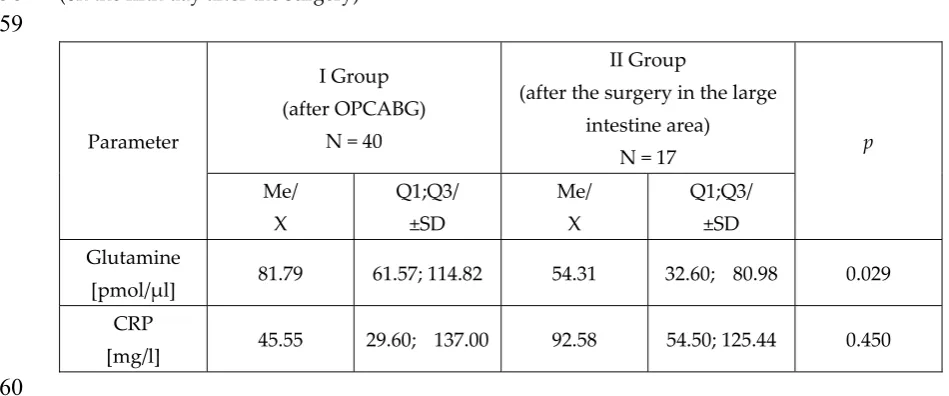
(p=0.047) (Table 2). On the 5th postoperative day, statistically significant higher level of glutamine
150
was observed in Group I (p=0.029). There was no statistically significant difference in the
151
concentration of CRP between groups. (Table 3).
152
Table 2. Comparison of the glutamine concentration and laboratory parameters in examined groups
153
(on the third day after the surgery)
154
155
Parameter
I Group (after OPCABG)
N = 40
II Group
(after the surgery in the large
intestine area)
N = 17 p
Me/
X
Q1;Q3/
±SD
Me/
X
Q1;Q3/
±SD
Glutamine
[pmol/µl] 70.35 47.33; 96.32 63.65 41.99; 80.34 0.326
CRP
[mg/l] 189.13 147.14; 231.77 130.01 57.21; 173.13 0.047
Table 3. Comparison of the glutamine concentration and laboratory parameters in examined groups
157
(on the fifth day after the surgery)
158
159
Parameter
I Group (after OPCABG)
N = 40
II Group
(after the surgery in the large
intestine area)
N = 17 p
Me/
X
Q1;Q3/
±SD
Me/
X
Q1;Q3/
±SD
Glutamine
[pmol/µl] 81.79 61.57; 114.82 54.31 32.60; 80.98 0.029
CRP
[mg/l] 45.55 29.60; 137.00 92.58 54.50; 125.44 0.450
160
4. Discussion
161
One of the elements of comprehensive approach to surgical treatment is to draw attention to the
162
proper nutritional status of patients. Nowadays, knowledge of the physiopathology of phenomena
163
occurring in the digestive system in the perioperative period has significantly increased. The
164
alimentary tract and GALT play an important role in mechanisms which help to maintain system
165
homeostasis. Glutamine in the postoperative period is mainly used by enterocytes and GALT cells,
166
so that it consequently improves the immune response of the system [16]. In recent years, much
167
attention has been paid to research aimed at increasing the effectiveness of nutritional therapy in
168
the perioperative period, with particular focus on potentially immunomodulatory components.
169
During an assessment of the concentration of glutamine in the preoperative period in the inpatients'
170
groups (Group I vs. Group II), it was observed that statistically significant higher level of glutamine
171
concentration occurred among the patients admitted for OPCABG (Group I), compared to the ones
172
admitted to comply right sided hemicolectomies (Group II). A factor that may influence the
173
increase in glutamine concentration in blood serum in Group I can be the long-term
174
inflammation in intima and in the middle velum of coronary arteries. Gastrointestinal tract diseases
175
may potentially be associated with chronic disorders of digestion and absorption of nutrients,
176
which may lead to the occurrence of nutrients' deficiencies, including a reduction in glutamine
177
concentration that plays a key role in the proper functioning of the intestinal villi. Xu et al.
178
investigate the protective effect of glutamine supplementation on intestinal villi in hypobaric
179
hypoxia environment vs. normal control group. Hypoxia may induce severe primary intestinal
180
barrier dysfunction, because intestinal microvilli are extremely sensitive to that parameters [17].
181
Glutamine play a special role in maintaining mucosal structure and probably may have a special
182
effects on the maintenance of tight junction and permeability of the intestinal mucosa. In conclusion
183
glutamine may play key role in protecting the human intestinal mucosal [18].
184
Hensley et al. compared glutamine metabolism in heath and cancer. Glutamine consumption occurs
185
largely in the kidney and gut, particularly the small intestine, in group of healthy people. Cancer
186
change pathway of glutamine metabolism from gut and kidney to skeletal muscle and greatly
187
increases the release of glutamine into the circulation. Simultaneously, intramuscular glutamine
188
pool are depleted in association with loss of lean muscle mass, which can remind cancer-cachexia
189
The study Nakazato et al., showed also lower values of the glutamine concentration in blood serum
191
in the control group in relation to the group of all examined patients with anorexia nervosa. One
192
possibility is that in anorexia nervosa, raised serum glutamine is a compensatory metabolic
193
response due to malnutrition[20]. In this study, basing on the results, pose a statement that
194
glutamine may be a biomarker of the systemic inflammation's severity, hence the increased values
195
in the control group compared to the group of healthy individuals can be justified by a generalized
196
atherosclerosis among patients from the Group I.
197
In the preoperative period, the own study shows statistically significant and directly proportional
198
relation between glutamine and albumin concentration. The quoted studies which involved
199
patients undergoing surgeries of the gastrointestinal tract, especially in the colon area, also
200
indicated the interrelation between glutamine and albumin concentration [21]. Experimental studies
201
on rats fed parenterally with a mixture of standard amino acids, or a mixture of amino acids with
202
glutamine have shown significantly higher concentration of albumin in the group supplemented
203
with glutamine [22]. In the perioperative period, the importance of glutamine for albumin
204
concentration may result from the fact that glutamine participates in the proper functioning of the
205
immune system and supports anti-inflammatory processes. Lack of inflammation does not move
206
glutamine and albumin metabolism in the direction of protein reserves consumption to produce
207
acute phase proteins.
208
The analysis of glutamine concentration was conducted also on the third and the fifth day after the
209
surgery. In our study the decline in glutamine concentration in blood serum was observed among
210
inpatients from Group I (OPCABG) on the third day after the surgery, compared to the
211
preoperative period. The studies performed on patients undergoing surgeries, have shown the
212
influence of the extent of the surgery on the glutamine concentration reduction. Concentration
213
decrease of this amino acid comes after the injury in the short time, as a result of glutamine
214
distribution for increased metabolic needs of the immune system [23].
215
In our study, the analysis of glutamine concentration on the 5th postoperative day in Group I
216
showed an upward trend and a return to output values observed before performing the procedure.
217
The increase in glutamine concentration up to the preoperative level may suggest an endogenous
218
glutamine's reserves rebuilding.
219
An additional factor influencing the return to output values may be the fact that the operation
220
included only the chest area without disrupting the continuity of the intestinal lumen and without
221
temporary motility inhibition caused usually by abdominal surgery.
222
Moreover, the glutamine concentration in blood serum on the 3rd postoperative day in Group II
223
has increased compared to pre-surgery values. Similar results were obtained by Poschke team,
224
studying patients with breast cancer during the perioperative period. According to researchers, the
225
increase in some amino acids concentration, including glutamine, was dependent on the scope of
226
the surgery. The hypothesis explaining the fact of the higher glutamine concentration in blood
227
serum after surgery may be mobilization of glutamine reserves associated with muscle tissue
228
proteins and transporting them to peripheral blood to use amino acid by rapidly dividing cells such
229
as enterocytes and lymphocytes [24].
230
Among inpatients from Group II, operated on the large intestine, the analysis of glutamine
231
concentration on the fifth day after the surgery has revealed that the concentration of this amino
232
acid decreased compared to the output value and the value obtained on the third day after the
233
surgery. The decrease of glutamine concentration in this group of patients, in reference to previous
234
analyses, suggests increased system requirements for this amino acid, resulting from intensified
235
production of proinflammatory cytokines and acute phase proteins, which is typical for surgeries of
236
A meta-analysis of randomized studies, including patients undergoing abdominal surgery fed
238
parenterally with standard formula and the group of patients fed parenterally with addition of
L-239
alanyl-L-glutamine showed the benefits of using glutamine such as shorter hospital stay and less
240
infections. However, there was no reduction in mortality in the group that received the addition of
241
glutamine to the nutrition formula [25].
242
C-reactive protein (CRP) as an index of inflammation can be considered as a parameter reflecting
243
the intensification of inflammation [26]. Activation of pro-inflammatory response in reaction to a
244
surgery had the impact on glutamine concentration examined on the third day after the surgery.
245
The increase of C-reactive protein concentration was accompanied by reduction in glutamine
246
concentration in blood serum. The study of Pan et al. also introduced an inverse relationship: with
247
an increase of CRP concentration the glutamine concentration decreases [22]. Changes in these
248
parameters confirm the consumption of glutamine for the production of pro-inflammatory proteins
249
in response to an injury. Due to the fact that glutamine is the energy source for rapidly proliferating
250
cells, it has the beneficial impact on proper functioning of the immune system.
251
The decrease in CRP concentration was observed on the fifth day after the surgery. The decline in
252
CRP concentration was higher in the group of inpatients who had undergone the surgery of
253
coronary artery bypass in reference to the values recorded in the group of inpatients after the
254
surgery of the large intestine. The Group I obtained nearly fourfold decrease in CRP level
255
concerning the value reached on the third postoperative day. In the Group II CRP level also
256
decreased, however in this group the decrease of C-reactive protein concentration wasn't so high.
257
In our study, patients undergoing the OPCABG surgery were extubated and left to spontaneous
258
breathing on average 16 hours after the surgery. On the day of extubation oral feeding was
259
initiated, beginning from water to complete diet according to tolerance. Patients undergoing the
260
large intestine surgery, were extubated and left to spontaneous breathing two hours after the
261
surgery. This condition is connected to the acceleration of metabolism and the activation the
262
respiratory muscles that is further associated with the maintenance of a strict diet as well as with a
263
negative energy balance and nitrogenous balance. The beginning of feeding using gastrointestinal
264
tract took place on average on the fourth day after surgery in Group II. The nutrition started from a
265
hypocaloric liquid diet which was successively moved to normal diet within few days. The diet
266
might have been one of the factors that leaded to quicker increase in glutamine concentration
267
after surgery and faster return to the normal glutamine levels in the blood serum.
268
5. Conclusions
269
Comparing the patients who undergo the surgery of large intestine with the patients who undergo
270
the coronary artery bypass grafting, it is concluded that the former group of patients showed the
271
lower glutamine concentration in blood serum. It may result from the violation of the integrity of
272
the gastrointestinal tract that consequently leads to prolong time to return to its physiological
273
function. Glutamine concentration depends on the severity of inflammation. The lower glutamine
274
concentration in blood serum observed in patients undergoing the surgery in the area of large
275
intestine suggest that the system is demanding for glutamine in perioperative period. The
276
demand for glutamine depends on the operated body cavity and the intensified catabolism which
277
results from different pathophysiology of digestive system diseases and coronary arterial diseases.
278
Author Contributions: A.R., M.J. and K.K. conceived and designed the experiments; A.R., M.J. performed the
279
experiments; M.J. and P.J. analyzed the data; P.K., P.S.-W. and P.K. contributed reagents/materials/analysis tools;
280
A.R., K.W. and J.S. wrote the paper. All authors read and approved the final version of the manuscript.
281
Conflicts of Interest: The authors declare no conflict of interest.
282
References
284
1. Sobotka L. Basic of clinical nutrition. Prague: Galen; 2013.
285
2. Oliveira GP, Dias CM, Pelosi P, Rocco PR. Understanding the mechanisms of glutamine action in critically
286
ill patients. An Acad Bras Cienc. 2010;82(2):417-430. doi: 10.1590/S0001-37652010000200018
287
3. Labow BI, Souba WW. Glutamine. World J Surg. 2000;24(12):1503-1513.
288
4. Zheng Y, Li F, Qi B, Luo B, Sun H, Liu S, Wu X. Application of perioperative immunonutrition for
289
gastrointestinal surgery: a meta-analysis of randomized controlled trials. Asia Pac J Clin Nutr.
290
2007;16(1):253-257.
291
5. Braga M, Ljungqvist O, Soeters P, Fearon K, Weimann A, Bozzetti F. ESPEN Guidelines on Parenteral
292
Nutrition: surgery. Clin Nutr. 2009;28(4):378-386. doi: 10.1016/j.clnu.2009.04.002
293
6. Weimann A, Braga M, Harsanyi L, Laviano A, Ljungqvist O, Soeters P et al. ESPEN Guidelines on Enteral
294
Nutrition: Surgery including organ transplantation. Clin Nutr. 2006;25(2):224-244. doi:
295
10.1016/j.clnu.2006.01.015
296
7. Schlemmer M, Suchner U, Schapers B, Duerr EM, Alteheld B, Zwingers T, Stehle P, Zimmer HG. Is
297
glutamine deficiency the link between inflamation, malnutrition, and fatigue in cancer patients? Clin Nutr.
298
2015;34:1258-1265. doi: 10.1016/j.clnu.2014.12.021
299
8. Wang B, Wu G, Zhou Z, Dai Z, Sun Y, Ji Y et al. Glutamine and intestinal barrier function. Amino Acids.
300
2015;47:2143–2154. doi: 10.1007/s00726-014-1773-4
301
9. Neu J, DeMarco V, Li N. Glutamine: clinical applications and mechanisms of action. Curr Opin Clin Nutr
302
Metab Care. 2002;5:69-75.
303
10. Thomson AB, Keelan M, Thiesen A, Clandinin MT, Ropeleski M, Wild GE. Small bowel review: diseases of
304
the small intestine. Dig Dis Sci. 2001;46:2555-2566.
305
11. Mondello S, Galuppo M, Mazzon E, Domenico I, Mondello P, Carmela A, Cuzzocrea S. Glutamine
306
treatment attenuates the development of ischaemia/reperfusion injury of the gut. Eur J Pharmacol.
307
2010;643(2-3):304-315. doi: 10.1016/j.ejphar.2010.06.044.
308
12. Engel JM, Pitz S, Mühling J, Menges T, Martens F, Kwapisz M, Hempelmann G. Role of glutamine
309
administration on T-cell derived inflammatory response after cardiopulmonary bypass. Clin Nutr.
310
2009;28(1):15-20. doi: 10.1016/j.clnu.2008.08.007.
311
13. O'Riordain MG, Fearon KC, Ross JA, Rogers P, Falconer JS, Bartolo DC, Garden OJ, Carter DC.
Glutamine-312
supplemented total parenteral nutrition enhances T-lymphocyte response in surgical patients undergoing
313
colorectal resection. Ann Surg. 1994;220(2):212-221.
314
14. Parry-Billings M, Evans J, Calder PC, Newsholme EA. Does glutamine contribute to immunosuppression
315
after major burns? Lancet. 1990;336(8714):523-525.
316
15. Eliasen MM, Brabec M, Gerner C, Pollheimer J, Auer H, Zellner M, Weingartmann G, Garo F, Roth E, Oehler
317
R. Reduced stress tolerance of glutamine-deprived human monocytic cells is associated with selective
318
down-regulation of Hsp70 by decreased mRNA stability. J Mol Med. 2006;84(2):147-158. doi:
319
10.1007/s00109-005-0004-6.
320
16. Li J, King BK, Janu PG, Renegar KB, Kudsk KA. Glycyl-L-glutamine-enriched total parenteral nutrition
321
maintains small intestine gut-associated lymphoid tissue and upper respiratory tract immunity. J Parenter
322
Enteral Nutr. 1998;22(1):31-36. doi: 10.1177/014860719802200131
323
17. Xu CL, Sun R, Qiao XJ, Xu CC, Shang XY, Niu WN. Protective effect of glutamine on intestinal injury and
324
bacterial community in rats exposed to hypobaric hypoxia environment. World J Gastroenterol 2014;
325
20(16): 4662-4674. doi: 10.3748/wjg.v20.i16.4662
326
18. Daniele B, Perrone F, Gallo C, Pignata S, De Martino S, De Vivo R, Barletta E, Tambaro R, Abbiati R,
327
D’Agostino L. Oral glutamine in the prevention of fluorouracil induced intestinal toxicity: a double blind,
328
placebo controlled, randomised trial. Gut. 2001;48:28-33. http://dx.doi.org/10.1136/gut.48.1.28
329
19. Hensley CT, Wasti AT, DeBerardinis RJ. Glutamine and cancer: cel biology, physiologym and clinical
330
opportunities. J Clin Invest. 2013; 123(9): 3678-3684. doi: 10.1172/JCI69600
331
20. Nakazato M, Hashimoto K, Schmidt U, Tchanturia K, Campbell IC, Collier DA, Iyo M, Treasure J. Serum
332
glutamine, set-shifting ability and anorexia nervosa. Ann Gen Psychiatry. 2010;9:29. doi:
10.1186/1744-333
859X-9-29.
334
21. Viggiano E, Passavanti MB, Pace MC, Sansone P, Spaziano G, Viggiano A, Aurilio C, Monda M, Vigianno
335
A, Pota V, De Luca B, De Luca E. Plasma glutamine decreases immediately after surgery and is related to
336
22. Pan YP, Chang PH, Fan CW, Tseng WK, Huang JS, Chen CH, Chou WC, Wang CH, Yeh KY. Relationship
338
between pre-treatment nutritional status, serum glutamine, arginine levels and clinicopathological features
339
in Taiwan colorectal cancer patients. Asia Pac J Clin Nutr. 2015;24(4):598-604. doi:
340
10.6133/apjcn.2015.24.4.23.
341
23. Magalhaes CR, Malafaia O, Torres OJ, Moreira LB, Tefil SC, Pinherio Mda R, Harada BA. Liver
342
regeneration with l-glutamine supplemented diet: experimental study in rats. Rev Col Bras Cir.
343
2014;41(2):117-121.
344
24. Poschke I, Mao Y, Kiessling R, de Boniface J. Tumor-dependent increase of serum amino acid levels in
345
breast cancer patients has diagnostic potential and correlates with molecular tumor subtypes. J Transl
346
Med. 2013;11:290. doi: 10.1186/1479-5876-11-290.
347
25. Yue C, Tian W, Wang W, Huang Q, Zhao R, Zhao Y, Li Q, Li J. The impact of perioperative
glutamine-348
supplemented parenteral nutrition on outcomes of patients undergoing abdominal surgery: a
meta-349
analysis of randomized clinical trials. Am Surg. 2013;79(5):506-513.
350
26. Strzelczyk J., Wasiak J., Modzelewski B. Monitoring of C-reactive protein for early detection of
351
complications after surgery. Pol Przegl Chir. 1994;66,4: 352−357.
352