Society and technology diffusion theories
and frameworks: the case of Information
and Communication Technology (ICT)
adoption in hotels and associated business
in Addis Ababa, Ethiopia
Wegene Demeke
|
[email protected]
The School of Computing and Technology
University of West London
This paper reports on the current discussion of the use of theory in research.
A number of existing theories are explored and discussed in the context of a study
of the adoption of Information and Communication Technology (ICT) by hoteliers
and tour operators in Addis Ababa, Ethiopia. It explores the existing theoretical
frameworks that explain the relationship between society and technology; it
identifies a selection criterion to find a theoretical framework that explains the
main factors for the adoption of ICT. Furthermore, it reports how Rogers’ theory of
diffusion was assessed and selected to be used as a basis for formulating a new
theoretical framework. The paper aims to share experience on how the selection
and development of a modified theoretical framework for the particular research
context was achieved. The modified theoretical framework, which may be used in a
similar context in developing countries, is presented.
Keywords
Introduction
Many international organisations advocate the role of ICT as a catalyst for development and poverty reduction. The United Nations (UN) recognise this and passed resolution 56/258. The core of this resolution is as follows:
‘Recognising that information and
communication technologies are among the critical determinants for creating a global knowledge-based economy, accelerating growth, raising competitiveness, promoting sustainable development, eradicating poverty and facilitating the effective integration of all countries into the global economy’,
UN general assembly resolution 56/258, 2001
There is no clear way in which ICT can be utilised to bring about development and reduce poverty. The current research discourse on ICT indicates that at least four different emphases are expressed. The first focuses on Gross Domestic Product growth (GDP). Easterly (2006) and Saches (2005) put the emphases on ICT to increase GDP and as a result reduce poverty and increase development. The second emphasis is on ICT to create empowerment for the poor and the disadvantaged to pull themselves out of poverty (Unwin, 2007). The third discourse emphases the capacity of ICT to create a networked society (Castells, 2010) to influence the political and social sphere of society and thus reduce poverty. The fourth emphasis focuses on ICT to create a Gross National Happiness (GNH) (Heeks, 2012). According to Heeks, ICT can create a condition, for example by creating job opportunities for the jobless, to create happiness for the individual. It is important to focus effort on aligning ICT to the particular emphasis so as to realise the potential of ICT. It is wise to note that there may not be one dominant effect. For example the emphasis on GDP can also bring about GNH by creating jobs and work satisfaction.
However, ICT has to be diffused in society to have the desired effects such as generating development, reducing poverty, empowering the poor and the disadvantaged, creating a networked society or to generate a high level of GNH. The diffusion of ICT is increasing in developing countries but the diffusion in Ethiopia is low compared to even the sub-Saharan region.
Ethiopia and current ICT diffusion
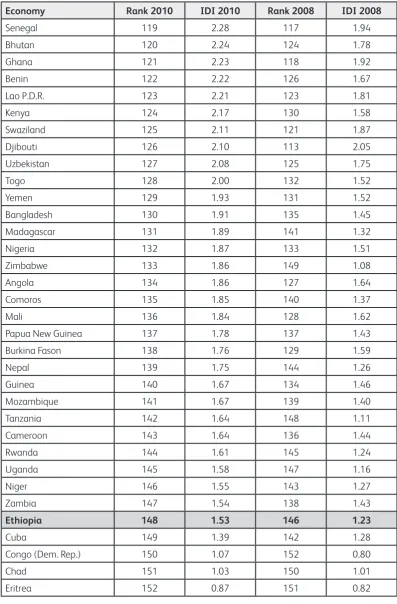
Economy Rank 2010 IDI 2010 Rank 2008 IDI 2008
Senegal 119 2.28 117 1.94
Bhutan 120 2.24 124 1.78
Ghana 121 2.23 118 1.92
Benin 122 2.22 126 1.67
Lao P.D.R. 123 2.21 123 1.81
Kenya 124 2.17 130 1.58
Swaziland 125 2.11 121 1.87
Djibouti 126 2.10 113 2.05
Uzbekistan 127 2.08 125 1.75
Togo 128 2.00 132 1.52
Yemen 129 1.93 131 1.52
Bangladesh 130 1.91 135 1.45
Madagascar 131 1.89 141 1.32
Nigeria 132 1.87 133 1.51
Zimbabwe 133 1.86 149 1.08
Angola 134 1.86 127 1.64
Comoros 135 1.85 140 1.37
Mali 136 1.84 128 1.62
Papua New Guinea 137 1.78 137 1.43
Burkina Fason 138 1.76 129 1.59
Nepal 139 1.75 144 1.26
Guinea 140 1.67 134 1.46
Mozambique 141 1.67 139 1.40
Tanzania 142 1.64 148 1.11
Cameroon 143 1.64 136 1.44
Rwanda 144 1.61 145 1.24
Uganda 145 1.58 147 1.16
Niger 146 1.55 143 1.27
Zambia 147 1.54 138 1.43
Ethiopia 148 1.53 146 1.23
Cuba 149 1.39 142 1.28
Telecommunication service is growing (table 1). At the end of 2011 there were 6 billion mobile phone subscribers worldwide, 1 billion mobile internet users, 590 million fixed (wired) broadband subscribers, and 2.3 billion people were on line. The growth of mobile phone subscriptions has been driven by the developing countries, which account for 80% of the 660 million new mobile subscribers (ITU, 2012).
The disparities remain high between the developed and the developing countries on mobile broadband subscription: it was 51 % and 8 % respectively at the end of 2011. Fixed (wired) broadband subscription is slowing in the developed world (5%), whereas it is growing at higher level in the developing countries (18%). In developing countries internet growth doubled between 2007 and 2011, but only a quarter of the population have access at the end of 2011.
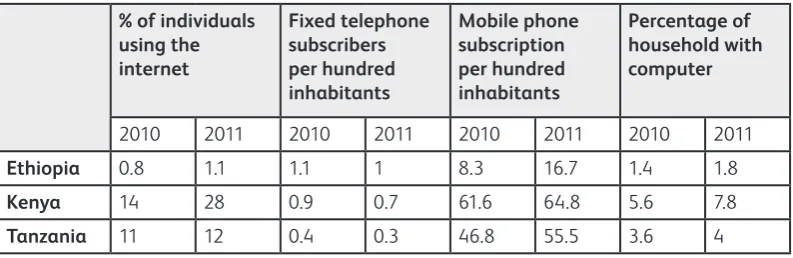
The growth of mobile phone and internet in the developing countries was remarkable, but if one looks at the data for countries like Ethiopia in the sub-Saharan area the result is disappointing ( table 2). At the end of 2011, the proportion of the population of mobile phone users in Kenya was 64.8%, and in Tanzania, it was 55.5%, whereas in Ethiopia it was 16.7 %. A high proportion of individuals living in Kenya (28%) and Tanzania (12%) had access to internet, but in Ethiopia, it was only 1.1 %. The telecommunication sector was liberalised in most of the African countries including Kenya and Tanzania, but the Ethiopian telecommunication authority is the only telecommunication operator providing services in the country.
% of individuals using the internet
Fixed telephone subscribers per hundred inhabitants
Mobile phone subscription per hundred inhabitants
Percentage of household with computer
2010 2011 2010 2011 2010 2011 2010 2011
Ethiopia 0.8 1.1 1.1 1 8.3 16.7 1.4 1.8
Kenya 14 28 0.9 0.7 61.6 64.8 5.6 7.8
Tanzania 11 12 0.4 0.3 46.8 55.5 3.6 4
The Ethiopian telecommunication authority has been struggling to meet the demand for telephone lines for many years. Many thousands of users are still on the waiting list for their first telephone landline service. The data shown below in figure 1 indicate that in 2004 the waiting list was at its maximum (156,963) but was reduced to 13,579 by 2007.
It was going up again and reached 18,548 in 2009. The ITU country report of 2002 indicates that the average waiting time for securing a landline was 8 years (ITU, 2002). However, at the same time, the switching capacity, or the number of total telephone lines were 550,000 of which only 340,000 lines (61%) were used. At the same time, 220,000 lines were idle and many potential customers were waiting for 8 years.
Figure 1: Number of consumers in Ethiopia waiting for a landline
(Source: Ethiopian Telecommunication Authority statistical bulletin 2008/2009) 180000
160000
140000
120000
100000
80000
60000
40000
20000
0
2003 146062
2004 156963
2005 58755
2006 56053
2007 13579
2008 19013
ICT cost and affordability
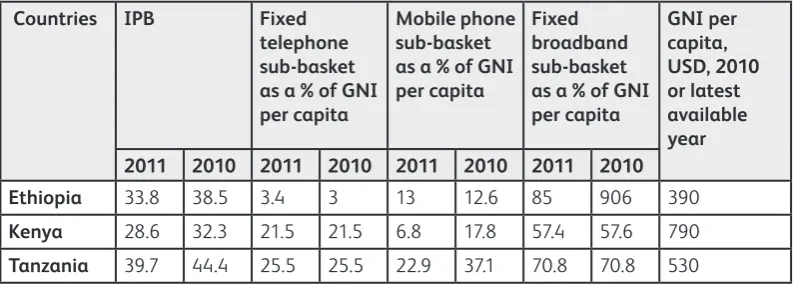
The ICT Price Basket (IPB) provides the cost and affordability of ICT services across countries and regions. It is the benchmark comparison measure of the cost of fixed line telephone, mobile phone, and fixed broadband. The comparison prices are given as a the percentage of the average monthly Gross National Income (GNI) per capita.
The IPB data given below in table 3 show that in Ethiopia there was a big reduction of prices for fixed broadband from 906 % to 85 % of the average monthly GNI per capita. However, it is still the most expensive compared with Kenya (57.4 %) and Tanzania (70.8 %). The cost for using mobile phone decreases in both Kenya (from 17.8% to 6.8%) and Tanzania (from 37.1 % to 22.9%) whereas it increases in Ethiopia from 12.6 % to 13% of the average monthly GNI per capita.
Countries IPB Fixed
telephone sub-basket as a % of GNI per capita
Mobile phone sub-basket as a % of GNI per capita
Fixed broadband sub-basket as a % of GNI per capita
GNI per capita, USD, 2010 or latest available year 2011 2010 2011 2010 2011 2010 2011 2010
Ethiopia 33.8 38.5 3.4 3 13 12.6 85 906 390
Kenya 28.6 32.3 21.5 21.5 6.8 17.8 57.4 57.6 790
Tanzania 39.7 44.4 25.5 25.5 22.9 37.1 70.8 70.8 530
Table 3: ICT Prices comparisons table for Ethiopia, Kenya, and Tanzania (Source: ITU. GNI and PPP USD ($) values are based on World Bank Data)
Methodology
A series of field visits to Addis Ababa were conducted to collect data from hoteliers and tour operators. In the first phase, detailed interviews were conducted with 17 hoteliers. In the second phase, a survey was conducted with 128 hoteliers and 57 tour operators. This paper is based on a doctoral research, which is not yet published. It is focused on how the choice of an appropriate theory was selected and adopted to support the research context. A series of difficulties were encountered before and during data collection. Lessons learned from this show the need to be sensitive to the local context and ethical issues (Demeke and Olden, 2012)
Do we need a theory?
Some researchers argued against using a theory for a number of reasons. For example, John Van Maanen has argued that more descriptive narratives based on intensive ethnographic study are appropriate to build knowledge, where later a theory can be developed (Van Maanen, 1995); he suggested a ten-year moratorium on theoretical papers. The implication of this argument is that theory should not be injected in to a research for the sake of it.
Again, Baker and Thyer disagreed on PhD programmes that are requiring students to use a theoretical framework for their study, even when the study, has not been guided by any explicit theory or tested in the outcome of the research (Baker and Thyer 2000). Other researchers emphasise the importance of accumulation of empirical findings as more important than trying to generalise in a theoretical framework. For example, Flyvberg takes this further by
arguing that social science cannot produce universal context independent theory, but it offers concrete context-dependent knowledge (Flyvberg, 2006). Similarly, Casley and Lury argued that a case study is applicable to initiate change of development policy in developing countries rather than a generalisation of science (Casley and Lury, 1987).
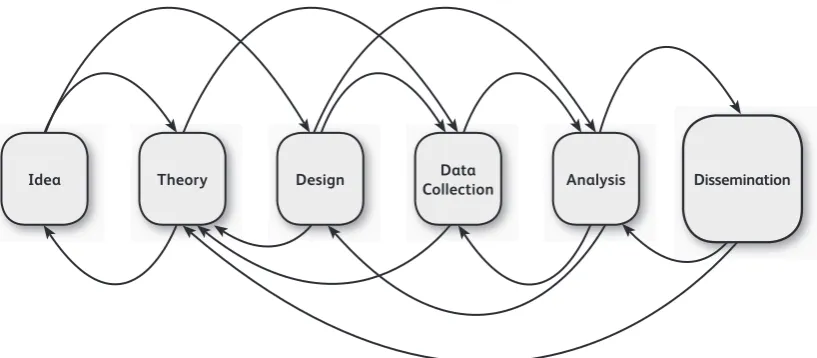
This paper is not aiming to put forward an argument on the importance of theory against the accumulation of case study knowledge, particularly in the case of diffusion studies in the developing countries. But it does report on how existing theories can be selected and adopted to fit in this particular research context and it tries to formulate a theoretical framework based on the existing Rogers’ diffusion of innovation theory. It emphases that the Political, Economic, Social, Technological, Environmental and Legal (PESTEL) factors affect the diffusion of ICT in the hotels and tour operators businesses. Figure 2: The Spiralling Research Approach adopted from Berg
The role of theory in research:
why does it matter?
Strauss argued that the role of a theory is to provide the key variables of the phenomena under study with underlying assumptions; it provides the research method (Strauss,1995). In addition, Strauss explains that a theory is a model that tries to replicate the real world. The real world is far more complicated and theories make sense of it by simplifying and reducing it to the most important factors.
The advantages of explicitly stating the theoretical foundation used in a research is to contribute to the verification of the theory from the particular angle of the investigation. Alternatively, if not verification it generates falsification of the theory as argued by Popper (1963). In addition, the theory can be used by different disciplines to investigate a phenomenon which the theory was not developed for. However, researchers do not necessarily specify the theory that guided their research; it may be implicit in the work. Furthermore, Weick argues against unstated or an implicit use of theory, it deters understanding, and he compares it to blind spots (Weick,1985).
A theory is described by Brunswick’s ‘Lens Model’ as adopted by Amundson and Cummings as shown below in figure 3, The model indicates that the ‘lens’ consists of Xs selected by the observer, taken to be the independent variables (Amundson and Cummings, 1997). The phenomenon is indicated as Y, and it is the Xs which determine its value. The selection of Xs affect the result of the study. The ‘lens’ is acting as a filter, to select what is considered to be the significant factor or factors that explain and predict about the nature of the phenomenon under investigation. The ‘lens’ metaphor can also be taken to reflect the context in which the investigation is conducted where there are for different contexts, different variables appearing to the observer to investigate the object under investigation.
The advantage of a theory is that it answers the queries of why, it explains and predicts a phenomenon. Furthermore, theory matters greatly as it lends itself to be used in a variety of conditions and its use in a variety of disciplines. For example, Rogers’ theory of innovation has been used to study diffusion in health, education, information systems, and marketing to name a few.
Figure 3: Brunswik’s Lens model adopted and presented by Amundson and Cummings X1
X2
...
Xn
Y
The Observer The ‘Lens’ or Theory The ‘Problem’ or
In conclusion, using theory in research is beneficial when it is appropriate and fitting for the particular research context. It contributes to knowledge and also tests the existing theories or generates a new theory that fits the context and the phenomenon under consideration.
Theories on society, science,
and technology
One of the primary bodies of literature that examines the mutual interaction of society and science is the sociology of science. This is the study of science and its effects on the social structures and processes of scientific activity (Ben-David, 1975). It focuses on how science as an institution looks into the practices and ways of the career paths and rewards for the practitioners in the field (Pinch and Bijker,1984).
According to Pinch and Bijker one of the main developments of the sociology of science is the extension of the sociology of knowledge into ‘hard science’. One of main characteristics of sociology of knowledge is that scientific knowledge is socially constructed: this by its very nature provides multiple interpretations for the same phenomenon. Sociology of science investigates the cause of beliefs in society irrespective of the scientific claims of truth. The central tenets are: different explanations are not sought for what is known to be a scientific ‘truth’ and also it is indifferent to the truth or falsity of the belief. This is an issue of socially constructed beliefs, not an epistemological issue.
Social history of technology
The social history of technology is part of the study of the sociology of science. It investigates the interaction of technology and society based on the historical accounts. These technological systems include
electricity generation/transmission and telecommunications infrastructures. According to Hughes (1987) these systems are the result of the integration of technical, social, economic, and political elements in a society. Furthermore, Hughes argues that these technological infrastructures require physical artefacts, organisations, scientific components, and legislative artefacts to evolve. Here Hughes, clearly shows that in the adoption of large infrastructures the context, the politics, social, law, technology and organisations all have to come together for the realisation of these infrastructures. This implies that the PESTEL factors play a pivotal role in the realisation of these projects. However, this theoretical framework is not completely applicable to what is happening at the moment regarding the diffusion of ICT. Even so, the PESTEL factors which have impacted on past diffusion continue to influence on the diffusion of large technological infrastructures.
Society and technology
Technology is taken to be a force of change especially in the area of the social, cultural, and economical situation in a society. The impact of technology, particularly in the industrial revolution has been extensively documented. Technology has three layers of meanings (MacKenzie , 1985). The first is the artefact itself, for example, cars or planes. Second, it also includes the human activity or process such as driving or flying, without this activity the car is a collection of metal, plastic and wire. Third, technology also refers to what people know and do with it, the knowledge to make a car is a technology. As technology is artefact, knowledge and activity, then it can be argued that the artefact is developed by knowledge, human activity and non human agents. In the final analysis, technology is a result of interaction of human actors and material substance.
The effects of the introduction of technology on productivity and competitiveness are well documented. Introduction of new motor driven technology or fully automated systems on the factory floor means fewer workers. This increases unemployment and changes other social, economic and cultural parameters. The worker’s salary may be reduced and poverty may be on the increase followed by other social ills. On the positive note, increase of productivity allows the worker to have spare time to pursue other activities and also give them leisure time.
In other words technical changes bring about social changes. Moreover, as Peter Large points out the social change that comes because of the microchip amounts to changes in the social configuration of the society, and it changes the cultural, economic, and social states of the society (Large 1980). It increases the productivity of the workforce, accordingly workers have ample leisure time.
The development and progress of technology can be self perpetuating, irrespective of the social elements. It can be assumed that technology follows a path determined by its physical nature. Equally it is affected by social, cultural, and economic factors. The engineers and technologists, who design these artefacts, are part of a certain social group; hence, the implication is that there is in its creation, at least, the prospect of the artefact being influenced by the social group. Furthermore, as MacKenzie (1985) defines technology as a social activity of the society that uses tacit knowledge or the creation process of knowledge to enable the creation of the artefact itself. Overall technology diffusion is the result of multiple factors, such as the social, economic, and cultural.
Mumford argues that technology not only shapes the society but it is also shaped by the society (Mumford, 1967). In addition, there are socio cultural conditions that precede the development of new technologies. He further argues that technology has an impact on society. Furthermore, it is found that the technology was directed. Winner coined the phrase ‘Do Artefacts have politics?’ He shows, on one of his examples, that the bridge which crosses over a park enables the upper and middle class car owner to use the park, but it creates a barrier to lower class people non-car owners who travel by bus. Because of the height limitation of the bridge, buses are not allowed to pass under the bridge, creating a physical barrier to exclude lower class sections of the society (Winner, 1986).
Social Construction
of Technology (SCOT)
The central tenets of SCOT are: first, it advocates the mutual shaping of society and technology, the social construction of artefacts by relevant social groups and the technological shaping of society. Second, different social groups can provide different meanings and attributes to the same artefact. Third, artefacts do not have inherent identity or attribute (Pinch and Bijker, 1984).
SCOT shares its interpretive flexibility with the sociology of science; it focuses on the problem, real or assumed, generated by artefacts for selected social groups, the social influence and input in the design of the artefacts. This influence is non-linear in its nature. The artefact shapes the selected social groups. Hence, the relationship between the society and technology is multidimensional. In addition, it focuses on a problem that arises because an artefact is created for a selected social group. The main assumption is that all members of the selected social group share common meanings in respect of the same artefacts. The underpinning methodological and empirical studies for SCOT focus on the discovery, naming, understanding and describing of the relationship between the selected social group and the artefact. Furthermore, different social groups provide many interpretive ideas for the same artefact as opposing interpretations are tolerated.
The closure and stabilization of an artefact occurs when there is certain degree of consensus achieved among the selected social groups about the artefact’s meaning, understanding, naming and when a solution is found for the initial problem identified. In reality, the problem may not need to be solved. However, if the selected social groups see the problem as being solved then the artefact is stabilized. Furthermore, the perception
for all social groups in the society. Bijker and Law propose the concept of ‘technological frame’ to explain this gradient of consensus for different social group for the same artefacts and this forms the development of heterogeneous socio-technical ensembles (Bijker and Law, 1992). This enables SCOT to generalise beyond a single case study to form a theory of sociotechnical ensembles. On the other hand, this closure forms part of the future norms and values of the society.
There are inherent problematic issues with SCOT: it requires defining a social group for its study. Furthermore, there is an assumption that the selected social group share similar meanings and understandings for the same artefact. In these ideal settings, two different individuals in the selected social group have the same idea and give the same meanings to an artefact. But can there be an absolute closure for an artefact in the sense that closure brings consensus about the meaning of the artefact by certain social groups? Consensus reduces interpretive flexibility, but this is not necessarily true for all social groups. Closure may seem to bring stabilisation to the artefact, which describes the continuity of the artefact. At the same time, technological change in the artefact brings new interpretations. This shows how SCOT defines the dynamic nature of change and continuity.
Technological frames form the basis for analysing sociotechnical ensembles. It is the method of how technology facilitates interaction and shapes specific cultures. It is a two way process, which looks at how new technology is constructed by allowing and restricting interactions within specific social groups in certain channels.
and no choices to switch to other suppliers, customers are left with no option but to accept substandard services. This in turn tends to influence the culture to accept substandard services.
Technology Acceptance
Model (TAM)
The behaviour of users in accepting and using a new technology is measured using the technology acceptance model (TAM). This is an information systems theory which is an extension of Theory of Reasoned Action (TRA). Bagozzi and Davis argue that users accept and use new technology based on two measures: perceived usefulness and perceived ease of use (Bagozzi et al. 1992). The advantage of this measure is its simplicity. The technology can have a multitude of capabilities, but this is useful only if the users perceive that it is useful for their job. However, the major criticisms are that the theory offers limited explanatory and predictive power to give it practical value.
Actor-Network Theory (ANT)
Actor-network theory was formulated on the basis of the work of Callon (1986), Latour (1980, 1987), and Law and Hassard (1999) and appears to share a number of attributes with SCOT particularly on the mutual interaction and construction of society, technology, and science. However, ANT is very different in its fundamental approaches, especially in its human and non-human entities relationship.
SCOT takes a constructivist approach, where nature and reality are constructed through the mutual interaction of technology, science and society. In comparison, Actor Network Theory recognizes the existence of reality outside and independent of society and humans, which cannot be changed. However, much cannot be said about nature without the participation and activities of humans. In this relationship, humans and non-human entities are defined on the relationship they form in the network.
When the interaction between humans and nature takes place, a relationship forms among, humans and things, and humans and other humans: this forms a network. Each network, has its configuration and relationship to other networks. It also defines the meaning, role and
identity of the elements within it. It is in this setting that truth, meaning and understanding is defined for that particular network. This truth, meaning and understanding can be different for different networks; it is a version of reality for that network. In this setting no one can claim to have an independent reference point outside any network. The assertion, ‘Water boils at 100°C’, has a dual character of natural characteristics and the human formation of concepts, measurements, tools and so on. It is not possible to say anything about this phenomenon without the human interaction, the technology and the science. The statement ‘water boils at 212°F’, even though this statement and the above assertion are similar, the last statement has a different configuration of tools and network. This also shows that the construction of reality can be different for different networks.
The notion of object and subject is not separated in Actor Network Theory: objects are defined by their relationships with other objects. In this myriad of relationships, the role, value and attributes of the elements are determined based on the position they assume in the network. The object without its connection and association to other objects has no role, value or attribute. This extends to humans and non-human entities. As Law points out (Law and Hassard,1999 p.3):
‘Actor Network Theory is a ruthless application of semiotics. It tells that entities take their form and acquire their attributes as result of their relations with other entities. In this scheme of things entities have no inherent qualities: essentialist divisions are thrown on the bonfire of the dualisms: truth and falsehood, large and small, agency and structure, human and non-human, before and after, knowledge and power, context and content, materiality and sociality, activity and passivity, in one way or another.’
actors. It particularly focuses on the processes through which humans and technology form heterogeneous networks. It is also different to other SST approaches especially for its material-semiotic stance. ANT explores how networks of human and non-human entities are created, sustained or disintegrated. It does not investigate why networks are generated but it explores how the network is sustained or disintegrated.
The conceptual framework provides the foundations to select models and tools to enable systematic ways of gathering data and to choose appropriate tools that are required to transform these data into information and knowledge. Furthermore, Latour summed this up in the following passage (Latour,1987 p.277):
‘The history of science is that of the many clever means to transform what ever people do, sell and buy into something that can be modified gathered, archived, coded, recalculated, and displayed’.
ANT argues that all actors are of equal importance, human or nonhuman, powerful or powerless. It is true that all actors contribute to the network in some level but actors that have significant power in the network play a critical role compared to those with less power. As Walsham points out, ANT has a disregard for the existing social order (Walsham, 1997).
Rogers’ theory of diffusion
of innovation
The availability of ICT has increased and the price of these tools decreases all the time. In spite of the potential advantages and use of ICT, the adoption is not encouraging particularly in a case like Ethiopia. Opposition to the adoption of ICT may come from different levels. At the organisational level, opponents to the adoption of ICT perceive the advantage and use of ICT differently to the adopters. Other opponents include users who use rival technology, or individuals who reject ICT on grounds such as health or safety issues who in general consider it not fit for purpose other than at the personal level.
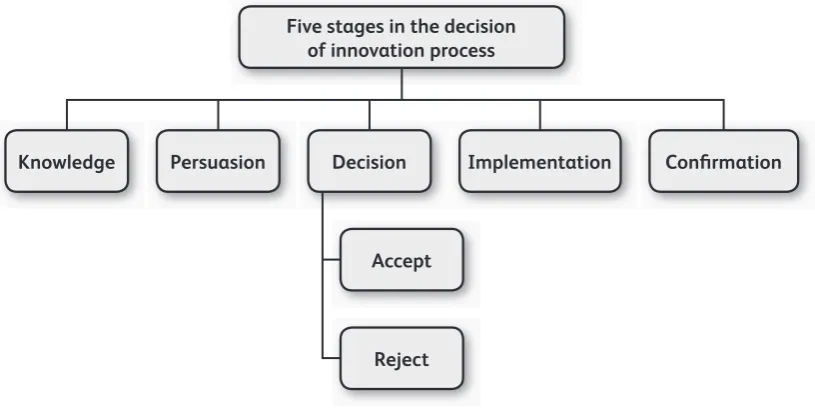
Diffusion of innovation is influenced by the innovation, and the means by which the idea is communicated, channels of communication, time, and the social system (Rogers, 2003). The ICT diffusion in the hotel sector influenced by these four factors progresses through the five stages, as shown below: Knowledge, Persuasion, Decision, Implementation, and Confirmation.
At the beginning of the diffusion processes, Rogers explains that when the potential adoptor is introduced to an innovation and gains some level of understanding, it can be termed the knowledge stage. The second stage occurs when an individual received
Five stages in the decision of innovation process
an opinion for or against to adopt or reject the innovation. This is the persuasion stage where the knowledge and understanding combined with the opinion of others convince the adoption or rejection of the innovation. Once an individual has decided to adopt an innovation and put the innovation into use, it signals the implementation levels. The confirmation stage is the continuation of the adoption or rejection of the innovation.
The speed at which individuals adopt an innovation varies, some adopt at first, while some lag behind. The adoption of an innovation follows an S curve when plotted over a length of time. Rogers recommends five categories of adopters: innovators, early adopters, early majority, late majority, and laggards. Rogers also identified five factors that influence the adoption of innovation by individuals: relative advantages of the innovation, compatibility, complexity or simplicity, trialability and observability.
Selection of theoretical
framework
In the study of the diffusion of innovation researchers have many theories at their disposal, but there are difficulties in choosing the appropriate theory for the proposed research. The properly selected theory enables the formulation of the research constructs. Although the selection of research method depends on the nature of the problem under investigation, the selected theory has an impact on the research method.
Truex et al. ( 2006) formulated some criteria how to choose the appropriate theory for research which includes:
1. best fit between the selected theory and the research phenomenon of interest 2. the theory’s historical context
3. the impact of the selected theory on the choice of research method
4. considering the theorising process and the cumulative theory.
Reasons for the adoption
of Rogers’ diffusion of
innovation theory
Rogers’s diffusion of innovation theory explains how an innovation is diffused in a society. It focuses on the individual adopter and the influence of the culture on the adopter to accept or reject an innovation. Looking closely at Rogers’ diffusion of innovation theory and the problem under investigation, which this paper is based on, shows that the theory is a good fit for the research phenomenon under investigation in two ways. Firstly, the theory explains how the individual adopter goes through the five stages of adoption processes to adopt ICT in their hotels and tour operators businesses. Secondly, the five factors of innovation adoption identified by the theory at least partially affect the diffusion processes. In addition, the theory is widely used in diffusion studies in various academic fields such as politics, economics, and information systems. Furthermore, recently its use in diffusion studies in Africa (Kiplang’at and Ocholla, 2005; Minishi-Majanja and Kiplang’at, 2005) indicates its appropriateness for this research.
Proposed new theoretical
framework
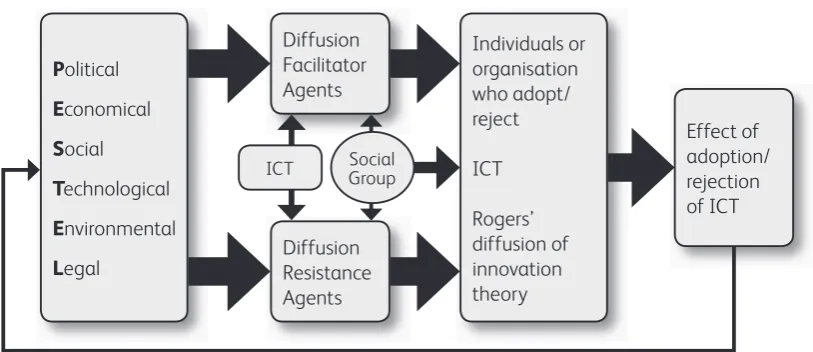
Rogers’ diffusion of innovation theory focuses on the user, and the influence of the culture on the adoption of an innovation. However, the data collected from Addis Ababa and from secondary data analysis leads to the conclusion that there are resistance diffusion agents caused by the PESTEL factors. Hence, individuals or organisations overall face diffusion resistance agents and diffusion facilitator agents. To include the main factors that affect diffusion, both resistance and facilitator agents caused by the PESTEL factors should be included in the theoretical framework. The researcher proposes to add two elements to Rogers’ diffusion of innovation theory, namely, diffusion facilitator and diffusion resistance agents caused by the PESTEL factors. This will shed light on how the macro factors in PESTEL act as facilitators or resistance agents, which go on to influence adopters and non-adopters.
The resultant of the balance of power between the facilitator and resistance agents creates the condition in the social system for the acceptance or rejection of the innovation for the particular social group. Diffusion facilitator and resistance agents affect different social groups differently. This shows that diffusion is a complex process. Furthermore, change in socio-economic conditions can result in change of the role of facilitators and resistance agents, which may result in resistance agents becoming facilitators or vice versa. Diffusion of innovation is a dynamic phenomenon: the diffused or rejected innovation also has an influence to change the facilitator and resistance agents.
The findings from the research indicate that the Ethiopian government’s decision not to liberalise the telecommunication sector is a political decision that has resulted in the dominance of a single, government owned telecommunication operator. The operator is unable to satisfy the demand for telephone services resulting in low-levels of adoption rate. This policy is a diffusion resistance agent affecting organisations and individuals and hindering the adoption of ICT.
Furthermore, the economic policy of a 40 % import tax on ICT equipment in addition to the 35 % inflation rate has resulted in a very high level of ICT price. This policy has created another resistance agent for the diffusion of ICT for almost all social groups except a few rich individuals. These two resistance agents have created very expensive ICT services, for example, wired broadband services at the end of 2011 costs 85 % of the monthly GNI per capita. This indicates that the two main policy factors arising from the political and economic conditions are the two main factors for non-adoption of ICT.
In addition, other resistance agents affect adoption of ICT for different social groups such as gender, age, education and those arising from underlying social issues. The proposed theoretical framework shown in figure 5 below includes the PESTEL factors as a source of diffusion resistance and facilitator agents in the diffusion processes for this particular study. In this particular study the Political, Economic, Social, Technological and Legal factors generate diffusion resistance and diffusion facilitator agents. But, no evidence has been found for Environmental factors for that generate resistance and diffusion agents. Further research requires us to look if the theoretical framework is appropriate for the study of diffusion study in the developing countries.
The proposed model will guide future
researches to identify resistance and diffusion agents and the degree and power of influence they impose on the adoption processes. Furthermore, identifying these agents may indicate the PESTEL factors that influence the policies and further adjustment or change of these policies may result in the desired adoption or rejection of innovation.
Conclusion
In this paper various theoretical frameworks have been discussed and theories on the adoption of innovation in a particular society for technology in general are explored. The importance of theory was discussed, and the argument for research in discovering knowledge without a theoretical framework was also presented. Using theory to ground research helps to understand the underlying assumption of the theory but also checks if the underlying context is fit and appropriate to the chosen theoretical assumption. Furthermore, it focuses the research to investigate what are considered as the important or detrimental factors stated by the theory.
In this particular research Rogers’ diffusion of innovation theory was selected to be appropriate but it is limited in the underlying assumptions in which the context of diffusion is happening. To enable the theory to describe the underlying assumption Rogers’ theory was modified to include the PESTEL factors that influence the diffusion of ICT in Addis Ababa. The findings of the study also confirm the role of PESTEL factors for the diffusion of innovation of ICT in the hotel and tour operators sector in Addis Ababa. The proposed modified Rogers’ diffusion theory will help other researchers to use the method to explore how the theory is adopted to the research context and so help other researchers to use it for the study of diffusion.
Figure 5: Proposed theoretical framework for diffusion study
Political
Economical
Social
Technological
Environmental
Legal
Diffusion Facilitator Agents
Diffusion Resistance Agents
Individuals or organisation who adopt/ reject
ICT
Rogers’ diffusion of innovation theory
Effect of adoption/ rejection of ICT
References
Amundson, S.D. and Cummings, L.L. (eds) (1997) Organizational vision through the lens of quality: a framework for integration of quality management and organizational behavior. In Fedor, D. and Ghosh, S. eds. Advances in the management of organizational quality, 2nd ed. Greenwich (CT): JAI Press.
Bagozzi, R.P., Davis, F.D. and Warshaw, P.R. (1992) Development and test of a theory of technological learning and usage. Human Relations, 45, p.659-686.
Baker, L. and Thyer, B. (2000) Promoting parental compliance with home infant apnea monitor use. Behaviour Research & Therapy, 38(3), p.285.
Ben-David, J. (1975) Sociology of science. Annual Review of Sociology, 1, p.203-222.
Berg, L.B. (2007) Qualitative research methods for the social sciences, 6th ed. Boston: Pearson International Edition.
Bijker, W.E. and Law, J. (1992) Shaping technology/building society: studies in sociotechnical change. Cambridge (MA) and London: MIT Press.
Callon, M. (1986) Some elements of sociology of translation: domestication of the scallop and fishermen of St Brieuc Bay. In Law, J. ed. Power, action and belief: a new sociology of knowledge. London: Routledge, p.196-223.
Casley, D.J. and Lury, D.A. (1987) Data collection in developing countries, 2nd ed. Oxford: Clarendon.
Castells, M. (2010) The rise of the network society, 2nd ed. Oxford: Wiley-Blackwell.
Flyvberg, B. (2006) Five misunderstandings about case-study research. Qualitative Inquiry, 12(2), p.219-245.
Heeks, R. (2012) Information technology and gross national happiness. Communications of the ACM, 55(4), p.24-26.
Hughes, T. (1987) The evolution of large technological systems. In Bijker, W.P., Hughes, T.P. and Pinch, T. eds The social construction of technological systems: new directions in the sociology and history of technology. Cambridge (MA): MIT Press, p.45-76.
ITU (2002) Internet from the Horn of Africa: Ethiopia case study [Online]. Available at: http://www.itu.int/osg/spu/casestudies/ETH_ CS1.pdf [Accessed: 20/05/2009].
ITU (2012) Measuring the information society [Online]. Available at: http://www.itu.int/ITU-D/ ict/publications/idi/material/2012/MIS2012_ without_Annex_4.pdf [Accessed: 20 /12/2012].
Kiplang’at, J. and Ocholla, D.N. (2005) Diffusion of information and communication technologies in communication of agricultural information among agricultural researchers and extension workers in Kenya. South African Journal of Library & Information Science, 71, p.234-246.
Large, P. (1980) Micro revolution. London: Fontana.
Latour, B. (1987) Science in action. Milton Keynes: Open University Press.
Law, J. and Hassard, J. (1999) Actor network theory and after. Oxford: Blackwell.
Mumford, L. (1967) The myth of the machine: technics and human development. London: Secker & Warburg.
Pinch, T.J. and Bijker, W.E. (1984) The social construction of facts and artefacts: or how the sociology of science and the sociology of technology might benefit each other. Social Studies of Science, 14, p.399-441.
Popper, K. (1963) Conjectures and refutations. London: Routledge & Kegan Paul.
Rogers, E.M. (2003) Diffusion of innovations. New York: Free Press.
Saches, J.D. (2005) The end of poverty. New York: Penguin Books.
Strauss, A. (1995) Notes on the nature and development of general theories. Qualitative Inquiry, 1(1), p.7.
Truex, D., Holmstrom, J. and Keil, M. (2006) Theorizing in information systems research: a reflexive analysis of the adoption of theory in information systems research. Journal of the Association for Information Systems, 7(12), p.797-821.
Unwin, T. (2007) No end to poverty. Journal of Development Studies, 45(3), p.929-953.
Van Maanen, J. (1995) Fear and loathing in organization studies. Organization Science, 6(6), p.687-692.
Walsham, G. (1997) Actor-network theory and IS research: current status and future prospects. In Lee, A.S., Liebenau, J. and DeGross, J.l. eds Information systems and qualitative research. London: Chapman and Hall, p.466-480.
Weick, K. (1985) Theoretical assumptions and research methodology selection. In McFarlan, F.W. ed. The information systems research challenge. Boston: Harvard Business School Press, p.111-132.
Winner, L. (1986) The whale and the reactor: a search for limits in an age of high technology. Chicago and London: University of