Context-aware Caching Distribution and UAV
Deployment: A Game-theoretic Approach
Tao Fang1 , Hua Tian1, Xiaobo Zhang1, Xueqiang Chen1, Xinhong Shao1and Yuli Zhang1
1 College of Communications Engineering, Army Engineering University of PLA, Nanjing 210000, China;
[email protected]; [email protected]; [email protected]; [email protected]; [email protected]; [email protected].
Abstract:This paper investigates the problem of the optimal arrangement for both UAVs’ caching contents and service locations in UAV-assisted networks based on the context awareness, which considers the influence between users and environment. In the existing work, users within the coverage of UAVs are considered to be served perfectly, which ignores the communication probability caused by line-of-sight (LOS) and non- line-of-sight (NLOS) links. However, the links are related to UAV deployment. Moreover, the transmission overhead should be taken into account. To balance the tradeoff between these two factors, we design the ratio of users’ probability and transmission overhead as the performance measure mechanism to evaluate the performance of UAV-assisted networks. Then, we formulate the objective for maximizing the performance of UAV-assisted networks as a UAV-assisted caching game. It is proved that the game is an exact potential game with the performance of UAV-assisted networks serving as the potential function. Next, we propose a log-linear caching algorithm (LCA) to achieve the Nash equilibrium (NE). Finally, related simulation results reflect the great performance of the proposed algorithm.
Keywords: context-aware, UAV-assisted networks, communication probability, cache content, potential game.
1. Introduction
During the past decades, UAVs have been popular in military applications due to its characteristics of high mobility and low cost [1–5], e.g., reasonable use of UAVs can reduce casualties of front-line soldiers. Inspired by the outstanding performance in military domain, recently UAVs have been widely utilized in civilian applications, including weather monitoring [6,7], forest fire monitoring [8,9] and first aid search and rescue [10,11], which have brought convenience to the public. Specifically, when UAVs are combined with wireless communication networks, users will experience better communication services due to the fact that traditional cellular networks have several following shortcomings [12]: i) the potential damage of communication facilities caused by natural disasters; ii) an increasingly unbearable communication burden resulted from growing smart devices and communication demands. Fortunately, it happens that the unique characteristics of UAVs can make up for these deficiencies. The characteristics of high mobility and low cost ensure that UAVs can quickly fly to the disaster area to provide services. Moreover, cache-enabled UAVs may increase the degree of the file reuse when hot files are requested repeatedly among users. Thus, especially in such an era of data explosion, the combination of UAVs and the cache is considered as a promising technology to deal with the challenges.
Recently, progress on related research has shown the validity and reliability of the aforementioned technology. In our existing work [13], the problem of selecting caching nodes was studied and a selection algorithm was proposed . However, it ignored the potential cooperation among caching nodes. Authors studied the problem of hybrid caching in D2D Networks in [14], which considered the cooperation but ignored the dynamics among nodes. In [15], a secure transmission scheme based on interference alignment was proposed, which made caching UAV provide service like SBSs. Idle SBSs
replaced by UAVs would disrupt eavesdropping. However, the caching content sharing of UAVs is not considered. Moreover, authors studied the problem of the resource allocation in a cloud network with cache-enabled UAVs in [16], where users’ content request distribution can be predicted based on the proposed algorithm. However, the research mentioned above, to a great extent, only focuses on the resource allocation and optimization of caching contents but ignores the optimization of UAVs’ service locations. This problem is rarely considered in existing work to our best knowledge. Although, authors took the change of UAVs’ location into account in [17], the potential cooperation among UAVs has been not considered. In our prior work, we investigated the problem of both caching contents and service locations in UAV-assisted emergency networks by multi-hop in [18]. However, there still exists several shortcomings as follows. We considered the cooperation among UAVs by multi-hop based on the assumption that users within the coverage of UAVs were served perfectly. Nevertheless, in practical scenario, the influence of propagation groups, line-of-sight (LOS) and non- line-of-sight (NLOS), which may result in the fact that users within the coverage of UAVs communicate with UAVs successfully by probability, should be taken into account. Multi-hop service will result in more delay for ground users. Therefore, it is necessary and significant to improve the shortcomings mentioned above.
In this paper, we consider the joint optimization of UAVs’ caching contents and locations with the goal of balancing the tradeoff between user’s service probability and transmission overhead. In proposed scenario, users need to be served in the disaster area when the communication facilities are destroyed. UAVs with caching contents fly to the destination to provide communication services. Considering the cooperation among UAVs, the caching contents of neighbor UAVs can be shared by one hop. Thus, the optimal arrangement of UAVs’ caching contents and service locations are the key points to solve. However, the problem is challenging. Firstly, the transmission overhead may be affected by both UAVs’ caching contents and service locations, i.e., the source of the request file and the neighbor UAV sets. Secondly, when considering the locations of UAVs, the probability that the users can communicate with UAVs successfully will be influenced due to the propagation groups, i.e., LOS and NLOS, with corresponding probabilities of occurrence.
Motivated by these observations, we consider both the probability that the users can communicate with UAVs successfully and transmission overhead that the users spend getting request files. Therefore, we apply the ratio of users’ service probability and transmission overhead as the performance indicators of UAVs’ actions to balance the tradeoff. Meanwhile, we formulate the challenging problem as an UAV caching game applying game theory and prove the existence of Nash equilibrium (NE). In addition, a log-linear caching algorithm (LCA) can achieve the great performance.
The main contributions are as follows:
• We first investigate the problem of joint optimization of UAVs’ caching contents and service locations with the goal of balancing the tradeoff between user’s service probability and transmission overhead under the consideration of the share of neighbor UAVs’ caching contents. • The problem is modeled as an UAV caching game, which intends to find the optimal solution that maximizes UAVs’ performance indicators, i.e., the ratio of user’s service probability and transmission overhead. In addition, the proposed game is proved to be a potential game with at least one pure-strategy NE. Meanwhile, the optimal solution can be achieved by its optimal NE. • The log-linear caching algorithm is proposed to achieve the desirable solution in joint caching
contents and service locations optimization problem. The simulation results show that the proposed algorithm can converge to a great NE solution and guarantee the great performance of UAV-assisted networks, which demonstrates the algorithm’s validity and effectiveness.
2. System Model and Problem Formulation
2.1. System model
We consider a UAV-assisted networks withNcache-enabled UAVs, i.e.,N ={1, 2, ...,N}, andM users, i.e.,M={1, 2, ...,M}. Denote the set of system files as f =nf1,f2, ...,f|f|
o
, where|f|denotes the number of system files. Suppose that all users request files from f according to a special file popularity distribution, which can be modeled by a Zipf distribution [19,20]:
Pfi = 1/fi
γ
|f| ∑ j=1
1/fjγ
, (1)
where fiis thei-th file requested by the user,|f|is the number of system files,γis the parameter of Zipf distribution,Pfi denotes the probability that the user requestsfi.
Specially, we denote userm’s requested files asQm=q1,q2, ...,q|Qm|
, where|Qm|is the number of files requested by usermandqidenotes the indicator function:
qi=
(
1, if usermrequestedi-th file,
0, if usermdo not requesti-th file. (2) An illustration of UAV-assisted communication networks is shown in Fig. 1. There are three small UAVs, a big central UAV and some users waiting to be served. As depicted in Fig. 1, the service process of the UAV consists of four parts: firstly, the small UAVs use some prior information provided by the central UAV and make their own caching contents decisions individually; Secondly, small UAVs fly to the service location with carried caching contents. Then, UAVs start to serve for users under the assumption that the caching contents can be shared among reachable neighboring UAVs by one hop. Next, if some users’ demands are still not met, the service UAV will fly to some UAVs with caching contents that the dedicated user wants, to cooperate. Meanwhile, the following file requests of corresponding users will be rejected until the service UAV comes back. Finally, the service UAV will return to the central UAV to get files if other UAVs cannot provide such services.
Motivated by [21], we denote reachable neighboring UAVs of UAVnby one hop asJn, i.e.,
Jn ={i∈ N:D(n,i)≤Dn}, (3)
whereD(n,i)denotes the distance between UAVnandi.Dnrepresents the communication distance thresholds for UAVs.
2.2. Problem Formulation
Note that the performance of UAVs is affected by its caching contents as well as the service locations, i.e., where to obtain the files requested by users and the successful communication probability from UAVs to dedicated users due to the influence of propagation groups. Therefore, we need to balance the tradeoff between the transmission overhead and successful communication probability. Consideran= (ln,cn)as the action of UAVn. Note thatlnreflects the service location of UAVn, which is actually a set of space coordinates, i.e.,(xn,yn,zn). Meanwhile,cn= (cf1,cf2, ...,cf|cn|)indicates the caching action of UAV n, wherecfi ∈ f,∀1≤i≤ |cn|and|cn|is the number of caching contents carried by UAVn, which is the cache space of UAVs. We define the transmission overhead by considering both caching contents and service location, as follows:
rm(a) =
|Qm|
∑
k=1Caching contents
Content sharing link
Transmission link
Trajectory of UAV Caching contents allocation
Figure 1.An illustration of the emergency communications network. ((a). The small UAVs obtain the caching contents by the given decision from the central UAV and fly to the destination with cached contents. (b). UAVs cooperate with reachable neighboring UAVs by one hop. (c). UAV will fly to some UAVs with caching contents that the dedicated user wants (d). UAV will return to the central UAV to get files if other UAVs cannot provide such services.)
where|Qm|is the number of files requested by userm,pmkdenotes the probability that user m requests filek,a= (a1,a2, ...,aN)denotes the actions of all UAVs.Cmk(a)is the transmission overhead under the consideration of different sources of files which is given by:
Cmk(a) =w1d(lum,lm) +I(k,cu0
k,lum,lu0k,lu00o),lum ∈(l1,l2, ...,lN),cum∈(c1,c2, ...,cN),um6=u 0 k, (5)
wherew1is the overhead per file per distance,umandmrepresent the UAV and its dedicated user,
lum = (xum,yum,zum)andlm = (xm,ym,zm)denote the location of UAVumand usermrespectively, thend(lum,lm) =
q
(xum−xm) 2+ (yu
m−ym) 2+ (zu
m−zm)
2denotes the distance from UAVumto userm,u0kandu00odenote the UAV that caches filekand the central UAV respectively,a= (a1,a2, ...,an) is the strategy profile of all UAVs,I(k,cu0
k,lum,lu0k,lu00o)is the indicator function as follows:
I(k,cu0
k,lum,lu0k,lu00o) =
0, i f k∈cum,
w2d(lum,lu0
k), i f k∈/cum,∃ k∈cu0
k,∃ u 0
k∈ Jn, w3d(lum,lu0
k), i f k∈/cum,∃ k∈cu0
k,∃ u 0
k∈/Jn, w4d(lum,lu00o), i f k∈/cum,∃ k∈/ ∪
n6=m,n∈N cn,
(6)
wherew2,w3andw4are different overheads per file per distance according to different source of files,
u0kis the UAV that caches filek,cu0
k means the set of files that UAVu 0
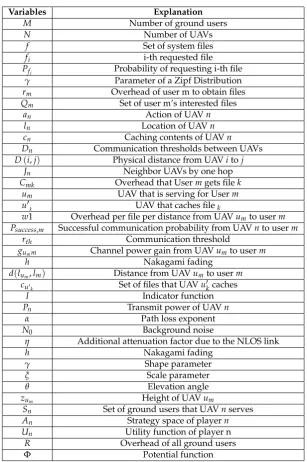
Table 1.key variables used in this paper.
Variables Explanation
M Number of ground users
N Number of UAVs
f Set of system files
fi i-th requested file
Pfi Probability of requesting i-th file γ Parameter of a Zipf Distribution
rm Overhead of user m to obtain files
Qm Set of user m’s interested files
an Action of UAVn
ln Location of UAVn
cn Caching contents of UAVn
Dn Communication thresholds between UAVs
D(i,j) Physical distance from UAVitoj Jn Neighbor UAVs by one hop
Cmk Overhead that Usermgets filek
um UAV that is serving for Userm
u0k UAV that caches filek
w1 Overhead per file per distance from UAVumto userm
Psuccess,m Successful communication probability from UAVnto userm
rth Communication threshold
gumm Channel power gain from UAVumto userm
h Nakagami fading
d(lum,lm) Distance from UAVumto userm
cu0
k Set of files that UAVu
0
kcaches
I Indicator function
Pn Transmit power of UAVn
α Path loss exponent
N0 Background noise
η Additional attenuation factor due to the NLOS link
h Nakagami fading
γ Shape parameter
ξ Scale parameter
θ Elevation angle
zum Height of UAVum
Sn Set of ground users that UAVnserves
An Strategy space of playern
Un Utility function of player n
R Overhead of all ground users
Φ Potential function
The explanation of I(k,cu0
k,lum,lu0k,lu00o) can be classified into four parts. The first expression indicates that UAVumcaches the file that users require; the second expression indicates that UAVum tends to obtain files from its neighbors; the third expression denotes the fact that UAVumtends to obtain files from other small UAVs, which are defined as potential neighbors; the truth that UAVum will fly back to the big central UAV to cache missing files is reflected in the last expression. Moreover, it should be noted that the value of each part in indicator function is related to the distance between UAVumand the destination for file requested by users, i.e.,d(lum,lu0
k)andd(lum,lu00o). Note that the third and last expression indicate that UAVumwill leave the service location. Therefore,w3andw4 involve the flight overhead per distance.
channels. Therefore, it means each communication link will not interfere with each other. Then, for an interference-free scenario, we define the successful communication probability as the probability that the received signal-to-noise ratio (SNR) by the received user is over a predefined communication threshold , as:
Psuccess=P(SNR>rth) (7)
whererthis the communication threshold, SNR is calculated by:
SNR= Pngumm
N0 (8)
wherePnis the transmitting power of UAVn,gummis the channel power gain from UAVumto userm,
N0is the background noise. Different from terrestrial communication network, the transmission link can be classified into two propagation groups, i.e., LOS and NLOS. Motivated by [23],gummfor LOS and NLOS links are respectively calculated by:
gumm=
(
h·d−α
umm, LOS link
h·η·d−umαm NLOS link (9)
wheredummreflects the distance from UAVumto userm,αdenotes the path loss exponent,ηdenotes an additional attenuation factor caused by the NLOS link,h, i.e.,h∼Γ(γ,ξ), represents the Nakagami fading. According to [23], both the service location and the elevation angleθbetween the UAV and the user influence the probability of LOS link. Thus, the probability of causing LOS links can be given as follows:
P(LOS) = 1
1+aexp(−b(θ−a)) (10)
whereaandbis the parameter related to the environment,θdenotes the elevation angle specified as follows:
θ= 180 π ×sin
−1( zum
dumm
) (11)
wherezum is the height of UAVum. The probability of causing NLOS link isP(NLOS) =1−P(LOS). Thus, we express the channel power gain as follows:
gumm=h P(LOS)d −α
umm+ηP(NLOS)d −α
umm
(12)
The good arrangements of UAVs’ caching contents and service locations will achieve an appropriate trade-off between high successful communication probability and low transmission overhead. Therefore, we design the ratio of users’ successful communication probability and transmission overhead as the performance indicators of UAVs’ actions. We denote the performance function of UAVnas:
un(a1,a2, ...,an) =
∑
m∈Sn
Psuccess,m
rm(a) (13)
whereSn denotes the set of users that UAVnserves,rmis the transmission overhead of user mto obtain requested files specified in [23],Psuccess,mis the successful communication probability from UAV nto userm. Thus, the performance of all UAVs can be measured by:
U(a) =
∑
n∈N
un(a1,a2, ...,aN) (14)
Therefore, the optimization object is to find the optimal strategy profilea∗ = (a∗1,a∗2, ...,a∗N) which can maximize the performance of all UAVs, i.e.,
a∗=argamaxU(a) =argamax ∑ n∈Nun
(a1,a2, ...,aN),
s.t. c1 : |cn|=F≤ |f|, c2 : Psuccess,m>Pthreshold,
(15)
where the conditionc1 reflects the fact that UAVs’ cache space does not exceed the number of system files,Pthresholdis the communication probability threshold, the conditionc2 indicates that the solution must ensure users have appropriate communication probability to communicate.
3. UAV-assisted Caching Game
3.1. Game Model
It is well known that game theory is efficient for solving the challenge of resource competition like the anti-jamming transmission problem [24,25], the opportunistic spectrum access problem [26], the distributed channel-slot selection optimizing problem[27], even the challenging UAV relay selection problem [28] and ultra-dense small cell network problem [29]. Similarly, we propose a UAV-assisted caching game in this paper from a game-theoretic perspective. The proposed game considers not only the UAVs’ locations, but also the caching contents. Moreover, UAVs will cooperate with their neighbors and share the caching contents, which reflects the cooperation. Therefore, when one UAV selects its action, it will consider the influence that its action brings to its neighbors.
LetG = {N,An,Jn,Un}denotes the UAV-assisted caching game, whereN denotes the set of players (UAVs),Anis the strategy space of UAVn,Jnis the neighbors of UAVn,Unindicates the utility function of playernof (UAVn).
Considering the influence of marginal contribution of UAVs to the system service, we design the utility function of UAVs as follows:
Un(an,aJn) =R(an,a−n)−R(an=0,a−n), (16) whereanindicates the current action of playern(UAVn),aJn is the joint action profile of UAVn’s neighbors, a−n = (a1, ...,an−1,an+1, ...,aN)denotes the joint action profile of UAVs except UAVn,
an = 0 reflects the fact that the current UAVntakes no action,R(an,a−n) = ∑ n∈Nun
(a1,a2, ...,aN)is the performance evaluation function of all UAVs, which is the same as (14).
The utility function shows the individual contribution of each UAV to the UAV-assisted network performance, which is influenced by caching contents and service locations of UAVs. Therefore, when UAVs take proper arrangement of caching contents and service locations, each individual contribution will increase. Therefore, the optimization object of the UAV-assisted caching game is given by:
G : max an∈An
Un(an,aJn),∀n∈ N, (17)
s.t. toc1 andc2. 3.2. Analysis of NE
The Nash equilibrium (NE) is the stable solution in the game theory. The existence of NE will be analyzed in the part. According to [14], we first give the definitions as follows:
Definition 1 (Nash Equilibrium):An action profilea∗= (a1∗, ...,a∗N)is a pure stragety NE if and only if no player can improve its utility by deviating unilaterally, i.e.,
Definition 2 (Exact potential game):A game is an exact potential game if and only if a potential functionΦ:A1⊗...⊗AN7→Rexists so that for∀n∈ N:
Un(an¯ ,aJn)−Un(an,aJn) =Φ(an¯ ,a−n)−Φ(an,a−n),∀an∈ An, ¯an∈ An. (19) Therefore, a game is an exact potential game when the change in individual utility function is the same as the change in the potential function.
According to the definitions [30], the following theorem is given to present the properties of the proposed game.
Theorem 1:Gis an exact potential game that has at least one pure strategy NE. The optimal pure strategy NE ofGis the optimal solution of proposed optimization problem.
Proof. Inspired by [31], we firstly denote the potential function as follows:
Φ(a1,a2, ...,aN) =R(an,a−n) (20) whereR(an,a−n) = ∑
n∈N
un(a1,a2, ...,aN)is the performance evaluation function of all UAVs, which is the same as (14).
The potential function indicates the performance of all UAVs. When UAVnchanges its decision action fromanto ¯an, then the change in utility function of UAVncaused by this unilateral change is given by:
Un(an¯ ,aJn)−Un(an,aJn) =R(an¯ ,a−n)−R(an¯ =0,a−n)−[R(an,a−n)−R(an=0,a−n)]. (21) Note thatan=0 and ¯an =0 all indicate the truth that UAV takes no action in service, which means that this UAV is broken and can not provide service. Therefore, the performance of UAV-assisted networks is actually the same in these two conditions, i.e.,
R(an =0,a−n) =R(an¯ =0,a−n). (22) According to (21) and (22), we can get the following equation:
Un(an¯ ,aJn)−Un(an,aJn) =R(an¯ ,a−n)−R(an,a−n) =Φ(an¯ ,a−n)−Φ(an,a−n). (23) From equation (23), we can draw the conclusion that the change in the utility function is exactly the same as the change in the potential function. Thus, according to the definition, the fact that our proposed game is an exact potential game is proved. Moreover, the potential game has the most important two properties.
• Potential game has one pure strategy NE at least.
• Local or global maxima of potential function constitutes a pure strategy NE.
Therefore, the UAV-assisted caching game has one NE at least. Moreover, the NE is a stable solution to the potential function, which equals to the performance of all UAVs. It means that the optimal NE can make the performance of UAV-assisted networks largest. Thus, Theorem 1 is proved.
3.3. Log-linear Caching Algorithm
After proposing the UAV-assisted caching game, it is desirable to find the NE point mentioned above. Therefore, the log-linear caching algorithm is proposed to optimize the performance of UAV-assisted networks motivated by [14].
into the local optimum. It will eventually result in a better NE solution by discarding a temporary good action. The detailed running mechanism of the proposed algorithm is as follows: Firstly, related parameters and actions of UAVs are initialized; Secondly, one UAV is selected randomly to enter an exploratory stage, i.e., the selected UAV randomly chooses a new action with equal probability; Finally, the selected UAV decides whether to explore the new action or to keep the original action according to its updating rules. More details are described in Algorithm 1.
Theorem 2: With a sufficiently large learning parameter, the log-linear caching algorithm converges to a NE point of the UAV-assisted caching game and maximizes the performance of UAV-assisted networks locally or globally.
Proof. According to Theorem 4 [32], the unique stationary distribution of any action profile can be determined. Based on the methodology provided in [21], it can be proved that when the learning parameter is large enough, the log-linear caching algorithm can asymptotically obtain the maximum of potential function. As is specified in (20), the potential function represents the performance of all UAVs. Therefore, the proposed algorithm can maximize the performance of UAV-assisted network. The similar proof process has been completed and more details can be read in [32]. Thus, Theorem 2 is proved.
Algorithm 1: Log-linear caching algorithm (LCA) 1. Initialization
(1) Initialize randomly users’ locations, file popularity and file requestsQm,m∈ M.
Initialize randomlylnandcn,n∈ Nsatisfying
toc1 andc2.
(2) Moreover, setk=0 as the round count and kmaxas the maximum round.
2. Repeat Round k=k+1
Choose UAVnrandomly. Repeat iterations::
(1) CalculateUnby taking the actionan.
(2) Generatea0nrandomly from its strategy space (3) CalculateUn0 by taking the actiona0nand
keep other UAVs’ actions. (4) Update strategy:
Pr[an(k+1) =an(k)] = exp(YβUn)
Pr[an(k+1) =a0n(k)] = exp(βU
0 n)
Y
whereY= exp(βUn) + exp(βU0n), and
βis the learning parameter. Meanwhile, all other
UAVs keep their actions, anda−n(k+1) =a−n(k).
(5)untilk≥kmaxor Pr[an(k+1)]>0.95,n∈ N
End iterations
Output :a∗= (a∗1,a∗2, ...,a∗N)
3. End rounds
4. Simulation and Numerical Results and Discussion
4.1. Simulation Scenario
0 100 200 300 400 500 600 700 800 Iteration (k)
0.65 0.7 0.75 0.8 0.85 0.9 0.95 1
The performance of UAV-assisted networks
Proposed algorithm Best NE
Figure 2.The convergence of the proposed algorithm.(|f|=6,N=8 and|cn|=3.)
4 4.5 5 5.5 6 6.5 7 7.5 8 Number of system files
0.4 0.5 0.6 0.7 0.8 0.9 1 1.1 1.2 1.3
The performance of UAV-assisted networks
Best NE
Log-linear caching algorithm Wosrt NE
Random algorithm
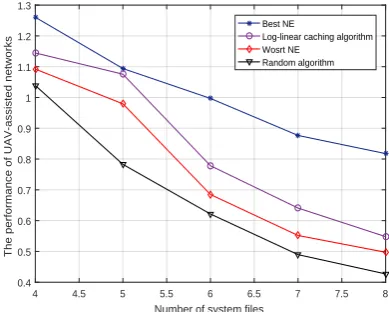
Figure 3.The performance of UAV-assisted networks versus the number of system files.(N=8 and |cn|=3.)
dbm respectively. The path loss exponent isα=3. The Nakagami fading ish∼Γ(2, 0.5). Inspired by [23], the parameter related to the environment a and b is a=11.95 and b=0.136.
4.2. Convergence Behavior
As shown in Fig. 2, the performance of UAV-assisted networks finally converges to a stable state. Here we consider that the number of system files is|f|=6, and there areN=8 UAVs to serve the users. Moreover, the cache space of UAVs is|cn| = 3. At the end of iteration, the performance of UAV-assisted network will finally converge. Also, the final performance is near to the best NE, which is the best one of 1000 independent trials based on the proposed algorithm. The simulation result validates its convergence and effectiveness of the proposed algorithm.
4.3. Performance Analysis
4.3.1. Performance of UAV-assisted Networks versus the Number of System Files
3 3.5 4 4.5 5 5.5 6 Number of cache space
0.4 0.5 0.6 0.7 0.8 0.9 1 1.1 1.2 1.3 1.4
The performance of UAV-assisted networks
Best NE
Log-linear caching algorithm Wosrt NE
Rand algorithm
Figure 4.The performance of UAV-assisted networks versus cache space of UAVs.(|f|=6 andN=8.)
5 5.5 6 6.5 7 7.5 8 Number of UAVs (N)
0.2 0.3 0.4 0.5 0.6 0.7 0.8 0.9 1
The transmission overhead of the system
Best NE
Log-linear caching algorithm Wosrt NE
Rand algorithm
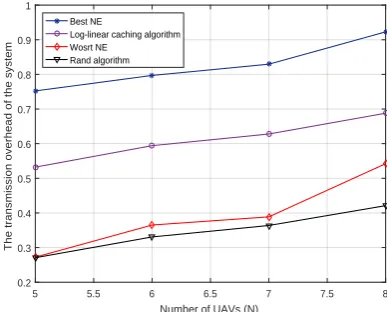
Figure 5.The performance of UAV-assisted networks versus the number of UAVs in service.(|f|=6 and|cn|=3.)
independent trials using the proposed log-linear caching algorithm. Actually, each convergent value is a NE solution. Then the average of values is defined as the final value. In addition, we choose the best one and worst one of the values as the best NE and the worst NE respectively. Fig. 3 depicts the performance of UAV-assisted networks when varying the number of system files from 4 to 8. Several important observations can be seen in this figure:1) the performance of UAV-assisted networks decreases as the number of system files increases. 2) compared with the random algorithm, the log-linear caching algorithm brings the better performance of UAV-assisted networks. 3) due to the limited UAVs’ processing capacity, when the number of system files increases, users’ requests become more complex, which leads to a decline in performance.
4.3.2. Performance of UAV-assisted Networks versus the Number of Cache Space
4.3.3. Performance of UAV-assisted Networks versus the Number of UAVs
Considering the number of UAVs varying from 5 to 8, we compare the performance of UAV-assisted networks. Fig. 4 indicates the influence of the number of UAVs on the performance of UAV-assisted networks. The fact is reflected from the simulation curves: in general, as the number of UAVs increases, the performance of UAV-assisted network increases. The reasonable explanation is that more UAV yields larger successful communication probability. Also, the final performance of proposed algorithm is close to the best NE with respect to different numbers of UAVs which again validates the proposed algorithm.
5. Conclusion
We investigated the problem of the optimal arrangement for both UAV’s caching contents and service locations in UAV-assisted networks. Due to the fact that UAV’s actions might influence the communication probability caused by line-of-sight (LOS) and non-line-of-sight (NLOS) link as well as the transmission overhead, we designed the ratio of users’ communication probability and transmission overhead as the performance measure mechanism to assess the performance of UAV-assisted networks. The objective for maximizing the performance of UAV-assisted networks was modeled as an UAV-assisted caching game. Moreover, we proved that the game is an exact potential game and analyzed the existence of Nash equilibrium (NE). Meanwhile, we also proposed the log-linear caching algorithm (LCA) to achieve the NE point. The simulation results validated the effectiveness of the proposed game and reflected the great performance of the proposed algorithm.
Author Contributions:Tao Fang and Yuli Zhang conceived the model; Tao Fang performed the simulation results and performance analysis; Xiaobo Zhang and Xueqiang Cheng analyzed the game proof; Tao Fang wrote the paper; and Hua Tian, Xinhong Shao provided some suggestions and revised the paper.
Funding: This work was supported by the National Natural Science Foundation of China under Grant No. 61771488 and No. 61631020, in part by the Natural Science Foundation for Distinguished Young Scholars of Jiangsu Province under Grant No. BK20160034, and in part by the Open Research Foundation of Science and Technology on Communication Networks Laboratory.
Conflicts of Interest:The authors declare no conflict of interest.
References
1. D. Orfanus, E. P. de Freitas and F. Eliassen, "Self-organization as a supporting paradigm for military UAV relay networks,"IEEE Communications Letters, vol. 20, no. 4, pp. 804-807, April, 2016.
2. M. A. Ma’sumet al., "Simulation of intelligent unmanned aerial vehicle (UAV) for military surveillance,"
2013 International Conference on Advanced Computer Science and Information Systems, pp. 161-166, Bali, 2013.
3. S. Giese, D. Carr and J. Chahl, "Implications for unmanned systems research of military UAV mishap statistics,"2013 IEEE Intelligent Vehicles Symposium, pp. 1191-1196, Gold Coast, QLD, 2013.
4. C. W. Johnson, "Military risk assessment in counter insurgency operations : Case study in the retrieval of a UAV, Nr Sangin, Afghanistan, 11 June 2006,"2008 3rd IET International Conference on System Safety, pp. 1-6, Birmingham, 2008.
5. Z. Chen, J. Luo, H. Jiang and W. Shi, "Design & application of MIS on UAV quality & reliability for total life span,"2009 8th International Conference on Reliability, Maintainability and Safety, pp. 1290-1292, Chengdu, 2009. 6. J. Cecil, "A conceptual framework for supporting UAV based cyber physical weather monitoring activities,"
2018 Annual IEEE International Systems Conference, pp. 1-8, Vancouver, BC, Canada, 2018.
7. Z. Shudao, W. Yanjie, Y. Song, Z. Guotao and C. Long, "The intelligent wind detection system of weather UAV based on the multi-mode variable structure,"2011 Fourth International Conference on Intelligent Computation
Technology and Automation, pp. 765-768, Shenzhen, Guangdong, 2011.
9. C. Yuan, Z. Liu and Y. Zhang, "UAV-based forest fire detection and tracking using image processing techniques,"2015 International Conference on Unmanned Aircraft Systems, pp. 639-643, Denver, CO, 2015. 10. X. Jiet al., "2-OptACO: An improvement of ant colony optimization for UAV path in disaster rescue,"2017
International Conference on Networking and Network Applications, pp. 225-231, Kathmandu, 2017.
11. K. Nakadaiet al., "Development of microphone-array-embedded UAV for search and rescue task,"2017
IEEE/RSJ International Conference on Intelligent Robots and Systems, pp. 5985-5990, Vancouver, BC, 2017.
12. Y. Zeng, R. Zhang and T. J. Lim, "Wireless communications with unmanned aerial vehicles: Opportunities and challenges,"IEEE Communications Magazine, vol. 54, no. 5, pp. 36-42, May. 2016.
13. T. Fang, H. Tian, Y. Yang, X. Liu, D. Wu and X. Chen, "An influence factor based caching node selection algorithm in D2D networks,” 2017 IEEE 17th International Conference on Communication Technology (ICCT), pp. 805-809, Chengdu, 2017.
14. Y. Zhang, Y. Xu, Q. Wu,et al., "A game-theoretic approach for optimal distributed cooperative hybrid caching in D2D networks," IEEE Wireless Communication Letter, vol. 7, no. 3, pp. 324-327, June, 2018.
15. N. Zhaoet al., "Caching UAV assisted secure transmission in hyper-dense networks based on interference alignment,"IEEE Transactions on Communications, vol. 66, no. 5, pp. 2281-2294, May. 2018.
16. M. Chen, W. Saad and C. Yin, "Liquid state machine learning for resource allocation in a network of cache-enabled LTE-U UAVs,"GLOBECOM 2017 - 2017 IEEE Global Communications Conference, pp. 1-6, Singapore, 2017.
17. M. Chen, M. Mozaffari, W. Saad, C. Yin, M. Debbah and C. S. Hong, "Caching in the sky: Proactive deployment of cache-enabled unmanned aerial vehicles for optimized quality-of-experience,"IEEE Journal
on Selected Areas in Communications, vol. 35, no. 5, pp. 1046-1061, May. 2017.
18. T. Fang, H. Tian, Y. Yang, X. Zhang, Y. Zhang and Y. Xu, "Location-aware emergency content delivery in UAV-assisted networks: A game-theoretic approach, " submitted toIEEE Access.
19. Cha M, Kwak H, Rodriguez P, et al,"I tube, you tube, everybody tubes: analyzing the world’s largest user generated content video system,”ACM IMC, 2007.
20. http://traces.cs.umass.edu/index.php/network/network.
21. Y. Xu, J. Wang, Q. Wu, A. Anpalagan and Y. D. Yao, "Opportunistic spectrum access in cognitive radio networks: Global optimization using local interaction games," IEEE Journal of Selected Topics in Signal
Processing, vol. 6, no. 2, pp. 180-194, April, 2012.
22. M. Emara, H. Elsawy, S. Sorour, S. Al-Ghadhban, M. Alouini and T. Y. Al-Naffouri, "Optimal caching in 5G networks with opportunistic spectrum access,"IEEE Transactions on Wireless Communications, vol. 17, no. 7, pp. 4447-4461, July 2018.
23. A. Al-Hourani, S. Kandeepan and S. Lardner, "Optimal LAP altitude for maximum coverage,"IEEE Wireless
Communications Letters, vol. 3, no. 6, pp. 569-572, Dec. 2014.
24. Y. Xu, G. Ren, J. Chen,et al., "A one-leader multi-follower bayesian-stackelberg game for anti-jamming transmission in UAV communication networks,"IEEE Access, vol.6, pp. 21697-21709, Apr. 2018.
25. L. Jia, Y. Xu, Y. Sun,et al., "Stackelberg game approaches for anti-jamming defence in wireless networks,"
IEEE Wireless Communication, to appear. (available: https://arxiv.org/abs/1805.12308)
26. Y. Xu, J. Wang, Q. Wu, J. Zheng, L. Shen and A. Anpalagan, "Dynamic spectrum access in time-varying environment: Distributed learning beyond expectation optimization," IEEE Transactions on Communications, vol. 65, no. 12, pp. 5305-5318, Dec. 2017.
27. J. Chen, Q. Wu, Y. Xu, Y. Zhang and Y. Yang , "Distributed demand- aware channel-slot selection for multi-UAV networks: A game-theoretic learning approach,"IEEE Access, vol. 6, pp. 14799-14811, Mar. 2018. 28. D. Liu, Y. Xu, J. Wang,et al., "Self-organizing relay selection in UAV communication networks: A matching
game perspective,"IEEE Wireless Communication, to appear.
29. Y. Zhang, Y. Xu, A. Anpalagan, Q. Wu, Y. Xu, Y. Sun, S. Feng, Y. Luo, "Context-aware group buying in ultra-dense small cell networks: Unity is strength,"IEEE Wireless Communications, accepted, 2018.