On Real-valued Visual Cryptographic Basis Matrices
Neil Buckley
(Department of Mathematics and Computer Science, Liverpool Hope University, England [email protected])
Atulya K. Nagar
(Department of Mathematics and Computer Science, Liverpool Hope University, England [email protected])
Subramanian Arumugam
(National Centre for Advanced Research in Discrete Mathematics, Kalasalingam University, Anand Nagar, Krishnankoil-626 126, Tamil Nadu, India
Abstract. Visual cryptography (VC) encodes an image into noise-like shares, which can be stacked to reveal a reduced quality version of the original. The problem with encrypting colour images is that they must undergo heavy pre-processing to reduce them to binary, en-tailing significant quality loss. This paper proposes VC that works directly on intermediate grayscale values per colour channel and demonstrates real-valued basis matrices for this pur-pose. The resulting stacked shares produce a clearer reconstruction than in binary VC, and to the best of the authors’ knowledge, is the first method posing no restrictions on colour values while maintaining the ability to decrypt with human vision. Grayscale and colour images of differing entropies are encrypted using fuzzy OR and XOR, and their PSNR and structural similarities are compared with binary VC to demonstrate improved quality. It is compared with previous research and its advantages highlighted, notably in high quality reconstructions with minimal processing.
Keywords: visual cryptography; secret sharing; cryptanalysis; colour images; image pro-cessing
ACM Categories: E.3; H.3.5; I.4
1
Introduction
Conventional cryptography relies on key distribution to valid participants, but two versions of a new cryptographic paradigm were created in 1987 by Kafri and Keren [Kafri, 87] and 1994 by Naor and Shamir [Naor, 94], that do not rely on such public and private keys. These methods, respectively random grids and visual cryptography (VC), are types of visual secret sharing (VSS), which encodes a secret binary image into a set of shadow images, or shares, such that stacking a qualified subset of them reveals a reduced quality version of the original secret. These shares form an access structure, containing qualified and forbidden combinations.
Ateniese, et al. [Ateniese, 96:2] proposed methods, such as cumulative array, for con-structing schemes for any access structure. However, they yielded far from optimal reconstructed image quality (i.e. contrast), leading to years of research into this prob-lem, such as that of [Arumugam, 12], who improved the contrast of a particular type of general access structure, and [Liu, 10], who built large access structures from smaller ones.
The major drawback is that only black and white images can be directly encoded. Grayscale and colour images must first undergo pre-processing (in the form of error-diffusion and colour decomposion, as in [Duraisamy, 13]), to reduce them to binary form. Even the best error-diffusion algorithms, such as Floyd-Steinberg [Floyd, 76] produce lossy images, leaking information from the image. When the shares of a VC scheme are combined in the decryption phase, the result is a highly lossy version of the original secret image, therefore conventional (binary) visual cryptography entails two stages of quality loss. Although much prior work exists in colour VC, the range of colours is limited either by definition or by large resulting pixel expansions.
In this paper, a novel VC method, real-valued visual cryptography (RVC), is presentated that encodes grayscale and colour values directly into the VC scheme, eliminating quality loss emerging from error-diffusion and bringing about clearer reconstructions than previously achieved using methods that permit decryption using both human vision or computation. The latter entails low computational cost fuzzy, as opposed to binary, operations for decrypting the secret, and to the best of the au-thors’ knowledge, is the first VSS proposal that removes all colour restrictions and error-diffusion requirements in such a cryptographic method. Furthermore, pixel exansions are improved versus prior methods. For example, a pixel expansion of four is demonstrated in Section 5 for a 10-colour scheme. Existing VSS methodologies are explored and redefined to relax requirements to real-valued (i.e. grayscale) input and output. The contributions presented herein are:
A new version of VC – RVC – that eliminates image pprocessing re-quirements while maintaining the theoretical ability to physically stack shares for visual decryption.
Redefinition of contrast calculation. Fuzzy decryption operations.
A simulated annealing method or the construction of RVC schemes.
2
Related Work
2.1 Binary Visual Secret Sharing
Although Naor and Shamir’s original work on VC remains a popular VSS method-ology, they were mindful of the contrast loss problem using the OR operation for reconstruction and wrote a follow-up paper proposing a “Cover semi-group” [Naor, 96]. However, they conceded the impossibility of building any (k, n) access struc-tures for k n 3, thus limiting its applicability. They also expressed concern over its inability to conceal colour images.
In the same year, [Ateniese, 96:2] proposed the cumulative array method for con-structing VC basis matrices (which are used to encode secret pixels into shares) from
(ZM ,ZM) access structures, where ZM is the set of maximal forbidden subsets of
participants. Although it is easily applicable to any required access structure, the resulting pixel expansion, hence contrast (given their mutual inverse proportionality) is far from optimal. For instance, a (3, 6)-VC scheme (VCS) produces pixel expan-sion 25. However, it is shown in [Hofmeister, 00] that the optimal value is 10.
In 2004, [Yang, 04] devised the first VC method without pixel expansion applica-ble to any access structure. The method relies on probabilistically setting share pixels to black or white, such that the mean count of black-representative pixels in the re-construction is higher than for white-representative pixels. This probabilistic VC
(PVC) is distinguished from conventional, or deterministic VC (DVC), in its use of random numbers to select individual share pixel values. Whereas the reconstruction contrasts of DVC can be easily and precisely calculated (see equation (2)), those in PVC are not. Moreover, constrasts resulting from the original PVC work were lower than for DVC. However, more recent work, such as that of [Wang, 11], has consider-ably improved it. Indeed, their work introduces the concept of a user-defined pixel expansion.
2.2 Colour Visual Secret Sharing
The first to study colour VSS was [Verheul, 97], who considered a secret pixel of colour ci, where the permitted number of colours is c, and 0 i c 1. They
consid-ered the result of stacking coloured share pixels as a “generalized colour”, where the presence of a black pixel results in a black reconstruction, and all concurrent pixels of the same colour produce that colour in the reconstruction. Additionally, they provide a construction method resulting in c basis matrices, each element of which is an inte-ger in {0, ...,c1}.
A method with improved contrast was devised by [Blundo, 01], who used c-colour (2, n) and (n, n) schemes, with the requirement (proof given in their paper) that cn. They provide two algorithms, one yielding optimal pixel expansion with maximal contrast, the other yielding a trade-off between these metrics. Pixel expansions in those works are still high, and image preprocessing is still required. Interestingly, an earlier work [Koga, 98] devised a simple method, again using c colours, using a col-our lattice comprising additive and subtractive models. They construct basis matrices with pixel expansion n1
combinations of black- and white-representative conventional basis matrices and sub-stituting white share pixels (i.e., zeros) with the required colours. However, their method is limited to (n, n)-VCS.
In [Adhikari, 05], the ratio of correctly reconstructed pixels was increased com-pared to [Koga, 98]. The method entailed either one of two colour sets, {C, M, Y} or {C, M, Y, R, G, B}, each colour requiring its own basis matrix. A further c-colour methods are provided by [Cimato, 05], followed up by [Cimato, 07], who demonstrate 3-colour schemes and compute a lower pixel expansion bound of 1
2n 1 c
.
Although such methods use mutli-value basis matrices, the preferred technique amongst researchers, such as [Chen, 11] and [Wu, 13] is a combination of halftoning and colour decomposition. Here, a colour image is decomposed into its three base colours (either additive or subtractive), and each of them is treated as an independent grayscale image. The gray levels are diffused into binary form using an error-diffusion algorithm such as Floyd-Steinberg. For example, [Hou, 03] decomposed colour pixels to their C, M and Y components before encoding using 2 2 colour blocks comprising the subtractive colours, white and black.
Colour decomposition is applicable to any type of VSS. The shares are constructed by recomposing the colours, and [Wu, 13] produced arguably the best colour image reconstruction using this and void-and-cluster in their recent work. However, infor-mation is inevitably lost in the necessary reduction to binary values. This is particu-larly deleterious when sharing high-entropy images, as further information is lost in the VSS encoding.
More recently, [Christy, 15] used a stochastic method, in the form of a feed-forward artificial neuron network, to generate extended VC schemes. In such schemes, the shares themselves take on the appearance of cover images, detracting attention from hackers who might be curious about the meaning and purpose of purely like shares. Although they achieved a little higher than 41 peak-to-signal noise-ratio, they do preprocess the image to reduce each channel to binary form.
Interestingly, [Sugawari, 15] also recently developed a new colour VC method without the need for preprocessing, but it does not involve simple transparent shares or computational stacking, but high-order retarder films. Conventional retarder films, commonly used to bring about three-dimensional cinematography, rotate polarized light by fixed angles. However [Sugawari, 15] propose arbitrary angle rotation to create colour VC shares.
All of the aforementioned research falls under the category of visual secret sharing, as decryption can be carried out visually and computationally. Many purely computa-tional methods have also been developed, such as [Lukac, 05], who encypted colour pixel values as numeric data, requiring conversion to binary and simple binary opera-tions to combine shares. Although this and similar methods produce lossless recon-struction, they are examples of visual secret sharing, due to lack of ability to visually decode from stacking shares..
3
Naor-Shamir Visual Cryptography
', a lossy reconstruction of the secret. Subsets comprise superset ( qual,forb), where is the access structure defining qualified and forbidden subsets, and
qual forb
. For simplicity, forb{X X: ,Xqual}. Access structures can be threshold or general. The latter explicity defines each X, whereas the
former assumes { : }
qual X X k
, producing threshold (k, n)-VCS.
The procedure, given below, takes two collections of binary matrices, C0,C1,
form-ing the basis of a scheme. These are therefore referred to as basis matrices. If , {0,1}
SiC ii , then all possible columns permutations of Si comprise the respec-tive collection. In this paper, the collections are ignored in favour of referring directly to the basis matrices Si, with Si~X denoting that matrix X is equal to Si up to col-umn permutation.
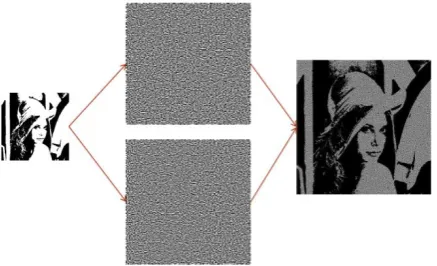
Each such matrix has dimensions nm, where m is the pixel expansion. To en-code a secret pixel, one member of C0 or C1 if selected if it is a white, resp. black, pixel. To encode shadow j, the jth row of Si is selected and converted into a rec-tangular matrix of “subpixels” whose dimensions are as close to each other as possi-ble (ideally a square matrix, if m is a square number, thus retaining aspect ratio). Each secret pixel is replaced by these subpixel blocks to form shadow images, as in Figure 1. Given that stacking is equivalent to binary OR, ' = 1 ... n. Figure 1 illustrates a simple (2, 2)-VCS.
Figure 1: Encryption and decryption of a (2, 2)-VCS
4
Real-valued Visual Secret Sharing
In this section, RVC scheme construction is demonstrated, along with the pre-requisitives for encryption, decryption and calculation of contrast. In 4.1, a simple equation is presented for converting grayscale or RGB values to real values. In 4.2, the standard contrast calculation of binary VC is generalised for RVC. As binary image decryption relies on binary operations for decryption, these are generalised to fuzzy operations in 4.3. Finally, in 4.4, the RVC methodology is introduced.
4.1 Mapping Real Values to Grayscale Colours
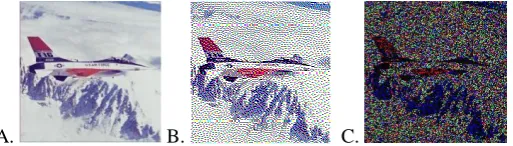
For I to be a valid input into a VSS scheme, it must be binary. Error-diffusion methods can be used on grayscale (and colour) images, but signifant information is lost, as evidenced in Figure 2, below. Furthermore, the result is a set of binary shares (i.e., each colour channel is binary), making it diffult to conceal additional “sublimi-nal” messages in them using steganography.
A. B. C.
Figure 2: A: Secret image, B: Halftoned image (Floyd-Steinberg), C: Final VSS decryption The proposed real-valued VC (RVC), avoids this information and quality loss by taking fractional colour values directly as input. Here, the grayscale secret image is a matrix of real values from 0 to 1 inclusive. If an RGB model is used with values ranging from 0 to 255, the pixel at position (i, j) of colour channel h is represented as,
pixel grayscale value 1
255
ijh (1)
where the pixel grayscale value is in 0,..., 255, i.e. the 8-bit colour value of the pixel in the respective channel. Given that a colour image comprises three combined grayscale images (of resp. red, green and blue hues), each channel can be taken as a separate grayscale image.
4.2 Contrast
The formulae given (in, for example [Ateniese, 96:1]; [Chen, 11]) to calculate re-constructed image contrast in VSS schemes assume binary pixel values, but these must be generalizes to real values. Relative contrast,
, in binary VC is defined as the mean difference between black- and white-representative pixels (or subpixel ma-trices) in the reconstruction. In VC, if Xqual and 0XS (resp. 1X
0 1
( X) ( X)
H S H S
m
, (2)where H(.) denotes Hamming weight.
An RVC scheme requires basis matrices Si,i{1,..., }c , where c is the number of colours. (2) can thus be generalizes as,
1
1 1
( ) ( )
c
X X
i i i
H S H S
m
(3)
4.3 Operations for Decryption
4.3.1 Fuzzy OR
RVC needs fuzzy equivalents of OR and XOR, respectively denoted fuz and fuz
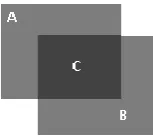
. The algorithms given in [Zadeh, 65] and other works on fuzzy logic are insuffifient. For example, the classical fuzzy-OR definition simply takes the maxi-mum value. However, Figure 3 illustrates the result of stacking two regions of colour value 0.5. The result of classical fuzzy-OR is the maximum, which is 0.5, but the stack is clearly darker than A or B. In fact, its grayscale value is 0.75 according to equation (1).
Figure 3: Stack of colours A and B (here A=B=0.5) to produce colour C
Based on this, equation (4) is given for the fuzzy OR of shadow image subpixels
1[ , ]x y and 2[ , ]x y :
1 2 1 (1 1)(1 2), [ , ]
fuz
i i
b b b b b x y (4)
Generalised for k shares is the iterative (5):
1 1
1
... 1 (1 )(1 ) , ( ) 1 (1 )(1 ),
, 1,..., 1, [ , ]
fuz fuz
k i i
j j j
i i
b b f b b
f b b b
i j k b x y
(5)
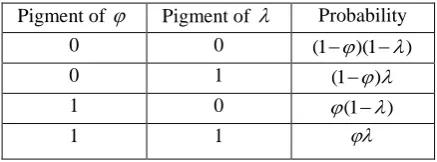
pigment ratio ( :1 ) ) onto the first, there are four possibilities, summarised in Table 1.
Pigment of
Pigment of
Probability0 0 (1)(1)
0 1 (1 )
1 0 (1)
1 1
Table 1: Pixel pigment superimposiiton probabilities
The latter three are relevant, since they are the stacks resulting in an existant pig-ment. Summing these gives (1 ) (1 ) = =1 (1 )(1), and equation (4) clearly follows from this. (5) is simply an iterative version of (4), taking each successive superimposition as the new
pigment, therefore its correct-ness follows.4.3.2 Fuzzy XOR
An advantage of VSS is the ability to decrypt without computation, by physically stacking shares. However, the information theoretic security of VSS is also available while using computation. There has been much research into applications of compu-tational decryption, such as [Wang, 13], who use XOR to losslessly decrypt multiple images from one random grid scheme.
A definition of 1 fuz 2
b b is thus needed. [Hernandez, 11] describes a “least sensi-tive” interpretation, based on the need for a definition that, given 3 1 2
fuz
b b b ,
1 2 3
(b ) fuz(b ) b for small . Here, this definition is denoted subscript LS. They prove that such a definition can be expressed as:
1 2 min max( ,1 2), max(1 1)(1 2) , [ , ]
fuz
LS i i
b b b b b b b x y (6)
4.4 RVC Schemes
Two additional parameters are introduced in an RVC scheme (RVCS), basis matrix count (
) and colour value count (). These are part of the definition of a thresholdaccess ( , , , )k n RVCS based on n m matrices S ii, {1, 2,..., } with pixel ex-pansion m. A Naor-Shamir VCS is seen as a special case in which 2.
Gen-eral access structures (see [Ateniese, 96:2]), are denoted ( , , ) RVCS, where { qual, forb}
is the access structure comprising all explicity defined qualified and forbidden share subsets.
An RVCS therefore has
basis matrices, whereSiencodes mapped grayscalevalue 1
1
i
0.5 and 1, each encoded by a basis matrix. Permitted matrix element values are
1
, {1, 2,..., } 1
i
i
. An example of a valid a (3, 3, 3, 3)-RVCS basis is,
1 2 3
.5 1 .5 0 1 0 .5 .5 0 1 .5 .5
~ 0 0 1 0 , ~ 0 1 0 0 , ~ 0 1 0 0
.5 1 1 0 1 .5 0 1 1 0 .5 1
S S S
.
According to [Kafri, 87], the mean contrast for minimal qualified subsets (i.e. k=2) is 0.25 in this example. This is also the contrast resulting from stacking all three shares. In this case,
, i.e. the number of possible colours is equal to the numberof basis matrices, but this need not be true. is chosen based on the number of grayscale values each basis matrix element can potentially take, whereas higher val-ues of
are chosen to create a finer grain encoding of colour ranges. In practice, its maximum value is 256, wherein each RGB colour value in 0,…,255 has its own re-spective matrix, but experiments have shown that such schemes are difficult to derive.The deterministic construction of these matrices remains a challenge in RVC.
Note in [Ateniese, 96:2] the need to construct basis { ,S S0 1} for an (n, n)-VCS. This is, as discussed in Section 4, simple for binary encoding, but not clear for real-valued encoding.
Simulated annealing is therefore proposed to stochastically derive RVC basis ma-trices for required parameters. However, for small k, n and , a brute-force method is applicable, whereby basis matrices of decreasing cost are reported.
A candidate solution, CS, is generated according to,
( 1) (0,1)] ~
1
mn
rand CS
(7)
where ~ indicates vector permutation and each sequential m-sized sub-vector forms the next respective row of S ii, {1,..., } . Important to note is that row ,j j1,...,n
of all basis matrices in the candidate are random column permutations of each other, which is crucial to maintain security, as discussed in Section 5.4.
The objective function is given in Algorithm 1. Although it is efficient, having at most O n( 2) complexity, when executed in a heuristic, the run time depends hugely
on n
k
and minqual . If the latter is 2, a valid basis is normally found within 30 seconds on a personal computer. This is sufficient for all graph access structures.
Algorithm 1: Objective Function for Stochastic RVC Basis Generator Input: CS, qualand preferred participant subset, pref qual
Output: S ii, {1,..., } , costValue Procedure:
Extract S ii, {1,..., } from CS
( pref), {1,..., }
i H Si i
Put i into ascending order and re-order the basis matrices according to i.
For each Yqual, do,
contrast of stack Y according to (5)*
costValuecostValue rewardConst
End For
For each Yforb, do,
contrast of stack Y according to equation (5)*
costValuecostValue rewardConst
End For
In conventional VC, the ith row of both basis matrices must have the same Ham-ming weight. In RVC, they are must be equal up to column permutation (as detailed in Section 6.4). That is,
1
[ ] ~ [ ], {1,..., }, {1,..., }
i i
S j S j i j n . (8)
Any basis not exhibiting this property is rejected in the evaluation phase, as it is not secure. Indeed, this guarantees that individual shares cannot leak the secret and guarantees perfect security in (2, n) schemes, as the only forbidden subsets are the individual shares themselves.
The annealer additionally requires a nearest neighbor and acceptance probability algorithm, as used in the SA architecture in Figure 5. Both algorithms follow:
Algorithm 2: Nearest Neighbour Input: CScurr CS, m, n,
,Output: CSnew
Procedure:
Extract S1,...,S from CScurr
1 ({1,..., })
r rand /RANDOM MATRIX
2 ({1,..., })
r rand n //RANDOM ROW OF MATRIX
3 ({1,..., })
r rand m //RANDOM SUBPIXEL IN ROW
4 ({ 1, 1})
r rand //RANDOM DIRECTION
({" "," "," "})
methodrand alter shift permutate
If method = “alter”, then,
1[ ][ ]2 3
pS r r , 4
1
r q p
If q > 1 or q < 0, then r4 r4, End If
4
1
r
p p
If r4 1, then,
1[ ]2 1[ ]2 1
r r
S r S r //LEFT SHIFT OF ELEMENTS
Else If r4 1, then,
1[ ]2 1[ ]2 1
r r
S r S r //RIGHT SHIFT OF ELEMENTS
End If
Else If method = “permutate”, then, Randomly permutate
1[ ]2
r
S r
End If
Hence a neighbor is selected by either altering the same pixel value in the same row of all matrices, shifting the elements of one matrix row by one position, or ran-domly permutating one matrix row. Crucially, each method maintains the relation between all matrices that all rows ,j j1,...,n are equal up to permutation.
Algorithm 3: Acceptance Probability Input: Ecurr,Enew,T
Output: P
Procedure:
If Enew Ecurr, then,P1
Else,
curr new
E E
T
P e
End If
Finally, Algorithm 4 describes the use of a derived set of RVC basis matrices to
encode a secret image into shares.
Algorithm 4: Encoding a Secret Image Input: ,S ii, 1,...,
Output: i,i1,...,n
Procedure:
1
, 1,..., 1
i
i
For each pixel at position x,y in , do,
[ , ]
s x y
{ : i min( i)}
i i s s
i
BS
For i1,...,n, do,
[ ]
VB i
M V reshaped to a p q matrix, where pq
Place subpixel block M at position x,y in i
Crucially, a common problem in binary VC is the reversal of colours in the recon-struction (producing a negative image). This is exacerbated in RVC, resulting in (seemingly) unpredictable permuations of reconstructed grayscale values. It is for this reason that the collection of RVC basis matrices must be reordered to optimize for the visual quality of a “preferred” share stack, pref . The simulated annealing algorithm is illustrated in Figure 5. Given the superior quality using XOR, fuz
LS is defined using equation (6) to improve the contrast of the decoded secret.
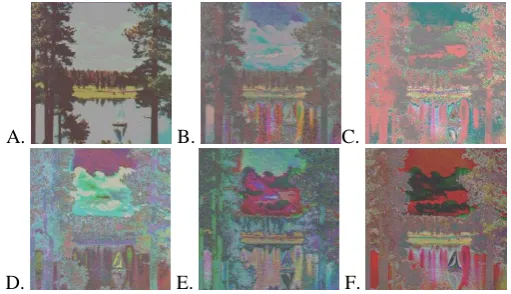
Algorithm 1 was applied to evolve the (2, 3, 10, 255)-RVCS below (each element rounded to two decimal places), with m=4, producing the shadow images in Figure 4.
1
0.99 0.59 0.01 0.76
~ 0.99 0.03 0.06 0.39 ,
0.85 0.45 0.03 0.67 S 2
0.59 0.01 0.99 0.76
~ 0.39 0.03 0.99 0.06 ,
0.85 0.03 0.45 0.67 S 3
0.59 0.76 0.01 0.99
~ 0.39 0.06 0.03 0.99 ,
0.03 0.67 0.45 0.85 S 4
0.01 0.59 0.76 0.99
~ 0.06 0.39 0.03 0.99 ,
0.45 0.67 0.03 0.85 S 5
0.76 0.99 0.59 0.01
~ 0.06 0.99 0.03 0.39 ,
0.45 0.67 0.03 0.85 S 6
0.59 0.01 0.76 0.99
~ 0.99 0.39 0.06 0.03 ,
0.85 0.45 0.67 0.03 S
7
0.59 0.01 0.99 0.76
~ 0.06 0.99 0.03 0.39 ,
0.45 0.85 0.67 0.03 S 8
0.59 0.01 0.99 0.76
~ 0.06 0.03 0.39 0.99 ,
0.67 0.85 0.45 0.03 S 9
0.76 0.01 0.59 0.99
~ 0.03 0.39 0.99 0.06 ,
0.67 0.85 0.45 0.03 S 10
0.76 0.01 0.99 0.59
~ 0.03 0.99 0.39 0.06
0.85 0.03 0.45 0.67 S
A. B. C. D.
E. F. G. H.
I. J. K.
It is clear here that, as in binary VC, XOR is superior to OR in decoding, as it elim-inates redundant dark pixels. Note the reordering of colours resulting in loss of quali-ty particulary in F and J above, whereas D and H are stacked subsets of shares in
pref .
5
Results and Discussion
5.1 Parameter Constraints
Parameters
and can be independently set. Indeed, any number of matrices and any number of shadow pixel values can be selected, ensuring:1
( iX) ( iX )
H S H S , where {1,..., 1},
qual
i X . (9)
However, it turns out that not all combinations of
, and m yield valid schemes. Obviously, it is preferable to have pixel expansion m as small as possible, resulting in smaller share sizes, but there exists a lower bound. For example, a (2, 2)-RVCS with 5,2,m4 has five basis matrices, which are stacked to produce five four-digit binary vectors. Each vector must have a different Hamming weight to satisfy equation (9), but the only possible Hamming weights here are 1, 2 ,3 or 4, so a valid scheme is impossible. (Zero is clearly not a valid Hamming weight, as it im-plies a matrix comprising only zeros.)A valid scheme therefore clearly requires that m , but ensuring security through equation (8) places further restrictions on the possible combinations and min-imal m. Experiments with the above parameters indicate that, in this case, m8. An example is the (2, 2, 5, 2)-RVCS basis,
1
1 1 0 0 0 1 1 0
~ ,
1 1 0 0 0 1 1 0
S
2
1 0 1 1 0 1 0 0
~ ,
0 0 1 1 0 1 0 1
S
3
1 1 0 0 0 0 1 1
~ ,
1 0 0 0 1 1 1 0
S
4
1 0 0 0 1 1 0 1
~ ,
0 1 1 0 0 1 1 0
S
5
1 0 0 0 1 1 0 1 ~
0 1 1 1 0 0 1 0
S
According to equation (3), this yields relative contrast
0.267. Interestingly and ironically, m10 produced the better quality 13
.
However, if, increases to to 3 or 4, schemes exist with m4 and m3, re-spectively. An example of the latter is,
1
0.67 1 0
~ ,
0.33 1 0
S
2
0.67 1 0
~ ,
0 1 0.33
S
3
0 0.67 1
~ ,
0.33 0 1
S
4
0 1 0.67
~ ,
0.33 0 1
S
5
0.67 0 1
~
0 1 0.33
S
with
0.296 according to equation (3).5.2 RVCS Encryptions and Decryptions
Here, the basis matrices and resulting shadow images and stacks are demonstrated for two full colour images. The first is a (2, 2, 10, 10)-RVCS with m=4. The sto-chastic algorithm produced the following basis with
0.272 under OR-based stacking.1
0 0.89 1 0.33
~ ,
0 0.89 0.56 0.11
S
2
0 1 0.89 0.33
~ ,
0 0.89 0.11 0.56
S
3
0.33 0 0.89 1
~ ,
0.56 0.11 0 0.89
S
4
0 1 0.89 0.33
~ ,
0.11 0 0.89 0.56
S
5
1 0.33 0 0.89
~ ,
0.11 0 0.56 0.89
S
6
1 0.33 0.89 0
~ ,
0.56 0.89 0 0.11
S
7
0 0.89 0.33 1
~ ,
0.89 0.11 0 0.56
S
8
0 1 0.33 0.89
~ ,
0.89 0 0.11 0.56
S
9
0.89 0 0.33 1
~ ,
0.11 0.56 0.89 0
S
10
0.89 0.33 0 1
~
0 0.56 0.89 0.11
S
Figure 6 shows the resulting shares and stacks using fuzzy OR and XOR, after en-coding the “earth” image using the above basis.
A. B. C.
D. E.
Figure 6: (2, 2, 10, 10)-RVCS, m4,0.272. A: Secret image, B:
1, C: 2,
D: 1fuz 2, E: 1LSfuz 2
Here, pref qual, since there exists only one stack from two shares. Figure 6D is the result of OR-stacking the shares, but with the luxury of computation to decrypt, least sensitive fuzzy XOR can be used to reveal the reconstruction in Figure 6E.
1
0.95 0.16 1 0.11
0.79 0.63 0.84 0.05
~ ,
0.47 0.79 0 0.89
0.95 0.21 1 0.21
S 2
0.16 1 0.95 0.11
0.05 0.79 0.84 0.63
~ ,
0 0.47 0.89 0.79
0.21 0.95 1 0.21
S 3
1 0.95 0.11 0.16
0.63 0.84 0.05 0.79
~ ,
0.47 0.79 0 0.89
0.95 0.21 1 0.21
S 4
0.95 0.16 1 0.11
0.63 0.84 0.79 0.05
~ ,
0.47 0.79 0.89 0 1 0.21 0.21 0.95 S 5
0.95 0.11 1 0.16
0.63 0.05 0.79 0.84
~ ,
0.79 0.89 0.47 0 0.21 0.21 0.95 1 S 6
0.95 0.16 0.11 1
0.84 0.05 0.79 0.63
~ ,
0 0.89 0.79 0.47
0.95 1 0.21 0.21
S 7
1 0.95 0.11 0.16 0.63 0.84 0.79 0.05
~ ,
0.79 0.89 0 0.47
1 0.95 0.21 0.21 S 8
0.16 0.11 0.95 1 0.05 0.79 0.84 0.63
~ ,
0.89 0 0.47 0.79
0.21 0.21 0.95 1 S 9
1 0.11 0.95 0.16 0.63 0.05 0.79 0.84
~ ,
0 0.47 0.79 0.89
0.21 0.95 0.21 1 S 10
1 0.16 0.95 0.11
0.63 0.05 0.79 0.84
~ ,
0.47 0.89 0.79 0
1 0.95 0.21 0.21 S 11
0.11 1 0.16 0.95
0.63 0.05 0.79 0.84
~ ,
0.89 0 0.47 0.79
1 0.95 0.21 0.21 S 12
0.16 0.11 0.95 1
0.63 0.79 0.84 0.05
~ ,
0.79 0 0.89 0.47
0.21 0.21 0.95 1 S 13
0.95 0.16 0.11 1
0.05 0.63 0.84 0.79
~ ,
0.79 0.47 0.89 0
1 0.21 0.21 0.95 S 14
0.16 0.95 1 0.11
0.63 0.05 0.79 0.84
~ ,
0.47 0.79 0 0.89
1 0.95 0.21 0.21 S 15
0.16 0.95 1 0.11
0.63 0.79 0.05 0.84
~ ,
0 0.89 0.47 0.79
1 0.95 0.21 0.21 S 16
0.95 0.16 0.11 1
0.79 0.63 0.84 0.05
~ ,
0.79 0.47 0.89 0
0.21 0.95 0.21 1 S 17
1 0.16 0.11 0.95
0.63 0.84 0.79 0.05
~ ,
0.89 0.47 0.79 0
0.21 0.21 0.95 1 S 18
0.95 0.11 0.16 1
0.63 0.84 0.79 0.05
~ ,
0 0.47 0.89 0.79
0.95 0.21 1 0.21
S 19
0.16 0.95 0.11 1
0.79 0.63 0.84 0.05
~ ,
0.47 0 0.89 0.79
0.21 1 0.95 0.21
S 20
0.16 0.11 1 0.95
0.79 0.84 0.05 0.63 ~
0.89 0.47 0 0.79
1 0.21 0.95 0.21 S .
A. B. C. D.
E. F. G.
Figure 8 gives the equivalent fuzzy-XOR stacks.
A. B. C.
D. E. F.
Figure 8: (2, 4, 20, 20)-RVCS, A-F: All possible 2-stacks combined using fuzzy-XOR
In this case, pref {1, 2}, rendering the correct colour order for 1{ , } 2 fuz
but
the aforementioned problem of colour reordering is blatant in the above example. So far, only graph access structure basis matrices have been obtained. In our pa-per, [Buckley, 13], genetic algorithms were used to evolve binary basis matrices and limitations were conceded due to combinatorial complexity. The problem is exacer-bated for real-valued matrices, as the possible number of combinations vastly increas-es.
5.3 Comparative Analysis
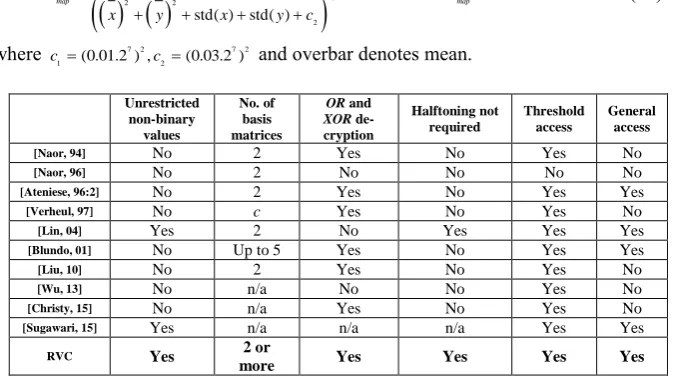
The findings of this study are compared to other key studies in terms of non-binary encryption capability (i.e. pixel values and basis matrix count), ability to decrypt us-ing both OR and XOR, pre-processing, access structures, perfect information theoretic security and computational cost.
Stacking results (of shares 1 and 2) are compared with those of conventional VC. Results are compared based on peak-to-signal noise ratio (PSNR) calculations, begin-ning with mean squared error, which is used to derive PSNR, i.e.,
2
1 1
1
( )
w h
channel xy xy
x y
MSE
wh
' ,3
10 10
1
20 log 255 10 log
3
channel channel
MSE
PSNR
(10)where w and h are the image dimensions, xyis the respective colour value (on a
this analysis. The map is calculated as follows, and the map average to arrive at the final index value.
1 2
2 2
2
2 2 cov( , )
, 100.
std( ) std( )
map map
x y c x y c
SSIM SSIM SSIM
x y x y c
(11)
where 7 2 7 2
1 (0.01.2 ) , 2 (0.03.2 )
c c and overbar denotes mean.
Unrestricted non-binary values No. of basis matrices
OR and
XOR de-cryption Halftoning not required Threshold access General access
[Naor, 94] No 2 Yes No Yes No
[Naor, 96] No 2 No No No No
[Ateniese, 96:2] No 2 Yes No Yes Yes
[Verheul, 97] No c Yes No Yes No
[Lin, 04] Yes 2 No Yes Yes Yes
[Blundo, 01] No Up to 5 Yes No Yes Yes
[Liu, 10] No 2 Yes No Yes No
[Wu, 13] No n/a No No Yes No
[Christy, 15] No n/a Yes No Yes No
[Sugawari, 15] Yes n/a n/a n/a Yes Yes
RVC Yes 2 or
more Yes Yes Yes Yes
Table 2: Comparative analysis 1
Perfect inf. sec. security
Comp. Cost based on
n k
or min( ) qual
XORPSNR Decoded XORSSIM Decoded
[Naor, 94] Yes 2
( )
O n 4-9 0-13%
[Naor, 96] Yes 2
( )
O n 5-10 0-16%
[Ateniese, 96:2] Yes 2
( )
O n 4-9 0-13%
[Verheul, 97] Yes 2
( )
O n 6-11 0-13%
[Lin, 04] Yes 2
( )
O n n/a n/a
[Blundo, 01] Yes 2
( )
O n <10 10-20%
[Liu, 10] Yes 2
( )
O n <12 5-20%
[Wu, 13] Yes 2
( )
O n n/a n/a
[Christy, 15] No n/a (stochastic) n/a n/a
[Sugawari, 15] Yes Unknown n/a (only simple images)
n/a (only simple images)
RVC Yes
2
( )
O n per SA
itera-tion 9-13 5-50%
The OR and XOR stacking results of binary and real-valued VC are compared for four grayscale images (A-D) of differing entropy values and colour distributions, as well as three full-colour images (E-G). The test images are given in Table 4, where entropy is given by,
2
0 255, 0
100 log
8 i
i i
i
E
, (12)
where i is the number of pixels of the ith grayscale colour.
Test Image Colour Distribution Percentage Entropy
Image A
37.3
Image B
71.3
Image C
94
Image D
Image E
50.8
Image F
74.6
Image G
97.1
Table 4: Test images and colour analyses
Each image was encrypted into a pair of binary, as well as real-valued shadow images using a (2, 2, 10, 30)-RVC with m4. Table 5 compares the resulting binary versus
Img VC Binary-OR Stacks RVC Fuzzy-OR Stacks XOR Stacks VC Binary- RVC Fuzzy-XOR Stacks
A
B
C
D
E
F
G
In each case, similarity of the decrypted image to the secret image was calculated in terms of PSNR and SSIM, the results of which follow in Table 6, and in Table 7 are the percentage increases in reconstructed image similarity of RVC over conven-tional VC. The results there clearly incidicate improved quality of reconstructed im-ages using the RVC approach, as opposed to conventional VC. Grayscale imim-ages with few colours or a smooth colour value distribution produced the most significant-ly improved PSNR and SSIM metrics, although the chaoticalsignificant-ly distributed Image D also showed lesser improvements in real-valued versus binary VC decryption.
(Peak to Signal Noise Ratio %, Structural Similarity %)
Image binary VC using OR
binary VC using XOR
RVC using OR
RVC using XOR
A (5.2, 1.0) (6.4, 11.2) (6.1, 5.1) (11, 25)
B (5.9, 3.1) (5.6, 6.6) (7.3, 6.1) (11, 23.3)
C (6.0, 2.7) (4.9, 4.0) (8.7, 8.3) (11.8, 20.8)
D (5.4, 13.2) (6.5, 31.3) (6.2, 15.2) (10.4, 49.0)
E (4.0, 0.7) (9.1, 45.9) (4.3, 3.2) (12.3, 18.3)
F (5.7, 0.8) (6.5, 1.5) (6.4, 1.4) (9.5, 5.2)
G (5.7, 4.0) (6.1, 9.2) (6.6, 5.4) (10.4, 22.7)
Table 6: PSNR of binary vs real-valued VC with parameters (2, 2, 10, 255), m=4
Interestingly, there is a broad increase in quality improvement with higher entropy values, with some obvious exceptions. Consider the low entropy colour Image E. Here, there is a huge improvement in OR-based stacking, but XOR-based stacking exhibits a decrease in quality versus conventional VC. However, in this case, the above metric is misleading, as it is clear in Table 5 that fuzzy-XOR decrypts the white background as an average gray colour, as opposed to binary-XOR, which retains the pure white. Since there are so many white pixels in the secret image, this change produces the significant error value.
A. B. C. D.
E. F. G. H.
I. J. K. L.
M. N.
Figure 9: Fuzzy-OR and –XOR reconstructions of Images A-G from a (2, 4, 30, 255)-RVC
Mean Percentage Improvement in PSNR and
SSIM
Scheme OR
PSNR
XOR PSNR
OR SSIM
XOR SSIM
(2, 2, 10, 255) 19 74 180 164
(2, 4, 30, 255) 59 73 52 269
Table 7: Improvements in similarity metrics using binary vs real-valued VC with parame-ters (2, 2, 10, 255), m=4
5.4 Security
Information theoretic security of conventional VC relies on the requirement, when calculating a scheme’s basis matrices, that H S( 0[ ])j H S j( [ ])1 j {1, ..., }n .
Equivalent-ly,
S0[ ]j
S j1[ ], because the sum and Hamming weight of a binary vector areequal. For the construction of the subpixel matrix at coordinate ( , )x y in the shadow image held by the jth participant, the following procedure is followed:
1. Select basis matrix S j ii[ ], xy, 2. Randomly permutate Si[ ]j , 3. Reshape Si[ ]j
into rectangular matrix M, and 4. Place M at coordinate ( , )x y in j.
An adversary possessing a share might want to retrieve the secret from that share. He must therefore retrieve xy from M. However, step 2 clearly renders this
impossi-ble due to Hamming weight equality. For example, if S0[1]
1 0 1 0
and
1[1] 0 0 1 1
S , both could be permutated to become
0 1
0 1
[1] [1] 0 1 1 0
1 0
S S M
. Hence the procedure is irreversible.
A set of RVC matrices is non-binary, meaning Hamming weight is inapplicable. Instead, equality of row sums might be considered preferable. For example,
1[1] 0 1 0.5 0.5 , 2[1] 1 0 1 0 , 3[1] 0.5 0.5 0.5 0.5
S S S . However, steps 2
and 3 do not conceal the mapping from Ix y, to M, because the distribution of colour
values in the resulting subpixel matrices differ.
To maintain information theoretic security in graph access structures, it is neces-sary that, given j, all S ji[ ] are equal up to permutation, as in equation (8). In non-graph access structures, ie. (k, n)-VC, k3, one must also ensure that no subset of shares X forb can access any part of the secret when they are stacked according to equations (4) and (5). Here, it is necessary that 1 ~ 2 ~ ... ~
X X X
S S S , i.e. all (OR’d or XOR’d) stacks of all subsets are equal up to column permutation.
As noted in Section 4.4, the candidate solution is initialised such that row
, 1, ...,
i i n in all matrices are equal up to permutation and the only change to the
solu-tion comes about using Algorithm 1. Furthermore, this algorithm guarantees to main-tain the quality up to permutation, hence information theoretic security in the final constructed RVC scheme is guaranteed for graph access structures. (As discussed, non-graph access is not considered in this paper.)
6
Conclusion and Ongoing Research
basis matrices, in which fractions between 0 and 1 represent grayscale values from 0 to 255. In effect, this is the first true colour VC methodology
No halftoning is required, retaining more of the information from the original gray-scale or colour image. This producing a better quality reconstruction evidenced here in the fuzzy OR and XOR decryptions of various images of differing entropies and colour distributions, in different access structures. Real-valued VC has been com-pared with conventional binary VC in terms of peak-to-signal noise ratio and struc-tural similarity index, and in the vast majority of cases, there is a significant (indeed, in many cases, a dramatic) improvement in image reconstruction quality. The mean improvement in quality for OR-based stacking in the examples in Section 5 (taking both PSNR and SSIM into account) is 86%, and that for computational (XOR-based) stacking is 145%!
This proposal is an entirely new type of VSS presententing new computer scientific and mathematical challenges. The problem of colour reordering in RVC has been demonstrated in Section 5. The equivalent problem in conventional VC is production of a negative image, but this is only a problem when using pixel expansion reduced basis matrices. Matrices with maximal expansion, produced using the cumulative array method [Ateniese, 96:2], although extremely space-inefficient, do not suffer from this effect. It is therefore a pressing challenge to devise an equivalent technique for generating (k, n,
,) schemes.A further unknown is the precise relationship between the bounds on parameters k, n,
, and m. A governing system of formulae would help to calculate the feasibil-ity of a given scheme, without having to infer infeasibilfeasibil-ity from the lack of successful experimental results. For example, if a high-entropy image needs to be encoded into a scheme with a low pixel expansion, it would be useful to derive theoretical bounds on the number of colour values.7
References
[Adhikari, 05] Adhikari, A, Sikdar, A.: A new (2,n)-visual threshold scheme for color images, In Proc. Indocrypt 2003, volume 2904, 148-161
[Arumugam, 12] Arumugam, S., Lakshmanan, R., Nagar, A.K.: On (k, n)*-visual cryptog-raphy scheme, Designs, Codes and Cryptogcryptog-raphy, July 2012, 1-10
[Ateniese, 96:1] Ateniese, G., Blundo, C., De Santis, A.: Constructions and Bounds for Visual Cryptography, Automata, Languages and Programming, volume 1099, 416-428
[Ateniese, 96:2] Ateniese, G., Blundo, C., De Santis, A.: Visual Cryptography for General Access Structure, Information and Computation, 129(2), 86-106
[Blundo, 01] Blundo C., De Bonis A., De Santis, A.,, De Santis, A.,: Improved Schemes for Visual Cryptography, Designs, Codes and Cryptography, 24(3), 255-278
[Buckley, 13] Buckley, N., Nagar, A.K., Arumugam, S.: Evolution of Visual Cryptography Basis Matrices with Binary Chromosomes, In Proc. 8th EUROSIM Conf. on Modelling and Simulation, 7-12
[Christy, 15] Christy, J.I., Seenivasagam, V.: Feed Forward Networks in Color Extended Visu-al Cryptography to Generate Meaningful Shares, InternerationVisu-al JournVisu-al of Security and Its Applications, 9(1), 165-178
[Cimato, 05] Cimato, S., De Prisco, R., De Santis, A.: Optimal colored threshold visual cryp-tography schemes, Designs, Codes and Crypcryp-tography, 35(3), 311-335
[Cimato, 07] Cimato, S., De Prisco, R., De Santis, A.: Colored visual cryptography without color darkening, Theoretical Computer Science, 374(1-3), 261-276
[Duraisamy, 13] Duraisamy, A., Sathiyamoorthy, M., Chandrasekar, S.: Protection of Privacy in Visual Crytography Scheme Using Error Diffusing Technique, Int. Journal of Computer Science and Network, n/a, 60-66
[Floyd, 76] Floyd, R.W., Steinberg, L.: An Adaptive Algorithm for Spatial Greyscale, Pro-ceedings of the Society for Information Display (Second Quarter 1976), 17(2), 75-77
[Hernandez, 11] Hernandez, J.E., Nava, J.: Least Sensitive (most robust) fuzzy “exclusive or” operations, In Proc. 2011 Annual Meeting of the North American Fuzzy Information Pro-cessing Society (NAFIPS), 1-6
[Hofmeister, 00] Hofmeister, T., Krause, M., Simon, H.U.: Contrast-optimal k out of n secret sharing schemes in visual cryptography, Theoretical Computer Science, 240(2), 471-485 [Hou, 03] Hou, Y.: Visual cryptography for color images, Pattern Recognition, volume 36, 1619-1629
[Kafri, 87] Kafri, O., Keren, E.: Image encryption by multiple random grids, Optical Letters, 12(6), 377-379
[Koga, 98] Koga, H., Yamamoto, H.: Proposal of a lattice-based visual secret sharing scheme for color and gray-scale images, IEICE Transactions on Fundamentals of Electronics, Commu-nication and Computer Sciences, 81-A(6), 1262-1269
[Lin, 04] Lin, C., Tsai, W., Tsai, W.: Secret image sharing with steganography and authentica-tion, The Journal of Systems and Software, 73(3), 405-414
[Liu, 10] Liu, F, Wu, C., Lin, X.: Step Construction of Visual Cryptography Scheme, IEEE Transactions on Information Forensics and Security, 5(1), 27-38
[Lukac, 05] Lukac, R., Plataniotis, K.: Bit-level based secret sharing for image encryption, Pattern Recognition, 38(5), 767-772
[Naor, 94] Naor, M., Shamir A.: Visual Cryptography, In Proc. EUROCRYPT 1994, 1-12 [Naor, 96] Naor, M., Shamir A.: Visual Cryptography II : Improving the Contrast Via the Cover Base, Security in Communication Networks, n/a, 197-202
[Sugawari, 15] Sugawari, S., Harada, K., Sakai, D.: High-chroma visual cryptography using interference colour of high-order retarder films, Optical Review, 22(4), 544-552
[Ulichney, 93] Ulichney, R.: The void-and-cluster method for dither array generation, In Proc. SPIE 1913, Human Vision, Visual Processing and Digital Display, 332-343
[Verheul, 97] Verheul, E.R., van Tilborg, H.C.A.: Constructions and Properties of k out of n visual secret sharing schemes, Designs, Codes and Cryptography, 11(2), 179-196
[Wang, 04] Wang, Z., Bovik, A.C., Sheikh, H.R., Simoncelli, E.P.: Image Quality Assessment: From Error Visibility to Structural Similarity, IEEE Transactions on Image Processing, 13(4), 600-612
[Wang, 13] Wang, Z., Pizzolatti, M.S., Chang, C.: Reversible Visual Secret Sharing Based on Random-grids for Two-image Encryption, Int. Journal of Innovative Computing, Information and Control, 9(4), 1691-1701
[Wu, 13] Wu, X., Sun, W.: Improving the visual quality of random grid-based visual secret sharin, Signal Processing, 93(5), 977-995
[Yang, 04] Yang, C.: New visual secret sharing schemes using probabilistic method, Pattern Recognition Letters, 25(4), 481-494