Patron: Her Majesty The Queen Rothamsted Research Harpenden, Herts, AL5 2JQ
Telephone: +44 (0)1582 763133 Web: http://www.rothamsted.ac.uk/
Rothamsted Research is a Company Limited by Guarantee Registered Office: as above. Registered in England No. 2393175.
Rothamsted Repository Download
A - Papers appearing in refereed journals
Urban, M., Cuzick, A., Rutherford, K., Irvine, A. G., Pedro, H., Pant, R.,
Sadanadan, V., Khamari, L., Billal, S., Mohanty, Sagar and
Hammond-Kosack, K. E. 2017. PHI-base: a new interface and further additions for
the multi-species pathogen–host interactions database. Nucleic Acids
Research. 45 (D1), pp. D604-D610.
The publisher's version can be accessed at:
•
https://dx.doi.org/10.1093/nar/gkw1089
The output can be accessed at:
https://repository.rothamsted.ac.uk/item/8v3x2/phi-base-
a-new-interface-and-further-additions-for-the-multi-species-pathogen-host-interactions-database
.
© 3 December 2016, CC-BY terms apply
PHI-base: a new interface and further additions for the
multi-species pathogen–host interactions database
Martin Urban
1,*, Alayne Cuzick
1, Kim Rutherford
2, Alistair Irvine
1,‡, Helder Pedro
3,
Rashmi Pant
4, Vidyendra Sadanadan
4, Lokanath Khamari
4, Santoshkumar Billal
4,
Sagar Mohanty
4and Kim E. Hammond-Kosack
1,*1Department of Plant Biology and Crop Science, Rothamsted Research, Harpenden, Hertfordshire AL5 2JQ, UK,
2Cambridge Systems Biology and Department of Biochemistry, University of Cambridge, Sanger Building, 80 Tennis
Court Road, Cambridge, Cambridgeshire CB2 1GA, UK,3The European Molecular Biology Laboratory, The European Bioinformatics Institute, Hinxton, Cambridgeshire CB10 1SD, UK and4Molecular Connections Private Limited, Basavanagudi, Bangalore 560 004, India
Received September 30, 2016; Revised October 24, 2016; Editorial Decision October 25, 2016; Accepted October 27, 2016
ABSTRACT
The pathogen–host interactions database (PHI-base) is available at www.phi-base.org. PHI-base con-tains expertly curated molecular and biological in-formation on genes proven to affect the outcome of pathogen–host interactions reported in peer re-viewed research articles. In addition, literature that indicates specific gene alterations that did not af-fect the disease interaction phenotype are curated to provide complete datasets for comparative pur-poses. Viruses are not included. Here we describe a revised PHI-base Version 4 data platform with im-proved search, filtering and extended data display functions. A PHIB-BLAST search function is provided and a link to PHI-Canto, a tool for authors to di-rectly curate their own published data into PHI-base. The new release of PHI-base Version 4.2 (October 2016) has an increased data content containing in-formation from 2219 manually curated references. The data provide information on 4460 genes from 264 pathogens tested on 176 hosts in 8046 inter-actions. Prokaryotic and eukaryotic pathogens are represented in almost equal numbers. Host species belong ∼70% to plants and 30% to other species of medical and/or environmental importance. Addi-tional data types included into PHI-base 4 are the direct targets of pathogen effector proteins in ex-perimental and natural host organisms. The curation problems encountered and the future directions of the PHI-base project are briefly discussed.
THREE KEY POINTS
(i) Improved PHI-base 4 platform with increase in pathogen species and genotypic/phenotypic data content.
(ii) On-line author curation tool called PHI-Canto for any pathogenic species and a PHIB-BLAST function. (iii) Cross-references for first plant host targets of pathogen
effectors.
INTRODUCTION
With an increasing world population and associated global trade, pathogens pose a constant threat to efforts focused on increasing crop yield, whilst safeguarding human and animal health and protecting natural ecosystems (1). Since the identification of the first bacterial avirulence gene in the plant infecting pathogenPseudomanas syringaein the early 1980s (2,3), many more research articles have been pub-lished describing the molecular analysis of pathogen gene mutations via experimentation and the functional charac-terization of these mutant alleles on one or more host or-ganisms.
The pathogen–host interactions database (www.phi-base. org) is a well recognized information resource catalogu-ing the phenotypes of experimentally verified pathogenicity, virulence and effector genes from a wide range of plant and animal pathogens and host species. The trained curation team manually extracts the information about gene func-tion in pathogenesis from peer reviewed literature and trans-fers the data into a computable form. This enables immedi-ate data access to guide further experimentation and enable comparative data analysis. Various complementary multi-species databases on pathogens exist that also provide gene
*To whom correspondence should be addressed. Tel: +44 1582 763 133; Fax: +44 1582 760 981; Email: [email protected]
Correspondence may also be addressed to Kim E. Hammond-Kosack. Tel: +44 1582 763 133; Fax: +44 1582 760 981; Email: [email protected]
‡Deceased 21 February 2016.
C
The Author(s) 2016. Published by Oxford University Press on behalf of Nucleic Acids Research.
Nucleic Acids Research, 2017, Vol. 45, Database issue D605
function annotation. Recently, these have been comprehen-sively reviewed (4,5).
PHI-base data were first made available via the internet (www-phi3.phibase.org) in May 2005 (6). The data content has been continually updated (7). Since 2011, PHI-base has provided phenotypic annotation for over 100 crop plant in-fecting microbial pathogens into Ensembl Genomes (8) as part of the PhytoPath project (9). With the help of part-time biocurators and continued support of the phytopathogen research community ∼10 papers are curated weekly and new data releases occur twice yearly.
PHI-base was intentionally set up to cover a wide scope of microbial species and their hosts to facilitate cross-kingdom comparative phenomics, genomics and network approaches for virulence gene discovery and to identify po-tential disease intervention targets (10,11). The database provides outlinks to primary information sources includ-ing (i) PubMed, (ii) the digital object identifier for the curated article, (iii) NCBI taxonomy for organism details and (iv) to UniProt Knowledgebase as a resource for func-tional up-to-date information on proteins. Detailed com-parative analyses across wide taxonomic distances can be made using nine high-level ‘species-neutral’ PHI-base phe-notypes. This controlled vocabulary has been defined pre-viously (7) and is routinely used in research publications but the individual terms have not been mapped to gene ontology (GO) terms (12) due to their generalized nature. Phenotypes are assigned to interactions (interaction phe-notype) that are defined as the observable function of one gene, on one host and one tissue type. Only one term is assigned per pathogen–host interaction. These pheno-types include four terms on ‘disease causing ability’ such as ‘loss of pathogenicity’, ‘reduced virulence’ and ‘unaffected pathogenicity’ as well as ‘resistance or sensitivity to chem-istry’.
Version 4.2 of PHI-base released in October 2016, and de-scribed in this article, contains information on 4460 genes, 8046 interactions, 264 pathogens, 176 hosts and 2219 ref-erences. Plant infecting pathogens (bacteria, fungi, protists and nematodes) represent 70% of the species in PHI-base. The majority of these plant pathogens are highly detrimen-tal to the productivity of either staple agricultural and hor-ticultural crops, for example, rice, maize, wheat, barley, rye, potato, brassica, bean, pepper, tomato and/or commercial tree species, for example, olive, apple, pear and pine. The other 30% of the pathogenic species in PHI-base are of med-ical or ecologmed-ical importance and infect humans, farmed animals, farmed fish and shell fish, cultivated mushrooms, honey bees, wild birds and/or specific insects.
In the following we describe three major improvements to the database: a new PHI-base web platform to search the database including BLAST functions, increased data content and a newly developed multi-species annotation tool, called PHI-Canto. PHI-Canto strongly supports the community annotation of a wide repertoire of pathogen gene types required for disease formation on host species, pathogen effectors that activate or suppress plant host de-fenses, the novel ‘in host’ functions of variant effector se-quences, effector targets in plants and the target sites of commercial anti-infectives.
RESULTS AND DISCUSSION
PHI-base 4: a new database search interface
The previous version of the PHI-base 3 relational database (online without major updates to the computational frame-work since 2005 atwww-phi3.phibase.org), was able to dis-play only a limited amount of the information currently being curated. Since PHI-base inception, curation depth was continuously increased to be able to extract, quantify and define about twice the amount of data from every re-search article using both generic and bespoke ontologies. Currently every article is scanned for information to be ex-tracted into a record spreadsheet with 81 fields (Supplemen-tary Text 1). In PHI-base 4 the majority of this information is now displayed in a faceted interface. The new information presented includes additional details on the pathogen gene modifications (such as a deletion containing a gentamicin resistance cassette), further details on pathogen and host strains, increased host data including genotype, plant resis-tance gene tested, tissue used in the inoculation bioassays and the first plant host target proteins physically interact-ing with curated pathogen effector proteins (Supplementary Table S1).
The new PHI-base 4 platform (www.phi-base.org) uses the Java programing language Version 1.7 and the Apache Lucene/SOLR NoSQL platform Version 4.7.1 (https:// lucene.apache.org) to allow full text indexing and faceted searching capability. The indexing approach allows in-creased flexibility in search terms. Keyword searches are now made possible using text autocomplete features. In the current workflow, twice yearly the spreadsheet with cu-rated data (downloadable from the website) is parsed into a MySQL database (version 5.0) (schema in Supplementary Figure S1) and indexed using SOLR. The web interface is generated in Apache Tomcat 6.0 using JavaServer Pages on CentOS 5.9 as a computing platform.
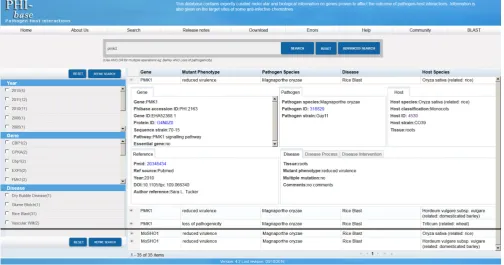
Figure 1. Search results for the genePMK1in PHI-base version 4. Information is displayed in facets. The main page shows a detailed view for the selected record PHI:2163. Here theMagnaporthe oryzae pmk1mutant was tested on roots and the observed mutant phenotype was ‘reduced virulence’. All retrieved 35 records are listed on the main page. Facet views on the left provide summary results and can be used to refine search results further.
PHIB-BLAST
PHI-base is primarily a knowledge provider and bioin-formatics tools to analyze PHI-base data are provided elsewhere. For example, advanced search functionality is provided by PhytoPath (www.PhytoPathdb.org) based on BioMart search functionality to enable searches for genes of interest across different species of plant pathogens provided in Ensembl Genomes (9). In the PhytoPath-Advanced-Search tool, filters can be set for specific search terms that include base interaction phenotypic outcomes, PHI-base experimental conditions and PHI-PHI-base hosts.
Feedback received from the PHI-base user community indicated that many users would appreciate the availabil-ity of a BLAST tool within PHI-base to determine whether a homolog of their ‘gene of interest’ had already been ex-plored experimentally in a pathogenic species. Therefore, a PHIB-BLAST tool is provided to allow the direct query of the translated PHI-base protein set. Archived versions of PHI-base 4 protein sets are provided for reproducibil-ity purposes. PHIB-BLAST functionalreproducibil-ity was established using SequenceServer Version 1.08 (www.sequenceserver. com) to provide the graphical user interface (Supplemen-tary Figure S2). Batch BLAST of multiple protein query sequences is also supported.
PHI-Canto: toward development of a multi-species pathogen–host interactions curation interface for authors
Biocuration of plant–host interaction experiments is com-plex and the curation process is difficult to automate. Ex-tracting a complete curation dataset from publications can
be challenging where data may be lacking from the pri-mary publication content. Such issues can arise from jour-nal restrictions on document length, authors using com-munity specific sources for gene/protein identifiers rather than UniprotKB protein identifiers and common organ-ism names rather than those with specific NCBI taxonomy identifiers. Authors of primary publications are the most knowledgeable persons to enter their research data into a database. However, this may require effective literature cu-ration tools and guidance from trained biocurators.
an-Nucleic Acids Research, 2017, Vol. 45, Database issue D607
notation extensions. Data requirements for PHI-Canto are: (i) data must come from a peer-reviewed publication with a PubMed ID. The predicted coding sequence of the gene(s) for curation must have (ii) a UniProtKB protein accession number(s) to create a systematic identifier and linkout to a specific organism. To prevent data duplication PHI-Canto can only have one assigned curator per PubMed ID. Each author can have several papers under curation at the same time. PHI-Canto curation guidelines ( http://curation.phi-base.org/docs) have been made available based on revised help documents from PomBase-Canto. A tutorial video cu-rating an example paper by Cuzicket al. (15) is available online (https://www.youtube.com/watch?v=-26pfqgWf2Q).
Biological data
Phenotype data in the current release of PHI-base. PHI-base version 4.2 includes 27% more phenotype interactions compared to PHI-base version 3.8 described previously (4). Bacterial and fungal pathogens represent the majority of the interaction data (Table1). A total of 3029 phenotype in-teractions describing experimental data on 898 genes taken from 407 newly curated research articles are included up to a 2016 publication date. An additional 33 pathogenic or-ganisms have been included into PHI-base for the first time. The highest number of pathogen–host interactions tested in molecular genetics studies and reported in the literature in-clude the filamentous fungal pathogens Fusarium gramin-earumand Magnaporthe oryzaecausing diseases on main staple food crops such as wheat, rice and maize. For the ani-mal kingdom the most frequently studied pathogens include the human pathogensCandida albicansandSalmonella en-terica (Supplementary Table S2). To permit wide inter-species comparisons, PHI-base curates for each experimen-tally tested gene a high-level interaction phenotype. A com-parable number of interactions is reported for most PHI-base phenotype outcomes. However, there is one exception. For the category ‘effector’, most interactions were tested in bacterial host interactions where currently effector discov-ery tested on host plant species is leading the field (Table 2).
Most host species in PHI-base belong to the plant king-dom (∼70%) while vertebrates species comprise 14% (Table 2 and Supplementary Table S3). It can be noted that the number of insect and other invertebrate host species (i.e. Crustaceae) is on the increase. More recent research activi-ties into biological control for insect species as well as in-creased adoption of the 3Rs principle are a contributing factor. The phenotype outcome ‘increased virulence (hyper-virulence)’ is currently more often observed for vertebrates than for plant hosts.
A major curation emphasis over the past two years was to increase the coverage of gene deletions which resulted in a hypervirulence phenotype on the host. This has risen from 112 genes in PHI-base version 3.8 to 233 genes (tested in 324 interactions) for PHI-base 4.2. A subset of these mu-tations were linked to naturally emerging infectious disease outbreaks in a recent review by Brownet al.(10). This gene set may warrant closer monitoring in pathogen populations when attempting to mitigate the spread of hypervirulent pathogens.
A second major emphasis of PHI-base curation was to increase the pathogen effector gene coverage. The number of effector interactions has increased from 172 in PHI-base 3.8 to 1668 interactions in PHI-base 4.2. Pathogen effectors contribute to disease in both the animal and plant king-doms. For PHI-base a high-level interaction phenotype ‘ef-fector (plant avirulence determinant)’ was introduced (7). In the plant kingdom, the presence, absence or modification of specific disease resistance loci and/or disease susceptibil-ity loci possessed by individual cultivars or ecotypes deter-mines the interaction outcome. Here, an effector protein is required for the direct or indirect recognition of a pathogen only in host genotypes which possess the corresponding dis-ease resistance gene or disdis-ease susceptibility gene. Positive recognition by the plant host either leads to activation of plant defenses and the pathogen fails to cause disease or leads to the activation of processes that result in disease sus-ceptibility. However, the terminology is currently under re-vision in collaboration with the GO consortium and further changes that fulfill community curation needs are likely to be included in a future PHI-base release.
Curation of novel data types: plant host targets of pathogen effectors. To extend the scope of PHI-base data we have begun to connect data from plant pathogen effectors to the first interacting host targets (examples given in Table 3). Our aim is to introduce pathogen effector and their host target annotations directly in genome browsers as part of the PhytoPath project (9). In this approach experimentally identified interacting proteins are mapped via their corre-sponding transcript IDs to Ensembl Genomes. In PHI-base this style of ‘coupled’ curation is still in its infancy due to the fact that information has to be extracted from sev-eral publications with gene transcript accessions assigned often in different database formats. In the examples given, plant pathogen proteins with an ‘effector’ phenotype were mapped to their respective genomes in Ensembl Fungi or Protists and genome transcript IDs were recorded for each of these entries. Host proteins interacting with these selected pathogen proteins were identified in literature searches and relevant publications describing physical protein interac-tions such as yeast two hybrid, co-immunoprecipitainterac-tions and bimolecular fluorescence complementation were se-lected. The identified first plant host target proteins were mapped in Ensembl Plants to extract the genome tran-script IDs. In PHI-base the first mapped host target data is displayed under the disease facet in the results page. In these cases of ‘coupled’ curation the additional Ensembl Genomes stable IDs have been added to the the facets for pathogen gene ID and the host target ID (visible under the gene and disease results facets, respectively).
Other developments
Table 1. Summary of pathogen groups, interactions and phenotypes within PHI-base version 4.2
Phenotype/Pathogen1 Bacterium Fungus Protist Nematode
Number of pathogens 135 110 15 4
Interactions in total 4038 3689 299 10
Loss of pathogenicity 358 326 3 1
Reduced virulence 1546 1569 47 5
Unaffected pathogenicity 656 1338 7 0
Effector (plant avirulence determinant) 1269 172 214 3
Increased virulence (hypervirulence) 187 114 22 1
Lethal 15 132 6 0
Chemistry target: resistance to chemical 5 30 0 0
Chemistry target: sensitivity to chemical 2 4 0 0
Enhanced antagonism 0 4 0 0
1First two rows are summary rows. All other rows list the number of interactions per PHI-base phenotype and pathogen group.
Table 2. Summary of the number of host species and interactions within PHI-base version 4.2
Phenotype Plant Vertebrate Insect Nematode Other1
Host species 121 24 19 2 10
Interactions in total 5710 1865 277 84 32
Loss of pathogenicity 533 143 8 3 1
Reduced virulence 1763 1174 161 42 27
Unaffected pathogenicity 1639 280 62 18 2
Effector (plant avirulence determinant) 1533 111 18 5 1
Increased virulence (hypervirulence) 129 150 28 16 1
Lethal2 78 3 0 0 0
Chemistry target: resistance to chemical 26 3 0 0 0
Chemistry target: sensitivity to chemical 5 1 0 0 0
Enhanced antagonism 4 0 0 0 0
1Other hosts include organisms belonging to the taxons of fungi, Crustacea and slime mold (Dictyostelium discoideum). 2Sixty eight interactions have no specific host associated due to proposed mutant lethalityin vitro.
Table 3. New data type curation - linking pathogen effectors with their host targets
PHI-base ID Pubmed ID Pathogen1 Effector Ensembl ID2 Host3
First host
target Ensembl plant ID
Interaction evidence4
PHI:2744 23459172 Um Pit2 EF: KIS71480 Zm CP2 GRMZM2G038636 T0.1 yeast two-hybrid; Co-IP PHI:4251 15096512 Pi EPI1 EP: PITG 22681T0 Sl P69B Solyc08g079870.1.1 Co-IP PHI:4252 15980196 Pi EPI10 EP: PITG 12129T0 Sl P69B Solyc08g079870.1.1 Co-IP PHI:4258 25284001 Ha HaRxL106 EP: HpaT814111 At MOS6 AT4G02150.1 BiFC; Co-IP PHI:4751 24339748 Ha HaRxL44 EP: HpaT808319 At MED19a AT5G12230.1 BiFC; Co-IP
PHI:4253-42575 20601497 Ha ATR1
NdWs-B EP: HpaT801867 At RPP1 AT3G44480.1 Co-IP
1Hyaloperonospora arabidopsidis(Ha),Phytophthora infestans(Pi),Ustilago maydis(Um). 2Ensembl Protist (EP), Ensembl Fungi (EF). Transcript IDs are listed.
3Zea mays(Zm),Solanum lycopersicum(Sl),Arabidopsis thaliana(At).
4Co-immunoprecipitation (Co-IP), Bimolecular fluorescence complementation (BiFC).
5FiveATR1NdWs-BcontainingHyaloperonospora arabidopsidisisolates were assessed in one publication.
from the website. We expect that this extra information will enable scientists not familiar with details on pathogens and their hosts to use PHI-base data in computational studies.
Major efforts are currently underway to promote data integration and interoperability of data services. PHI-base recently joined (via the UK node) the European ELIXIR project (https://www.elixir-europe.org) that pro-vides a training and network platform for European aca-demic service and database providers to connect their sources. Guiding principles for scientific data manage-ment and stewardship were recently set out by the ‘FAIR’ data initiative (16). Applying these principles to PHI-base, Rodriguez-Iglesiaset al. created a plant pathogen database, a subset of PHI-base without the animal records, called ‘Se-mantic PHI-base’ (17). The aim of the modified database
is to offer users the ability to ask questions across multi-ple connected databases that share common identifiers and structure.
Community adoption and future plans
Nucleic Acids Research, 2017, Vol. 45, Database issue D609
ecosystems and alter insect behavior to favor fungal spore dispersal (18,19), (ii) characterization of the potential viru-lence genes within the genomes of eight dematiaceous fun-gal species which infect humans in tropical regions (20) or facilitate ascomycete fungal endoparasitism of nematodes (21), (iii) exploration of divergent and convergent evolution of fungal pathogenicity in insect, plant and human hosts (22) and (iv) studying the rate of horizontal gene transfer events from pathogenic bacteria to plant pathogenic fungi (23).
Data curation for PHI-base will encounter new chal-lenges as new data types are being reported in the litera-ture. These new data types include (i) siRNA (small inter-fering RNAs) of pathogen and host origin that enable bidi-rectional trans-kingdom gene silencing (24), (ii) provision of unique identifiers for non-proteinaceous pathogen effec-tors such as chitin oligomers and small metabolites and (iii) capturing molecular interaction data between pathogen and host proteins reported in crystallographic studies.
The adoption and consistent use of ontologies as an-notation vocabularies is an additional important expan-sion area for PHI-base to allow data integration and en-able phenotype searches across kingdoms (25). Ontology development for microbial pathogen–host interactions is not straightforward and there is an urgent need for fur-ther ontology development. This is demonstrated by the fact that from∼700 terms developed over a 3-year period in the PAMGO (Plant-Associated Microbe Gene Ontol-ogy) consortium (26), 117 terms were made obsolete again by GO due to inconsistencies or scope for improvement. Thus the PHI-base biocurators are currently developing ad-ditional preferably species-neutral ontology terms in associ-ation with the PomBase team (Cambridge, UK) and species experts within the global plant-pathogen scientific commu-nity.
We welcome user feedback and suggestions of pub-lications for inclusion in PHI-base by email to [email protected]. The Chrome web browser is recom-mended for optimal PHI-base use.
AVAILABILITY
1. PHI-base 4:www.phi-base.org
2. Data exchange link: http://www.phi-base.org/Down loadable/phi42 accessions.xml
3. PHI-base 4 training tutorial:https://www.youtube.com/ watch?v=5DLXo0 brMo
4. PHIB-BLAST:http://phi-blast.phi-base.org
5. PHI-Canto (multi-species community annotation tool): http://curation.phi-base.org
6. PHI-Canto training video: https://www.youtube.com/ watch?v=-26pfqgWf2Q
7. Previous version PHI-base 3:http://www-phi3.phibase. org/
8. Linked resource - PhytoPathdb: http://www.phytopat hdb.org
9. Linked resource:http://ensemblgenomes.org
SUPPLEMENTARY DATA
Supplementary Data are available at NAR Online.
ACKNOWLEDGEMENTS
We thank all the species experts who contributed database annotations from their field of expertise into PHI-base. We are grateful to Drs Paul Kersey and Uma Maheswari at the European Bioinformatics Institute (Cambridge, UK) for helpful discussions and for mapping PHI-base annota-tion to Ensembl Genomes. Drs Valerie Wood and Midori Harris (University of Cambridge, UK) are thanked for dis-cussing PomBase biocuration. The GO team is acknowl-edged for checking the number of PAMGO terms that have since been made obsolete. Dr Michael Hammond-Kosack is thanked for organizing and displaying the literature cit-ing PHI-base use. PHI-base is part of the UK node of the European ELIXIR project.
FUNDING
UK Biotechnology and Biological Sciences Research Coun-cil (BBSRC) [BB/I/001077/1, BB/K020056/1]; BBSRC as a National Capability [BB/J/004383/1]. Funding for the open access charge: Research Councils UK Open Access Fund.
Conflict of interest statement.None declared.
REFERENCES
1. Fisher,M.C., Henk,D.A., Briggs,C.J., Brownstein,J.S., Madoff,L.C., McCraw,S.L. and Gurr,S.J. (2012) Emerging fungal threats to animal, plant and ecosystem health.Nature,484, 186–194.
2. Staskawicz,B.J., Dahlbeck,D. and Keen,N.T. (1984) Cloned avirulence gene ofPseudomonas syringaepv.glycineadetermines race-specific incompatibility onGlycine max (L.) Merr. Proc. Natl. Acad. Sci. U.S.A.,81, 6024–6028.
3. Napoli,C. and Staskawicz,B. (1987) Molecular characterization and nucleic acid sequence of an avirulence gene from race 6 of
Pseudomonas syringaepv.glycinea. J. Bacteriol.,169, 572–578. 4. Urban,M., Irvine,A.G., Cuzick,A. and Hammond-Kosack,K.E.
(2015) Using the pathogen-host interactions database (PHI-base) to investigate plant pathogen genomes and genes implicated in virulence.Front. Plant Sci.,6, 605.
5. Cairns,T.C., Studholme,D.J., Talbot,N.J. and Haynes,K. (2016) New and improved techniques for the study of pathogenic fungi.Trends Microbiol.,24, 35–50.
6. Winnenburg,R., Baldwin,T.K., Urban,M., Rawlings,C., Kohler,J. and Hammond-Kosack,K.E. (2006) PHI-base: a new database for pathogen host interactions.Nucleic Acids Res.,34, D459–D464. 7. Urban,M., Pant,R., Raghunath,A., Irvine,A.G., Pedro,H. and
Hammond-Kosack,K.E. (2015) The pathogen-host interactions database (PHI-base): additions and future developments.Nucleic Acids Res.,43, D645–D655.
8. Kersey,P.J., Allen,J.E., Christensen,M., Davis,P., Falin,L.J., Grabmueller,C., Hughes,D.S., Humphrey,J., Kerhornou,A., Khobova,J.et al.(2014) Ensembl Genomes 2013: scaling up access to genome-wide data.Nucleic Acids Res.,42, D546–D552.
9. Pedro,H., Maheswari,U., Urban,M., Irvine,A.G., Cuzick,A., McDowall,M.D., Staines,D.M., Kulesha,E., Hammond-Kosack,K.E. and Kersey,P.J. (2016) PhytoPath: an integrative resource for plant pathogen genomics.Nucleic Acids Res.,44, D688–D693. 10. Brown,N.A., Urban,M. and Hammond-Kosack,K.E. (2016) The
trans-kingdom identification of negative regulators of pathogen hypervirulence.FEMS Microbiol. Rev.,40, 19–40.
11. Baldwin,T.K., Winnenburg,R., Urban,M., Rawlings,C., Koehler,J. and Hammond-Kosack,K.E. (2006) The pathogen-host interactions database (PHI-base) provides insights into generic and novel themes of pathogenicity.Mol. Plant Microbe Interac.,19, 1451–1462. 12. Blake,J.A., Christie,K.R., Dolan,M.E., Drabkin,H.J., Hill,D.P.,
13. Rutherford,K.M., Harris,M.A., Lock,A., Oliver,S.G. and Wood,V. (2014) Canto: an online tool for community literature curation. Bioinformatics,30, 1791–1792.
14. Huntley,R.P., Harris,M.A., Alam-Faruque,Y., Blake,J.A., Carbon,S., Dietze,H., Dimmer,E.C., Foulger,R.E., Hill,D.P., Khodiyar,V.K. et al.(2014) A method for increasing expressivity of gene ontology annotations using a compositional approach.BMC Bioinformatics,
15, 155.
15. Cuzick,A., Urban,M. and Hammond-Kosack,K. (2008)Fusarium graminearumgene deletion mutantsmap1andtri5reveal similarities and differences in the pathogenicity requirements to cause disease on Arabidopsis and wheat floral tissue.New Phytol.,177, 990–1000. 16. Wilkinson,M.D., Dumontier,M., Aalbersberg,I.J., Appleton,G.,
Axton,M., Baak,A., Blomberg,N., Boiten,J.W., da Silva Santos,L.B., Bourne,P.E.et al.(2016) The FAIR guiding principles for scientific data management and stewardship.Sci. Data,3, 160018.
17. Rodriguez-Iglesias,A., Rodriguez-Gonzalez,A., Irvine,A.G., Sesma,A., Urban,M., Hammond-Kosack,K.E. and Wilkinson,M.D. (2016) Publishing FAIR Data: an exemplar methodology utilizing PHI-base.Front. Plant Sci.,7, 641.
18. Agrawal,Y., Khatri,I., Subramanian,S. and Shenoy,B.D. (2015) Genome sequence, comparative analysis, and evolutionary insights into chitinases of entomopathogenic fungusHirsutella thompsonii. Genome Biol. Evol.,7, 916–930.
19. Agrawal,Y., Narwani,T. and Subramanian,S. (2016) Genome sequence and comparative analysis of clavicipitaceous
insect-pathogenic fungusAschersonia badiawithMetarhizium spp. BMC Genomics,17, 367.
20. Kuan,C.S., Yew,S.M., Chan,C.L., Toh,Y.F., Lee,K.W., Cheong,W.H., Yee,W.Y., Hoh,C.C., Yap,S.J. and Ng,K.P. (2016) DemaDb: an integrated dematiaceous fungal genomes database.Database,2016, baw008.
21. Lebrigand,K., He le,D., Thakur,N., Arguel,M.J., Polanowska,J., Henrissat,B., Record,E., Magdelenat,G., Barbe,V., Raffaele,S.et al. (2016) Comparative genomic analysis ofDrechmeria coniospora reveals core and specific genetic requirements for fungal endoparasitism of nematodes.PLoS Genet.,12, e1006017. 22. Shang,Y., Xiao,G., Zheng,P., Cen,K., Zhan,S. and Wang,C. (2016)
Divergent and convergent evolution of fungal pathogenicity.Genome Biol. Evol.,8, 1374–1387.
23. Jaramillo,V.D., Sukno,S.A. and Thon,M.R. (2015) Identification of horizontally transferred genes in the genusColletotrichumreveals a steady tempo of bacterial to fungal gene transfer.BMC Genomics,16, 2.
24. Wang,M., Weiberg,A., Lin,F.M., Thomma,B.P., Huang,H.D. and Jin,H. (2016) Bidirectional cross-kingdom RNAi and fungal uptake of external RNAs confer plant protection.Nat. Plants,2, 16151. 25. Deans,A.R., Lewis,S.E., Huala,E., Anzaldo,S.S., Ashburner,M., Balhoff,J.P., Blackburn,D.C., Blake,J.A., Burleigh,J.G., Chanet,B. et al.(2015) Finding our way through phenotypes.PLoS Biol.,13, e1002033.