This article was downloaded by: [Liverpool Hope University] On: 04 August 2015, At: 05:02
Publisher: Routledge
Informa Ltd Registered in England and Wales Registered Number: 1072954 Registered office: 5 Howick Place, London, SW1P 1WG
Click for updates
The Quarterly Journal of Experimental Psychology
Publication details, including instructions for authors and subscription information:http://www.tandfonline.com/loi/pqje20
Fit to last: Exploring the longevity of the survival
processing effect
Daniel P. A. Clarka & Davide Brunoa a
Department of Psychology, Liverpool Hope University, Liverpool, UK Accepted author version posted online: 30 Jul 2015.
To cite this article: Daniel P. A. Clark & Davide Bruno (2015): Fit to last: Exploring the longevity of the survival processing effect, The Quarterly Journal of Experimental Psychology, DOI: 10.1080/17470218.2015.1076864
To link to this article: http://dx.doi.org/10.1080/17470218.2015.1076864
Disclaimer: This is a version of an unedited manuscript that has been accepted for publication. As a service to authors and researchers we are providing this version of the accepted manuscript (AM). Copyediting, typesetting, and review of the resulting proof will be undertaken on this manuscript before final publication of the Version of Record (VoR). During production and pre-press, errors may be discovered which could affect the content, and all legal disclaimers that apply to the journal relate to this version also.
PLEASE SCROLL DOWN FOR ARTICLE
Taylor & Francis makes every effort to ensure the accuracy of all the information (the “Content”) contained in the publications on our platform. However, Taylor & Francis, our agents, and our licensors make no
representations or warranties whatsoever as to the accuracy, completeness, or suitability for any purpose of the Content. Any opinions and views expressed in this publication are the opinions and views of the authors, and are not the views of or endorsed by Taylor & Francis. The accuracy of the Content should not be relied upon and should be independently verified with primary sources of information. Taylor and Francis shall not be liable for any losses, actions, claims, proceedings, demands, costs, expenses, damages, and other liabilities whatsoever or howsoever caused arising directly or indirectly in connection with, in relation to or arising out of the use of the Content.
This article may be used for research, teaching, and private study purposes. Any substantial or systematic reproduction, redistribution, reselling, loan, sub-licensing, systematic supply, or distribution in any
Accepted Manuscript
Publisher: Taylor & Francis & The Experimental Psychology Society
Journal: The Quarterly Journal of Experimental Psychology
DOI: 10.1080/17470218.2015.1076864
RUNNING HEAD: SURVIVAL PROCESSING EFFECT LONGEVITY
Fit to last: Exploring the longevity of the survival processing effect
Daniel P. A. Clark & Davide Bruno
Department of Psychology
Liverpool Hope University, Liverpool, UK
Corresponding Author: Daniel Clark
Department of Psychology, Hope Park,
Liverpool, L16 9JD.
Telephone: 0151 291 3820. Email: [email protected].
Acknowledgements
The authors would like to thank Charlotte Ambrose, Mathew Dakin and Kerry Bentley for their contributions in data collection and analysis.
Accepted Manuscript
Accepted Manuscript
AbstractMounting evidence indicates that processing items for their survival value produces superior
recall compared to a number of other well-known memory-enhancing techniques, and that
this mnemonic advantage remains up to 48 hours after encoding (Raymaekers et al., 2013).
However, little attention has been dedicated to the survival processing effect in location
memory, which may represent a better test of adaptive memory than retrieval of verbal
information. The current study aims to fill this gap by exploring the longevity of the survival
processing effect with both word list (Experiment 1) and location based (Experiment 2)
stimuli. Participants rated target items using a single incidental encoding scenario, either
Survival versus Pleasantness (word stimuli) or Survival versus Scavenger Hunt (location
stimuli). They were then asked to complete a surprise recall task immediately after the ratings
and a second recall task 96 hours later. The results demonstrated that, despite a general
reduction in memory performance across time, the survival processing advantage was
detected at both test times for both stimuli types. These findings provide further support for
the survival processing effect and extend the observed effect duration for both word lists and
location to 96 hours.
Accepted Manuscript
IntroductionNairne and colleagues (e.g., Nairne, Thompson & Pandeirada, 2007) adopted a
functional approach to the study of memory, suggesting that our memory systems have been
tuned by the process of natural selection (Nairne & Pandeirada, 2010; Nairne, 2005) and have
subsequently been subject to the pressures of evolution and survival. For example,
remembering where a dangerous animal may be, or where food is located, is adaptive, and
therefore a healthy memory function will increase our chances of survival. To test this
hypothesis, Nairne et al. (2007) asked participants to rate a series of concrete nouns with
regards there relevance to their survival in a foreign grassland, relevance in facilitating a
move to a foreign country, or there perceived pleasantness. A subsequent surprise free recall
task demonstrated significantly higher levels of recall in the survival scenario as compared to
the other conditions. Following these findings, there has been a surge of interest in adaptive
memory. Research appears to show consistently that survival processing is a more effective
encoding task than other types of semantic processing paradigms, including imagery and
self-reference (Kang, McDermott & Cohen, 2008; Nairne, Pandeirada & Thompson, 2008;
Nairne, Pandeirada, Gregory & Van Arsdall, 2009; Nairne & Pandeirada, 2010; Burns, Burns
& Hwang, 2011; Otgaar et al., 2011; Soderstrom & McCabe, 2011; Seamon et al., 2012;
Bröder, Krüger & Schütte, 2011; Klein, 2012; Nairne, VanArsdall, Pandeirada & Blunt,
2012; Nouchi & Kawashima, 2012; Howe & Otgaar, 2013; Pandeirada, Pinho & Faria, 2014;
but for exceptions, see Butler, Kang & Roedier, 2009; Klein, Robertson & Delton, 2010;
Klein, Robertson & Delton, 2011). All in all, it has been suggested that survival processing
may be “the ‘best of the best’ of known encoding procedures” (Nairne, Pandeirada &
Thompson, 2008, p. 180).
Accepted Manuscript
Despite this increased popularity, the majority of the survival processing literature hasfocused on the recall of lists of words, with memory for others types of stimuli receiving little
attention (for exceptions see Otgaar, Smeets & van Bergen, 2010; Nairne et al., 2012).
Nevertheless, it could be argued that recalling the location of objects, i.e., food, shelter,
would serve a more direct survival-promoting function than the recall of words, thus
potentially providing a more direct test of the survival processing hypothesis. However, only
one study has so far has reported survival processing effects within a location memory
paradigm. Nairne et al. (2012) asked participants to rate either food items or animals in
separate experiments, with regards to either ease of collection/capture in a survival scenario
(i.e., survival scenario), or ease of collection in a scavenger hunt/hunting scenario (i.e.,
non-survival scenario). In both experiments, results indicated that participants were more
accurate, as measured by deviation from the target location, at locating target objects in space
in the survival processing scenario than in the scavenger hunt/hunting scenario.
The longevity of the survival processing advantage is another area of the literature
which has received little attention. This issue is particularly important because for an
encoding procedure to be considered effective, especially to facilitate one’s survival,
information must be retained and be usable over a relatively lengthy period of time.
Raymaekers, Otgaar and Smeets (2014) explored the longevity of the survival processing
effect between groups with participants completing a free recall task immediately after
encoding, after a 24 hour, or after a 48 hour delay. The free recall findings demonstrated that,
despite general forgetting across time, more items were recalled when survival processing
was employed at encoding as opposed to a moving scenario at all three test times. Similar
findings were reported by Abel and Bäuml (2013) who compared the levels of recall and
recognition between a survival processing condition and a pleasantness rating. These findings
Accepted Manuscript
provide evidence that the survival processing effect endures for at least 48 hours afterencoding.
Both Raymaekers et al. (2014) and Abel and Bäuml (2013) explored the longevity of
the survival processing effect using a between-participants design. However, if our memory
systems are “tuned” to recall survival-relevant information, this information ought to be
stored not just for a “single use”, but for access on multiple occasions across time. Therefore,
it is of interest to test whether the survival processing advantage is maintained within
participants across time. A within participants delay is particularly salient for location
memory, when recalling the location of static survivally salient resources (such as the
location of a water source or food) which could continue to promote survival across a larger
time frame.
Following the above considerations, the current study aims to explore the longevity of
the survival processing advantage in both word lists (Experiment 1) and with object location
as target stimuli (Experiment 2). Both experiments employed a within participants design and
explored the survival processing effect across a period of 4 days. A four day delay was
chosen based on Ebbinghaus’ (1964) suggestion that the majority of forgetting occurs during
the first 4-5 days after encoding. In Experiment 1, we attempted to replicate and transpose the
findings of Raymaekers et al. (2014) and Abel and Bäuml (2013) to a longitudinal paradigm
using word lists as target stimuli. We predicted that a comparable pattern of recall to
Raymaekers et al. (2014) and Abel and Bäuml (2013) would be observed. In Experiment 2,
we adapted Experiment 1’s design to a location memory paradigm and attempted to 1),
replicate the survival processing effect in location memory, and 2), further explore the
longevity of the survival processing effect in location memory using a within participants
Accepted Manuscript
design. Again, we predicted that we would observe the survival processing benefit in locationmemory and that the benefit would be maintained across the delay period.
Experiment 1
Method
Participants
A total of 40 participants (13 male, 27 female) naive to the true aims of the experiment
took part in the current study. The sample size was calculated using an a priori power
analysis conducted using G*Power 3.1.7 (Faul, Erdfelder, Lang & Buchner, 2007) with an
alpha =.05, power =0.80 and an effect size f = 0.40. The participants were predominantly
students and staff at Liverpool Hope University with a mean age of 21.98 years (SD = 5.17).
The participants received £10 for completing both test sessions and were all native English
speakers.
Design
The study had a 2 x 2 mixed factorial design with a within-participant factor (Time; two
levels: Day 0 and Day 4) and a between-participant factor (Encoding Scenario; two levels:
Survival and Pleasantness). The dependent variable was the number of correctly recalled
target words on both days.
Materials
Encoding Scenarios
In the current study each participant was assigned to one of two groups and each group
was given a different encoding condition. These conditions were Survival and Pleasantness.
Accepted Manuscript
The Survival scenario was replicated from Nairne and Pandeirada (2010). The other scenariowas a simple pleasantness judgement which has been shown to be a deep encoding process
that promotes high levels of memory recall (e.g. Packman and Battig, 1978). These
conditions are outlined below.
The Survival Scenario:
In this task, please imagine that you are stranded in the grasslands of a foreign
land, without any basic survival materials. You have recently received word that a
dangerous predator has been seen in the area. You will need to avoid and/or escape the
predator to ensure your survival. We are going to show you a list of words, and we
would like you to rate how relevant each of these words would be in your attempt to
avoid the predator.
The Pleasantness Scenario:
You are going to be presented with a number of words. You are asked to rate each
word as to how pleasant you perceive it to be.
Target Stimuli
The study used 32 concrete nouns as target stimuli (see Appendix 1), taken from Nairne
and Pandeirada (2010). All participants were tested using the same 32 words although the
order of display was randomised. The stimuli were displayed using Eprime 2.0 and the target
words were all presented at the top of the screen (font size 32) with a Likert scale displayed
below ranging from 1-9.
Procedure
Accepted Manuscript
Encoding
At the start of the study phase, each participant was randomly allocated to one of the
two encoding conditions and they were asked to read the relevant scenario on the computer
screen. In the Survival condition, participants were asked to rate how relevant each item was
to their survival (1 = No relevance; 9 = Vital); in the pleasantness condition, participants
were asked to rate the pleasantness of each item (1 = Not pleasant at all; 9 = Very pleasant).
Participants were asked to indicate their response by pressing the relevant number key on the
computer keyboard. There was no time limit for each individual judgement and participants
continued until they had rated all of the 32 words.
Retrieval
Once the participants had completed the ratings, they were asked to complete a surprise
memory task. Participants were given 5 minutes to list as many of the words they had seen in
the encoding task as possible. Participants then returned 96 hours (4 days) after the initial test
to complete the same retrieval task. To preserve the accuracy of the time delay, participants
were asked to return for testing at approximately the same time of day (±1 hour). To limit the
influence of repeat testing on recall (the Testing Effect), participants were not provided with
any feedback on their performance in the recall task at time 1 (Day 0), nor were the
participants explicitly told that they would repeat the memory task at time 2 (Day 4). Instead,
they were asked to return to complete an additional cognitive task on day 4. An informal
debrief after the Day 4 test session suggested that the participants were naïve to the true aims
of the second test session.
Results and Discussion
Accepted Manuscript
Data from one participant was not included in the statistical analysis as they representedan outlier in the recall dataset (> 2 SD from the mean). The excluded participant was from the
Survival condition and removing their data increase the mean level of recall by 0.35 items.
Thus data were analysed from 39 participants.
Encoding Ratings
The first stage of analysis was to explore whether there was a difference in the
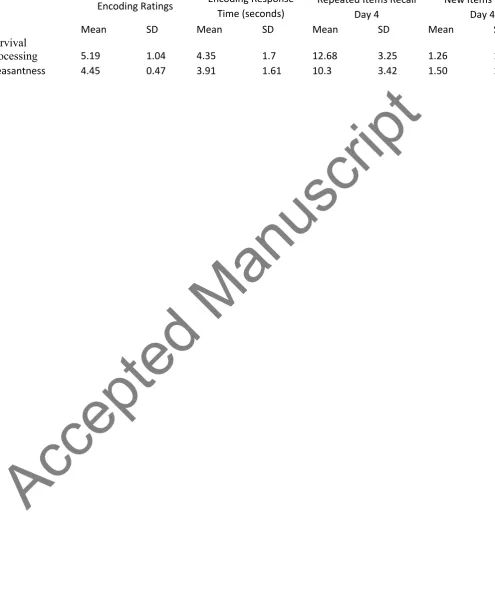
encoding ratings and response times between the two encoding conditions (see Table 1 for
descriptive statistics). An independent t-test was conducted to test for a difference in ratings
between the Survival and the Pleasantness Conditions. The test revealed a significant
difference between the ratings in the Survival and Pleasantness conditions, t(38) = 2.98,
p=.005, d = 0.98, indicating significantly higher ratings in the Survival condition than those
in the Pleasantness condition. It is, however, important to note that whilst significant, the
mean difference in ratings between conditions was relative small (0.77). An additional
analysis was conducted to explore the time taken to make a response in each condition. As,
the response time data violated the assumptions of a parametric test, a Mann-Whitney U test
was used to test for a difference between the Survival and Pleasantness response times. The
test revealed no significant difference in the response times between two conditions, U = 153,
p=.208. These analyses suggest that whilst participants rated the items moderately higher in
the survival condition, that there was no significant difference in the time taken to make these
ratings.
(Table 1 about here)
Free Recall
Accepted Manuscript
Figure 1 shows the mean number of correctly recalled words in both conditions on bothtest days.
(Figure 1 about here)
Figure 1 shows that the Survival condition yielded a higher level of recall than the
Pleasantness condition at day 0 and, despite a general reduction in the number of items
recalled over time, this advantage was still present at day 4. This effect was formally tested
using a 2 x 2 ANOVA with a single within participants factor (Time –with 2 levels, Day 0
and Day 4) and a single between participants factor (Encoding Scenario, with 2 levels,
Survival and Pleasantness). The ANOVA revealed a main effect of Time, F(1,37)=54.87,
MSE = 308, P<.001, ɳ2 = 0.60, and a significant main effect of Encoding Scenario, F(1,37) =
7.82, MSE = 108, p=.008, ɳ2 = 0.18. However, the data showed no significant Time vs.
Encoding Scenario interaction, F(1,37) = 0.02, MSE = .12, p = .886. These results provide
further evidence for the longevity of the survival processing advantage.
As the delay period in the current study was manipulated within participants, it is
interesting to investigate the pattern of both repeated recall (items recalled on both Day 0 and
Day 4) and new recall between conditions on Day 4. The descriptive statistics can be seen in
Table 1. An independent t-test was conducted to explore the survival processing effect in the
repeated item recall, revealing a significant difference between conditions, t(37) = -.95, p =
.03, d = 0.71. This suggests further evidence of the survival processing effect in the repeated
items, with more items being recalled in the Survival condition than in the Pleasantness
condition. Table 1 also shows the number new items recalled on Day 4. A Shapiro-Wilk’s
test indicated that these data were not normally distributed, as such a Mann Whitney test was
conducted to formally test the survival processing effect in the new items. The test revealed
Accepted Manuscript
no significant difference between the number of items recalled in each condition, U=-.65,p=.515. This suggest that there was no evidence of the survival processing effect in the new
items recalled at Day 4, although it should be noted that comparatively few new items were
recalled in either condition (Survival Mean = 1.26 versus Pleasantness Mean = 1.50).
Total number of extra-item intrusions were low (see Table 1), with the majority of
participants making no intrusions on either test day. As data were not normally distributed,
we conducted two Mann-Whitney U tests to explore differences between the two encoding
scenarios on both days and found no significant effect of encoding scenario on the number of
intrusions on either Day 0 (U =184, p>.05) or Day 4 (U = 163, p>.05). These results suggest
that there was no significant difference in the number of intrusions generated between groups
on both test days.
Correlation Analysis
A number of studies (e.g. Nairne et al. 2007; Otgaar and Smeets, 2010) have
demonstrated that words with a higher mean item rating are recalled with a greater frequency.
To assess this relationship, we conducted a correlation analysis between the mean rating for
each item and the frequency with which that item was recalled. We predicted that items that
had been rated higher in the survival processing scenario would be recalled a greater
proportion of the time. Figure 2 shows this relationship for both conditions at both times.
(Figure 2 about here)
A Pearson’s correlation test was used to formally explore these relationships. These
data showed no significant correlation between the mean item encoding ratings and
proportion recalled in the Survival condition at Day 0 (r=-.06, p=.761) or at Day 4 (r=-.11,
Accepted Manuscript
p=.550), nor was there a significant relationship in the Pleasantness condition at Day 0(r=-.11, p = .550) or at Day 4 (r=-.17, p=.334). This analysis suggests that the mean item
encoding rating was not related to the frequency with which the item was recalled in either
condition at either test time.
The results of Experiment 1 demonstrated analogous patterns of recall to those
reported by both Raymaekers et al. (2014) and Abel & Bäuml (2013), providing further
evidence of the longevity of the survival processing advantage. Interestingly, Experiment 1
produced only low levels of extra-item intrusions (see Table 1). This is in contrast with
higher intrusion rates reported elsewhere (e.g. Nairne et al., 2007). Whilst we observe the
same pattern in intrusion rates (with pleasantness ratings providing lower levels of intrusions
at both Day 0 and Day 4), these differences were not statistically significant. It could also be
predicted that as general levels of recall decrease across the time period, the number of
intrusions could increase. The current study did not provide any evidence of this and whilst
there was a small increase in the number of intrusions observed in both the Survival and
Pleasantness conditions (0.72 and 0.032 respectively), this increase was not statistically
significant. It is possible that the low levels of intrusions could be a result of the shorter recall
period employed in the current study which was significantly shorter than that in Nairne et al.
(2007) who gave participants 10 minutes to retrieve the target items as opposed to the 5
minutes used in the current study. However, it should be noted that other studies have also
reported no significant differences in intrusion rates using a 10 minute, 5 minute and 4 minute
recall period (e.g. Butler et al., 2009; Klein, 2013; Klein, Robertson, Lax & Delton, 2012
respectively), suggesting that the duration of the retrieval interval is unlikely to be the
determining factor.
Experiment 2
Accepted Manuscript
MethodsParticipants
A total of 65 participants (25M: 40F) took part in the current study. The participants
were predominantly staff and students (who received course credit for participation) at
Liverpool Hope University and had a mean age 24.15 (SD = 9.22). The participants were all
naïve to the true aims of the experiment and had not participated in Experiment 1.
Design
Experiment 2 employed a 2 x 2 x 2 mixed factorial design two within participants
factors, Time (with two levels: Day 0 and Day 4) and Distance (with two levels: near and
far). There was also a single between participants factor (Encoding Scenario; two levels:
Survival and Scavenger Hunt). The dependant variable was the deviation (measured in
pixels) between the centre of the target object and the recalled location.
Materials
Encoding Scenarios
Experiment 2 employed two encoding Conditions both of which were adapted from
Nairne et al. (2012). These conditions were a Survival Scenario and a Scavenger Hunt
Scenario which can be seen below.
The Survival Scenario:
Accepted Manuscript
In this task we would like you to imagine that you are stranded in the grasslands of aforeign land, without any basic survival materials. Over the next few months, you’ll need to
find a steady supply of food in order to survive. We are going to show you pictures of food
items that will be displayed in various locations of the screen and we would like you to rate
how easy this item is to collect to help your survival. You should consider your initial
position is at your camp site at the centre of the screen, as indicated by a circle containing a
tent. You should also take the items distance from the campsite and ease of collection (e.g.
items up a tree maybe harder to collect than ones growing on smaller plants) into account
when rating how easy the item is to collect. Remember, your goal is to collect as many items
as possible to help you survive.
The Scavenger Hunt Scenario:
In this task we would like you to imagine that you have been invited to take part in a
scavenger hunt in which you have to collect a number of food items. Your goal is to win this
contest and as such you will need to collect as many food items as possible. We are going to
show you pictures of food items that will be displayed in various locations of the screen and
we would like you to rate how easy it is to collect. You should consider your initial position is
at a camp site located at the centre of the screen (indicated by a circle containing a tent). You
should take each items distance from the campsite and ease of collection (e.g. items up a tree
maybe harder to collect than ones growing on smaller plants) into account when rating how
easy the item is to collect. Remember, your goal is to collect as many items as possible to
help you win the contest.
Stimuli
Accepted Manuscript
In the current study participants were shown 8 scenes. Each scene was 1280 x 1024pixels in size. At the centre of each scene, there was an image that represented the
participants “Campsite” (depicted by an image of a tent in a circle) around the campsite
image a target item was displayed. All of the target items were pictures of common fruit and
vegetables (Apple, Banana, Carrot, Grapes, Mushrooms, Pear, Pineapple and a Pumpkin).
The target item images can be seen in Appendix 2. Each target image was 120 x 120 pixels in
size and the target stimuli could be positioned at anywhere on the screen, however, half of the
items were presented within a 358 pixels radius of the centre of the screen and the remaining
half were presented outside of this radius. This means that stimuli could be broadly classified
as being displayed near (<358 pixels) or far (>358 pixels) from the centre of the screen. The
stimuli used in the test phase of the experiment were the same scenes as at encoding but only
displayed the campsite location (with the target items removed). An example of the encoding
and test stimuli can be seen in Figure 3.
(Figure 3 about here)
Procedure
Encoding
Experiment 2 utilised a similar methodology to that employed in Experiment 1. At the
beginning of the encoding phase, participants were randomly allocated to one of the two
encoding conditions (Scavenger Hunt or Survival) and were asked to read the relevant
scenario on the computer screen. Participants were presented with a stimulus on the screen
for 5 seconds. After 5 seconds had lapsed the stimulus was replaced by a screen displaying
the rating scale. In the survival condition, the participants were asked to rate how easy the
item was to collect to help them to survive and in the Scavenger Hunt scenario participants
Accepted Manuscript
were asked to rate how easy it was to collect each item to help them win the contest (ratingscale 1-9, 1 = Very Difficult; 9 = Very Easy). Participants indicated their selection by
pressing the relevant number key on the computer keyboard. There was no time limit to
complete the rating and the cycle was repeated until the participant had rated all 8 food items.
Retrieval
Once the ratings were completed the participants were asked to complete a surprise
recall task. In this task, participants were first shown a screen that displayed one of the target
food items for 5 seconds. The screen then changed to the retrieval screen (a blank screen with
only the campsite marked at the centre). On this screen the participants were asked to recall
the target items location and indicate this location using the computer mouse. This process
was repeated for each of the 8 food items and the order that the stimuli were presented was
randomised to prevent order effects. Participants then returned 96 hours (4 days) later after
the initial test to complete an additional cognitive task (the second retrieval task). Again, to
preserve the accuracy of the time delay, participants were asked to return for the second test
at approximately the same time of day (± 1 hour). .
Results and Discussion
Encoding ratings
The first stage of the analysis was again to explore whether there was any difference
in the ratings between the two encoding conditions and the target distances (near or far).
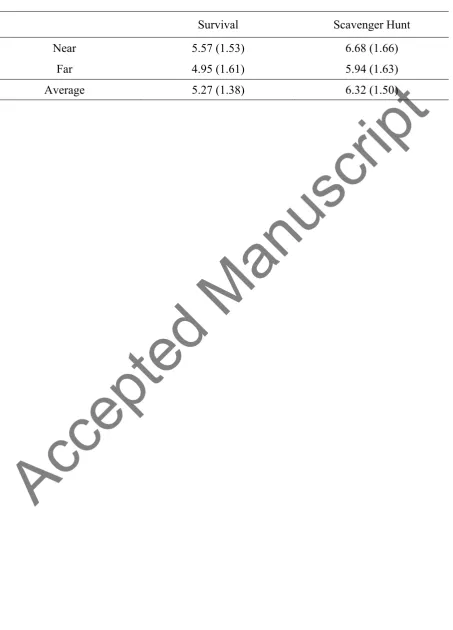
Table 2 shows the descriptive statistics for the two encoding conditions at both distances.
(Table 2 about here)
Accepted Manuscript
Table 2 indicates that the ratings in the Scavenger Hunt condition were higher than those inthe Survival condition and in both conditions items were rated easier to collect when they
were presented nearer to the participant’s imagined location. These findings were formally
tested using 2 x 2 mixed ANOVA with a single between participants factor (Encoding
Scenario with two levels: Survival and Scavenger Hunt) and a single within participants
factor (Distance, with two levels: Near and Far). The analysis demonstrated a significant
effect of Condition, F(1,62)=8.28, MSE=34, p=.005, ɳ2 = .12 and a significant effect of
Distance, F(1,62)=15.68, MSE=14, p<.001, ɳ2 = .20. The analysis demonstrated no
significant Condition x Distance interaction, F(1,62)=.15, MSE=.14, p=.701, ɳ2 = .01. These
results indicate that items were rated easier to collect in the Scavenger Hunt condition than
the Survival condition. In addition, items that were presented closer to the participants
imagined starting location were rated easier to collect, suggesting that the distance of the
target was considered during the rating task.
Recall
The first stage of the recall analysis was to use the X and Y coordinates to calculate the
deviation from recalled location to the centre of the target object. The deviation scores were
the Euclidean distance computed as:
−
+
−
Where X1 and Y1 represent the X and Y coordinates of the target object and X2 and Y2
represent the coordinates of the recalled location. The deviation scores are a measure of recall
accuracy, where larger values are indicative or poorer memory performance. Figure 4 shows
Accepted Manuscript
the average recall performance for both near and far target locations in both the Survival andScavenger Hunt Scenarios on both test days.
(Figure 4 about here)
Figure 4 suggests that there is evidence of the survival processing effect in both near
and far target locations on both Day 0 and Day 4. This effect was formally tested using a 2 x
2 x2 Mixed ANOVA with a single between participants factor, Encoding Scenario (with 2
levels, Survival and Scavenger Hunt) and two within participants factors, Distance (with 2
levels, Near and Far) and Time (with 2 levels, Day 0 and Day 4). The analysis revealed a
main effect of Encoding Scenario, F(1, 63)=6.36, MSE=196197, p =.014, ɳ2=.09, a main
effect of Distance, F(1,63)=59.57, MSE =869588, p<.001, ɳ2= .49 and a main effect of Time,
F(1,63)=19.04, MSE = 283431, p<.001, ɳ2= .23. These data also revealed a significant Time
x Distance interaction, F(1, 63) = 5.33, MSE=31218, p=.024, ɳ2= .08. There were no
significant Distance x Condition interaction (p>.05), no significant Time x Condition
interaction (p>.05) and no significant Time x Distance x Condition interaction (p>.05). These
results provide evidence of the longevity of the survival processing effect in location
memory. In addition, the results also suggest that items that were located ‘near’ to the centre
of the stimulus array were recalled with greater recall accuracy than items that were further
away (far), replicating the findings of Nairne et al. (2012).
Correlation Analysis
As the dependent variable in Experiment 2 is the observed recall accuracy (the deviation from
target location), it is possible to directly explore the relationship between the encoding rating
and retrieval accuracy at the level of the individual target (as opposed to exploring pooled
Accepted Manuscript
data in Experiment 1). We predicted that the target ratings would be directly related to recallaccuracy, where items rated easier to collect to facilitate survival rating are recalled with
greater accuracy. Figure 5 shows the correlations between the individual encoding ratings for
each target object in both conditions and at both times (Day 0 and Day 4).
“(Figure 5 about here)”
As the Shapiro-Wilk test indicated that these data were not normally distributed
Spearman’s correlation test was used to formally explore these relationships. These data
showed no significant correlation between the encoding ratings and recall accuracy in the
Survival condition at Day 0 (r=-.062, p=.299) or at Day 4 (r=-.077, p.201), nor was there a
significant difference between the encoding ratings and recall accuracy in the Scavenger Hunt
condition at Day 0 (r=-.032, p = .617). There was, however, a significant correlation between
the encoding ratings and recall accuracy in the Scavenger Hunt condition on Day 4 (r=-.267,
p<.001, r2 = 0.07), indicating that if the items were rated higher in the encoding task they
were recalled with greater accuracy on Day 4. However, this is a small effect which accounts
for approximately 7% of the overall variation.
The results of Experiment 2 provide further support for the survival processing effect
in location memory and replicate the findings of Nairne et al. (2012). These data also clearly
demonstrate the longevity of the survival processing effect in location memory. In addition,
the pattern of recall in Experiment 2 mirrors that observed in Experiment 1, showing the
survival processing effect is present on Day 0 and despite general forgetting across time the
same pattern of recall is demonstrated on Day 4.
One interesting finding was the significant difference observed in the initial rating task
(where the target items were rated easier for collection in the Scavenger Hunt condition as
Accepted Manuscript
opposed to the Survival condition). This finding is surprising as whilst both conditionsprovide a different context, the encoding rating is essentially the same; rate the items
regarding their ease of collection. Given that the target objects were displayed in the same
places for each condition, we would predict no difference in these ratings. Indeed, Nairne et
al. (2012) who employed the same task showed no significant difference between the two
conditions ratings. At this point it is unclear why there is a difference in the ratings between
the two conditions; however, this finding adds further support for the survival processing
effect as the higher mean ratings in the Scavenger Hunt condition should promote a
Scavenger Hunt mnemonic advantage, not the Survival Processing benefit observed.
General Discussion
The survival processing paradigm has been hailed as one of the most effective, if not
the most effective, forms of encoding. However, few studies have investigated its longevity
with language based stimuli (Raymaekers et al., 2014; Abel & Bäuml, 2013) and no studies
have explored the effect duration in location memory. The results of our study show that the
survival processing advantage is still present 4 days after encoding in both language based
and location memory. These findings are the first to demonstrate the longevity of the effect in
location memory.
The current studies are the first to explore the longevity of the survival processing
effect within participants. As argued earlier, it is unlikely that survival relevant information
would only be retained for recall on a single occasion and as such exploring the survival
processing effect using a within participants design is an interesting extension to previous
works. A potential limitation of this approach, however, is that repeat testing can inflate
recall rates in subsequent sessions (test-enhanced learning; e.g., Roediger & Karpicke
Accepted Manuscript
(2006)). Indeed, recall performance on Day 4 in the Survival condition (Experiment 1) washigher than that reported by Raymaekers et al. (2014) in their 48 hour condition (recall
proportion of 0.43 versus approximately 0.28 respectively), despite comparable levels of
recall after the immediate test (0.55 versus approximately 0.58 respectively). To further
explore the influence of repeated testing, we split the Day 4 analysis to explore the survival
processing effect in both repeated items and new items. This analysis revealed evidence of
the survival processing effect in the repeated items but not in the new items, suggesting that
the survival processing effect was carried by higher recall of the repeated items. Therefore, it
is possible that Day 4 recall performance was, at least in part, inflated by test-enhanced
learning. However, few new items were recalled in either condition on Day 4 (a mean of 1.26
and 1.50 in the Survival and Pleasantness conditions respectively), which limits the ability to
detect a survival processing effect with those words. Finally, of note, the principal findings of
our study still suggest that a similar pattern of recall was found across time in our
within-participants design and in the between participant designs (i.e., Raymaekers et al., 2014), thus
generally providing support for the longevity of survival processing advantage.
Nairne et al. (2007) reported that the average levels of recall increased monotonically
with the average survival ratings. Similar findings were reported in other studies (e.g. Butler
et al., 2009; Kroneisen & Erdfelder, 2011), who also demonstrated higher levels of recall for
items that were awarded higher ratings. However, our data did not replicate this finding. In
Experiment 1, we pooled data across participants and demonstrated no significant
relationship between the mean encoding rating for each target item and the frequency with
which that target was recalled in either condition at either time interval. In Experiment 2, we
explored the relationship between the initial encoding ratings and the target’s recall accuracy
at the level of the individual target, again failing to find a correlation in both conditions on
Accepted Manuscript
Day 0 and the Survival condition on Day 4. The only significant correlation observed was inthe Scavenger Hunt condition at Day 4. The correlation results from Experiment 2 are
particularly surprising, especially given that the near versus far analysis demonstrated that
when target items were positioned near to the central starting point, they were recalled with
greater accuracy and were rated as easier to collect. Thus the current findings suggest that
whilst the proximity of the target item influences the accuracy with which it is recalled, the
ratings do not. This discrepancy is possibly the result of the ratings including the
consideration of two separate factors, 1) a judgement of the distance to the target and 2) a
judgment of the ease of collection (suck as picking the item from a tree or collecting it from
the ground). Thus, in this instance, it is possible that the judgment of distance seems to
predict recall accuracy but considering the ease of collection does not. This is purely
speculative and it is clear that further research would be required to fully tease apart this
discrepancy.
The current data also contribute to the debate surrounding elaboration as the
proximate mechanism of the survival processing hypothesis. Kroneisen and Erdfelder (2011)
argued that the survival processing scenario produced high levels of elaboration which
subsequently generated the mnemonic benefit, hence when a shorter survival scenario was
utilised, the advantage disappeared. Experiment 1 demonstrated evidence of the survival
processing advantage using a shortened survival scenario. This suggests that simply
shortening the scenario length did not remove the survival processing effect at either test
time. These findings are in keeping with recent reports which have argued that the shorter set
of survival processing encoding instructions is equally effective in generating a survival
processing effect (Nairne & Pandeirada, 2010; Otgaar, Howe, Smeets & Garner, 2014).
However, it remains an empirical question whether the original set of instructions would have
Accepted Manuscript
produced different results in our study. Of note, it could be predicted that if the shorterscenario limits levels of elaboration at encoding it could shorten the longevity of the effect.
A final consideration of the current study refers to the terminology of location
memory. In the current study we refer to Experiment 2 as assessing location memory in
replication of the terminology employed by Nairne et al. (2012). Whilst the methodology
employed provides a measure of location memory, it is limited to objects being presented at
different spatial positions within the 2 dimensional space represented by the computer screen.
Although this provides a measure of location memory, which we believe to be most relevant
for assessing the survival processing effect, it needs to be acknowledged that it represents a
limited approach to assessing location memory. As such, whilst our findings suggest evidence
of the survival processing effect in location memory, future research should consider
expanding to larger spatial frameworks.
References
Andrade, J., & Meudell, P. (1993). Short report: Is spatial information encoded automatically
in memory? The Quarterly Journal of Experimental Psychology, 46A, 365-375.
Abel, M., & Bäuml, K. T. (2013). Adaptive Memory: The influence of sleep and wake delay
on the survival-processing effect. Journal of Cognitive Psychology, 25, 917-924.
Bröder, A., Krüger, N., & Schütte, S. (2011). The survival processing memory effect should
generalise to source memory, but it doesn’t. Psychology, 2, 896-901.
Burns, D. J., Burns, S. A., & Hwang, A. J. (2011). Adaptive memory: Determining the
proximate mechanisms responsible for the memorial advantages of survival processing.
Journal of Experimental Psychology: Learning memory and Cognition, 37, 206-218.
Accepted Manuscript
Butler, A. C., Kang, S. H. K., & Roediger III, H. L. (2009) Congruity effects betweenmaterials and processing tasks in the survival processing paradigm. Journal of
Experimental Psychology: Learning memory and Cognition, 35, 1477-1486.
Ebbinghaus, H. E. (1964). Memory: A contribution to experimental psychology. New York:
Dover. (Original work published 1885)
Faul, F., Erdfelder, E., Lang, A. G., & Buchner, A. (2007). G*Power 3: A flexible statistical
power analysis for the social, behavioral, and biomedical sciences. Behavior Research
Methods, 39, 175_191.
Hasher, L., & Zacks, R. T. (1979). Automatic and effortful processes in memory. Journal of
Experimental Psychology: General, 108(3), 356-388.
Howe, M. L., & Otgaar, H. (2013). Proximate mechanisms and the development of adaptive
memory. Current Directions in Psychological Science, 22, 16-22.
Kang, A. H. K., McDermott, K. B. & Cohen, S. M. (2008). The mnemonic advantage of
processing fitness-relevant information. Memory & Cognition, 36, 1151-1156.
Klein, S. B. (2012). A role for self-reverential processing in tasks requiring participants to
imagine survival on the Savannah. Journal of Experimental Psychology: Learning
memory and Cognition, 38, 1234-1242.
Klein, S. B. (2013). Does optimal recall performance in the adaptive memory paradigm
require the encoding context to encourage thoughts about the environment of
evolutionary adaptation?. Memory & cognition, 41, 49-59.
Klein, S. B., Robertson, T. E., & Delton, A. W. (2010). Facing the future: Memory as an
evolved system for planning future acts. Memory and Cognition, 38, 13-22.
Accepted Manuscript
Klein, S. B., Robertson, T. E., & Delton, A. W. (2011). The future-orientation of memory:Planning as a key component mediating the high levels of recall found with survival
processing. Memory, 19, 121-139.
Klein, S. B., Robertson, T. E., Delton, A. W., & Lax, M. L. (2012). Familiarity and personal
experience as mediators of recall when planning for future contingencies. Journal of
Experimental Psychology: Learning, Memory, and Cognition, 38, 240-245.
Kroneisen, M., & Erdfelder, E. (2011). On the plasticity of the survival processing effect.
Journal of Experimental psychology: Learning, Memory and Cognition, 37, 1553-1562.
Nairne, J. S., Thompson, S. R., & Pandeiada, J. N. S. (2007). Adaptive Memory: Survival
processing enhances retention. Journal of Experimental Psychology: Learning memory
and Cognition, 33, 263-273.
Nairne, J. S., Pandeirada, J. N. S., & Thompson, S. R. (2008). Adaptive Memory: The
comparative value of survival processing. Psychological Science, 19, 176-180.
Nairne, J. S., Pandeirada, J. N. S., Gregory, K. J., & Van Arsdall, J. E. (2009). Adaptive
memory: Fitness relevance and the hunter-gatherer mind. Psychological Science, 20,
740-746.
Nairne, J. S., & Pandeirada, J. N. S. (2010). Adaptive memory: Ancestral priorities and the
mnemonic value of survival processing. Cognitive Psychology, 61, 1-22.
Nairne, J. S., Pandeirada, J. N. S., Smith, M. A., Grimaldi, P. J., & Bauernschmidt, A. (2010,
November). Adaptive memory: Does survival processing enhance memory for source?
Paper presented at the 51st Annual Meeting of the Psychonomic Society, St. Louis, MO.
Accepted Manuscript
Nairne, J. S., VanArsdall, J. E., Pandeirada, J. N. S., & Blunt, J. R. (2012). Adaptivememory: Enhanced location memory after survival processing. Journal of Experimental
Psychology: Learning, memory and Cognition, 38, 495-501.
Nouchi, R., & Kawashima, R. (2012). Effect of the survival judgement task on memory
performance in subclinically depressed people. Frontiers in Psychology, 3.
Otgaar, H., Howe, M. L., Smeets, T., & Garner, S. R. (2014). Developmental trends in
adaptive memory. Memory, 22, 103-117.
Otgaar, H., & Smeets, T. (2010). Adaptive memory: Survival processing increases both true
and false memory in adults and children. Journal of Experimental Psychology:
Learning, memory and Cognition, 36, 1010-1016.
Otgaar, H., Smeets, T., Merckelback, H., Jelicic, M., Verschuere, B., Galliot, A., & van Riel,
L. (2011). Adaptive memory: Stereotype activation is not enough. Memory and
Cognition, 39, 1033-1041.
Otgaar, H., Smeets, T., & van Bergen, S. (2010). Picturing survival memories: Enhanced
memory after fitness-relevant processing occurs for verbal and visual stimuli. Memory
& Cognition, 38, 23-28.
Packman, J. L., & Battig, W. P. (1978). Effects of different kinds of semantic processing on
memory for words. Memory & Cognition, 6, 502-508.
Pandeirada, J. N. S., Pinho, M. S., & Faria, A. L. (2014). The mark of adaptive memory in
healthy and cognitively impaired older adults and elderly. Japanese Psychological
Research, 56, 168-179.
Accepted Manuscript
Raymaekers, L. H. C., Otgaar, H., & Smeets, T. (2014). The longevity of adaptive memory:Evidence for the mnemonic advantages of survival processing 24 and 48 hours later.
Memory. 22, 19-25.
Roediger, H. L., & Karpicke, J. D. (2006). Test-enhanced learning: Taking memory tests
improves long term retention. Psychological Science, 17, 249-255.
Seamon, J. G., Bohn, J. M., Coddington, I. E., Ebling, M. C., Grund, E. M., Haring, C. T.,
Jang, S., Kim, D., Liong, C., Paley, F. M., Pang, L. K., & Siddique, A. H. (2012). Can
survival processing enhance story memory? Testing the generalizability of the adaptive
memory framework. Journal of Experimental Psychology: Learning memory and
Cognition, 38, 1045-1056.
Soderstorm, N. C., & McCabe, D. P. (2011). Are survival processing memory advantages
based on ancestral priorities? Pyschonomic Bulletin Review, 18, 564-569.
Appendix 1
Experiment 1 stimuli
(Table 3 about here)
Appendix 2
(Figure 6 about here)
Accepted Manuscript
Figure CaptionsFigure 1. The average number of items recalled in each condition at both testing times.Error
bars represent ± 95% confidence intervals.
Figure 2. The relationship between the mean item encoding ratings and the frequency with
which the item was recalled in both conditions at both test times. The coloured bands
represent 95% confidence intervals.
Figure 3. An example of the encoding and retrieval stimuli employed in Experiment 2.
Figure 4. The average deviation from target location for both near and far target locations in
both encoding Scenarios at both retrieval times. The error bars represent ± 95% confidence
intervals.
Figure 5. The relationships between the encoding ratings and recall accuracy for both
groups at both times. The colour bands represent 95% confidence intervals.
Figure 6. The target food items used in Experiment 2.
Accepted Manuscript
Table 1. The average rating, response time, new and repeated recall and extra-items intrusions for both condition
Encoding Ratings Encoding Response Repeated Items Recall New Items Rec
Time (seconds) Day 4 Day 4
Mean SD Mean SD Mean SD Mean SD Survival
Processing 5.19 1.04 4.35 1.7 12.68 3.25 1.26 1.7
Pleasantness 4.45 0.47 3.91 1.61 10.3 3.42 1.50 1.5
Accepted Manuscript
Table 2. The mean encoding ratings for target objects positioned both near and far in bothconditions.
Survival Scavenger Hunt
Near 5.57 (1.53) 6.68 (1.66)
Far 4.95 (1.61) 5.94 (1.63)
Average 5.27 (1.38) 6.32 (1.50)
Accepted Manuscript
Table 3. The target words used in Experiment 1.ANT EMERALD OAK RIVER
ARM FATIGUE ODOR ROAD
BLOOD IDEA ORANGE ROSE
BOY LIGHT OXYGEN SHADOW
BUILDING MAP PLANK SKULL
CARROT MOSQUITO POLE STRING
DUST MOSS RAIN SUNBURN
EAGLE MOUNTAIN REFLEX WEAPON