Teacher Perspectives), 3 (1). pp. 31-41.
Downloaded from: http://insight.cumbria.ac.uk/2861/
Usage of any items from the University of Cumbria’s institutional repository ‘Insight’ must conform to the following fair usage guidelines.
Any item and its associated metadata held in the University of Cumbria’s institutional repository Insight (unless stated otherwise on the metadata record) may becopied, displayed or performed, and stored in line with the JISC fair dealing guidelines (available here) for educational and not-for-profit activities
provided that
• the authors, title and full bibliographic details of the item are cited clearly when any part of the work is referred to verbally or in the written form
• a hyperlink/URL to the original Insight record of that item is included in any citations of the work • the content is not changed in any way
• all files required for usage of the item are kept together with the main item file. You may not
• sell any part of an item
• refer to any part of an item without citation
• amend any item or contextualise it in a way that will impugn the creator’s reputation • remove or alter the copyright statement on an item.
The full policy can be found here.
Citation
Dyer, S. (2016)‘In the case of high attaining, phonemically aware, bilingual Year One children, can spelling tests using phonemically irregular words be an effective strategy in order to improve In the case of high attaining, phonemically
aware, bilingual Year One children, can spelling tests using phonemically irregular words be an effective strategy in order to improve spelling?
The STeP Journal Student Teacher Perspectives
Copyright © 2016 University of Cumbria Vol 3 (1) pages 31-41
Scott Dyer
University of East London
AbstracT
Poor spelling can stifle creativity and limit the range of vocabulary that young children may attempt to use, which will in turn limit the quality of their writing. Many schools look to utilise spelling tests as a strategy designed to improve spelling despite valid criticism from educational psychologists and linguists for being anachronistic and incompatible with the way that pupils actually learn to spell (see the work of Charles Read who describes spelling as a creative skill). Yet could spelling tests aid pupils learning with English as an Additional Language considering their potential lack of exposure to written English morphology? This study observed notable improvement in target language spelling in both experimental and naturalistic conditions even 4 weeks after initial testing. However, the impact on promoting a broader range of spelling strategies and in particular morphological awareness appears more limited.
.
Keywords
Spelling tests; morphological awareness; EAL; overlapping waves model.
Introduction
I efe e e to the iti g of ili gual hild e , OF“TED , p. a s the e is g o i g e ide e that advanced bilingual learners do not achieve their full potential in English as they move through s hool. W iti g is o iousl a ultifa eted skill, but one of its most elementary rudiments is spelling. Weak spellers are prevented from focusing on higher order writing processes (Treiman and Cassar, 1996) and the quality of story development, syntactic maturity and richness of vocabulary also suffers as a consequence of poor spelling, even if spelling itself is not an assessed criterion (Juel, 1994). At present in the UK, most children in Year One classrooms will only encounter formal spelling instruction through a synthetic phonics programme, where the focus is on phonemic strategies such as knowing the English phonemes and how they are most commonly represented. Orthographic strategies are included to an extent as children engage with digraphs and use of double letters. However, for those bilingual children who prove themselves to be phonemically secure in English at an early stage and can regularly demonstrate this in their written work, this level of input alone would appear to be insufficient when attempting to maximise their progress.
Kwong and Varnhagen (2005, p.158 a gue that it is essential to expose children, even very young children, to multiple strategies that can be used in attempting to spell new words . If this is the case, are some ili gual hild e s needs being overlooked by failing to encourage the development of other strategies when they appear ready? Formal instruction would prove difficult due to already demanding schedules but these strategies can often be developed implicitly through repeated exposure (Pacton et al., 2001). A solution could be the use of short but targeted spelling tests, designed to raise awareness of words containing phonemically irregular aspects, thereby encouraging the augmentation of alternative spelling strategies.
Research has been undertaken in a state maintained primary school in England. Out of its intake of 460 children, 56% are classified as learning with EAL, covering a total of 48 different home
languages, with French and Lithuanian being most prevalent (School X, 2014). The Year One classes are a typical representation of the rest of the school.
Research Approach
The purpose of this study is to observe the impact of repeated spelling tests on targeted bilingual children in an attempt to encourage a broader utilisation of spelling strategy; action research is therefore a model that well suits the intentions of this study going forward.
In order to minimise any issues surrounding bias and impartiality, the gathering of data has been recorded quantitatively. Although this form of data gathering is usually related to larger scale studies (Denscombe, 2010, p.238), there are a number of advantages to gathering data in this manner. Primarily, the nature of spelling is such that it is either correct or it is not, therefore results can be gathered and improvements can be observed with greater ease through the statistics when measured against baseline assessments. However, more crucial is the notion that the role of the practitioner is less likely to obscure the outcome of the study with any unintentional bias (McGrath and Coles, 2013). By focusing on objective and quantitative results, the aim is that the validity of the study will hold up to greater scrutiny. The only significant drawback in this case is that small
quantities of data may make the resulting statistics less generalisable.
To give maximum weight to the findings of this study, it is important to ensure that the greatest degree of reliability can be attached to the results. The a itio is to o se e the hild e s spelli gs not only in the isolation of spelling tests but also in the naturalistic environment of free writing. This is particularly important as this is how children are usually expected to perform and when the other pressures of writing are involved, this can potentially affect the spelling strategies that children use. By carrying out naturalistic assessments at the beginning and the end of the study, in conjunction with experimental assessments of spelling tests repeated at different time intervals, suitable triangulation of results should allow a greater level of reliability and validity in terms of the findings (McGrath and Coles, 2013).
Literature Review
The question that this study is based upon asks if spelling tests can perform a role in increasing the spelling strategies used by young bilingual children with the intention of improving spelling in general. However, the task of improving the spelling of children has a long history and ideas surrounding methods of best practice have evolved significantly over the decades.
people attempt to recall lists of items, the so-called se ial positio Je se , . “o e, su h as Berko (1958) realised that morphological rules applied to English orthography and that young children did in fact learn these rules, as opposed to simply memorising random strings of letters. Obviously, the flaw to the vast majority of this early research is that spelling is not just memorised. Read (1971; 1986) was one of the first to argue that spelling was creative and pointed to pre-school children who could use their phonemic knowledge to attempt credible spellings before they were formally taught to write. This was groundbreaking research that introduced linguistic knowledge into the eal of hild e s spelli g a d e a e the asis of u h o k o pho olog Ge t , ; Henderson, 1985; Treiman, 1993; T ei a & Cassa , a d o ti ued o k o hild e s use of
o pholog Bee s & He de so , ; He de so , ; ‘u i , . ‘ead s o k as highl valuable because he actually attempted to discover why children misspelt words. His use of naturalisti a d e pe i e tal e i o e ts fo hild e s spelli g also added sig ifi a t eight to the reliability of his results and has influenced the approach of this study. However, Treiman (1993, p. poi ts out that that ‘ead s o k fails to e og ise the ole of o thog aph i hild e s spelli g atte pts due to a o e ea tio agai st the ea lie ie of spelli g as a pu el isual p o ess . Fi all , ‘ead s sa ple of hild e as a ade i all ad a ed a d p edo i a tl f o a p i ileged background, therefore making the generalisability of his findings difficult.
The fundamental belief was that children began by developing their phonemic awareness but progressed on to employing orthographic and morphological awareness as they evolved into proficient spellers (Gentry, 1982; Henderson, 1985). However, this argument that young children do not access morphemic patterns or orthographic conventions until they are older has been
challenged by significant and broad research which followed in subsequent years (Treiman, 1993; Treiman and Cassar, 1996; Berninger et al.,2010). Ultimately, the overriding conviction of most contemporary researchers in this area is that children can access a range of spelling strategies almost from as soon as they begin writing. Treiman (1993, p.159) acknowledges the existence of orthographic patterns such as double consonants being placed in the middle or at the end of words but seldom at the beginning in her study of first grade children. Furthermore, the children also knew which consonants could be doubled and which could not without any formal tuition on orthography. This was a study with a vast sample of 43 children over two cohorts, providing strong reliability. The observation in naturalistic settings such as free writing also ensures children would have provided genuine attempts at spelling rather than attempting to please an observing adult. Therefore the finding of this research should carry significant importance.
The case in favour of young children using morphological strategies is not as conclusive as that of orthography. However, Treiman and Cassar (1996) were able to demonstrate that children had some morphological knowledge by using word-final consonant clusters in one and two-morpheme words su h as a s a d a s . ‘esults illustrate that the first consonant was omitted on significantly fewer occasions in two-morpheme words, even among first graders. Rubin (1988) had attempted to prove similar results using consonant clusters, but her unregulated use of voiceless and voiced stops in her consonant clusters may have prejudiced the outcome of the experiment (Treiman & Cassar, 1996). Sustained and repeated evidence of this sort has led to a partial acceptance of an
o e lappi g a es odel ‘ittle-Johnson & Siegler, 1999; Kwong & Varnhagen, 2005; Nassaji, 2007) whereby children are believed to think in a variety of competing ways about phenomena from a very early stage.
spelling, yet relevant data does appear to suggest that the metalinguistic knowledge that bilingual children use to spell is more variable than that of their monolingual equivalents (Rickard Liow & Lau, 2006) and that first languages can impact upon orthographic and morphological spelling strategies in English (Rickard Liow & Lau, 2006; Dixon et al., 2010). Both studies draw from significant samples and are based upon sound methods, however, both also deal solely with Asian additional languages. The concern this causes is in terms of generalisability, the impact of particular languages and scripts
a ha e a g eate o s alle i flue e upo a ili gual hild s E glish spelli g st ategies, fo
example, the experience of a Lithuanian bilingual writer may have little similarity to that of a Chinese bilingual writer.
The study of Kwong and Varnhagen (2005) may prove to be of interest here because it involves asking children how they attempted to spell. If this is transferable to children in Year One, then knowing how each bilingual child attempts to spell a word could shed light on what strategies they use, and whether or not they can use them accurately in order to spell words correctly. The role of spelling tests in this study should not be to encourage a return to the rightly discredited rote
memorisation techniques of Jensen (1962) but instead, be a vehicle for expanding and improving the spelling strategies of bilingual children as a means of improving their spelling in general.
Analysis Method
This study contains a sample of 5 children, 3 girls and 2 boys, all of whom are bilingual and work at high attai e t le els i the s hool s s theti pho i s p og a e ‘uth Miski s ‘ead W ite I .). In school, no formal instruction has been given in regards to other spelling strategies such as morphology or analogy. Some degree of orthography is covered in the phonics programme, such as the order and positioning of digraphs and the use of double vowels and consonants. In reading, all are working at level 2A and all evidence suggests that these children are phonemically competent. The average age of the sample is 6 years and 2 months and all 5 were selected as they were the only children in the class that were both bilingual and phonemically aware to a high competence. Two children describe English as an L2, whilst the other 3 prefer to view English as their L1 or equal in significance to another language. The alternative languages of the 5 children are Hindi, Lithuanian, Polish, Spanish and Filipino.
The children were asked to complete two pieces of writing based upon familiar stories, the first at the commencement of the study (entry assessment) and the second at its conclusion (exit
assessment). Gathering naturalistic evidence such as this is beneficial to the study as children are more likely to spell words the way they would normally do; artificial or isolated environments could encourage the adoption of unusual strategies (Treiman, 1993). Conversely, this method can be restrictive if children only use words they already know how to spell. Alternatively, children may accidentally focus on the meaning of a word they know how to spell at the expense of its form (Nassaji, 2007).
all contained phonemically irregular elements to encourage a diversification of spelling strategies. The first test was based upon words that may have been suitable to use in the exit assessment, whilst words for the second test were taken from errors made either in the entry assessment or in other written work (see appendix 1).
Finally, to strengthen the validity of the results, children were asked to explain how they attempted to spell each word and these explanations were categorised into phonological, morphological, orthographic, analogical and retrieved strategies. Precedent for this method exists with Kwong and Varnhagen (2005), who utilised the same procedure with first-grade children in Alberta, Canada. Observations of the children whilst they were carrying out the spelling task were used in an attempt to ensure accuracy in their reported explanations; however, other factors such as typing latency (Kwong and Varnhagen, 2005) were not measured as they were not viewed as reliable indicators in this context. Obviously, this does bring into question the accuracy of these particular results and certainly limits the generalisability of the research findings. However, the indicative nature of the results may still prove useful in the realm of this study and have therefore been included.
Results
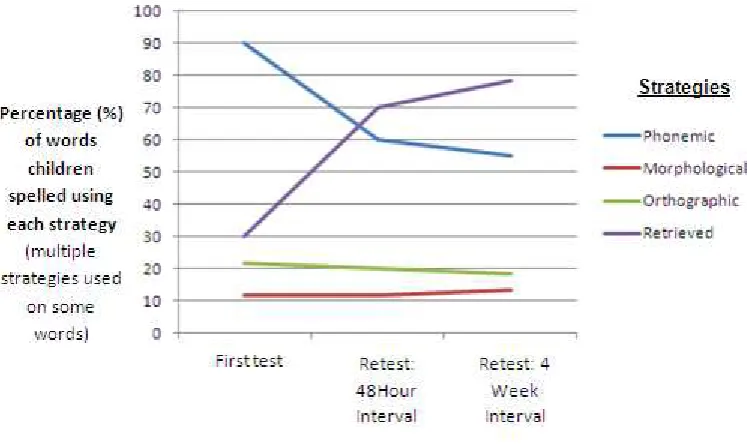
Figure 1 demonstrates the use of spelling strategies reported by the children throughout the spelling tests. At the first encounter of these words, it is unsurprising to observe a heavy reliance on
phonemic methods; in Year One, all spelling instruction directs child e to sou d out o ds that they are not familiar with. However, the ost sig ifi a t the e f o these esults is the hild e s move towards memory retrieval techniques at the expense of phonemic strategies when they take the tests again 48 hours later. It is also interesting to note that this pattern towards retrieval methods over phonemic strategy increases even further when the tests are retaken 4 weeks later, although at a less expansive rate.
Figure 1.
Fig. 1 illustrates the shift in strategy from phonemic to memory retrieval after the initial test. It also provides evidence of a weak uptake in other methods used to spell at any stage in the experiment, especially morphological strategy.
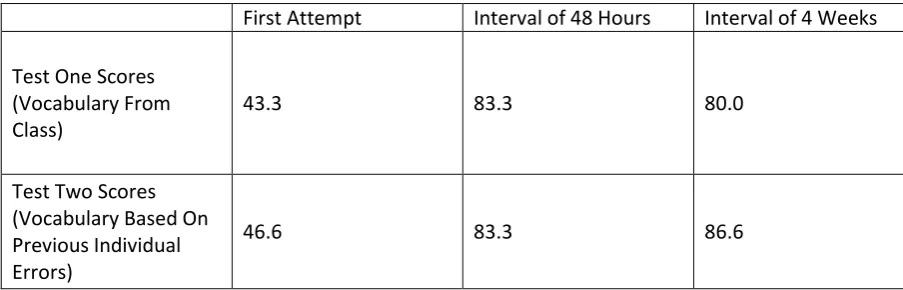
words that were at least partially non-phonemic, the result was that less than half of responses were accurate. However, at the second and third attempts, the children were aware of the limitations of the phonemic strategy and adapted. This undoubtedly had a significant impact on accuracy and must be considered largely responsible for accuracy of over 80%. Kwong and Varnhagen (2005, p.153) fou d hild e ill sele t a st ateg that ill e ui e the least a ou t of effo t hile, at the sa e ti e, ei g ost likel to a hie e a o e t espo se .
Table 1.
First Attempt Interval of 48 Hours Interval of 4 Weeks
Test One Scores (Vocabulary From Class)
43.3 83.3 80.0
Test Two Scores (Vocabulary Based On Previous Individual Errors)
46.6 83.3 86.6
Combined overall test scores as a percentage (%).
Table 1 demonstrates little difference in the results between words that were selected on the basis of a lass u it fo test Post & Ca eke , a d o ds that e e d a f o hild e s p e ious work in test 2 (Graham, 1999).
However, the strategy that the children most commonly adopted was that of memory retrieval for at least part or all of a word, usually still in conjunction with phonemic strategy. Although spellings remained impressively accurate even after an interval of 4 weeks, the main discussion point surrounding this study is perhaps why no significant increase in the uptake of other spelling strategies occurred once children realised the limitations of phonemic methods. Furthermore, will the knowledge of how to spell these words be maintained by the children in the long-term if they are achieving accuracy through rote memorisation rather than alternative spelling strategies? It is also worth noting that 3 children reported using 4 different strategies at least once during the tests, whilst the other 2 children reported using 3 and 2 strategies respectively. The first 3 children were all 100% accurate on their final tests, taken at an interval of 4 weeks from the first test; the othe hild e s spelli g a u a as e o ded at % a d % espectively. No direct conclusions can be made from this evidence as the sample is too small and the reporting of strategies used by the hild e is ot elia le e ough. Ho e e , he o side ed u de the o e lappi g a es odel (Rittle-Johnson and Siegler 1999; Nassaji, 2007), it would be appropriate that those children with the most strategies would prove more accurate.
This experiment did acknowledge the use of morphological and orthographic strategies (see fig. 1) but it is important to note that the extent of their use could be underreported for several reasons. Primarily, children usually adopt these strategies implicitly (Packton et al., 2001) so are less likely to report their use. It was also not always possible as a researcher, to ensure that every word naturally lent itself to being spelled using a morphological or orthographic strategy. However, enough
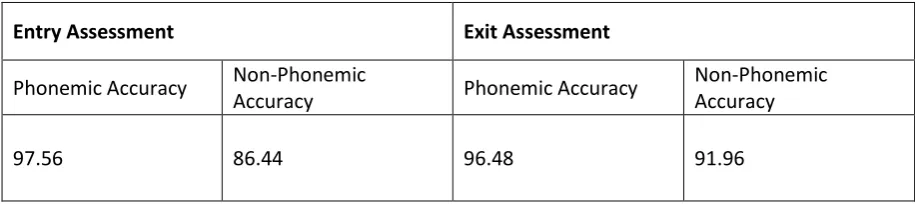
To tease out more reliable data o the hild e s use of morphological strategy, we turn to the naturalistic data of the general writing tasks that bookend this study. As table 2 illustrates below, phonemic accuracy in all work was very high throughout, suggesting a secure knowledge and confidence using phonemic strategies in order to spell. As expected, words that do not follow phonemic rules represent a greater difficulty for the children, yet the level of accuracy is still good from all candidates, indicating the existence of other spelling strategies.
Table 2.
Entry Assessment Exit Assessment
Phonemic Accuracy Non-Phonemic
Accuracy Phonemic Accuracy
Non-Phonemic Accuracy
97.56 86.44 96.48 91.96
Table 2highlights the ea a e age % of hild e s a u a of pho e i o ds a d o ds ith non-phonemic elements.
One sign of morphological awareness in young learners is the correct spelling of affixes, especially those affixes su h as -ed he e pho e i methods alone are unlikely to lead to success. (Treiman, 1993; Treiman, Cassar and Zukowski, 1994; Treiman and Cassar, 1996). All affixes written by the children were counted and checked; affixes that were spelled both phonemically and correctly were excluded. However, accuracy was recorded at 92.59%, with only two errors found (PREFORMANCE and DECYTFULL). Of course, this only demonstrates a very basic form of morphological awareness but this assessment does provide evidence that supports the view that morphology plays a role in
ou g hild e s spelli g Berko, 1958; Rubin, 1988; Treiman and Cassar, 1996; Berninger et al., 2010), and at least partially explains how non-phonemic accuracy was so high.
Table 3.
Number of test words used in exit assessment
Accuracy (%) of spelling in final spelling test
Accuracy (%) of spelling in written exit assessment
16 out of a possible 30 80 68.75
Table 3 shows the number of words used in writing that were taken from spelling test 1 and how accurately they were used. (Repetitions of words were excluded).
The fi al poi t to o side is a o pa iso et ee the a u a of hild e s spelli g du i g
experimental tests in isolation and the decline in accuracy when other writing considerations have to be taken into account by the children (see table 3). Both tests were taken within 3 days of each other and both were more than 4 weeks after the words were initially introduced to the children, de o st ati g ho e pe i e tal data does ot al a s t a slate i to eal o k i a a that o e would naturally expect (Treiman, 1993).
The remit of this study was to view the use of spelling tests as a vehicle for improving the spelling of phonemically irregular words by bilingual children. Initially, the results of the spelling tests noted in table 1 do suggest a vast improvement that has an impact at least into the medium term. However, the caveats appear to be the excessive use of memorisation as a strategy and limitations of isolated experimental environments, mainly how they do not always translate as effectively under more natural conditions, as illustrated by table 3.
Following the overlapping waves model (Rittle-Johnson & Siegler, 1999), the key to making these spelling tests genuinely useful for bilingual children, and any other child at a similar stage of phonemic awareness, is to base the tests around morphological instruction. Ultimately, the more strategies to spell a word that are available to a child, the more effective their spelling is likely to become (Kwong & Varnhagen, 2005; Nassaji, 2007). Children at this level experience phonological and some orthographic instruction already and this is clearly evident in their written assessments. Ho e e , E glish is a o phopho e i la guage, a d o d spelli gs efle t o phologi al structure as ell as pho ologi al st u tu e Apel & We fel, , p. .
The most significant indicator in this study was the relatively low use of morphological spelling strategy by this group of bilingual children. It was noticeable in the misspelling of words such as: CALED (called), HIRD (heard), and HUGED (hugged). In the absence of a morphological strategy, the
hild e e e u a le to o side the oot o d, fo e a ple, hea i hea d , o use o phologi al rules such as using a double consonant after a short vowel when adding an inflected morpheme so
hug e o es hugged . Despite its o ple atu e, o phologi al a a e ess is i po ta t a d it can be a predictor of spelling proficiency when children are older (Leong, 2000). Treiman (1993, p.286) also explai s: egula ities e ist, ut at the le el of ea i g athe tha the le el of sou d. A more comprehensive understanding of English morphology would surely therefore, only benefit young bilingual learners.
It is also necessary to comment here on the findings of Rickard Liow and Lau (2006) and Dixon et al. (2010), who raised the concern that other languages can have an impact on English orthography when bilingual children write. Whilst their findings do carry weight and must be considered seriously, this study has failed to find any evidence to suggest that the children observed have any noticeable L2 influences in their English writing. In fact, out of the 47 different spelling mistakes
oted i this stud , o l o e e a ple of a illegal o thog aphi e o was found: SNEACY (sneaky) and even then, it could be argued that the /k/ phoneme is represented at the end of morphemes in i egula fo i o ds su h as agi T ei a , .
The notion that children develop different strategies to deal with spelling and adopt the methods that best suit what they are trying to spell is an important element for any teacher to consider when teaching in Key Stage One. Treiman (1993) concludes that formal spelling instruction is
advantageous but even informal instruction can be used to develop morphological strategies and for particularly challenging words, other strategies such as analogy or mnemonics could be introduced.
References
Apel, K. and We fel, K. Usi g o phologi al a a e ess i st u tio to i p o e itte la guage skills , Language, Speech and Hearing Services in Schools, 45, pp.251-260.
Beers, J.W. and He de so , E.H. A stud developing orthographic concepts among first-grade hild e , Research in the Teaching of English, 11, pp.133-148.
Be ko, J. The hild s lea i g of E glish o pholog , Word, 14, pp.150-177.
Berninger, V.W., Winn, W.D., Naggy, W. and Ca lisle, J. G o th i pho ologi al, o thog aphi a d o phologi al a a e ess i g ades to , Journal of Psycholinguistic Research, 39, pp.141-163.
Denscombe, M. (2010) The Good Research Guide for Small-Scale Social Research Projects, 4th ed. Glasgow: Open University Press.
Dixon, L.Q., Zhao, J. and Joshi, ‘.M. I flue e of L o thog aph o spelli g E glish o ds bilingual children: A natural experiment comparing syllabic, phonological, and morphosyllabic fi st la guages , Learning Disability Quarterly, 33, pp.211-221.
Ge t , J.‘. A a al sis of de elop e tal spelli g i g s at k , Reading Teacher, 36, pp.192-200.
G aha , “. Ha d iti g a d spelli g i st u tio fo stude ts ith lea i g disa ilities: A e ie , Learning Disability Quarterly, 22, pp.78-98.
Henderson, E.H. (1985) Teaching Spelling. Boston: Houghton-Mifflin.
Hutcheon, G., Campbell, M. and Stewart, J. Spelling instruction through etymology – A method of developing spelling lists for older stude ts , Australian Journal of Educational and Developmental Psychology, 12, pp.60-70.
Je se , A.‘. “pelli g e o s a d the se ial-positio effe t , Journal of Educational Psychology, 53, pp.105-109.
Juel, C. (1994) Learning to read and write in one elementary school. New York: Springer-Verlag. Kwong, T.E. and Va hage , C.K. “t ateg de elop e t a d lea i g to spell e o ds:
Ge e alizatio of a p o ess , Developmental Psychology, 41, pp.148-159.
Leong, C.K. ‘apid p o essi g of ase a d de i ed fo s of o ds a d g ades , 5 and 6 hild e s spelli g , Reading and Writing, 12, pp.277-302.
McGrath, J. and Coles, A. (2013) Your Education Research Project Companion, 2nd ed. Oxford: Routledge.
Nassaji, H. (2007) The de elop e t of spelli g a d o thog aphi k o ledge i E glish as a L : A longitudinal case study, Canadian Journal of Applied Linguistics, 10 (1), pp.77-98.
OF“TED Could they do even better? The writing of bilingual learners of English at KS2: HMI
survey of good practice , London, QCA.
Packton, S., Perruchet, P., Fayol, M. and Clee e a s, A. I pli it lea i g out of the la : The ase of o thog aphi egula ities , Journal of Experimental Psychology: General, 130, pp.401-426.
Post, Y.V. and Ca e ke , “. O thog aphi si ila it a d pho ologi al t a spa e i spelling , Reading and Writing, 15, pp.317-340.
‘ead, C. P e-s hool hild e s k o ledge of E glish pho olog , Harvard Educational Review, 41, pp.1-34.
Read, C. (1986) Childre s Creative Spelli g. London: Routledge and Kegan Paul.
Rickard Liow, S.J. and Lau, L.H.“. The de elop e t of ili gual hild e s ea l spelli g i E glish , Journal of Educational Psychology, 98 (4), pp.868-878.
Rittle-Joh so , B. a d “iegle , ‘.“. Lea i g to spell: Va ia ilit , hoi e, a d ha ge i hild e s st ateg use, Child Development, 70, pp. 332-348.
School X (2014) I provi g outco es for pupils e titled to free school eals, Available at: School X website. (Accessed: 8th February 2015)
“pa he, G. A iti al a al sis of a ious ethods of lassif i g spelli g e o s, I , Journal of Educational Psychology, 28, pp.287-296.
Treiman, R. (1993) Beginning to Spell: A Study of First-Grade Children. New York: Oxford University Press.
Treiman, R., Cassar, M. and )uko ski, A. What t pes of li guisti i fo atio do hild e use i spelli g? The ase of flaps , Child Development, 65, pp.1,318-1,337.
Appendix 1
Test one spellings selected from vocabulary based on class theme or unit. (Given to all children in study).
mischievous sneaky beautiful screamed worker bossy
Test two spellings selected from errors made in entry assessment. (Individual lists made, 6 spellings each).
Child A
called orange with blue would please
Child B
animals surprised rocket accidental people grey
Child C
grey language leafy hugged guard pigeon
Child D
flew using creepy excited view please
Child E
little saw what something moved fell