Multi-Tenant Radio Access Network Slicing:
Statistical Multiplexing of Spatial Loads
P. Caballero, A. Banchs, Senior Member, IEEE, G. de Veciana, Fellow, IEEE, and X. Costa-P´erez,Member, IEEE
Abstract—This paper addresses the slicing of Radio Access Network (RAN) resources by multiple tenants, e.g., virtual wireless operators and service providers. We consider a criterion for dynamic resource allocation amongst tenants, based on a weighted proportionally fair objective, which achieves desirable fairness/protection across the network slices of the different tenants and their associated users. Several key properties are established, including: the Pareto-optimality of user association to base stations, the fair allocation of base stations’ resources, and the gains resulting from dynamic resource sharing across slices, both in terms of utility gains and capacity savings. We then address algorithmic and practical challenges in realizing the proposed criterion. We show that the objective is NP-hard, making an exact solution impractical, and design a distributed semi-online algorithm which meets performance guarantees in equilibrium and can be shown to quickly converge to a region around the equilibrium point. Building on this algorithm, we devise a practical approach with limited computational, infor-mation, and handoff overheads. We use detailed simulations to show that our approach is indeed near-optimal and provides substantial gains both to tenants (in terms of capacity savings) and end-users (in terms of improved performance).
I. INTRODUCTION
Driven by the capacity requirements forecasted for future mobile networks as well as the decreasing margins obtained by operators, infrastructure sharing has established itself as a key business model for mobile operators to reduce the deployment and operational costs of their networks (e.g., [1] reports a 280% increase in deals within the last 5 years). While passive and active sharing solutions, ranging from exclusive allocation of resources to roaming agreements, are used and have been standardized, these sharing approaches are based on fixed contractual agreements with Mobile Virtual Network Operators (MVNO) over long time periods (typically on a monthly/yearly basis). In this paper, we focus on a structured dynamic slicing approach which enables a much more efficient sharing of network resources, as envisioned by the 3GPP Network Sharing Enhancements for future mobile networks which the authors contributed to [2]. Following [3], our approach divides the infrastructure into network slices, assigning a different slice to each operator, and implements the sharing of network resources among operators by dynamically allocating resources to slices.
Such a novel network slicing approach is expected to result in new business models and revenue sources for infrastructure providers.1 Indeed, this approach supports not only classical
P. Caballero and G. de Veciana are with the University of Texas at Austin. A. Banchs is with the University Carlos III of Madrid and with the Institute IMDEA Networks, Spain. X. Costa-P´erez is with NEC Europte Ltd., Germany.
1See for instance the envisioned roles defined by the organization of
telecommunication operators NGMN for 5G [3].
players (mobile operators) but also new ones such as Over-The-Top (OTT) service providers that may buy a sliceof the network to ensure satisfactory service to their users (e.g., Ama-zon Kindle’s support for downloading content or a pay TV channel including a premium subscription). In the literature, the term tenantsis often used to refer to the different types of players, and multi-tenancy refers to approaches enabling dynamic network slicing and resource sharing for multiple tenants. For simplicity, hereafter we use the term operator in a broad sense to refer to classical (virtual) operators as well as the new players enabled by this approach.
In designing a practical solution for dynamic resource sharing among slices we face multiple challenges. To start with, we need a sharing criterion that not only allocates resources to operators (and their corresponding slices) fairly, but also, shares the resources of each operator fairly among its users. Furthermore, the criterion should allow for flexible sharing “levels” to meet operators’ heterogeneous require-ments; for practical purposes, these levels should be coarse-grained, rather than based on instantaneous resource needs. When allocating resources to an operator, one should take into account the numbers and locations of active users on the network – indeed some locations may see higher demand and (consequently) the associated resources might be scarce.
Beyond the criterion itself, designing an algorithm to imple-ment it, while realizing timely adaptation to network changes, is also very challenging. Given the amount of information involved (including the channel quality of each user) and its dynamic nature, the algorithm should be as distributed as possible. Also, since the algorithm may be triggered frequently (whenever a user joins, leaves or changes its location), it should becomputationally efficient. When adapting to network changes, the algorithm should control the number of handoffs triggered, as those may represent a highoverhead.
Key contributions: This paper proposes a criterion for slicing the network infrastructure amongst operators and an algorithm to allocate resources accordingly. The key contributions are as follows. In Section II, we introduce a criterion for dynamic resource sharing among operators; while the criterion has been proposed before, we provide a characterization supporting its use in a multi-tenant network setting. These properties are developed in Section II-C, providing insights on the optimality and fairness of the resulting allocations, and the benefits are studied in Section II-D, by characterizing the capacity savings by means of a closed-formula. We show that the criterion not only improves overall network utility but also that of each individual operator, thus guaranteeing that operators are not harmed by the sharing of resources amongst slices.
In Section III-A, we show the criterion corresponds to an NP-hard problem, motivating the need to devise an efficient approximation algorithm which is introduced in Section III-B. The proposed algorithm is semi-online, distributed, incurs low computational complexity, and has been specifically designed to control overheads associated with handoffs and/or mobile user reassociations. We rely on several intermediate analytical results to drive the key design choices underlying our algo-rithm. One of these intermediate results, presented in Section III-B2, is a variation of the algorithm which achieves similar performance bounds to state-of-the art algorithms while being distributed – which is in itself a valuable theoretical con-tribution on state-of-the-art approaches. Section IV provides a comprehensive performance evaluation based on detailed simulations, showing that (i) operators can save up to 80% capacity while providing the same quality to their users, and (ii) for a fixed capacity, we improve user performance in terms of file download times by up to 30%, among other results.
Related work: We next review and contrast our work to the state-of-the-art in (i) resource allocation based on proportional fairness, and (ii) resource sharing among operators.
Considerable research effort has been devoted to address the problem of fair resource allocation in networks. In wireline networks, fair resource allocation based on utility function maximization has been extensively studied following the sem-inal work of [4]. Building on this work, further algorithms for congestion control in multi-path environments have been proposed [5]–[7]. Not unlike our work, these algorithms are distributed. However, they allow users to decide among mul-tiple routes while we focus on a wireless setting where each user can only use one resource (her base station).
In the specific context of wireless networks, several ap-proaches have been proposed [8]–[10] to the problem of resource allocation and user association based on weighted and unweighted proportional fairness, respectively. The un-weighted case has been largely studied in the literature in different contexts (e.g., power control [11], interference avoid-ance [12]). The authors of [8] and [12] analyzed the complex-ity of the problem and proved the existence of polynomial time algorithms which provide an exact solution, and [10] designed a distributed algorithm with convergence guarantees. In contrast to the above, the resource allocation criterion proposed in this paper relies onweightedproportional fairness, with operator-specific weights; this is a more difficult problem as it is NP-hard [8] and the convergence of distributed greedy algorithms cannot be guaranteed [13].
Weighted proportional fairness resource allocation in wire-less networks has received much wire-less attention. In [9], an algorithm with tight worst-case performance bounds oflog(2) is proposed, while [14] proposes an heuristic algorithm. In contrast to the distributed approach proposed in this paper, both algorithms are centralized, which are expected to perform better since they possess global network information. However, the performance bound of the proposed distributed algorithm is log(e), close to the bound in [9]. The authors of [15], [16] propose a Gibbs-sampling mechanism based on simulated annealing that converge to an optimal solution. However, the
convergence of this mechanism is known to be slow and for this reason they resort to a greedy solution, with the same spirit of our algorithm. For the latter, the authors neither provide performance bounds nor analyze convergence of the proposed algorithm; additionally, the overhead of these algorithms is not controlled, which limits their practical deployment. All the approaches mentioned above address the problem of a single-operator network, in contrast to our work which focuses on the slicing and sharing of resources among multiple operators. Multi-operator network sharing has been studied from many different angles, including planning [17], economics [18], cov-erage [19], performance [20], etc. This paper focuses specifi-cally on the design of algorithms for resource sharing among operators, which has been previously addressed by [21]– [23]. In [21], the optimization of the total network utility is addressed by using max-min fairness; in contrast, the criterion that we propose here relies on weighted proportional fairness, which (as we show) provides many desirable properties. The works of [22], [23] present a proportional fair formulation similar to ours; however, they do not provide a rationale for their choice, in contrast to the solid analytical arguments provided in this paper. Furthermore, [22] does not address the algorithm design, while [23] uses a general non-linear solver that incurs a very high computational complexity (as confirmed by our results of Section IV-D). To the best of our knowledge, this paper is the first to propose an efficient algorithm for multi-tenant network slicing that builds on analytical results.
II. RESOURCEALLOCATIONCRITERION
In this section, we formulate the optimization problem that will drive (i) the association of users to base stations, and (ii) the allocation of base stations’ resources to users. Hereafter, we refer to this optimization as the multi-operator resource allocation (MORA) criterion. We show analytically that the criterion satisfies desirable properties in terms of optimality and fairness, and develop a simple model to evaluate the potential sharing gains of our network slicing approach.
A. System model
We start by presenting our system model which was de-veloped with LTE/LTE-A systems in mind, but is generally applicable to cellular systems. Consider a network consisting of a set B of base stations (or sectors in case of sector
antennas) that are shared by a set of operatorsO. At any given time, we letU denote the set of users sharing the network and
Uo, o ∈ O the subsets of users belonging to each operator.
We let cub denote the current transmission rate from base
stationbto useru, which is defined as the rate the user would receive if she were allocated all of the base station’s resources with the modulation-coding scheme selected for transmissions to the user based among others on path loss, neighbouring stations interference and fast fading; following similar analyses in the literature [21]–[25], we shall assume that cub is fixed
for each {user, base station}pair. An allocation of resources
involves two sets of variables: (i) the association of users to base stations, denoted by x = (xub : u ∈ U, b ∈ B),
xub= 1for one of the base stations and0otherwise, and (ii)
the allocation of the resources of each base station among its associated users, denoted by f = (fub:u∈ U, b∈ B), where
fub is the fraction of the base station b’s resources which are
allocated to useru. Thus the rate allocated to useru,ru(x,f),
under a given allocation of resources, is given by
ru(x,f) := X
b∈B
fubxubcub.
B. MORA criterion
In line with previous approaches [21]–[23], the underlying assumption behind our criterion is that operators share the cost of deploying and/or maintaining the infrastructure, and the resources received by each operator should be based on the level of its (financial) contribution to the shared network: if an operator contributes twice as much as another, it should roughly get twice the resources. To this end, each operator is assigned anetwork share so∈[0,1],to represent its level of
contribution to the network. Without loss of generality, these shares are normalized so thatPo∈Oso= 1.
The proposed criterion allocates resources across operators dynamically, tracking changes in the numbers and locations of operators’ mobile users and the associated transmission rates cub. When doing this, we need to make sure that
(i) network resources are fairly shared among the various operators according to their share, and (ii) at the same time, the resources allocated to a given operator are fairly shared among the users of that operator. To achieve this, we follow an approach akin to that in [26]2: we maximize the overall network utility resulting from aggregating operator utilities, where the utility of an operator is in turn the aggregation of its users’ utilities.
To aggregate operators’ utilities, we define the overall network utility as the weighted sum of operators’ utilities,
W(x,f) =X
o∈O
soUo(x,f),
where, by weighting the utility of an operator by its share, we ensure that operators with larger shares are allocated more resources. We further define the operator utility as the sum utility of the operator’s users, where a user’s utility is logarithmic in its rate, i.e.,
Uo(x,f) = 1 |Uo|
X
u∈Uo
log(ru(x,f)),
where the operator utility is normalized by the number of users of the operator to align the utility values of operators with different numbers of users.
By combining the above equations, one can rewrite the network utility as follows:
W(x,f) =X
o∈O
X
u∈Uo
wulog(ru(x,f)), (1)
2Reference [26] addresses a similar problem to ours in the context of users
and flows, as it aims at allocating resources fairly to users while preserving fairness among the flows of each user.
where the user weightswuare defined as the operator network
share divided by the total number of users of the operator, i.e., wu =so/|Uo| (in simple terms, the network share of an
operator is divided equally amongst its current users). With the above, we can now formulate the MORA opti-mization problem as follows:
max
x,f W(x,f), (2a)
subject to:
ru(x,f) = X
b∈B
fubxubcub, ∀u (2b)
X
b∈B
xub= 1andxub∈ {0,1}, ∀b, u (2c) X
u∈U
fubxub≤1 andfub≥0, ∀b, u. (2d)
In the sequel we shall letxM ORA,fM ORAdenote a (possibly
not unique) optimal solution to this optimization problem. At any given time the above optimization corresponds to the weightedproportional faircriterion (see e.g. [4]) extended to a multi-operator setting. In such multi-operator setting, individual user utilities within the network utility are not as important as operators’ utilities, given by the sum of the respective user utilities. Also, as users’ weights depend on operator shares and their associated number of active users, these affect the interaction among the operators’ spatial loads when sharing the network.
C. Properties of MORA Resource Allocation
Next, we show that the MORA criterion satisfies some desirable properties both in the way base stations’ resources are allocated to associated users, and the way users are associated with base stations.
1) Per-base station resource allocation: Let us first con-sider a general setting, where user associations to base stations arefixed, to see how MORA allocates base station resources. Let x∗ be the fixed (not necessarily optimal) user to base
station association. If we optimize the resource allocation f
for this user association, i.e., maxfW(x∗,f)subject to (2b)
and (2c), it can be seen from Lemma 5.1 of [9] that the resulting resource allocation is unique and given byfM(x∗) =
(fM
ub(x∗) :u∈ U, b∈ B), where
fubM(x∗) =
wux∗ub P
v∈Uwvx∗vb
. (3)
Further ifx∗=xM ORA, then fM(x∗) =fM ORA, i.e., we
have MORA optimal allocation of network resources. The above result is fairly intuitive. Users associated with a given base station are allocated resources proportionally to their weights wu. This can be viewed as follows. The share
of an operator represents the total budget of the operator. When assigning a weightwu=so/|Uo|to users, this share is
viewed as the cost of a unit of resource at the base station. Thus, operators with users associated with heavily loaded base stations will have to pay a higher cost (e.g, increase their network share or limit their overall number of users) or receive fewer resources.
The above shows that the number of active users that op-erators have on the network and theirspatial distributionwill impact the resources the are allocated under MORA. Indeed, allocations across base stations are coupled together through
|Uo|, i.e., an operator with a large number of active users will
have lower weights and likely lower per-user allocations. At the same time, the resources obtained by an operator heavily depend on theloadat base stations to which its users will be associated with.
2) Characteristics of user association: Next we study the properties of MORA user associations.
The first result, which follows from the optimality of MORA allocations, is that the resulting resource allocations is Pareto-optimal, which means that for any alternative allocation (x0,f0)for whichru(x0,f0)> ru(xM ORA,fM ORA)for some
u, we necessarily haverv(x0,f0) < rv(xM ORA,fM ORA)for
some v6=u. Indeed, if this was not the case then W(x0,f0) would be larger thanW(xM ORA,fM ORA), which contradicts
the fact that the optimal MORA allocation(xM ORA,fM ORA)
maximizesW(x,f).
Thus, Pareto optimality in this context means that if under some other user association choice, a user sees a higher throughput than that under MORA then there must be another user which sees a lower throughput allocation. Note that this need not always be the case. Consider, for instance, a network with |U| users, such that the largest cub of each
user corresponds to a different base station. While the optimal allocation would associate each user to the base station with largestcub, a criterion based on local decisions that looks at
users one by one may lead to a different association. The above result guarantees that this will not happen under MORA.
While the above shows the optimality of MORA user associations, it leaves the question of whether this is achieved at the detriment of some operator. The following theorem establishes that if an operator could unilaterally change its users’ associations to improve its own utility, it would obtain a limited benefit. This suggests that MORA is not harming any operator for the global benefit: if it did so, such an operator would likely obtain a large gain by modifying its users’ associations.
Theorem 1. Consider an optimal solution(xM ORA,fM ORA)
to MORA. Suppose operator o∈ O unilaterally modifies its users’ associations leading to a new overall user association vectorx0, and that resources at each base station are allocated
according MORA’s resource allocationfM(x0)as given by(3).
Then, the overall change in utility for operatoro, denoted by ∆Uo, is bounded below by−log(e), i.e.,
∆Uo=. Uo(xM ORA,fM ORA)−Uo(x0,fM(x0))≥ −log(e).
Proof. See the Appendix.
The above result also shows that if an operator had control over its users’ associations, it would not be able to significantly
increase its own utility (at the detriment of others) by deviating from MORA optimal user associations.
D. Gains and Savings
In the following we evaluate the benefits of having MORA-based infrastructure slicing. To that end, we introduce a simple baseline –static slicing(SS), a proxy for not sharing resources at all.
1) Static Slicing (SS) Baseline: This baseline assume that each operator contracts for a fixed slice/fraction so of
the network resources at each base station, i.e., the allocation of resources in each station is static and correspond to the assignation of so fraction of resources of every station to
operator o.The operator can of course still optimize its users associations,xo= (x
ub:u∈ Uo, b∈ B), and allocation of its
so resources among its users,fo= (fub:u∈ Uo, b∈ B), so
as to maximize its utility. Specifically each operatoro∈ Ocan determine its user association and resource allocations based on:
max
xo,fo Uo(x
o,fo) (4)
subject to ru(xo,fo) = X
b∈B
fubxubcub, ∀u∈ Uo,
X
b∈B
xub= 1, ∀u∈ Uo, X
u∈Uo
fubxub≤so, ∀b∈ B,
xub∈ {0,1}, fub≥0, ∀b∈ B,∀u∈ Uo.
This is similar to MORA except limited to the operator o’s current usersUoand the resource constraint is restricted only to
the fixed slicesoallocated to the operator at each base station.
Although the user associations and resource allocations under static slicing are independently optimized by each operator, we shall let xSS,fSS be a (possibly not unique) optimal choice
across all operators under static slicing. Also paralleling our discussion of MORA, it is easy to show that if one fixes a feasible user associationx∗, (4) is convex and yields resource
allocations given by
fS(x∗) := (f∗
ub(x∗) : ∀u∈ U,∀b∈ B),
where
fub∗(x∗) =
x∗
ubso P
v∈Uox
∗
vb
1{u∈ Uo}, (5)
i.e., this is again a weighted proportionally fair allocation of the operators’ slice of the base station resources.
2) Operator Utility Gains and Protection: Theoverall net-work utility under MORA is clearly larger than that under the more constrained allocations possible under SS. This however does not guarantee that a givenoperator’sutility under MORA is greater than that under SS. Below we show that for thesame
Theorem 2. For a given user associationx, MORA’s resource allocationfM(x)(see Eq. 3) achieves a higher utility than that
of SS given by fS(x)(see Eq. 5), i.e., for allo∈ O
Uo(x,fM(x))≥Uo(x,fS(x)).
Proof. See the Appendix.
Theorem 2 does not take into account that SS and MORA may choose different user associations. The following result takes this into account giving a bound on the possible operator utility gap.
Theorem 3. The optimal utilities under MORA and SS are such that for allo∈ O
Uo(xM ORA,fM ORA)−Uo(xSS,fSS)≥ −log(e).
Proof. See the Appendix.
This analysis suggests that there may be cases in which an operator sees a higher utility under SS than MORA, but the additional utility can be no more thanlog(e).
3) Capacity Savings: Next we consider the capacity savings resulting from operators sharing infrastructure. Specifically we compare the spectrum capacities, i.e., total amount of resource, required to achieve the sameaverage utilityper operator under MORA and SS. The aim is to give some intuition on the typical savings one might expect and its dependence on the network load, number of operators and their shares. For tractability we will examine a scenario where traffic is spatially homogenous and operators’ network shares are proportional to their load.
We consider a network model in which there is a fixed
total number of users |U|of which each operator contributes a fixed number of users proportional its network shareso, i.e.,
no = so|U| which are assumed to be integer valued. Each
operator’s users are randomly (uniformly) distributed amongst the |B| base stations, so the number of users of operator o associated with base station b, is given by a random variable No,b, such that No,b ∼ Binomial(no,|B|1 ). The total number
of users at base station b is denoted by a random variable Nb =Po∈ONo,b ∼Binomial(|U|,|B|1 ). We also assume for
simplicity that users have the same capacity cub = c to the
base stations with which they associate.
Note that under the above traffic model all users u have the same weight wu = nsoo = 1/|U|. Thus expected overall
network utility under MORA is given by:
¯
W =E
" X
o∈O
X
b∈B
Nobwulog
c Nb
#
=E
" X
b∈B
X
o∈O Nob
|U| log
c Nb
#
=E
" X
b∈B Nb |U|log
c Nb
#
= |B|
|U|E
Nblog
c Nb
,
where the last equality follows by using the uniformity of traffic across base stations. Moreover, under our model the network utilityW¯ is the average utility across all users, which by symmetry is equal to the expected utility of a given operator ounder MORA, i.e.,U¯M ORA
o = ¯W.
Now applying Taylor’s approximation to the function xlog(c/x)at E[Nb]we obtain
Nblog
c Nb
≈E[Nb] log
c
E[Nb]
+
log
c
E[Nb]
−1
·
(Nb−E[Nb])−
1 2E[Nb]
(Nb−E[Nb])2,
which in turn gives
E
Nblog
c Nb
≈E[Nb] log
c
E[Nb]
− 1
2E[Nb]Var(Nb).
Since Nb ∼ Binomial(|U|,|B|1 ) we have that Var(Nb) =
|U|
|B|(1−|B|1 )≈ |U||B|, and so
¯
UoM ORA≈log
c
E[Nb]
− |B|
2|U|. (6)
Let ∆o denote the extra capacity that operator o would
require under SS to achieve the above utility. The expected utility experienced by operatorounder SS is given by
¯ UoSS=E
" X
b∈B
No,b
no log
soc(1 + ∆o)
No,b #
= |B| noE
No,blog
soc
No,b
+ log(1 + ∆o).
Again using a Taylor expansion this can be approximated as
¯
UoSS≈log
soc E[No,b]
−|B|n
o
Var(No,b)
2E[No,b] + log(1 + ∆o).
Noting that Var(No,b)≈so|U||B| = |B|no we have that
¯ USS
o ≈log
c
E[Nb]
− 2n|B| o
+ log(1 + ∆o). (7)
Finally equating the expected utilities, i.e., (6) and (7), we obtain the following estimate of the necessary extra capacity ∆o required when static slicing rather than MORA is used:
log(1 + ∆o)≈ |B|
2no×(1−so). (8)
where under our traffic load model no=so|U|.
This result gives a clear intuition on the possible savings resulting from sharing the infrastructure with MORA dynamic slicing. In particular, the savings increase exponentially in the product of two terms. The first is inversely proportional to the average number of users operator o has per base station, i.e., no/|B|; indeed, if the operator has a large number of
users, its multiplexing gain is already high without sharing the infrastructure, and hence there is little gain from sharing. The second term is large when the operator has a small network share: if its share is high, the operator is using most of the network resources and there is little sharing.
III. APPROXIMATIONALGORITHM FOR MORA
The analysis in previous section and simulations to be presented in the sequel suggest that MORA resource allocation across operators not only has desirable characteristics but will make efficient use of resources while protecting operators from one another. Unfortunately, as we show below, the complexity and information overheads associated with doing so for are already high for a static system, and excessive when operators’ mobile users and associated channels are subject to constant change. In this section we further discuss the state-of-the-art algorithms to tackle MORA, and then propose an approximation algorithm based on a sequence of theoretical results and insights that support the design.
A. Complexity and State-of-the-Art Algorithms
The optimization problem underlying MORA is a non-linear integer programming problem, which can be shown to be NP-hard and hence there is no polynomial time algorithm unless P =N P.
Theorem 4. The MORA problem is NP-hard. Proof. See the Appendix.
There have been a number of works in the literature devoted to solving problems similar to MORA. In particular, [9] pro-poses an approximation algorithm for the single operator case with guaranteed performance bounds. However, their approach is still computationally demanding; indeed, the results in Section IV-D, show that for a network with only 100 users, the algorithm takes 20 seconds on a dual-core 2.8GHz processor. Given that this would need to be executed every time cub
values change or new users enter/leave the network, this seems computationally impractical. Moreover the proposed approach is centralized, so there would be a substantial information overhead to gather the cub of each user to each potential
base stations, given the amount of data and dynamic nature of mobile users.
In the multi-operator setting, [23] proposes an approach based on using a standard non-linear solver to address a problem similar to MORA. Unfortunately the approach is also very complex and centralized. Indeed, our evaluation of this proposal in Section IV-D, shows that the time required to execute this algorithm increases sharply with the number of users, making it impractical at about 50 users. Moreover, [23] does not provide any analytical performance bounds.
In summary, to make dynamic multi-operator resource shar-ing possible, a new radically simplified approach is required. It should have low computational complexity and be based on distributed operation requiring only local information, to allow near real-time operation.
B. Algorithm design
In the following, we devise an algorithm for MORA that can be used in practical deployments. In contrast to previous
approaches, our algorithm involves a low computational com-plexity and relies on data that can be gathered from neighbor-ing base stations, allowneighbor-ing for a distributed implementation.3 Given the user dynamics, i.e., joining, moving and leaving the network, an offline algorithm that computes an optimal re-source allocation for a fixed set of users is impractical. Instead, we will pursue an approach that tracks users dynamics, and occasionally adjusts resource allocations by modifying current or new users’ associations. Since reassociations of current users correspond to handoffs, their number should be kept to a minimum. To design such an algorithm, we need to answer the following questions:
• Do we really need to reassociate users? • Where should users be (re)associated to? • In which order should users be reassociated? • How many reassociations do we need?
For each of these questions, in the following we provide some theoretical analysis that eventually leads to our proposed algorithm. In all cases, once a user association x is set, resources at each base station are allocated according MORA’s resource allocationfM(x).
1) Need for reassociations: Following the standard termi-nology of online algorithms, we say that an algorithm isonline
if, upon a user joining the network, it only decides how to associate the new user, without triggering any reassociations of existing users. We say the algorithm issemi-onlineif it can further trigger reassociations of a limited number of users. Thus our first question is whether an online algorithm would suffice. The following theorem suggests that the performance of an online algorithm can be arbitrarily bad, motivating us to consider semi-online approaches.
Theorem 5. Consider an online algorithm that triggers no reassociations of existing users. Let(x0,f0)denote the solution
resulting from this algorithm and(xM ORA,fM ORA)a MORA
optimal solution. Then,W(xM ORA,fM ORA)−W(x0,f0)
can-not be bounded.
Proof. See the Appendix.
2) Criterion for (re)associations: Next we address the question regarding how to associate, or reassociate, users to base stations. In particular, consider a Distributed Greedy algorithmwherein we iteratively examine (in arbitrary order) if there is a user which could change her association to increase her rate, and if this is the case, she chooses to re-associate with the base station providing the largest rate. The following result characterizes the performance of this algorithm if an equilibrium is reached.
Theorem 6. Let (x0,f0) be an equilibrium allocation for
the Distributed Greedy algorithm, and (xM ORA,fM ORA) a
MORA optimal solution, then
W(x0,f0)≥W(xM ORA,fM ORA)−log(e).
Proof. See the Appendix.
3Note that, while the algorithm implementation is distributed, the logic is
Note we have not established the convergence of this algorithm. The convergence of this type of algorithms has received substantial attention in the literature [13], [27], [28]. Indeed, since the throughput of useruis an increasing function of cub/Pv∈Uwvxvb, the Distributed Greedy algorithm can
be viewed as a congestion game in which the load at a base station is given by the sum of weights of the users at the base station,lb=Pv∈Uwvxvb, and a user seeks to minimize
aublb, where aub = 1/cub. This game falls in the category
of a singleton weighted congestion game with player-specific multiplicative constants and linear variable cost. Based on the lack of a counter-example and the existence of polynomial-time algorithms for special cases, [27] conjectures that this type of games have an equilibrium (see Conjecture 3.7 of [27]). Based on the simulations we have run for numerous instances of the game, we further conjecture that the Distributed Greedy algorithm (which implements a best response dynamics) con-verges to this equilibrium.
With the above conjecture, the Distributed Greedy approach represents a valuable theoretical contribution from an al-gorithmic perspective, as it solves MORA problem with a performance bound similar to state-of-the-art solutions but in a distributed manner and with much lower computational complexity (see the results of Section IV-D).
In particular, Distributed Greedy satisfies W(x0,f0) ≥
W(xM ORA, fM ORA) − log(e), while [9] proposes
an algorithm that provides a throughput larger than ru(xM ORA,fM ORA)/(2 +) to all users, which translates
into W(x0,f0)≥ W(xM ORA,fM ORA)−log(2 +); hence,
the algorithm of [9] provides only a slightly tighter bound than Distributed Greedy.
3) Order of reassociations: While our analysis of the Dis-tributed Greedy algorithm suggests a user should (re)associate to maximize her rate, it does not indicate in which order user reassociations should be considered to speed up convergence. To address this, we consider the Greedy Largest Gain algo-rithm, which operates as the Distributed Greedy algorithm but at each iteration updates the association of the user achieving the highest gain, i.e., the one achieving the largestrnew
u /ruold,
where rold
u is the user’s current throughput and rnewu is the
throughput she would receive under the improved association. The following theorem shows that the Greedy Largest Gain algorithm exhibits a desirable convergence property. In partic-ular, one can guarantee that at each iteration the network utility increases until it reachesW(xM ORA,fM ORA)−2 log(e), and
from then on it never decreases belowW(xM ORA,fM ORA)−
(2 + maxuwu) log(e).4Note that Distributed Greedy does not
exhibit this kind of behavior: if we select users in an arbitrary order, the network utility may decrease at any iteration (as the increase in utility of the reassociated user may be smaller than the decrease experienced by the other users).
Theorem 7. Let (xi,fi) be the solution at the ith
iteration of the Greedy Largest Gain algorithm and
(xM ORA,fM ORA) a MORA optimal solution. Then
W(xi,fi) increases at each iteration until W(xi,fi) ≥
4Note that, if all operators have a large number of users, we have that
2 + maxuwu≈2.
W(xM ORA,fM ORA) − 2 log(e), and thereafter it never
decreases belowW(xM ORA,fM ORA)−(2+max
uwu) log(e).
Proof. See the Appendix.
Note that while this is not exactly a convergence result, it asserts that resource allocations are such that the network utility is close to optimal.
4) Proposed algorithm: Greedy Local Largest Gain. Based on the above considerations we now propose our algorithm for MORA, the Greedy Local Largest Gainalgorithm. We shall first describe how it operates at a high level, and then provide a more detailed algorithmic description. When a user joins the network, she greedily joins the base station providing the largest throughput. However, as we have seen, we may need to consider triggering user reassociations. To limit their number and associated handoffs overheads we constrain these to at most m. For the firstm−1 reassociations, users choose the base station that provides the largest throughput, but in themth
the user chooses the base station so as to maximize the network utility W(x,f). In each of these steps, we select which user to reassociate (if any) based on Greedy Largest Gain criterion, but instead of considering all users in the network, involving possibly a high overhead, we restrict the selection locallyto users associated with only two base stations (see below).
At a more detailed level, the algorithm needs to consider the following cases: (i) a user joins the network, (ii) leaves, or (iii) changes her location. The algorithm for a joining user is detailed in the pseudocode of next page. The rationale is as follows. In the optimal allocation, users are somehow balanced among base stations, users’ weights playing a role in this balance. When a new user joins the network, the balance is broken and the base station with which the user associates may have too many users. Hence, in the first step we reassociate one of the users of this base station. In the next step, the base station that received the reassociated user may have too many users; however, depending on the weights of the joining and reassociated users, the original base station may still have too many users as well. Hence, we consider the users from the two base stations as candidates for reassociation. We repeat this, considering users from two base stations, in the subsequent steps. Finally, in the last step, to avoid that the reassociation of a user harms the overall performance, we select the base station association that maximizes the overall network utility rather than the throughput of the reassociated user.
When a user leaves the network, the algorithm is quite similar (pseudocode omitted for space reasons). When she moves, her cub values to the neighboring base stations may
change; if, as a result of these changes, at some point the user would receive a larger throughput in a new base station, we reassociate her to this base station. Then, the old base station executes the same algorithm as when a user leaves the network while the new base station executes the algorithm corresponding to a joining user.
Algorithm 1:GLLG user joining.
Definitions:
rv,b:throughput of userv if she associates tob;
rv: current throughput of userv;
Ub:set of users associated tob,(u∈ U s.t.xu,b = 1); U{c∪p}:set of users associated toc orp;
Wu,q:network utility if useru associates toq; Input:x
Userv joins the network: b0= arg max
b∈B
rv,b;
xv,b0 = 1←Associate uservwith base stationb0;
[u∗, p∗] = arg max
(u,p)∈Ub0×B
ru,p
ru ;
ifru∗,p∗/ru>1 then
Associate useru∗ with base stationp∗, x
u∗p∗ = 1; else
stop
c=p∗ (current base station); p=b0 (previous base station);
form−1timesdo [u∗, q∗] = arg max
(u,q)∈U{c∪p}×B ru,q
ru ;
ifru∗,q∗/ru>1 then
Associate useru∗ with base stationq∗, xu∗q∗=
1;
c←q∗;p←previous base station of useru∗;
else stop
W ←current network utility; [u∗, q∗] = arg max
(u,q)∈U{c∪p}×B Wu,q
W ;
ifWu∗,q∗/W >1then
Associate useru∗ with base stationq∗, xu∗q∗ = 1;
which aims to distribute tasks among servers (where each task can only be associated to a restricted set of servers) in such a way that the maximum load across all servers is minimized. This problem is similar to ours, with tasks and servers corresponding to users and base stations respectively, in the particular case where all users have the same wu and
cub. Not unlike their setting, the performance in this case is
optimized when base station loads are as balanced as possible (i.e., the highest load is minimized). According to the analysis of [29], the performance in terms of the highest load with our algorithm (which has a limit of m reassociations) over the highest load with the optimal algorithm (with no constraint m) is given byO(e1−lnm|B|). This shows that algorithm’s
per-formance improves rapidly (exponentially) inm, and suggests a smallmsuffices to achieve near-optimal network utility.
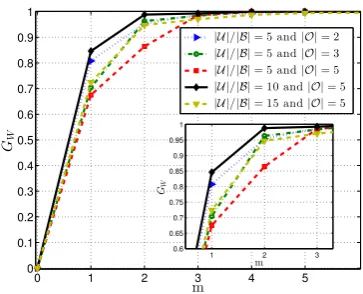
To further explore the impact ofm on network utility, we present the following simulation results (see Section IV for a description of the simulation setup). Here, W(m) is the network utility achieved for a given mvalue, W(∞) is the utility with unconstrained overhead, W(0) is the utility with no reassociations, andGW(m)= 1. −WW((0)m)−−WW((∞∞)) represents
the normalized utility gain with m reassociations, showing
0 1 2 3 4 5
0 0.1 0.2 0.3 0.4 0.5 0.6 0.7 0.8 0.9 1
m GW
|U |/|B|= 5 and|O|= 2 |U |/|B|= 5 and|O|= 3 |U |/|B|= 5 and|O|= 5 |U |/|B|= 10 and|O|= 5 |U |/|B|= 15 and|O|= 5
1 2 3
0.6 0.65 0.7 0.75 0.8 0.85 0.9 0.95 1
m GW
Fig. 1. Normalized utility gain as a function ofm.
how close we get to the unconstrained overhead utility. Fig. 1 depicts this gain as a function ofmfor different scenarios. As can be seen, utility gains increase very sharply. Furthermore, form= 3the gains are already very close to their maximum value; based on this, we set mequal to 3 (this is indeed the value used in the experiments of Section IV).
IV. PERFORMANCE EVALUATION
Next, we evaluate the performance of our proposed ap-proach. The mobile network scenario considered is based on the IMT Advanced evaluation guidelines for dense ‘small cell’ deployments [30]. It consists of base stations with an intersite distance of 200 meters in a hexagonal cell layout with 3 sector antennas (thus in this setting users will associate with sectors rather than the base stations we used in our algorithm description). The Signal Interference to Noise Ratio (SINR) is computed as in [25], SINRub = Pbgub/(Pk∈B,k6=bPkguk+
σ2), where P
b is the transmit power and gub denotes the
channel gain between useruand base stationb, which includes path loss, shadowing, fast fading and antenna gain. Following [30], we set Pb = 41 dBm, σ2 = −104dB, path loss
equal to 36.7 log10(dist) + 22.7 + 26 log10(fc) for carrier
frequency fc = 2.5GHz, and antenna gain of 17 dBi. The
shadowing factor is given by a log-normal function with a standard deviation of 8dB (as in [25]) updated every second, and fast fading follows a Rayleigh distribution dependent of the user speed and the angle of incidence (as in [31]). Achievable rates are then computed with the Shannon formula, BWlog2(1 +SINRub), for the the average SINRub given by
pathloss and shadowing [24] and a channel bandwidth of BW= 10MHz [24]. Finally, the modulation-coding scheme is selected according to the SINRubthresholds reported in [32].
Unless otherwise stated, users move according to the Random Waypoint Model (RWP), network size |B| is 57 sectors, all operators have the same share, the number of users of the operator o is proportional to so, i.e., |Uo| = |U| ·so, and
confidence intervals are below 1%.
A. Utility gains
21 30 39 48 57 −0.64
−0.62 −0.6 −0.58 −0.56 −0.54
|B|
W
SINR SS DG SS
GLLG DG Centralized
Sharing Gain
Association Gain
Fig. 2. Utility gains for different approaches as a function of the network size.
10 users/sector and 3 operators, and plotW(x,f)as a function of the network size |B|. In this setting, we compare the per-formance of our algorithm for dynamic sharing,Greedy Local Largest Gain(‘GLLG’), against the following approaches:
i) SINR-based Static Slicing(‘SINR SS’): the resources of each sector are statically divided among operators and users associate with the based station with highest SINR; ii) Distributed Greedy Static Slicing (‘DG SS’): resources are also sliced statically and user associations follow the Distributed Greedy algorithm discussed in Section III-B2; iii) Distributed Greedy (‘DG’): this is the algorithm for
dynamic sharing presented in Section III-B2;
iv) Centralized (‘Centralized’): this is the centralized algo-rithm proposed in [9].
The results are exhibited in Fig. 2. We draw the following conclusions: (i) significant gains result from both improving user association (DG SS vs. SINR SS) and sharing resources dynamically (DG vs. DG SS); (ii) the Distributed Greedy approach of Section III-B2 performs almost at the same level of the baseline approach of [9] (DG vs. Centralized); and (iii) the proposed approach performs closely to these two approaches, although it pays a small price for reducing the handoff overheads (GLLG vs. DG). Note that the purpose of this results is to benchmark different approaches and the descend trend exhibited in Fig. 2 is caused only by the evaluation in different sized networks.
In addition to the overall network gain, it is also interesting to look at the gains of the individual operators. Theorem 3 showed that the difference in an operator’s utility under MORA and SS exceeds −log(e), but in fact we expect it to be positive. Fig. 3 shows the probability density function for the sampled difference of operators utility under MORA and SS over multiple simulation runs, for different numbers of operators|O|and user densities |U|/|B|. As can be seen it is indeed positive, which confirms that MORA effectively pro-tects all operators ensuring gains to all of them. As expected, such gains are higher for scenarios with more operators and lower loads.
0 0.05 0.1 0.15 0.2 0.25 0.3 0
5 10 15 20 25
Uo(xM O R A,fM O R A)−Uo(xSS,fSS) |U |/|B |= 5,|O|= 2
|U |/|B |= 5,|O|= 3
|U |/|B |= 5,|O|= 5
|U |/|B |= 10,|O|= 5
|U |/|B |= 15,|O|= 5
Fig. 3. Distribution for operator utility gain of MORA vs SS.
2 3 4 5 6
0 10 20 30 40 50 60 70 80 90
∆
(%
)
|O|
|U |/|B|= 5
|U |/|B|= 10
|U |/|B|= 15
}
Static slicing withenhanced userassociation
}
Static slicing withSINR based user association
Fig. 4. Capacity savings for different scenarios as a function of the number of operators.
B. Capacity savings
We next evaluate the benefits of our approach to operators based on the capacity savings they would achieve. Specifi-cally, consider a network operated under our algorithm for dynamic sharing, where the capacity (i.e., total amount of resource) of each base station is given by CGLLG, and let
Cbaseline be the base stations’ capacity required to achieve
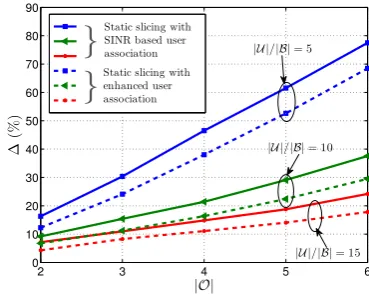
the same network utility under two baselines: (a) static slic-ing with SINR-based user association, and (b) static slicing with enhanced user association (i.e., using our algorithm for user association). These two baselines allow us to study the potential gains earned due to a smarter user association and the gains achieved by dynamic resource sharing. Fig. 4 illustrates the corresponding capacity savings, computed as ∆ = (Cbaseline−CGLLG)/CGLLG, for different numbers of
operators,|O| ∈ {2, . . . ,6}, and three different user densities,
|U|/|B| = 5 (low density), |U|/|B| = 10 (medium) and
|U|/|B| = 15 (high). The results show that substantial gains can be realized.
|U |/|B|
5 10 15 20 25
∆
0 10 20 30 40 50 60 70 80 90 100
Simulation results
Theoretical results
|O|= 5
|O|= 3
|O|= 2
|O|= 4
Fig. 5. Validation of the theoretical results on capacity savings.
exploit statistical multiplexing in the network, leading to higher gains.
As a consequence of regarding the results from a different angle, results show that in an scenario with operators with different shares, the operators with smaller shares are more benefited from MORA, as suggested in Section II-D3. In order to gain additional insight into the impact of these factors, Fig. 5 displays the influence of the share of the operator (so) and the
average load per base station sector|U|/|B|in the percent of extra capacity required to achieve the same utility (∆) with the static slicing with enhanced user association baseline. Results are also compared with the analytical result of Section II-D3, confirming that the theoretical analysis result holds in real conditions.
C. User performance
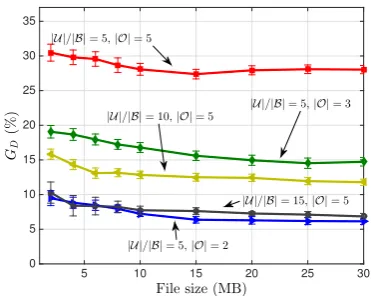
To illustrate the gains from a user perspective, we compare the per-user throughput achieved by our approach against the two baselines: static slicing with SINR-based user association (‘Baseline 1’), and static slicing with enhanced user associ-ation (‘Baseline 2’). The resulting box-and-whisker plots are shown in Fig. 6 for different user densities and numbers of operators. We observe that our approach provides substantial gains both in terms of the median values as well as the various percentiles. Furthermore, similarly to the above, gains increase with the number of operators but decrease with per-sector user load. To complement the previous results, we compare the file download times achieved by our approach against a baseline scenario (static slicing with enhanced user association), when base stations have the same capacity in both cases and users are constantly downloading files. Let us define the file download time gain asGD= (DSS−DGLLG)/DSS,
whereDSS is the average file download time with the static
slicing approach and DGLLG with ours. The gains achieved
are shown in Fig. 7 as a function of the file download size, for different user densities and numbers of operators. We observe the gains are substantial, and fairly independent of the file size.
D. Computational complexity
As mentioned in Section III-A, one of the key advantages of the proposed approach over the state-of-the-art is its reduced
0 2 4 6 8 10 12 14 16
T
h
ro
u
g
h
p
u
t
(M
b
it
/
s)
Baseline 1 Baseline 2 Online m=3 MORA
|U |/|B|= 5 |O|= 2
|U |/|B|= 5 |O|= 3
|U |/|B|= 5 |O|= 5
|U |/|B|= 10 |O|= 5
|U |/|B|= 15 |O|= 5
Fig. 6. Improvement on the user throughput.
File size (MB)
5 10 15 20 25 30
GD
(%
)
0 5 10 15 20 25 30 35
|U |/|B|= 5,|O|= 5
|U |/|B|= 5,|O|= 3 |U |/|B|= 10,|O|= 5
|U |/|B|= 15,|O|= 5
|U |/|B|= 5,|O|= 2
Fig. 7. Improvement on the file download time for different file sizes.
computational complexity. To quantify this, we have measured the time required to execute the following algorithms in a dual-core 2.8GHz processor: (i) our algorithm for dynamic sharing (‘GLLG’); (ii) the Distributed Greedy approach of Section III-B2, which has unconstrained overhead (‘DG’); (iii) the centralized algorithm of [9] (‘Centralized’); and (iv) the non-linear solver used by [23] (‘Non-linear Solver’). Fig. 8 shows the resulting execution times (in seconds) as a function of the number of users for a fixed network size|B|= 57and
|O|= 4operators. The results confirm that the algorithms of [23] and [9] are impractical, especially if we take into account that they have to be triggered every time the channel quality of a user changes. By contrast, the execution time of our Distributed Greedy algorithm remains very low, and it remains even lower for our GLLG approach (due to the constraint that GLLG imposes on the number of handovers).
E. Impact of non-uniform load distributions
|U |
0 20 40 60 80 100
T
im
e
(s
ec
on
d
s)
0 5 10 15 20 25 30 35 40 45 50
|U |
40 60 80 100
T
im
e
0 0.5 1 1.5
DG GLLG
DG
GLLG
Centralized Non-linear
Solver
Fig. 8. Computational complexity of our approaches and state-of-the-art algorithms.
C1 C2 C3 C4 C5
5 10 15 20 25 30 35
Scenario
∆
(%
)
|U |/|B|= 5,|O|= 5
|U |/|B|= 5,|O|= 3
|U |/|B|= 10,|O|= 5
|U |/|B|= 5,|O|= 2
|U |/|B|= 15,|O|= 5
Fig. 9. Capacity savings for different levels of non-uniformity under the SLAW mobility model.
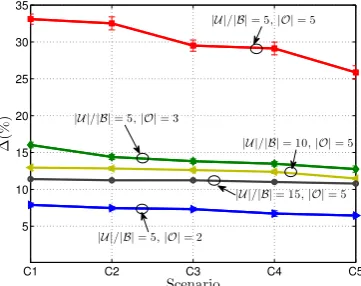
with five different configurations of increasing non-uniformity, from C1 to C5, whose parameters {waypoints, clustering range, alpha distance, inverse self-similarity} have been set as follows:C1 ={100,20,5,0.95},C2 ={85,40,4.5,0.85}, C3 ={75,60,4,0.75}, C4 ={65,80,3.5,0.65} and C5 =
{50,100,3,0.55}. The results, given in Fig. 9, show that (as expected) capacity savings decrease if loads are non-uniform since multiplexing gains are reduced when users concentrate around some areas. However, the decrease is very gradual, which shows that non-uniformity has a limited impact on the resulting gains.
It is worth noting that the above experiment assumed that all operators follow the same mobility pattern, by using the same instance of the SLAW model to generate the users hotspots; if different patterns are assumed for different operators (which may be the case for instance if we consider services of different nature) by using different instances of the SLAW model to generate the users hotspots, then gains increase (rather than decrease) with non-uniformity, as each operator may have its users concentrated in different hotspots, thereby maximizing the benefit from resource sharing. This is shown by the results given in Fig. 10.
C1 C2 C3 C4 C5
20 40 60 80 100 120
Scenario
∆
|U |/|B|= 5,|O|= 2
|U |/|B|= 15,|O|= 5
|U |/|B|= 5,|O|= 3
|U |/|B|= 10,|O|= 5
|U |/|B|= 5,|O|= 5
Fig. 10. Capacity savings for different levels of non-uniformity when operators follow different patterns.
V. CONCLUSIONS
In this paper we have addressed the problem of multi-tenant RAN resource slicing. While there has been substantial work towards addressing this problem, most has focused on architec-tural issues, leaving algorithmic aspects open to consideration. The design of algorithms for dynamic resource sharing across slices is challenging as it involves user association decisions (which is a difficult problem in itself) as well as multi-operator sharing policies. Our main contribution has been to show that, despite its complexity, it is possible to design practical solutions that scale to large networks and can track network load dynamics. Indeed, our analytical results provide strong evidence that the resulting allocations are near-optimal, and our simulations confirm robust benefits to operators (in terms of capacity savings) as well as to users (in terms of improved performance).
REFERENCES
[1] Coleago consulting, “Mobile network sharing report,” Sep. 2015. [Online]. Available: http://www.coleago.com/mobile-network-sharing-managed-services/mobile-network-sharing/
[2] 3GPP, “Telecommunication management; Network sharing; Concepts and requirements.” TS 32.130, v12.0.0, Dec. 2014.
[3] NGMN Alliance, “5G White paper,” Feb. 2015.
[4] F. Kelly, “Charging and rate control for elastic traffic,” European
Transaction Telecommunications, vol. 8, no. 1, pp. 33–37, Feb. 1997.
[5] F. P. Kelly, A. K. Maulloo, and D. K. H. Tan, “Rate Control for Communication Networks: Shadow Prices, Proportional Fairness and Stability,”Journal of the Operational Research, vol. 49, no. 3, pp. 237– 252, Mar. 1998.
[6] R. J. Gibbens and F. P. Kelly, “Resource Pricing and the Evolution of Congestion Control,”Automatica, vol. 35, no. 12, pp. 1969–1985, 1999. [7] J. Anselmi and N. S. Walton, “Decentralized proportional load balanc-ing,”SIAM Journal on Applied Mathematics, vol. 76, no. 1, pp. 391–410, Jan. 2016.
[8] T. Bu, L. Li, and R. Ramjee, “Generalized Proportional Fair Schedul-ing in Third Generation Wireless Data Networks,” inProc. of IEEE
INFOCOM, Apr. 2006.
[9] L. Li, M. Pal, and Y. R. Yang, “Proportional fairness in multi-rate wireless LANs,” inProc. of IEEE INFOCOM, Apr. 2008.
[10] E. Aryafar, A. Keshavarz-Haddad, M. Wang, and M. Chiang, “RAT selection games in HetNets,” inProc. of IEEE INFOCOM, Apr. 2013. [11] J. W. Lee, R. R. Mazumdar, and N. B. Shroff, “Joint resource allocation and base-station assignment for the downlink in CDMA networks,”
[12] K. Son, S. Chong, and G. D. Veciana, “Dynamic association for load balancing and interference avoidance in multi-cell networks,” IEEE
Transactions on Wireless Communications, vol. 8, no. 7, pp. 3566–3576,
Jul. 2009.
[13] M. Mavronicolas, I. Milchtaich, B. Monien, and K. Tiemann, “Con-gestion games with player-specific constants,” inProc. of Mathematical
Foundations of Computer Science, Aug. 2007.
[14] T. Zhou, Y. Huang, W. Huang, S. Li, Y. Sun, and L. Yang, “Qos-aware user association for load balancing in heterogeneous cellular networks,”
inProc. of IEEE VTC Fall, Sep. 2014.
[15] I.-H. Hou and C. S. Chen, “Self-organized resource allocation in LTE systems with weighted proportional fairness,” inProc. of IEEE ICC, May 2012.
[16] I.-H. Hou and P. Gupta, “Proportionally fair distributed resource al-location in multiband wireless systems,”IEEE/ACM Transactions on
Networking, vol. 22, no. 6, pp. 1819–1830, Dec. 2014.
[17] P. D. Francesco, F. Malandrino, T. K. Forde, and L. A. DaSilva, “A Sharing- and Competition-Aware Framework for Cellular Network Evolution Planning,”IEEE Transactions on Cognitive Communications
and Networking, vol. 1, no. 2, pp. 230–243, Jun. 2015.
[18] B. Leng, P. Mansourifard, and B. Krishnamachari, “Microeconomic Analysis of Base-station Sharing in Green Cellular Networks,” inProc.
of IEEE INFOCOM, Apr. 2014.
[19] J. Kibida and L. A. DaSilva, “Efficient Coverage through Interoperator Infrastructure Sharing in Mobile Networks,” inProc. of IFIP Wireless Days, Nov. 2013.
[20] J. S. Panchal, R. D. Yates, and M. M. Buddhikot, “Mobile Network Re-source Sharing Options: Performance Comparisons,”IEEE Transactions
on Wireless Communications, vol. 12, no. 9, pp. 4470–4482, Sep. 2013.
[21] A. Gudipati, L. E. Li, and S. Katti, “RadioVisor: A Slicing Plane for Radio Access Networks,” inProc. of HotSDN, Aug. 2014.
[22] I. Malanchini, S. Valentin, and O. Aydin, “Generalized resource sharing for multiple operators in cellular wireless networks,” inProc. of IWCMC, Aug. 2014.
[23] R. Mahindra, M. Khojastepour, H. Zhang, and S. Rangarajan, “Radio Access Network sharing in cellular networks,” inProc. of IEEE ICNP, Oct. 2013.
[24] V. Sciancaleporeet al., “Interference coordination strategies for content update dissemination in LTE-A,” inProc. of IEEE INFOCOM, 2014. [25] Q. Yeet al., “User Association for Load Balancing in Heterogeneous
Cellular Networks,” IEEE Transactions on Wireless Communications, vol. 12, no. 6, pp. 2706–2716, Jun. 2013.
[26] A. Banchs, “User fair queuing: fair allocation of bandwidth for users,”
inProc. of IEEE INFOCOM, Mar. 2002.
[27] C. Georgiou, T. Pavlides, and A. Philippou, “Network uncertainty in selfish routing,” inProc. of IEEE IPDPS, Apr. 2006.
[28] M. Gairing, B. Monien, and K. Tiemann, “Routing (un-) splittable flow in games with player-specific linear latency functions.”Lecture Notes
in Computer Science, vol. 4051, pp. 501–512, 2006.
[29] J. Westbrook, “Load Balancing for Response Time,” in Proc. of the
Third Annual European Symposium on Algorithms, Sep. 1995.
[30] ITU-R, “Report ITU-R M.2135-1, Guidelines for evaluation of radio interface technologies for IMT-Advanced,” Technical Report, 2009. [31] H. Dhillon et al., “Modeling and Analysis of K-Tier Downlink
Het-erogeneous Cellular Networks,” IEEE Journal on Selected Areas in
Communications, vol. 30, no. 3, pp. 550–560, Apr. 2012.
[32] 3GPP, “Evolved Universal Terrestrial Radio Access (E-UTRA); Physical layer procedures,” TS 36.213, v12.5.0, Rel. 12, Mar. 2015.
[33] K. Leeet al., “SLAW: self-similar least-action human walk,”IEEE/ACM
Transactions on Networking, vol. 20, no. 2, pp. 515–529, Apr. 2012.
APPENDIX
Proof of Theorem 1: Let (x∗,f∗) = (xM ORA,fM ORA)
be a (possibly not unique) optimal solution to MORA. Since (x∗,f∗)is optimal, we have :
W(x∗,f∗)−W(x0,fM(x0)) =
P
p∈OUp(x∗,f∗)−Up(x0,fM(x0))≥0
Thus,
X
p∈O\{o}
Up(x∗,f∗)−Up(x0,fM(x0))≥
Uo(x0,fM(x0))−Uo(x∗,f∗) =−∆Uo.
Now letU∗
o,bdenote the set of users of operatoroconnected
to base stationbunder user associationx∗, andU0
o,bthe same
for user associationx0. Furthermore, letω
u= 1/|Uo|foru∈ Uo, ω∗ob = |Uo,b∗ |/|Uo| and ωob0 = |Uo,b0 |/|Uo|. Note that for
p6=o,U∗
p,b=Up,b0 andωp,b∗ =ω0p,b. Then, X
p∈O\{o}
Up(x∗,f∗)−Up(x0,fM(x0)) =
= X
p∈O\{o}
X
b∈B X
u∈U∗ p,b
ωulog
cubωu
P q∈Oωqb∗
−
X
u∈U0 p,b
ωulog
cubωu
P q∈Oω0qb
!
=X
b∈B
X
p∈O\{o}
X
u∈U∗ p,b
ωulog
cubωu
P q∈Oω∗qb
− (9)
ωulog
cubωu
P q∈Oω0qb
=X
b∈B
X
p∈O\{o}
X
u∈U∗ p,b
ωu
log Pq∈Oω
0
qb P
q∈Oω∗qb
(10)
=X
b∈B
X
p∈O\{o}
ωp,b∗
log Pq∈O\{o}ω
0
qb+ω0ob P
q∈O\{o}ω∗qb+ω∗ob
≤X
b∈B
X
p∈O\{o}
ωp,b∗
log Pq∈O\{o}ω
0
qb+ω0ob P
q∈O\{o}ω∗qb
=X
b∈B
ω0oblog
P
q∈O\{o}ω∗qb
ω0
ob + 1
P
q∈O\{o}ωqb∗
ω0 ob
P
q∈O\{o}ω∗qb ω0ob
≤X
b∈B
ω0obloge= loge (11)
Note that (9) holds since U∗
p,b = Up,b0 for p 6= o, (10) is
obtained by using properties of the logarithm, and inequality (11) holds since((x+ 1)/x)x< eforx≥0.
Proof of Theorem 2: For a given user association x the utility of operatorounder SS is maximized when the resource blocks of each operator at each base station are equally distributed among the operator’s users. This yields
Uo(x,fS(x)) =
=X
b∈B
X
u∈Uo
1
|Uo|
xublog P 1 b∈B
P v∈Uoxvb
so P
o0∈Oso0cub ! , = 1 so X b∈B X
u∈Uo
wuxublog P 1 b∈B
P v∈Uoxvb
so P
o0∈Oso0cub !
,
where the weights arewu= |Usoo|, u∈ Uo.
If we multiply the numerator and denominator inside the log()bywu, and take into account thatwu=wvforu, v∈ Uo
andPo0∈Oso0 = 1, the above can be rewritten as
Uo(x,fS(x)) =1
so X
b∈B
X
u∈Uo
1 so
X
b∈B
X
u∈Uo
wuxublog P
b∈B
P
v∈Uowvxvb
so
.
The utility of operatorowith MORA allocation is given by
Uo(x,fM(x)) = 1
so X
b∈B
X
u∈Uo
wuxublog
wucub P
v∈Uwvxvb
,
which can be rewritten as
Uo(x,fM(x)) =1
so X
b∈B
X
u∈Uo
wuxublog(wucub)−
1 so
X
b∈B
X
u∈Uo
wuxublog X
v∈U
wvxvb !
.
From the above, if we can show that
X
b∈B
X
u∈Uo
wuxublog P
b∈B
P
v∈Uowvxvb
so
≥
X
b∈B
X
u∈Uo
wuxublog X
v∈U
wvxvb !
,
(12) the theorem is proved.
To show the above, we consider the maximization of function Pb∈Byblog(xb) over xb subject to Pb∈Bxb = 1.
By applying Lagrange multipliers, it can be easily seen that this function is maximized for xb = yb/Pb0∈Byb0. Since
both the left and right-hand sides of (12) conform to this constrained optimization problem, and the left-hand side of (12) corresponds to its optimal solution, the inequality of (12) follows.
Proof of Theorem 3: Let(xM ORA,fM ORA)and(xS,fSS)
denote optimal allocations under MORA and SS. Suppose we choose x0 as a user association where x0u=xSSu for u∈ Uo
and x0
u = xM ORAu otherwise. Then by Theorem 1 we have
that
Uo(xM ORA,fM ORA)−Uo(x0,fM(x0))≥ −log(e).
Furthermore, from Theorem 2 we have
Uo(x0,fM(x0))≥Uo(x0,fS(x0)).
Combining the above two equations we get
Uo(xM ORA,fM ORA)−Uo(x0,fS(x0))≥ −log(e),
Note that under SS the utility of an operator is independent of the user associations of the other operators, thus given our choice of x0 we have that
Uo(x0,fS(x0)) =Uo(xSS,fSS)
which combined with the above gives
Uo(xM ORA,fM ORA)−Uo(xSS,fSS)≥ −log(e)
which proves the theorem.
Proof of Theorem 4: The reduction is via the 3-dimensional matching problem which is known to be NP-complete. Re-call that the 3-dimensional matching problem is stated as follows. Let us consider disjoint sets C = {c1, . . . , cn},
D={d1, . . . , dn}and E={e1, . . . , en}, and a family T = {T1, . . . , Tm}of triples with|Ti∩C|=|Ti∩D|=|Ti∩E|= 1
for i = 1, . . . , m, with m ≥ n. The question is whether T contains a matching, i.e., a subfamilyT0 for which |T0|=n and∪Ti∈T0Ti=C∪D∪E.
Our reduction is along the lines of [?]. We call the triples that containcj triples of type j. Lettj be the number of triples
of typej forj= 1, . . . , n. Base stationicorresponds to the triples Ti for i = 1, . . . , m. We create two types of users,
element users and dummy users. We have 2n element users, u∈ {1, . . . ,2n}, corresponding to the2nelements of D∪E. There are tj−1 dummy users of type j for j = 1, . . . , n.
Note that the total number of dummy users is m−n, u ∈ {2n+ 1, . . . , m+n}. Element users can connect to the base
stations that correspond to a triple that contains this element, with a transmission rate of R. Dummy users of type j can connect (also with a transmission ofR) to the base stations that correspond to triples of typej. Element users have a weight wu= 1/(2m)and dummy users have a weightwu= 1/m.5
We claim that a matching exists if and only if the network utility with the MORA criterion is W = (n/m) log(R/2) + ((m−n)/m) log(R).
Proof of Theorem 5: We prove the theorem by means of the following example. Let us consider a scenario with |B|
base stations in which|B|2 users join the network. All users
have the same weight and can associate with any of the |B|
base stations with cub = 1. Independently of the criterion
followed to associate new users, after all users have joined there must be a base station with at least |B| users. Now, suppose all users but these |B| leave the network. For this scenario, the network utility provided by the online algorithm is W(x0,f0) =P|U|
i=1|B|1 log(|B|1 ) = −log(|B|). The optimal
solution is that each user associates with a different base sta-tion, which yields W(xM ORA,fM ORA) = log(1). Thus, we
have W(xM ORA,fM ORA)−W(x0,f0) = log(1) + log(|B|),
which grows to∞as|B| → ∞.
Proof of Theorem 6: Since in an equilibrium of the Dis-tributed Greedy algorithm, each user is associated with the base station that maximizes ru, the following holds for allu:
X
b∈B
x0ubwulog
wucub P
v∈Ux0vbwv
≥
X
b∈B
x∗ubwulog
wucub P
v∈Ux0vbwv+wu
(13)
where the base station for which x0
ub = 1 is the one with
which useru is associated under Distributed Greedy, and the base station for which x∗
ub = 1 is the one with which it is
associated under the optimal allocation (i.e.,x∗=xM ORA).
5These weights can be achieved by considering a scenario with two