ARTICLE
Physician Medical Decision-making at the End of Life
in Newborns: Insight Into Implementation at 2 Dutch
Centers
A. A. Eduard Verhagen, MD, JDa, Mark A. H. van der Hoeven, MD, PhDb, R. Corine van Meerveld, MDa, Pieter J. J. Sauer, MD, PhDa
aDepartment of Pediatrics, University Medical Center Groningen, Groningen, Netherlands;bDivision of Neonatology, University of Maastricht, Maastricht, Netherlands
The authors have indicated they have no financial relationships relevant to this article to disclose.
ABSTRACT
OBJECTIVE.Decisions regarding end-of-life care in critically ill newborns in the
Neth-erlands have received considerable criticism from the media and from the public. This might be because of a lack of proper information and knowledge. Our purpose was to provide detailed information about how and when the implementation of end-of-life decisions, which are based on quality-of-life considerations, takes place.
METHODS.We reviewed the charts of all infants who died within the first 2 months
of life at 2 university hospitals in the Netherlands from January to July 2005 and extracted all relevant information about the end-of-life decisions. We interviewed the responsible neonatologists about the end-of-life decisions and the underlying quality-of-life considerations and about the process of implementation.
RESULTS.Of a total of 30 deaths, 28 were attributable to withholding or withdrawing
life-sustaining treatment. In 18 of 28 cases, the infant had no chance to survive; in 10 cases, the final decision was based on the poor prognosis of the infant. In 6 patients, 2 successive different end-of-life decisions were made. The arguments that most frequently were used to conclude that quality of life was deemed poor were predicted suffering and predicted inability of verbal and nonverbal commu-nication. Implementation consisted of discontinuation of ventilatory support and alleviation of pain and symptoms. Neuromuscular blockers were added shortly before death in 5 cases to prevent gasping, mostly on parental request.
CONCLUSIONS.The majority of deaths were attributable to withholding or
withdraw-ing treatment. In most cases, the newborn had no chance to survive and prolong-ing of treatment could not be justified. In the remainprolong-ing cases, withholdprolong-ing or withdrawing treatment was based on quality-of-life considerations, mostly the predicted suffering and predicted inability of verbal and nonverbal communica-tion. Potentially life-shortening medication played a minor role as a cause of death.
www.pediatrics.org/cgi/doi/10.1542/ peds.2006-2555
doi:10.1542/peds.2006-2555
Key Words
bioethics, withholding/withdrawing treatment, NICU, palliative care
Abbreviations EoL— end-of-life NCTS—no chance to survive PP—very poor prognosis NMB—neuromuscular blocker
Accepted for publication Dec 12, 2006
Address correspondence to A. A. Eduard Verhagen, MD, JD, Department of Pediatrics, University Medical Center Groningen, PO Box 30.001, 9700 RB, Groningen, Netherlands. E-mail: [email protected]
I
N THE PAST 2 years, the foreign press (especially in Italy, the United Kingdom, and the United States) has paid extensive attention to a supposedly outrageous practice in the Netherlands of physicians’ terminating the life of severely defective newborn infants.1–7 It wassuggested that all end-of-life (EoL) decisions in the Neth-erlands were in fact acts of euthanasia based on quality-of-life considerations, with reference to the medical practice in Germany during the Second World War. These accounts were based on the (mis)interpretation of publications regarding EoL decisions and the use of po-tentially life-shortening drugs in newborns in the Neth-erlands.8–13
Decisions on when to start, withhold, or withdraw treatment in very sick newborns are among the most difficult decisions in pediatric practice. The difficulty lies to a large extent in the dilemma that is presented by 2 views: the value of life and the quality of life. The advances in technology and pharmacology have created new possibilities to save and prolong the life of new-borns, but extension of life can also result in endless and severe suffering, which might not be in the interest of the infant. Studies from the United States and Europe have reported that the proportion of sick newborns in whom the decisions to withhold or withdraw life sup-port preceded death increased substantially during the past 10 years.14–16 Quality-of-life concerns have been
reported by neonatologists as reasons for these deci-sion in a substantial proportion (20%–50%) of deaths.8,9,14,17–20 Despite the frequency of these
deci-sions, not much is known about what these quality-of-life concerns really are or about how the imple-mentation of the decision takes place in practice. With respect to the latter, the role of potentially life-short-ening drugs that alleviate pain and other symptoms at the end of life of newborns is of special interest. The legal difference between letting die and active ending of life is in principle based on the administration of these drugs.
The quality of EoL decisions, including the decisions regarding palliation of pain and symptoms, can be eval-uated and compared between various countries only when sufficient insight is provided about medical prac-tice at the end of life. With the purpose to gain more insight into what the medical practice in the Netherlands actually is, we conducted a retrospective descriptive study in 2 large university-based tertiary NICUs to de-termine the reasons that motivate physicians to make EoL decisions and how those are implemented in prac-tice.
METHODS
Demographics
We reviewed the charts of all newborn infants who died in 2 university hospitals (A and B) with tertiary NICUs
within the first 2 months of life between January and July 2005. We abstracted information from the attend-ing physicians’ and nurses’ notes to determine demo-graphics: birth weight, gestational age, day of death and diagnoses (using both clinical data and autopsy materials when available), and details about the decision-making process. According to Dutch law, no approval for this study from the ethical committee is required because it is a retrospective study using anonymous data.
The total number of NICUs in the Netherlands is limited to 10 by law to promote efficient use of expertise, manpower, and resources. All deliveries before 32 weeks’ gestation take place in a hospital with a NICU. Older newborn infants who require intensive care treat-ment are referred to these NICUs. Extracorporeal mem-brane oxygenation is not available in the study hospitals, and heart surgery is not available in NICU B. Patients who require these facilities are transferred to another NICU. In both NICUs, all medical decisions are made by a multidisciplinary team that is led by the attending neonatologist, who is ultimately responsible. The attend-ing neonatologist also informs the parents of their in-fant’s status and proposed treatment plans during regu-lar discussions with the parents. Discussions regarding limiting treatment options are initiated by both the par-ents and the physicians. Consensus among all team members and the parents in EoL decisions is always sought. During the study period, 423 patients were ad-mitted (280 in NICU A and 143 in NICU B), and the average daily census of critically ill patients was 19 in NICU A and 13 in NICU B.
Classification of Newborns
The attending neonatologist’s daily notes and death summaries were used to determine whether death had occurred with or without a preceding medical EoL deci-sion. Medical EoL decisions were defined as medical decisions with the effect or the probable effect that death was hastened. These decisions include the decisions to withhold or withdraw life-prolonging treatment and the decision to end deliberately the life of a newborn. On the basis of the notes, we categorized the newborns at the time of each EoL decision into 1 of the following groups from the literature10,21: group 1, no chance to survive
(NCTS); group 2, theoretical chance to survive, very poor prognosis (PP); or group 3, stable, hopeless prog-noses with severe suffering, not depending on intensive care. During the study period, in neither center was a patient found to belong in group 3.
Decision-making and Implementation
physician on the basis of the EoL decision were collected from the files to describe the practice of implementation of these decisions. We used the medical charts and phar-macy notes to identify potentially life-shortening medi-cation, comparing medication before and after the EoL decision. Medication before the decision was defined as the highest dosage of medication with potentially life-shortening effect as administered in the 12 hours before the EoL decision.
We interviewed all neonatologists who were involved in each EoL decision with quality-of-life arguments face to face. We cross-checked all data that were extracted from the medical charts and asked them to explain in detail why they took the decision to withhold or with-draw treatment and how the decision was implemented. In cases in which potentially life-shortening drugs were used, we asked for the purpose. The reasons to limit treatment were grouped into categories that were de-rived from publications in the Dutch medicolegal litera-ture.22,23
Definitions
Withholding treatment was defined as withholding po-tentially life-saving treatment, which included not only withholding cardiopulmonary resuscitation but also not providing additional intensive care treatment (eg, not making additional ventilator changes despite hypox-emia, not providing additional catecholamines despite hypotension) in accordance with definitions in the 1992 report by the Dutch Pediatric Association.22
Withdraw-ing treatment was taken to be equivalent to withdrawWithdraw-ing life-sustaining treatment (eg, withdrawing the ventila-tor). Deliberate ending of life was defined as administer-ing lethal drugs with the purpose to end the life or shorten the life of a newborn who is otherwise stable. We do not use the term “euthanasia” because in the Netherlands, this can be used only when a physician ends the life of a patient on the patient’s explicit request, in accordance with the Dutch euthanasia law. In this legal framework, life shortening as an inevitable adverse effect of appropriate pain and/or symptom alleviation is considered acceptable clinical practice. The legal and moral status of administering lethal drugs with the pur-pose to shorten life in an unstable newborn in the dying phase, as part of careful EoL management, is still uncer-tain and subject to ongoing debate.
RESULTS
Demographics
A total of 30 newborns died within the first 2 months of life in the 2 hospitals during the 6-month study period: 21 died in hospital A, and 9 died in hospital B. Twenty-nine infants died in a NICU, and 1 patient died on a PICU. Table 1 shows the main characteristics of all deaths and the categories in which all newborns were
classified. Overall, 24 (83%) deaths were attributable to withdrawal of treatment, 4 (10%) were by withholding treatment, and 2 (7%) occurred despite maximum treat-ment. The diagnoses that led to death varied, the largest group being term newborns with hypoxic-ischemic en-cephalopathy (23%).
Classification of Newborns
The data from the medical charts were sufficient to classify all patients in categories. Of all 28 deaths that were preceded by an EoL decision, 18 (64%) were clas-sified as NCTS and 10 (36%) as PP at the time of the final decision. The proportion of deaths in the PP category was the same in both hospitals: 6 (35%) of 17 in hospital A and 4 (36%) of 11 in hospital B. In 9 (32%) of cases, 2 EoL decisions were made, with a median of 24 hours (range: 6 –210 hours) between the first and the second decision. Six of these patients were initially classified as PP and moved to NCTS at the time of the second EoL decision. The proportion of deaths that were preceded by an EoL decision and classified as PP was the same in both hospitals: 6 (35%) of 17 in hospital A and 4 (36%) of 11 in hospital B.
Decision-making and Implementation
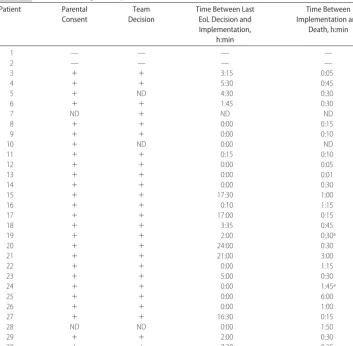
In all deaths in the NCTS group, it was apparent from the physicians’ notes that treatment was withdrawn because there was no chance of survival. Both the parents and the medical team consented to the decision in all docu-mented cases (Table 2). The median time between the final decision and implementation of the decision was 2 hours (range: 0 –24 hours). In 1 case, the time course was undocumented. The implementation consisted of discontinuation of artificial ventilation and removal of the endotracheal tube in all cases except 1. In 1 case, the patient was gradually weaned from the ventilator in 24 hours on parental request. Intravenous medication and fluids were continued until death in all cases. The me-dian time between implementation and death was 30 minutes (range: 1–105 minutes).
In all cases of PP, treatment was withheld or with-drawn because the prognosis was considered very poor. The considerations that led to this conclusion were doc-umented in the medical charts but without much detail (eg, treatment stopped because quality of life is deemed low). Table 3 shows more detailed information from the interviews indicating that in all cases,⬎1 consideration was present. The predicted very low quality of life was most frequently based on the predicted suffering and predicted inability to communicate. With inability to communicate, the neonatologists meant inability to be engaged in any kind of communication with other peo-ple, verbally or nonverbally (eg, because of deafness and blindness combined with predicted severe mental retar-dation or predicted vegetative state).
imple-mentation of the decision in cases of PP was 1 hour (range: 0 –24 hours). The implementation consisted of discontinuation of artificial ventilation and extubation in all cases except 1. In 1 case, the ventilatory support was weaned stepwise in 24 hours on the parents’ request. The median time between implementation and death in this group was 60 minutes (range: 15–360 minutes).
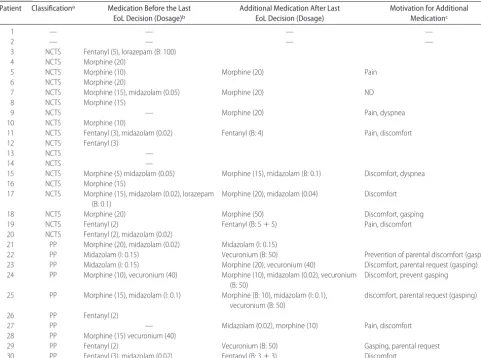
Each of the documented decisions was preceded by at least 1 or more decision-making meetings of the medical team followed by 1 or more with the parents. In these meetings, provision of sedation and analgesia as potentially life-shortening medication was also dis-cussed. Table 4 presents the use and dosing of this medication before and after the final EoL decision. Before the final EoL decision was made, the majority of cases in NCTS (n⫽15; 83%) and in PP (n⫽9; 90%) received opioids and benzodiazepines. In all cases, the dosage was within the normal dosing range. Two new-borns with pulmonary hypertension were treated with neuromuscular blockers (NMBs) as part of the hospi-tal’s standard treatment of this disease. Additional medication after the final EoL decision was adminis-tered in 7 (39%) cases in NCTS and 8 (80%) cases in
PP. It was given as an increased dosage of the existing continuous medication or as a bolus infusion. The dosages remained within normal dosing range. The reasons to provide additional medication were treat-ment of presenting symptoms (eg, pain, dyspnea, dis-comfort) and prevention of suffering from these symptoms in the process of dying. None of the physi-cians interviewed considered hastening death as the aim of additional medication, but all declared that they would consider it an acceptable adverse effect. NMBs were added in 5 newborns in PP. Four of them had a diagnosis of hypoxic-ischemic encephalopathy, 1 with sepsis/meningitis. In 4 of 5 cases, NMBs were prescribed to prevent gasping. In 3 of these cases, this was done on explicit parental request, and in 1 case, it was the physician’s decision to do so because it was expected that gasping would scare the parents away from their dying child. In the remaining case, the dosage of previously prescribed NMB was increased to ensure optimal effect, whereas discontinuation was expected to impose unnecessary suffering. All cases were classified as deaths from natural cause by the attending neonatologists.
TABLE 1 Patient Characteristics and EoL Decision Characteristics of All Deaths in 2 NICUs From January to July 2005
Patient, Hospital
GA, wk Weight,
g
Age at Death, d
Diagnosis That Led to Death Decisions and Patient Classification Time
Between Decisions, h Preceding
Decision
Final Decision
1, A 31 2210 1 Hydrops fetalis Continue treatment
2, A 29 990 1 Lung hypoplasia Continue treatment
3, A 40 2800 29 Hypoplastic heart syndrome Withdraw, NCTS
4, A 34 1900 1 Congenital malformations Withdraw, NCTS
5, A 28 630 33 Extremely low birth weight, sepsis Withdraw, NCTS
6, A 40 4100 2 Meconium ileus, perforation, sepsis Withdraw, NCTS
7, A 41 3530 1 Diaphragmatic hernia Withdraw, NCTS
8, A 32 2150 1 Lung hypoplasia Withdraw, NCTS
9, A 27 1100 8 Sepsis Withdraw, NCTS
10, B 27 760 10 Extremely low birth weight, sepsis Withdraw, NCTS
11, B 28 1005 7 Sepsis, IVH Withdraw, NCTS
12, B 31 680 1 Circulatory failure, hyperkaliemia Withdraw, NCTS
13, B 33 1560 1 Diaphragmatic hernia, congenital malformations Withdraw, NCTS
14, B 37 2675 1 Potter syndrome Withhold, NCTS
15, A 31 1128 2 Trisomy 18 Withhold, PP Withdraw, NCTS 6
16, A 36 2950 1 Dysplastic kidney, lung hypoplasia Withhold, PP Withdraw, NCTS 12
17, A 39 3850 50 Congenital heart disease Withhold, PP Withdraw, NCTS 144
18, A 30 1370 20 Congenital heart disease, cerebral malformation, NEC Withhold, PP Withdraw, NCTS 72
19, B 29 970 2 HIE, convulsions Withhold, PP Withdraw, NCTS 20
20, B 31 515 81 NEC, MOF Withhold, PP Withdraw, NCTS 216
21, A 36 3500 3 Hydrops fetalis, HIE Withhold, PP Withdraw, PP 24
22, A 40 3445 3 HIE Withhold, PP Withdraw, PP 43
23, A 34 2600 10 Sepsis/meningitis, sinus thrombosis Withhold, PP Withdraw, PP 24
24, A 27 915 1 PPHN Withhold, PP
25, A 39 3400 1 HIE Withhold, PP
26, B 37 2760 1 HIE, convulsions Withhold, PP
27, A 39 2750 11 HIE, congenital malformations Withdraw, PP
28, B 37 2645 6 Chondrodysplasia punctata, sepsis, PPHN Withdraw, PP
29, B 39 3940 4 HIE, MOF Withdraw, PP
30, B 37 3100 10 HIE, MOF, NEC Withdraw, PP
DISCUSSION
The attitude of neonatologists in the Netherlands regard-ing EoL issues has been reported extensively in several publications.8–11,24–26 This study is the first to report in
detail to which practices this attitude really leads. We acknowledge several limitations of this study. First, our data may not be representative of the medical practice regarding sick newborns nationwide, because we
evalu-TABLE 2 Decision-making and Implementation in 30 Deaths
Patient Parental
Consent
Team Decision
Time Between Last EoL Decision and Implementation,
h:min
Time Between Implementation and
Death, h:min
1 — — — —
2 — — — —
3 ⫹ ⫹ 3:15 0:05
4 ⫹ ⫹ 5:30 0:45
5 ⫹ ND 4:30 0:30
6 ⫹ ⫹ 1:45 0:30
7 ND ⫹ ND ND
8 ⫹ ⫹ 0:00 0:15
9 ⫹ ⫹ 0:00 0:10
10 ⫹ ND 0:00 ND
11 ⫹ ⫹ 0:15 0:10
12 ⫹ ⫹ 0:00 0:05
13 ⫹ ⫹ 0:00 0:01
14 ⫹ ⫹ 0:00 0:30
15 ⫹ ⫹ 17:30 1:00
16 ⫹ ⫹ 0:10 1:15
17 ⫹ ⫹ 17:00 0:15
18 ⫹ ⫹ 3:35 0:45
19 ⫹ ⫹ 2:00 0:30a
20 ⫹ ⫹ 24:00 0:30
21 ⫹ ⫹ 21:00 3:00
22 ⫹ ⫹ 0:00 1:15
23 ⫹ ⫹ 5:00 0:30
24 ⫹ ⫹ 0:00 1:45a
25 ⫹ ⫹ 0:00 6:00
26 ⫹ ⫹ 0:00 1:00
27 ⫹ ⫹ 16:30 0:15
28 ND ND 0:00 1:50
29 ⫹ ⫹ 2:00 0:30
30 ⫹ ⫹ 7:30 0:25
Data are derived from the medical charts. ND indicates not documented. aNo extubation on parental request.
TABLE 3 Considerations to Decide to Withhold or Withdraw Treatment Because of a PP in All Newborns in Group 2 (nⴝ16)
Considerations Hospital A (n⫽11),
Frequency (Patient)
Hospital B (n⫽5), Frequency (Patient)
Treatment does not contribute to medical condition 3 (17, 23, 28) 4 (19, 20, 29, 30) Treatment is disproportionate 6 (15–18, 22, 28) 1 (30)
Predicted very low quality of life 6 (15, 16, 21, 22, 25, 27) 5 (19, 20, 25, 29, 30) Predicted inability to communicate 3 (22, 24, 27) 2 (26, 30)
Predicted lack of self-sufficiency 1 (24) 1 (26)
Expected hospital dependence 1 (16) 1 (26)
Long life expectancy — —
Predicted suffering 5 (15, 16, 22, 25, 27) 4 (18, 19, 29, 30)
From pain (now and future) — 1 (30)
From discomfort — —
From functional disability 1 (25) 1 (29)
From poor prognosis 2 (15, 16) 5 (19, 20, 26, 29, 30)
From hopelessness 3 (15, 16, 22) 2 (19, 29)
Other: patient not aware of own existence 1 (21)
ated data from 2 of 10 hospitals with NICUs. However, these 10 NICUs have regular meetings, and they use the same practice guidelines including those regarding EoL decision-making. Second, no information is provided on other potentially important factors in the decision-mak-ing, such as the parents’ experience and their perception of the management of symptoms around the time of death. Third, our retrospective analysis of decision-mak-ing may have been influenced by inaccuracy in recall of arguments by the neonatologists who were interviewed. We found that 28 (93%) of a total of 30 deaths were attributable to the decision to withhold or withdraw life-sustaining treatment. Withdrawal of life-sustaining treatment was much more common than withholding treatment (86% vs 14%). The proportion of deaths that resulted from withholding or withdrawal of treatment in our study is substantially higher than that described in the early articles on neonatal EoL care (14%–30%).27,28
Most more recent reports from centers in the United States, the United Kingdom, Australia, and Europe have reported rates between 58% and 75%.15–18,29 Only 2
studies have described similar proportions as our study. Barton and Hodgman30reported that 124 (86%) of 146
deaths had treatment withheld or withdrawn in their unit between 1998 and 2002. Arlettaz et al19 reported
that in 93% of 199 deaths, treatment was withheld or withdrawn. The relatively high proportion in our study is likely to reflect the prevailing approach of the Dutch neonatologists that in sick newborns, it is not only the life-ending decision but also the life-prolonging decision that must be justified.10,22In their opinion, if treatment is
medically futile, then it should be stopped to prevent unnecessary suffering of the infant. Considering that this is a nationwide approach, it can be assumed that the high proportion reported by us is representative of the whole country. It may also reflect the philosophy of
TABLE 4 Use of Potentially Life-shortening Medication, Before and After the Last EoL Decision, in NCTS and PP Groups
Patient Classificationa Medication Before the Last
EoL Decision (Dosage)b
Additional Medication After Last EoL Decision (Dosage)
Motivation for Additional Medicationc
1 — — — —
2 — — — —
3 NCTS Fentanyl (5), lorazepam (B: 100) 4 NCTS Morphine (20)
5 NCTS Morphine (10) Morphine (20) Pain
6 NCTS Morphine (20)
7 NCTS Morphine (15), midazolam (0.05) Morphine (20) ND
8 NCTS Morphine (15)
9 NCTS — Morphine (20) Pain, dyspnea
10 NCTS Morphine (10)
11 NCTS Fentanyl (3), midazolam (0.02) Fentanyl (B: 4) Pain, discomfort 12 NCTS Fentanyl (3)
13 NCTS —
14 NCTS —
15 NCTS Morphine (5) midazolam (0.05) Morphine (15), midazolam (B: 0.1) Discomfort, dyspnea 16 NCTS Morphine (15)
17 NCTS Morphine (15), midazolam (0.02), lorazepam (B: 0.1)
Morphine (20), midazolam (0.04) Discomfort
18 NCTS Morphine (20) Morphine (50) Discomfort, gasping
19 NCTS Fentanyl (2) Fentanyl (B: 5⫹5) Pain, discomfort
20 NCTS Fentanyl (2), midazolam (0.02)
21 PP Morphine (20), midazolam (0.02) Midazolam (I: 0.15)
22 PP Midazolam (I: 0.15) Vecuronium (B: 50) Prevention of parental discomfort (gasping) 23 PP Midazolam (I: 0.15) Morphine (20), vecuronium (40) Discomfort, parental request (gasping) 24 PP Morphine (10), vecuronium (40) Morphine (10), midazolam (0.02), vecuronium
(B: 50)
Discomfort, prevent gasping
25 PP Morphine (15), midazolam (I: 0.1) Morphine (B: 10), midazolam (I: 0.1), vecuronium (B: 50)
discomfort, parental request (gasping)
26 PP Fentanyl (2)
27 PP — Midazolam (0.02), morphine (10) Pain, discomfort
28 PP Morphine (15) vecuronium (40)
29 PP Fentanyl (2) Vecuronium (B: 50) Gasping, parental request
30 PP Fentanyl (3), midazolam (0.02) Fentanyl (B: 3⫹3) Discomfort
Data are as stated in the medical charts. B indicates bolus infusion; I, intermittent dose. aAt the time of the last EoL decision.
bHighest dose in 12 hours before final EoL decision, continuous intravenous administration unless indicated differently, in units as used in normal dosing. Normal dosing: morphine 25 to 50g/kg per hour; fentanyl 0.5 to 5.0g/kg per hour; midazolam 0.01 to 0.06 mg/kg per hour (intermittent 0.05 to 0.15 mg/kg per dose); lorazepam 0.1 to 0.4 mg/kg per dose; vecuronium 30 to 150g/kg per hour (intermittent 100g/kg per dose).51
Dutch physicians that when a newborn is clearly dying or going to die despite treatment, all efforts must be made to let the child die in the arms of the parents, disconnected from the ventilator. In our study, the de-cision to withhold treatment under these circumstances was taken as an EoL decision, whereas in other studies, these cases were classified as deaths despite maximal support16or classification remained unclear.15,30This
ob-servation illustrates that comparison of the contribution of withholding or withdrawing treatment between stud-ies is difficult because definitions vary between studstud-ies. Singh et al14 took withholding treatment to be
equiva-lent to withholding cardiopulmonary resuscitation and withdrawing as withdrawing of mechanical ventilation. A much broader definition, as used by Wall and Par-tridge18and by us, is likely to result in a higher rate of
deaths after withholding or withdrawing of treatment. Decisions that were based on quality-of-life argu-ments (PP) preceded death in 16 (57%) of 28 deaths in our study. Comparison of this finding with other studies is hampered by the fact that all other studies focused on the final decision that led to death. We included all EoL decisions that preceded death in our analysis and ob-served that in a substantial number of cases (9 [32%] of 28),⬎1 type of EoL decision was made. Our results show that in most cases, the first decision was the decision to withhold treatment because of the patient’s PP. Several hours to days later, it was determined that the patient had NCTS and the second decision to stop treatment was made. The newborn had shifted from PP to NCTS. One explanation for this shift could be that the first decision to withhold treatment was made to gain time without imposing additional burden, hoping that the restricted treatment would still lead to improvement. Instead of improving, the clinical situation of the child worsened over time, as a result of the underlying disease, resulting in absence of a chance of survival. Another explanation could be that the decision to withhold treatment was initially more acceptable for the parents. A third possi-bility could be that by withholding life-saving treatment, the physician created a situation in which survival was simply not possible. By evoking this situation, the phy-sician prevented the more difficult discussion about quality of life. We think that our observation suggests that classification of EoL decisions in newborns can not be based on the final decision only. Evaluation and comparison of the decision-making process in NICUs and, specifically, the quality-of-life arguments at the end of life in newborns must include all previous decisions because of the possible causality between these deci-sions.
The neonatologists in our study used general and specific quality-of-life considerations to justify why the predicted quality of life was deemed very low. The gen-eral considerations relate to the moral principle of pro-portionality of treatment, suggesting that the “costs” in
terms of additional burden for the patient versus the foreseeable “effects” in terms of improvement of the patient’s medical condition must be balanced. The most frequently used specific considerations were predicted suffering and the predicted inability to be engaged in any kind of verbal and nonverbal communication. These considerations seem to legitimize limitation of treatment for neonatologists in the Netherlands. Only a few au-thors have reported similar details regarding quality-of-life arguments. Wall and Partridge18 reported the
prog-nosis for severe disabilities and the infant’s predicted suffering as the main quality-of-life concerns. Sing et al14
described that treatment was limited if the burden of continuing interventions outweighed the benefits of prolonging life. Recently, Hentschel et al31reported PP;
severe disabilities; and long-term, far-reaching therapy as considerations.
The infants in this study died relatively fast after the last decision to withhold or withdraw life-saving treat-ment. Death occurred after a median time of 30 and 60 minutes in NCTS and PP groups, respectively. We were interested in the role of medication with potential life-shortening effect around the time of death. We found that provision of sedation and analgesia was discussed at each decision-making meeting. The medication was ad-ministered before and after most EoL decisions to treat symptoms around the time of death (pain, dyspnea, and discomfort). Dosages have consistently remained within normal dosage levels in all cases. This finding suggests a limited role of the potentially life-shortening medication as the cause of death, although lethal adverse effects of the medication cannot be ruled out completely. Earlier studies about the use of potentially life-shortening drugs in the Netherlands focused on the intentions of the physician to differentiate between active ending of life and letting die.8,9,32The problem with intentions is that
they are very subjective, ambiguous, and sometimes un-clear even to the physician himself or herself.33,34 We
have tried to find the medical reasons for the decision to administer medication. Neonatologists in our study con-sistently pointed out that the purpose was alleviation of symptoms in all cases. At the same time, they confirmed in the interviews that hastening death as a possible adverse effect of adequate palliative care would be ac-ceptable. This is in line with other reports from neona-tologists.12,35,36The underlying “double effect” principle,
suggesting that an action that causes a serious harm (death) can be permissible as an adverse effect of pro-moting some good end (relief of pain and suffering), is accepted in common medical practice of critical care and EoL care.34
Pain and symptom management at the end of life is known to be of great concern to parents.37A remarkable
infant. In 3 of 4 cases, administration took place on explicit request of the parents. In the discussions with the medical team, the parents made it clear that they would not accept suffering and agony. The role of NMBs in symptom management at the end of life is controver-sial. Several studies have reported a practice in the use of these agents at the end of life in children.12,38–40 Most
commentary on this issue has concluded that the initi-ation of these agents as the ventilator is being withdrawn is morally indefensible.40–42 Some have argued that the
desire to comfort the patient’s family is an important consideration and that initiating neuromuscular block-ade can be acceptable when the patient’s death after the withdrawal of mechanical ventilation is certain.43–45
However, others believe that the patient’s well-being is always more important than family interests. They argue that neuromuscular blockade potentially masks symp-toms of pain and suffering and makes proper assessment and adequate treatment impossible.46 Our study is the
second to report that parents sometimes explicitly re-quest the use of lethal drugs for their child.47We think
that a request from parents shortly before a certain death is completely understandable because the sight of a gasp-ing child is a potent source of stress and discomfort to all people who witness the dying newborn. Neonatologists in our study were prepared to grant the parental request. This suggests that they accepted the parents’ distress as their responsibility. It is uncertain whether the use of medication with a certain lethal effect can be legitimized by referring to this responsibility. We are convinced that robust palliative care is indicated in all EoL situations, providing parental education and support about the EoL physical signs in the dying child, supportive staff, antic-ipatory grief work, and bereavement service follow-up. If the parental request to administer NMBs to the dying newborn consistently persists despite all of theses mea-sures, then we think that the requests should be granted in the presence of skilled and experienced clinicians.
The results of this study also confirm that deliberate ending of life in newborns remains a rare event, also in the Netherlands, where it is considered to be legally acceptable.48–50In 6 months, no cases were registered in
the study hospitals.
CONCLUSIONS
We report that the vast majority of deaths in 2 Dutch units were attributable to withholding or withdrawing of treatment. In most cases, the newborns had NCTS and prolonging of treatment could not be justified. In the remaining cases, the decision was based on a combina-tion of quality-of-life consideracombina-tions, mostly the pre-dicted suffering and prepre-dicted inability of verbal and nonverbal communication. Potentially life-shortening medication played a minor role as a cause of death in the implementation. No case of deliberately ending the life of a newborn occurred.
REFERENCES
1. Smith W. Killing babies, compassionately. The Netherlands follows in Germany’s footsteps.The Weekly Standard. April 20, 2006:1
2. Sgreccia E. Euthanasia in the Netherlands, even in children [in Dutch].L’Osservatore Romano.September 3, 2004:8
3. Barr B. Euthanasia, or the Dutch treat.The Washington Times. December 26, 2004:B7
4. Sterling T. Netherlands debates proposal to legalize euthanasia for babies and others who can’t decide for themselves [press release].Associated Press.November 30, 2004
5. Bianchin R. That’s why we help children to die [in Italian].La Repubblica. September 2, 2004:1–13
6. Traynor I. Secret killings of newborn babies trap Dutch doctors in moral maze.Guardian.December 21, 2004:3
7. McElroy D. This doctor is proud to have killed four newborns.
The Daily Telegraph. December 26, 2004:21
8. van der Heide A, van der Maas PJ, van der Wal G, et al. Medical end-of-life decisions made for neonates and infants in the Netherlands.Lancet.1997;350:251–255
9. Vrakking AM, van der Heide A, Onwuteaka-Philipsen BD, Keij-Deerenberg IM, van der Maas PJ, van der Wal G. Medical end-of-life decisions made for neonates and infants in the Netherlands, 1995–2001.Lancet.2005;365:1329 –1331 10. Verhagen AAE, Sauer PJ. End-of-life decisions in newborns: an
approach from the Netherlands.Pediatrics.2005;116:736 –739 11. Verhagen E, Sauer PJ. The Groningen protocol: euthanasia in
severely ill newborns.N Engl J Med.2005;352:959 –962 12. van der Heide A, van der Maas PJ, van der Wal G, Kollee LA,
de Leeuw R. Using potentially life-shortening drugs in neo-nates and infants.Crit Care Med.2000;28:2595–2599
13. Michalsen A, Reinhart K. “Euthanasia”: a confusing term, abused under the Nazi regime and misused in present end-of-life debate.Intensive Care Med.2006;32:1304 –1310
14. Singh J, Lantos J, Meadow W. End-of-life after birth: death and dying in a neonatal intensive care unit.Pediatrics.2004;114: 1620 –1626
15. Hagen CM, Hansen TW. Deaths in a neonatal intensive care unit: a 10-year perspective. Pediatr Crit Care Med. 2004;5: 463– 468
16. Wilkinson DJ, Fitzsimons JJ, Dargaville PA, et al. Death in the neonatal intensive care unit: changing patterns of end of life care over two decades.Arch Dis Child Fetal Neonatal Ed.2006; 91:F268 –F271
17. de Leeuw R, de Beaufort AJ, de Kleine MJ, van Harrewijn K, Kollee LA. Foregoing intensive care treatment in newborn infants with extremely poor prognoses: a study in four neona-tal intensive care units in the Netherlands.J Pediatr.1996;129: 661– 666
18. Wall SN, Partridge JC. Death in the intensive care nursery: physician practice of withdrawing and withholding life sup-port.Pediatrics.1997;99:64 –70
19. Arlettaz R, Mieth D, Bucher HU, Duc G, Fauchere JC. End-of-life decisions in delivery room and neonatal intensive care unit.
Acta Paediatr.2005;94:1626 –1631
20. Provoost V, Cools F, Mortier F, et al. Medical end-of-life deci-sions in neonates and infants in Flanders. Lancet.2005;365: 1315–1320
21. Sauer PJ. Ethical dilemmas in neonatology: recommendations of the Ethics Working Group of the CESP (Confederation of European Specialists in Paediatrics).Eur J Pediatr.2001;160: 364 –368
22. Dutch Pediatric Association.To Do or Not to Do? Boundaries of Medical Action in Neonatology[in Dutch]. Utrecht, Netherlands: Den Daas; 1992
4th ed. Houten, Netherlands: Bohn Stafleu von Loghum; 2000: 302–378
24. Rebagliato M, Cuttini M, Broggin L, et al. Neonatal end-of-life decision making: physicians’ attitudes and relationship with self-reported practices in 10 European countries.JAMA.2000; 284:2451–2459
25. Walther FJ. Withholding treatment, withdrawing treatment, and palliative care in the neonatal intensive care unit.Early Hum Dev.2005;81:965–972
26. Verhagen AA, Sol JJ, Brouwer OF, Sauer PJ. Deliberate termi-nation of life in newborns in the Netherlands; review of all 22 reported cases between 1997 and 2004 [in Dutch].Ned Tijdschr Geneeskd.2005;149:183–188
27. Duff RS, Campbell AG. Moral and ethical dilemmas in the special-care nursery.N Engl J Med.1973;289:890 – 894 28. Whitelaw A. Death as an option in neonatal intensive care.
Lancet.1986;2(8502):328 –331
29. Roy R, Aladangady N, Costeloe K, Larcher V. Decision making and modes of death in a tertiary neonatal unit.Arch Dis Child Fetal Neonatal Ed.2004;89:F527–F530
30. Barton L, Hodgman JE. The contribution of withholding or withdrawing care to newborn mortality.Pediatrics.2005;116: 1487–1491
31. Hentschel R, Lindner K, Krueger M, Reiter-theil S. Restriction in ongoing intensive care in neonates: a prospective study.
Pediatrics.2006;118:563–569
32. van der Maas PJ, van der Wal G, Haverkate I, et al. Euthanasia, physician-assisted suicide, and other medical practices involv-ing the end of life in the Netherlands, 1990 –1995. N Engl J Med.1996;335:1699 –1705
33. Quill TE. The ambiguity of clinical intentions.N Engl J Med.
1993;329:1039 –1040
34. Quill TE, Dresser R, Brock DW. The rule of double effect: a critique of its role in end-of-life decision making.N Engl J Med.
1997;337:1768 –1771
35. Partridge JC, Wall SN. Analgesia for dying infants whose life support is withdrawn or withheld.Pediatrics.1997;99:76 –79 36. Solomon MZ, Sellers DE, Heller KS, et al. New and lingering
controversies in pediatric end-of-life care.Pediatrics.2005;116: 872– 883
37. McHaffie HE, Lyon AJ, Fowlie PW. Lingering death after treat-ment withdrawal in the neonatal intensive care unit.Arch Dis Child Fetal Neonatal Ed.2001;85:F8 –F12
38. Provoost V, Cools F, Bilsen J, et al. The use of drugs with a life-shortening effect in end-of-life care in neonates and in-fants.Intensive Care Med.2006;32:133–139
39. Burns JP, Mitchell C. Is there any consensus about end-of-life care in pediatrics?Arch Pediatr Adolesc Med.2005;159:889 – 891 40. Burns JP, Mitchell C, Outwater KM, et al. End-of-life care in the pediatric intensive care unit after the forgoing of life-sustaining treatment.Crit Care Med.2000;28:3060 –3066 41. Brody H, Campbell ML, Faber-Langendoen K, Ogle KS.
With-drawing intensive life-sustaining treatment: recommendations for compassionate clinical management.N Engl J Med.1997; 336:652– 657
42. Truog RD, Cist AF, Brackett SE, et al. Recommendations for end-of-life care in the intensive care unit: the Ethics Commit-tee of the Society of Critical Care Medicine. Crit Care Med.
2001;29:2332–2348
43. Kuhse H. Response to Ronald M Perkin and David B Resnik: the agony of trying to match sanctity of life and patient-centred medical care.J Med Ethics.2002;28:270 –272
44. Rushton CH, Terry PB. Neuromuscular blockade and ventilator withdrawal: ethical controversies. Am J Crit Care. 1995;4: 112–115
45. Perkin RM, Resnik DB. The agony of agonal respiration: is the last gasp necessary?J Med Ethics.2002;28:164 –169
46. Truog RD, Burns JP, Mitchell C, Johnson J, Robinson W. Pharmacologic paralysis and withdrawal of mechanical venti-lation at the end of life.N Engl J Med.2000;342:508 –511 47. Provoost V, Cools F, Deconinck P, et al. Consultation of parents
in actual end-of-life decision-making in neonates and infants.
Eur J Pediatr.2006;165:859 – 866
48. Sheldon T. The Netherlands regulates ending the lives of se-verely ill neonates.BMJ.2005;331:1357
49. Verhagen E. End of life decisions in newborns in the Netherlands: medical and legal aspects of the Groningen pro-tocol.Med Law.2006;25:399 – 407
50. Dorscheidt JH. Assessment procedures regarding end-of-life decisions in neonatology in the Netherlands.Med Law.2005; 24:803– 829
DOI: 10.1542/peds.2006-2555
2007;120;e20
Pediatrics
Pieter J. J. Sauer
A. A. Eduard Verhagen, Mark A. H. van der Hoeven, R. Corine van Meerveld and
Implementation at 2 Dutch Centers
Physician Medical Decision-making at the End of Life in Newborns: Insight Into
Services
Updated Information &
http://pediatrics.aappublications.org/content/120/1/e20 including high resolution figures, can be found at:
References
http://pediatrics.aappublications.org/content/120/1/e20#BIBL This article cites 41 articles, 13 of which you can access for free at:
Subspecialty Collections
dicine_sub
http://www.aappublications.org/cgi/collection/hospice:palliative_me Hospice/Palliative Medicine
http://www.aappublications.org/cgi/collection/ethics:bioethics_sub Ethics/Bioethics
following collection(s):
This article, along with others on similar topics, appears in the
Permissions & Licensing
http://www.aappublications.org/site/misc/Permissions.xhtml in its entirety can be found online at:
Information about reproducing this article in parts (figures, tables) or
Reprints
DOI: 10.1542/peds.2006-2555
2007;120;e20
Pediatrics
Pieter J. J. Sauer
A. A. Eduard Verhagen, Mark A. H. van der Hoeven, R. Corine van Meerveld and
Implementation at 2 Dutch Centers
Physician Medical Decision-making at the End of Life in Newborns: Insight Into
http://pediatrics.aappublications.org/content/120/1/e20
located on the World Wide Web at:
The online version of this article, along with updated information and services, is
by the American Academy of Pediatrics. All rights reserved. Print ISSN: 1073-0397.