Alternative Approach for predicting the
performance of Irreversible Otto Cycle
Mohd Nadeem Khan
Department of Mechanical Engineering, Krishna Institute of Technology, Ghaziabad (U.P), India.
E-Mail: [email protected]
ABSTRACT
The performance of an air-standard Otto cycle with variation of cycle peak temperature and variable specific heats of working fluid is analyzed. The relations between the power output and the compression ratio, between the thermal efficiency and the compression ratio, as well as the optimal relation between power output and the efficiency of the cycle are derived by detailed numerical examples. Moreover, the effects cycle peak temperature and variable specific heats of working fluid on the cycle performance are analyzed. The results show that the effects of cycle peak temperature and variable specific heats of working fluid on the cycle performance are obvious, and they should be considered in practice cycle analysis. The results obtained from this work are presented in the form of generalized equations for specific work output in term of compressor efficiency, turbine efficiency and compression ratio of the cycle. These equations can be used by the designers for predicting the performance of real otto cycle.
The results obtained in this paper may provide guidance for the design of practice internal combustion engines.
Keywords: Otto cycle, Cycle peak temperature, Variable specific heat, compression ratio. INTRODUCTION
The Otto cycle is one of the important models of heat engines. In recent years, many authors have optimized the performance of irreversible Otto heat-engines by using different objective-functions, such as the work output, power output, efficiency, etc. Orlov et al. [1] obtained the power and efficiency limits for internal-combustion engines. Angulo-Brown et al. [2] modelled an Otto cycle with friction-like loss during a finite time. Klein [3] studied the effect of heat-transfer on the performance of the Otto-cycle. Chen et al. [4] derived the relations between the net power and the efficiency of the Otto-cycle with heat-transfer loss. Chen et al. [5] derived the characteristics of power and efficiency for an Otto-cycle with heat-transfer and friction-like term losses. Ge et al.
[6,7] considered the effect of variable specific heats on the cycle process and studied the performance characteristics of endoreversible and irreversible Otto-cycles when variable specific heats of working fluid are linear functions of the temperature. Abu-nada et al. [8] advanced a non-linear relation between the specific heats of a working fluid and its temperature, and compared the performances of the cycle with constant and variable specific heats. Rocha-Matinez et al. [9] presented a simplified irreversible Otto-cycle model with fluctuations in the combustion heat.
Wu and Blank [10,11] investigated the effect of combustion on a work-optimized Otto cycle; Angulo-Brown et al. [12,13] calculated the maximum power-output and efficiency of irreversible Otto heat-engines; Chen et al. [14] analyzed heat transfer effects on the net work output and efficiency of an air-standard Otto heat engine; Leff and Landsberg [15,16] and Arago´n-Gonza´lez et al. [17] derived the maximum work and efficiency of an Otto heat-engine; and Scully and his co-workers [18] considered how to
improve the efficiency of an ideal Otto heat engine. This paper will study the effects of the variable specific heats of working fluid and heat transfer loss on the performance of Otto cycle.
CYCLE MODEL
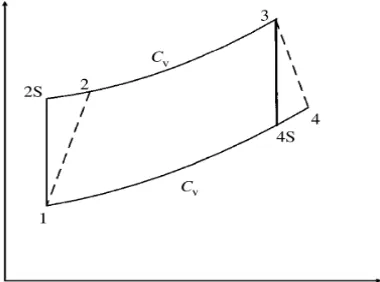
describe the irreversibility of these processes. 1 2 1 2
T
T
T
T
S C
……….. (3)and s t
T
T
T
T
4 3 4 3
……….. (4)Also
1
4 3
1
2
c s sr
T
T
T
T
………. (5)
From equation (3), (4) and (5)
c cr
T
T
1
1
1 12 ……… (6)
13
4
T
1
t1
r
cT
……… (7)where =Cp/Cv and rc=V1/V2 1
The power output and efficiency are two important parameters of heat engines. Using Eqs. (1), (2), (3), (4), (5), (6) and (7), one can derive the expressions of the power output and efficiency as
c k c k c tr
r
k
RT
w
.
.
1
1
1
……… (8)
.
1
1
.
1
23
k c c k c k c t c k c thr
r
r
r
Q
w
……….. (9)Where k = γ-1
It is different from the efficiency definition in [4], in which the efficiency is independent of the heat loss, although the heat loss was considered.
3. Numerical Example and discussions.
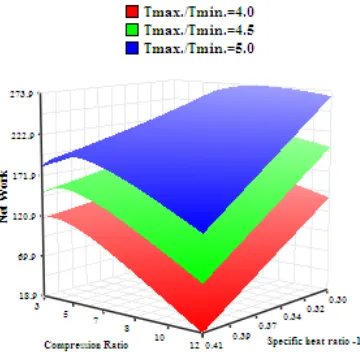
Figure 2 and figure 3 shows the effects of compression ratio, specific heat ratio of working fluid and peak temperature of cycle on the work output. The graphs indicates that at a particular value of (specific heat ratio -1) with increases of compression ratio the work output first increases, reaches its peak value and then goes on decreasing with increase of compression ratio. Also for the particular value of compression ratio and (specific heat ratio -1) the work output increases with increase of peak temperature of the cycle. Figure 4 also indicate the same results and from this figure it is easy to find the conditions under which sp. Work output is maximum i.e. in order to achieve maximum sp. Work output the value of compression ratio is equal to 9, specific heat ratio is equal to 1.3 and Tmax./Tmin. is equal 5 should exist simultaneously.
Figure 2: Performance curves of Net work with variation
of Compression ratio(r) and (ratio of specific heat -1) at different values of Tmax./ Tmin..
Figure 3: Performance curves of Net work with variation
of Compression ratio(r) and (ratio of specific heat -1) at different values of Tmax./ Tmin..
Figure 4: Performance curves of specific work output with
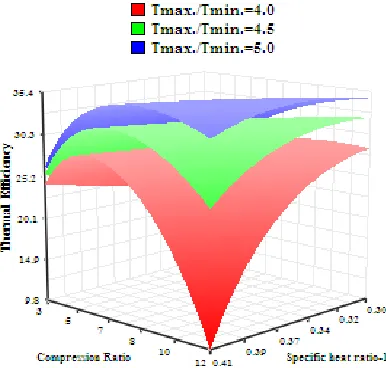
Figure 5and figure 6 shows the variation of thermal efficiency of the cycle w.r.t. sp. heat ratio and compression ratio. The graphs indicates that at a particular value of (specific heat ratio -1) with increases of compression ratio the work output first increases, reaches its peak value and then goes on decreasing with increase of compression ratio. Also for the particular value of compression ratio and (specific heat ratio -1) the work output increases with increase of peak temperature of the cycle. Figure 7 indicate the conditions under which thermal efficiency is maximum i.e. in order to achieve maximum thermal efficiency the value of compression ratio is equal to 8, specific heat ratio is equal to 1.41 and Tmax./Tmin. is equal 5 should exist simultaneously.
From the above discussion, one can easily find out that the work output and thermal efficiency of the cycle is highly affected by the variation of compression ratio, peak cycle temperature and sp. heat ratio of working fluid. From figure 4 and figure 7 we can say that the efficiency is decrease by 7.12% w.r.t. to its peak value at which work output is maximum and the work output is decrease by 34.4% w.r.t. its peak value at which efficiency is maximum.
Figure 5: Performance curves of Thermal Efficiency
with variation of Compression ratio(r) and (ratio of specific heat -1) at different values of
Figure 6: Performance curves of Thermal Efficiency
with variation of Compression ratio(r) and (ratio of specific heat -1) at different values of
Figure 7: Performance curves of Thermal Efficiency with
Figure 8 show the variation of thermal efficiency Vs net work in the same range of compression ratio, cycle peak temperature and sp. heat ratio as mention above. Here the figure shows that at the particular value of cycle peak temperature the effect of specific heat ratio is more dominating that net work of the cycle i.e. if the specific heat ratio is increase by 26.8%, the work output is decrease by 26.8% to 27.5% but at the particular value of specific heat ratio with increase of cycle peak temperature by 20%, the net work of the cycle increase by 17 % to 40% and the thermal efficiency of the cycle is decrease by 20% to 22%.
Generalized Equations
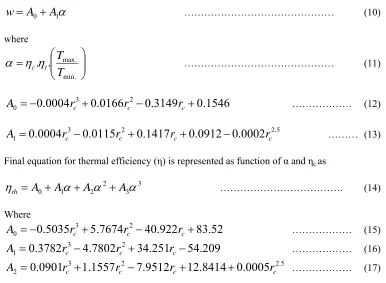
In order to reduce the complex calculations for specific work output and thermal efficiency from equation (8) and (9), the specific work output and the thermal efficiency of the cycle are presented as the function of α and ηc keep the specific heat ratio constant as shown in equations below.
Final equation for specific work output (w) is represented as function of α and ηc as
1 0
A
A
w
……… (10)where
. min
. max
.
.
T
T
t c
……… (11)1546
.
0
3149
.
0
0166
.
0
0004
.
0
3 20
r
c
r
c
r
c
A
……… (12)5 . 2 2
3
1
0
.
0004
r
c0
.
0115
r
c0
.
1417
r
c0
.
0912
0
.
0002
r
cA
……… (13)Final equation for thermal efficiency (η) is represented as function of α and ηc as
3 3 2 2 1
0
th
A
A
A
A
………. (14)Where
52
.
83
922
.
40
7674
.
5
5035
.
0
3
2
Figure 8: Performance curves of Thermal Efficiency Vs Work output under different conditions
Figure 9 and 10 shows the variation of specific work output and thermal efficiency with simultaneous variation of alpha and compression ratio. Theses figure show that in cases of specific work output and thermal efficiency, the peak value is achieved at highest value of compression ratio and highest value of alpha. The specific work output and thermal efficiency of the cycle calculated from equations (10) and (14) are compared with the values calculated from equation (8) and (9). There is good agreement between the predicated values from the generalized equations and the values calculated from the basic equations.
Conclusion
Temperature dependant specific heats will affect the power output and Thermal efficiency calculations. The differences in the results using the two methods are significant. Therefore, temperature dependant specific heat must be used in modeling the performance of Otto cycle. The effects of different parameters, such as compression ratio, specific heat of working fluid and peak temperature of the cycle are investigated in this paper. The performance characters tics of the cycle were obtained by numerical example. The results shows there are significant effects of the compression ratio, specific heat of working fluid and peak temperature of the cycle on the performance of the cycle and this should be considered in practical cycle analysis. The conclusions of this investigation are of importance when considering the designs of actual cycle.
The above study also reflects that equations (10) and (14) can be used by the designers for predicting the performance of irreversible Otto cycle for various ambient temperatures, compression ratios, thermal efficiencies of compressor and turbine for all possible practical operating parameters.
Nomenclature
Wp Net work output (kJ) R Gas constant (kJ/kg.k)
T Temperature (K)
V Volume (m3)
ηc Compressor Efficiency ηt Turbine Efficiency
ηth Thermal Efficiency
REFERENCES
[1] Orlov VN, Berry RS. Power and efficiency limits for internal-combustion engines via methods of finite-time thermodynamics. J Appl Phys 1993;74(10):4317–22.
[2] Angulo-Brown F, Fernandez-Betanzos J, Diaz-Pico CA. Compression ratio of an optimized Otto-cycle model. Eur J Phys 1994;15(1):38–42.
[3] Klein SA. An explanation for observed compression ratios in internal-combustion engines. Trans ASME J Eng Gas-Turbine Power 1991;113(4):511–3.
[4] Chen L, Wu C, Sun F, Wu C. Heat transfer effects on the net work output and efficiency characteristics for an air standard Otto-cycle. Energy Convers Manage 1998;39(7):643–8.
[5] Chen L, Zheng T, Sun F, Wu C. The power and efficiency characteristics for an irreversible Otto cycle. Int J Ambient Energy 2003;24(4):195–200.
[6] Ge Y, Chen L, Sun F, Wu C. Thermodynamic simulation of performance of an Otto cycle with heat transfer and variable specificheats for the working fluid. Int J Therm Sci 2005;44(5):506–11.
[7] Ge Y, Chen L, Sun F, Wu C. The effects of variable specific-heats of the working fluid on the performance of an irreversible Ottocycle. Int J Exergy 2005;2(3):274–83.
[8] Abu-Nada E, Al-Hinti I, Al-Aarkhi A, Akash B. Thermodynamic modelling of a spark-ignition engine: effect of temperaturedependent specific heats. Int Comm Heat Mass Transfer 2005;32(8):1045–56.
[9] Rocha-Matinez JA, Navarrete-Gonzalez TD, Pavia-Miller CG, et al.. A simplified irreversible Otto-engine model with fluctuations in the combustion heat. Int J Ambient Energy 2006;27(4):181–92.
[10] Wu C, Blank DA. The effects of combustion on a work-optimized endoreversible Otto cycle. J Inst Energy 1992;65:86–9.
[11] Wu C, Blank DA. Optimization of the endoreversible Otto cycle with respect to both power and mean effective pressure. Energy Convers Mange 1993;34:1255–9.
[12] Angulo-Brown F, Ferna´ndez-Betanzos J, Diaz-Pico CA. Compression ratio of an optimized air standard Otto-cycle model. Eur J Phys 1994;15:38–42.
[13] Angulo-Brown F, Rocha-Martinez JA, Navarrete-Gonzalez TD. A non-endoreversible Otto-cycle model: improving power-output and efficiency. J Phys D: Appl Phys 1996;29:80–3.
[14] Chen L, Wu C, Sun F, Cao S. Heat-transfer effects on the net work output and efficiency characteristics for an air-standard Otto-cycle. Energy Convers Mange 1998;39:643–8.
[15] Leff HS. Efficiency at maximum work output: new results for old heat-engines. Am J Phys 1987;55:602–10.
[16] Landsberg PT, Leff HS. Thermodynamic cycles with nearly universal maximum-work efficiencies. J Phys A: Math Gen 1989;22:4019–26.
[17] Arago´n-Gonza´lez G, Canales-Palma A, Leo´n-Galicia A. Maximum irreversible work and efficiency in power cycles. J Phys D: Appl Phys 2000;33:1403–9.
[18] Scully MO. Quantum afterburner: improving the efficiency of an ideal heat-engine. Phys Rev Lett 2002;88:050602-1-4. [19] Arago´n-Gonza´lez G, Canales-Palma A, Leo´n-Galicia A. Maximum irreversible work and efficiency in power cycles. J Phys D:
Appl Phys 2000;33:1403–9.
[20] De Vos A. Endoreversible thermodynamics of solar-energy conversion. Oxford: Oxford University Press; 1992.
Biographical Notes
Mr. M.N.Khan is Associate Professor, Department of Mechanical Engineering, Krishna Institute of Engg. & Tech.