Smart Traffic Light System
Gurudatta Verma Rishabh Sonkar
Department of Computer Science & Engineering Department of Computer Science & Engineering Shri Shankaracharya Institute of Professional Management
and Technology, Raipur, Chhattisgarh, India
Shri Shankaracharya Institute of Professional Management and Technology, Raipur, Chhattisgarh, India
Lekhraj Bowaria
Department of Computer Science & Engineering
Shri Shankaracharya Institute of Professional Management and Technology, Raipur, Chhattisgarh, India
Abstract
In our day-to-day life, we have seeing conventional traffic light system controlling the flow of automobiles at many junctions of roads. In conventional traffic light systems each road at junction gets predefined green light time, hence it is not able to handle variable flows approaching the junctions, due to which we have to deal with traffic jams and congestion on the road. To deal with this problem and to provide smooth motion of vehicles in the transportation routes we proposed this paper in which we are going to discuss, how can we solve above stated problem by implementation of Internet of Things (IoT).
Keywords: IoT, FSR
________________________________________________________________________________________________________
I. INTRODUCTION
Smart traffic light system is a system, which uses Internet of Things (IoT) [1] to provide smooth motion of vehicles in the transportation routes.
IoT:
The Internet of things (IoT)[1] is the network of physical devices, vehicles, home appliances and other items embedded with electronics, software, sensors, actuators, and connectivity which enables these objects to connect and exchange data. Each thing is uniquely identifiable through its embedded computing system but is able to inter-operate within the existing Internet infrastructure. Smart city is a powerful application of IoT generating curiosity among world's population. Smart surveillance, automated transportation, smarter energy management systems, water distribution, urban security, environmental monitoring and smart traffic light system all are examples of internet of things (IoT)[1] applications for smart cities.
Conventional Traffic Light:
In conventional traffic light systems each road at junction gets predefined green light time, hence it is not able to handle variable flows approaching the junctions, due to which we have to deal with traffic jams and congestion on the road.
Smart Traffic Light:
In smart traffic light system, we propose the idea to use IoT to provide smooth motion of vehicle in transportation routes and to reduce the waiting time at the junction at each side of road by skipping unnecessary greenlight time to road when there is no traffic on it. For the same, smart traffic light uses FSR [3] sensor to detect vehicle on the road and provide greenlight to only the road with vehicle on it. As soon as the vehicles leaves the road or we can say that there is no traffic on the road then green light time is passes to next lane or traffic signal get converted to red signal.
Force Sensitive Resistor (FSR) Sensor:
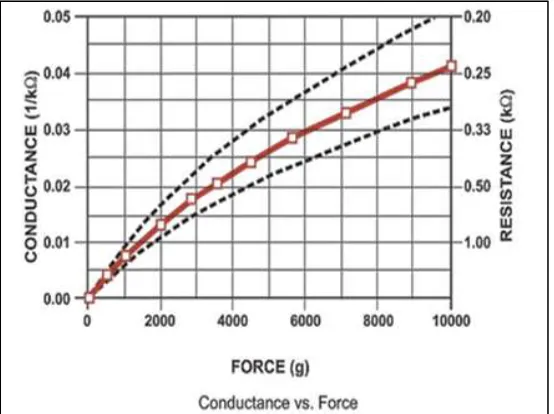
FSRs are sensors that allow you to detect physical pressure, squeezing and weight according to this they changes resistive value (in ohms Ω) depending on how much it is pressed. These sensors are fairly low cost, and easy to use.
Smart Traffic Light System
(IJSTE/ Volume 4 / Issue 10 / 021)
Fig. 1: Relation between force and conductance in FSR
Arduino UNO:
Arduino UNO [2] is an open-source microcontroller board, which act as a brain of smart traffic light system. Picture of Arduino UNO given below in figure 2.
An Arduino is an open-source microcontroller development board. In plain English, you can use the Arduino to read sensors and control things like motors and lights. This allows you to upload programs to this board which can then interact with things in the real world. With this, you can make devices which respond and react to the world at large. For instance, you can read a humidity sensor connected to a potted plant and turn on an automatic watering system if it gets too dry. Or, you can make a stand-alone chat server which is plugged into your internet router. Or, you can have it tweet every time your cat passes through a pet door. Or, you can have it start a pot of coffee when your alarm goes off in the morning.
Fig. 2: Arduino UNO
Diagrams:
State Transition Diagram:
Fig. 3: State Transition Diagram for Smart Traffic Light System
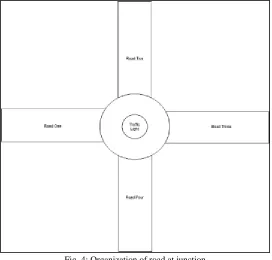
In figure 3 state 1 represent that traffic light is signaling red light to all the road at junction, state 2 represent that traffic light is signaling green to only road one, state 3 represent that traffic light is signaling green to road two, state 4 represent that traffic light is signaling green to road three, state 5 represent that traffic light is signaling green to road four as shown in figure 4.
Different transition in state diagram is represented by different color, which represent their priority. The order of priority of transition is given as blue > green > orange > brown > black. In state diagram arrow represents sensor which is sensing traffic in roads i.e. if we are in state 2 and we sense traffic in state 3 and state 5 then we move to state 3 since it is connected through higher priority line.
Fig. 4: Organization of road at junction
Smart Traffic Light System
(IJSTE/ Volume 4 / Issue 10 / 021)
II. BACKGROUND STUDY
Cihan Karakuzu et.al. has coined the idea to develop fuzzy logic based traffic junction light simulator system for design and smart traffic junction light controller purposes and to observe its performance. Traffic junction simulator hardware is developed to overcome difficulties of working in a real environment and to easily test the performance of the controller. By using the traffic light simulator developed in this study, results of constant duration (conventional) traffic light controller and fuzzy logic based traffic light controller are compared, where the vehicle inputs are supplied by the simulator. Statistical experimental results obtained from the implemented simulator show that the fuzzy logic traffic light controller dramatically reduced the waiting time at red lights since the controller adapts itself according to traffic density. It is obvious that the intelligent light controller is going to provide important advantages in terms of economics and environment. [Published on: 25 June 2009, Published at Elsevier]
Vishakha S.Thakare et.al. said that the occurrence of traffic congestion at the intersections in cities is one of the major problem. The present traffic light controlling system could not sufficient to tackle the traffic congestion due to the lack of efficiency in the designing. The main design problems of present traffic light controller system are fixed time interval, no mechanism provided for the occurrence of an emergency vehicle. [Published on: March - April 2013, Published at IOSR Journal of Computer Engineering (IOSR-JCE)]
Volodymyr Miz et.al. has described a cognitive traffic management system based on the Internet of Things approach. Telecommunication technologies, which can be used for the system development and deployment, are analyzed. Smart traffic light integration is proposed as a replacement of the existing traffic lights. The main purpose of such replacement is to optimize traffic management processes, which are made by government authorities. Smart traffic light integration excludes mistakes caused by human factor. Proposed approach can be used as a part of e-government system in further. [Published on: 02 February 2015, Published at IEEE].
III. MOTIVATION
The purpose of making this paper is to discuss the solution of problem that we face with conventional traffic light system. I n conventional traffic light system, we need to wait for at least 90 seconds even if there is no traffic in other sides of junction. To solve this problem we propose the idea of smart traffic light.
Smart traffic Light has many applications in real day-to-day life. It can used to reduce traffic accident by controlling the traffic across the signal. Smart traffic light is smart enough to reduce waiting time at the signal by allowing green signal only when there is traffic in the road. It can also reduce accident rates because in order to get green signal, Driver need to register themselves to traffic light by stopping their vehicle just above the FSR[3] sensor, which is placed before the zebra crossing. It can also prevent traffic jams by using round robin algorithm [4] designed by us.
IV. PROBLEM IDENTIFICATION
Currently IOT is on trend because it is very easy to implement any idea using IOT. In IOT, we have a system of interrelated computing devices, mechanical and digital machines, objects, animals or people that provided with unique identifiers and the ability to transfer data over a network without requiring human-to-human or human-to-computer interaction.
Hence, we decided to use this platform to implement our idea. In this paper, we are going to describe about smart traffic light system that does not work like the conventional traffic light and saves the travelling time. To save time our Smart Traffic Light use an algorithm which register traffic on each road in a queue and allow traffic to clear in round robin fashion.
V. PROPOSED METHODOLOGY AND RESULT
Conventional traffic light systems provides predefined green light time to each road at junction, hence it results in heavy traffic jams and congestion on the road. Hence, we developed an algorithm, which work like round robin algorithm [4].
According to our algorithm, Arduino UNO [2] will check each road of junction in circular fashion and if it detects any traffic on the road then it allow it to cross the junction by signaling green light to it. However, if there is no traffic on the road then it will signal the road as red light and check for traffic in next road.
Fig. 5: Circuit Diagram for Smart Traffic Light
Because of implementing Smart Traffic Light in place of conventional traffic light, we would have following benefits:
Reduce Accidents:
To get green light vehicle need to stop just above the FSR sensor, which placed before the zebra crossing. Hence, Smart Traffic Light helps to reduce accidents by not allowing vehicle to cross zebra crossing at red light.
Reduce Waiting Time:
Smart Traffic Light is capable of handling variable flow of traffic at junctions and allows variable green light time to each road of junction accordingly. Hence, it helps to reduce waiting time.
Prevent Traffic Jam:
Smart Traffic Light helps to prevent traffic jams by following round robin algorithm [4] with variable time slot for green light.
Smart Traffic Light System
(IJSTE/ Volume 4 / Issue 10 / 021)
REFERENCES
[1] F. Bonomi. Connected vehicles, the internet of things, and fog computing. VANET 2011, 2011.
[2] M. Bowman, S. K. Debray, and L. L. Peterson. Reasoning about naming systems. ACM Trans. Program. Lang. Syst., 15(5):795–825, November 1993.
[3] G. Forman. An extensive empirical study of feature selection metrics for text classification. J. Mach. Learn. Res., 3:1289–1305, Mar. 2003.
[4] B. Fr¨ohlich and J. Plate. The cubic mouse: a new device for three-dimensional input. In Proceedings of the SIGCHI conference on Human factors in computing systems, CHI ’00, pages 526–531, New York, NY, USA, 2000. ACM.
[5] M. J. Sannella. Constraint satisfaction and debugging for interactive user interfaces. 2003.
[6] P. Tavel. Modeling and simulation design. 2007.
[7] https://en.wikipedia.org/wiki/Internet_of_things
[8] https://en.wikipedia.org/wiki/Arduino_Uno
[9] https://learn.adafruit.com/force-sensitive-resistor-fsr/overview