ISSN (Online): 2320-9364, ISSN (Print): 2320-9356
www.ijres.org Volume 4 Issue 5
ǁ
May. 2016
ǁ
PP. 15-19
www.ijres.org 15 | Page
DCT shift system based on fuzzy logic research
Xian Zhang Bian,Pei Teng Zhao,Yuan Chao Mu
Shanghai University Of Engineering Science
ABSTRACT:
- It is proposed that the problems exist in the traditional system of shift in this paper. Then, we conclude that a variety of factors influence the driver decision ,through particular analysis of the shiftprocessduring making the decision[1]. At the same time, this paper extracts he main characteristics of DCT gear
decision-making system which reflects driving intention in all kinds of driving mode. According to these
characteristics, this paper adopts the fuzzy logic method to establish the new recognition of driving intention
recognition system that contains road condition, and this method is accordance with the driver's decision-making
process characteristics, using the fuzzy logic theory, which use more comprehensiveinformation than before, thus
the result is more accurate and reliable.
Keywords
:- fuzzy logic,decision-making system,DCT,driving intentionsI.
INTRODUCTION
In recent years,the traditional shift schedule has beenmaturely applied in the automatic transmission,but
traditional shift schedule only regards speed and throttle opening as the geardecision control parameters,at the
same time it is just according to the car traveling in the straight road to determine the best performance or the
best fuel economy . Literature [2] has carried on the exploration and analysis of double clutch automatic
transmissionbasic shift schedule,but the article does not consider environmental conditions and the pilot driving
intention, which is only based on automobile driving state shift schedulewhile in normal driving environment
with good performance, howeverthis method may cause problems in some specific driving environment[3], such
as vehicle frequently shiftproblems in the cycle of bumpy road , etc. This seriously affect the ride comfort, the
span of service life and the vehicle dynamic performance.[4, 6] conducted technology based on fuzzy logic and
expert knowledge on traditional automatic transmission of block a decision research, but the establishment of
the fuzzy shift rules and membership functions of correction is more complicated, at the same time, the problem
of block decision systemwith real time control system also need to be resolved.
The process of DCT shiftuse the method of pre-joint synchronizer. If the process has cycle shift or
frequent shift phenomenon, it will inevitably lead to the synchronizer and clutch frequentlyunnecessary actions,
and affect the ride comfort and the span of service life of clutch and synchronizer [7]. DCT shift system,
therefore, must be carried out on the driving intention recognition, and should as far as possible eliminate
frequent shift problem. In order to solve the defects of the traditional shift schedule, fuzzy logic block decision
systemis proposed according to the driver's decision-making process,whichrecognize driver’s driving intention.
II.
DRIVER'S DECISION-MAKING PROCESS
In order to better analyze the driver's driving behavior, we need to knowthe driver’s wholeprocess from
the first reaction to the final operation. Driver's decisions are driver's subjective behavior, at the same time also
largely decided by the objective factors of the surrounding traffic environment[8]. During the process of vehicle
running, the driver make a series of pilot control decisionsbased on factors (vehicle speed, vehicle positionin
front of the car window) such as acceleration, deceleration and uniform. In this reaction to the manipulation of
informationanalyze these information to determine operating command, according to the driver's own
experience[9] , and finally drive vehicle rightly.
According to the driver's decision-making process, we draw a driver's decision-making framework, as
shown in figure 1.
Figure1The driver’s decision-making process
(1) driving information
According to the driver's visual characteristics, transportation information that influence driver’s decision mainly includes speed ,acceleration of the vehicle, location, the frontvehicle speed, travel destination
and travel time requirements, etc. These objective traffic factors has a decisive roleon the driver's driving
behavior .
(2) information acquisition
This part is to point to the driver through the body sense organs affect driver's decision-making of
traffic information collection, through the cerebral cortex processing, thus achieve the cognitive process. In the
process of the cognition of information is the most important thing is to determine the scope of the driver's
perception of information, if the information is outside the scope of the driver's perception, the driver will ignore
this information, free.
(3) information processing
Driver's handling of information refers to the driver in accordance with its own driving experience who
will classify the information such as the speed, acceleration, position. The category of the information means
which driving decision the driver should be taken. Experience ,among them, should be the template as the basis
of information classification, which often have subjectivity and fuzziness,so that causes the boundaries not
clearbetween the different driving decisions.so the experience template is the key factor in driving
decisions-making, and the key research pointof driving behavior study nowadays.
(4)decision execution
The driver of drive the vehicle in accordance with the decision. The driver's response mainlyrely on the
driver's driving ability and vehicle performance, and the more driving ability is skilled, the less driver make
mistake, and the driver's decision response will decide brake response and the safe distance between drivers and
vehiclesin the emergency.
III.
THE ESTABLISHMENT OF THE SHIFT SYSTEM
DCT shift control system must comprehensively consider three aspects, the condition of vehicle driving
environment, road and the driver's operation intention. DCT make gear decisionaccording to the different
characteristics of more comprehensive situation , so that make itselfmeet shifting control requirements in
complex environment conditions[10]. Gear decision system should be able to meet the demand of different
driving intention with shift control,and effectively solve frequently and unexpected shifting problems on the
www.ijres.org 17 | Page
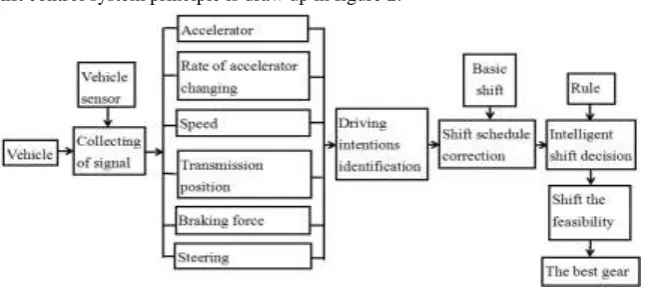
comfort. DCT shift control system principle is draw up in figure 2.Figure 2 DCT shift control system principle
Among them, the intelligent decision mainly depend on the establishment of the shiftrule base and
establishment of the shiftrule base is decidedby expert knowledge and the experience of the best drivers. Of
course, it is very hard to establish a complete shift decision rule base, because it needs to be constantly improve
through car running process.
The shift feasibility analysis mainlyestimatethe vehicle dynamic performance before shift and after
shift based on vehicle dynamic performance requirements, in order to meet the vehicle dynamic performance
requirements. At the same time, DCT synchronizer and clutch actuators operating characteristics must be
considered, especially the response time of the actuator.
IV.
DRIVER INTENTION RECOGNITION SYSTEM CONTAINSRECOGNITION
OFDRIVING CYCLE
4.1 the traditional driving intention and driving cycle recognition
Driver intention refers to the driver's operation targetunder the specific driving cycle. Driving intention
can be divided into acute acceleration, the acceleration, cruise, deceleration and stop, according to the actual
experience of driving.but vehicle driving cycle is extremely complexin the process of actual operation condition,
mainly divided into good road, bumpy road, slope road and tortuousroad, etc.
The separate division ,driving intention and driving cycle above, likely to cause staggered phenomenon
and difficult decision-making at the end of shift [12]. Due to the identification of driving intention and driving
cycleare both carried out by on-board sensor signal. Therefore, it is possible to unify the driving intention and
driving cycle identification. According to the driving intention and driving cycle of partition and description of
their respective characteristics. Driving intention as the main line is put forwardto simplify the shift the decision
making process, and unify the driving intention and driving cycle as the following 5 typical case.
A.Urgent to accelerate
Urgent acceleration intention indicate that the driver urgent requirementto accelerate , generally used
for overtaking, with particular emphasis on power performance, and at this time transmission should be
downshift early and upshift delay.
B. speed up
From the dynamic point,acceleration resistance can be equivalent to ramp resistance, at this time
upshift should be delayed to make full use of the engine driving force, anddownshift timely when engine lack
of driving force.
C. cruise
Cruise intentions main characteristic is that the speed change is not obvious, and the driver wants to
www.ijres.org 18 | Page
D. Deceleration
Even with brakein driving. Driver should limit to upshift and downshift timely to take full advantage of
engine auxiliary braking in this process .
E. parking
Characterized by the throttle opening is zero, and with continuous braking signal.
4.2 contains the condition of recognition of driver intention recognition system
The driving intention is hard to use accurate mathematical models to describe, so that the model
belongs to the experience model. The theory of fuzzyhas great advantages in processing experience model.
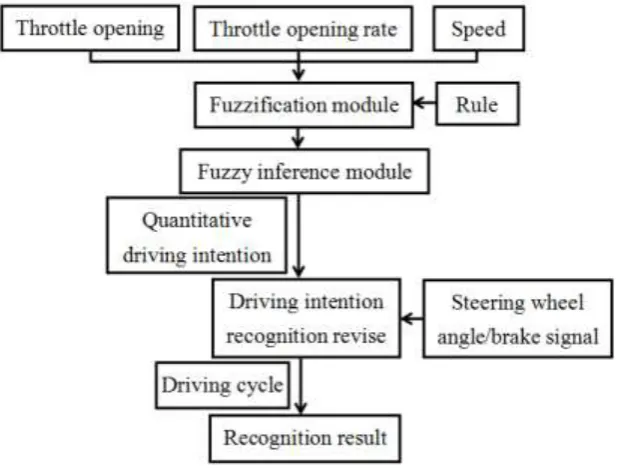
Driving intentions usually use fuzzy inference model according to the throttle opening and changing rate, speed,
braking signal.Throttle opening and its changing ratecan mostly reflect the driving intention, and the speed of
the vehiclemostly reflect the status of vehicle and environment. Braking signal only appears when vehicle is
parking or slowdown intention.
Speed, throttle opening and throttle opening rate as input, and thequantified driving intention as the
output, combining with skilled driver experience and expert knowledge, the driver intention recognition fuzzy
inference model is set up as shown in figure 3.
Figure 3 Fuzzy inference model of driving intention recognition
Theory of domain ua [0 100] is the throttle opening range, the throttle opening were divided into three
fuzzy set, the fuzzy language is: {S, M, B}, meaning is: {small, middle, big}.
Theory of domain UΔ [-100 100] is a throttle opening rate after the equivalent variation range of data
processing, the fuzzy language is: {NB, NS, Z, PS, PB}, meaning is: {negatives big ,negative mall , negative,
zero, small, big}.
Theory of domain uv [0100] is the speed range, the speed more than this range according to the
boundary treatment, the fuzzy language is: {S, M, B}, meaning is: { small, middle, big}.
Ud is quantitative fuzzy reasoning theory domain value output driver's intentions, the fuzzy language is:
{T, D, K, A, C}, meaning is: {parking, deceleration, cruise, acceleration,}. Determine the input and output
theory domain and membership function, according to the collection of knowledge and expert experience and
skilled driver based on dynamics characteristics in the vehicle, set the driver intention of fuzzy inference rules
listed in table 1.
www.ijres.org 19 | Page
Throttle position Changing rate of throttle position SpeedS M B
S NB T T D
NS T D D
Z K K K
PS K A A
PB A A C
M NB T T T
NS T T T
Z K K K
PS A A A
PB C C C
B NB D D D
NS D D D
Z K K K
PS A A A
PB C C C
REFERENCES
[1]. Lei Sun. Research on HEV driver braking intention recognition and control algorithms[D].jilin
university,2012
[2]. Yuhai Wang,Jian Song,etc. The unified recognition and real-time algorithm of driver intention and
driving environment[J].Journal of Mechanical Engineering,2006.12,Vol.22,No.12
[3]. Yuhai Wang,etc. Research on driver's intention recognition based on fuzzy reasoning[D].Highway
traffic science and technology,2005.12,Vol.22,No.12
[4]. Huiyi Wang. Automobile anti-lock braking system build of the application of fuzzy control method and
its simulation test bed[D].Jilin university of technology,1998
[5]. Huarong Zheng. Considered peripheral driving intention lane changing risk early warning
research[D].Wuhan university of technology,2013
[6]. Huifang Kong. Research on the key technology of the transmission and control of the electronic
controlled mechanical automatic transmission[D].HeFei University of Technology, 2007
[7]. Jingwen Bai. Research on the algorithm of automatic transmission control system with double
clutch[D]. Xi'an University Of Architecture And Technology, 2011
[8]. Yejie Cui. Study on identification method and application of driver's control intention[D].Jilin
University, 2013
[9]. Fuxue Zhu. Research on DCT shift control strategy of dual clutch automatic transmission[D]. Xi'an
University of Science and Technology,2013
[10]. Shuwen Zhang. Research on AMT shift control strategy based on driver's intention[D]. Chongqing
University. 2014
[11]. Bo Xiong. Research on intelligent vehicle autonomous driving method based on fuzzy control[J].
Journal of Transportation Systems Engineering and Information Technology April 2010 Vol.10 No.2
[12]. Ze Wang. Decision making of driving based on Fuzzy Clustering[J].Journal of Jilin University,vol.45