RESEARCH ARTICLE
VIRTUAL LEARNING ENVIRONMENTS (VLES): THE DEVELOPMENT OF STUDENT’S LEARNING
DOMAINS AT HIGHER LEARNING INSTITUITION (HLI)
*1
Nik ZulkarnaenKhidzir,
1Khairul Azhar Bin Mat Daud and
2Mohd AsrulHery Ibrahim
1
Global Entrepreneurship Research & Innovation Centre, University Malaysia Kelantan
2Faculty of Entrepreneurship and Business
ARTICLE INFOABSTRACT
Virtual Learning Environments (VLEs) Provide online interaction of various kinds which can take place between learners and tutor, including online learning when the student and lecturers are in different places but in the same time. However, the effectiveness of the approach still debated among scholars from different discipline on how this method could improve the Domain of Learning development among student especially in Higher Learning Institution (HLI). Therefore, the purpose of this study is to explore and measure the level of three Domains of Learning (Cognitive, Psychomotor, and Affective) development in Virtual Learning Environments (VLE) for higher learning institutions. Questionnaires were distributed to various group of scholars in numerous discipline for the study through purposive sampling. About 112 respondent participate in the survey. The findings of the study show the Cognitive domain development was the most effectedDomain of Learningfor the implementation of Virtual Learning Environment (VLE). This paper has also highlighted and discuss others two Domain of Learning based of the analysis results. Through the findings, Higher Learning Institution (HLI), practitioners and technologist could gain valuable indicator and source of scientific evidence consider toward the improvement of their Virtual Learning Environment (VLE) in order to gain the real benefit of its implementation.
INTRODUCTION
A Virtual Learning Environments (VLEs), or learning platform, is an e-learning education system based on the web that models conventional in-person education by providing equivalent virtual access to classes, class content, tests, homework, grades, assessments, and other external resources such as academic or museum website links. It is also a social space where students and teacher can interact through threaded discussions or chat. It typically uses Web 2.0 tools for 2-way interaction, and includes a content management system.The success of a virtual learning environment (VLE) depends to a considerable extent on student acceptance and use of such an e-learning system. The question is, how far the approach could stimulate the growth of student’s Learning Domains in Higher Learning Institution (HLI). Based on the previous study, a unique approach had been developed to solve the mystery. The finding could be significant to the improvement of the teaching and learning approach towards the development of student’s cognitive ability, psychomotor and affective skill. This paper explores respondent’s perception on these three Domain of Learning level for the implementation of Virtual Learning Environments (VLEs) platform in Higher Learning Institution.
*Corresponding author: Nik Zulkarnaen Khidzir,
Global Entrepreneurship Research & Innovation Centre, University Malaysia Kelantan.
Related concept and previous literature also being reviewed to establish the scope of the study.
Literature Review
Virtual Learning Environments (VLEs) Concepts
Virtual Learning Environments (VLEs) are the basic components of contemporary distance learning, but can also be integrated with a physical learning environment (Dillenbourg, 2000), which may be referred to as blended learning. The terms virtual learning environment (VLE) and learning platform are generically used to describe a range of integrated web based applications that provide teachers, learners, parents and others involved in education with information, tools and resources to support and enhance educational delivery and management. These terms are broadly synonymous with 'managed learning environments' (MLEs) and 'managed virtual learning environments' (MVLEs). The applications that form part of these online services can include web pages, email, message boards and discussion forums, text and video conferencing, shared diaries, online social areas, as well as assessment, management and tracking tools (Briefing Paper, 2014, JISC,
2002 and
http://whatis.techtarget.com/definition/virtual- learning-environment-VLE-or-managed-learning-environment-MLE). The same context and helps promote and spread education plus learning activities on digital mediums on the
Article History: Received 24th January, 2017 Received in revised form 15th February, 2017
Accepted 14th March, 2017
Published online 30th April, 2017
www.ijramr.com
International Journal of Recent Advances in Multidisciplinary Research
Vol. 04, Issue 04, pp.2460-2464, April, 2017
Keywords:
web. With the advancement in technology the education sector has given a real positive boost to online education and this is the reason that online communication in the form of exchange of information exists between the teacher, student and the faculty with ease and without hassle through virtual learning environment (http://edutechwiki.unige.ch/en/Virtual_learning_ environment)In technical terms the most generic of definitions to sum up we can say that a virtual learning environment is a
designed information space for education purpose
(http://tecfa.unige.ch/tecfa/publicat/dil-papers-2/Dil.7.5.18.pdf)
The Evolution of Virtual Learning Environments (VLEs)
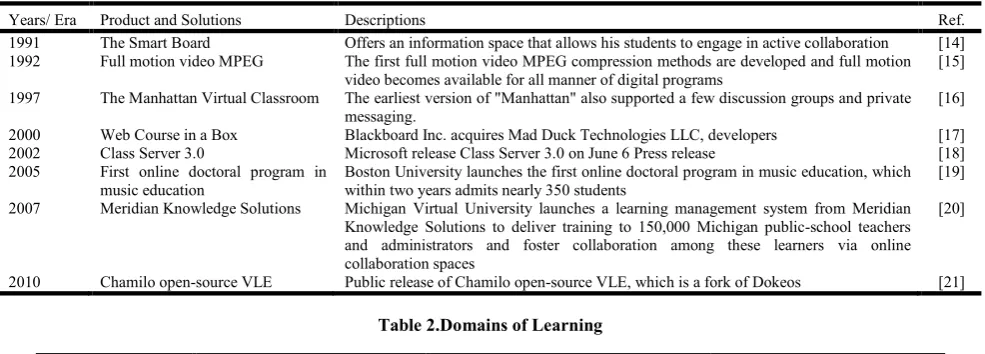
Following the emergence of the internet technology in the early 1990s, various new tools, platforms and products have been developed to fully exploit its benefits. Since the mid-1990s the education community has witnessed the appearance of software products labelled Virtual Learning Environments (VLEs) that aim to support learning and teaching activities across the internet (O’Leary Ros 2002) For example, popular commercial Virtual Learning Environments (VLEs) current being used in UK HE include Blackboard (http://www.blackboard.com) and WebCT (http://www.webct.com) In this article, review on the evolution of Virtual Learning Environments (VLEs) from 1990s until 2010s. Table II highlight several literature about the evolution of Virtual Learning Environments (VLEs).
The review had highlighted an active developments of Virtual Learning Environments (VLE) internationally. Therefore study toward the improvement of the Virtual Learning Environments (VLEs) implementation become an interest among researchers and technology implementer.
Domain of Learning in Higher Learning institutions (HLIs)
Benjamin Samuel Bloom (February 21, 1913 – September 13, 1999) was an American educational psychologist who made contributions to the classification of educational objectives and to the theory of mastery-learning. He also directed a research team which conducted a major investigation into the development of exceptional talent whose results are relevant to the question of eminence, exceptional achievement, and greatness (Bloom, 1985). Bloom et al. are well known for
dividing categories of learning into the cognitive, affective, and psychomotor domains. The cognitive domain involves the learning and application of knowledge (Bloom, 1956). The affective domain addresses the acquisition of attitudes and values (Krathwohl, 1956) and the psychomotor domain involves development of the body and skills it performs (Bressan’s, 1971).
Benjamin Bloom has suggested three domains of learning:
Cognitive – To recall, calculate, discuss, analyze,
problem solve, etc.
Psychomotor – To dance, swim, ski, dive, drive a car,
ride a bike, etc.
Affective – To like something or someone, love,
appreciate, fear, hate, worship, etc.
In Most of Higher Learning institutions, these domains were widely adopted in the entire ecosystem of their teaching, learning environment as well as in the assessment approach. Table II briefly describe the domain description.
MATERIALS AND METHODS
A study using questionnaire survey was applied in this research. Five-Point-Likert-Scale was used to measure the Domains of Learning Development in Virtual Learning
Environment implementation. Questionnaires were distributed to various fields of studies academic professional from various position and academic level in university through purposive sampling. Both primary and secondary data were used in order to accomplish this research objective. An appropriate data analysis method used to conclude the findings. Reliability test also conducted in order to test the consistency of data collection instrument.
Research Model
The research model in Figure 1 is built based on the combination of several past literatures instead of a single research model. Figure 1 illustrates the model of the research.
Table 1. Evolution of VLEs After the Emergence of The Internet
Years/ Era Product and Solutions Descriptions Ref.
1991 The Smart Board Offers an information space that allows his students to engage in active collaboration [14]
1992 Full motion video MPEG The first full motion video MPEG compression methods are developed and full motion
video becomes available for all manner of digital programs
[15]
1997 The Manhattan Virtual Classroom The earliest version of "Manhattan" also supported a few discussion groups and private
messaging.
[16]
2000 Web Course in a Box Blackboard Inc. acquires Mad Duck Technologies LLC, developers [17]
2002 Class Server 3.0 Microsoft release Class Server 3.0 on June 6 Press release [18]
2005 First online doctoral program in
music education
Boston University launches the first online doctoral program in music education, which within two years admits nearly 350 students
[19]
2007 Meridian Knowledge Solutions Michigan Virtual University launches a learning management system from Meridian
Knowledge Solutions to deliver training to 150,000 Michigan public-school teachers and administrators and foster collaboration among these learners via online collaboration spaces
[20]
2010 Chamilo open-source VLE Public release of Chamilo open-source VLE, which is a fork of Dokeos [21]
Table 2.Domains of Learning
Cognitive Domain Psychomotor Domain Affective Domain
Domain Description Simulation required learners to
apply their cognitive skill
Simulation involved actions of the participant, refined psychomotor required
Allow participant to experience feelings, questions and concern Source: Clark (1999)
Fig. 1. Research Model
RESULTS AND DISCUSSION
The survey questionnaire captured background data of respondent profile as well as their perception on the level of how the Virtual Learning Environment (VLE) could encourage the Domains of Learning development among students in Higher Learning institutions. Data collected from 113 academic, professional feedback were analyzed and discussed. The analysis and discussions are presented in two parts. Firstly, this section provide descriptive summary of the data on respondent’s and discusses respondent’s demographic profiles and the perception on Virtual Learning Environment implementation in several field of studies. Secondly, the level of academic professional perception how Virtual Learning Environment (VLE) could encourage the student’s cognitive, psychomotor and affective skill development in university.
Respondent’s Demographic Profiles Descriptive Analysis
Respondent’s demographic profile examined were
respondent’s personal academic qualification, their position level, domains of expertise, and field of teaching in university. Most of them are the academic professional from tutor to professors in Higher Learning Institutions (HLI). demographic profile revealed some salient point. Essentially, the respondents were academician from different academic qualification and position in Higher Learning Institutions (HLI). The majority of respondents owned a Master
their highest qualification representing 60% of the sample population. The profiling showed that a moderately significant number (45.1%) had been appointed as Lecturer, 20.4% were Assistant Professor/ Senior Lecturer, 8.0% were Associate Professor and 3.5% were Professor. Therefore, the analysis shows that most of the respondent were consider as appropriate professionals that possess sufficient experience to response to the entire question trustfully and accurately. Table III Summarized the demographic profiles of respondents involved in the study.Respondents who participate in the survey also came from various domains of expertise. Figure 2 illustrates domains of expertise and the percentage of respondents involved in the study.The majority of respondents from the population are experts in Social Sciences and others were aptured background data of respondent profile as well as their perception on the level of how the Virtual Learning Environment (VLE) could encourage the Domains of Learning development among students in Higher Learning institutions. Data collected from 113 academic, professional feedback were analyzed and discussed. The analysis and discussions are presented in two parts. Firstly, this section provide descriptive summary of the data on respondent’s and discusses respondent’s demographic profiles rception on Virtual Learning Environment implementation in several field of studies. Secondly, the level of academic professional perception how Virtual Learning Environment (VLE) could encourage the student’s cognitive,
velopment in university.
Respondent’s Demographic Profiles Descriptive Analysis
Respondent’s demographic profile examined were
respondent’s personal academic qualification, their position level, domains of expertise, and field of teaching in university. Most of them are the academic professional from tutor to ning Institutions (HLI). The demographic profile revealed some salient point. Essentially, the respondents were academician from different academic qualification and position in Higher Learning Institutions (HLI). The majority of respondents owned a Master Degree as their highest qualification representing 60% of the sample population. The profiling showed that a moderately significant number (45.1%) had been appointed as Lecturer, 20.4% were Assistant Professor/ Senior Lecturer, 8.0% were Associate or and 3.5% were Professor. Therefore, the analysis shows that most of the respondent were consider as appropriate professionals that possess sufficient experience to response to the entire question trustfully and accurately. Table III raphic profiles of respondents involved in the study.Respondents who participate in the survey also came from various domains of expertise. Figure 2 illustrates domains of expertise and the percentage of respondents spondents from the population are experts in Social Sciences and others were
expert in art and heritage, language studies, technology/ engineering, health sciences/ veterinary, natural sciences, computing/ICT/ multimedia, business, management and entrepreneurship.
Table 3. Respondents demographic profiles data
Respondent’s Demographic Items Gender
Male Female Age (Years)
25 – 29 30 – 34 35 – 39 40 – 44 45 – 49 50 – 54 55 – 60
Academic Qualification PhD Master Degree Designation Professor Assoc. Professor Assist. Professor/ Senior Lecturer
Lecturer Assist. Lecturer Tutor TOTAL
Fig. 2. Respondent’s Percentage of Expertise Domains
Fig.3. Respondent’s Perceptions Percentage
Virtual Learning Environment (VLE) and Implementation Descriptive Analysis
Respondent’s perceptions feedback on Virtual Learning Environment (VLE) implementation in Higher Learning Institution (HLI) were collected from three major group field of studies consist of Art/ Social Sc
Entrepreneurship; and Science and Technology.When
analyzing the responses, majority of 62.8% respondent realize that Virtual Learning Environment could encourage student’s Domains of Learning development in Art/ Social Sciences Studies. While, 19.5 % of the respondents aware that Virtual Learning Environment (VLE) could improve the student’s Domains of Learning development in Business and Entrepreneurship Studies.
expert in art and heritage, language studies, technology/ engineering, health sciences/ veterinary, natural sciences, computing/ICT/ multimedia, business, management and
Table 3. Respondents demographic profiles data
Respondent’s Demographic Items
Frequency Percentage (%)
53 60
46.9 % 53.1 %
Frequency Percentage (%)
44 27 8 12 14 4 4 38.9 % 23.9 % 7.1 % 10.6 % 12.4 % 3.5 % 3.5 %
Frequency Percentage (%)
34 60 19 30.1 % 53.1 % 16.8 %
Frequency Percentage (%)
4 9 23 51 5 21 3.5 % 8.0 % 20.4 % 45.1 % 4.4 % 18.6
113 100%
Fig. 2. Respondent’s Percentage of Expertise Domains
Respondent’s Perceptions Percentage
Virtual Learning Environment (VLE) and Field of Study ementation Descriptive Analysis
Respondent’s perceptions feedback on Virtual Learning Environment (VLE) implementation in Higher Learning Institution (HLI) were collected from three major group field of studies consist of Art/ Social Sciences; Business and
Entrepreneurship; and Science and Technology.When
But only minority of them (17.7%) feel that Virtual Learning Environment (VLE) platform could not be implemented successfully in Science and Technology teaching and learning process. Figure 3 illustrates percentage of perceptions from various field of studies. Results of the analysis shows that the implementation of Virtual Learning Environment (VLE) in Higher Learning Institutions (HLI) could encourage better outcome for student’s Domains of Learning variables (Cognitive knowledge, Psychomotor and Affective skills) development in art/ social sciences compared to business/
entrepreneurship; and science/ technology curriculum.
Therefore, the content of the curriculum and field of studies contributed to the respondent’s perception on how effective
Virtual Learning Environment (VLE) implementation.
Additionally, there are other factors could influence their
perception on Virtual Learning Environment (VLE)
implementation such as design of the curriculum; level of knowledge or skills taught; operational policy; current technology and the virtual community exposure and experience using the platform.
Reliability Test Results
Cronbach’s Alpha Coefficient was used to test the survey item’s reliability. A coefficient value which is closer to “1” is required. Cronbach Alpha value for Domains of Learning (0.75) are high. Since all items in Table IV below had a reliability of more then 0.7, the scale for these construct were considered to exhibit an acceptable reliability.
Domains of Learning Variable Analysis: Cognitive, Psychomotor and Affective Level
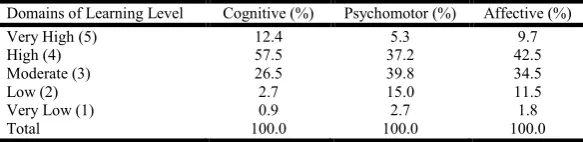
This section presents the findings of the study. Deeper analysis on Domains of Learning were conducted to explore, measure and discover how far the Virtual Learning Environment (VLE) could stimulate the growth of student’s Learning Domains in Higher Learning Institutions (HLIs). Analysis results above in Table V describe the Domains of Learning level for cognitive, psychomotor and affective development. In general, there are different level of perception for each Domains of Learning variables identified through this study. Analysis revealed that 57.5% respondents realized the cognitive skills could highly be learned through Virtual Learning Environment (VLE), 26.5% as moderately accepted and 2.7% as low. Surprisingly, another 12.4% from the population feel that the Virtual Learning Environments (VLE) is very highly stimulates the cognitive skills among students.
Analysis also discovered that 39.8% respondents realized that psychomotor skills could moderately be learned through a Virtual Learning Environment (VLE), 37.2% as highly accepted and 15.0% as low. Unfortunately, only 15.3% from the population feel that the Virtual Learning Environment (VLE) is very highly stimulating the psychomotor skills among students.Finally, the results obtained through the analysis revealed another interesting findings. 42.5% agreed that affective skill could highly be learned through Virtual Learning Environment (VLE), 34.5% as moderately accepted and 11.5% as low.
Conclusion
Virtual Learning Environments (VLEs) offer an alternative and effective approach for Higher Learning Institution (HLI) to manage the increasing numbers of students. Through this approach,the platform not only provide the basic components of contemporary distance learning, but can also be integrated with a physical learning environment which may be referred to as blended learning. Literatures highlight several evidences about the evolution of Virtual Learning Environments (VLEs) and its implementation in Higher Learning Institutions (HLI).
Perception analysis on Domains of Learning variables for Virtual Learning Environments (VLEs) implementation in Higher Learning Institutions (HLI) could provide a measurable indicator to discover level of cognitive, psychomotor and affective skill development among the students. Eventually, the findings possibly will provide an empirical evidences for the improvement to practitioner and technology implementer. The findings shows that, perception about the capability of Virtual Learning Environments (VLEs) to stimulate the growth of student’s cognitive, psychomotor and affective skill were are not the same for different content of the curriculum and field of study. Further analysis on cognitive, psychomotor and affective variables shows Virtual Learning Environments (VLEs) implementation could highly effective to stimulate the growth of cognitive skills in Higher Learning Institutions (HLIs).
Acknowledgment
The authors wish to thank Global Entrepreneur Research & Innovation Centre, University of Malaysia Kelantan for their financial support. Special thanks also to all respondents who participated in the survey.
Table 4. Reliability Test Results
Construct Variables No. of Items Cronbach’s Alpha Coefficient N = Number of Respondents
Domains of Learning
Cognitive Psychomotor Affective
3 0.75 113
Table 5. Domains of learning, variable analysis
Domains of Learning Level Cognitive (%) Psychomotor (%) Affective (%)
Very High (5) High (4) Moderate (3) Low (2) Very Low (1)
12.4 57.5 26.5 2.7 0.9
5.3 37.2 39.8 15.0 2.7
9.7 42.5 34.5 11.5 1.8
Total 100.0 100.0 100.0
REFERENCES
Dillenbourg, Pierre, "Virtual learning environments," presented at the EUN Conference 2000: Learning in the new millennium: Building new education strategies for schools, 2000.
Bloom, B. S. (ed). 1985. Developing Talent in Young People.
New York: Ballantine Books.
"Briefing Paper 1: MLEs and VLEs Explained". JISC. 2007. Retrieved 10 September 2014.
JISC. 2002. "Inform1." Retrieved 10 September 2014, from http://www.jisc.ac.uk/publications/publications/pub_inform 1.aspx.
http://whatis.techtarget.com/definition/virtual-learning- environment-VLE-or-managed-learning-environment-MLE.
http://edutechwiki.unige.ch/en/Virtual_learning_environment. http://tecfa.unige.ch/tecfa/publicat/dil-papers-2/Dil.7.5.18.pdf. Bloom, B. 1956. ed., Taxonomy of educational objectives,
handbook I: Cognitive domain. New York: McKay, 1956. Krathwohl, D., et al. 1956. Taxonomy of educational
objectives, handbook II: Affective domain. New York: McKay.
Bressan’s adaptations of Jewett et al., “Educational change through a taxonomy for writing physical education
objectives,” Quest 15, 35-36, 1971.
O’Leary, Ros 2002. Virtual Learning Environments.
Association for Learning Technology. Available online
from: http://www.alt.ac.uk/docs/eln002.pdf
http://www.blackboard.com . Retrieved 11 September 2014. http://www.webct.com. Retrieved 11 September 2014.
Johnson-Eilola, Johndan. Datacloud: Toward a New Theory of
Online Work. Cresskill, NJ: Hampton Press, Inc., 2005.
Print.
Nick Higgett and Andrew McNamara. "Multimedia Design: Teaching a New Design Discipline". Retrieved 10 September 2014.
Steven Narmontas, 1997.History of Manhattan Virtual
Classroom. Western New England College. Online.
Mad Duck Technologies LLC 2000. Networked Learning Environment – THE BLACKBOARD LEARNING SYSTEM – and Blackboard History". Retrieved 10 September 2014.
http://www.microsoft.com/en-us/news/press/2003/jun03/06-05classserver30pr.aspx. Retrieved 10 September 2014. Hebert, D. G. 2007. "Five Challenges and Solutions in Online
Music Teacher Education," Research and Issues in Music Education, Vol. 5.
"http://www.govtech.com/education/-Michigan-Virtual-University-Chooses-Meridian.html". Retrieved 10
September 2014.
http://www.chamilo.org/en/about-chamilo. Retrieved 11
September 2014.