International Journal of Pharmaceutical Research & Allied Sciences, 2019, 8(3):126-130
Research Article
CODEN(USA) : IJPRPM
ISSN : 2277-3657
Correlation between Balance and Attention in Children with Attention Deficit
Hyperactivity Disorder
Amira H. Mohammed
Department of Physical Therapy for Pediatric Disorders, Faculty of Physical Therapy, Delta University for Science and Technology, Egypt.
Email: amira.hussien @ deltauniv .edu .eg
ABSTRACT
Objective: The purpose of the current study was to investigate balance in children with attention deficit hyperactivity disorder contrasted to normal subjects. Furthermore, it studied the relationship between their balance and the total percentile scores of ADHD Rating Scale-IV. Design: The study was a cross-sectional design. Methods: Sixty children were involved in this research from both sexes (42 boys and 18 girls) with age ranged from 60 to 84 months. They were subdivided into two groups based on the ADHD Rating Scale-IV. The control group included 30 normally developed children from both sexes (20 boys and 10 girls) with a mean age of 67.53 ± 1.41 months, and the total percentile scores of ADHD Rating Scale-IV ≤ 50. The study group comprised of 30 children from both sexes (22 boys and 8 girls) with attention deficit hyperactivity disorder (ADHD) with a mean age of 68.60 ± 4.62 months. The total percentile scores of ADHD Rating Scale-IV were ≥ 93. Both groups were investigated for their balance by Pediatric Balance Scale (PBS). Results: According to the PBS scoring, the children with ADHD had significantly lower balance and total percentile scores of ADHD Rating Scale-IV than the children who are normally developed. Furthermore, the PBS score and the percentile scores of ADHD Rating Scale-IV had a significant negative correlation. Conclusion: It can be concluded that children with ADHD had significant balance disturbance as contrasted to normal subjects. The
disturbance in their balance was inversely correlated with the percentile scores of ADHD.
Key words: ADHD Rating Scale-IV, balance, attention, Pediatric balance scale.
INTRODUCTION
Attention deficit hyperactivity disorder (ADHD) is a highly reported condition, influencing preschool children. It is distinguished by inattention, impulsivity, and hyperactivity. The pervasiveness of ADHD varies among various countries. It ranges from 2% to 16% according to the diagnostic criteria and estimation tools. Boys are three times more prone to be diagnosed with ADHD than girls [1-3]. The recorded prevalence of ADHD among primary school children ranged between 6.5% and 7.9% [4 -7]. Some factors induce ADHD, such as being born prematurely, having a low birth weight and smoking, alcohol or drug abuse throughout pregnancy [3]. Based on the established clinical criteria of the Diagnostic and Statistical Manual of Mental Disorders (DSM IV-TR), there are three types of ADHD, including hyperactive, inattentive, and combined types [8]. ADHD is associated with the frequent occurrence of motor deficiencies comprising fine as well as gross motor skills e.g. posture and gait deficiencies [8, 9].
Balance is a fundamental skill for the motor development and physical activity (PA) performance of children [10]. Balance in ADHD is not widely investigated. Subjects suffering from ADHD showed postural control and gait balance abnormality as compared to normal peers [11, 12]. In contrast, Schlee et al stated that there was no significant difference in the balance and postural capacity of children with ADHD as contrasted to normal subjects [13].
balance scale (PBS) [11, 14 -16]. PBS was a valid and reliable mean of assessing the School age children's balance [16].
So, the aim of the present study was to study the balance in children with attention deficit hyperactivity disorder
contrasted to normal children. Furthermore, it studied the relationship between their balance and the total
percentile scores of ADHD Rating Scale-IV.
SUBJECTS, INSTRUMENTATIONS, AND PROCEDURES:
Subjects:
This study was performed in the period from July 2018 to November 2018. Sixty children were involved in the present research from both sexes (42 boys and 18 girls) with age ranged from 60 to 84 months, which were subdivided into two groups (control and study groups). They were recruited from different kindergartens at Cairo, Egypt, based on the following criteria:
Study group: The study group included thirty children from both sexes (22 boys and 8 girls) with attention deficit hyperactivity disorder (ADHD) based on the ADHD Rating Scale-I. They had the total percentile scores of ADHD Rating Scale-IV ≥ 93, with no history of cerebral palsy, epilepsy or head trauma.
Control group: The control group included thirty normally developed children from both sexes (20 boys and 10 girls). They had the total percentile scores of ADHD Rating Scale-IV ≤ 50.
The study was approved by an Ethics Committee of Cairo University. Child’s parents had signed a consent form about the goal of the study, its benefits and inherent risks, their committee with regard to time and money, as well as agreement to participate.
Instrumentations:
Before the following assessment, the objectives and procedures were fully described to the children’s parents.
ADHD Rating Scale-IV checklist, school version [8]:
Both groups were investigated by the ADHD Rating Scale-IV checklist, school version to know if the child was diagnosed with ADHD or rule out.
Pediatric Balance Scale (PBS):
Both groups were assessed for their balance by PBS [9].
Procedures:
Each child in both groups was examined individually, using the ADHD Rating Scale-IV checklist. The child's teacher was asked to write the checklist. Then the therapist interpreted the total scores obtained from the checklist and she converted it to the percentile scores based on their total scores [17].
Both groups were assessed for their balance by PBS. PBS includes fourteen items, each of them with subsets scored as 4, 3, 2, 1 or 0. Finally, the total test score was determined [16].
Statistical analysis:
The mean value and standard deviation were determined for each variable measured during the research. Unpaired t-test was calculated for variables measured during this study. The significance level of 0.05 was utilized. The bivariate correlations methode calculated Pearson- a parametric test, to determine the correlation between PBS score and the total percentile scores of ADHD Rating Scale-IV variables with ordered categories and their significance levels.
RESULTS
Descriptive data of both control and study groups:
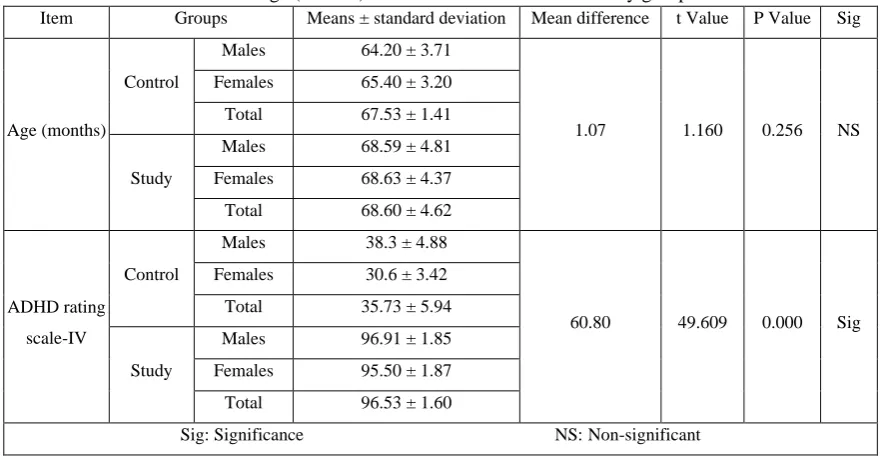
The mean values ± standard deviations of the ages were 67.53 ± 1.41 and 68.60 ± 4.62 for control and study groups respectively, which revealed no significant difference (P > 0.05). The mean values ± standard deviation of the total percentile scores of ADHD rating scale-IV were 35.73 ± 5.94 and 96.53 ± 1.87 for control and study groups respectively, which revealed a significant difference (P < 0.05). The results are shown in table (1).
The frequency distribution of gender in both the control and study groups:
Comparison between pediatric balance scale scores in both the control and study groups:
The mean values ± standard deviation of pediatric balance scale scores were 53.93 ± 2.26 and 43.87 ± 2.75 for control and study groups respectively, which revealed a significant difference (P < 0.05). The results are shown in table (2).
Pearson bivariate correlation between the pediatric balance scale scores and the gender, age and ADHD rating scale-IV for the study group:
As shown in table (3), there was a significant negative correlation between the PBS score and the total percentile scores of ADHD Rating Scale-IV in the study group. Moreover, there was a significant positive correlation between the PBS score and the gender in the study group, which was revealed to have significant relationships at a 5% significance level.
Table 1: Age (months) for both the control and the study groups.
Item Groups Means ± standard deviation Mean difference t Value P Value Sig
Age (months)
Control
Males 64.20 ± 3.71
1.07 1.160 0.256 NS
Females 65.40 ± 3.20
Total 67.53 ± 1.41
Study
Males 68.59 ± 4.81
Females 68.63 ± 4.37
Total 68.60 ± 4.62
ADHD rating
scale-IV
Control
Males 38.3 ± 4.88
60.80 49.609 0.000 Sig
Females 30.6 ± 3.42
Total 35.73 ± 5.94
Study
Males 96.91 ± 1.85
Females 95.50 ± 1.87
Total 96.53 ± 1.60
Sig: Significance NS: Non-significant
Table 2: Comparison between pediatric balance scale scores in both the control and study groups.
Item Groups Means ± standard deviation Mean difference t Value P Value Sig
Pediatric
balance scale
(PBS) score
Control
Males 53.65 ± 2.28
10.07 14.85 0.000 S
Females 54.50 ± 2.22
Total 53.93 ± 2.26
Study
Males 43.23 ± 2.78
Females 45.63 ± 1.85
Total 43.87 ± 2.75
Sig: Significance S: significant
Table 3: Pearson bivariate correlation between the pediatric balance scale scores and the gender, age and
ADHD rating scale-IV for the study group.
Item
Study group Control
Age Gender ADHD rating
scale-IV Age Gender
ADHD rating
scale-IV
Pediatric
balance scale
score
Pearson Correlation -0.137 0.392* -0.475** 0.489** 0.180 -0.084
Sig. (2-tailed) 0.469 0.032 0.008 0.006 0.340 0.660
*. Correlation is significant at the 0.05 level (2-tailed).
DISCUSSION
This research was performed to contrast balance in children with attention deficit hyperactivity disorder to normal children. Additionally, it tried to understand the association between the attention and balance in the children with ADHD. The age of the children involved in the present research ranged from five to seven years old as it was recorded that ADHD influences 3-5% of children of primary school age [18]. The findings of this investigation revealed that there was no significant difference between the mean values of the age for both control and study groups. This proposed that there was a matching between the control and study groups. Furthermore, the findings revealed that boys were suffering from ADHD more than girls. Both groups were evaluated by PBS, which is a trustworthy measure of balance utilized with a child with motor impairment [16]. Furthermore, the findings of this investigation revealed a significant difference in PBS scores in the study group (ADHD group) as contrasted to the control group (normally developed children group). This revealed that there was balance disturbance in children with ADHD. The PBS in children with ADHD is lower than the normally developed children by 19.42 % and 16.28% for males and females, respectively. These results are in concordance with Kim et al., who stated that the children with ADHD had a disturbance of balance [19]. Furthermore, it was verified by Mao et al., who proposed that balance ability skill levels in children with ADHD were generally not as high as those of the controls in different viewpoints, comprising static and dynamic balance [15]. The children with ADHD had posture and gait performance abnormalities, especially in the movement coordination test and paced stepping task [8].
Furthermore, the findings of this research reveal there was a significant negative correlation between the PBS score and the percentile scores of ADHD Rating Scale-IV in the study group. This result showes that the disturbance of the balance in the children with ADHD was inversely correlated with their percentile scores of ADHD. This result is in concordance with Abuin-Porras et al., who proposed that there was a significant correlation between attention and balance and gender differences that may condition the way to address balance issues in boys and girls [20].
The disturbance of balance in children with ADHD can be attributed to a reduction in the volume of cerebrum and cerebellum in children with ADHD as compared to healthy children. Furthermore, there was cerebellum dysfunction in the children with ADHD because of the reduction in brain conductivity from the cerebellum to the middle frontal and medial frontal gyri in those children [9, 19, 21].
CONCLUSION
It can be concluded that children with ADHD had significant balance disturbance as contrasted to normal subjects. The disturbance in their balance was inversely correlated with the percentile scores of ADHD.
Conflict of interest
Author (s) has not declared any conflict of interest.
REFERENCES
1. Shetty. A.P. and Shilpa. J. (2015): Effectiveness of dance movement therapy on attention deficit
hyperactivity disorder children aged between 6-12 years. Manipal Journal of Nursing and Health Sciences; 1 (1): 19-23.
2. El-Nemr. F. M., Badr. H. S., and Salem. M. S. (2015): Prevalence of Attention Deficit Hyperactivity
Disorder in Children. Science Journal of Public Health; 3(2): 274-280.
3. El-Nagger. N. S, Abo-Elmagd. M. H., and Ahmed. H. I. (2017): Effect of applying play therapy on
children with attention deficit hyperactivity disorder. Journal of Nursing Education and Practice; 7(5): 104-118.
4. Farahat T, Alkot M, Rajab A, Anbar R. (2014): Attention-Deficit Hyperactive Disorder among Primary
School Children in Menoufia Governorate, Egypt. Int J Family Med;
https://doi.org/10.1155/2014/257369.
5. El-Tallawy HN, Hassan WA, El-Behary AA, Shehata GA. (2005): Prevalence of attention deficit
6. Farid MN, Sabbour SM, Osman MH. (2008): Prevalence and risk factors of attention deficit hyperactivity disorder among school children. Egypt J Comm Med; 26(2):10-41.
7. Soliman GT, Afify MF, Yehia MA, Abdel-Naem EA, Abdalkarim SM. (2010): Attention deficit
hyperactivity disorder, an epidemiological study of preschool and primary school children in Minia city. El-Minia Med Bul; 21(1):171-179.
8. Buderath P, Gartner K, Frings M, et al. (2009): Postural and gait performance in children with attention
deficit/hyperactivity disorder. Gait Posture; 29(2):249–254.
9. Udal AH, Malt UF, Lovdahl H, Gjaerum B, Pripp AH, Groholt B. (2009): Motor function may
differentiate attention deficit hyperactivity disorder from early onset bipolar disorder. Behav Brain Funct; 5:47.doi:10.1186/1744-9081-5-47.
10. Klavina. A., Zusa-Rodke. A., and Galeja. Z. (2017): The assessment of static balance in children with
hearing, visual and intellectual disabilities. ActaGymnica; 47(3): 105–111.
11. Shorer, Z., Becker, B., Jacobi-Polishook, T. et al. (2012): Postural control among children with and
without attention deficit hyperactivity disorder in single and dual conditions. Eur J Pediatr;171(7):1087-94.
12. Konicarova. J., Bob. P., Raboch. J. (2014): Balance deficits and ADHD symptoms in medication-naive
school-aged boys. Neuropsychiatr Dis Treat; 15(10):85-8.
13. Schlee G, Neubert T, Worenz A, Milani TL. (2012): Children with ADHD show no deficits in plantar
foot sensitivity and static balance compared to healthy controls. Res Dev Disabil; 33:1957-1963.
14. Bozkurt.s.,Erkut. O., and Akkoc.O. (2017): Relationships between Static and Dynamic Balance and
Anticipation Time, Reaction Time in School Children at the Age of 10-12 Years. Universal Journal of Educational Research; 5(6): 927-931.
15. Mao. H., Kuo. L., Yang. A., and Su. C. (2014): Balance in children with attention deficit hyperactivity
disorder-combined type. Research in Developmental Disabilities; 35: 1252–1258.
16. Franjoine. M. R., Gunthe. J. S., and Taylor.M. J.(2003): Pediatric Balance Scale: A Modified Version
of the Berg Balance Scale for the School-Age Child with Mild to Moderate Motor Impairment. Pediatr Phys Ther;15: 114–128.
17. DuPaul. G. J., Anastopoulos. A. D., Power. T. J., Reid. R., Ikeda. M., McGoey. K. E. (1998): Parent
ratings of attention-deficit/hyperactivity disorder: Factor structure, normative data, and psychometric properties. J PsychopatholBehav Assess; 20(1):83–102.
18. Szatmari. P, Offord D. R., and Boyle. M. H. (1989): Ontario child health study: prevalence of attention
deficit disorder with hyperactivity. J Child Psychol Psychiatry; 30:219–30.
19. Kim. S. M., Hyun. G. H., Jung. T, Son. Y. D, Cho. I., Kee. B. S., and Han. D. H. (2017): Balance
Deficit and Brain Connectivity in Children with Attention-Deficit/Hyperactivity Disorder. Psychiatry Investig; 14(4):452-457.
20. Abuin-Porras. V, Villafañe. J.H., Jiménez-Antona. C, Palacios. A., Martínez-Pascual. B., and
Rodríguez-Costa. I. (2018): Relationship between attention and balance: a dual-task condition study in children. Journal of Exercise Rehabilitation; 14 (3):349-355.
21. Gehricke. J. G., Kruggel. F., Thampipop. T., Alejo. S. D., Tatos. E., Fallon. J., et al. (2017): The brain