
Cloud Computing: A Catalyst for
Commercial Success of Computing Trends
Dr. KAVITA TANEJA
Maharishi Markandeshwar Institute of Computer Technology & Business Mgmt, MMU, Mullana, Ambala
HARMUNISH TANEJA
Department of Information Technology, Maharishi Markandeshwar Engineering College MMU, Mullana, Ambala
DIVYA CHADHA
Department of Computer Engineering, Maharishi Markandeshwar Engineering College MMU, Mullana, Ambala
Abstract- Internet is growing in many ways, be it the importance, functionalities, growth, users and last but not the least, the ease with which it can be accessed. Way back the access was via limited dialup connections at home, or the company network in the offices. Later its use was made easy with home broadband connections, Internet cafes, Wi-Fi based wireless hotspots and now the access is as simple as a click or simple touch, appreciation to smartphones, iPhones and other smart mobile devices that have made the use as easy and essential as breathing in. Not to forget the advent of Cloud computing that has become as an important paradigm to overcome problems faced by organizations to use expensive software and other services. It is one of the most important archetype shifts of the past decades. The approach promotes deployment of services with security, good performance and maintenance and various other remarkable features. This paper highlights computing technologies that are so much engrossed around us. Also, the origin, rich applications and architecture of cloud computing is presented to emphasize its role in success of emerging trends in information and communication technology.
Keywords- Grid computing, cloud computing, distributed systems, embedded system, cloud architecture.
I. COMPUTING TRENDS FOR COMMERCIAL APPLICATIONS
Computing trends often have ‘mobility’ as the focal element in the present technological era. Services on the fly have helped to shape today’s attitudes to technology. This liberation of data and content in a never ever so connected world has led to the rise in Cloud services. The user expectation from wired data to ubiquitous data is raised in a way that content that was previously only available intermittently, is now accessible everywhere. The acceleration of this unbinded world is set to increase with advance mobile devices, mobile broadband services advocated with liberation of music and pictures from their physical albums with Flikr and Picassa. Distributed computing is a type of parallel computing, but parallel computing is most commonly used to describe program parts running simultaneously on multiple processors in the same computer. Both types of computing require dividing a program into parts that can run simultaneously, but distributed programs often must deal with heterogeneous environments, network links of varied latencies, and stochastic failures in networks. While Grid is a form of distributed computing whereby a “super virtual computer” is composed of many networked loosely coupled computers acting together to perform very large tasks [21].
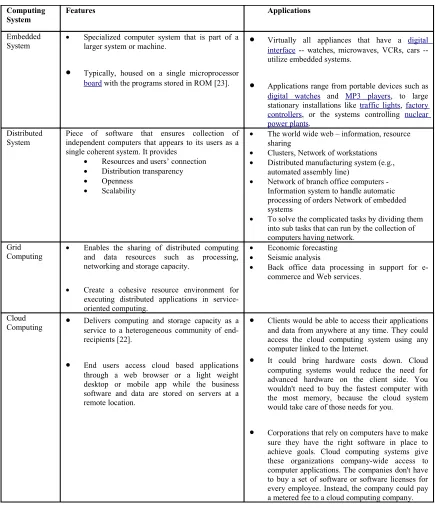
Computing System
Features Applications
Embedded
System • Specialized computer system that is part of a larger system or machine. • Typically, housed on a single microprocessor
board with the programs stored in ROM [23].
• Virtually all appliances that have a digital interface -- watches, microwaves, VCRs, cars -- utilize embedded systems.
• Applications range from portable devices such as
digital watches and MP3 players, to large stationary installations like traffic lights, factory controllers, or the systems controlling nuclear power plants.
Distributed
System Piece of software that ensures collection of independent computers that appears to its users as a single coherent system. It provides
• Resources and users’ connection
• Distribution transparency
• Openness
• Scalability
• The world wide web – information, resource sharing
• Clusters, Network of workstations
• Distributed manufacturing system (e.g., automated assembly line)
• Network of branch office computers - Information system to handle automatic processing of orders Network of embedded systems
• To solve the complicated tasks by dividing them into sub tasks that can run by the collection of computers having network.
Grid
Computing • Enables the sharing of distributed computing and data resources such as processing, networking and storage capacity.
• Create a cohesive resource environment for executing distributed applications in service-oriented computing.
• Economic forecasting
• Seismic analysis
• Back office data processing in support for e-commerce and Web services.
Cloud
Computing • Delivers computing and storage capacity as a service to a heterogeneous community of end-recipients [22].
• End users access cloud based applications through a web browser or a light weight desktop or mobile app while the business software and data are stored on servers at a remote location.
• Clients would be able to access their applications and data from anywhere at any time. They could access the cloud computing system using any computer linked to the Internet.
• It could bring hardware costs down. Cloud computing systems would reduce the need for advanced hardware on the client side. You wouldn't need to buy the fastest computer with the most memory, because the cloud system would take care of those needs for you.
• Corporations that rely on computers have to make sure they have the right software in place to achieve goals. Cloud computing systems give these organizations company-wide access to computer applications. The companies don't have to buy a set of software or software licenses for every employee. Instead, the company could pay a metered fee to a cloud computing company.
Table 1- Computing Trends
The rest of the paper is organized as follows. Cloud computing origin is discussed in section II. Advantages and issues associated with cloud computing are listed in section III. Section IV presents the types of clouds and section V describes the basic architecture. The review of existing three cloud architectures is done in section VI. Concluding remarks are given in section VII.
II. CLOUD COMPUTING: ORIGIN
In telecommunications, a “cloud” is the unpredictable part of any network through which data passes between two end points. For the purposes of this paper, the term is used to refer generally to any computer network or system through which personal information is transmitted, processed, and stored, and over which individuals have little direct knowledge, involvement, or control.
Cloud is described here as an adjective that highlights a diagrammatic use of cloud as metaphor for the internet. Most of the definitions include pay-per-use, instant availability, scalability, hardware abstraction, self-provisioning, virtualization and internet. A short but safe summary would be “Cloud Computing is a new way of delivering IT services: end users can deploy the services they need when they need them. Many of those services are available over the internet and users are only charged for what they consume.”
Cloud computing is an efficient computing model. The concept emerged from public and grid computing. It is basically a host that provides a variety of services to customer and very economic for business enterprises because user can use virtualized resources as a service in, 1980’s when user dependability on internet started increasing because of increased complexity of work and number of Users, the concept of Grid computing came into existence. Grid is to use the Internet to link the various resources, including computing, storage, bandwidth, software, data, information, knowledge etc., distributed in geography into a logical entirety, and the virtual organization will finally realize the resource sharing and synergistic work in the virtual environment to fully achieve the information sharing [1].
In 90’s public computation gained an edge over the entire application level and Cloud Computing emerged to make up the defects of Grid computing and to change existing pattern. It laid emphasis on service pattern that carried computation. Customer has to pay appropriate expenses according to services according to terms and condition for that particular service. Customer actually utilizes resources or avail services through network on payment basis. The public computing service includes the hardware, the software, computation resources [2]. It is not possible for all business enterprises to buy high cost software, hardware and other storage resources as they can cross their annual Return on investment to a great extent. To avoid this heavy cost these days companies use to get these services on rent from various service providers. Providers such as Amazon, Google, Sales force, IBM, Microsoft, and Sun Microsystems are efficiently emerging in this field so that business enterprises do not spent their excessive time in installation, configuration, testing, running, security, and up gradation. To provide redundancy and to ensure reliability these service providers have established new data centers for hosting Cloud computing applications in various locations around the world. The benefit of this technology is that it requires minimal management and service provider interaction that actually consume a lot of time and other resources. Cloud computing is such a model that enables convenient and on-demand network access to these shared resources that can be rapidly provisioned [3].
III. ADVANTAGES AND ISSUES OF CLOUD COMPUTING
The computing propensity advocated by cloud computing does not need user’s high level equipment, so it reduces the user’s cost. It provides secure and dependable data storage center, so user needn’t do the awful things such as storing data and killing virus, this kind of task can be done by professionals. It is proved to be helpful in finding some hidden problems and provides solution for them. Cloud computing is a computing style that provides power referenced with IT as a service. Different types of services including infrastructure as a service, platform as a service, software as service have been proposed for cloud computing. Some of the benefits of cloud computing include reduced cost, scalability, better performance, service oriented and availability of easily and quickly movable application development. User can avail the services provided by cloud computing without knowing anything about technology used, control or location of actual data storage. [5]. Computational cloud services provide on demand commuting resources that are scalable, inexpensive and can run any type of application. Storage cloud services allow all clients to store their large datasets on provider’s storage banks. Application cloud allows access too many services that a developer can integrate to build their application. Cloud Computing tools and services are widely used everywhere because of its benefits to the business enterprises.
domain. SciCumulus bridges a gap between scientific workflow Management system and Cloud. Besides so many advantages of Cloud computing, there are some issues such as threat to security that includes confidentiality, Integrity and availability, lack of trust, lack of customer support, lack of standard and interoperability and lack of reliability [6]. Legal issues must be strict to ensure security for availing cloud services [7]. Cyber crime is a major threat to cloud computing as the clouds which are not fully secured are target of cyber criminals at high priority [8].
IV. TYPES OF CLOUD
Cisco [13] presented four major categories of cloud currently in the marketplace or emerging in the near future: public clouds, private clouds, virtual private clouds, and eventually inter-clouds.
A. Public
Clouds-Public clouds are “stand-alone,” or proprietary, clouds mostly off-premise, run by third party companies such as Google, Amazon, Microsoft, and others. Public cloud is inexpensive set-up because hardware, application and bandwidth costs are covered by the provider. There is no wastage of resources because you pay for what you use.
B. Private
Clouds-Private clouds also called internal or corporate cloud are typically designed and managed by an IT department within an organization. Private Clouds allow computer networks and data centre administrators to effectively meet the needs of their customers within the corporation .Private Clouds are enabled by such services of Cisco.
C. Virtual Private
Clouds-Virtual private clouds provide a unique service feature to service providers. Infrastructure can be consumed as a part of virtual private cloud. Virtual Cloud Computing provides brighter aspects to organizations by enhancing simplicity and facilitating on demand, desktop and application services in better way. Virtual private cloud can be with on-demand and at-scale characteristics, that is a typical feature of a virtual private cloud infrastructure.
D.
Inter-cloud-Cisco Inter cloud is much like internet that act as public open and internetwork. Inter cloud can be said as extension of internet. Cloud computing allows enterprise to get resources on demand because it decouples resource consumers from cloud resource providers. Inter cloud provides a significant feature of trust standards and discovering and public system naming. It is useful for addressing portability and data exchange. Inter cloud can have Workload migration as a relevant and dominant use case for the inter-cloud, as an open market.
V. CLOUD COMPUTING ARCHITECTURE
The number of levels in any specific operational environment is based on the cloud platform and its characteristics [14]. At the first level, each client/instance works as independent module independent of other client instances on same server. The users within a client domain address a single instance of an application running on a server. This is the traditional hosted service operating in the cloud. Each software instance is individually customized for each client. The percentages should not be taken literally, in this instance. At the second level, the instance for each client is separate but code base for configurable version of instance is same. It reduces maintenance costs and economy of scale is achieved. At the third architectural level, Configurable metadata determines the feature set for each client. In this level security is more efficiently imposed by authorization and security policies. The vendor runs a sole instance that is shared by multiple clients. At the fourth level, the same “level three” instances are run on a server side as load balancing and provider/client’s business, operational and architectural models can only determine architecture level.
A. Basic Architecture of Cloud
. Figure 1. Hierarchical view of Cloud Computing [15]
• Software –as-a-Service (SaaS)
SaaS is a software distribution model in which application are hosted by vendors or service provider and made available to customer over network, typically internet. As Service oriented architecture, Web services and development approaches are supported by technologies. SaaS is becoming an efficient and very beneficial service and much used by organizations [16].
• Infrastructure-as-a-Services (IaaS)
IaaS is the service of huge computing resources like storage, network and capacity of processing. For example when user avails storage service on rent , storage location or disk is not to be paid, only a part of it is paid. Consumer gets infrastructure services without having any knowledge about the location of storage. Sometimes the IaaS is also called Hardware-as-a-Service (HaaS) [17].
• Platform-as-a-Service (PaaS)
PaaS provides operating system and application platform–level abstractions to service consumers. Resource management functions for scheduling processing time, memory allocation and application integrity within environment are provided by PaaS. It is an application-development tool that enables service consumers to build cloud applications that run on the hosted platform [18].
• Data Centers
Data centers provide the hardware where clouds run. This is the base of cloud computing.. Data center are made up of various interconnected servers. They are built in less populated areas and with less energy rate to avoid natural disaster. [15].
VI. REVIEW OF CLOUD COMPUTING: EXISTING ARCHITECURE
Cloud computing services act as a shared pool of configurable resources that can be accessed on demand basis.
A. A. IBM Cloud Computing
Figure 2. Major Elements of Architecture
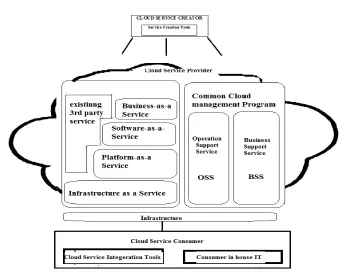
Figure 3. IBM Cloud Computing Architecture [19]
The architecture described above presents Cloud Service Creator, Service Providers and Service Consumers. These are described below:
• CLOUD SERVICE CREATOR
Cloud service creator is responsible for creating cloud service that is run by cloud service provider. To create these services service creation tools are used. It includes development of runtime artifacts and management related aspects. Tools are developed with context to a particular service e.g. for infrastructure as a service tools are developed with respect to that particular service.
• CLOUD SERVICE PROVIDER
Cloud Service Provider is responsible for providing services to consumers. There are two components of this module: Common Cloud Management Platform (CCMP) and Cloud Services. CCMP delivers instances of Cloud Services of any category to Cloud Service Consumers and allows consumers to manage those instances. The Cloud Services are Business Process as a Service, Platform as a Service and Infrastructure as a service and it is associated with some
Cloud Essential Characteristics
1. On Demand Self Service 2. Broad Network Access 3.Resource Pooling 4.Rapid elasticity 5.Measured Service
SERVICE MODEL • Business Process as a Service
• Software As a Service
• Platform as a Service
• Infrastructure As a Service
attributes such as a pay-per-use model, self-service usage, flexible scaling & shared of underlying IT resources.
• CLOUD SERVICE CONSUMER
Cloud Service Consumer is a human being or IT Company that utilizes. It consists of Service Integration tools and Consumer In House IT. The functionality of Cloud Service Integration Tools is specifically relevant in the context of hybrid clouds, where seamless integrated management, usage and interoperability of cloud services in integration with on-premise IT is critical. Consumer of IT can have in house IT. It should be integrated with services provided by cloud service provider for this integration tools are available.
B. Cisco Cloud reference
Architecture-Cisco [13] presented Architecture-Cisco Cloud reference Architecture. The layered architecture describes various layers responsible for security, service delivery, management and its interface with cloud consumers in Figure 4. These layers are as follows:
Figure 4. Cisco Cloud Reference Architecture [13]
• Technology architecture. The foundation of this framework consist of technology Architecture that contains features like network, storage and corporate. Layers are the hosts that provide services to consumers.
• Security architecture. This layer is for security purpose. Security is a key challenge and it must be ensured across the entire framework. Security issues must be dealt on priority basis.
• Service Orchestration architecture . It consists of configuration repository enablers that contain information like service catalogue, asset inventory and resource to service mapping.
• Service management. It takes place in service delivery and management architecture. The topmost layer is the consumer-facing layer, usually exposed via a portal-like solution. This is the layer where service is defined, requested, and managed by the consumer.
C. RESERVOIR Cloud
Figure 5. Reservoir Architecture [20]
The RESERVOIR provides platform to service provider’s architecture provides a remarkable platform to Service Providers by identifying and distinguishing the needs of users who understand the operation of particular businesses and offer suitable Service applications. It satisfies Providers, who lease computational resources in the form of a Cloud computing infrastructure. The following are Levels of this architecture:
• LOWEST LEVEL
The lowest layer of RESERVOIR is Virtual Execution Environment Host (VEEH). It enables the upper layer to have an interface with virtualization products. It also provides plugins for different supervisors.
• Middle Level
The Upper Layer of architecture Virtual Execution environment Manager (VEEM),it provides abstraction for cloud computing. It interacts with VEEH and control multiple VEEHs within one site. It controls activation of virtualized operating system, its migration, replication and deactivation.
• Highest level
Last is Service managers. This is highest level of interaction. It interacts with service providers to ensure correctness of requirements. In addition to it , it also performs management task.
The key differentiator from other Cloud Computing infrastructure is RESERVOIR’s ability to federate across different sites, which might be implementing different virtualization products. This is achieved by cross-site interactions between multiple different VEEMs operating on behalf of different Cloud computing providers.
VII. CONCLUSION
availability of services, this area is being developed because of its high demand and comparatively more benefits. The tools for cloud computing are evolving and the challenges to deploying cloud solutions need to be considered for sustaining existing computing trends.
VIII. REFERENCES
[1] Zheng, J. and Chen, L. 2010. The Evolution Process and Economic Analysis of Cloud Computing with Its Application in Chinese University, International Conference on Challenges in Environmental Science and Computer Engineering. [2] Zhang, S. , Zhang, S., Chen, X. and Wu, X. 2010. Analysis and Research of Cloud Computing System Instance, Second
International Conference on Future Networks.
[3] Mell, P. and Grance, T. 2009. The NIST Definition of Cloud Computing, National Institute of Standards and Technology, Information Technology Laboratory, Version 15, \10-7-09.
[4] Cavoukian, A. 2009. Privacy in the Clouds, Toronto: Information and Privacy Commission of Ontario.
[5] Zhang, S., Zhang, S., Chen, X. and Huo, X. 2010. Cloud Computing Research and Development Trend, Second International Conference on Future Networks IEEE.
[6] Habib,S. B., Ries, S., Mühlhäuser, M. 2010. Cloud Computing Landscape and Research Challenges regarding Trust and Reputation, Symposia and Workshops on Ubiquitous, Autonomic and Trusted Computing, IEEE.
[7] Yang , J. And Chen. Z, 2010. Cloud Computing Research and Security Issues, IEEE.
[8] Somani, U. , Lakhani, K. And Mundra, M. 2010. Implementing Digital Signature with RSA Encryption Algorithm to Enhance the Data Security of Cloud in Cloud Computing, 1st International Conference on Parallel, Distributed and Grid Computing (PDGC - 2010), IEEE.
[9] Harris, M. J. and Lastra, A. 2001. Real time Cloud Rendering. The Eurographics Association and Blackwell Publishers 2001.
[10] Jasti,A., Mohapatra,S., Potluri, B. and Pendse, R.2011. Cloud Computing Aircraft Data Network, IEEE.
[11] Xiaoping, Y. and Yuejin. D. 2007. Exploration of Cloud Computing Technologies for Geographic Information Services. [12] Oliveira D. et. al. 2010. SciCumulus: A Lightweight Cloud Middleware to Explore Many Task Computing Paradigm in
Scientific Workflows. 2010 IEEE 3rd International Conference on Cloud Computing
[13] Cisco Cloud Computing -Data Center Strategy, Architecture,and Solutions . 2009.Point of View White Paper for U.S. Public Sector, 1st Edition.
[14] Katzan, H. 2009. Cloud Software Service: Concepts, Technology, Economics, Katzan: Cloud Software Service: Concepts, Technology, Economics service Science 1(4), pp. 256-269.
[15] Tsai, W.T. , Sun, X. and Balasooriya, J. 2010. Service-Oriented Cloud Computing Architecture, Seventh International Conference on Information Technology.
[16] Mathur, P. and Nishchal, N. 2010. Cloud Computing: New challenge to the entire computer industry, 1st International Conference on Parallel, Distributed and Grid Computing (PDGC - 2010).
[17] Gong, C., Liu, J., Zhang, Q., Chen H. and Gong Z. 2010.The Characteristics of Cloud Computing, 39th International Conference on Parallel Processing Workshops.
[18] Chong, F., Miguel, A., Hogg, J., Homann, U., Zwiefel, B., Garber,D., Joseph, J., Zimmerman, S. and Kaufman, S. 2009. Design Considerations for S+S and Cloud Computing.
[19] Behrendt, M. et. al . 2011. Introduction and Architecture Overview ,IBM Cloud Computing Reference Architecture 2.0. [20] Rochwerger B, Breitgand D, Levy E, Galis A, Nagin K, Llorente L,Montero R,Wolfsthal Y, Elmroth E, C´aceres J,
Ben-Yehuda M, Emmerich W, G´alan F (2009) The RESERVOIR Model and Architecture for Open Federated Cloud Computing. IBM Systems Journal Special Edition on Internet Scale Data Centers 53(4)
[21] Foster, I., Kesselman, C., Tuecke, S.: The anatomy of the grid: enabling scalable virtual organizations. Int. J. High Perform. Comput. Appl. 15(3), 200 (2001)
![Figure 1. Hierarchical view of Cloud Computing [15]](https://thumb-us.123doks.com/thumbv2/123dok_us/1425956.1656102/5.612.146.468.76.220/figure-hierarchical-view-of-cloud-computing.webp)
![Figure 4. Cisco Cloud Reference Architecture [13]](https://thumb-us.123doks.com/thumbv2/123dok_us/1425956.1656102/7.612.141.469.252.436/figure-cisco-cloud-reference-architecture.webp)
![Figure 5. Reservoir Architecture [20]](https://thumb-us.123doks.com/thumbv2/123dok_us/1425956.1656102/8.612.163.462.74.245/figure-reservoir-architecture.webp)