TPMC: A Model Checker For Time–Sensitive
Security Protocols
Massimo Benerecetti, Nicola Cuomo, Adriano Peron
Dept. of Physical Sciences, Universit`a di Napoli “Federico II”, Napoli, Italy Email:{bene, ncuomo, peron}@na.infn.it
Abstract— In this paper we consider the problem of ver-ifying time–sensitive security protocols, where temporal aspects explicitly appear in the description. In previous work, we proposed Timed HLPSL, an extension of the specification language HLPSL (originally developed in the Avispa Project), where quantitative temporal aspects of security protocols can be specified. In this work, a model checking tool, TPMC, for the analysis of security protocols is presented, which employs THLPSL as a specification language and UPPAAL as the model checking engine. To illustrate the tool, we provide a specification of the Wide Mouthed Frog protocol in THLPSL, and report some experimental results on a number of timed and untimed security protocols.
I. INTRODUCTION
Much work has been devoted to formal specification and analysis of cryptographic protocols, leading to a number of different approaches and encouraging results (e.g. see [19]). Most of the proposed protocol specifi-cation languages and verifispecifi-cation techniques are limited to cryptographic protocols where quantitative temporal information is not crucial (e.g. delay, timeout, timed disclosure or expiration of information do not affect the correctness of the protocol), and details about some low level timing aspects of the protocol are abstracted away (e.g. timestamps, duration of channel delivery etc). In this context, the specification language HLPSL has been proposed within the Avispa Project (see [1]), for the specification of industrial-strength security protocols. HLPSL allows for modular specifications, specification of control-flow patterns, data-structures, and security properties. It is also sufficiently high-level to be used by protocol engineers.
In this paper we focus on the problem of speci-fying and verispeci-fying security protocols where temporal aspects directly affect the correctness of the protocol, and, therefore, need to be explicitly considered both in the specification and the verification. Examples of time sensitive protocols are, for instance, the non-repudiation Zhou-Gollmann protocol [21], the TESLA authentica-tion protocol [15] and the well known Wide Mouthed Frog protocol [4].
This work is partially supported by Italian MIUR project FIRB RBAU01P5SS ”Automatic verification of Internet security protocols”.
The formal framework generally employed to model temporal features, in the context of finite state machines, is that of Timed Automata [2], and the corresponding model checking verification techniques are supported by a variety of tools. Examples of model checkers for Timed Automata are KRONOS [12], which sup-ports model checking of branching time requirements, and UPPAAL toolkit [18], which allows for checking safety and bounded liveness properties. However, Timed Automata cannot be employed by protocol designer as a specification formalism in itself, being a rather low level formalism, lacking the ability of expressing parallelism and synchronization on structured messages built over cryptographic primitives. In this paper we propose the TPMC (Timed Protocols Model Checker) tool we developed for the analysis of timed security protocols. TPMC employs THLPSL, a timed extension of HLPSL, as a specification language, and UPPAAL as the model checking engine.
Timed HLPSL (THLPSL for short) has been in-troduced in previous papers ( [5], [6]). The tempo-ral features introduced in THLPSL are: (a) tempotempo-ral constraints on the control-flow (the usual delays and timeouts associated with performing a transition) with respect to the occurrence of some event, (b) duration of a transition, (c) temporal constraints on the availability and usability of messages (message disclosure and expiration time) with respect to the occurrence of some event, and (d) delay of channel delivery.
addition, we introduce a form of time–sensitive security goals, called timed authentication, which extends the authentication goals of HLPSL to a timed setting.
The analysis of a protocol in TPMC consists in a translation of its THLPSL specification into the in-put language of UPPAAL according to the semantics presented in [5]. For the sake of ease of definition, such a semantics maps THLPSL specification onto pure XT As (eXtended Timed Automata), without exploiting the full expressive power of the UPPAAL language, which allows for shared integer variables, and integer and boolean arrays. The use of these additional features allows for exponentially more succinct UPPAAL speci-fications. The mapping implemented in TPMC is not the one described in the formal semantics, but an equivalent one which, taking advantage of the full expressiveness of UPPAAL XT As, can be more efficiently employed for implementation purposes. We shall use the Wide Mouthed Protocol as a simple, but significant, running example of time–sensitive protocol. We also provide an experimental evaluation of the tool on a number of security protocols.
The paper is organized as follows: in the next sec-tion we present the specificasec-tion language THLPSL; in Section III we provide the THLPSL specification for the Wide Mouthed Frog protocol. In Section IV we describe the translation of THLPSL specifications into UPPAAL XTAs [7]. In Section V we present some experimental evaluation of our tool. Finally, we discuss the related work.
II. TIMEDHLPSL
In this section we informally describe the main fea-tures of the specification language THLPSL, a timed extension of the specification language HLPSL [1] and give an intuition of its semantics. A formal definition of the THLPSL syntax and semantics, which is given in terms of Timed Automata, can be found in [5].
A strong limitation of the original HLPSL is that it does not allow for explicit specification of temporal aspects such as delays, timeouts, timing constraints on the validity of messages, etc., therefore making it un-suited to specify protocols where temporal aspects may affect correctness. THLPSL extends HLPSL to express the following temporal aspects:
a) temporal constraints on the control-flow of partici-pants to a protocol session (delays and timeouts); b) duration of a transition, expressed as lower and
upper bounds on its duration;
c) temporal constraints on the availability and usabil-ity of messages (message disclosure and expiration time);
d) duration of channel delivery, expressed as lower and upper bounds on the channel delay.
In addition, THLPSL provides the ability to model different kinds of intruders and channels (even within
a single protocol specification). In particular, THLPSL allows to specify:
• the actions the intruder can perform on a channel;
• the actions the intruder can perform on the mes-sages listened over the channels;
• the reliability of a channel with respect to message
delivery.
As to reliability of channels, THLPSL provides dif-ferent types of channels:
• operational channels, where the delivery of a mes-sage is guaranteed within a bounded time interval [lb, ub];
• resilient channels, where the delivery of a message
is eventually guaranteed, but no upper bound is en-sured (i.e., an operational channel with unbounded delivery delay);
• unreliable channels, where the delivery of a mes-sage cannot be guaranteed.
THLPSL allows for structured definitions of protocols. A protocol specification consists in the description of a set of roles. It is possible to distinguish between two kinds of roles: basic roles, which describe the behavior of a participant to a protocol; and composition roles that compose in parallel (assuming the standard interleaving semantics) instances of basic roles (one for each participant to the protocol session), instantiating their formal parameters with actual parameters (i.e., con-stants). Following is an abstract schema of a THLPSL specification, declaring two basic roles, Alice and Bob, and a composition role Main which composes in parallel instances of the basic roles.
role Alice(<formal parameter list>) played_by <agent> def= :
local <variable list>
init <initialisation predicate> transition <transition list> end role
role Bob(<formal parameter list>) played_by <agent>
... end role ...
role Main() def=
composition
Alice(<actual parameter list>) /\ Bob(<actual parameter list>) /\ ... end role
channel names); public key and symmetric key type (for public and symmetric keys used by cryp-tographic primitives); text type (for text messages); nat type (for natural numbers); function type (for hash functions). Type text may have additional at-tributes enclosed within brackets. For instance, the type text(fresh)is the type for freshly generated nonces. The type channel may have additional attributes enclosed within brackets. A channel declaration has the form C:channel(ct,act,lb,ub), where ct may assume the following three values:Ufor unreliable channel, O for operational channel and R for resilient channel; act may assume the following three values: R for a channel on which the intruder has read-only access,Wfor a channel on which the intruder has write-only access; andRWfor a channel on which the intruder has read-write access;lbis the least transmission delay (a rational number in Q+) and
up is the maximum transmission delay (a rational number inQ+∪ {∞}).
Notice that a channel under the control of a Dolev-Yao (DY) intruder [10] (i.e., an intruder who has complete control over the channel) can be specified as follows C(U,RW,ub,lb), and can be abbreviated in THLPSL as C(dy,ub,lb).
THLPSL provides some form of flexibility in the specification of the constraints on delay/timeout and message disclosure/expiration, by allowing to express these constraints with respect to the occurrence of a transition executed by a participant in the protocol. To this purpose, THLPSL is equipped with a type role_instance for role instances, which can only be used for formal parameters of roles (and not for the declaration of local variables). Intuitively, a formal parameterRIof typerole_instancewill be instan-tiated with a number between1 andnin the definition of the main composition role, where exactlynroles are composed in parallel. Therefore, if RI is instantiated with numberi, then it refers to thei-th role instance in the parallel composition. This allows for expressing time constraints relative to occurrences of events (referred to by transition labels) taking place within specific role instances.
Participants to a protocol session communicate by sending and receiving structured messages. Structured messages are represented by message terms which are inductively composed from variables and constants in the following way:
• Variables and constants are terms;
• X[dt,et,RI,lab] is a term (timed term), where X is a variable of type text, text (fresh) or key, dt is a rational number in Q+ and et
a rational number in Q+∪ {∞}, RI is a formal
parameter of type role_instance, andlabis a transition label.
• V’is a term, withV any variable (priming);
• {T}_K is a term, withK a term of type
symmet-ric key or public key, andTa term (encryption);
• T1.T2is a term, withT1,T2terms (pairing);
• H(T)is a term, withTa term andHa term of type function (hashing);
• inv(K) and {T}_inv(K) are terms, with T a term andKa term of type public key (private key and signature).
A message term where no variable occurs is called ground message. Priming of variables is used for vari-able assignments, to refer to the values of the varivari-ables after the assignment. Priming can be used in different contexts:
• a primed variableX’can occur within a message term sent over a channel and models the generation of a fresh ground message (nonce) assigned toX;
• a primed variableX’can occur within a message term received over a channel, and models the assignment to X of the ground message received in the communication with some party;
• a primed variable can occur in a predicate of the form X’ = <const> to assign the value <const>toXin the target state of a transition. A term of the formX[dt,et,RI,lab]represents a message term X that is disclosed between time dt andetrelative to the execution of the transition labeled lab within role instance RI, and which expires after the bound et. Moreover, we add predicates DIS(X) andEXP(X), withXa variable of type text, text (fresh) or key, which holds true if X is assigned to a message which has already been disclosed, resp. has expired. A predefined labelstartis provided to refer to the event of initializing the main role.
The behavior of a basic role is described by means of a state-transition formalism. Intuitively, a state of the role instance is determined by the content of its local variables and the value of its actual parameters. Set of states of the role are declaratively denoted by standard boolean expressions over the value of vari-ables and primed varivari-ables (e.g. a Boolean expression represents the set of role states where the Boolean expression holds true). For instance, the Boolean expres-sionStat=1 /\ DIS(X)represents the set of states where variable Stat evaluates to 1 and the message assigned toX has been disclosed.
A transition allows to leave a state of the role, possibly receiving a message (from another participant), and to reach a state, possibly sending a message. Transitions are declared in a role by a sequence of transition schemas having one of the following forms:
lab. Pred Rec_Op >>(t1,t2,lb,ub,RI,lab1) Primed_Pred /\ Send_Op
(1) lab. Pred ->(t1,t2,RI,lab1) Primed_Pred
• labis a label identifying the current transition in the role schema;
• Predis the triggering predicate defining the set of states which the transition takes place from. It is a conjunction of a state predicate SPred, and pos-sibly a message predicate MPred.SPredhas the form Vki=1Xi =ci, where Xi is a state variable,
namely a variable not occurring in any message term in the role, and ci is a constant.MPredis a
conjunction of (negations) of atoms either of the form X = Y or DIS(X) or EXP(X), where X andY are message variables, namely variables occurring in message terms within the role;
• Rec_Opis an optional receive action of the form C(T), where C is a channel variable and T a message term;
• Primed_Pred specifies the target states of the transition. It has the formVzi=1Xi′=ci, whereXi′
is a primed variable not occurring in any message term of the role and ci is a constant. In the target
states, the variables occurring in Primed_Pred are assigned the corresponding constant value, and the remaining variables keep their current values;
• Send_Opis an optional send action on a channel of the form C(T), where C is a channel variable and T a term. Primed variables in T are assigned newly generated values (e.g., fresh nonces);
• RI is a formal parameters of the current role of type role_instance, t1 and lb are rational numbers in Q+,
t2 and ub rational numbers in
Q+∪ {∞}, and
lab1 is a transition label. These parameters specify a transition that will be enabled between time t1andt2 relative to the execution of the transition labeled lab1 within the role of the role instance RI, that will complete between timelbandub.
Notice that untimed transitions can easily be recov-ered in THLPSL. For instance, a transition with-out any temporal constraints (neither delay/time with-out nor duration constraints) can be specified as follows: >>(0,∞,0,∞,RI,start). Without loss of gen-erality, we assume that no timed transition schema contains both a send action and a receive action.
Transition schema of the form (2) specifies urgent transitions, namely transitions which are intended to model activities local to a role, which have no dura-tion and whose execudura-tion must not affect the overall timing. The parameters have the same interpretation as in the previous case. The intuitive reading of an urgent transition is a transition which is enabled between time t1 and t2, relative to the execution of the transition labeledlab1within the role instanceRI, and is forced to trigger as soon as enabled, i.e. without any further delay. Notice that triggering of an urgent transition does not depend upon synchronization with other roles, as send or receive actions in an urgent transition are not
allowed.
Security properties can be specified within the goal section. THLPSL provides three kind of properties: secrecy properties, (weak and strong) authentication, and (weak and strong) timed authentication properties. Following is an example of a goal section containing a security goal of each type:
goal
secrecy_of M
Alice authenticates Bob on M Alice Tauthenticates Bob on M end goal
The first goal is a secrecy property and requires that message term Mis kept secret during any protocol run (i.e., it is not known by the intruder). The second goal is a authentication property, which requires that a receipt of an instance of messageMby Alice must match with the same instance previously sent by Bob (in other words, message M serves as a proof of authentication between the two parties). The third goal is a timed authentication property, which requires authentication of Alice and Bob with the additional timed constraint that the authentication must occur during the temporal validity of message M, namely after its disclosure and before its expiration.
III. SPECIFICATION OF THEWIDEMOUTHEDFROG PROTOCOL INTHLPSL
In this section we consider the well known Wide Mouthed Frog authentication protocol [4]. The protocol involves three participants: Alice, Bob and the Server. Alice sends a message to the Server containing the iden-tity of Bob (the intended receiver), a fresh session key Kab, and a timestampTA, encrypted with a symmetric
key KAS, shared by Alice and the Server. The Server
then checks if the timestamp is recent and, if this is the case, forwards the session key and a new timestampTB
to Bob, encrypted with a symmetric keyKBS, shared by
Bob and the Server. Bob can now check if the timestamp TS is recent and, if this is the case, accepts the session
key as valid. Following is a description of the protocol steps:
1 A→S:A,{B, Kab, TA}KAS
2 S→B:{A, Kab, TS}KBS
in forcing the Server to keep the timestamps updated indefinitely, causing a, possibly compromised, session key to be associated to a fresh timestamp.
In order to model the validity of timestamps and session keys in THLPSL, we associate to each of them an expiration time. In particular, the initiator assigns an expiration time to the session key, wide enough to cover the estimated maximum delays of both the communication channels from Alice to the Server and from the Server to Bob. Similarly, Alice (resp., the Server) assigns the expiration time to each generated timestamp. An attack would be detected if Bob receives an expired session key associated with a non expired timestamp.
Below is a possible specification of the protocol, where we assume a maximum delay 5 to the channels connecting the participants. The expiration of the session key is set to 10, a value greater than the expiration time of the timesptamps. The role for agent Alice is specified as follows:
role Alice(A,B,S:agent, SND:channel(dy,0,inf), Kas:symmetric_key, AI:role_instance) played_by A def= :
local Stat:nat, Ta:text(fresh), Kab:symmetric_key
init Stat=0 transition
a0. Stat=0 >>(0,∞,0,0,AI,start) Stat’=1 /\ SND(A.{Ta’[0,5,AI,a0].B.Kab[0,10,AI,a0]}_Kas) /\ Twitness(A,B,k,Kab)
end role
Notice that role Alice is parameterized with respect to three agent names (A, B,S), one DY channel SND, one symmetric key Kas, and one role instance pa-rameter AI. The played_by keyword states that the agent playing the role corresponds to the first agent parameter A. In the local variable declaration section the variable Stat, of type natural number, a fresh nonce variable Ta and a symmetric key Kab are de-clared. The init clause opens the variable initial-ization section, while the transition clause opens the section containing transition schemas. The transi-tion schema, labeled a0, is a send timed transition which takes from a state where variableStat is equal to 0 to a state where Stat is equal to 1, and all the remaining variables, exceptTa, remain unchanged. The additional effect of the transition is that the term A.{Ta’[0,5,AI,a0].B.Kab[0,10,AI,a0]}_Kas is sent over the channelSND, whereTa’[0,5,AI,a0] represents a fresh timestamp generated and assigned to Ta by the transition. The disclosure/expiration interval of Ta is set between time 0 and 5 relative to the execution of the transitiona0of the current role instance AI. This transition also issues a Twitness action, which is used to model timed authentication together with a matching Trequest issued by Bob. The role for Bob is specified as follows:
role Bob(A,B,S:agent, RCV:channel(dy,0,inf), Kbs:symmetric_key, BI:role_instance) played_by B def=
local Stat, Ts:text, Kab:symmetric_key init Stat=0
transition
b0. Stat=0 /\ RCV({Ts’.A.Kab’}_Kbs) >>(0,∞,0,0,BI,start) Stat’=1 b1. Stat=1 /\ not EXP(Ts) -->(0,∞,RI,start)
Stat’=2 /\ Trequest(B,A,k,Kab) end role
As to Bob’s role, the first transition is a receive tran-sition which requires that another party synchronously sends a message along the channelRVC, and that the sent message conforms to the structure of the term {Ts’.A.Kab’}_Kbs. The primed variablesTs’and Kab’in the received term are assigned, after the transi-tion is executed, the value of the corresponding subterm in the unifying received message. The last transition is an urgent transitions which test the validity of the timestamp and, if it is not yet expired, accepts the key issuing aTrequestaction on it.
The Server role is specified as follows:
role Server(A,B,S:agent, RCV:channel(dy,0,inf), SND:channel(dy,0,inf), Kas:symmetric_key, Kbs:symmetric_key, SI:role_instance) played_by S def=
local Stat:nat, Ts:text(fresh), Ta:text, Kab:symmetric_key init Stat=0
transition
s00. Stat=0 /\ RCV(A.{Ta’.B.Kab’}_Kas) >>(0,∞,0,0,SI,start) Stat’=1 s01. Stat=1 /\ not EXP(Ta)
>>(0,∞,0,0,SI,start) Stat’=3 /\ SND({Ts’[0,5,SI,s02].A.Kab}_Kbs) end role
Notice that both the Server and Bob check for non expiration of timestamps (not EXP(Ta) and not EXP(Ts)) before proceeding (resp., before accepting the session key). Moreover, the Server sets expiration of the timestamps it generates relative to the transition generating it.
The main roleMaininstantiates one instance of role Alice, one of the role Bob and three of the role Server. Roles are instantiated by associating actual parameters (i.e., the declared constants) to formal ones. The result-ing role instances are composed in parallel.
role Main() def=
const a,b,s: agent, kas,kbs: public_key, snda,rcva,sndb,rcvb: channel(dy,0,5) composition
Alice(a,b,s,snda,kas,0) /\ Bob(a,b,s,rcvb,kbs,1)
/\ Server(a,b,s,snda,,rcvb,kas,kbs,2) /\ Server(b,a,s,sndb,rcva,kbs,kas,3) /\ Server(a,b,s,snda,rcvb,kas,kbs,4) end role
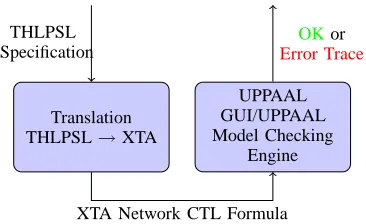
Translation THLPSL→XTA
UPPAAL GUI/UPPAAL Model Checking
Engine THLPSL
Specification
XTA Network CTL Formula OKor
Error Trace
Figure 1. The architecture of the tool.
the Trequest keywords. For instance, the following timed authentication goal:
goal
Alice Tauthenticates Bob on Kab end goal
together with the request and witness condition oc-curring in the specification (Trequest(B,A,k,Kab) andTwitness(A,B,k,Kab)), requires that a receipt of a not yet expired instance ofKabby Bob must match with the same instance sent by Alice.
IV. FROMTHLPSLSPECIFICATIONS TOUPPAAL XTAS
The general architecture of TPMC is depicted in Fig. 1. The system is composed of two modules, a verifica-tion engine, namely the model checker UPPAAL [18], and a compiler which takes as input a THLPSL spec-ifications and translates it into the input language of UPPAAL. The input language of UPPAAL is a textual representations of an XTA. The tool takes a THLPSL specification and automatically generates a network of XTAs, simulating the protocol and an appropriate CTL formula, which encodes the desired security goal possi-bly included in the THLPSL specification. Therefore, in this section we shall show how aT HLP SL specifica-tion can be encoded intoXT As, which are then model checked by UPPAAL.
UPPAALXT As are an extension of Timed Automata. A Timed Automaton T A is a finite state automaton enriched with a set CK of real-valued clocks, whose value can constrain the triggering of transitions (for a formal definition and an account of the semantics see [2]). Transitions of aT Ahave the form lhφ,a,λ−→il′, which represents a transition from the location l to the locationl′on input symbola. The guardφis a constraint on clocks, and specifies when the transition is enabled. The update set λ⊆CK states the set of clocks to be reset to zero on executing the transition. Additional con-straints over clocks, called invariants, may be associated to locations. An invariant states the temporal condition under which the automaton is allowed to remain idle in that location. An eXtended Time Automaton [7] is the
parallel composition A1 k . . . k An of a collection of
Timed Automata A1, . . . , An. Automata communicate
by means of channels and the communication style is handshaking. Input symbols ofT Aare replaced by chan-nel names inXT A. Ifais the name of a communication channel, then the symbola?denotes the receiving action over channela, while the symbola!denotes the sending action over channel a. In addition, XT As can use (boolean and integer) variables and arrays. Therefore, the guard φ of a XT A transition may also constrain values of variables and array elements besides clocks. The updateλ is generalized allowing also assignments involving variables and arrays.
As previously said, the formal semantics of the ba-sic fragment of T HLP SL has been given in [5] by translation into a network of Timed Automata. In such a translation a Timed Automaton is provided for each instance role and a Timed Automaton is provided for the intruder. In order to define these automata, one has to consider, besides the control-flow information provided by the protocol specification, also the set of ground messages which can be sent or received or are simply known by the participants and the intruder.
A. Generation of ground messages.
From a theoretical viewpoint, under the hypothesis of a finite number of sessions and of a finite number of fresh messages, finiteness of the set of ground messages necessary to assess security (or insecurity) of a protocol is guaranteed by the results reported in [17]. In order to satisfy the theoretical constraints above, we restrict to THLPSL specifications where a finite number of role instances are allowed and no cycles are allowed in the control-flow of roles. This ensures that only a finite number of nonces can be generated. In this subsection we sketch the procedure generating the finite set of ground messages upon which the runs of the protocols are defined.
LetGM be the possibly infinite set of ground mes-sages defined as the closure of the set of atomic ground messages GM0, under the formation rules of message
terms given in Section II. The set GM0 is defined as
follows. It contains: (i) all the constants declared in the roles; (ii) the actual parameters used to instantiate each role instance; (iii) a distinct copy of a fresh atom for each primed variable occurring in a send action of a role instance (nonces generated by role instances); (iv) a distinct copy of a fresh atom for each primed variable occurring in a receive action of a role instance (nonces generated by the intruder). Under the enforced restrictive hypothesis, GM0 is a finite set. We can now give the
a receiving transition. Let X be a set of variables and M T be the set of message terms built from variables and constants. Letρ:X →2GM0 be a type-preserving
function, assigning sets of atomic ground messages to variables according to their type. We can define the uni-fication relation⇒ρ⊆M T×GM×2X ×GM0×2X ×GM0,
which associates a message term M and a ground messagemwith two partial valuation functionsθandθa
, binding unprimed and primed variables occurring inM to ground messages, respectively. Intuitively,θcaptures a possible instantiation of the unprimed variables ofM according to ρ, whileθa captures possible assignments to the primed variables occurring in M, so that the resulting ground message is an instance of the termM. The unification relation is defined inductively as follows:
• (m, m)⇒ρØ,Øifm∈GM;
• (X, m)⇒ρ{(X, m)},Øifm∈ρ(X);
• (X′, m)⇒ρØ,{(X, m)}, withX ∈V ar;
• ({M}Z,{m}k)⇒ρθ1∪θ2, θ
a
1∪θ
a
2 if(M, m)⇒ρ
θ1, θ
a
1,(Z, k)⇒ρ θ2, θ
a
2, and bothθ1∪θ2andθ
a
1∪
θa
2 are partial functions;
• (M1.M2, m1.m2) ⇒ρ θ1 ∪ θ2, θ
a
1 ∪ θ
a
2 if
(M1, m1) ⇒ρ θ1, θ
a
1, (M2, m2) ⇒ρ θ2, θ
a
2, and
bothθ1∪θ2 andθ
a
1∪θ
a
2 are partial functions; • (H(M), m)⇒ρθ1∪θ2, θ
a
1∪θ
a
2 if for someh,mˆ ∈
GM, (M,mˆ) ⇒ρ θ1, θ
a
1, (H, h) ⇒ρ θ2, θ
a
2 and
h( ˆm) =m, and bothθ1∪θ2andθ
a
1∪θ
a
2 are partial
functions;
• (inv(M), m) ⇒ρ θ, θ a
if for some mˆ ∈ GM, inv( ˆm) =mand(M,mˆ)⇒ρθ, θ
a
;
• ({M}inv(Z),{m}k) ⇒ρ θ1 ∪ θ2, θ
a
1 ∪ θ
a
2 if
(M, m) ⇒ρ θ1, θ
a
1, (inv(Z), k) ⇒ρ θ2, θ
a
2, and
bothθ1∪θ2 andθ
a
1∪θ
a
2 are partial functions.
Actually, only a finite subset of messages in GM is relevant for verification purposes, since the protocol runs can only progress when the ground message received over a channel matches the structure of a message term in a receive action. Therefore, let GM ⊂ GM be the set of ground messages in GM which unify with a message term M received over a channel in some receive THLPSL transition. In other words, m ∈GM if(M, m)⇒ρθ, θa for some termM occurring in a
re-ceive action of some transition. Since the number of such terms is finite as finite are the possible instantiations of every variable sinceGM0is finite, the setGM is clearly
a finite set. The set GM can easily be computed by a simple least fixed-point computation, which applies the unification relation starting from GM0 to the message
terms occurring in send and receive actions of the roles. Each ground message m ∈ GM is, then, encoded by a unique integer. In the following, we shall confuse a messagemwith its integer encoding.
B. Definition of clocks, channels and data structures.
We shall now describe the set of clocks used to ex-press time constraints of the protocol, the set of channels used for communication, and additional data structures (arrays and variables) to encode the knowledge of the participants and the intruder.
Communication between role instances is not direct, but implemented by a pair of synchronizations, one between the sender and the intruder and one between the intruder and the receiver. Since communication in the formalism ofXT Atakes the form of pure communi-cation, a different channel is provided for each conveyed message. Therefore, for each pair< m, CHN >, with m a ground message possibly sent (resp., received) by a role instance and CHN a channel name (i.e., the channel where the message has been sent), a XT A synchronization channel named C_CHN_s_m (resp., C_CHN_r_m) is created.
Delays/timeouts of timed transitions and disclo-sure/expiration of timed messages are specified relative to a transition label. In order to model these features, a clock named CK_lab_ri is associated to every pair hlab,rii, such that transition label laband role instancerioccur among the parameters of some timed transition or timed message term. An additional clock named CK_start is used to model timed constraints referencing the special label start, corresponding to the initialization time of the main role. Moreover, a boolean arrayF[]is used to record, for each transition label referenced within a timed message term or timed transition, whether it has been already executed. To model durations of transitions taken by role instances, a local clock nameddriis associated to each role instance
ri. Finally, for every channelCHN for which a delay constraint is specified, a clockCK_CHNmodels channel delays. Arrays and variables are used both to encode the knowledge of the role instances and of the intruder, as well as the intruder’s ability to compose and decompose messages.
For each role instanceri, we define a type preserv-ing function ρri : Xri −→ 2
GM0, mapping message
variables of the role of ri (Xri) onto sets of possible
atomic ground messages. To each roleri, a vectorNri[]
is associated which encodes the knowledge of the role instance at a particular stage of the protocol. The array locationNri[X], whereX is a variable occurring in the
role of ri, may contain a possible instantiation of X belonging toρri(X).
l” ?
?
l’ l
hφ, a, λi hlb≤C K d ri≤ub, , i
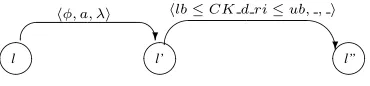
Figure 2. XT Atransitions encoding a timed transition.
encoded by a boolean array K[]indexed by the set of ground messagesGM. A location of the array K[]is set to true when the intruder knows the corresponding message.
C. Definition of the automaton of a role instance
In the following we sketch the construction of the automaton for some instance role ri. Each location of a role instance automaton represents a location in which some state predicate contained in the role specification holds. Let L be the set of atoms of the form X = c, such that eitherX =c occurs in a transitionSPredor X′=c occurs in a transitionPrimed_Pred. The set of locations of the role instance automaton for ri are in correspondence with subsets ofL.
Let us first consider send timed transitions, whose general form is:
lab. SPred /\ MPred >>(t1,t2,lb,ub,RI,lab1) Primed_Pred /\ CHM(M)
Each T HLP SL transition defines a set of pairs of XT A transitions, a pair for each possible instantiation (according to the unification relation⇒ρri) of the
mes-sage variables occurring in the transition, as shown in Fig. 2. The first XT A transition models the effect of the THLPSL transition, while the second one models its duration.
With reference to Fig. 2, for everym∈GM such that (M, m)⇒ρri θ, θ
a
, the first transition added is such that 1. l is a location corresponding to a set of atoms inLwhich contains all the atoms in SPred; 2. l′ is a location corresponding to a set of atoms
in L which contains all the atoms of the form X = c, such that X′ = c occurs in Primed_Pred, and all the atoms X = c occurring in SPred such that X′ does not occurs inPrimed_Pred;
3. l′′is a distinct copy ofl′, introduced to model transition duration;
4. φis a conjunction of:
a) atoms of the form Nri[Xi] = mi, where
(Xi, mi)∈θ, for every message variable
Xi occurring unprimed in the message
term M;
b) the constraint F[lab1_ri] ∧ t1 ≤
CK_lab1_ri≤t2;
c) atoms of the form Nri[Xi] = Nri[Xj]
(resp., ¬ Nri[Xi] = Nri[Xj]), for every
atom of the form Xi = Xj (resp., ¬
Xi=Xj) occurring in MPred;
d) constraints of the form F[lab2_ri] ∧ CK_lab2_ri≥dt(¬(F[lab2_ri]∧ CK_lab2_ri ≥ dt ), resp.), for every atom of the formDIS(Xi)(¬DIS(Xi),
resp.) occurring in MPred, where the atomic messageXi is timed with the
sig-natureXi[dt, et, ri, lab2];
e) constraints of the form F[lab3_ri]
∧ CK_lab3_ri ≥ et (resp., ¬
(F[lab3_ri]∧ CK_lab3_ri≥et)), for every atom of the form EXP(Xi) (¬
EXP(Xi), resp.) occurring in MPred,
where the atomic message Xi is timed
with the signatureXi[dt, et, ri, lab3];
5. aisC_CHM_s_m!;
6. λ is a set of assignments containing
F[lab_ri] := 1, CK_lab_ri := 0,
CK_d_ri := 0, and Nri[Yi] := mi for
(Yi, mi) ∈ θa, with Yi occurring primed in
M.
Notice that constraints in4.a)check that the unprimed variables of the message term sent comply, via θ, with the current knowledge of the role instance; constraints in 4.b)check that the delay/timeout constraint is satisfied; constraints in4.c)check that the current knowledge ofri satisfies all the conditions inMPred; and constraints in 4.d)(resp.,4.e)) encode the disclosure (resp., expiration) predicates. Finally, the updates in λ keep track of the occurrence of the event associated to the current tran-sition (F[lab_ri]:=1); reset the clock counting the time passed from the execution of the transition and the clock used to model the duration of the transition; and assign, according to θa
, the fresh values to the primed variables in the message term sent, thus updating the knowledge ofri.
The general form of a receive timed transition is:
lab. SPred /\ MPred /\ CHM(M)
>>(t1,t2,lb,ub,RI,lab1) Primed_Pred
Similarly to send transitions, each receive T HLP SL transition defines a set ofXT Atransitions, one for each possible ground messagemunifying withM, according to the relation ⇒ρri. For each m ∈ GM, such that (M, m) ⇒ρri θ, θ
a
, a pair of XT A transitions, as in Fig. 2, is introduced, wherel,l′,l′′,φandλare defined exactly as for a send transition, while the transition label aisC_CHM_r_m?.
To guarantee that the duration of a timed (send or receive) transition is modeled correctly, the intermedi-ate location in Fig. 2 is equipped with the invariant CK d ri≤ub, which forces the second XTA transition to trigger before the time upper bound of the THLPSL transition elapses.
The general form of an urgent transitions is:
Notice that an urgent transition cannot send nor receive messages, and that no duration is specified. Therefore, neither synchronization nor update are necessary, and no intermediate location is needed. They are encoded as XTA transitions between a starting location l to an ending locationl′ defined as in the previous cases, with the addition that the starting location is set urgent. A urgent location is a location where time is not allowed to pass, namely where entering and exiting from the location is instantaneous. The guard of the transition is a conjunction of atoms containing the same kinds of constraints defined for cases 4.b), 4.c), 4.d) and 4.e), for timed send and receive transitions.
D. Definition of the automaton of the intruder
The automaton for the intruder clearly depends on the intruder model. While THLPSL and TPMC provide different kind of intruder models, for the sake of space, we describe only the strongest form of intruder allowed by the tool, i.e., the Dolev-Yao intruder. A Dolev-Yao intruder can intercept, decompose (provided it has the necessary encryption/decryption keys), forward, block and delay messages. In other words, it has complete control over the communication channel and is usually identified with it. For the sake of presentation, we present an automaton for the intruder which, while being semantically equivalent to the optimized version implemented in TPMC, does not correspond precisely with it. At the end of this section a qualitative discussion of the optimizations implemented in TPMC is given.
The automaton has a single location and four kinds of loop transitions: (i) sending transitions, which send messages known by the intruder to some role instance; (iii) receive transitions, which receive messages sent by role instances; (iii) composition transitions, which freely build new ground messages from known ones; and (iv) decomposition transitions, deriving message components from known structured messages.
We need a sending transition for every channel CHN and ground message m ∈ GM unifying the message term in some THLPSL receive transition on CHN. The decoration hφ, a, λi for a sending transi-tion is hK[m] = 1 ∧CK CHN ≥lb , C CHN r m!, i, where the triggering constraint checks that the message m is known by the intruder (K[m] = 1) and that the minimal channel delay associated to CHN (of type CHN(dy,ub,lb)) has passed (CK_CHN≥ lb). Notice that, under the assumption of a DY intruder, the upper bound on the delay of a channel cannot be guaranteed. The label C_CHN_r_m! corresponds to the receiving action associated to CHN for com-munication from the intruder to the role instances. No update is necessary for this kind of transitions. Similarly, for every channel CHN and ground mes-sage m ∈ GM unifying the message term in some
Composition rule Decomposition rule m1, m2⊢m1.m2 m1.m2⊢m1 m1.m2 ⊢m2
m, k⊢ {m}k {m}k, k⊢m (k∈SK)
m, inv(k)⊢ {m}
inv(k) {m}inv(k), k⊢m (k∈P K) m, k⊢ {m}k {m}k, inv(k)⊢m (k∈P K) h, m⊢h(m)
TABLE I.
THE DERIVATION RULE OF ADYINTRUDER.
THLPSL receive transition onCHN, a loop transition for a receive action is introduced, whose decoration is
h , C CHN s m?, K[m] := 1; CK CHN := 0i, which is always enabled (no constraint), updates the knowledge of the intruder and resets the clock associated to the channel, which measures the time for channel delay.
Transitions for composition/decomposition of mes-sages encode the standard rules of a DY intruder, which are reported in Table I. The first composi-tion rule states that if the intruder knows two ground messages m1 and m2 and m1.m2 ∈ GM, then
it also knows m1.m2 (and vice versa for the
cor-responding decomposition rule). The corcor-responding composition (resp., decomposition) loop transition is decorated by hK[m1] ∧ K[m2], , K[m1.m2] := 1i
(resp., hK[m1.m2], , K[m1] := 1;K[m2] := 1i).
The second composition (resp., decomposition) rule is for messages encrypted with symmetric keys. The loop transitions for the two rules are decorated by
hK[{m1}k]∧K[k], , K[m1] := 1iandhK[m1]∧K[k], ,
K[{m1}k] := 1i, respectively. The loop transitions for
the other rules are defined similarly.
sessions, and verification is typically the most expensive phase.
E. Encoding of security goals
The model checker UPPAAL allows to verify prop-erties of XTAs expressed in a fragment of Timed CTL [18]. Therefore, TPMC allows to verify THLPSL specification against properties directly written in that fragment. In this subsection we describe how the secu-rity goals of a THLPSL specification are automatically encoded for verification in UPPAAL.
Since the number of ground messages in the protocol can be kept finite, a secrecy goal for a message term M is encoded by a CTL formula which checks that, in every reachable state, every ground message, possibly instantiating the message termM, is not contained into the knowledge of the intruder.1 A Timed authentication property is specified in THLPSL using the Twitness and the Trequest keywords (see Section III for the intuitions). For instance, the timed weak authentication goal for the Wide Mouthed Frog protocol:
goal
Alice Tauthenticates Bob on Kab end goal
together with the clauses Twitness(A,B,k,Kab) and Trequest(B,A,k,Kab) (see the specification in Section III), requires that a receipt of an instance of message Kab by Bob must match with the same instance previously sent by Alice, and this must occur during the validity time interval of term Kab. While this kind of property cannot be directly encoded in the fragment of CTL supported by UPPAAL, an equivalent CTL formula can be constructed by introducing, for every possible instance of message Kab, three addi-tional Boolean variables: one for the Trequest; one for the Twitness; and which records the temporal validity of the message instance. A Trequest variable is set to true exactly when the transition issuing the Trequest for the corresponding instance of Kab is executed, and similarly for a Twitness variable. The variable for the temporal validity of the instance is set to true together with the Trequest variable only if the clock constraint expressing the disclosure and non-expiration of that instance is satisfied. Therefore, timed authentication of Alice and Bob w.r.t. message term Kab reduces to a conjunction of implications, one for each instance ofKab, each conjunct requiring that the truth of a Trequest variable implies the truth of both the corresponding Twitness variable and the temporal validity variable. Untimed authentication goal is similar to Timed authentication, except that reference to the validity of the message term is absent.
1In the syntax of CTL this is expressed by:A[]V
m∈ρ(M)¬K[m], whereρ(M)denotes the set of possible instances ofM.
F. Resilient and operational channels
Resilient and operational channels share the property that the delivery of a sent message is always guaranteed. This property belongs to the class of fairness properties and, therefore, cannot be directly expressed in CTL. As a consequence, a suitable encoding involving XTAs is necessary. Let us consider the encoding for resilient channels. In detail, we need to add three boolean arrays:
• I[]used to record, for each message/channel pair, whether the message has been sent along that channel and it is potentially available for delivery;
• R[]used to record, for each message/channel pair, whether there is a role instance currently able to receive that message along that channel;
• RSL[] used to record, for each message/channel pair, whether the resilience property is currently violated.
When a messagem is sent along a resilient channel c and the lower bound on delivery delay ofchas passed, the location of array I[] corresponding to the pair
hc, miis set to true. When a role instance is in a state where messagem can be received along channelc, the location of arrayR[] corresponding to the pairhc, mi
is set to true, and it is set back to false as soon as the role instance changes state. Whenever both the location of I[] and R[] for a pair hc, mi are set to true, the corresponding location in the array RSL[] is set to true (the resilience property is currently violated). This location of the arrayRSL[]is set back to false when a receive transition is executed by some role instance for message m along channel c (thus witnessing delivery of the message). These updates are suitably encoded by extending the definition of the transitions of the intruder. Verification of any reachability (security) propertyφ under the assumption of channels resilience reduces to check whether every reachable state satisfy the fol-lowing property: (DEADLOCK ∧ ∀i¬RSL[i]) ⇒ φ. The proposition DEADLOCK is a built-in proposition in UPPAAL and holds only in those states reached by maximal computations, i.e., computations which cannot be extended with further control actions. The intuitive reading of the invariant above is that in all the states, where no further messages can be sent or received and where no message/channel pairs violates the resilience property, the security propertyφmust hold.
As to operational channels, where delivery must be guaranteed within a time upper bound, the encoding is performed similarly to resilient channels. The main difference is that a location of the array RSL[] can be reset to zero only if the time when the message is actually delivered is within the upper bound on delivery of the channel.
V. EXPERIMENTS
Protocol Inst CT VT
WMF 1-1-3 .01 .34
WMFF ix 1-1-3 .01 .01
WMF 5-5-15 .15 628.8 WMFF ix 4-4-12 .05 25.83
ZG 1 .14 .04
ZG 3 .27 758.47
ZG Res. 1 .04 .05
ZG Res. 3 .28 1928.3
ZG Oper. 1 .04 .03
ZG Oper. 3 .3 249.9
TESLA 1 .028 1.8
Figure 3. Experimental results for Timed Protocols (times in seconds).
to UPPAAL XTAs with the model checking engine UPPAAL. To assess the efficiency and scalability of the resulting environment, we ran it on a number of timed and untimed protocols. An excerpt of the results of our experiments is given in Figure 3 and Figure 4. The ex-periments have been performed on a 3.0GHz Pentium IV with 1Gb of memory running Linux (Slackware 11.0). The column Inst. reports the number of protocol sessions for the corresponding test. Both compilation time (CT) and verification time (VT) are reported. Figure 3 reports the tests performed on the following timed protocols: the original and fixed version (as proposed by Lowe [13]) of the Wide Mouthed Frog protocol; three versions of the Zhou-Gollmann protocol, each testing the protocol under different assumptions on the communication channel: unreliable (ZG), resilient (ZG Res), operational channels (ZG Oper), where all but the last one report an attack; the correct version of the TESLA protocol [15]. The column Inst. for the Wide Mouthed Frog protocol reports the number of instances of the participants involved (one for Alice, one for Bob and the last for the Server).
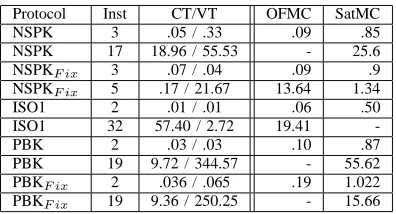
In order to compare with state-of-the-art verification tools for security protocols, we ran our tool on some untimed protocols. Figure 4 compares the experimental results of TPMC with two of the verification engines included in the AVISPA suite, namely OFMC and SATMC. The untimed protocol analyzed (taken from the AVISPA library of protocols [20]) are the following: the Needam–Schroeder Public Key protocol (original and fixed version), the PBK protocol (original and fixed ver-sion), and the ISO1 protocol. All the tests are parametric in the number of sessions, where a session involves two participants. The property checked for all the protocols is authentication. On all the tests, our tool correctly reports the expected attack on the flawed versions of the protocols and no attacks for the fixed versions. We only report the results for the minimal and maximal instance of the protocols we tried to analyze (absence of a value for the time spent indicates non-termination within 20 minutes).
The results show that, even though our tool has not been optimized for untimed protocols and the compiler and the model checker are not tightly integrated as in the
Protocol Inst CT/VT OFMC SatMC
NSPK 3 .05 / .33 .09 .85
NSPK 17 18.96 / 55.53 - 25.6 NSPKF ix 3 .07 / .04 .09 .9
NSPKF ix 5 .17 / 21.67 13.64 1.34
ISO1 2 .01 / .01 .06 .50
ISO1 32 57.40 / 2.72 19.41
-PBK 2 .03 / .03 .10 .87
PBK 19 9.72 / 344.57 - 55.62 PBKF ix 2 .036 / .065 .19 1.022
PBKF ix 19 9.36 / 250.25 - 15.66
Figure 4. Experimental results for Untimed Protocols (times in seconds).
competitor tools, the performances are still comparable and, in some cases, scale better as the number of sessions increases. Notice that verification and compilation times (column CT/VT) are usually not correlated. For example in the case of the ISO1 protocol the exchanged messages are highly structured. Therefore, increasing the number of sessions the compiler has to face an exponential growth in the number of messages. The verification time for the same protocol scales much better as the model checker only needs to explore a portion of the state space to find an attack. Timing also plays a fundamental role in the scaling of the compilation/verification procedure. For example WMF is a timed protocol whose message structure is quite simple. The number of messages which can be generated grows slowly as the number of sessions increases. Therefore, the additional work for the com-piler is quite limited. On the other hand, the verification time increases rapidly, as the model checker has to work on a Timed Automaton where timing constraints are actually present, while for the ISO1 protocol (and all the untimed protocols) timing is absent.
VI. RELATEDWORK
The idea of using formal methods to check time– sensitive security properties is not new (e.g., see [8], [9], [11], [14]). A number of those papers relies on low level formalisms as specification languages.
In [14] the low-level formalism of Timed Automata is extended to allow for the ability to express parallelism and synchronization on structured messages built over cryptographic primitives, providing a more convenient way to model security protocols with Timed Automata. Similarly, in [11] a timed process algebra is proposed as the specification language for security protocols. Both approaches do not provide a high-level specification language comparable to THLPSL.
accepted in the security protocol community, provides the definition of several temporal features and different models of intruder and channels, and integrates the temporal features within a protocol verification tool.
In [9] the authors use constraint programming com-bined with symbolic exploration to analyze infinite state protocols with explicit use of timestamps (focussing, in particular, on the Wide Mouthed Frog protocol).
VII. CONCLUSIONS
In this paper we presented a verification tool for time– sensitive security protocols. The specification language THLPSL permits explicit modeling of many temporal features of protocols, while remaining sufficiently high level to be used by protocol designers and engineers. The verification engine, based on a translation into Timed Automata, has been tested against a number of timed and untimed protocols, showing encouraging performances. At the current stage, THLPSL still suffers from some expressiveness limitations, mainly inherited from the underlying semantic model (Timed Automata). For in-stance, it is not currently possible to specify temporal constraints in a parametric way. This ability would allow to fully specify protocols where temporal con-straints are negotiated among the participants in the bootstrapping phase of the protocol, which is quite common in many protocols (for instance, the TESLA and the Zhou-Gollmann protocols). We are currently investigating techniques to overcome these limitations, by employing other formalisms as the semantic mo-del. For instance, we are considering Parametric Timed Automata [3], where some forms of parametric timed constraints are allowed, still preserving the decidability properties essential for verification.
We are also investigating possible strengthening of the Dolev-Yao intruder model, by, e.g., relaxing the perfect cryptography assumption, which forces the intruder to decode encrypted messages only by known keys. Some preliminary work has been done to model an intruder with the ability to derive messages by exploiting the prefix property [16] (formally captured by the derivation rule {a, b}k ⊢ {a}k), a property exhibited by some
encryption algorithms based on cipher-block-chaining (CBC).
Another extension under implementation concerns the possibility to associate time costs to the intruder operations. Indeed, a DY-intruder model assumes an intruder with unbounded computational power. By al-lowing constraints on its computational power and time costs associated to actions, TPMC would allow to model and verify more realistic scenarios.
REFERENCES
[1] AVISPA: Automated Validation of Inter-net Security Protocols and Applications. http://avispa-project.org.
[2] R. Alur, D. Dill, A theory of timed automata, Theoretical Computer Science, 126, pp. 183-235, 1994.
[3] R. Alur, T.A. Henzinger, and M.Y. Vardi. Parametric real-time reasoning. In STOC: ACM Symposium on Theory of Computing (STOC), 1993.
[4] M.Burrows,M.Abadi,and R.Needham, A logic of authen-tication, ACM Trans. on Computer Systems, 8(1):18–36, 1990.
[5] M. Benerecetti, N. Cuomo, and A. Peron, Timed HLPSL for specification and verification of time sensitive pro-tocols. Proceedings of FCS-ARSPA’06, Seattle, August 15–16, 2006.
[6] M. Benerecetti and N. Cuomo and A. Peron, TPMC: A Model Checker For Time–Sensitive Security Protocols. In proc. of HPCS’07, June 4th - 6th, 2007, Prague, Czech Republic, pp. 742–749, 2007.
[7] J. Bengtsson, W. Yi: Timed Automata: Semantics, Al-gorithms and Tools. Lectures on Concurrency and Petri Nets 2003: 87-124
[8] R.J. Corin, S. Etalle S., P.H. Hartel, and A.H. Mader. Timed analysis of security protocols. Journal of Com-puter Security, 15(6):619–645, 2007.
[9] G. Delzanno and P. Ganty. Automatic verification of time sensitive cryptographic protocols. In Proc. of TACAS 2004, Barcelona, Spain, pages 342–356, 2004.
[10] D. Dolev, A.C. Yao, On the Security of Public-Key Protocols, IEEE Transactions on Information Theory, 29(2):198–208, 1983.
[11] R. Gorrieri, E. Locatelli, and F. Martinelli. A simple language for real-time cryptographic protocol analysis. In ESOP: 12th European Symposium on Programming, 2003.
[12] C. Daws, A. Olivero, S. Tripakis, S. Yovine, The tool KRONOS, In Hybrid Systems III: Verification and Con-trol, LNCS 1066, pp. 208-219, 1996.
[13] Gavin Lowe. A family of attacks upon authentication protocols. Technical Report 1997/5, Department of Math-ematics and Computer Science, University of Leicester, 1997.
[14] M. Napoli, M. Parente, and A. Peron. Specification and verification of protocols with time constraints. Electr. Notes Theor. Comput. Sci, 99:205–227, 2004.
[15] A. Perrig, R. Canetti, J. D. Tygar, D. Song, Efficient Authentication and Signing of Multicast Streams over Lossy Channels. IEEE Symposium on Security and Pri-vacy 2000: 56-73.
[16] M. Rusinowitch. Automated analysis of security proto-cols. Electr. Notes Theor. Comput. Sci, 86(3), 2003. [17] M. Rusinowitch and M. Turuani. Protocol insecurity
with a finite number of sessions and composed keys is NP-complete. TCS: Theoretical Computer Science, 299, 2003.
[18] K. Larsen, P. Petterson, W. Yi, UPPAAL in a nutshell, Springer International Journal of Software Tools for Technology Transfer, 1, 1997.
[19] C. Meadows, Formal methods for cryptographic protocol analysis: emerging issues and trends. IEEE Journal On Selected Area in Communications, 21, 2003
[20] L. Vigan`o. Automated security protocol analysis with the AVISPA tool. Electr. Notes Theor. Comput. Sci, 155:61– 86, 2006.